Comsol -leaderboard other pages

Topics

On the hunt for cosmic clocks

The galactic centre (GC) is one of the most extreme places we know – a dense stellar cluster filled with turbulent plasma, orbiting the four-million-solar-mass black hole Sagittarius A* (Sgr A*). For decades, astronomers have expected this region to host a rich population of pulsars. Yet only a handful have been detected, and none within a parsec of Sgr A*. A deep survey with the Green Bank Telescope, part of the Breakthrough Listen (BL) programme, has now delivered both a stringent non-detection of the expected population and an intriguing millisecond pulsar candidate near Sgr A*.

Pulsars are rapidly rotating, highly magnetised neutron stars, whose periodic radio emission sweeps across Earth like a cosmic lighthouse. Their stable periods make them among the most precise clocks in nature. Ever since Jocelyn Bell Burnell’s 1967 detection of the B1919+21 pulsar, more than three thousand have been catalogued in our galaxy.

Many should populate the GC. The region hosts a dense concentration of massive stars that evolve and die in supernovae, leaving behind neutron stars. Population-synthesis models estimate the number of pulsars within the central parsec at hundreds, perhaps thousands. Moreover, the 2013 discovery of a magnetar (J1745-2900) just arcseconds from Sgr A* confirmed that neutron stars can survive, and be detected, in this environment.

Delving deep

Why, then, are they so elusive? Radio pulses are scattered by clumps of ionised gas along the line of sight, blurring them in time. The effect is severe everywhere, but worse near the dense GC, where it can stretch millisecond pulses to seconds at standard observing frequencies. Higher frequencies are scattered far less, and so pass through more cleanly. The BL GC survey took advantage of this, focusing on high radio frequencies of 8–12 GHz, well above the band typically used for pulsar searches. The observations total more than 20 hours between 2021 and 2023, with 11 hours on the innermost 1.4 arcminutes around Sgr A*. The result is one of the deepest pulsar searches ever performed in this region.

At the achieved sensitivity, the survey should have detected roughly 10% of the millisecond pulsars, rotating hundreds of times per second, and up to half of the slower, canonical pulsars expected if the GC population resembled that of the wider galaxy. It came up empty – almost.

In a one-hour scan, the survey identified a candidate consistent with an 8.19 millisecond pulsar, dubbed the Breakthrough Listen Pulsar (BLPSR). The signal was coherent across both time and frequency throughout the observation, with statistical tests on randomised data giving a chance occurrence rate of roughly one in a thousand (about 3σ) from its statistical properties alone, and closer to one in a million (approaching 5σ) when its coherent signal power is included.

These figures make a chance-origin unlikely on a single trial, though they are not, on their own, sufficient to establish a pulsar. The candidate did not reappear in subsequent observations, and a much stronger case is required before asserting an astrophysical origin. If confirmed, BLPSR would be the first millisecond pulsar found in the immediate GC environment, and an encouraging sign that more may yet lurk in the central parsec, just below current detection thresholds.

Still, the shortage of detections raises real questions. GC pulsars could be intrinsically fainter, older, or differently distributed than expected. Strong scattering may persist at higher frequencies through complex, localised structures in the interstellar medium. Selection effects, including long periods and unfavourable beaming geometry, could also play a larger role than usually assumed.

Millisecond pulsars are extraordinarily stable rotators, and serve as precision clocks for measuring gravitational effects. A confirmed millisecond pulsar in close orbit around Sgr A* may open a new window on strong-field gravity, allowing precision tests of general relativity in the immediate vicinity of a supermassive black hole.

The connection to fundamental physics extends further. Wide-band, high-resolution radio data of the kind used here have also been turned to the search for axion dark matter, where axion-to-photon conversion in stellar magnetic fields would imprint narrow spectral features. Modern radio surveys are increasingly designed for this kind of breadth, with the same observations used to search for pulsars, signatures of dark matter, and potential signs of extraterrestrial technology.

The path forward needs deeper, more sensitive searches, supported by advances in instrumentation and analysis. The Square Kilometre Array and the next-generation Very Large Array promise to overcome the current sensitivity and frequency limitations. Open data are equally important. By releasing GC observations publicly, BL enables the broader community to pursue independent analy­ses and complementary science cases.

If confirmed, a millisecond pulsar near Sgr A* would be a step forward in our understanding of the GC, and a potential new probe of physics in its most extreme regimes.

A sharper probe of a rare Bs decay

CMS figure 1

The Bs→ φμ+μ process, in which a bottom quark decays into a strange quark and a pair of oppositely charged muons, is a powerful probe of physics beyond the Standard Model (SM). For the first time, the CMS collaboration has measured its branching fraction as a function of q2, the squared invariant mass of the dimuon pair. In the low-q2 region, from 1.1 to 6 GeV2, the result lies 4.2σ below SM predictions obtained from a range of form-factor calculations.

In the SM, the weak nuclear force is mediated by the heavy gauge bosons W+, W and Z0. Transitions mediated by the Z0 boson in which fundamental particles, such as quarks, change their flavour without altering their electric charge are known as flavour-changing neutral current (FCNC) processes. These transitions are absent at tree level in the SM and can only happen via complex, higher-order “penguin” or “box” loop diagrams. Moreover, the Glashow–Iliopoulos–Maiani mechanism ensures that contributions from the up-type quarks in the loop largely cancel, heavily suppressing FCNCs. As a result, these rare processes provide a sensitive probe for physics beyond the SM.

The Bs→ φμ+μ decay is an FCNC transition where a bottom quark decays to a strange one, with the intermediate loop dominated by a top quark. Recent studies of similar processes have revealed tensions between experimental measurements and theoretical predictions for both the branching fraction and angular observables. Specifically, using 9 fb–1 of data collected at 7, 8 and 13 TeV centre-of-mass energies, the LHCb collaboration observed that the Bs→ φμ+μ branching fraction lies 3.6σ below the SM prediction (CERN Courier September/October 2021 p15).

In this new result, the CMS collaboration reports its first differential measurement of the branching fraction of the Bs→ φμ+μ decay as a function of q2, using 138 fb–1 of data collected at 13 TeV centre-of-mass energy. The Bs-meson candidate is reconstructed in the K+Kμ+μ final state by requiring soft-muon identification and high-purity hadronic tracks. The two hadron tracks, assigned the kaon mass hypothesis, are paired to form the φ-meson candidate. The narrow natural width of the φ resonance enables a clean selection with low background.

Signal events are extracted from extended, unbinned maximum-likelihood fits to the K+Kμ+μ invariant mass distribution over various q2 intervals. The branching fraction is then measured relative to the normalisation channel Bs→ J/ψφ, which shares the same final state, allowing many systematic uncertainties to cancel. The angular observables FL and A6 are extracted in each q2 bin, from an unbinned maximum-likelihood fit to the three-dimensional distributions of the Bs candidates’ invariant mass and two angular variables.

While the angular observables FL and A6 are consistent with expectations, the analysis reveals an up to 4.2σ tension between the measured branching fraction and SM predictions (see figure 1). Still, the current sensitivity is limited by statistical constraints. The inclusion of Run 3 data will significantly reduce these uncertainties, yielding the improved precision required to address the persistent anomalies in the beauty quark sector.

Jets boost nuclear coalescence

ALICE figure 1

The production mechanism of light (anti)nuclei in hadronic collisions has been studied in several experiments over the past decades, but is still not fully understood. One candidate mechanism is baryon coalescence, in which nuclei can form from preexisting nucleons only if they are close in phase space. The ALICE collaboration has now reported the first measurement of deuteron production in and out of jets in p–Pb collisions at a centre-of-mass energy per nucleon pair of 5.02 TeV. The results are consistent with the enhancement expected from coalescence models.

Jets, the collimated emission of hadrons produced by the hadronisation of high-energy quarks, are a natural testing ground for coalescence, as the nucleons they contain are typically close in phase space. Comparing yields inside and outside jets can then test the mechanism directly. In the ALICE analysis, the coalescence probability is investigated by calculating the coalescence parameter BA, defined as the ratio between the nucleus invariant yield and the proton invariant yield raised to the mass number A of the nucleus. This quantity is calculated both in (BjetA) and out of jets (BUEA, where UE represents the underlying event). In the latter, the density of produced particles is expected to be lower, and thus coalescence should be less likely. If proximity in phase-space affects the coalescence probability, BjetA should therefore exceed BUEA. Otherwise, the two should be similar.

Three regions of equal width are used to study the jet-correlated production: “toward”, “away” and “transverse” to the jet axis, with the direction approximated by the highest-transverse-momentum particle in the event. The in-jet contribution is obtained from the toward region by subtracting the underlying event, captured by the transverse region. Bjet2 appears to be enhanced with respect to BUE2 (see figure 1), as expected from coalescence models.

Compared to previous studies in pp data, the system formed in p–Pb collisions is slightly larger and produces more particles, providing additional constraints on coalescence. The enhancement of Bjet2 with respect to BUE2 is found to be larger in p-Pb than in the corresponding pp measurement at 13 TeV. This difference could be explained by the different source sizes and, possibly, by different particle-species compositions of the jets.

Further investigations of the coalescence parameter in and out of jets will be carried out with data from Run 3 of the LHC, which includes software-triggered pp data samples up to three orders of magnitude larger than those collected in Run 2. The full exploitation of this data will allow for the inclusion of A = 3 nuclei (3He, triton) and the extension of the transverse momentum coverage to higher values, providing additional information to constrain the processes behind the formation of light (anti)nuclei.

Two new CP tests for Higgs couplings

ATLAS figure 1

The origin of the observed asymmetry between matter and antimatter in the universe, of the order of one part in 10 billion, is one of the open questions in particle physics. In 1967, Andrei Sakharov showed that one of the necessary conditions to generate such an imbalance in the early universe is the violation of the combined charge-conjugation and parity (CP) symmetry. In the Standard Model (SM), CP violation arises from a complex phase in the quark mixing matrix, but this contribution is too small to account for the observed asymmetry. Additional sources of CP violation are therefore required, such as contributions from the neutrino sector or from other sources beyond the SM.

The discovery of the Higgs boson has opened a new sector in which to search for additional CP-violating interactions. The ATLAS experiment at the LHC recently reported the results of two new analyses that probe the CP properties of Higgs-boson interactions with electro­weak gauge bosons, including the structure of its couplings to longitudinally and transversely polarised W and Z bosons.

The first comes from a measurement of Higgs production through the vector boson fusion mechanism (VBF), with the Higgs boson decaying into two photons. It is the first ATLAS measurement to use Run 3 data, collected between 2022 and 2024, to probe CP violation in the interaction between the Higgs boson and electroweak gauge bosons.

The Higgs decay into two photons provides a clean experimental signature with a large sample of Higgs events. The analysis exploits CP-odd observables, which change sign under a CP transfor­mation, and whose average over the full phase space vanishes in the absence of CP violation. Any observed asymmetry would therefore signal a violation of CP symmetry. One such quantity, used in this analysis, is the optimal CP-odd observable. It is constructed from the per-event ratio of the CP-odd SM–BSM interference term to the SM matrix element squared, evaluated from the reconstructed four-momenta of the Higgs boson and the two jets.

ATLAS figure 2

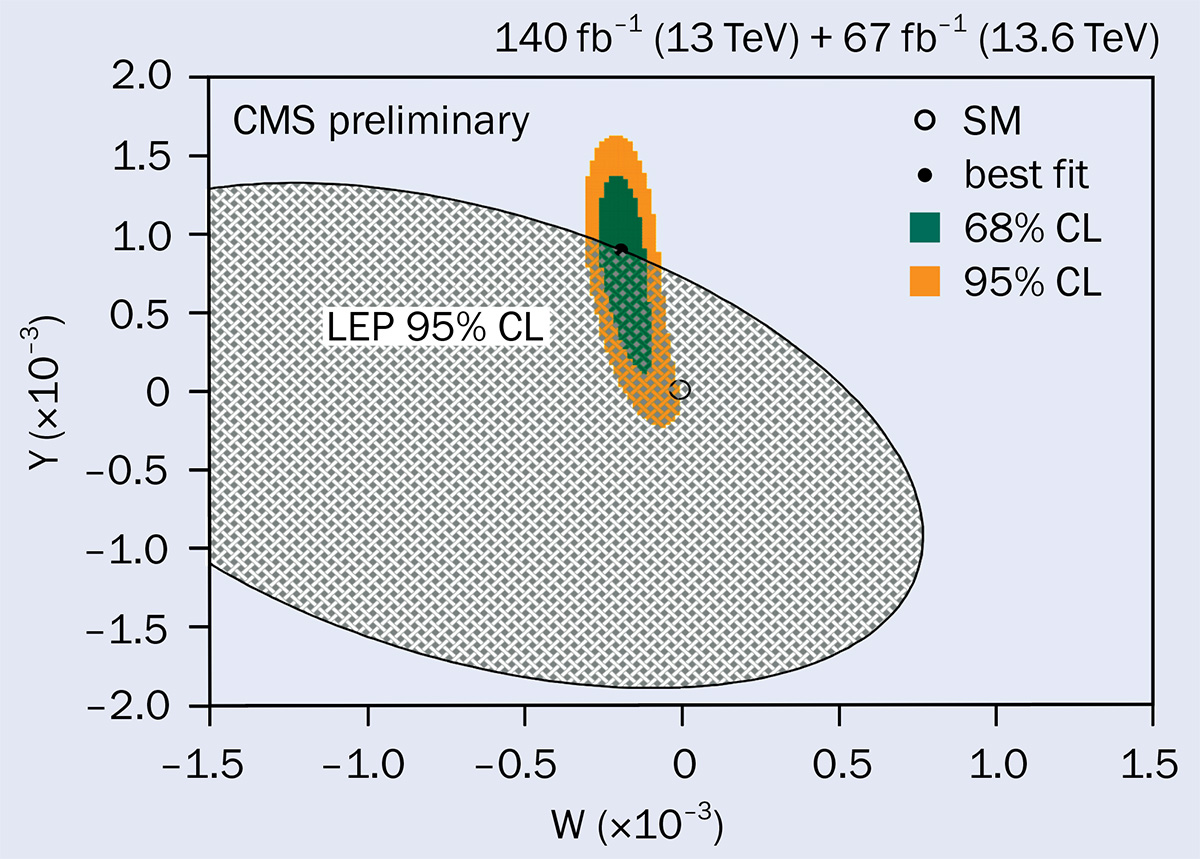
No asymmetry was observed (see figure 1), and results were interpreted in the Standard Model effective field theory (SMEFT) framework. SMEFT provides a systematic, model-indepen­dent parameterisation of potential new-physics effects at energy scales beyond those directly accessible at the LHC, by extending the SM Lagrangian with higher-dimensional operators parameterised by Wilson coefficients. Constraints on these coefficients are broadly reinterpretable across a wide class of BSM scenarios. This new result improves the Run 2 limits by more than a factor of two.

The second result combines measurements from several Higgs-boson decay channels and production modes recorded during Run 2 to extract even stronger limits on possible CP-violating interactions. This combination uses the full Run 2 results from VBF H → ττ, H → WW*, VBF H → γγ, H → ZZ* and WH with H → bb̅. A strategy similar to that of the Run 3 VBF H → γγ analysis was employed in all the single channels by looking for asymmetries in CP-odd observables and interpreting the results in terms of SMEFT. In addition to constraining individual sources of CP violation, the combination disentangles the effects from multiple sources, since different channels probe different combinations of operators. This allows simultaneous limits to be set on three CP-violating Wilson coefficients, yielding the most stringent constraints to date (see figure 2).

These new results highlight the breadth of the ATLAS programme aimed at understanding the CP properties of the Higgs boson and its interactions with electroweak gauge bosons. They also demonstrate the growing potential of the Run 3 dataset to address open questions in the Higgs sector of the SM.

An upgraded take on CP violation

LHCb figure 1

The LHCb collaboration has announced its first Run 3 measurement of the CKM angle γ, a key parameter describing CP violation in the quark sector. The measurement, consistent with previous results, yields γ = (68.1 ± 6.7)°, and will provide an important input to the world average.

The matter–antimatter asymmetry in the universe remains one of the central puzzles in physics, and violation of the combined charge–parity (CP) symmetry is a prerequisite for it. Within the Standard Model (SM), the only established source of CP violation is the complex phase in the Cabibbo–Kobayashi–Maskawa (CKM) matrix, which governs the weak transitions between quarks of different flavour. Precise experimental tests of the CKM framework thus play a central role in understanding CP violation and weak interactions.

Among the CKM parameters, the angle γ is central to testing the SM paradigm. Its direct determination through B → DK decays provides a clean theoretical environment and is largely insensitive to physics beyond the SM. Indirect determinations, obtained from global fits to other CKM observables under the assumption of CKM unitarity, currently achieve higher precision, but involve loop-level processes where new physics could enter, and are limited by challenging theoretical uncertainties. A precise direct determination of γ is therefore essential to compare the two approaches and provide a stringent test of the CKM picture.

LHCb is the best-positioned experiment to produce such a determination. Its highly efficient tracking system, excellent vertex resolution and powerful particle-identification capabilities allow it to reconstruct large samples of B → DK decays. As a result, LHCb measurements currently dominate the world average on γ, with a recent combination yielding γ = (62.8 ± 2.6)°. After a major upgrade of the detector from 2019 to 2022, the experiment now records data at five times the previous luminosity and operates with a highly-efficient, fully software-based trigger, significantly increasing its physics reach.

LHCb has now measured the CKM angle γ in the golden channel B± → DK±, with D → K0Sh+h, using data collected by the upgraded LHCb detector between July and October 2024, corresponding to an integrated luminosity of 5.8 fb–1. The decay B± → ± is included to help control detector-induced effects and reduce the dependence on simulation, leading to a high-precision measurement. About 16,000 B± → DK± and 240,000 B± → ± signal candidates were observed by inspecting their invariant-mass spectra.

Despite using only four months of Run 3 data, corresponding to a lower integrated luminosity than the combined Run 1 and Run 2 dataset, the signal yield is 17% larger. This illustrates the substantial gain in performance from the upgraded detector and reoptimised software trigger system. CP-violating observables are extracted through a simultaneous analysis of data across the decay phase space (see figure 1). A clear signature of direct CP violation is visible as the opening angle between the B+ and B vectors: the two differ by a relative rotation of 2γ, directly encoding the CP-violating phase. Interpreting these observables in terms of the underlying physics parameters yields γ = (68.1 ± 6.7)°.

Excellent precision has already been achieved with a small fraction of the LHCb Run 3 dataset. The full dataset, projected to increase the sample size by a factor of four, is expected to produce the most precise direct measurement of γ. The planned LHCb Upgrade II, with its much larger dataset and enhanced detector capabilities in the HL-LHC era, will further strengthen tests of the SM through increased sensitivity to CP violation.

Rencontres de Moriond turns 60

For 60 years, Rencontres de Moriond has brought theorists and experimentalists in high-energy physics into close, sustained contact. The 2026 Electroweak session, held in the Alpine town of La Thuile, Italy, from 15 to 22 March, gathered around 140 participants for a week covering flavour, neutrinos, dark matter, Higgs and beyond-the-Standard Model physics.

Several updates came from the flavour sector. The LHCb collaboration presented the first measurement of the CP-violating angle γ using a small fraction of the Run 3 dataset (see “An upgraded take on CP violation“). This result, compatible with previous determinations, demonstrated the improved sensitivity of the upgraded trigger. LHCb also reported the observation of a new doubly charmed hadron, the Ξ+cc. The BES III collaboration showed many new measurements in charm and tau physics, while Belle II presented an updated measurement of R(D*) – a test of lepton-flavour universality comparing τ leptons with electrons and muons in the B → D*ν decay. This new result, with its improved precision, is consistent with both the Standard Model (SM) at 1.5σ and the world average at 1.3σ. The growing LHCb Run 3 dataset and the record peak luminosity reached by SuperKEKB will enable several interesting results in B-physics.

Branching out

NA62 presented a new result based on 2023–2024 data for the very rare decay K+→ π+νν (see “The kaon stays on script“), whose SM branching ratio of order 10–10 makes it highly sensitive to new physics. Combined with previous NA62 data, the new result determines the branching ratio with a precision of about 20%, in agreement with the SM prediction.

In neutrino physics, new results addressed the sterile neutrino anomalies (Δm2 ~1 eV2). The MicroBooNE experiment, using a combination of data from the Booster Neutrino Beam and the NuMI beam at Fermilab, excluded essentially all the parameter space favoured by the MiniBooNE and LSND anomalies at 95% confidence level. Similarly, the KATRIN experiment showed new results excluding almost all the parameter space favoured by the Gallium anomaly. The 3 + 1 sterile-neutrino explanation of the anomalies now seems to be excluded (see CERN Courier January/February 2026 p8), although new-physics alternatives are still under scrutiny. The JUNO experiment, which measures antineutrinos from nuclear reactors, released its first results based on 59 days of data-taking. With this small fraction of the target exposure, it has already achieved world-leading accuracy on the θ12 and Δm221 mixing parameters. The main goal of JUNO is to establish the ordering of the three neutrino masses, and it should achieve 3–4σ significance in about six to seven years of data-taking, with detector performance already close to the design.

The limits from the LHC experiments provide strong guidance for theorists when building new models

New results from direct searches for dark matter in the 1 GeV–10 TeV range were presented by the LUX-ZEPLIN, XENONnT and DarkSide-50 experiments. The exclusion limits for the WIMP spin-independent cross-section are now approaching 10–48 cm2 for masses in the ~30–70 GeV region. In addition to the “standard” analyses, optimised for WIMPs above 10 GeV, dedicated techniques have been developed to cover the lower WIMP mass region (1–10 GeV). XENONnT and LUX-ZEPLIN are now entering the “neutrino fog”, an irreducible background from coherent elastic neutrino–nucleus scattering, and both report first signals from 8B solar neutrinos.

Many searches for phenomena beyond the SM at the LHC were presented by the ATLAS and CMS collaborations. In addition to the “classical” high-energy signatures, the experiments are now investing large resources to investigate the more challenging phase-space regions characteristic of models with feebly interacting particles and compressed-SUSY scenarios. New trigger strategies, such as scouting and trigger-level analyses, parked data and delayed streams, and end-of-fill triggers, have been developed to address these complicated topologies, while dedicated reconstruction, calibration and machine-learning techniques help identify non-conventional signatures. Despite great efforts, no significant signals have been found – but the limits from the LHC experiments provide strong guidance for theorists when building new models.

Golden era

The ATLAS and CMS collaborations presented several new results on Higgs-boson physics. New total and differential cross-section measurements in the “golden” H → ZZ*→ 4ℓ channel were shown, using about half of the LHC Run 3 data set (2022–2024). With this subset of the total collected data, the two experiments have already reached a precision on the total cross-section of less than 10%.

A new ATLAS measurement reached, for the first time, 3σ evidence for the inclusive H → bb production with transverse momentum above 450 GeV. When the detectors were designed, this process was considered unobservable due to the large QCD dijet background. The achievement comes from developing and calibrating in situ a new algorithm based on graph neural networks, optimised to identify boosted objects decaying into heavy-flavour jets.

The research programmes at existing and planned facilities point to strong progress in the coming years

Concerning di-Higgs (HH) production, which provides critical information about the Higgs boson self-couplings and constraints on its potential, ATLAS and CMS presented their legacy Run 2 combination. The measured signal strength is σ/σSM = 0.8+0.9–0.7, showing sensitivity to the SM signal at better than 1σ. The performance gains already seen with Run 3 data point to possible evidence for the process by combining the two experiments’ Run 2 and Run 3 datasets, assuming the SM production rate.

Thanks to the large collected datasets, ATLAS and CMS are now able to explore very rare processes in top-quark and multi-boson production. The latter are very powerful at constraining new-physics interactions in the framework of effective field theory, and several new results were presented, including top + boson, top + diboson and three-top production. It is also worth highlighting the first measurement of the |Vcb| CKM element using on-shell W bosons from top-quark decays presented by ATLAS.

In summary, Moriond Electroweak 2026 demonstrated steady experimental improvements in addressing the fundamental open questions in particle physics. Although the experimental challenges are arduous, the research programmes at existing and planned facilities point to strong progress in the coming years.

Scaling new heights towards Long Shutdown 3

The Chamonix Workshop is the annual strategic meeting of the CERN Accelerator and Technology Sector (ATS), a long-standing tradition dating back to 1991. Initially dedicated to the performance of the LEP collider, the workshop shifted its focus to the LHC in 2001 and, since 2024, has covered the entire CERN accelerator complex as well as future projects.

The 28th edition took place at the Majestic conference centre in Chamonix from 2 to 5 February, with around 130 participants from CERN attending, along with international guests. This year’s workshop was quite unique, as it covered not only the operational aspects of the accelerator complex until the end of Run 3, but also the tasks and challenges facing the sector for Long Shutdown 3 (LS3), which will start in July for the LHC and on 31 August for the rest of the injector complex (the ISOLDE facility and AWAKE experiment have already started their LS3 activities). There was also discussion of the 2026 update to the European Strategy for Particle Physics, and its implications for future activities at CERN.

Record-breaking

2025 was yet another year of records for the CERN accelerator complex. The LHC integrated a proton–proton dataset of 125 fb–1, the highest to date for a single year, and produced physics collisions with neon and oxygen ions for the first time. The Proton Synchrotron Booster delivered record intensities to the ISOLDE facility, as did ELENA to the AD experiments, while the SPS North Area received 20% more spills than targeted. Operation in 2026 was discussed at length, in particular the strategy for settings management and the tests still to be performed before LS3. These include reliability runs in the LHC injectors to ensure that the beams planned for the High-Luminosity LHC (HL-LHC) are operationally ready in the injector chain, and a high-intensity test scheduled in the LHC for the last two weeks of Run 3. This is unknown territory for beam physics and probes the limits of existing LHC equipment, which was designed for “ultimate” intensities of 1.7 × 1011 protons per bunch, against the 2.3 × 1011 expected for the HL-LHC.

The second and third days of the workshop focused on LS3 activities. The first priority is the HL-LHC project, which aims to produce 10 times more physics data than the LHC. Progress towards the HL-LHC was reviewed in detail, and significant advancements were noted on all fronts, as the project prepares to transition to the installation phase in the LHC tunnel. Installation activities are proceeding well in the new HL-LHC technical galleries, with the major cryogenic refrigerator installations nearly complete.

2025 was yet another year of records for the CERN accelerator complex

Progress with the inner triplet (IT) magnet string test in the SM18 test hall received particular attention. The test stand has since reached a vital operational milestone: cool-down began on 9 March and reached 1.9 K just eight days later, with the first powering tests following on 20 April. This is a major achievement that will allow the collective behaviour of the different systems in the final-focus zone of the HL-LHC to be validated. Lessons learnt from the IT string installation have already led to design changes that will greatly facilitate the work in the LHC tunnel.

In 2025, some technical challenges required mitigation actions to ensure the timely readiness of certain components. ATLAS and CMS also experienced some technical difficulties, which are being addressed to minimise their impact.

Other LS3 projects include an intensity and energy upgrade for ISOLDE, with major works to replace the current beam dumps; consolidation of the SPS North Area to renovate this fixed-target experimental area after 47 years of operation; and its preparation for the high-intensity ECN3 project, in view of the Beam Dump Facility and the recently approved SHiP experiment.

A solid plan for LS3 is now established, with all the main activities scheduled and only details to be finalised. On the critical path ahead lies the upgrade of the experimental insertions at points 1 and 5, where the LHC equipment will be removed to make way for the HL-LHC. The “safety first, safety always” message was clear. The successful and timely completion of LS3 will rely on the expertise, ingenuity, commitment and dedication of all the CERN teams involved.

A solid plan for LS3 is now established

The last day of the workshop was dedicated to the Laboratory’s longer-term future. It opened with how the FCC programme fits into the CERN strategy for 2026–2030, followed by talks on its organisation and an initial look at the workforce required for its implementation. The baseline accelerator design concepts for the FCC-ee and its injector complex, as well as the FCC-hh, were also discussed. The final session covered the development of an ATS roadmap for common accelerator-control hardware and software, advances in magnet and radio-frequency acceleration technologies, and the future fixed-target physics landscape.

Bringing together colleagues from across the ATS sector and beyond, the workshop was once again an excellent opportunity to take stock of the breadth of activities across the CERN accelerator complex and to finalise preparations for LS3.

Drilling down on dark matter

The High Energy, Cosmology and Astro­particle Physics (HECAP) Abu Dhabi Workshop, held at New York University Abu Dhabi on Saadiyat Island from 13 to 15 January, brought together more than 30 researchers to discuss some of the deepest mysteries in fundamental physics.

A central theme was the effort to unravel the nature of dark matter (DM) and understand its production mechanisms, both in the early universe and in laboratory experiments. The traditional freeze-out paradigm, in which DM was once in thermal equilibrium with ordinary matter and froze out as the universe expanded and cooled, was contrasted with freeze-in scenarios, where DM is never in equilibrium and is produced through extremely weak interactions. In particular, Andrzej Hryczuk (NCBJ) analysed the production of multi-component dark sectors, including non-equilibrium effects such as conversions and cannibalisation processes, and Hyun Min Lee (Chung-Ang University) explored gravity-mediated DM scenarios. Complementary perspectives on DM phenomenology were presented by Nuria Rius (IFIC/UV), who discussed scenarios with warped extra dimensions where DM interacts gravitationally with Standard Model (SM) particles.

Search and research

The possible signatures of dark sectors at colliders were discussed by Giovanna Cottin (UC Chile), who emphasised that dark-sector particles may be long-lived and produce displaced vertices or other unconventional signatures at the LHC. The importance of dedicated searches and of reinterpreting existing LHC data was highlighted, together with the prospects offered by future facilities such as the Future Circular Collider.

A recurring theme was the connection between the origin of matter and the nature of dark matter. Cosmological observations directly establish a quark–antiquark asymmetry, conventionally identified with a baryon asymmetry under the assumption that the dark sector carries no compensating baryon number. Whether this assumption holds, and what its breakdown would imply, was a recurring question. Pilar Hernández (UV) discussed the link of this puzzle to neutrino masses, while a complementary scenario was presented in which the observed quark–antiquark asymmetry predicts the existence of DM, stabilised by the same symmetry that prevents proton decay.

Several presentations focused on the early universe as a probe of new physics. Javier Rubio (Universidad Complutense de Madrid) discussed Hubble-induced phase transitions triggered by the evolution of the scalar component of space­time curvature after inflation, which can amplify field fluctuations, generate transient topological defects, and potentially lead to observable gravitational-wave signals. The role of early-universe dynamics in uncovering new physics was also highlighted by Basabendu Barman (SRM University), who discussed how cosmological observations may provide unique information about physics beyond the SM.

Closely related to these questions is the study of vacuum decay in scalar field theories. José Ramón Espinosa (IFT) showed that the standard semiclassical “bounce” picture can be extended to include pseudo-bounce and antibounce configurations, revealing a richer structure of vacuum decay channels than previously considered.

Thermal history

The reheating epoch following inflation was also discussed as a crucial stage in the thermal history of the universe, when it evolved from a nearly empty state to a hot radiation-dominated plasma. The details of this transition can significantly affect DM production and enlarge the viable parameter space for DM candidates, as discussed by Yann Mambrini (Université Paris-Saclay) and Kuldeep Deka (NYU Abu Dhabi).

Gravitational waves provide an important observational probe of these early-universe processes. Antonio Junior Iovino (NYU Abu Dhabi) discussed gravitational-wave signatures from primordial black holes across a wide range of frequencies and the prospects for detecting them with experiments ranging from pulsar timing arrays to the LIGO–Virgo–KAGRA network. Related aspects of gravitational-wave production in the early universe were addressed by Xunjie Xu (IHEP), who discussed the thermal generation of a cosmic gravitational-wave background.

A recurring theme was the connection between the origin of matter and the nature of dark matter

The workshop also covered precision tests of the SM. Yosef Nir (WIS, Rehovot) presented recent developments in flavour physics, including the puzzling measurement of the branching fraction of Bs K0K0, which appears to be in tension with SM expectations based on flavour-symmetry relations. The decay proceeds dominantly through loop diagrams and is therefore sensitive to virtual contributions from new heavy particles. In addition, measurements of CP asymmetries in B  J/ψ π decays were discussed, as they help refine the determination of the CKM parameter sin(2β).

Alberto Casas (IFT) discussed how high-energy experiments can test fundamental aspects of quantum mechanics, including quantum entanglement and Bell non-locality, at unprecedented energy scales. In addition, Juan José Gómez Cadenas (DIPC) reviewed the status of searches for lepton-number violation and the progress of the NEXT experiment in probing neutrinoless double-beta decay.

Overall, the workshop provided an excellent forum to discuss recent developments at the interface of particle physics, cosmology and astroparticle physics, in particular in the search for physics beyond the SM. Many of the discussions illustrated how progress in understanding DM, the early universe and fundamental interactions increasingly relies on the interplay between theoretical work, laboratory experiments and astrophysical observations.

Garching gathers for the FCC

From 26 to 30 January 2026, the Max Planck Institute for Physics in Garching, near Munich, hosted the 9th FCC Physics Workshop, a major gathering of theorists and experimentalists advancing the physics case, addressing the experimental challenges and developing detector-concept candidates for the proposed Future Circular Collider (FCC). The event brought together hundreds of scientists from Europe and beyond to discuss the FCC and the broader strategy for the field after the LHC and its high-luminosity phase.

European physicists have recently recommended the electron–positron FCC (FCC-ee) as the preferred next flagship project in the ongoing update to the European Strategy for Particle Physics, with a final decision on construction anticipated around 2028 (CERN Courier January/February 2026 p7). This endorsement followed years of extensive design and feasibility studies, and provided an important backdrop to the Munich workshop, where participants worked to align physics goals with technical feasibility and long-term sustainability considerations.

The meeting marked a visible shift in tone and substance for the FCC programme, with conceptual exploration giving way to operational, benchmark-driven studies. Five days of discussion converged on a common message: if the FCC is to deliver as the next flagship collider at CERN, precision must be engineered at every level, from beam energy calibration and theoretical predictions to detector granularity, reconstruction algorithms, analysis software and governance structures.

The FCC’s first stage, FCC-ee, is conceived as a high-luminosity electron–positron collider operating at multiple centre-of-mass energies, including the Z pole, WW threshold, Higgsstrahlung maximum around 240–250 GeV and the top-quark pair threshold. The physics case has long emphasised unprecedented precision in electroweak observables, Higgs couplings and top-quark properties, alongside sensitivity to rare and exotic processes. What was striking in Munich was the degree to which this ambition is now translated into quantitative requirements and structured work plans.

The meeting marked a visible shift in tone and substance for the FCC programme

The Physics Studies work package presented a coordinated strategy across electroweak, Higgs, flavour, QCD, top and beyond-the-Standard Model (BSM) groups. The workshop highlighted the need for consistent benchmark processes, shared uncertainty frameworks and global fit strategies capable of combining hundreds of measurements into coherent constraints on new physics.

At FCC-ee luminosities, statistical uncertainties on many observables would improve by up to three orders of magnitude over previous electron–positron colliders. This shifts the limiting factor toward systematic effects: beam energy calibration, luminosity normalisation, detector alignment, flavour-tagging biases, uncertainties in higher-order calculations and parton-shower modelling. Matching this statistical power with equally ambitious control of systematics is a prerequisite for turning per-mil measurements into probes of new physics well beyond the direct kinematic reach.

The workshop made clear that the FCC physics case cannot be decoupled from detector performance. Precision Higgs and electroweak measurements demand excellent tracking momentum resolution and minimal material budgets to control multiple scattering and secondary interactions. Heavy-flavour and tau-physics programmes hinge on vertexing and impact-parameter resolution, with b- and c-tagging joined by emerging capabilities such as strange-quark tagging. Multi-jet final states from W, Z and Higgs decays bring jet-energy resolution to the fore. Meeting these goals favours highly granular calorimetry and particle-flow reconstruction, which combines information from all subsystems to identify and measure each particle in the event.

Beyond precision

At the same time, the programme also extends beyond canonical precision channels. Sensitivity to long-lived particles and feebly interacting states motivates continuous tracking and hermetic calorimetric coverage. Ultra-precise luminosity measurements at the 10–5 level are integral to the detector architecture, and particle-identification capable of K/π separation over wide momentum ranges supports flavour and QCD studies.

Four detector concepts – ALLEGRO, CLD, IDEA and ILD – are under active development, exploring complementary technologies toward shared performance goals. A fifth, ALFA, has recently emerged, and the workshop encouraged further proposals. The timeline outlined in Munich foresees optimisation studies through 2027, system demonstrators by around 2030, scalable prototypes in the early 2030s, and conceptual design reports in 2033. While the final political decision is still pending, detector R&D is advancing in lockstep with physics requirements.

The Physics Software and Computing (PSC) work package presented its vision for supporting physics and detector studies. At its core is Key4hep, a community-driven framework for HEP experiments, prototyped by FCC together with other future collider projects and increasingly adopted by related R&D efforts. Key4hep provides modularity, interoperability and long-term sustainability, integrating past work from linear-collider facilities and current CEPC and EIC work. In Munich, updates were presented on full simulation geometries for several detector subsystems, integrated digitisation and reconstruction chains, and improved user workflows.

Large-scale production campaigns, data-management strategies and distributed-analysis frameworks are being aligned with CERN IT services and GRID tools, with machine-learning methods increasingly embedded in reconstruction and analysis workflows. Realistic simulation studies, incorporating beam-induced backgrounds and detailed geometries, are gaining importance, alongside the development of robust analysis algorithms that can be validated across simulation levels.

Core contributors

The PSC session also addressed human infrastructure. Recognising computing experts as core scientific contributors – with appropriate career paths and visibility – was considered essential to the long-term success of a data-intensive programme like the FCC.

One of the most distinctive aspects of the Munich workshop was the visible role of early-career professionals. The FCC Early Career Forum presented a draft document synthesising discussions from FCC Week 2025 and subsequent exchanges. Its focus on sustainability, communication, careers and governance resonated across sessions.

One of the most distinctive aspects of the workshop was the visible role of early-career professionals

Sustainability emerged as a central design consideration: environmental, economic and social aspects must be integrated from the earliest design phases through operation and decommissioning. Participants stressed the importance of engaging local and regional communities, and of clearly articulating how the FCC could contribute to broader societal goals.

The Munich workshop made clear that the FCC programme is entering a new phase of maturity and consolidation. With coordinated efforts across physics, detectors, computing and accelerator physics, the community is laying the groundwork for a project that promises to extend our understanding of fundamental interactions and prepare particle physics for its next frontier.

Big Science and industry meet in Copenhagen

How can Europe turn its world-leading capabilities in Big Science into industrial and societal impact? The conclusion of the Research and Technology Infrastructures (RTIs) Summit 2025 was clear: Europe has the skills, partners and ambition, but progress is slowed by fragmentation and lack of consistent funding.

Held in Copenhagen on 22–23 October 2025, and hosted under the Danish EU presidency, the RTI Summit brought together leaders from across Europe to shape the future of research and technology infrastructures and to discuss how to implement the new European strategy in this field, launched by the European Commission at the event.

A dedicated session on accelerators and superconducting magnets examined today’s best practices and the steps needed to build a reliable route from lab to market. Several European strengths are already visible. Pierre Vedrine (CEA Saclay) showed how open technology infrastructures, such as Synergium, accelerate innovation from materials and components to full systems, including superconducting MRI magnets. Clean rooms, assembly platforms and large-scale testing shorten development cycles and enable close collaboration between scientists, industry, and small and medium-sized enterprises (SMEs). Martina Bauer (GSI/FAIR) presented the Hi-Acts platform, which offers companies a single-entry point into Helmholtz competencies to find contacts, access beamtime and services, and obtain guidance on cooperation.

The I.FAST EU-funded project coordinated by CERN, presented by Maurizio Vretenar, provided another example of co-innovation: involving SMEs in R&D from the outset supports earlier adoption of industrial standards, faster prototype improvement and lower costs. I.FAST brings together 49 partners, including 17 companies as co-innovation partners to develop technologies common to many accelerator platforms, from high-efficiency klystrons and thin-film superconducting RF cavities to new beam-window materials and energy-efficiency strategies. Industry presentations confirmed the long-term payoff of Big Science engagement: Julio Lucas (Elytt Energy) showed how experience from ITER tooling translated to CERN magnet systems and FAIR dipoles, while Torben Ekvall (Mark & Wedell) described how one-off contracts opened doors to the private fusion market.

Despite this progress, familiar obstacles persist. Access rules, intellectual property (IP) practices and internal priorities still vary by country and facility. Funding and support mechanisms exist but are difficult to navigate across borders. Funding cycles are often too short for hardware-heavy, low-TRL (technology readiness level) development – four-year projects rarely suffice to reach robust prototypes and market adoption, keeping the so-called “valley of death” wide. At the same time, administrative procedures overwhelm smaller companies without dedicated grant management. Talent retention is another pressure point: SMEs struggle to match big-company salaries and maintain niche competencies during long project gaps.

The Big Science market also presents a challenging risk profile for SMEs. Long projects offer few invoicing milestones against unavoidable upfront spending on engineering, tooling, quality systems and certification. Specialised skills must be maintained through periods of low order volume, and key experts are hard to replace in tight labour markets. Markets are lumpy and project-based, with long gaps between tenders and highly customised solutions that do not always translate to other buyers. Cross-border collaboration adds further complexity. Strategically, firms often enter early-stage R&D without a clear view of the post-project market, and risk over-dependence on a single facility.

A panel discussion with Pierre Vedrine (CEA), Julio Lucas (Elytt Energy), Raffaella Geometrante (KYMA Undulators and co-chair of the Accelerator Science and Technology Industry Permanent Forum), Sabine Brock (Hi-Acts) and Elena Hoffert (French Ministry of Higher Education and Research) converged on a set of practical remedies.

First, early and structured co-innovation should become the norm. When SMEs participate from low-TRL levels, roles and milestones can be defined up front, risk shared more evenly, and manufacturability feedback integrated before costs escalate.

Second, Europe would benefit from a more coherent access and IP framework. Building on models such as Hi-Acts, Europe could connect companies to testbeds, services and expert brokers without forcing them to relearn procedures in each country. Harmonised IP principles would help: open, royalty-free academic research, clear commercialisation pathways for industry, and standard terms agreed upfront rather than under time pressure.

Longer, steadier funding is equally important, as hardware-centric deep-tech needs time. Extending funding horizons beyond four years would match development realities, while dedicated technology-transfer funds – combining public and private capital – could bridge feasibility, prototyping and first deployments. Targeted instruments such as vouchers or match funding can reduce the barrier to SME participation in pilot projects, test campaigns and certification.

Markets matter

Market signals matter too: if facilities publish procurement roadmaps and use framework agreements, SMEs can plan capacity and recover innovation costs by selling validated solutions to multiple sites. Standardised specifications and qualification across facilities would increase portability and reduce repeated rework.

People remain the backbone of deep-tech translation. Mobility programmes and joint appointments between RTIs, universities and SMEs can spread know-how and create shared cultures. Embedding training and student pipelines within projects turns RTIs into talent multipliers. Temporary support to retain key teams between projects can prevent hard-won competencies from dissipating during inevitable times of low market demand.

Administrative simplification and lasting coordination would further lower barriers. SME-friendly procedures, template agreements and faster feedback make participation less daunting. Permanent, lightly funded structures can maintain continuity and provide a platform for roadmapping and collaboration. Securing the industry perspective in long-term strategies is essential, with the AIPF Forum being one such initiative.

In the end, the session’s messages were well aligned. Europe has the infrastructure, excellence and entrepreneurial SMEs to lead globally in Big Science technologies. By turning its diversity into a strength, through coordinated standards, simpler access to facilities, more continuous funding and earlier industry engagement, it can move technology transfer from a by-product to a central objective. This will allow SMEs to recover development costs and invest in people and in durable collaboration structures that keep the know-how alive. Europe could then ultimately accelerate the translation of Big Science into societal and industrial impact.

bright-rec iop pub iop-science physcis connect