On 6 February 2026, beams of oxygen ions circulated through the Relativistic Heavy Ion Collider (RHIC) at Brookhaven National Laboratory for the last time. A leading facility in the study of hadronic matter and the strong force since 2000, RHIC now hands its tunnel and many of its components to its successor, the Electron–Ion Collider (EIC).
“Experiencing the challenges of first trying to get beams to circulate during commissioning in the fall of 1999, one could not have dreamed how far the performance of this machine would come,” said Wolfram Fischer, chair of Brookhaven’s Collider-Accelerator Department. “We’ve pushed well beyond the original design in terms of the number of collisions we can produce, the energy range of those collisions, the variety of ions we’ve collided, and our ability to align the spins of protons and maintain a high degree of this alignment or polarisation.”
RHIC was conceived above all to study the quark–gluon plasma (QGP). In QGP, quarks and gluons, normally confined inside protons and neutrons, roam free under extreme temperature and density. The early universe is thought to have existed in this state for a fraction of a second after the Big Bang, before cooling into the ordinary matter around us.
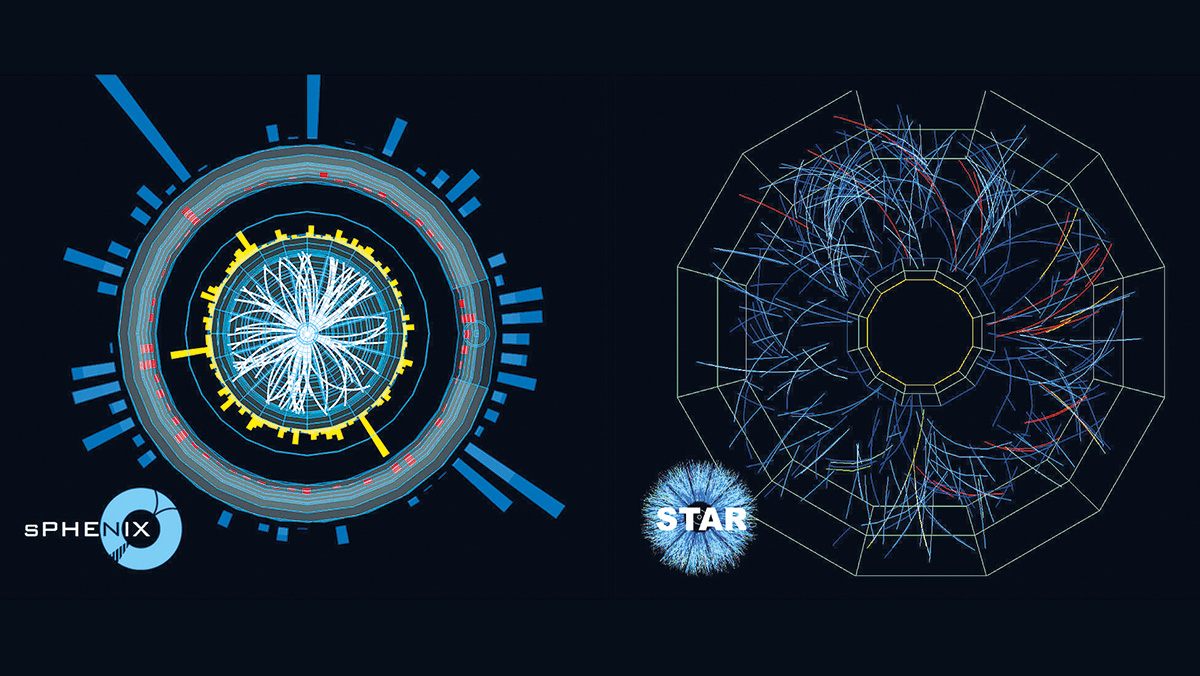
Theorists had expected this primordial soup to behave as a weakly coupled gas of quarks and gluons. Gold–ion collision data from RHIC’s four original detectors, BRAHMS, PHENIX, PHOBOS and STAR, found instead a strongly coupled liquid. By 2005 the collaborations had concluded that they were producing one of the lowest-viscosity substances ever observed, a nearly “perfect” liquid. Later runs traced how this extreme state of matter swirls, flows and cools, and revealed that even small collision systems can briefly form tiny droplets, overturning earlier ideas about how QGP forms.
RHIC transformed nuclear physics by demonstrating the remarkable consequences of ‘boiling the vacuum’
“RHIC transformed nuclear physics by demonstrating the remarkable consequences of ‘boiling the vacuum,’” said theorist Raju Venugopalan, paraphrasing T D Lee’s description of matter governed by quantum chromodynamics.
Beyond QGP, STAR and PHENIX measurements in polarised proton–proton collisions established that gluons carry a significant share of the proton’s spin. In the final run, sPHENIX, the faster successor to PHENIX, became the first detector to record a continuous streaming dataset from RHIC’s spin-polarised proton collisions – thus eliminating the need for triggers.
The final run also gave a sense of the scale of modern physics data: sPHENIX alone recorded more than 200 petabytes of raw data, more than every previous RHIC dataset combined, including 40 billion gold–ion collision events. Analysis of RHIC data will continue for at least another decade. Much of RHIC’s infrastructure will then live on in the EIC, including its ion sources, pre-accelerator chain and one of its superconducting storage rings. A new electron ring will share the tunnel, crossing the ion beam at points where polarised electrons and ions will collide. The EIC will enable precision measurements that reveal how quarks and gluons are organised within protons or atomic nuclei, helping physicists to understand how mass, spin, and nuclear structure emerge from the strong force.