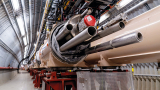
 Read article 'The many lives of RHIC'
The many lives of RHIC
James Dunlop and Wolfram Fischer recount a quarter century of discovery at the first collider built for heavy ions, and the only one to have run with polarised protons.

 Read article 'The many lives of RHIC'
James Dunlop and Wolfram Fischer recount a quarter century of discovery at the first collider built for heavy ions, and the only one to have run with polarised protons.
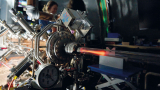 Read article 'The accelerator gap in cancer therapy'
More compact, reliable and affordable accelerators could narrow the gap in access to modern radiotherapy.
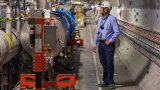 Read article 'A shutdown in name only'
The LHC will see no beam until 2030, yet its tunnel has not been this busy since the machine was installed.
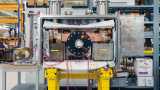 Read article 'PSI captures positrons for the FCC'
An experiment at PSI produced, captured and transported positrons using a system developed for CERN’s proposed FCC.
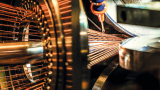 Read article 'Ten thousand magnets later'
Superconductivity, first observed by Heike Kamerlingh Onnes in 1911, has come to drive CERN's colliders.
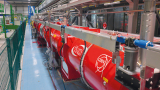 Read article 'HL-LHC magnets reach full current'
The focusing magnets for the High-Luminosity LHC have reached their nominal operating current.
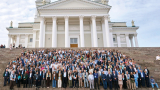 Read article 'Helsinki muses on the FCC'
The FCC Week brought scientists, engineers, industry representatives and policymakers from 38 countries to the University of Helsinki.
 Read article 'The LHC completes its third run'
The LHC has entered its third Long Shutdown after a Run 3 that surpassed expectations, beginning four years of upgrades towards the High-Luminosity LHC.
 Read article 'Accelerator experts meet in Normandy'
IPAC'26 drew more than 1500 accelerator physicists to Deauville to discuss flagship colliders, light sources, novel acceleration techniques and machine learning.
 Read article 'The FCC, half a century on'
The European Strategy has recommended the FCC-ee as CERN’s next flagship collider. The case for it, Alain Blondel argues, rests on 50 years of inventions and discoveries.