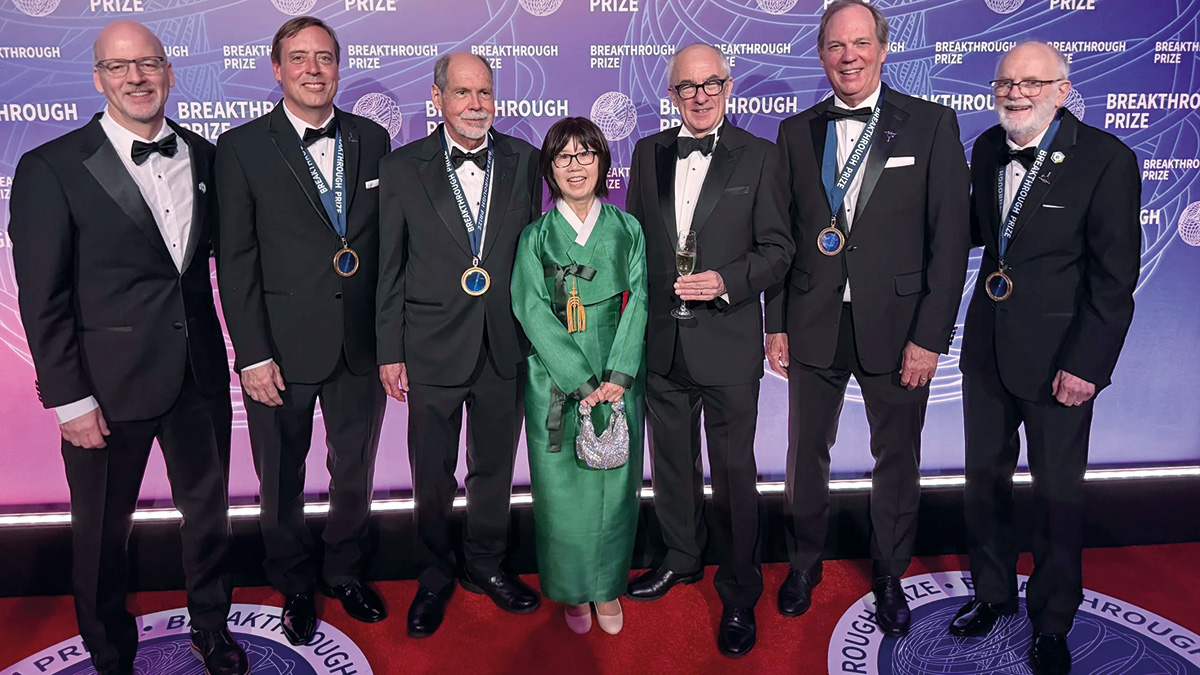
The 2026 Breakthrough Prize in Fundamental Physics recognised the multi-decade programme to measure, with ever-increasing precision, the muon’s anomalous magnetic moment (“g-2”). Announced in Los Angeles on 18 April, the $3 million award is shared among the living co-authors of the key publications from the muon g–2 collaborations at CERN, Brookhaven National Laboratory and Fermilab. Five further Breakthrough prizes recognised work in theoretical physics, dark-matter searches and cosmology.
As a charged particle with spin, the muon behaves like a tiny magnet whose strength is set by a dimensionless factor close to, but not exactly, two. The deviation, known as the anomalous magnetic moment, encodes virtual loop corrections from all sectors of the Standard Model (SM), and comparing it with theoretical predictions is among the most stringent tests of the theory.
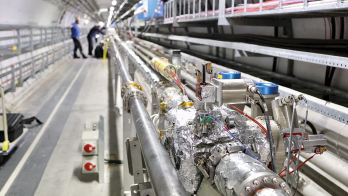
Following initial measurements at Columbia University in 1957, the story began at CERN in 1959 with a small magnet borrowed from the University of Liverpool and Leon Lederman’s idea to test quantum electrodynamics using the muon. The idea was to place muons in a uniform external magnetic field and observe their spin precession frequency, which depends on the strength of the field and the muon’s magnetic moment. By 1962, a dedicated 6 m magnet at the Synchrocyclotron had enabled the CERN team to pin down the anomalous magnetic moment with a precision of 0.4%. Two storage-ring experiments at the Proton Synchrotron followed. The third reached a precision of 7.3 parts per million by 1979, and pulled hadronic effects into view for the first time.
Brookhaven’s E821 experiment took over at the Alternating Gradient Synchrotron, reaching 540 parts per billion in its final 2006 report. The measurement stood 2.2–2.7σ above the SM evaluations of the day. In the summer of 2013, the experiment’s 14 m-diameter superconducting storage ring travelled by road and barge from Long Island to Batavia, where Fermilab’s more intense and pure muon beam awaited.
The story of the g-2 began at CERN in 1959
The final Fermilab measurement, announced in June 2025, reached a precision of 127 parts per billion: 30,000 times better than the first g–2 results (CERN Courier July/August 2025 p7). The theory side has moved as sharply. By August 2023, the discrepancy with respect to the 2020 prediction of the Muon g–2 Theory Initiative, an international consortium tasked with delivering a consensus SM value, had reached 5.1σ. Its 2025 update, which drops data-driven inputs to the hadronic vacuum polarisation in favour of a lattice-QCD consensus, sits within roughly 1σ of the measured value. The shift between the two predictions is itself about 3σ, reflecting an unresolved tension (CERN Courier January/February 2026 p41).
The 2026 Special Breakthrough Prize in Fundamental Physics went to David Gross (KITP, UC Santa Barbara) for a lifetime of contributions to theoretical physics. In 1973, Gross and his graduate student Frank Wilczek at Princeton, and independently David Politzer at Harvard, found that the strong nuclear force becomes weaker as quarks approach one another, a property known as asymptotic freedom. The three shared the 2004 Nobel Prize in Physics.
The inaugural Vera Rubin New Frontiers Prize went to Carolina Figueiredo (Princeton University). With Nima Arkani-Hamed and collaborators, she showed that the scattering amplitudes of three apparently unrelated theories, describing gluons, pions and a simplified scalar toy model, are generated by a single function, related by a simple shift of the kinematics. The result emerges naturally from a geometric formulation known as surfaceology.
Among the New Horizons in Physics Prize recipients, Benjamin Safdi (UC Berkeley) was recognised for his contributions to axion searches. Clay Córdova (University of Chicago), Thomas Dumitrescu (UCLA), Shu-Heng Shao (MIT) and Yifan Wang (New York University) shared a New Horizons in Physics Prize for the development of generalised symmetries in quantum field theory, with applications ranging from condensed-matter physics to string theory. A third New Horizons in Physics Prize recognised Dillon Brout (Boston University), J Colin Hill (Columbia University), Mathew Madhavacheril (University of Pennsylvania), Maria Vincenzi (University of Oxford), Daniel Scolnic (Duke University) and W L Kimmy Wu (Caltech) for analyses of cosmic microwave background data and Type Ia supernova samples, delivering tight constraints on the expansion and composition of the universe.