A report from the CMS experiment.
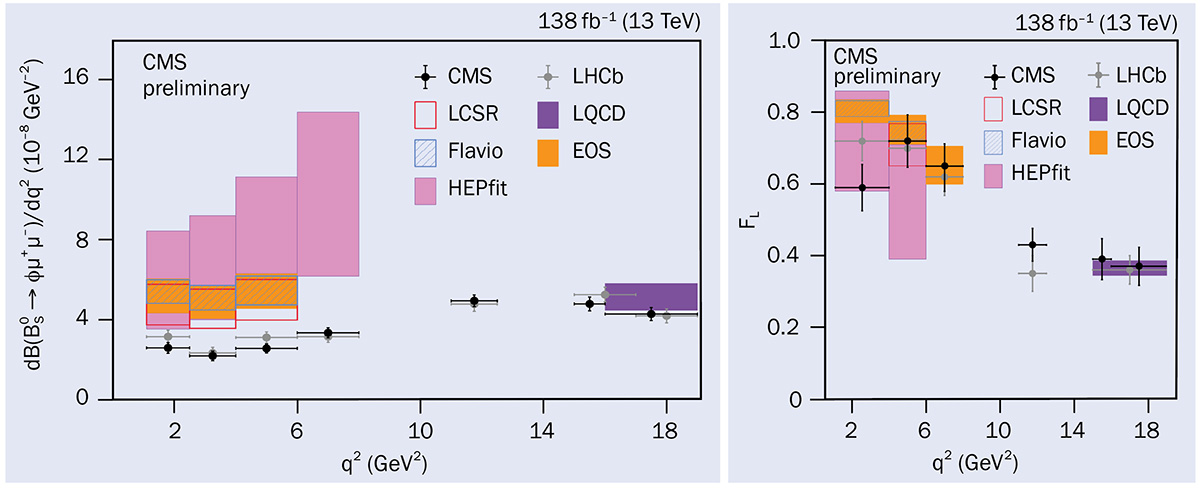
The Bs → φμ+μ– process, in which a bottom quark decays into a strange quark and a pair of oppositely charged muons, is a powerful probe of physics beyond the Standard Model (SM). For the first time, the CMS collaboration has measured its branching fraction as a function of q2, the squared invariant mass of the dimuon pair. In the low-q2 region, from 1.1 to 6 GeV2, the result lies 4.2σ below SM predictions obtained from a range of form-factor calculations.
In the SM, the weak nuclear force is mediated by the heavy gauge bosons W+, W– and Z0. Transitions mediated by the Z0 boson in which fundamental particles, such as quarks, change their flavour without altering their electric charge are known as flavour-changing neutral current (FCNC) processes. These transitions are absent at tree level in the SM and can only happen via complex, higher-order “penguin” or “box” loop diagrams. Moreover, the Glashow–Iliopoulos–Maiani mechanism ensures that contributions from the up-type quarks in the loop largely cancel, heavily suppressing FCNCs. As a result, these rare processes provide a sensitive probe for physics beyond the SM.
The Bs → φμ+μ– decay is an FCNC transition where a bottom quark decays to a strange one, with the intermediate loop dominated by a top quark. Recent studies of similar processes have revealed tensions between experimental measurements and theoretical predictions for both the branching fraction and angular observables. Specifically, using 9 fb–1 of data collected at 7, 8 and 13 TeV centre-of-mass energies, the LHCb collaboration observed that the Bs → φμ+μ– branching fraction lies 3.6σ below the SM prediction (CERN Courier September/October 2021 p15).
In this new result, the CMS collaboration reports its first differential measurement of the branching fraction of the Bs → φμ+μ– decay as a function of q2, using 138 fb–1 of data collected at 13 TeV centre-of-mass energy. The Bs-meson candidate is reconstructed in the K+K–μ+μ– final state by requiring soft-muon identification and high-purity hadronic tracks. The two hadron tracks, assigned the kaon mass hypothesis, are paired to form the φ-meson candidate. The narrow natural width of the φ resonance enables a clean selection with low background.
Signal events are extracted from extended, unbinned maximum-likelihood fits to the K+K–μ+μ– invariant mass distribution over various q2 intervals. The branching fraction is then measured relative to the normalisation channel Bs → J/ψφ, which shares the same final state, allowing many systematic uncertainties to cancel. The angular observables FL and A6 are extracted in each q2 bin, from an unbinned maximum-likelihood fit to the three-dimensional distributions of the Bs candidates’ invariant mass and two angular variables.
While the angular observables FL and A6 are consistent with expectations, the analysis reveals an up to 4.2σ tension between the measured branching fraction and SM predictions (see figure 1). Still, the current sensitivity is limited by statistical constraints. The inclusion of Run 3 data will significantly reduce these uncertainties, yielding the improved precision required to address the persistent anomalies in the beauty quark sector.
Further reading
CMS Collab. CMS-PAS-BPH-23-003.