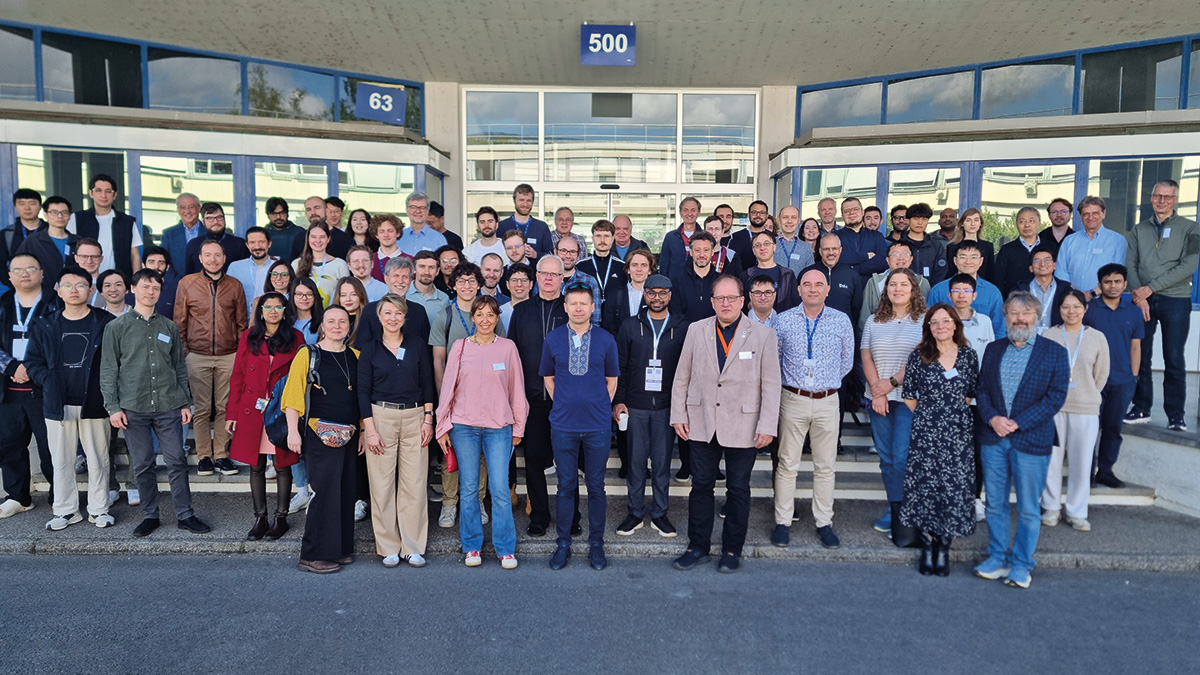
The 16th Workshop on Critical Point and Onset of Deconfinement (CPOD26), held at CERN from 13 to 17 April 2026, brought together more than 100 researchers focused on the phase structure of strongly-interacting matter. The workshop continued the long-running CPOD series, which centres on understanding how and when ordinary hadronic matter transforms into quark–gluon plasma (QGP), and whether a critical point exists in the QCD phase diagram.
The series adopts a plenary-only format, to encourage unified discussion across theory and experiment and bridge gaps between different approaches to the same underlying questions. In this same spirit, the programme emphasised clarity and synthesis rather than specialised talks for a narrow audience. Many of the review talks were devoted to emerging subfields, making it easier to connect developments across traditionally separate areas.
Critical point
The central scientific theme was the search for the hypothetical QCD critical point, where the smooth crossover between hadronic matter and the QGP gives way to a genuine first-order transition, deconfining and chiral-restoring at once. Identifying it remains one of the most important open problems in high-energy nuclear physics.
Speakers examined how matter behaves under extreme temperature and density – conditions recreated in relativistic heavy-ion collisions. While lattice QCD provides invaluable results at vanishing net-baryon density, extending these calculations to high net-baryon density remains difficult due to the infamous “sign problem”. Still, new exclusion limits were presented, ruling out parts of the phase diagram as possible locations for the critical point.
On the experimental side, several contributions highlighted results from ongoing heavy-ion programmes, probing a wide range of observables with beam-energy and system-size scans. These efforts are designed to uncover non-trivial structures in the excitation functions of observables that might signal critical behaviour – or the onset of deconfinement. Particular attention was given to event-by-event fluctuations and correlations, as well as to methodology, since signals can be distorted by the dynamical evolution of the collision system.
Central were, of course, the properties of the QGP. Presentations addressed transport coefficients, collective flow, dileptons and the role of fluctuations in the QGP, aiming to understand how such properties vary across different regions of the phase diagram. The connection between early-time dynamics and final-state observables was a recurring theme, with hydrodynamic and transport models playing an important role.
A key takeaway from CPOD26 was the importance of integrating multiple approaches
Understanding hadronisation – the transition from QGP back to hadrons – is essential for linking theoretical descriptions of deconfined matter to experimental measurements. Various models of particle production and freeze-out were compared, with emphasis on how they affect fluctuation observables and potential signatures of critical phenomena. Subtler effects, such as possible indications of isospin-symmetry breaking, were also noted.
The workshop’s scope extended to dense QCD matter in astrophysical environments, particularly in neutron stars, with observations from modern astrophysics providing complementary constraints on the QCD equation of state at high density. This interdisciplinary perspective highlighted how insights from astrophysics and heavy-ion collisions can inform each other, contributing to a more complete picture of the phase diagram.
Looking to the future, several talks focused on new experimental facilities and detector upgrades. Speakers discussed developments at the FAIR complex at GSI – home to the CBM and HADES experiments – and at CERN, including the proposed new fixed-target experiment NA60+/DICE, the upgrade of NA61/SHINE and the next-generation ALICE 3 detector for the HL-LHC. The possibility of a fixed-target experiment at the Electron–Ion Collider (EIC) was also discussed. These efforts aim to improve sensitivity to rare signals and extend coverage into previously unexplored regions of the phase diagram.
Intriguing hints
A key takeaway from CPOD26 was the importance of integrating multiple approaches, especially given the uncertainty about the existence and location of the critical point. Experimental hints are intriguing but not yet conclusive, and theoretical predictions still face challenges in achieving quantitative agreement with data. The need for new, precise measurements at collision energies between 3 and 10 GeV was stressed throughout the workshop.
By bringing together diverse perspectives in a focused and collaborative setting, CPOD26 highlighted both how far the community has progressed in refining its tools and how much remains to be understood about the fundamental behaviour of strongly interacting matter. The next workshop is planned in Lanzhou (China), on 16–20 August 2027.