A report from the CMS experiment.
Since its discovery at CERN in 1983 (CERN Courier November 1983 p355), the W boson has been one of the most thoroughly studied particles in high-energy physics – yet some of its rarest decay modes remain unobserved. The CMS experiment has recently carried out a search for its decay into three light charged hadrons, using 420 fb–1 of proton–proton collision data recorded between 2016 and 2025. The result sets an upper limit on the branching fraction that excludes a large range within the theoretical expectation, constraining certain models of these rare decays.
While decays of the W boson into hadrons are the most common, they are also exceptionally complex. The process of hadronisation, in which quarks transform into detectable particles like pions and kaons, typically produces around 30 final-state particles in a single W-boson decay. Consequently, reconstructing the parent W boson and studying its properties with high precision is significantly more difficult than for leptonic decay modes.
In its recent study, the CMS experiment focused on a much cleaner and rarer signature: W-boson decays into three light charged hadrons. This decay offers the highest potential of observation among low-multiplicity exclusive modes, as it combines a clean, fully charged final state with a relatively high rate, well above that of competing processes such as decay into a photon and a pion. Observing it would provide valuable new insights into quantum chromodynamics, particularly the behaviour of factorisation and form factors at high energies.
To identify these events, charged hadrons are reconstructed either from isolated particle tracks in the detector or as hadronically-decaying tau leptons, since a common decay mode of the tau lepton produces a charged pion together with a neutrino.
The study focused on a much cleaner and rarer signature
The analysis requires events with at least three hadron candidates. The two candidates with the highest transverse momentum are reconstructed as hadronically-decaying tau leptons, whilst the third may also be reconstructed as an isolated charged-particle track. This strategy both expands the accessible phase space – by taking advantage of the lower transverse momentum threshold for isolated tracks – and suppresses background contributions through stricter momentum requirements for hadronically-decaying tau leptons. The sensitivity is further improved using a dedicated DeepTau machine-learning classifier, which helps distinguish hadronically-decaying tau leptons from jets.
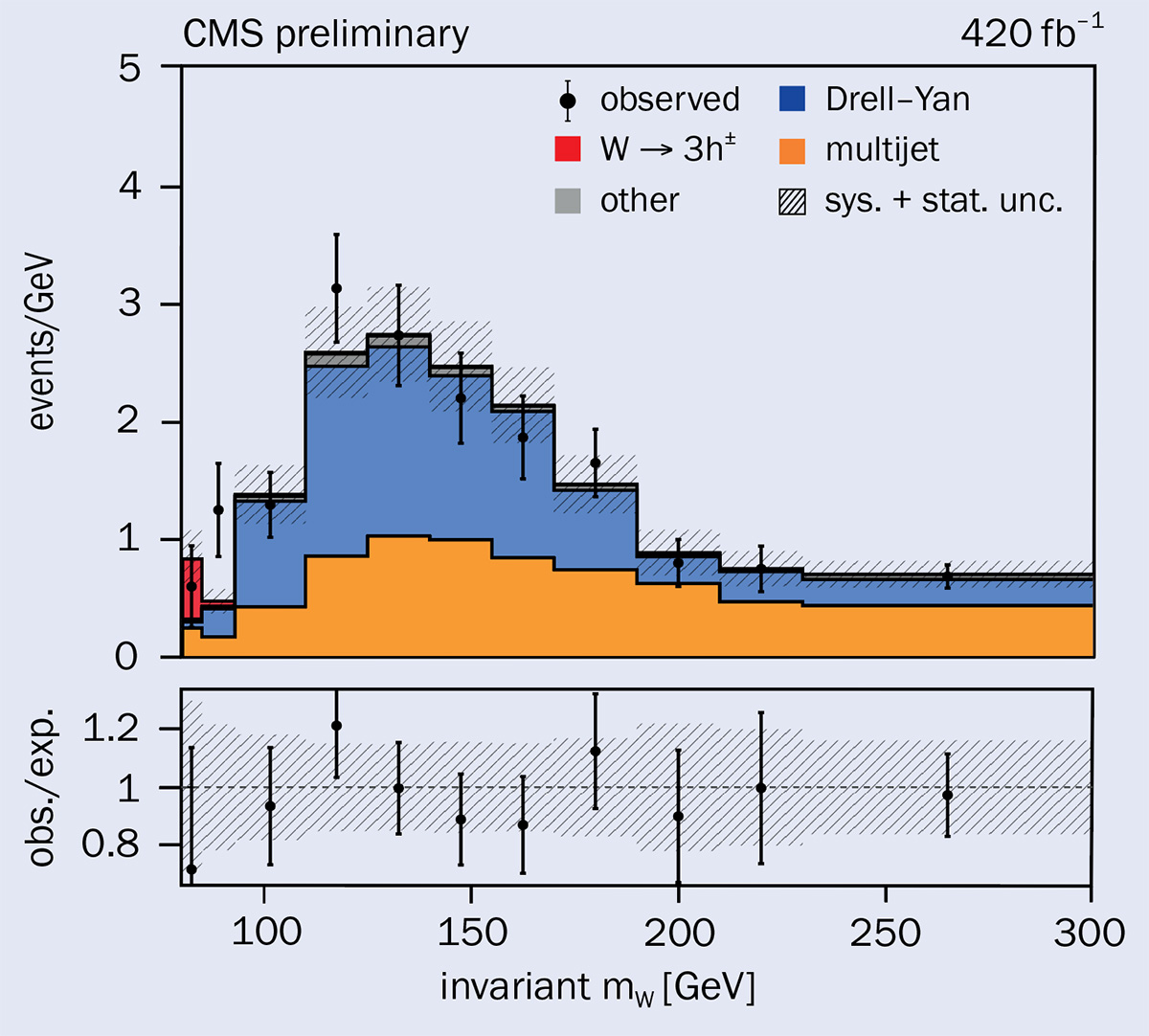
The search is performed by examining the invariant mass of the hadrons (see figure 1). No significant excess of events with W bosons decaying into three charged hadrons is observed. The most stringent 95% CL upper limit on the branching fraction of the W boson to three light charged hadrons is set at 3.0 × 10⁻⁷, while theory estimates a branching fraction in the vicinity of 10–5–10–7.
The decay of the W boson into a low-multiplicity exclusive state probes an interesting dynamical domain at the boundary of perturbative and non-perturbative QCD physics, where theorists strongly need experimental input. Although the signal has not yet been observed, the result already constrains certain models of this rare W-boson decay. As larger datasets become available, these rare decay modes offer a new window on the dynamics of the strong interaction.
Further reading
CMS Collab 2026 CMS-PAS-SMP-25-011.