A report from the ATLAS experiment.
When nucleons are bound within nuclei, their parton distribution functions (PDFs) differ from when they are free. The origin of these modifications, first discovered by the European Muon Collaboration in 1982 (CERN Courier November 1982 p362), remains one of the central open questions in nuclear physics, since the MeV-scale energies that bind nucleons together should have little bearing on the GeV-scale processes that probe their quarks and gluons. Results presented by the ATLAS collaboration at the Deep Inelastic Scattering (DIS) conference now provide the first observation that nucleons near the edge of a nucleus exhibit different PDFs from those near its centre.
The measurement relies on ultra-peripheral collisions (UPCs) of lead ions at the LHC, where – unlike a typical head-on collision – the ions glance past each other without their nucleons overlapping. They still interact, however, through the intense electromagnetic fields that surround each ion. Photonuclear UPCs occur when one nucleus emits a high-energy photon that strikes the other. One possible outcome is the production of jets through hard scattering between the photon and the nucleus, whose cross-section is sensitive to the parton distribution.
Such hard scatterings usually break the nucleus up, producing forward neutrons that are detected in the ATLAS zero-degree calorimeters located 140 metres from the interaction point. The key insight of this measurement is that, in about 4% of photonuclear scatterings, the photon strikes a single nucleon and leaves the rest of the nucleus whole. These events can be tagged by the absence of neutrons in the direction of the struck nucleus. Since nucleon densities are lower near the edge of the nucleus, collisions that leave it intact are also typically the more peripheral ones.
To study these collisions, the collaboration analysed lead–lead collision data collected in 2018 during Run 2 of the LHC, corresponding to an integrated luminosity of 1.72 nb–1. Events were selected by requiring at least two jets in the calorimeter with large rapidity gaps – regions of the detector devoid of particle production, characteristic of these photon-initiated processes. These were then categorised as “inclusive” or “peripheral” according to the presence or absence of forward neutrons, respectively.
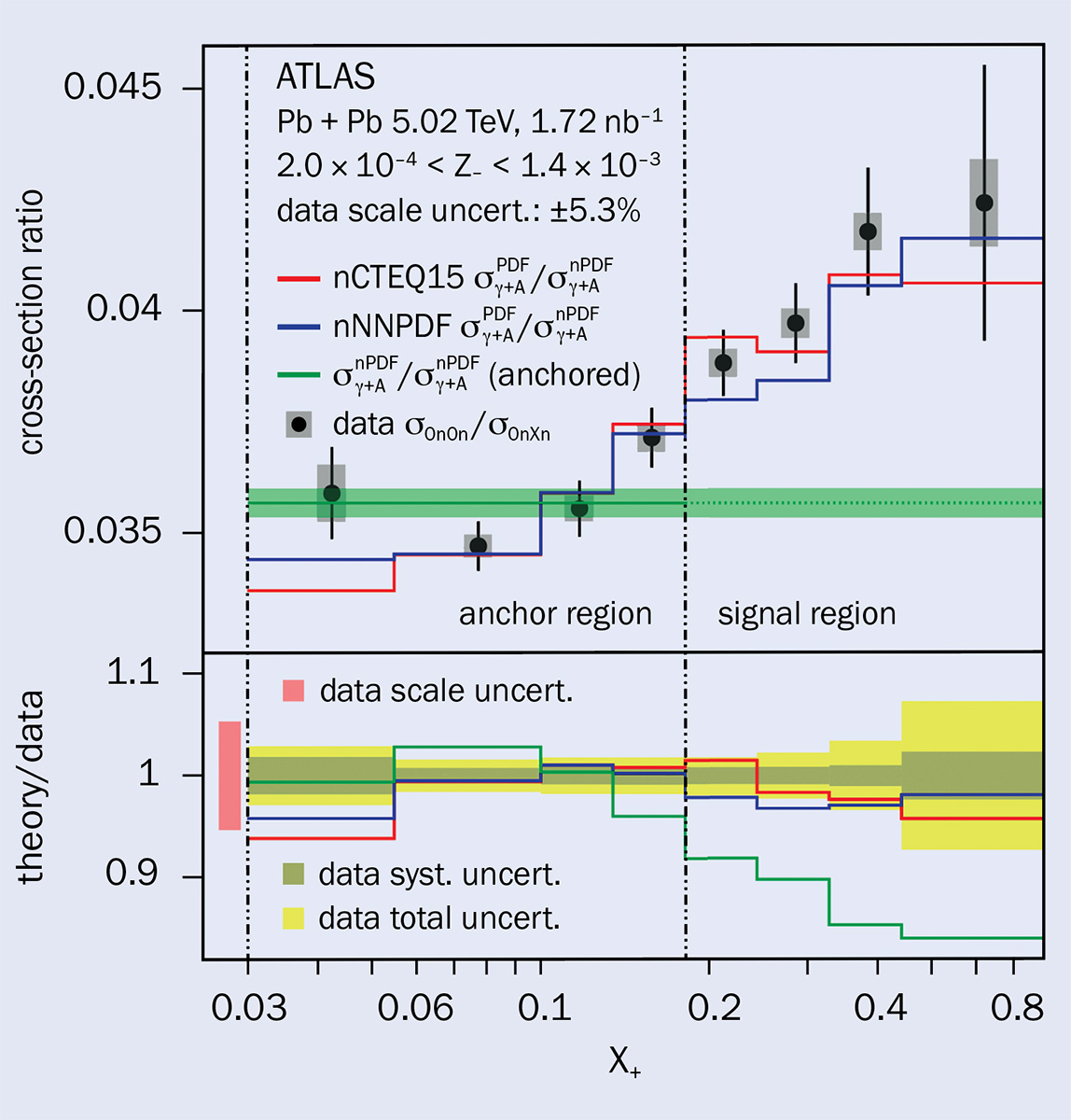
To interpret the results, proxy variables for the parton kinematics were defined using the properties of the measured jets. One such variable is x+, which provides an estimate for the Bjorken-x of the struck parton, the fraction of the nucleon’s momentum that it carries. The measured ratio of the x+ distributions between inclusive and peripheral collisions has a clear slope (see figure 1), indicating a significant difference in the nuclear modification of the parton distributions between the two classes. The size of this effect is quantified through a statistical test of the difference between them, which reaches a significance of 6σ.
These results provide the first observation that nucleons near the edge of a nucleus have different PDFs from those near the centre, and mark a significant step forward in understanding the structure of nuclei. The analysis also has important implications for the interpretation of relativistic heavy-ion collisions, which are sensitive to the PDFs of the colliding ions, and demonstrates a novel methodology that could be applied at the future Electron-Ion Collider (EIC). While this analysis uses Run 2 data, the larger Run 3 lead–lead dataset and the HL-LHC programme will offer substantial opportunities to improve both the precision and scope of these measurements.
Further reading
ATLAS Collab. arXiv:2604.20559.
ATLAS Collab. arXiv:2604.24435.