Galaxy clusters are the largest bound objects in the universe, and among the most spectacular astrophysical systems. Their gravity lenses the light of background sources and heats the intracluster gas to X-ray-emitting temperatures. Within them – or in their smaller counterparts, galaxy groups – resides a large fraction of today’s galaxies. Their dense environments also drive galaxy evolution, with the densest clusters hosting the most evolved systems in the local universe.
By studying clusters at different epochs, we can track how galaxies and their environments changed over time. They are also signposts of large-scale structure, and their number counts constrain cosmological models, including the nature and amount of dark matter, and the behaviour of dark energy. The South Pole Telescope, for example, searches for massive high-redshift clusters via the Sunyaev–Zel’dovich effect, in which hot electrons in the intracluster medium scatter cosmic microwave background (CMB) photons to higher energies, distorting their spectrum.
When deep optical and infrared imaging surveys began in the 1990s, it became clear that massive galaxy clusters are rare in the early universe – if they exist at all. In the first few billion years after the Big Bang, we find galaxies associated with one another spatially, but generally not in bound systems approaching the 1015 solar masses of the largest present-day clusters. This reflects the growth of structure predicted by the cold dark matter (CDM) model, which reproduces the density fluctuations seen in the CMB and the clustering of galaxies on large scales, but is harder to test against the properties of galaxies themselves.
When and how?
And yet, a major question remains open: when and how did the first galaxy clusters and groups form? An answer could potentially come from the James Webb Space Telescope (JWST), which measures the three-dimensional positions of astrophysical objects back to when the universe was less than a billion years old. Galaxies in the same region of sky that share similar radial velocities, and thus distances, are likely physically associated, and may evolve over time into a massive present-day cluster.
Such a system was recently identified in the GOODS-S field, as part of the JWST Advanced Deep Extragalactic Survey (JADES), a guaranteed-time programme of two of JWST’s instrument teams. A recent analysis of galaxy positions and distances in this field by our group revealed significant overdensities as far back as when the universe was about a gigayear old. But proximity in the sky alone does not guarantee a bound structure: such systems could still be assembling, rather than already being mature and gravitationally bound. One way to tell is to look for X-ray emission from intracluster gas shocked to high temperatures as the system collapses. At these early times, however, such emission is expected to be extremely faint.
JADES–ID1 is an exceptionally rare but plausible example of early structure formation
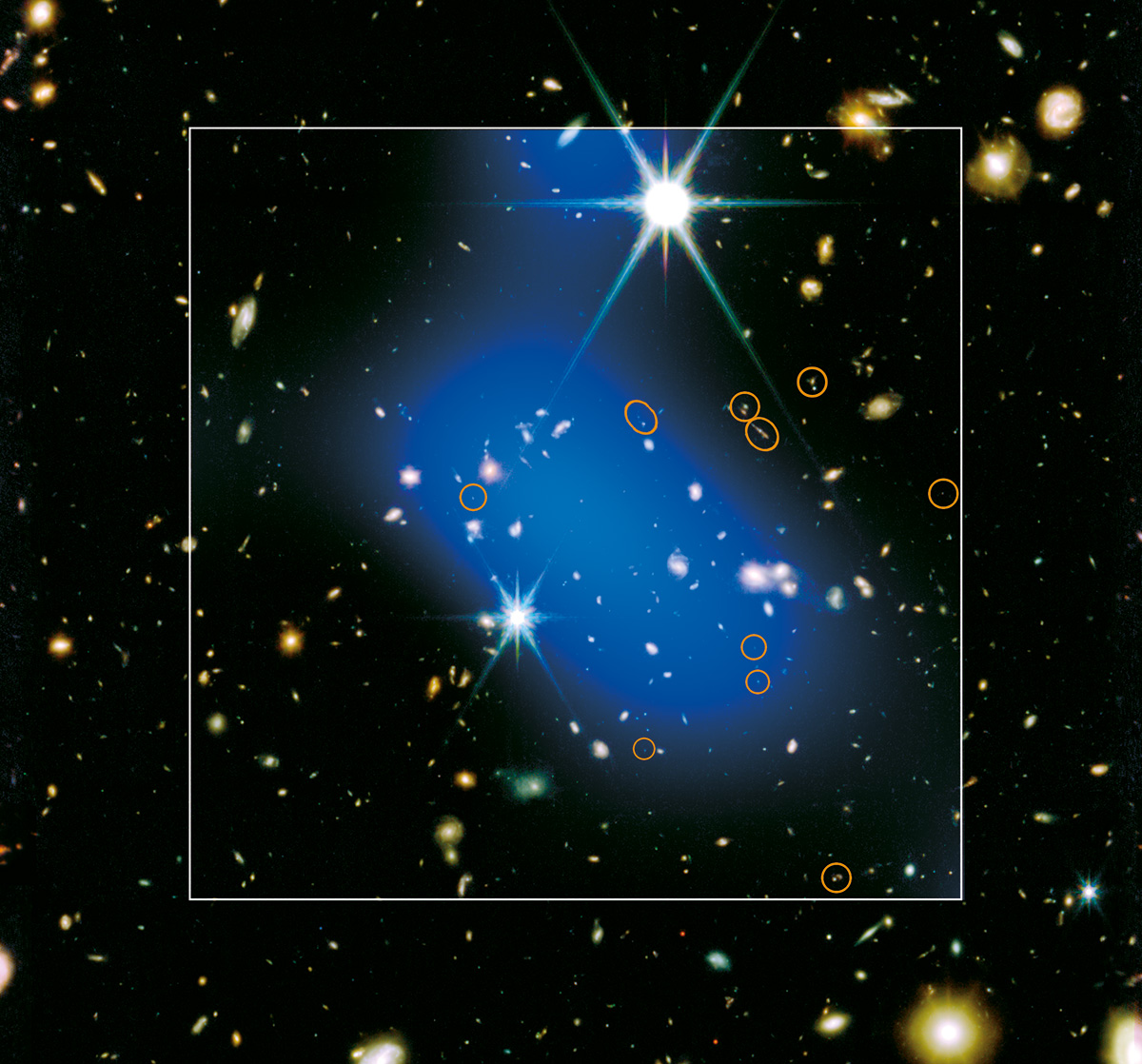
Our team discovered an X-ray-emitting protocluster, JADES-ID1, at redshift z ≈ 5.68. Found just one billion years after the Big Bang, it is the earliest protocluster known to host a hot intracluster medium, a stage of cluster formation not previously seen before the universe was three billion years old. Measured in the deepest X-ray observations ever taken by the Chandra observatory, it has a total gravitational mass of about 20 trillion solar masses – far too large for a single galaxy. Instead, it must comprise many galaxies within a shared gravitational potential that has existed long enough to heat the intracluster gas, allowing it to emit X-rays.
This discovery may have important implications for both galaxy evolution and cosmology. The presence of an X-ray-emitting intracluster medium indicates that substantial gravitational collapse, shock heating and mass assembly have already occurred, whereas most cosmological models predict that protoclusters should have been at much earlier stages. JADES-ID1 appears as a mature, bound group significantly earlier than when models predict such systems should be abundant.
Early efficiency
The patch of sky in which JADES-ID1 was discovered is exceptional, with the deepest multiwavelength coverage available, X-rays included. Finding such an object in a small patch of sky suggests that it may not be a statistical fluke: standard predictions would expect the most massive bound systems in the surveyed volume to be roughly an order of magnitude lighter than JADES-ID1. If comparable systems are discovered in other regions, it may imply that current models of early universe structure and galaxy formation underestimate the efficiency of early structure growth. Caution is in order, however, as a single detection is not enough to demonstrate a failure of Lambda–CDM cosmology.
Still, JADES-ID1 adds to a growing set of JWST observations pointing to faster early structure formation (CERN Courier November/December 2025 p11). For now, the conservative reading is that JADES–ID1 is an exceptionally rare but plausible example of early structure formation. If upcoming JWST, X-ray and Sunyaev-Zel’dovich surveys reveal a substantial population of similarly massive systems, this may eventually warrant a revision of galaxy and cluster-formation models.
We have now been awarded JWST spectroscopy time to study the system in more detail, which may give us more clues to its origin as well as how an early structure overdensity drives the formation of its host galaxies.