A cosmic-ray detector built at CERN has measured muons from one pole to the other. The Courier spoke to James Devine and Etam Noah, who built and ran the project, about the open hardware behind it, the data it brought back, and the car expedition that carried it across the world.

Etam, Victor Hess discovered cosmic rays on a historic balloon flight in 1912. More than a century later, why is measuring them at the poles interesting?

Etam Noah Near the equator, the Earth’s magnetic field deflects the lower-energy cosmic rays arriving from space, while at the poles those same particles stream almost freely down the field lines. Although this latitude dependence has been known since the 1930s, ground-level measurements from the polar caps themselves are remarkably scarce, which is exactly the gap we wanted to close. After all, the origin of cosmic rays – at energies many orders of magnitude beyond those of the LHC – is still debated, and their secondary products continue to provide an accessible, free-of-charge source for both fundamental and applied research. CERN’s CLOUD experiment, for example, has shown that cosmic-ray-induced ionisation can influence aerosol nucleation, with implications for climate modelling.
How far north had anyone measured muons before?
Etam In 2018, the Polarquest2018 expedition (CERN Courier December 2018 p30) sailed the 18 m aluminium yacht Nanuq into the Svalbard archipelago, carrying a scintillator detector built at CERN by high-school students from Italy, Switzerland and Norway as part of the Extreme Energy Events (EEE) network proposed by Antonino Zichichi in 2004. Polarquest2018 reached 82°07′ N, setting what was then the northernmost published ground-level muon record. Around the same time, the Dutch Clean2Antarctica expedition wheeled a solar-powered cart instrumented with a HiSPARC scintillator panel from Nikhef to the South Pole, across 1200 km of Antarctic ice. Both projects were as much about education and environmental advocacy as they were about physics, which is also the spirit behind Cosmic Pi.
James, how did the Cosmic Pi project come about?

James Devine The story goes back to a weekend project at the 2012 CERN Webfest. There, we wired together an Arduino microcontroller, an Android phone and a single Geiger-Müller tube borrowed from the ERGO project, to demonstrate a low-cost approach to distributed cosmic-ray timing over the public internet. Our prototype was crude. Android’s USB accessory ecosystem was barely usable at the time, but it convinced us that the idea was sound. The project resumed in 2014 under the code name X1 at THE Port, a hackathon hosted at CERN’s IdeaSquare. The explicit target was to switch from Android to the new Raspberry Pi single-board computer – and to release all designed components as open hardware and open source.
And how does the detector actually work?
James The principle is simple. Each unit has two plastic scintillator slabs, one above the other, each read out by a silicon photomultiplier. A particle passing straight through both, lights them up together, and that coincidence is what picks out muons and rejects the stray background, which usually triggers only one of them. A microcontroller timestamps each event with help from a satellite navigation receiver down to 65 ns, while the Raspberry Pi handles the internet connection and logs all the data.
From the start, you wanted the detector to be cheap and widely accessible. How has that worked out?
James Not in the way we planned. We had initially hoped to crowd-fund production for less than $500 a unit, but six years of supply problems put that out of reach. The first major hiccup in the global semiconductor supply chain occurred in 2020, when COVID-19-related shutdowns at chip fabrication plants massively restricted the flow of much-needed components. This worsened in 2022, with Russia’s invasion of Ukraine. Unrestrained enthusiasm for AI has driven further chip shortages, making it almost impossible – and very expensive – to obtain a Raspberry Pi. DRAM prices have increased by more than five times in just one year. So we changed strategy, and focused on building small batches of detectors to ship as prizes to runners-up in CERN’s Beamline for Schools (BL4S) competition. More than a hundred units have now been distributed to schools and individual experimenters around the world.
So how did one of them end up on a polar expedition?
James Almost by accident. In the autumn of 2023, I got a call from Paola Catapano (CERN), leader of Polarquest2018. She had been contacted by the Transglobal Car Expedition (TGCE), which was attempting to cross both the north and south poles by car. The idea was to take the EEE detectors from the Nanuq expedition along, but they were too big to fit in the polar vehicles. Her question was straightforward: could a detector designed for the classroom survive being driven onto the sea ice, and would it be ready for the start of the expedition, in January 2024?
And, of course, the answer was yes. How did you prepare?
James The expedition was, by any measure, an incredible logistical challenge. It covered more than 92,000 km across 42 countries, including a 6000 km Arctic crossing and a 7200 km Antarctic crossing, with ambient temperatures swinging from −50 °C to +50 °C. No previous wheeled expedition had reached the geographic North Pole – and we had a very short time to get ready. So we improvised. First, I called around some other educational cosmic-ray projects to see if anyone had suitable hardware. We soon concluded that the spare parts left over from BL4S would be the best option. We knew our detectors should behave acceptably down to at least –20 °C, and we did the only test available: we put them in a domestic chest freezer overnight, and any that were still working in the morning were sent on the expedition. They were repackaged into rugged Pelican-style cases to protect against water ingress and vibration, and each was named after a polar explorer or vessel: Nansen, Amundsen, Scott, Nobile and Erebus. The last honours the HMS Erebus, which sailed to both polar regions.
Etam, how did the detectors hold up out there?
Etam As James said, we carefully packed and tested every unit before sending it out – along with as many spare parts as we could think of. The constant vibration during long overland transits can affect solder joints and the points where each scintillator’s light reaches its sensor. And then there was the extreme environment. We didn’t expect all the detectors to make it, so we were very pleased to see that three of them successfully recorded data for almost the entire North Pole leg. Power, a modest 5 W per detector, came from the expedition vehicles, and the data was relayed back to Geneva over our Starlink satellite link, a piece of infrastructure unavailable to our 2018 polar predecessors. The most surreal moment of the journey was perhaps a live call with the team at the North Pole, including expedition leader Vasily Shakhnovsky, while detector data was streaming in real time to our servers.
And what did all that data add up to?
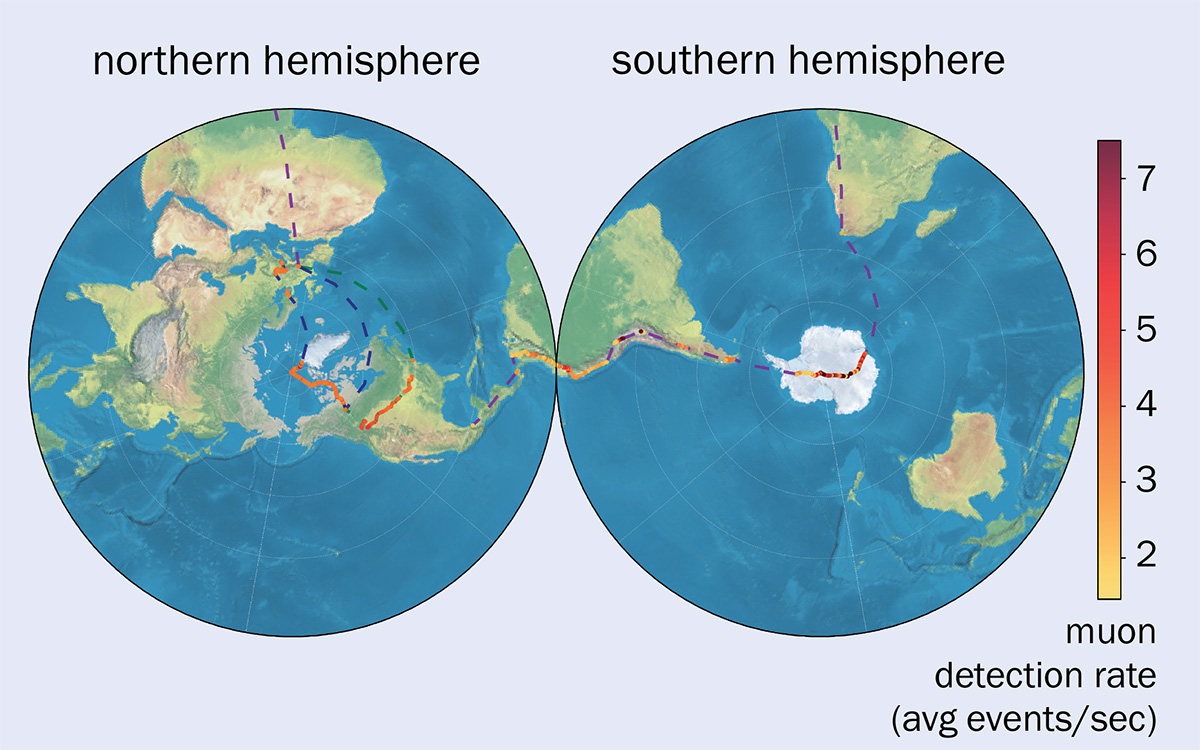
Etam The dataset covers 10 January to 12 May 2024, along a route from North America through the Arctic, to the North Pole and onward to Greenland. It includes per-second muon event counts, along with associated GPS coordinates, temperature, humidity, pressure, accelerometer and magnetometer readings. The key result is a continuous, geo-tagged record of secondary muon flux extending to 90° N, surpassing Polarquest’s 82°07′ N by nearly eight degrees of latitude.
The expedition then turned to Antarctica. What does the second pole bring?
Etam Of the units that worked in the Arctic, only one returned usable data from the Antarctic, a reminder of how tough a multi-year, multi-vehicle expedition is, even for ruggedised hardware. Yet that one unit covered Cape Town to the South Pole and back to the equator through South America. Taken together, the two datasets total 6.7 GB – a comprehensive latitude scan of secondary muon flux from approximately 90° N, crossing the equator, to approximately 90° S (see “Pole to pole” figure), all collected with the same instrumentation. Thanks to it, we can compare measurements without cross-calibration uncertainties dominating the result. The muon rate changes most clearly with latitude, but the scan also sets it against altitude, pressure, magnetic field and temperature. We hosted a workshop for high school students analysing the North Pole data at the CERN Science Gateway. We haven’t discovered anything new, but we are nonetheless very proud of what we achieved, and grateful to the expedition team for taking our detectors along.
James, how much of Cosmic Pi is open for others to build on?
James Cosmic Pi is a volunteer project, with contributors donating their own time alongside their regular work. In keeping with its origins, everything is open. The board designs are published under CERN OHL v1.2, an open-hardware licence that lets anyone reproduce and modify them. The firmware, dashboards and analysis notebooks are under GPL-3.0, the standard free-software licence, and the raw and sanitised datasets are openly available on Zenodo. We also ran outreach events along the route and kept close links with the CREDO citizen-science consortium.
Looking back over more than a decade, what did you set out to do, and where did you end up?
James We set out to make a cutting-edge cosmic-ray detector available to the whole world, and we ended up going on a fantastic journey and measuring around the whole world instead. It’s been a challenge, and an exciting one at that.
Further reading
Full transglobal dataset, doi:10.5281/zenodo.19470071.
http://cosmicpi.org.