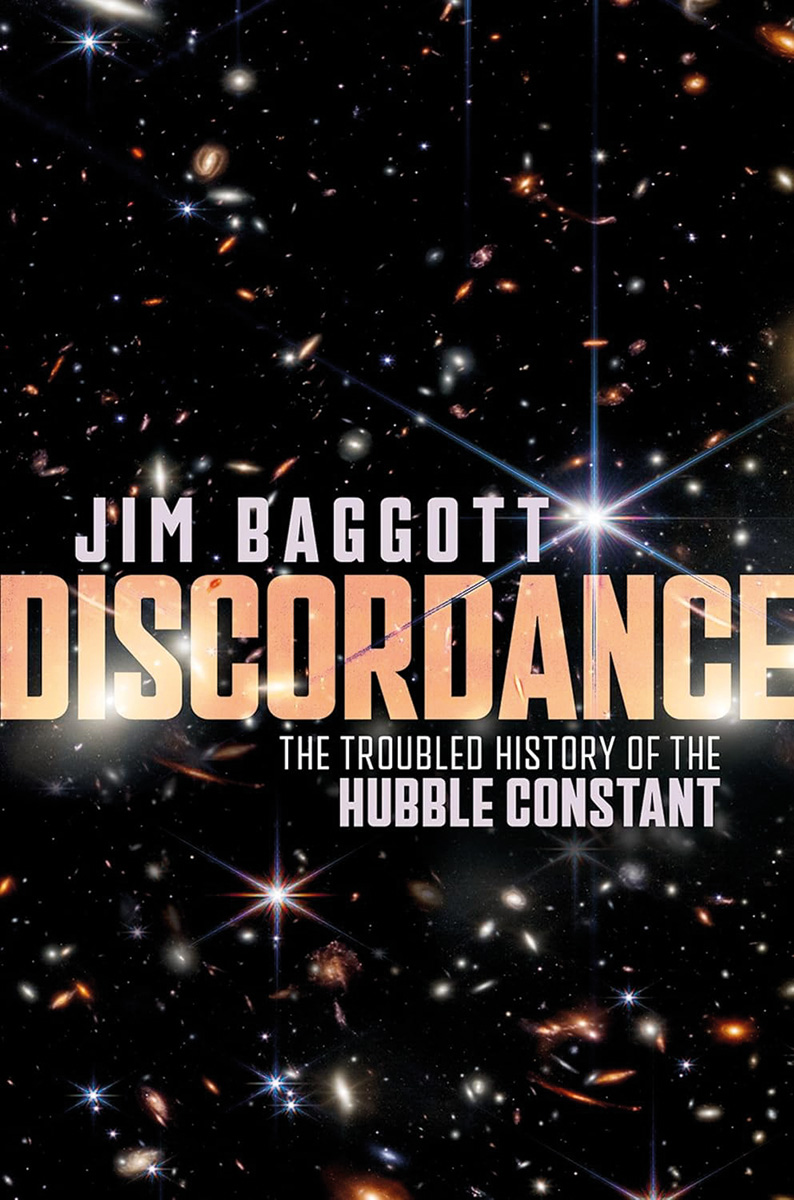
Discordance: The Troubled History of the Hubble Constant, by Jim Baggott, Oxford University Press

Jim Peebles won the Nobel Prize in Physics in 2019 for his work on the foundations of cosmology. Looking back at the state of his field in the early 1960s, he did not paint a pretty picture. Cosmology was, he recalled, “a limited subject … with two or three numbers.” He added, “A science with two or three numbers always seemed to me to be pretty dismal.” It was even worse than Peebles made it out to be. One of those numbers – the main number for many people – was the Hubble constant, named after Edwin Hubble, which quantified the expansion rate of the universe. Since the late 1920s, there had been a systematic campaign to measure the Hubble constant with ever-increasing precision. Yet, as the astronomer Allan Sandage showed in a 1962 review of the topic, there was no real agreement. Some astronomers found that the Hubble constant was 113 (in units of kilometres per second per megaparsec), with an uncertainty of about five. Others were getting 75, with an uncertainty of 25. Given the uncertainties, the results were remarkably discrepant – or “discordant”.
By the mid-1990s, the situation wasn’t much different. I remember attending the Critical Dialogues in Cosmology conference in Princeton in 1996, at which Wendy Freedman advocated a “high” value of the Hubble constant (above 70), while Gustav Tammann pushed for a low value (around 50). In a heated debate, they were at each other’s throats, and it became clear that the different camps weren’t going to agree, nor were they going to concede. By the early 2000s, the “Hubble battles” seemed to have ended, and a consensus was emerging that the Hubble constant was around 70. That is, until measurements became so precise that “discordance” re-emerged. This is the situation we find ourselves in now. Measurements that probe the early universe by looking at the cosmic microwave background yield a “low” value of the Hubble constant of 67, while methods that examine the late universe by measuring the properties of variable stars and supernovae give us a “high” value of 74. These numbers seem close, but the uncertainties have come down so dramatically that the difference matters.
It is a mesmerising story that has been in the background of my career as a cosmologist. On the one hand, we want the tension to go away, to see it resolved, given how successful the cosmological model is. On the other, for the more theoretically minded, there is hope that this is tantalising evidence for new physics, an undiscovered fundamental property of the universe yet to be uncovered. There is yet another possibility, which sounds much less scientific, namely that the protagonists throughout the ages have become wedded to their own favourite values, preventing convergence. Having met many of them, I can vouch that they are strong and fascinating characters.
Jim Baggott’s Discordance is an attempt to describe the history of cosmology throughout the past century or more. It covers a lot of ground and delves into some of the less explored aspects of the story. For example, he describes the “Harvard computers”, a cohort of women working at the Harvard College Observatory who played an instrumental role in establishing the foundations for the distance indicators crucial in measuring the Hubble constant. Henrietta Leavitt stands out as the person who unearthed the period-luminosity relation for Cepheid variables, which are at the heart of the current Hubble debates.
He also rightly describes what I call the “golden age of cosmology”, from when Peebles and others first began building accurate mathematical models of the large-scale structure of the universe to the modern measurements of the cosmic microwave background. I grew up during this era and have been lucky enough to witness firsthand this remarkable success story, a beautiful example of theory and observation coming together. This is physics and astronomy at their best. It is not all about discordance.
What I missed was a more in-depth analysis of what is going on, of how the different camps work and interact with each other. The characters are interesting, and it would have been good to get to know them better and understand what drives them. As it stands, they are mostly two-dimensional protagonists in a whistle-stop tour through the history of cosmology. Often, I found myself reading the book as if it were a layperson’s review article, a simplified version of what one might find in the Reviews of Modern Physics or Physics Reports. The result is a useful and easy way to get up to date on what is going on in cosmology, but no more than that.