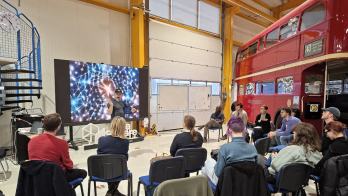
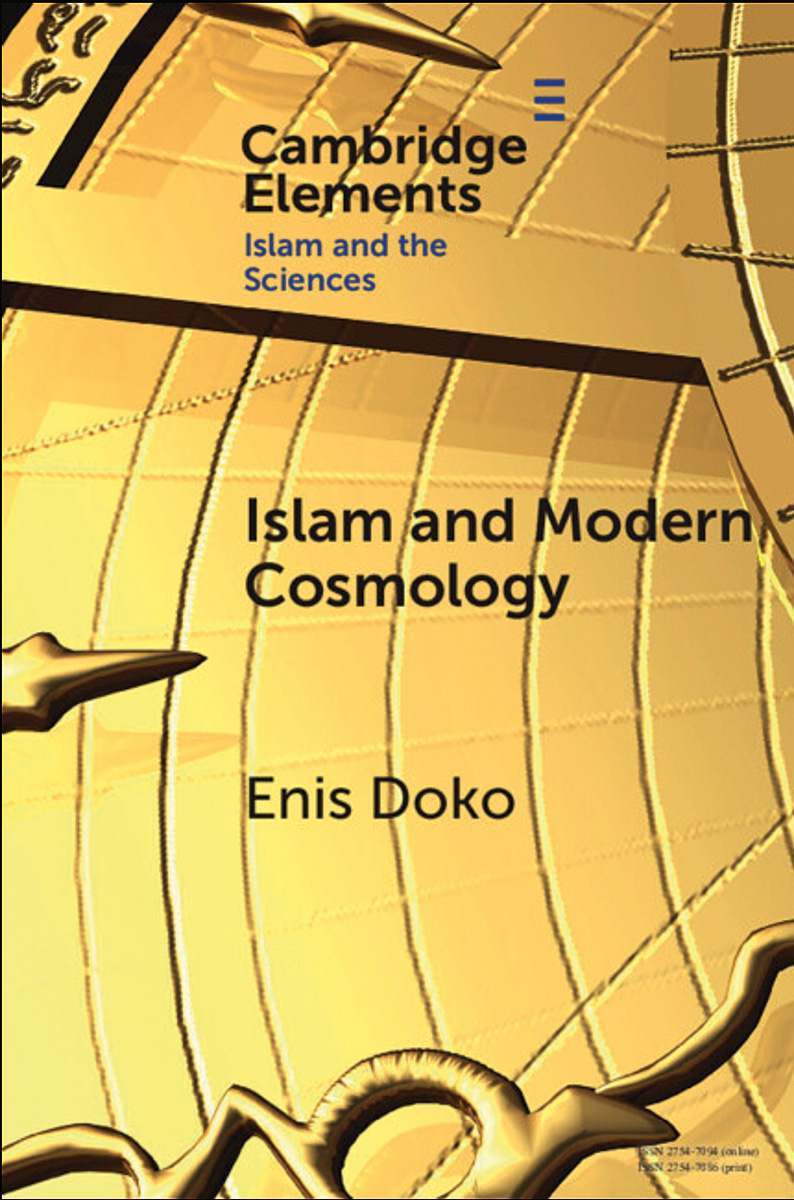
Islam and Modern Cosmology, by Enis Doko, Cambridge University Press
Enis Doko’s Islam and Modern Cosmology is an ambitious and intellectually serious contribution to a genre too often dominated by superficial concordism. Doko explores whether modern cosmology and Islamic intellectual traditions can enter into meaningful philosophical dialogue. In an age when “science and religion” literature often oscillates between naive scientism and mystical vagueness, this alone is noteworthy.
The work’s strongest feature is methodological. In its early chapters, Doko repeatedly emphasises that the Qur’an is not a scientific textbook and that cosmological theories remain provisional. This is a refreshing departure from the “scientific miracle” literature that continues to dominate much popular Islamic discourse. Doko is familiar with both contemporary cosmology and analytic philosophy of religion, and he treats scientific theories with seriousness and nuance. Discussions of singularities, inflation, fine-tuning, quantum cosmology and multiverse scenarios are generally informed and competently presented.
Yet the project’s very ambition also reveals some delicate tensions. The central epistemic issue, which Doko himself recognises in the earlier chapters, is that modern cosmology and “Qur’anic cosmology” do not operate within the same conceptual framework. Scientific cosmology is empirical, mathematical and inherently revisable, whereas Qur’anic cosmology is symbolic, existential and theological in orientation. The former seeks predictive explanatory models constrained by observation, while the latter addresses meaning, creation, transcendence and humanity’s place in the cosmos.
Doko is aware of this distinction, and this awareness gives the early sections of the book much of their intellectual strength. As the argument develops, however, symbolic “resonance” occasionally edges toward implied cosmological correspondence. At times, modern cosmological ideas seem to be read back into Islamic theological frameworks in ways that some readers may find historically ambitious or philosophically debatable.
This tendency becomes particularly visible in the treatment of inflationary cosmology and multiverse theories. The book often presents inflation as the dominant explanatory paradigm for the early universe – a position that reflected the optimism surrounding inflationary cosmology and landscape multiverses during the late 1990s and early 2000s. Since then, however, the intellectual landscape has become more nuanced and contested, and alternatives have shown up, even if not necessarily more credible.
Inflation was introduced to address important puzzles in Big Bang cosmology, including the horizon and flatness problems. It achieved considerable phenomenological success and remains influential, but several conceptual difficulties remain unresolved. The inflaton field itself is still hypothetical, and some critics argue that inflation shifts fine-tuning questions rather than resolving them entirely. The proliferation of inflationary models has also led some cosmologists to question how predictive the framework ultimately remains. Doko acknowledges some of these debates, though he occasionally presents inflation as closer to a stable consensus than many cosmologists today might consider warranted.
A related issue arises with string theory and landscape cosmology. Much of the speculative architecture of the later chapters draws upon ideas such as extra dimensions, branes and multiverse landscapes. Yet string theory remains experimentally unconfirmed despite decades of theoretical development, and some of the motivations that once strongly supported supersymmetric extensions of the Standard Model have weakened. This does not delegitimise such theories, but it does suggest that the broader theoretical context remains less settled than it once appeared.
In this changing scientific context, attempts to draw theological significance from speculative cosmological frameworks inevitably become more delicate. Doko sometimes moves rather quickly from mathematical possibility to metaphysical interpretation, particularly when discussing the multiverse as a possible expression of divine creativity or cosmological plurality within Islamic thought.
This does not make the project illegitimate, but it does make it historically and philosophically fragile. The effort to connect modern cosmology with the four major classical Islamic creation frameworks – emanation, temporal origination, manifestation and perpetual creation – is imaginative and stimulating, yet it also raises difficult historical questions. These classical doctrines emerged within intellectual worlds very different from those of inflationary cosmology or string landscapes, and the bridge between them is necessarily interpretive rather than direct.
One of the most thoughtful and sophisticated attempts to place Islamic thought into dialogue with contemporary cosmology
Attempting to put the Sufi doctrine, with its spectrum of rather vague and ethereal views, in resonance with some cosmological concepts – the multiverse in particular – may provide existential depth and protect cosmology from reductive scientism by allowing it to become spiritually meaningful rather than merely mechanistic.
However, a symbolic framework capable of accommodating Aristotelian cosmology, Newtonian mechanics, relativistic spacetime, inflationary multiverses and string landscapes with equal ease risks losing any explanatory claim. The issue is not that Sufi metaphysics is “wrong”, but that its interpretive openness can make it difficult to distinguish enduring metaphysical insight from retrospective symbolic accommodation.
In this respect, the later chapters increasingly read less as a study of historical Islamic cosmology and more as a contemporary philosophical synthesis shaped by Doko’s intellectual and spiritual vision. This is not necessarily a flaw, as many important philosophical works are constructive rather than purely historical, but some readers might benefit from a clearer distinction between inherited doctrine and modern reinterpretation.
Despite these reservations, Islam and Modern Cosmology remains one of the most thoughtful and sophisticated attempts in recent years to place Islamic thought into dialogue with contemporary cosmology. It is serious, learned and often genuinely illuminating. It is also a good introduction to Islamic philosophy during the formative centuries, as well as an elaborate review of modern cosmology written with as much depth and accuracy as a short monograph permits. If the book occasionally stretches the connection between speculative cosmology and theology further than some readers may find fully persuasive, this reflects less a lack of rigour than the immense difficulty of the enterprise itself. The result is a stimulating and intellectually ambitious synthesis. Its long-term significance may depend as much on where cosmology itself evolves scientifically as on how successfully the author’s work and others of the same strand engages with the theological questions it raises.