Comsol -leaderboard other pages

Topics

Probing the pomeron

Particle physics experiments ultimately depend on the way pairs of particles scatter off each other. A simple example of scattering is a game of billiards, in which the cue ball scatters off the other balls in carefully chosen directions. In physics language, billiards is an “elastic scattering” ­ the balls simply bounce off each other. While in billiards the balls do not shatter, in elementary particle scattering the objective is usually to create havoc, the balls knocking bits off each other or even disintegrating totally, creating new balls in a complicated game of snooker that is played under the rules of relativity and quantum mechanics.
scatter1_4-99

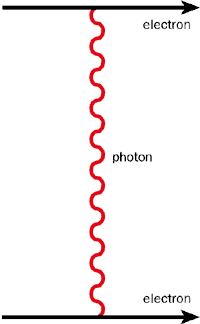
The interaction of ordinary billiard balls can be understood by their elasticity. After an initial compression as they collide, two balls subsequently spring back into shape and recoil away. For the more complex process of particle interactions, physicists understand the interaction via invisible particles transferring momentum from one visible particle to another as they pass each other. Such an “exchange process” is illustrated in figure 1, which shows the electromagnetic interaction between two electrons mediated by the exchange of an invisible light quantum or “photon”.

For the high-energy scattering of particles that feel the strong force, such as protons, the same physical concept applies, but now the exchange is made by whole families of related particles. One such is the rho family, named after its lightest member, the spin-1 rho meson, which comprises the rho and its cousin spin-3, spin-5, …. recurrences at higher mass.
scatter2_4-99

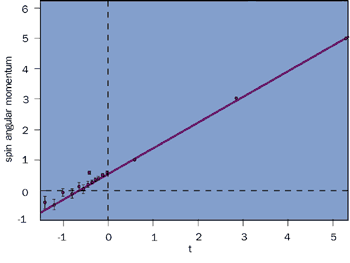
Regge theory (after the Italian physicist Tullio Regge) gives the collective effect of the exchange of all of the members of such a family in terms of a Regge trajectory a(t), which is described mathematically as a function of the invariant momentum transfer, t. The rho trajectory is shown in figure 2 for the “time-like” region of positive t corresponding to the real physical particles of spin-1, spin-3, spin-5, etc, and in the “space-like” region of negative t relevant for the exchange in a scattering process. The trajectory is well described by a straight line: a(t) = a0 + a‘t = 0.55 + 0.86t. This is an experimental result: it cannot be predicted by Regge theory. It turns out that the trajectories of all of the dominant meson-exchange families lie close to this line ­ they are almost degenerate.

Regge theory

Regge theory tells us that the energy dependence of the sum of everything that happens ­ the “total cross-section” ­ is dependent on the value of the trajectory at t = 0. Specifically, it is given by the square of the collision energy, s, raised to the power a0-1. As all of the meson trajectories are nearly degenerate and have a0 = 0.55, the energy dependence is s-0.45, roughly as the inverse of the square root of s, so the prediction of Regge theory for meson exchange is that the cross-section should decrease with increasing energy and do so at a well defined rate.
scatter3_4-99

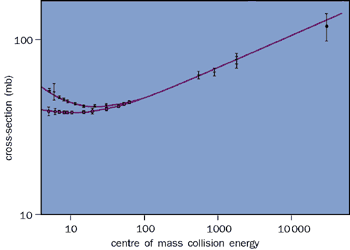
While such behaviour is indeed seen at collision energies below about 15 GeV, at higher energies the total cross-section at first flattens out and then begins to rise slowly, an effect first hinted at in cosmic-ray data, demonstrated unambiguously for the first time at the CERN ISR Intersecting Storage Rings and the rising trend confirmed at the CERN’s proton­antiproton collider and at Fermilab’s Tevatron. The cross-section for proton­proton and proton­antiproton scattering is shown in figure 3. The simplest assumption to make is that this rising cross-section is due to the exchange of another Regge trajectory and so also gives a simple power of s. To produce a rising cross-section it must be such that a0 = 1 + e with e positive. This is the phenomenological or “soft” pomeron, named after the Russian physicist Igor Pomeranchuk.

The parameter e is universal, independent of the particles being scattered. Fitting the total cross-sections for proton­proton, proton­antiproton, positive and negative pion­proton, positive and negative kaon­proton and photon­proton scattering over the centre of-mass energy range 10 GeV to 1.8 TeV gives e = 0.095. Extrapolation to cosmic-ray energies of 30 TeV shows no deviation from the fit. However, the data errors are much greater than those at current accelerator energies and we will need to await the arrival of the LHC to provide the precise data necessary to test the theory fully at these very high energies.

Physical particles have quarks as their constituents: three quarks for the proton and antiproton, plus a quark and an antiquark for the mesons. One view of high-energy particle scattering is that the pomeron interacts with these valence quarks. In the fits to the total cross-sections the ratios of the strengths of pomeron exchange in pion­proton and proton­proton or proton­antiproton scattering is almost exactly 2/3. This can be taken as evidence that the pomeron does indeed couple to single valence quarks in a hadron ­ the “additive quark rule”.

An alternative viewpoint is that the pomeron interacts both with the valence quarks and with the gluons that bind the quarks together to form the physical particles, and the cross-section ratios simply reflect the different sizes of these particles. This issue is still unresolved.

Symmetry violation in a new setting

The CDF experiment at Fermilab’s Tevatron proton­antiproton collider has produced heroic new evidence for the violation of “CP” symmetry, a hypothetical operation which takes a particle into a mirror image of its antiparticle.

Although a tiny effect in particle physics, CP violation could be the cause of the matter­antimatter asymmetry of the universe ­a Big Bang which presumably produced equal amounts of matter and antimatter resulted in a universe populated entirely by matter.

So far, the only quantitative evidence for this subtle violation has been in the decays of neutral kaons, at a few per mil. CDF now sees tentative evidence for CP violation in the decays of neutral B mesons, in which the strange quark of the neutral kaon is replaced by a heavy b-quark. CDF looks at B decays producing a J/psi and a short lived neutral kaon.

The vital parameter is measured to be 0.79±0.44, a non-zero value indicating CP violation. While CP violation is not completely understood and therefore cannot be predicted from scratch, the measured value is in line with expectations based on the interconsistency of many Standard Model measurements. Several months ago, CDF published an analysis based on a subset of its B decay sample. The new result uses its full available sample.

With a new generation of electron­positron colliders hoping to open up this area of B physics, we plan to publish more on these initial B­CP violation pointers soon.

Neutrons in time

A new limit on the electric dipole moment of the neutron comes from an experiment using ultra-cold neutrons at the research reactor at the international Institut Laue-Langevin, Grenoble, France. For many years, the team has been refining its techniques to push the limit progressively lower.

Viewed as an electrically neutral particle, the neutron should have no electric dipole moment, but an effect could arise due to its constituent electrically charged quarks.

An electric dipole moment (the product of spin and electric field) violates time reversal symmetry (T), and any non-zero value for the neutron electric dipole moment would signal a dependence on the arrow of time.

This would be no surprise to physicists. The neutral kaons violate the combined CP reflection which changes particle to antiparticle as well as producing a mirror image. Because the combined CPT has to be good, T symmetry has to be broken in sympathy.

This “natural” level of T violation should give a value for the neutron electric dipole moment of some 10­30. Meanwhile, imaginative physicists have proposed models which predict a larger value. The latest measurement of 6.3 x 10⁻²⁶, although still a long way from the naturally expected value, does start to restrict theoretical speculation.

CERN: Circular solution to the enigma of nucleon spin

Over half the nucleon’s spin is unaccounted for, but circularly-polarized photons could soon reveal where it is. Physicists working on the new NA59 experiment at CERN aim to study the production of high-energy circularly polarized photon beams using crystals. If they are successful, such beams could be used to probe directly the contribution to nucleon spin carried by gluons, answering a question first posed by a European Muon Collaboration experiment in 1988 which found that quarks contribute less than half the nucleon’s spin.

Circularly-polarized photon beams are traditionally produced from polarized electron beams. But the sort of physics NA59 has in mind would require much higher electron energies than are currently available. The solution proposed by NA59 is to start with unpolarized electrons and produce circular polarization in a two-step process using a pair of crystals. The first crystal would generate a linearly polarized photon beam, the second would act as a “quarter-wave plate”, converting linear into circular polarization. Quarter-wave plates are frequently used to analyse polarized light ­ a feature which makes the work of NA59 potentially interesting to prospective builders of future high-energy electron­positron colliders. Quarter-wave plates might also be used to measure beam polarization in such machines.

The first step has already been demonstrated by the earlier NA43 experiment which demonstrated that linearly polarized light can be produced by firing a high-energy unpolarized electron beam into a crystal. The degree of polarization, however, was not determined. Measuring it will be the first goal of NA59 during a three-week run in 1999 using a 180 GeV electron beam. A second experiment to produce circularly-polarized light is planned for 2000 if the 1999 results are encouraging.

Circularly-polarized photon beams are not the only way to measure the gluon contribution to nucleon spin. The COMPASS experiment at CERN will soon begin to attack the question using a high-energy muon beam. The photon route, however, offers an attractive alternative with the advantage that for photons of 70 GeV and above, the experimental signature is particularly clear. In a polarized nucleon target, photons fuse with gluons to produce charm­anticharm quark pairs. Measuring the asymmetry between production rates for opposite polarizations of the target gives the gluon contribution to the nucleon’s spin. This means that despite the large attenuation of the beam caused by passing it through two crystals, the final measurement would still be competitive with alternative approaches.

The quest for gravitational waves

waves1_3-99

The gravitational waves emitted by accelerated masses were predicted by Albert Einstein’s General Theory of Relativity as long ago as 1916, but so far remain undetected. One piece of indirect evidence affirming their existence came in 1974 when Joseph Taylor and Russell Hulse studied PSR1913+16, a system of two compact neutron stars ­ one of which is a detectable pulsar ­ orbiting each other in a slowly decreasing eight-hour period. The orbital frequency acceleration was observed to be in perfect agreement with that expected from the energy loss corresponding to their calculated gravitational wave emission. For their accomplishment, Hulse and Taylor were awarded the 1993 Nobel Physics Prize.

Unfortunately these twin stars are presently emitting gravitational waves too feebly to be detectable on Earth, a condition that will continue until the end of their pas-de-deux inspiral some 350 million years hence. Still, from the density of observed binaries, a few such inspiral events are expected per century in our galaxy.

Since the theoretical prediction of gravitational waves, scientists have searched for ways of directly detecting them. To date, efforts have been unsuccessful because the extreme weakness of the postulated signals places them below the detection threshold currently available, and as yet no unexpectedly strong signal has graciously decided to assert itself.

waves2_3-99

The quest to detect gravitational waves started in earnest in 1965, with the pioneering work of J Weber on resonating bars. These are basically high-quality bells designed to be rung by transient gravitational waves. From this beginning, a small gravitational wave detection community has arisen and thrived, continuing to improve on the original idea. The main effort is directed towards noise reduction by introducing ever lower cryogenic temperature and ever more sensitive displacement sensors, to improve detector sensitivity and ultimately reveal a signal. Many more bars, progressively sophisticated, have been built. One in particular, the Explorer, has been quietly functioning at CERN since 1989.

Drawback

Despite their great potential sensitivity, the primary drawback of resonant bars is that they are, by definition, resonant. They are sensitive mainly to signals with a frequency corresponding to the bar mechanical ringing frequency, of the order of 1 kHz. A bar would respond to the hammer blow of an asymmetrical supernova explosion by simply ringing at its own bell tone, and would be excited by a twin neutron star inspiral only in that brief instant when the two stars chirp up through the bell tone frequency.

Recent advancements in laser interferometry have cleared a path to discovery with a new wide-band detection technique. This technique is capable of following a star inspiral from the time it starts generating a distinguishable signal above the clutter of gravitational noise produced by the microseismically vibrating Earth’s crust (a few Hz for inspirals in our galaxy), to the time when the two neutron stars actually merge and stop emitting gravitational waves as point-like masses (a few kHz). The whole process is calculated to last for a fraction of an hour above 5 Hz, and for only about a second above 100 Hz.

Detection would be via very long Michelson interferometers. Inside them, light is modulated by its reflections between mirrors, suspended from wires, free to be jerked by any incoming gravitational wave. The technique has initial sensitivity sufficient to reveal inspirals occurring in neighbouring galaxies, thus allowing detection of some inspiral gravitational wave signals within a physicist’s lifetime. Further advancement in lasers, mirrors, seismic isolation, and phase detection techniques must be achieved to get longer reach, up to the full potential of this technique, and reduce the expected time between detectable events to months or even days.

Challenging the Big Bang: a longer history of time

bang1_3-99

The idea that the universe, and time itself, originated from a primordial explosion – the Big Bang – has transcended the boundaries of scientific knowledge to become a key part of modern culture. But is this belief completely justified? An alternative explanation, suggested by recent developments in theoretical physics, holds that the Big Bang was just one of many transitions in the history of the universe, though possibly the most dramatic. In this new scenario, a long prehistory slowly prepared the Big Bang in much the same way that long periods of steady evolution precede the collapse or explosion of stars. But what is wrong with the traditional dogma?

Singularity

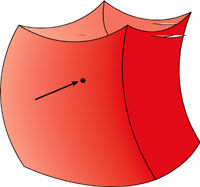
Standard cosmology, based on Einstein’s Theory of General Relativity, states that some 10 billion years ago the universe was just a mathematical point. As such, not only did it have exactly zero size, but physical quantities, such as temperature, energy density, pressure ­ and the resulting curvature of space-time ­ were all infinite. Indeed, the Big Bang is the most dramatic example of a phenomenon that is often encountered in field theories like General Relativity, when the predictive powers of the theory break down. The phenomenon is known as a singularity. Asking what happened before that singular instant, which is conventionally defined as time zero, doesn’t make any sense. There was no “before”. At least, that’s what we are told.

When hard pressed, cosmologists admit that extrapolating the equations of General Relativity back to time zero is not justified. Even the most optimistic will agree that what happened around and before 10-43 seconds was greatly affected by quantum effects that General Relativity happily ignores. (10-43 seconds is the so-called Planck time: the timescale first constructed by Max Planck out of the speed of light, Planck’s constant and Newton’s constant of gravitation. At accelerator energies, the gravitational force between two elementary particles is much weaker than the other forces of physics. However, at the Planck scale the effects become comparable.)

Thus, to be on the safe side, we should ask how the universe would have looked not at t = 0 but, say, at t = 3 x 10-43 seconds, possibly a bit later. The answer turns out to be quite embarrassing. According to General Relativity, the many-billion-light-year universe that we observe today was then only one millimetre across. This size, though tiny compared with the present dimensions, was huge compared with the other relevant distance at the time: the distance travelled so far by light: 10-32 centimetres.

Cosmological puzzles

The enormous ratio of these two scales, 1031, is both a mystery and the source of many unsolved cosmological puzzles (the so called homogeneity, entropy and flatness problems). These problems have been nicely summarized by Roger Penrose in an illustration in his compelling book The Emperor’s New Mind, in which God selects with unimaginable care the initial state of the universe. In particular, this initial state had to contain a huge amount of matter/energy distributed in a very orderly fashion. This was as improbable as finding, at one moment, all of the molecules of the Earth’s atmosphere above the North Pole, and nowhere else.

bang3_3-99
bang2_3-99

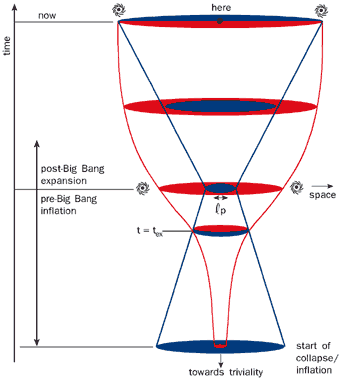
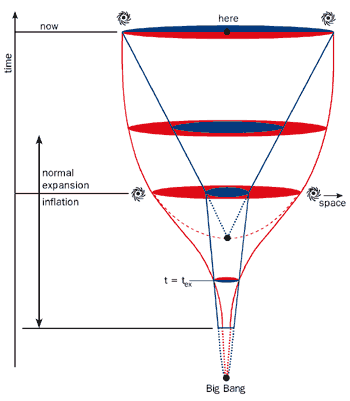
Whenever similarly odd situations are encountered in physics, the obvious question to ask is: “Can we understand them as the result of an evolution from something more ‘natural’?” However, if we assume that the Big Bang was the beginning of everything, there is simply no “past” available to us for assuming those more natural initial conditions. The standard solution to these cosmological puzzles is to invoke the hypothesis that something new ­ a relatively long period of extremely rapid expansion of the universe, inflation ­ took place after the Big Bang and cured its deficiencies. Unfortunately, even after some 18 years of hard work, inflation still lacks a deep theoretical understanding and contains a large degree of arbitrariness, and is therefore difficult to test.

Alternatively, one should appeal to processes that happened around or at the Planck time, but then, as was mentioned earlier, one has to include sizable quantum effects. Indeed, it looks quite plausible that the singularity problem and the puzzles of standard cosmology should somehow be related, and should be simultaneously solved by quantum effects. However, until recently, there has been no way of dealing with these kinds of question. There was no scheme combining General Relativity and quantum mechanics into a consistent theory of quantum gravity.

This situation changed some 15 years ago with the advent of superstring theory, which was itself a re-elaboration of a model developed at CERN about 30 years ago. The way in which strings cope with the problems met by the conventional approach is subtle, but not difficult to describe. In string theory, conventional point-like particles are replaced by small, one-dimensional objects called strings. The typical size of a string, which is dictated by quantum mechanics, defines, through the speed of light, a characteristic timescale that turns out to be about an order of magnitude larger than the Planck time: ts = 10-42 seconds.

The ratchet of time

kaons1_3-99

The neutral kaon is one of Nature’s trickiest particles and has to be handled with respect by experimenters. Measuring its detailed behaviour has kept many physicists busy for over 30 years, and the quest continues, with major experiments still to make definitive precision measurements.

The neutral kaon comes in two forms, which are particle and antiparticle of each other, distinguished only by their strangeness quantum number. The problem is that strangeness is only conserved in strong nuclear interactions, so that when the weak force is in action, the neutral kaon and its antiparticle get mixed up. This gives some unusual and interesting results which could have implications for our understanding of the universe.

The conventional theory of particle physics is completely time symmetric ­ a video of a simple particle interaction would be equally valid whether run forwards or backwards. The neutral kaon defies this rule and shows there can be a one-way valve in the passage of time.

This delicate asymmetry could help explain how a universe created in a Big Bang that was matter­antimatter symmetric has evolved into one that contains no antimatter at all. Perhaps time is the arch-enemy of antimatter.

How Nature is asymmetric

In 1956 the world of physics was startled to discover that the weak force looks very different when viewed in a mirror. Weakly interacting particles have a definite “handedness”. If nuclear beta decay is reflected in a mirror, a right-handed particle becomes left-handed, and the physics scenario is not the same. In the trade, such a mirror reflection is called a parity operation, P. Parity is violated in weak interactions.

The parity violation blow was quickly followed by another. Physicists also discovered that the weak force scenario also changes if particles are switched into antiparticles and vice versa. This “charge conjugation symmetry”, C, is also violated in weak interactions.

If P and C separately are not respected by the weak force, what is? Physicists suggested that perhaps the separate P and C violations compensate for each other, and that the compound CP symmetry would be good. In such a CP mirror, a left-handed particle (such as a neutrino) changes into a right-handed antiparticle (such as an antineutrino), etc.

The next shock came in 1964 when a fraction of a per cent of the decays of the neutral kaon were found to violate CP symmetry. What symmetry would be the next to fall? Powerful theorems said that the underlying formalism should be invariant under CPT ­ when the compound CP operation is supplemented by time reversal, T. If CPT went, then the underlying formalism would sink and physics would be in deep trouble, as nobody would understand very much any more.

If CPT is to hold good, and CP is violated by the neutral kaons, then the neutral kaons necessarily violate time reversal symmetry ­ rewinding a “videotape” of a neutral kaon interaction would not take you back to the point of departure.

Violation

The traditional description of CP violation by neutral kaons includes two alternatives: CPT good and T violation, and CPT violation and T good. The first evidence for the first alternative was found in 1970 in an experiment at CERN’s PS proton synchrotron which looked at the time dependence of neutral kaon decays. This result was of key importance for the understanding of neutral kaon decay. Ever since, physicists have been searching for other glimpses of time symmetry violation.

kaons2_3-99

One of the major experiments continuing to probe neutral kaon physics to provide precision measurements of CP violation is Fermilab’s KTEV study, which began in 1996 and is currently churning through the data accumulated so far. Most of the time the long-lived neutral kaon decays into three particles, respecting CP. One rare neutral kaon decay is into two charged pions accompanied by an electron­positron pair, a decay channel only recently seen for the first time. It accounts for only 3 x 10⁻⁷ of the total decays, much smaller than CP violation in the mainstream decay channels.

This decay can happen via several mechanisms, some of them CP violating, some not, and these different mechanisms interfere. Several years ago, Lalit Sehgal at Aachen realized that because of this subtle quantum mechanical interference, the angle between the plane of the two pions and that of the electrons is sensitive to the arrow of time. If such a decay were run backwards, momenta would be reversed, but the “resultant” involvement of the neutral kaon would not always correspond to the original process.

Asymmetry

From some 1800 such decays, the KTEV experiment reports an asymmetry of some 13%, in line with the prediction. This time asymmetry is much larger than the usual levels of CP violation, seen in the dominant neutral kaon channels, and shows how a rare decay channel, once found, can be a rich source of information.

Also studying this decay process is the big NA48 experiment at CERN, which began gathering precision data in 1997. Its major objective is to measure the elusive parameters of the more usual examples of CP violation.

Another example of T violation comes from the CPLEAR collaboration, which studied CP violation physics at CERN’s LEAR low energy antiproton ring from 1990 until LEAR was closed in 1996. CPLEAR looks at the many different particle combinations emerging from proton­antiproton annihilation.

Among them are two interesting quantum opposites: a positive kaon, a negative pion and a neutral kaon; or a negative kaon, a positive pion and a neutral kaon antiparticle. Whether the annihilation produced a neutral kaon or its antiparticle is “tagged” by the electric charge of the associated kaon.

This contrasts with the situation in experiments using secondary beams of neutral kaons, which are particle­antiparticle mixtures.

Once formed in the initial strong interaction annihilation, the CPLEAR kaons or antikaons are then free to decay under the weak force. Comparing these decays with the original strangeness tags from the annihilation process shows whether a kaon has subsequently transformed into an antiparticle, or vice versa. If time reversal is good, as many kaons will change into antikaons as antikaons into kaons.

CPLEAR finds a mismatch between the two rates. The time asymmetry is measured at 6.6 x 10⁻³ and is compatible with the observed levels of CP violation. The arrow of time is broken, but in such a way that the master CPT symmetry is good.

More work to do

The major experiments probing CP violation in with neutral kaons ­ NA48 at CERN, KTEV at Fermilab and KLOE at Frascati’s DAFNE electron­positron collider ­ still have a lot of work to do before these effects are measured definitively.

But the big mystery remains. Why is CP, and therefore time reversal symmetry, violated at all? To answer this question, physicists will probably have to use the longer CP violation (and therefore T violation) lever expected with B particles containing the fifth, beauty, or “b” quark.

Directions beyond the Standard Model

desy1_3-99

While the Standard Model (SM) of strong, weak and electromagnetic interactions is healthy and keeps surviving experimental tests, motivations to go beyond it are primarily based on theoretical considerations in the quest for a unified theory of all fundamental forces. Leading candidates at the moment are supersymmetric field theories and string theories.

On the experimental side, traditional high-energy physics experiments have tested the SM to a high degree of precision and strongly constrain many new theoretical ideas. However, the 1998 harvest of new results on atmospheric neutrinos, together with the accumulated data on solar particles, might provide the first sign of physics beyond the Standard Model. Other more indirect arguments for physics beyond the SM might come from cosmological considerations, like the question of the baryon asymmetry or the nature of dark matter in the universe.

The status of the “Search for new particles at high-energy colliders” was covered by P Zerwas of DESY. Most notably the searches at LEP at CERN and the Tevatron at Fermilab have pushed the mass threshold for new particles to higher and higher values. He then went on to explain how CERN’s LHC proton collider or, looking further ahead, an electron­positron linear collider (TESLA, NLC, JLC) might help shed new light on the physics beyond the Standard Model. This will not only give information about particle spectroscopy, but will also allow us to study the Higgs mechanism and distinguish between specific models. The design parameters of such a linear collider might play a crucial role for these future precision experiments.

Supersymmetry

desy2_3-99

S Pokorski of Warsaw reviewed the supersymmetric extension of the Standard Model and its comparison with electroweak precision experiments. While many of the superpartners have to be quite heavy, the prediction of a light Higgs boson in the supersymmetric models seems to be consistent with available data.

On the theoretical side, string theory (a generalization of quantum field theory to one-dimensionally extended objects) has been revolutionized in the past few years. Various unexpected symmetries, called “dualities”, relate different string theories to each other. This leads to the conjecture that all string theories are interconnected via dualities, and unified in what is called M-theory. Apart from strings, such theories would then also contain higher dimensional objects (“p-branes”), as was explained by S Theisen (LMU Munich).

P Mayr from CERN reported on “Insights into field theory from string theory”. He explained how many results in quantum field theory can be derived by embedding these theories in higher dimensional string theories. Parameters in field theory, like gauge coupling constants, then become geometric objects with extra dimensions in string theory. S Yankielowicz (Tel Aviv) explained the origins of the new Maldacena-conjecture which suggests a deep conceptual connection between string and field theory.

Black holes

H Verlinde of Amsterdam linked these results to progress in the understanding of black holes and quantum gravity, including the celebrated “holographic principle”, originally introduced in an attempt to unify general relativity and quantum mechanics.

That such developments could have an impact on possible generalizations of the SM was emphasized by I Antoniadis (Paris) and L Ibanez (Madrid). “New aspects in string phenomenology” appear as a result of string dualities, including some results concerning non-perturbative aspects in the effective low-energy supergravity theories, as Ibanez explained. Antoniadis concentrated on currently popular models where the string scale (usually identified with the Planck scale, 1018 GeV) is lowered to the TeV range. Such models would be tested at future collider experiments, as well as experiments probing the structure of gravity in the sub-millimetre range, which could reveal deviations from Newtonian gravitation at distances smaller than a millimetre.

Generalizations of the Standard Model often link to cosmology and astrophysics, and observations in these fields would then test particle physics theories. M Drees (Sao Paulo) concentrated on supersymmetric candidates for cold dark matter and the experimental efforts to find signals in direct detection of so-called WIMPs (Weakly Interacting Massive Particles). Other “Astronomical probes of new physics”, like ultra-high-energy cosmic rays, the cosmological constant and density perturbations in the cosmic microwave background, were discussed by S Sarkar of Oxford.

C Wagner (CERN) described the possible generation of a baryon asymmetry of the universe during the electroweak phase transition. Such a mechanism (not possible in the SM) might be operative in the MSSM with a relatively light Higgs boson. Q Shafi (Delaware) considered models of an inflationary universe and its predictions for the large-scale structure of the universe to test the nature of nonbaryonic dark matter, including neutrinos. This brought the focus back to neutrino oscillations. The implications of the new experimental results on grand unified theories were analysed by T Yanagida of Tokyo.

The final talk came from M Koshiba (Tokyo) who recounted the landmark history of Kamiokande and Super-Kamiokande and looked forward to new insights in particle physics and neutrino astronomy.

Relic neutrinos, a challenge for the next millennium

relic1_3-99

Neutrinos are probably one of the most abundant components of the universe. As well as the 3K microwave background radiation, the universe is filled with a sea of relic neutrinos that decoupled from the rest of the matter within the first 10 seconds after the Big Bang. These relic neutrinos may have played a crucial role in nucleosynthesis, structure formation and the evolution of the universe as a whole. They may also contain clues about baryogenesis ­ the formation of nuclear matter.

Relic neutrinos, their role in Nature and their possible manifestations were the focus of a workshop entitled the Physics of Relic Neutrinos, which was organized at the Abdus Salam International Center for Theoretical Physics (ICTP) in Trieste, Italy, last September by ICTP and the Italian INFN.

A non-zero neutrino mass can dramatically change the properties of the relic neutrino sea and its role in the evolution of the universe. A special session looked at the evidence for neutrino masses and consequent mixing from the studies of atmospheric and solar neutrinos. E Lisi (Bari) showed that all data on atmospheric neutrinos (including the latest SuperKamiokande data and the old results from Kamiokande) can be well described by maximal muon­tau neutrino oscillations with a squared mass difference of some 5 x 10⁻³ eV2.

Muon neutrino oscillations into non-interacting “sterile” neutrinos can also give a good fit of the data (O Peres, Valencia). A majority of alternative explanations of the atmospheric neutrino problem, like a neutrino decay, reviewed by S Pakvasa (Hawaii), still imply non-zero neutrino masses.

Although the solar neutrino data give a strong hint of neutrino mass we are still far from reaching a conclusion, and progress (in Lisi’s opinion) will be slow. Detailed studies of spectral distortions and possible time variations (L Krauss, Case Western) are needed to determine the neutrino parameters.

Neutrino mass spectrum

Reconstruction of the complete neutrino mass spectrum from present data is of great importance both for particle physics and cosmology, as discussed by M Fukugita (Tokyo), F Vissani (DESY) and R Mohapatra (Maryland). One of the most interesting recent suggestions is the bimaximal mixing scheme with degenerate neutrinos in eV mass range (Vissani). Attempts to accommodate all of the existing data and/or to explain large mixing lead to the introduction of sterile neutrinos (reviewed by Mohapatra). Their existence would have enormous consequences for astrophysics and cosmology (Z Berezhiani, Tbilisi).

relic2_3-99

Several talks looked at a possible relationship between properties of the relic neutrinos and baryogenesis. One of the favoured mechanisms (reviewed by E Roulet, La Plata) is an initial lepton asymmetry, converted to baryon asymmetry through electroweak sphalerons. (The electroweak vacuum has two topologically distinct classes. Sphalerons can connect these different vacua.)

The lepton asymmetry can be generated via the CP-violating decay of heavy (1010 GeV) right-handed neutrinos. W Buchmuller (DESY) has considered a supersymmetric realization of this possibility. A new mechanism of leptogenesis, via CP-violating oscillations of the right-handed neutrinos with masses 20-50 GeV and very small couplings, was described by E Akhmedov (ICTP). A Pilaftsis (Munich) discussed the enhancement of leptonic CP asymmetries in the decays of nearly degenerate TeV neutrinos. In all of these scenarios the lepton asymmetry is typically of the same order as the final baryon asymmetry. Through the “seesaw” oscillation mechanism these right-handed neutrinos naturally endow light neutrinos with masses in the range 10-3-1 eV, relevant for cosmology and for explaining the solar and atmospheric neutrino data. The leptonic asymmetry can also be produced without right-handed neutrinos in the decays of new triplet Higgs particles (U Sarkar, Ahmedabad).

The neutrino sea was crucial for Big Bang nucleosynthesis (BBN). The present status of the BBN “crisis” – inconsistent values of baryon-to-photon number densities implied by helium-4 and deuterium abundances ­ was covered by G Steigman (Ohio). This issue is not yet settled, although recent studies indicate a larger He-4 abundance. The problem can be resolved if there were less than three light neutrino species at the time of nucleosynthesis. This can be realized, for example, if the mass of the tau neutrino is a few MeV and it decays with a lifetime of about 5 s (S Pastor, Valencia).

Another solution can be related to a significant leptonic asymmetry. The influence of the leptonic asymmetry on BBN was discussed by R Volkas (Melbourne), X Shi (San Diego) and D Kirilova (Sofia). The general principles of the creation of an asymmetry in oscillations of active to sterile neutrinos in a medium were presented by Volkas. A lepton asymmetry of some 10-5 produced at high temperatures may suppress the generation of the equilibrium concentration of sterile neutrinos in oscillations at low temperatures. This could reconcile a possible large mixing of active and sterile neutrinos (as indicated by the atmospheric neutrino data) with the BBN bound. For this to work, the heaviest neutrino has to be heavier than 15 eV (Shi). The production of a lepton asymmetry in neutrino oscillations after neutrino decoupling and its influence on He-4 abundance was discussed by Kirilova.

Structure formation

One of the central themes of the workshop was the role played by relic neutrinos in the structure formation of the universe. Recently the situation has changed dramatically. According to J Silk (Berkeley), no model fits the detailed shape of the power spectrum of density perturbations and satisfies all of the existing constraints. The cold + hot dark matter (CHDM) model with neutrinos contributing 0.2 to the critical (omega) parameter gives a better fit than other models. This implies a neutrino mass of about 5 eV and describes the nearby universe well, however (like the other models with (omega) = 1 and zero cosmological constant) it is disfavoured by data on early galaxies, cluster evolution and high redshift type IA supernova (J Primack, UC Santa Cruz). A good fit of both the nearby and distant data can be obtained with a cosmological constant and (omega) about 0.6, and the presence of large-scale inflationary relics like voids (Silk). As was underlined by Primack and M Roos (Helsinki), the presence of HDM is not necessary in this model, although some amount of HDM is still possible and may be useful for further tuning the data.

The situation can be clarified with new precision measurements of the cosmic background radiation anisotropy made by MAP and PLANCK, and by new galaxy surveys like SDSS. The latter will be sensitive to neutrino masses as low as 0.1 eV.

The properties of neutrinos and the relic neutrino sea are imprinted in the cosmic microwave background anisotropy. The observations by MAP and PLANCK will be sensitive to the effective number of neutrino species to an accuracy of 0.1, so it will be possible to test the existence of sterile (even non-equilibrium) neutrinos in the relic sea, neutrino decays (S Hannestad, Aarhus), and a possible neutrino degeneracy (discussed by S Sarkar, Oxford). Present data admit a rather strong degeneracy. A large lepton asymmetry can modify the history of the universe, leading, for example, to symmetry non-restoration. A large lepton asymmetry can be generated by neutrino oscillations or other mechanisms.

The evolution of the relic neutrino sea (clustering, formation of structures and so on) in the presence of neutrino masses or new interactions is of special interest. As was discussed by N Bilic (Zagreb), self-gravitating neutrino clouds can show “gravitational phase transitions” in the process of contraction and form neutrino stars, the scale of whose sizes would depend on the neutrino mass.

The properties of neutrinos and their reactions in extreme conditions ­ very dense and hot media, and very strong magnetic fields ­ are an important issue. These were considered by R Horvat (Zagreb), A Ioannisian (Munich) and D Grasso (Valencia).

Detecting relic neutrinos directly will of course be of fundamental importance, but it would seem to be impossible with present methods. However, we may be able to observe some indirect manifestations of the relic sea even now. D Fargion (Rome) and T Weiler (Vanderbilt) have considered the possibility that the highest energy cosmic rays detected on Earth may have been produced by the annihilation of ultra-high energy neutrinos with the neutrinos from the relic sea. This mechanism implies a neutrino mass of at least a few eV and the clustering of HDM near our galaxy. The relic sea could also be detected if neutrinos undergo a relatively fast radiative decay. Such a decay would explain the ionization of hydrogen in the universe. The present status of this hypothesis was summarized by D Sciama (Trieste). Direct searches for the 900 Å line from this radiative decay are now under way by the UV detector EURD, in orbit since April 1997, and results are expected soon.

Apart from the Big Bang relic neutrinos, the present universe must be filled with relic neutrinos from past supernovae (K Sato, Tokyo) or from collapses of supermassive objects with an energy spectrum in the range 1­50 MeV. Some contribution may also come from the evaporation of primordial black holes (E Bugaev, Moscow). The possibilities for detecting neutrinos from relic and real-time supernovae with existing and new underground neutrino detectors were discussed by D Cline (UCLA), who also described the new project for a supernova burst observatory, where neutrinos will be detected through secondary neutrons emitted by the recoiling nuclei.

The workshop revealed deep connections between a variety of fundamental open questions in cosmology, astrophysics and particle physics. In a sense it outlined a new field of research which has the goal of understanding the properties of the relic neutrino sea and its possible detection. This goal will be one of the challenges for the physics and astrophysics of the next millennium.

Putting a spin on physics

spin2_3-99
spin1_3-99

The series of biennial International Symposia on High Energy Spin Physics was initiated in 1974 and, in his opening talk at the recent meeting (the 13th in the series) at the Institute for High Energy Physics, Protvino, Russia, International Committee chairman Charles Prescott pointed out that the symposium venues have established a right-handed rotation about the world axis.

Last year marked the tenth anniversary of the European Muon Collaboration’s publication, which launched the nucleon spin problem ­the spin of the proton is not the sum of the spins of its individual quarks. E Gabathuler (Liverpool) gave an overview of recent experimental progress. The latest nucleon spin structure measurements were reported by I Savin (SMC, CERN), E Hughes (E155, SLAC, Stanford) and A Bruell (HERMES, DESY, Hamburg).

Progress in this sector means collecting data at smaller Bjorken x (momentum fraction carried by the struck quark) and increased statistical precision. The new high-precision experimental data for the proton and deuteron spin structure functions are consistent with previous measurements and allow better extrapolation to x = 0.

The small-x behaviour of the structure is one of the unsolved problems en route to a final resolution of the overall nucleon spin puzzle. Others are the important issues of gluon and sea quark contributions to the nucleon spin,
and the role of orbital angular momentum.

It is not easy to define the separate components of the nucleon spin in an interacting field theory of quarks and gluons. Different theoretical approaches to the nucleon spin problem in quantum chromodynamics (QCD) are related, to a large extent, to the renormalization and the role of the axial anomaly. These general theoretical problems and recent results were covered by V Petrov (Protvino).

After 10 years, explaining nucleon spin structure remains a problem. A solution could be expected from non perturbative QCD (for example, lattice calculations). Another possibility, advocated by T P Cheng (Missouri), is a two-stage approach where the first stage uses effective degrees of freedom at large distances (constituent quarks) and in the second stage these effective degrees of freedom are related to the QCD quarks and gluons. Experimentally, the constituent quark idea can be tested by measuring the strange quark content of the proton via parity-violating processes in high-energy electron scattering. Preliminary results from HAPPEX at Jefferson were reported by E Burtin (CEA-DSM/DAPNIA).

The theoretical status of spin effects in hard hadronic reactions was discussed by P Ratcliffe (Milan), while the current experimental results were covered by A Bravar (Mainz). Large spin asymmetries at the level of 30% were reported in inclusive meson and hyperon production. The asymmetries in different reactions have a similar dependence on transverse momentum and Feynman x and tend not to decrease with transverse momentum. However, elastic proton­proton scattering shows increasing such behaviour with increasing transverse momentum.

After G Fidecaro of CERN related the early history of spin experiments, A Penzo (Trieste) surveyed future perspectives for such studies and their role in the resolution of current problems. A key player will be the spin experimental programme at Brookhaven’s RHIC collider, described by S Vigdor (Indiana). New physics opportunities at HERA with polarized protons were covered by A De Roeck (DESY), using material from a recent workshop. Perspectives for future experiments depend strongly on the progress in acceleration of polarized beams, and the availability of new polarized targets and sources.

In his plenary talk, A Masaike (KEK) described the role of spin as a probe of symmetry in intermediate and low-energy regions. H Ejiri (Osaka) reviewed the role of spin effects in neutrino-nuclear responses and nuclear medium effects. Reports on workshops sponsored by the International Committee were given by their organizers  D Crabb (Virginia), A Efremov (Dubna) and Yu Mamaev (St Petersburg) ­ and the meeting summary was given by A Krisch (Michigan).

Despite the enduring puzzles, the Protvino symposium displayed the considerable spin physics progress over the past two years. The next chapter in the story will be reported in Osaka, Japan, in 2000.

The local Protvino organizing committee received support from the International Committee, the Russian Ministry of Science and the Foundation for Basic Research. The proceedings are being published by World Scientific.

bright-rec iop pub iop-science physcis connect