 Read article 'In pursuit of right-handed photons'
In pursuit of right-handed photons
The presence of new virtual particles could be clearly signalled by a right-handed contribution to the photon polarisation.

 Read article 'In pursuit of right-handed photons'
The presence of new virtual particles could be clearly signalled by a right-handed contribution to the photon polarisation.
 Read article 'Leptoquarks and the third generation'
In a recent CMS analysis researchers have challenged the Standard Model by investigating a previously unexplored leptoquark signature.
 Read article 'Sensing a passage through the unknown'
A global network of ultra-sensitive optical atomic magnetometers – GNOME – has begun its search for exotic fields beyond the Standard Model.
 Read article 'Researchers grapple with XENON1T excess'
The excess could be due to a difficult-to-constrain tritium background, solar axions or solar neutrinos with a Majorana nature, says the collaboration.
 Read article 'Funky physics at KIT'
The FUNK experiment has set an improved limit on the existence of hidden photons as candidates for dark matter with masses in the eV range.
 Read article 'ATLAS extends search for top squark'
A challenge for such searches is that the masses of the supersymmetric particles are unknown, leaving a large range of possibilities to explore.
 Read article 'Circular colliders eye Higgs self-coupling'
Alain Blondel and Panagiotis Charitos report on developments at the third FCC Physics and Experiments Workshop.
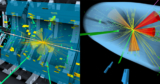 Read article 'First foray into CP symmetry of top-Higgs interactions'
The ATLAS and CMS collaborations have obtained new insights into the charge-parity structure of top-Higgs interactions.
 Read article 'First physics for Belle II'
The collaboration scoured four months of electron-positron collisions at SuperKEKB for evidence of invisibly decaying Z′ bosons.
 Read article 'Anomalies persist in flavour-changing B decays'
Updated measurements by LHCb of the angular distributions of a rare neutral B meson decay add fresh intrigue to the flavour puzzle.