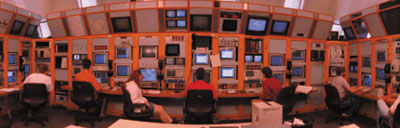
This years’s Particle Accelerator Conference in New York City on 29 March – 2 April included news from several major new machines that are beginning to flex their muscles. Both of the new B-factories, PEP-II (SLAC, Stanford) and KEKB (KEK, Japan), had seen collisions and measured luminosities. They are both rolling in their detectors BaBar and Belle respectively and both foresee physics runs from May.
PEP-II has achieved 750 mA of electrons and 1171 mA of positrons, which are believed to represent the highest positron current ever stored, with a peak luminosity of 5 x 1032/sq. cm/s (design 3 x 1033) and an average luminosity of 2 x 1032 over substantial periods.
PEP-II’s goal for its May-August run is a maximum luminosity of 1033 and an average of 5 x 1032. KEKB has achieved 420 mA electrons and 380 mA positrons, with a maximum luminosity of 1.2 x 1031, on 25 March. Both KEKB and PEP-II observe dust trapping and reduced lifetime in a range of currents, and evaporation above, as well as pressure runaway as a result of electron multipacting. Both machines need feedback to stabilize the beams.
Linear optics in both agree well with models. There are no serious single-bunch instabilities and no multiple bunch instabilities related to modes in the RF cavities in KEKB.
The new RHIC heavy-ion collider had been hoping to provide headline news at PAC, but unfortunately it suffered a serious mechanical failure. Leak checks are now complete, but power supplies are still being installed. Cooldown has begun, first to 50 K then to 4 K. Beam commissioning is foreseen from 18 May, with shutdown from August to October and a 37 week physics run from November. Fermilab’s new Main Injector was reported as having achieved six of seven milestones. The last is 2 x 10¹³ protons/pulse resonant extracted.
The permanent-magnet recycler was completed in the week of the conference. The initial injection into the Tevatron will be followed by a fixed-target run. Protonantiproton collider Run II is scheduled from February 2000. Its goals are a maximum luminosity of 5 x 1031, integrated luminosity of 2 inverse femtobarns by the end of 2002, and 3 x 10¹³ 120 GeV protons on target every 1.92.9 s.
Frascati’s DAFNE phi factory had a circulating beam after the KLOE detector had been rolled in. It must make the beams flat by correcting the coupling caused by the detector solenoid. Before the shutdown for rolling in the detector, it achieved a maximum luminosity of 1031 with 13 bunches in each beam. J M Slater, a physician, spoke about the Loma Linda proton therapy machine. Under a fabrication contract between Loma Linda University and Fermilab, which was signed in 1986, the 250 MeV machine was installed in 1989. By now more than 4000 patients have been treated. The rate is 100 patients per day with 20 min per patient, 16 h a day, five days a week and 98% uptime. The cost was $125 million, but replicas could be built for half of that amount.
Slater gave a list of 17 future installations. His examples were mostly prostate cancer and some eye treatment. The operation needs more physicists and engineers, and about the same number of nurses and medical technicians, as other forms of treatment.
The conference session on linear colliders opened with a tribute to the late Bjoern Wiik and his work.
‘To see something new, you must make something new.’ This quotation from 18th-century German scientist and philosopher Lichtenberg was a favourite of the late Bjoern Wiik, chairman of the DESY Directorate, and chief promoter of DESY’s TESLA electronpositron linear collider and X-ray laser project.
While for particle physicists this credo seems natural, the general public and many politicians usually find it harder to digest, especially when facing the finance of basic research.
Conveying the purpose of basic research and introducing the public to the thrill and fascination of frontier science and discovery are the main goals of a new DESY exhibition, which is planned to take place in Hamburg from June to October 2000, as one of the Worldwide Projects of the EXPO 2000 World Exhibition.
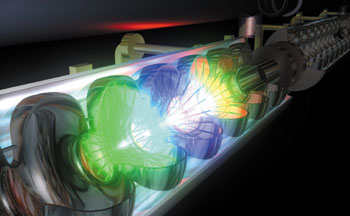
The Light for the New Millennium will be delivered by the new type of Free Electron Laser (FEL) into which DESY’s TESLA Test Facility (TTF) will eventually be converted. What had started mainly as a testbed for TESLA’s superconducting acceleration principle will be extended as a 300 m FEL delivering laser light of wavelengths in the soft-X-ray range down to 6 nm. Radiation generation via the SASE (self-amplified spontaneous emission) principle is a completely novel technique allowing high-intensity laser pulses to be produced at these short wavelengths for the first time. SASE-FEL proof of principle is foreseen later this year.
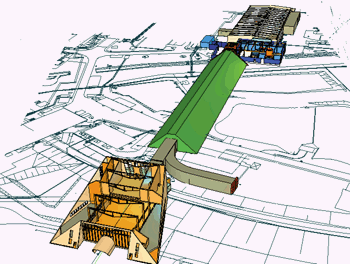
The facility, which is due to go into test operation in 2002 and be available to users from all over the world a year later, will be under construction during the exhibition. Visitors will witness the machine being built and inspect it much more closely than would ever again be possible during operation.
However, accelerator and FEL components in the facility’s tunnel will be only one facet of the DESY-EXPO: a 1200 square-metre exhibition in the future experimental hall will show the technology and research opportunities of the new device, general DESY research in both synchrotron radiation and particle physics and the laboratory’s plans for the future.
Laser insights
Multimedia and virtual reality shows as well as hands-on experiments will introduce the fascination of science and the emotion and thrill of discovery. Subjects will include “From light to microscopes to the X-ray laser”, “Laser technology in science and everyday life”, New insights opened up by the FEL in fields such as biology and materials sciences, and a presentation of DESY, its research programme and its planned TESLA project.
With 50 000 visitors expected, exhibition staff will be supported by DESY’s own undergraduate and graduate students, plus a new idea undergraduates from other German universities, who will be offered a research trainee period at DESY in return.
Exhibition languages will be German and English. Admission, which is free, will be from 1 June to 31 October 2000, from 10.00 a.m. to 7.00 p.m daily but until midnight on Thursdays. In the meantime, the Web site at “http://www.desy.de/expo2000/” is well worth a visit.
The article “HERA strikes it RICH” in the November 1998 issue described the first rings seen in the Ring Imaging Cherenkov (RICH) being commissioned for the HERA-B experiment at the HERA electronproton collider at DESY, Hamburg.
In those early days, moist Hamburg air served as the Cherenkov radiator, but over the end-year shutdown the 100 cubic-metre RICH vessel was filled with C4F10 gas, which is ten times as dense as air.
The greater density has three related consequences:
Cherenkov rings from highly relativistic particles more than double in size;
more than four times as many photons contribute to the characteristic rings (proportional to the square of the Cherenkov angle);
the threshold momentum for producing Cherenkov light is reduced by the same factor of two.
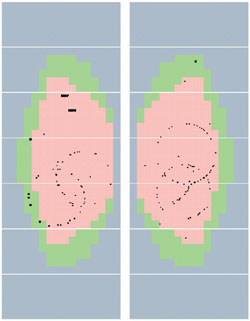
The first events with the 920 GeV HERA proton beam in January dramatically confirmed these expectations. Because of the RICH optics design, some rings have photons detected on both the upper and the lower photomultiplier arrays. One of the rings is smaller than the others, showing that it comes from slower particles.
The design and construction of the gas circulation and purification system for the HERA-B RICH relied heavily on expertise from CERN. The groups responsible for the HERA-B RICH project consist of the University of Texas at Austin; the University of Barcelona; the University of Coimbra in Portugal; Northwestern University; the University of Houston (incorrectly indicated in the November article); the J Stefan Institute; and the University of Ljubijana, Slovenia. Support was provided by DESY and the University of Hamburg.
A prototype detector for the ALICE experiment at CERN’s LHC collider will be installed in the STAR detector at Brookhaven’s RHIC heavy ion collider, scheduled to come into action this year. ALICE will concentrate on heavy ion collisions at the LHC, and this way the prototype detector will have a foretaste of high energy heavy ions.
The ALICE detector involved is the High Momentum Particle Identification system, based on the Ring Imaging Cherenkov (RICH) technique.
The “Roman pot” technique has become a time-honoured particle physics approach each time a new energy frontier is opened up, and CERN’s LHC proton collider, which can attain collision energies of 14 TeV, will be no exception. While other detectors look for spectacular head-on collisions, where fragments fly out at wide angles to the direction of the colliding beam, with Roman pots the intention is to get as close as possible to the beams and to intercept particles that have been only slightly deflected.
If two flocks of birds fly into each other, most of the birds usually miss a head-on collision. Likewise, when two counter-rotating beams of particles meet, most of the particles are only slightly deflected, if at all. Paradoxically, most of the particles in a collider do not collide. Of those particles that do, many of them just graze past each other, emerging very close to the particles that are sailing straight through.
These forward particles are also important for measuring the total collision rate (cross-section). In the same way as light diffracting around a small obstacle gives a bright spot in the centre of the geometric shadow, so the wave nature of particles gives a central spot of maximum “brightness”.
To pick up these forward particles means having detectors that venture as near to the path of the colliding beams as possible, like avid spectators at a motor race leaning over the safety barrier. This is where Roman pots come in.
Why Roman? They were first used by a CERNRome group in the early 1970s to study the physics at CERN’s Intersecting Storage Rings (ISR), the world’s first high-energy protonproton collider.
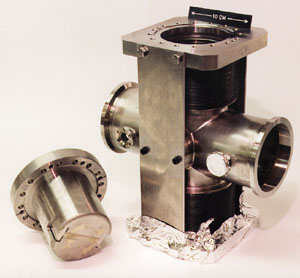
Why pots? The delicate detectors, able to localize the trajectory of subnuclear particles to within 0.1 mm, are housed in a cylindrical vessel. These “pots” are connected to the vacuum chamber of the collider by bellows, which are compressed as the pots are pushed towards the particles circulating inside the vacuum chamber.
The physics debut of these Roman pots was a physics milestone. Experiments at lower energies had found that the proton interaction rate was shrinking, and physicists feared that the proton might shrink out of sight at higher energies. Using the Roman pots, the first experiments at the ISR were able to establish rapidly that the interaction rate of protons (total cross-section) in fact increases at the new energies probed by the ISR.
In their retracted position, the Roman pots do not obstruct the beam, thus leaving the full aperture of the vacuum chamber free for the fat beams encountered during the injection process. Once the collider reaches its coasting energy, the Roman pot is edged inwards until its rim is just 1 mm from the beam, without upsetting the stability of the circulating particles.
Each time a new energy regime is reached in a particle collider, Roman pots are one of the first detectors on the scene, gauging the cross-section at the new energy range. After the ISR, Roman pots have been used at CERN’s protonantiproton collider, Fermilab’s Tevatron protonantiproton collider and the HERA electronproton collider at the DESY laboratory, Hamburg.
In the future, Roman pots will again have their day in the TOTEM experiment at CERN’s LHC proton collider.
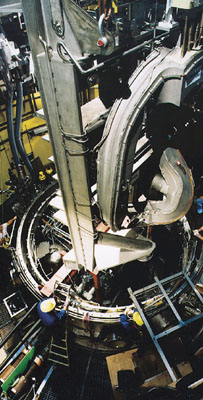
Two of the initial firms supplying superconducting dipole magnets for CERN’s LHC proton collider Noell of Würzburg, Germany, and Ansaldo of Genoa, Italy have joined forces to supply 50 superconducting magnets worth DM 110 million for the Wedelstein 7-X plasma experiment currently being built in Greifswald, Germany. Procurement is managed by the Max Planck Institute for Plasmaphysics in Garching, near Munich. Each of the superconducting coils weighs 3 tons and measures 3.4 x 2.5 x 1.4 m.
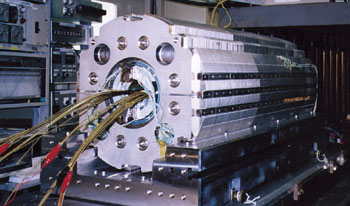
Special superconducting quadrupole magnets for squeezing the beams at CERN’s LHC collider have been successfully developed at the Japanese KEK laboratory as part of the LHC co-operation programme between CERN and KEK.
Since 1997, two model magnets have been made. The first reached the maximum operational field gradient of 220 T/m at the third training quench and has successfully achieved the maximum field gradient of 250 T/m at 1.9 K after thermal cycling and training. The second model reached 222 T/m at the first quench.
KEK has undertaken to provide magnets for the inner triplets, which provide the final focusing of the LHC beams for the four planned major experiments: ATLAS, CMS, LHC-B and ALICE.
KEK and Fermilab will each provide 16 of the 32 magnet cold masses, and Fermilab will be further responsible for the integration of the magnets within the cryostats.
The magnet features a high design field gradient of 240 T/m and a large coil aperture of 70 mm, and it must provide long-term stable operation at 200220 T/m under the heat owing to lost particles and showers from the colliding beams.
The magnet consists of four-layer coils wound with NbTi/Cu compacted strand cables closely surrounded by an iron yoke to maximize the magnetic field, and also to function as the mechanical structure that supports the electromagnetic force.
The field quality of the model magnets has also been evaluated and the measurements indicated a necessary adjustment of the two-dimensional design of the coil to reduce the 20-pole component, according to the recent study of the beam dynamics carried out by the US team.
A third 1 m model is being developed to finalize the design. The full-scale prototype magnet programme will begin this year and extend to full production by 2001.
A new development in detector technology is good news for astronomers. Designed by a team in the space science department of the European Space Agency’s Science and Technology Centre, the detector saw first light earlier this spring at the William Herschel Telescope on La Palma.
The detector is based on an array of tantalum superconducting tunnel junctions (tantalum is a metal from the same family as niobium) and it operates at about 0.3 K. The instrument is interesting to astronomers because it allows single photon counting, imaging capability and the possibility to determine the energy of the incoming photon, all at the same time.
The detector has a count rate capability of 1 kHz and time tags the arrival of each photon to an accuracy of 5 µs using the Global Positioning System as reference.
In the past, astronomers used gratings to achieve high-energy resolution. However, this dispersed the light and reduced efficiency. Now they will be able to determine the energy of photons without losing light.
Testing at the William Herschel Telescope was carried out at optical wavelengths, with an array of 6 x 6 junctions, each with a field of view of 0.6 arcsec. The detector works equally well for radiation up to 1 keV X-rays, where an energy resolution of 5 eV has been obtained.
Superconducting tunnel junction (STJ) devices can also be used for building very sensitive amplifiers (SQUID circuits), and STJ] logic circuits have applications in ultrafast signal processors. They only work in zero or fixed, low magnetic fields, however.
The development is the culmination of more than 10 years of R&D in collaboration with European industry.
Competition is the lifeblood of science. We see this at every level. Just now there is intense competition between experiments at the Tevatron at Fermilab and those at LEP at CERN to make the most precise measurement of the mass of the W boson. On many other topics one or other of the two machines is the clear leader: only the Tevatron can make real top quarks, for instance, while only LEP can determine the couplings of the W and the Z bosons to a precision of a few parts per thousand.
CERN’s next machine, the Large Hadron Collider (LHC), will collide protons at 14 TeV, an energy seven times as high as the Tevatron will ever reach, and at a much higher rate. The world’s particle physicists agree that it is the right machine to build next, but it is surely not going to be the only future machine. There is a growing consensus that its competition must come from a linear electron-positron collider with an energy range from the topantitop quark threshold (350 GeV) to somewhere near 1 TeV. Who will build it, and where, is another fascinating competition that will not be decided for a few more years. However, wherever it is built, there is a growing community of would-be users pushing for it.
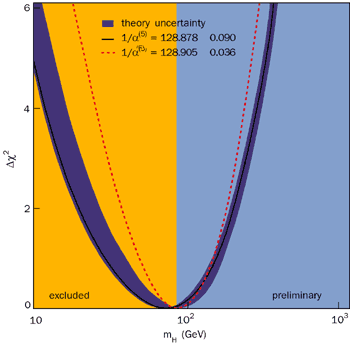
Taking the Standard Model of particle physics at face value, recent fits to the precision data from LEP, Stanford’s SLC and Fermilab show that the Higgs boson mass should be less than 300 GeV, within the reach of both the LHC and of a 500 GeV linear collider.
Higgs boson
To see a real Higgs boson will be a great achievement, but we will immediately have to ask whether it has the properties predicted by the Standard Model. We expect a “light” Higgs (lighter than 140 GeV) to decay into photonphoton or into beauty quark-antiquark pairs. If it is heavier it should decay into pairs of W bosons, Z bosons or top quark and antiquark. The LHC would surely get into this region first, but it would not be able to measure some of the most basic Higgs properties, for instance its decay width related to its lifetime by the Heisenberg principle.
A linear collider would be needed to do that, either producing the Higgs boson through its direct coupling to W bosons or, for a very light Higgs, by making Higgs bosons in real photon-photon collisions. A high-luminosity linear collider would also be needed to measure the coupling of the Higgs boson to the top quark.
In theories beyond the Standard Model there could be more than one Higgs boson. Minimal supersymmetric models need five, together with the supersymmetric partners of the Standard Model particles.
The precision of the linear collider would be essential in identifying the supersymmetric partner particles of the non-quark/gluon particles (those not carrying the interquark colour force) and making precise measurements of their masses. As its colliding protons contain quarks interacting through the colour force, the LHC will be better for identifying the partners of the quarks and gluons.
Between them the LHC and the linear collider should also be able to check whether the behaviour of the lightest supersymmetric particle is consistent with its being the main constituent of the missing “dark matter” that astrophysics requires to explain the observed large-scale gravitational attractions.
As well as venturing into new physics, the linear collider should also make much improved measurements on the workings of established theory. Its energy can be scanned very carefully across the production threshold of top quarkantiquark pairs. Quantum chromodynamics (QCD), the theory of quarks and gluons, makes very specific predictions for what happens at this threshold, and it should be possible to measure the top quark mass (near 175 GeV) to better than 175 MeV much more precisely than the LHC. The top quark mass will then be proportionally far better known than that of any of the lighter quarks.
At a high-luminosity linear collider, the samples of light quarkantiquark events will match those from LEP1 and offer a chance to probe the evolution of QCD to higher energy scales.If real photon beams can be produced, then the linear collider will also probe the structure of the photon with the same sensitivity that is being achieved for the proton at the HERA electron-proton collider at DESY, Hamburg, thereby testing more of the predictions of QCD.
Even if there is no Higgs boson and if supersymmetry does not appear, some new physics must still happen at the 1 TeV energy scale. There is no precise theory of what this new physics might be, but it would very likely increase the production of top quark-antiquark pairs and of W and Z boson pairs.
Again, the LHC would see something, but it will take a lepton (non-quark) machine with collision energy in the 24 TeV region to sort out the full theory. This could be either a higher energy linear electronpositron collider or a muon collider. However, before then the linear collider in the 500 GeV 1 TeV range should have seen the first signs of the new physics through increasing the precision of studies of W and Z couplings, already testing the Standard Model so stringently at LEP’s 192 GeV.
To do the physics, the detectors at the linear collider will have to be better than those at LEP or the SLC. At higher energies there will be more and narrower jets of particles that have to be kept separate, so the calorimeters that measure the directions of energy flow will need to be finer-grained. It will be particularly important to measure the pairs of electrons or muons from Z decays to see a recoiling Higgs boson in annihilations producing a Higgs and a Z. This requires a good particle tracker to measure the momentum from the curvature of the outgoing electrons or muons.
In European studies, the tracker of choice has been a Time Projection Chamber, like that in ALEPH or DELPHI at LEP, with much higher performance and a 3 Tesla magnetic field. Alternatively, in a 1996 study at Snowmass, the North Americans considered an all-silicon tracker like that planned for the ATLAS experiment at the LHC with a magnetic field of 4 Tesla. The first tracker design from Japan used a large “jet” drift chamber, similar to those in OPAL, or L3 at LEP and SLD at Stanford. Work has already begun on new inner (vertex) detector techniques for the linear collider, using charge-coupled devices or “smart pixels”.
The biggest differences between the detectors for the linear collider and those at LEP will be in the forward directions, close to the colliding beams. The beams meeting head-on at a linear collider have to be compressed into tiny “rods” (with a cross section of around 10 x 500 nm almost molecular proportions compared with tens of microns at LEP) so that the collision rate (luminosity) produces useful numbers of events. Each bunch in the beam contains some 1010 electrons or positrons travelling at close to the speed of light, and producing very strong electric and magnetic fields.
The new physics will emerge from individual high-energy electrons and positrons colliding, but, while these clean events are happening, the two beams will be interacting in other “dirty” ways deflecting and disrupting one another, and producing background radiation when particles in one beam scatter on the electromagnetic fields from the other.
To keep this radiation away from the tracking detectors, thick conical tungsten “masks” will be fitted in the forward regions. These will prevent precise measurements on small angle tracks, though it is hoped to develop techniques (perhaps with quartz fibres buried in the tungsten to produce detectable pulses of light when particles pass through) so that at least it will be known whether any tracks from an interesting event went into a mask.
Significant detector R&D will be needed, but there is no doubt that the experimental environment will be easier than at the LHC, with fewer background events and less radiation hitting the detectors. If the collider can be funded and built then the physics can be done. And although many of the goals are complementary to those of the LHC, there will be real competition too.
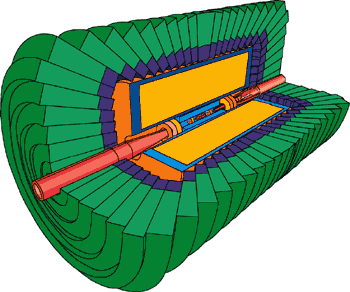
A new large neutrino detector is currently being constructed by an international collaboration that includes Hungary, Japan and the US in the underground site that used to be the home of the pioneering Kamiokande experiment. Called KamLAND (Kamioka Liquid scintillator Anti-Neutrino Detector), it will be the largest low-energy antineutrino detector ever built and will study a wide range of science, spanning particle physics, geophysics and astrophysics.
The principal goal will be to investigate the possibility of neutrino oscillations by studying the flux and energy spectra of neutrinos produced by Japananese commercial nuclear reactors. Approximately one-third of all Japanese electrical power (which is equivalent to 130 GW thermal power) is produced by nuclear reactors and KamLAND is centrally located on the main island of Honshu, therefore the experiment is exposed to a very large flux of low-energy antineutrinos, which are mainly produced at a distance of between 150 and 200 kilometres. The broad energy spectrum of antineutrinos emitted by the neutron-rich fission fragments of a reactor has a maximum at around 3.5 MeV.
Oscillation behaviour
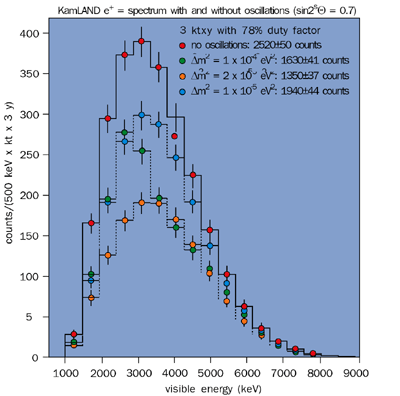
With two kinds of neutrinos, the oscillation probability depends on one mixing parameter and on the sine of Dm2 L/En, where L is the “baseline” traversed by the neutrinos, EnDm2 is the mass squared difference. Measurements would constrain Dm2 and the mixing parameter.
Since for a given baseline the oscillation probability depends on the neutrino energy, different neutrino energies will have different oscillation behaviour. Hence, in general, oscillations would distort and suppress the detected spectrum. With an expected (non-oscillating) rate of 700 antineutrinos detected per year, three years of data-taking would be a hundred-fold improvement over existing neutrino mass measurements.
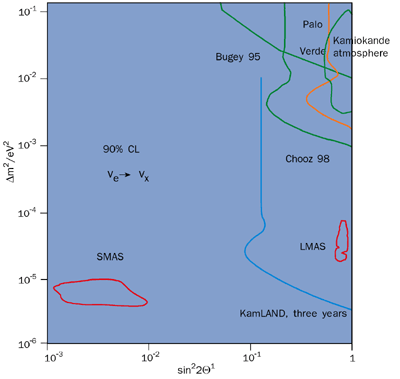
More important is that the experiment’s sensitivity covers one of the possible solutions of the “solar neutrino puzzle”. While solar and atmospheric neutrinos have provided the first signals for neutrino oscillations, terrestrial experiments, with both source and detector well quantified, are required to investigate and understand such oscillations in detail.
While Minos in the US, K2K in Japan and a possible CERNGran Sasso beam are designed to investigate the mass region of interest for atmospheric neutrinos, KamLAND is the first attempt to study the solar neutrino puzzle “in the laboratory”. This has a historical precedent in meson physics, where the first investigations were driven by cosmic-ray experiments using balloons or on high mountains, while subsequent discoveries and systematic study came via accelerators and bubble chambers.
KamLAND will, for the first time, also be able to detect antineutrinos from uranium and thorium beta decays inside the Earth. While the present experimental data on this topic are derived from sparse and shallow samplings, KamLAND will provide a global measurement. About half of the heat produced in our planet is believed to be produced by such decays, therefore this measurement will be of considerable geophysical interest.
In addition, comparisons with similar measurements from Borexino should make it possible to calculate the ratio of uranium to thorium in the crust and mantle of the Earth. This is because Borexino is surrounded by thick continental crust, while KamLAND is located at the edge of the Asian plate and, hence, over about half of its angular coverage it receives antineutrinos from beneath the Pacific Ocean.
Recoil energy
A natural continuation of the KamLAND programme will include the direct observation of beryllium-7 and boron-8 solar neutrinos by detecting recoil energy in neutrinoelectron scattering processes. While Borexino is particularly optimized for the study of beryllium-7 solar neutrinos, the larger mass of KamLAND opens up the low-energy measurement of the rarer boron-8 neutrinos. (The high-energy component of such neutrinos will be covered by the SuperKamiokande and Sudbury (SNO) water Cherenkov detectors.)
The direct detection of solar neutrinos involves single ionization events (as opposed to double in the case of reactor and terrestrial antineutrinos), thus the quality of these measurements will depend on the extent to which the radioactive contamination (and hence the background) can be controlled. Here the kiloton mass of the detector is a major asset, allowing the active scintillator volume to be separated from the external components by a very thick layer of inert shielding oil.
Should the background be higher than expected, an additional layer of scintillator will be used as shielding, with a software cut on the event position, while retaining a very large fiducial volume. Simulations show that the the KamLAND background will be dominated by the internal radioactivity of the scintillator, and by the radon produced mainly in the photomultiplier glass and carried to the centre of the detector by convection.
The first phase of running will show conclusively whether more effort is needed for precise observations of the solar neutrino fluxes to be made. Such a staged approach minimizes expense and effort in the notoriously tricky field of detector background. Searches for supernova neutrinos, solar antineutrinos and, possibly, neutrinoless double beta decay will complete the physics programme.
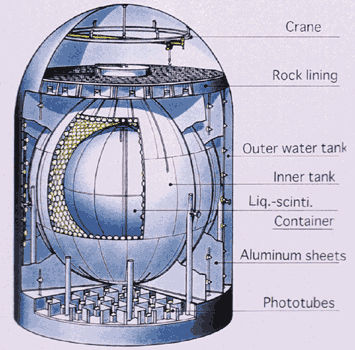
The heart of KamLAND will be a spherical volume containing a kiloton of very-high-purity liquid scintillator. Unlike water Cherenkov detectors that can only detect relatively high-energy particles, KamLAND’s scintillator has enough sensitivity to detect fractions of a mega electron volt, with the possibility of background-free low-energy electron-type antineutrino detection. This would be achieved by observing both the positron and the neutron produced by the inverse beta decay capture of antineutrinos by protons.
Fake events resulting from natural radioactivity and cosmic-ray backgrounds are reduced by different layers of shielding, the careful selection of construction materials and event signature.
Scintillation
The active scintillator volume is housed in a 2.5 m thick layer of ultrapure mineral oil that shields it from external neutron and gamma radiation. Scintillation light is picked up by an array of about 2000 specially developed photomultipliers achieving 3.5 ns time resolution using a very large (17 inch diameter) photocathode. While good time resolution is essential to localize events within the fiducial volume, an important feature is the novel approach of its electronics, thus providing a complete history of the signals from each tube preceding and following triggered events. This will be invaluable in suppressing backgrounds, either using the scintillator pulse shapes produced by different types of particle or by studying correlations in radioactive decay chains over a broad timescale range.
An advanced system of buffering will ensure no deadtime up to several kilohertz during several 1 s bursts. The active scintillator is separated from the buffer oil by a very thin layer of transparent plastic a 13 m diameter weather balloon! This is a critical component of the detector, allowing scintillation light to reach the photomultiplier tubes, but blocking the radon from uranium contamination in external materials. The 3000 tons of liquid scintillator, buffer oil and photomultipliers are contained and supported by an 18 m diameter stainless-steel sphere. The volume between the sphere and the cylindrical cavity in the rock is flooded with water in which cosmic-ray muons are detected by their Cherenkov light. The read-out of this veto detector is provided by the old Kamiokande photomultipliers.
By recycling and upgrading existing facilities,
a new “superdetector” will rise from the “ashes” of Kamiokande for a modest investment. KamLAND’s schedule foresees the exploration of neutrino physics,
geophysics and astrophysics from the beginning of 2001.
To provide the best experiences, we use technologies like cookies to store and/or access device information. Consenting to these technologies will allow us to process data such as browsing behavior or unique IDs on this site. Not consenting or withdrawing consent, may adversely affect certain features and functions.
Functional
Always active
The technical storage or access is strictly necessary for the legitimate purpose of enabling the use of a specific service explicitly requested by the subscriber or user, or for the sole purpose of carrying out the transmission of a communication over an electronic communications network.
Preferences
The technical storage or access is necessary for the legitimate purpose of storing preferences that are not requested by the subscriber or user.
Statistics
The technical storage or access that is used exclusively for statistical purposes.The technical storage or access that is used exclusively for anonymous statistical purposes. Without a subpoena, voluntary compliance on the part of your Internet Service Provider, or additional records from a third party, information stored or retrieved for this purpose alone cannot usually be used to identify you.
Marketing
The technical storage or access is required to create user profiles to send advertising, or to track the user on a website or across several websites for similar marketing purposes.