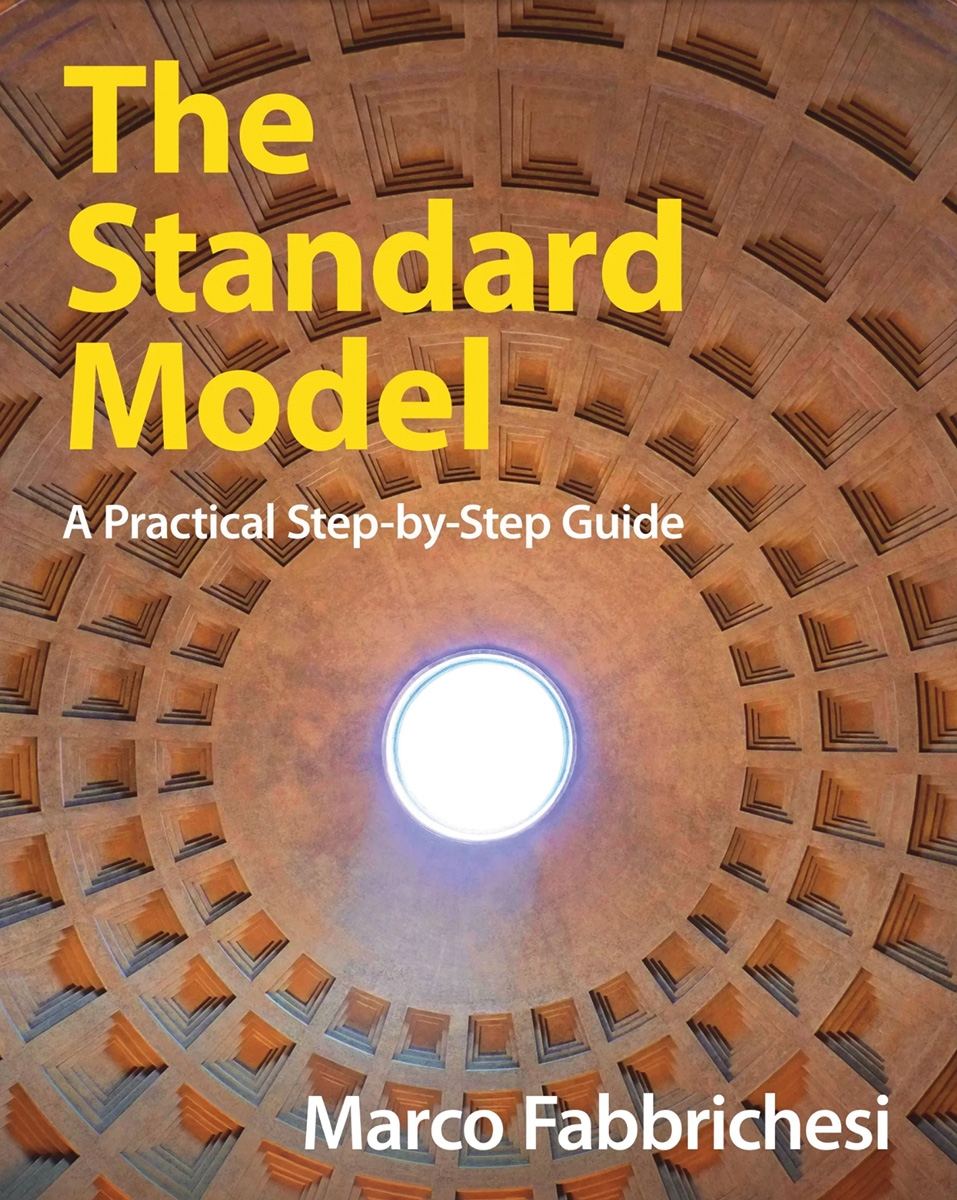
The Standard Model: A Practical Step-by-Step Guide, by Marco Fabbrichesi, Cambridge University Press
This new textbook offers an intermediate-level presentation of the Standard Model (SM). It assumes that students have a knowledge of relativistic quantum mechanics and are comfortable with the Dirac equation, the properties of Dirac spinors, and covariant notation, including how to write Lagrangians in it. It also assumes familiarity with Feynman diagrams in quantum electrodynamics and with the basic application of the Feynman rules. Even so, the book opens with a substantial revision chapter taking up about a quarter of the main text, covering discrete symmetries, the S-matrix and aspects of QED, with a complete calculation of Compton scattering between a photon and an electron. Although the author does not treat phase-space calculations – the integrals over the kinematics of final-state particles that turn a matrix element into a cross section or decay rate – as an independent topic, the complicated example of muon decay is worked out in detail.
A distinctive feature is the inclusion of fully worked-out examples, in which the algebra is carried out at much greater length than in most other textbooks. The effect is that of a blackboard lecture, rather than one of those slide presentations in which all the so-called “trivial” steps – that students rightly find anything but trivial – are omitted. Several of the examples broaden the physical understanding in ways rarely seen at this level: the hydrogen atom solved with the Dirac equation, coupled oscillators, mechanics problems involving torque, forces and inertia, all pressed into service to illuminate the underlying particle physics.
The heart of the volume is divided into two parts. The first sets out the basic elements of the SM, starting with the electroweak interactions mediated by photons, W and Z bosons, through gauge symmetry, spontaneous symmetry breaking and the Higgs boson, and ending with QCD. The second turns to applications. It includes an accessible treatment of higher-order corrections, flavour physics, flavour-changing currents and the CKM matrix that encodes the mixing between quark generations. It also features a chapter on QCD applications, covering the parton model and deep-inelastic scattering. A more elementary treatment is reserved for hadronisation, the non-perturbative process by which quarks and gluons turn into observable hadrons.
A clean section on the lowest-order calculation of gluon–gluon fusion Higgs-boson production at hadron colliders sits alongside the more standard material. Kaon oscillations, CP violation and neutrino oscillations close the book, alongside a 20-page experimental chapter of the kind one might expect in an introductory course. The book is presumably aimed at students with a stronger grounding in quantum field theory than in particle physics, who are now building from that base toward an understanding of the SM.
Overall, the book is faithful to its title. It sticks to the SM and avoids new-physics scenarios, save perhaps for neutrino oscillations, which some already classify as beyond it. Occasional bridges are built nonetheless. For instance, Majorana neutrinos appear in one of the exercises, while an accessible treatment of the θ-QCD term comes a breath away from discussing axions. The author does not shy away from using modern computational tools, with examples drawing on Mathematica, FeynCalc, the event generators MadGraph and Pythia, which simulate hard scattering and the subsequent parton showers and hadronisation, and the detector-simulation package Delphes. Each chapter ends with a small set of problems.
The result is a clear and engaging treatment, carefully tailored to its readership. Its fresh perspective, its unconventional examples and the painstaking attention to algebraic detail, make it a useful resource not only for students but also for instructors teaching introductory particle physics.