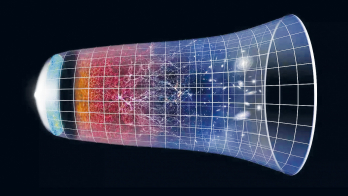
The universe is a cosmic web, woven from vast filaments that connect galaxies and clusters. Elena Pinetti explains how these elusive threadlike structures are opening a new window on the nature of dark matter.
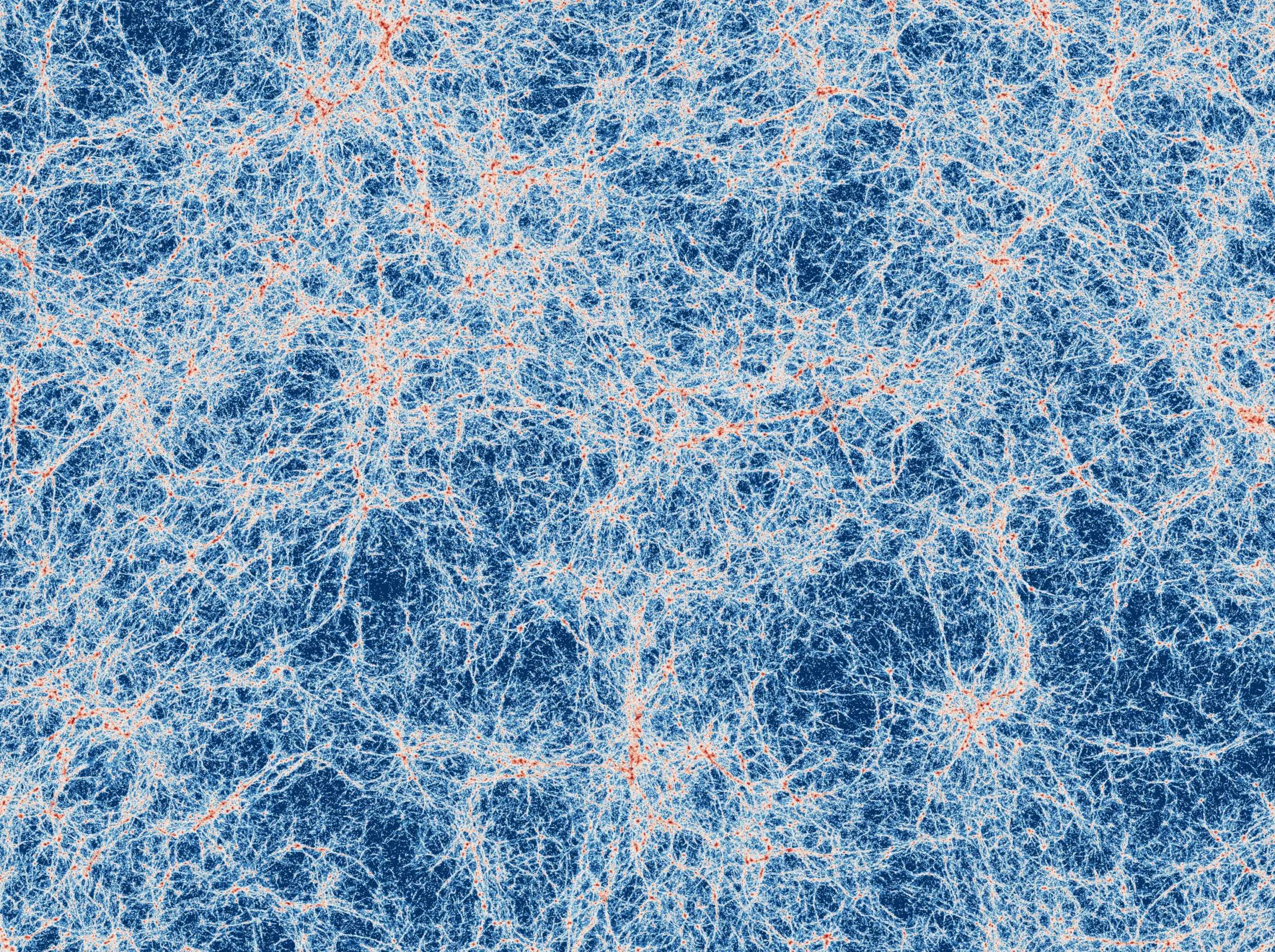
Cosmological filaments form the backbone of the cosmic web, the vast, interconnected network that defines the universe on the largest scales. Stretching across tens to hundreds of millions of light-years, they link galaxies and galaxy clusters along the pathways where matter assembles under gravity. They may also hold the key to one of the deepest questions in modern physics: the nature of dark matter.
For astrophysicists, filaments first drew attention as a potential reservoir of missing baryons. Big Bang nucleosynthesis and precision measurements of the cosmic microwave background agree on how much ordinary matter the universe should hold, but the census of stars, galaxies and hot gas comes up short. The leading explanation is a warm, diffuse gas permeating cosmic filaments, too faint to detect in any single observation but increasingly accessible through statistical techniques at X-ray and radio wavelengths.
More recently, dark-matter hunters have begun to recognise the potential of filaments as probes of new physics. Filaments are not only vast but overwhelmingly dark-matter-dominated, with lower astrophysical backgrounds than traditional search targets such as the galactic centre. New simulations are pinning down their dark-matter density profiles with enough precision to make quantitative predictions, and recent theoretical work has opened detection channels that could turn these structures into laboratories for physics beyond the Standard Model.
Dark matter and the cosmic web
Our scientific understanding of stars and the structures they inhabit has grown remarkably over the past century. We now know that galaxies are vast collections of stars, and clusters are collections of galaxies. These immense systems do not float randomly; they are woven into an intricate “cosmic web” resembling that of a spider. Gravity shapes this web and governs the motion of the celestial bodies within it. Yet many observations defy expectations. Galaxies rotate too quickly, clusters bend light too strongly, and the cosmic web holds together with more gravitational pull than visible matter would allow. Something unseen must be at work. A new, invisible “dark matter” component must dominate the mass of the universe.
Dark-matter candidates in the spotlight
Dark matter accounts for roughly 85% of the matter in the cosmos, and about 27% of its content once dark energy is included, yet its nature remains unknown. Several well-motivated candidates have emerged, each predicting distinct signatures that indirect searches, including those targeting cosmic filaments, could probe. Weakly interacting massive particles, sterile neutrinos, primordial black holes and axions are among the most prominent.
Weakly interacting massive particles These hypothetical particles naturally arise in several extensions of the Standard Model and possess two defining features: they are massive, and they interact only through gravity and the weak force.
Sterile neutrinos Unlike the three known active neutrino species, they do not interact through the weak force. Their existence is motivated by extensions of the Standard Model that aim to explain both neutrino masses and the matter–antimatter asymmetry of the universe.
Primordial black holes Unlike stellar black holes, which form from collapsing stars, primordial black holes are hypothetical relics of the early universe, born from the collapse of exceptionally dense regions of matter moments after the Big Bang.
Axions Originally proposed to solve the strong CP problem, axions are hypothetical particles whose production mechanism can account for the observed dark-matter abundance, elegantly linking two of modern physics’ greatest mysteries.
Dark matter accounts for roughly 85% of the matter in the cosmos and dictates how cosmic structures form and evolve. Yet, despite decades of international effort and extraordinary experimental ingenuity, its nature remains a puzzle. The Standard Model of particle physics, describing all known fundamental particles, can’t account for the observational effects of dark matter. In response, theorists have proposed a wide range of models that include dark-matter candidates (see “Dark-matter candidates in the spotlight” panel). A well-motivated dark-matter theory, one that truly excites theorists, typically meets three criteria. First, it accounts for the observed cosmic abundance of dark matter. Second, it yields clear, testable predictions. And third, it resolves multiple open questions in fundamental physics.
Rich landscape
While the theoretical landscape is rich, testing it requires identifying cosmic environments where dark matter’s signatures might be detectable. One of the most powerful strategies is indirect detection – the search for faint cosmic messengers produced when dark matter annihilates, decays or interacts with ordinary matter. These signatures may appear as electromagnetic waves, neutrinos or charged cosmic rays. Observing these messengers requires high sensitivity and careful modelling of both the dark-matter signal and the astrophysical backgrounds. Progress, therefore, depends on close collaboration between particle physicists, astrophysicists and cosmologists, integrating theoretical predictions with multi-messenger observations.
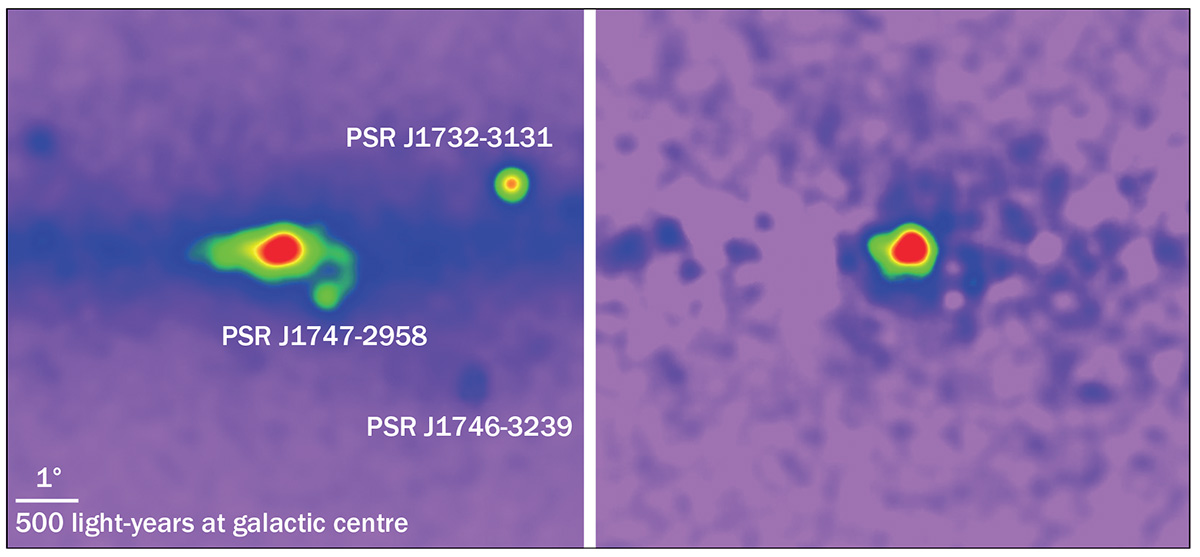
Choosing optimal targets is crucial for indirect dark-matter searches. Traditional efforts have focused on the galactic centre and on dwarf satellite galaxies of the Milky Way. The galactic centre is expected to host the highest dark-matter density, but it also contains intense and complex astrophysical backgrounds, which is why the origin of a long-debated gamma-ray excess observed by Fermi-LAT remains uncertain (see “Gamma-ray excess” figure). Dwarf galaxies, by contrast, are dark-matter-dominated and relatively free of astrophysical emission. However, their stellar populations are orders of magnitude smaller than that of the Milky Way. This limits the available kinematic tracers – observables whose spatial distribution correlates with the underlying matter density field – and leads to sizable uncertainties in the predicted signals.
Unconventional environments
Recently, unconventional but promising probes have gained attention, such as cosmological filaments. Filaments are a natural outcome of anisotropic gravitational collapse in an expanding universe. Matter can collapse under gravity in some directions while still expanding in others, producing elongated structures that are bound across their width but continue to grow along their length. Not all cosmic filaments are alike. Some lie within galaxy clusters, linking individual galaxies over relatively short distances. Others extend far beyond cluster boundaries, forming vast inter-cluster bridges that connect galaxy clusters and even superclusters across tens and hundreds of megaparsecs. The longer the filament, the thinner and more diffuse it tends to be. This reflects the way gravity draws matter out of underdense regions and funnels it into elongated bridges between massive nodes.
Together, galaxy clusters and the diffuse filaments that connect them form the cosmic web and make up most of the baryonic matter. Yet the very properties that make filaments so fundamental to cosmic structure also make them extraordinarily difficult to observe. Their emission is faint, diffuse and easily overwhelmed by brighter astrophysical sources, posing a major challenge for direct detection across the electromagnetic spectrum.
To overcome this limitation, astronomers have turned to a statistical technique known as “image stacking”. In stacking analyses, many observations of similar systems are superimposed. Any emission associated with filaments then adds coherently, while random noise and unrelated astrophysical signals average away. The result is a significant enhancement in sensitivity, allowing extremely weak, extended emission to emerge that otherwise would remain invisible.
A potent technique
The power of this approach relies on numbers: the larger the sample that can be stacked, the stronger and more reliable the resulting signal. Image stacking is therefore a potent but data-hungry technique, one that becomes increasingly effective as modern surveys deliver ever-larger datasets. This requirement poses a particular challenge for filaments, whose precise locations are generally unknown. Since cosmological filaments connect massive structures, a natural strategy is to use galaxy clusters as signposts: by stacking observations of regions between pairs of clusters, the faint emission from the filamentary bridges that link them can be statistically enhanced.
Cluster catalogues have expanded dramatically over the past decade. Today, surveys based on optical imaging, weak gravitational lensing and the Sunyaev–Zel’dovich effect, in which scattering with high-energy electrons distorts the cosmic microwave background, collectively identify tens of thousands of clusters across the sky. While progress is remarkable, it may still fall short of what is needed to robustly detect the extremely faint emission expected from typical filaments. This limitation motivates the search for alternative tracers. A reliable proxy for galaxy clusters available in far greater numbers, potentially in the millions, would enormously increase the statistical power of stacking analyses.
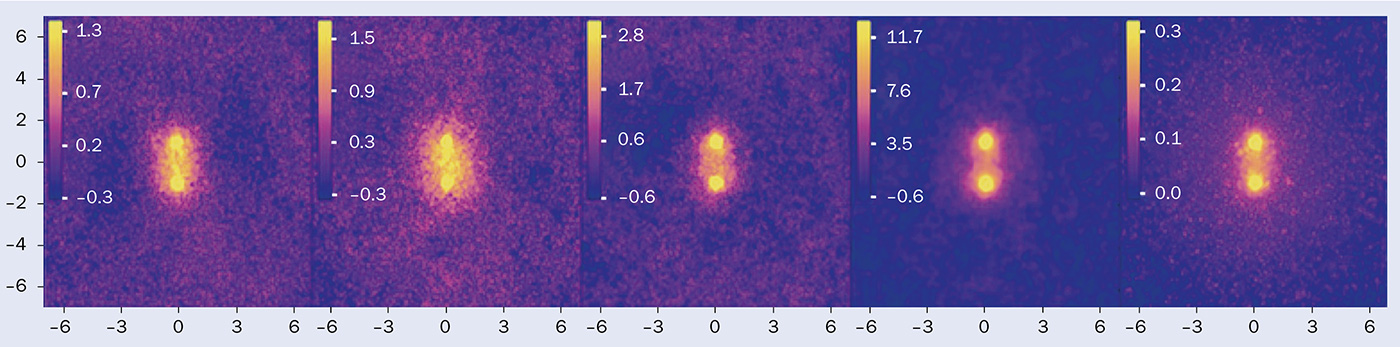
Particularly effective proxies for galaxy clusters are luminous red galaxies (LRGs). These massive, early-type galaxies have been observed and catalogued for decades and are known to be excellent tracers of the large-scale structure of the universe. LRGs typically reside in, or near, the centres of galaxy clusters, making them reliable signposts of the densest regions of the cosmic web. Pairs of LRGs that are close to one another in the sky and in physical distance can therefore be used as proxies for nearby cluster pairs. Statistically, such pairs are likely to be connected by inter-cluster bridges or filaments, even if the filaments themselves cannot be directly identified in individual observations.
By applying this stacking technique to pairs of LRGs drawn from the Sloan Digital Sky Survey, whose catalogues contain millions of such galaxies, together with radio maps from the GLEAM and OVRO-LWA surveys, researchers have identified an intriguing anomaly. The radio emission associated with stacked filaments (see “Stacked maps” figure) exceeds theoretical predictions for diffuse filamentary gas by more than an order of magnitude.
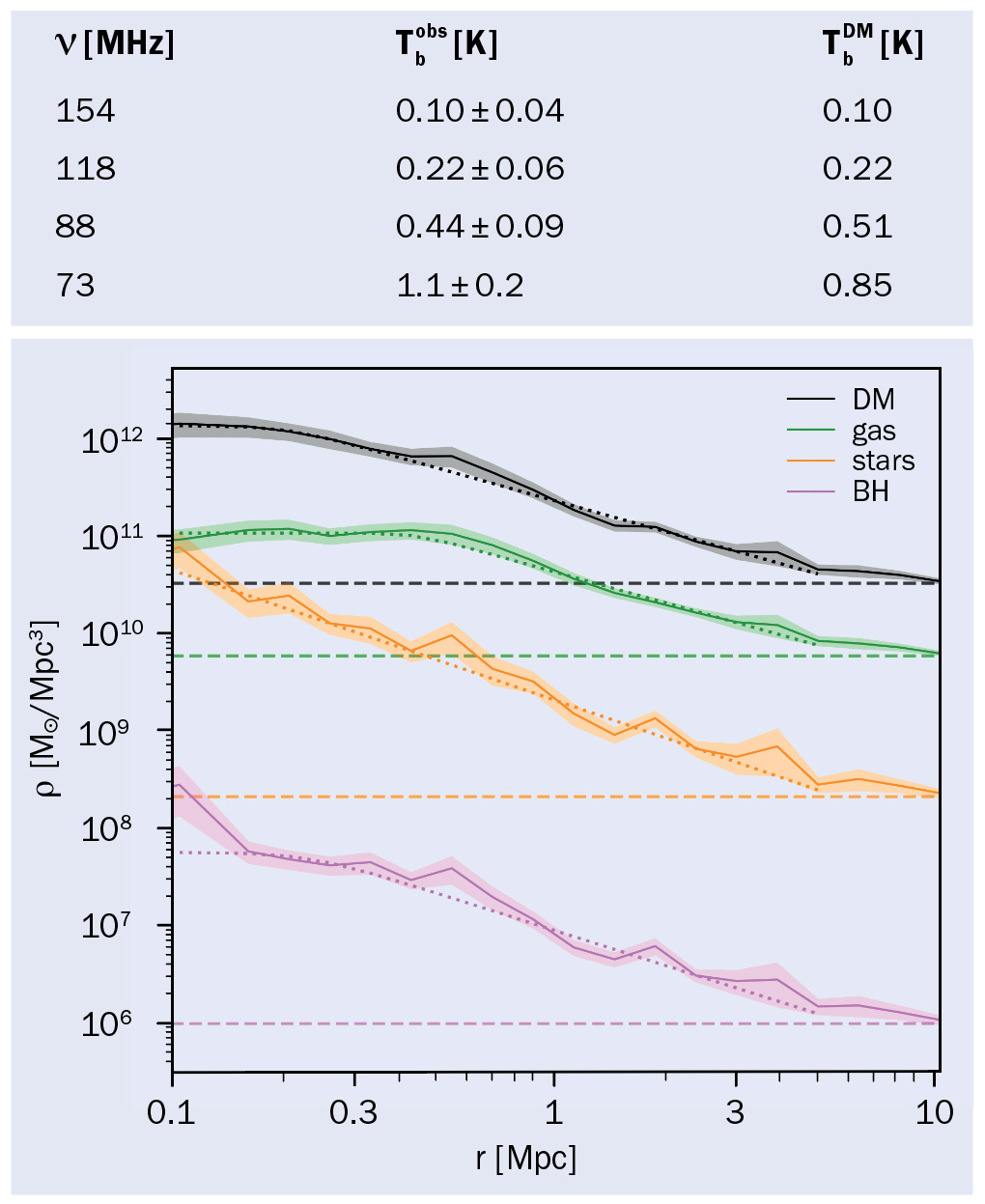
One possible interpretation is that this excess arises from secondary radiation produced by dark matter (see “Simulations, observations and theory” figure). In this scenario, weakly interacting massive particles with masses of a few GeV decay into electrons, which then spiral through filament magnetic fields and emit synchrotron radiation at radio wavelengths. For the magnetic field strengths inferred in the stacking analysis, the amplitude of the observed signal is consistent with that expected from a dark-matter flux of this kind.
As with other anomalies, this interpretation remains debated. A more conventional explanation attributes the emission to astrophysical particle acceleration in strong accretion shocks, generated as matter falls into filaments and galaxy clusters. While shocks can in principle produce radio synchrotron emission, reproducing the observed excess appears to require acceleration efficiencies higher than those typically assumed in simulations. Significant uncertainties persist in filament properties, such as their magnetic field strengths and shock characteristics, which complicate the modelling of expected signals and remain an active area of research.
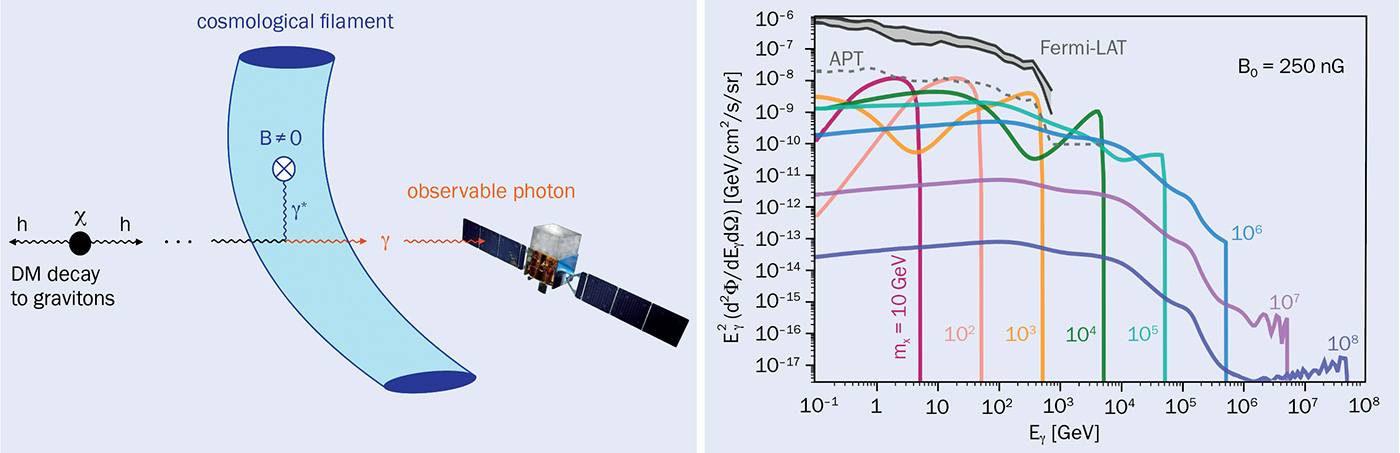
Cosmic filaments may also open a window onto more exotic dark-matter scenarios. Recent work has shown that if heavy dark matter decays into gravitons – the hypothetical quantum carriers of the gravitational interaction – these can convert into photons via the Gertsenshtein effect (see “Graviton-to-photon” figure), closely analogous to the Primakoff conversion of axions, as they propagate through the large-scale magnetic fields threading filaments. This process generates an irreducible extragalactic gamma-ray background, allowing such scenarios to be constrained with Fermi-LAT data and offering promising sensitivity for future gamma-ray observatories.
A bright future for the dark universe
For millennia, humanity has been inspired by the starry sky. Philosophers, poets and scientists alike have gazed upward, their minds filled with questions, joy and awe. Dante, one of Italy’s greatest poets, expressed this enduring fascination in the closing line of Inferno in The Divine Comedy:
“E quindi uscimmo a riveder le stelle”
“And thence we came forth to see again the stars”
Centuries after Dante, the sky continues to guard many of its secrets. However, we are now entering a golden era for indirect dark-matter searches. Future facilities, most notably the Square Kilometre Array (SKA), currently under construction in South Africa and Australia, will deliver unprecedented sensitivity to the diffuse structures of the cosmic web, and may soon be capable of directly imaging large filaments, characterising their properties and turning these vast structures into powerful probes of physics beyond the Standard Model.
These observational advances are being matched by progress on the theoretical front. Cosmological simulations are reaching new levels of realism, while the growing use of machine-learning and artificial-intelligence techniques is beginning to transform how filamentary structures are identified, modelled and interpreted. These developments promise a far more precise characterisation of filament properties, sharpening their role as laboratories for fundamental physics. The cosmic web may not keep its secrets much longer.
Further reading
T Vernstrom et al. 2021 MNRAS 505 4178.
E Pinetti et al. 2025 arXiv:2504.08025.
D I Dunsky et al. 2025 arXiv:2503.19019.