Die Urknallmaschine, by Barbara Warmbein, National Geographic Deutschland
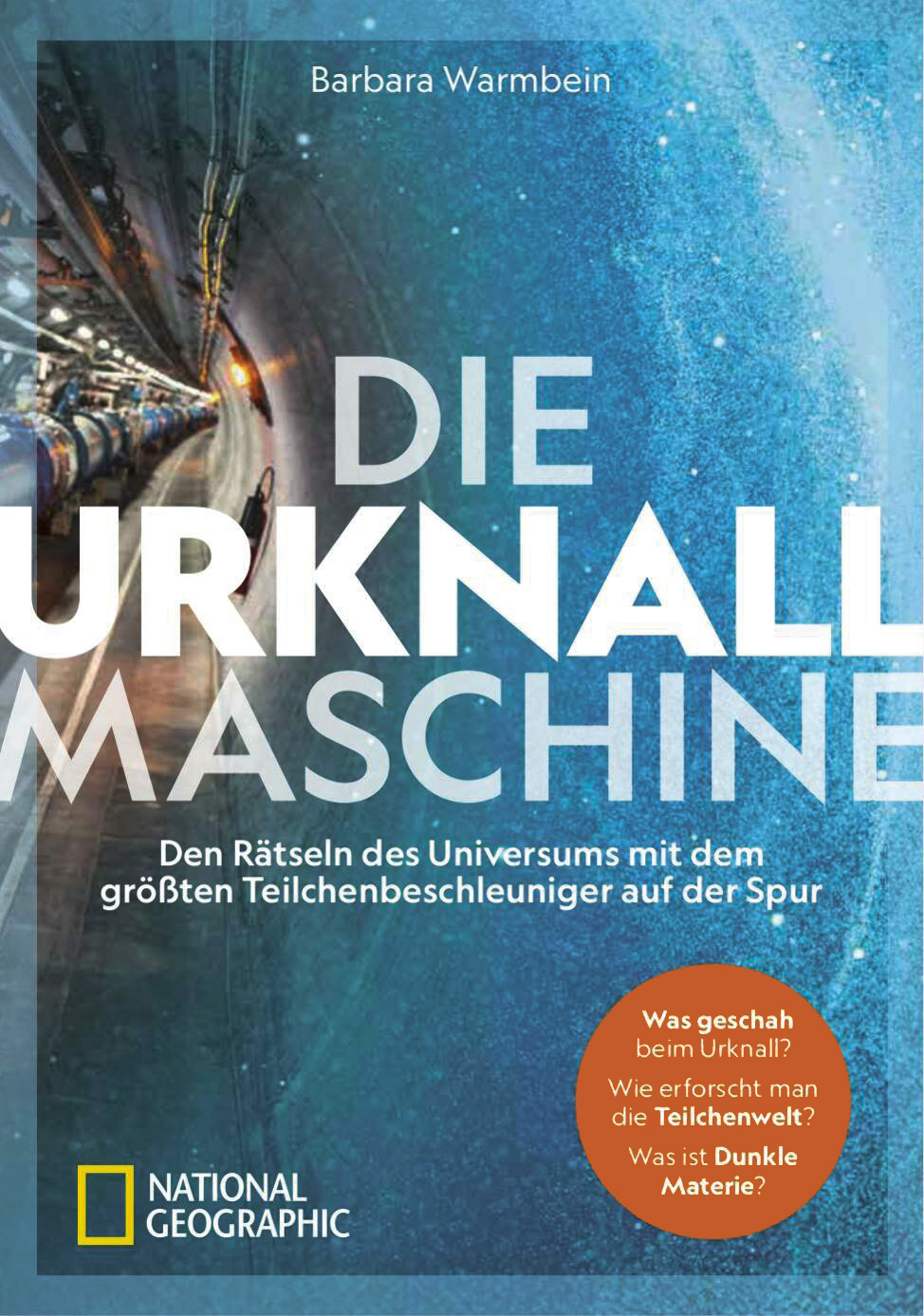
How to explain CERN to someone who’s never been there? That’s indeed not always easy, but this book can surely help.
The German-language Die Urknallmaschine (The Big Bang Machine) by Barbara Warmbein offers an authentic glimpse into the research at CERN and the unique, sometimes extraordinary, environment in which it happens.
Warmbein has a real talent for combining fundamental ideas in physics and engineering at CERN with illustrative analogies. She creates mental pictures that make complex ideas easier to grasp, and much more likely to stick. The level is accessible to anyone with a general interest in physics and remains engaging without becoming overly technical or intimidating. This makes the book a good choice not only for readers without a CERN background, but also for anyone looking for better ways to explain the laboratory to friends, family or visitors.
Warmbein starts with the big questions, the great mysteries of our universe, and gradually builds a bridge to CERN’s research. Along the way, she explores both what we already understand and what remains unknown, often linking these ideas to everyday experiences. She weaves in historical context, reminding us, for example, that around the year 1900 many physicists believed that their work was almost complete, just before quantum mechanics and special relativity changed everything once again.
After roughly 50 pages dedicated to well-pitched basics, Warmbein moves on to accelerators and detectors, before widening the perspective to CERN as an organisation. She traces its development over the past 70 years, highlighting both what happens on site and the global network of institutes and collaborations that make CERN possible.
A nice touch is the inclusion of small but interesting pieces of side information, details that even people working at CERN might not know, in a compact form. This adds an extra layer of discovery, even for long-time insiders. The applications of accelerators outside fundamental research are one such example. Warmbein presents her material in a warm, approachable way, capturing both the science and the human side of CERN in one stroke.