Daniel Whiteson reflects on a career in particle physics at ATLAS, and on building a parallel path in science communication through books, podcasts and children’s television.
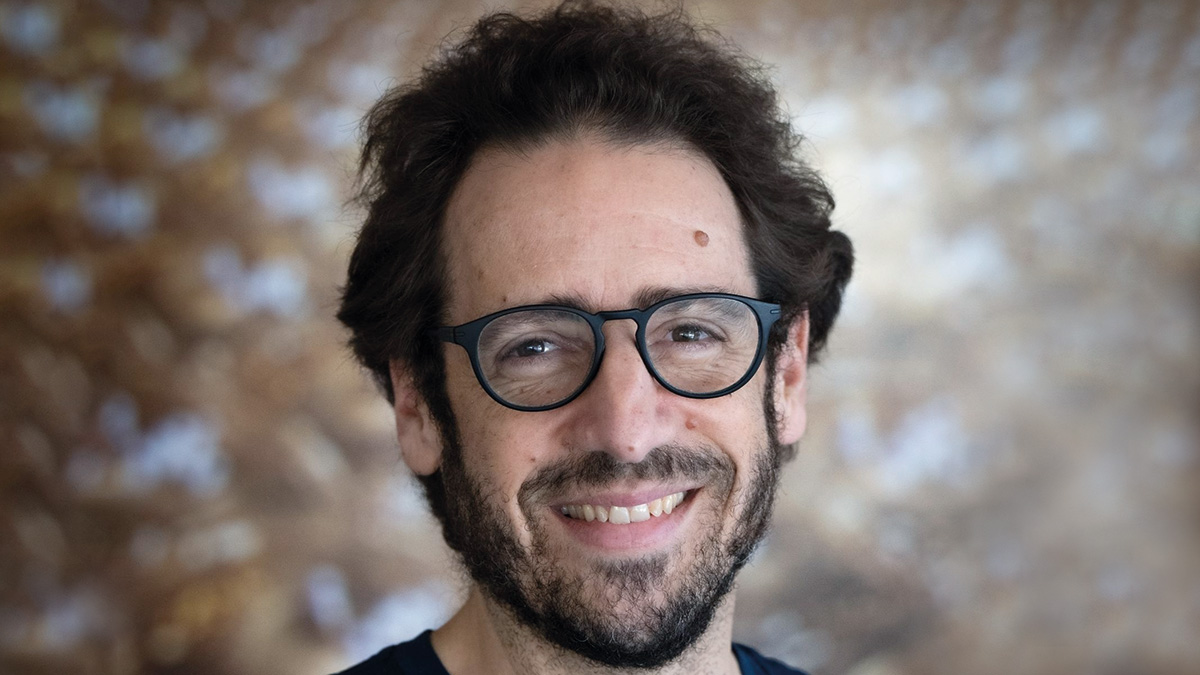
For Daniel Whiteson, professor at the University of California, Irvine, and a researcher on the ATLAS experiment at CERN, there was no obvious path ahead. As an undergraduate, he moved between fields, looking for one that fit. One summer, he tried plasma physics and later moved on to one of those laser labs in which, as he argues, “something is always broken”. It was only in particle physics that things eventually clicked. “That’s when I realised it’s possible to have fun doing research,” he recalls. “I also enjoyed the daily work of computer programming and data analysis, not vacuum chambers or optical systems. Particle physics is really personal.”
That idea has stayed with him. “We’re all interested in the big questions, but what you enjoy doing day-to-day determines where you can actually contribute,” he says. Finding that alignment, however, is rarely immediate. “When you’re young, you don’t know yourself well enough to know what you are going to like,” he reflects. “If everybody knew at 20 who they wanted to be at 40, their lives would be much simpler.”
Turning point
A second turning point came during his postdoctoral years, when he considered leaving academia. He had no doubt about the science. What worried him, instead, was the life that came with it. Looking at faculty 10 years older, he saw few who seemed happy, and few who had managed a good work–life balance. Luckily, there were exceptions. “I found mentors who seemed to be having healthy patterns and tried to follow their lead,” he says. “I thought I could make it work.”
Whiteson’s research with ATLAS focuses on “breaking down barriers to discovery, by using machine learning to make previously intractable problems tractable”, an area he has been working in since the late 1990s. One example is the use of machine-learning algorithms to distinguish rare particle signals from overwhelming background noise in LHC data, improving the sensitivity of searches for new physics beyond the Standard Model.
In parallel, he has built a career in science communication. The output spans podcasts, books, such as his recent volume Do Aliens Speak Physics? with cartoonist Andy Warner, and the PBS Kids series Elinor Wonders Why. Rather than teaching facts, the show portrays the process of science: when the children ask questions, adult characters don’t know the answer and show the children how to work it out for themselves.
We’re all interested in the big questions, but what you enjoy doing day-to-day determines where you can actually contribute
That journey started alongside cartoonist Jorge Cham. “I always wanted to use cartoons to convey science, because I feel like our field is so abstract that visuals are really important,” he says. Humour, too, became central to that approach. “I feel like humour is such an important part of communication. It puts people at ease.” As he puts it, “How complicated could this quantum field theory be if there’s dad jokes mixed in, right?”
After Whiteson reached out to Cham, the collaboration grew quickly. The first video, on dark matter, reached more than a million viewers on YouTube. A second, on the Higgs boson, was cited in the further-reading materials accompanying the 2013 Nobel Prize announcement. All the while, research did not halt. “I never stopped having students. I never stopped going to CERN. I never stopped writing papers,” he says. “My scientific productivity never dropped or dimmed.” If anything, communication helped. “I learned physics because I had to describe it for the general public. And that improved my science.”
Still, he is candid about the challenges: “The field is not always supportive of those kinds of efforts away from research.” He has felt this himself. “It’s unfair, but it’s also the reality,” he says. “There’s a tension within the community, and things are changing.”
Compelling prose
If there is one skill Whiteson feels is consistently underestimated, it is writing. “Writing is so important and so undervalued, especially in this AI age.” Papers are a natural example “If you read a paper, and it’s written sloppily, you think maybe the work is sloppy. Whereas if you read a paper, and it’s crisp and clear, then you feel grateful to the author for putting in the time to think things through.” Grants are another, and here the audience matters too. “Most of the grants submitted have great ideas. If the prose is compelling, it captures that bored grant reviewer and convinces them that you know what you’re doing.” The same applies to communication more broadly. “The challenge of science communication is not knowing if you understand the material, it’s whether you understand where the audience is coming from, and how to guide them.”
For early-career researchers, his advice is simple. “Do not get advice from people my age,” he says, pointing to how quickly the field is changing. “There’s now a path for people who do AI and physics. Thirty years ago, there really wasn’t. Even AI was like a side gig for folks like me!” What matters more, in his view, is to be true to oneself. “Do the stuff you find fun,” he says. “Because that’s where you’re going to shine.”