Marie-Noëlle Minard passed away on 15 May 2022. She began her career as a physicist in 1969, with a postgraduate thesis at the Institute of Nuclear Physics (IPN) in Orsay under the direction of Louis Massonnet, on the subject of high-energy neutron detectors. She joined the CNRS as a research associate, while still at the IPN, in 1972 and began her PhD studies exploring ways to detect exotic particles under the supervision of Michel Yvert. Minard defended her thesis in 1976 and joined the newly created Annecy particle-physics laboratory (LAPP). She then spent two years at SLAC, where she worked on the rapid-cycling bubble chamber. Back at LAPP in 1979, she joined the group of physicists involved in the UA1 collaboration at the CERN SppS proton–antiproton collider. The group participated in the construction of the electromagnetic calorimeter, analysis tools, data taking and physics analyses.
With her colleagues at LAPP and CERN, Marie-Noëlle created an analysis to search for Z bosons, exploiting the UA1 data extracted online by the 168E emulators – the so-called “express line”. It was by analysing these events that Marie-Noëlle spotted the first Z boson on the night of 4 May 1983 – a source of immense pleasure in her career.
In 1987 Marie-Noëlle turned to LEP physics. She created, with Daniel Décamp, the ALEPH group at LAPP. This idea came up against obstacles: there was already an L3 group, and the rule at the time was that each IN2P3 laboratory could only participate in one experiment at LEP (with one exception). This occasion demonstrated the measure of Marie-Noëlle’s determination: when she was convinced of the merits of a project, her enthusiasm and energy were such that she was able to convince even the most reluctant. She finally obtained the green light for an ALEPH team at LAPP, which, under her direction, made many contributions to the experiment. She herself was run coordinator, responsible for calibration, and a pillar of the di-fermion analysis group (measuring the Z lineshape).
In the early 2000s Jacques Lefrançois invited Marie-Noëlle to join the LHCb collaboration. The team at LAPP, under her direction, made a major contribution to the experiment, particularly in the construction and operation of calorimetric systems as well as in numerous physics analyses. Project manager of the calorimeter group during its start-up between 2008 and 2011, then assistant to the project manager until 2013, Marie-Noëlle participated in the commissioning and definition of control and calibration procedures for the calorimeters and ensured the continuous monitoring of the gains and of the aging of the cells of the electromagnetic calorimeter throughout the first period of data taking (2011–2013).
Between 2000 and 2006 Marie-Noëlle was deputy director of LAPP, during which she strongly contributed to the definition and implementation of its scientific strategy. Very careful to communicate our science to the public, her creativity enabled her to organise several original and appreciated events. Marie-Noëlle supervised nine theses. For services rendered to research, she received one of the highest awards in France (de chevalier de la Légion d’honneur).
She was certainly demanding, much more of herself than of others, but always convinced that in a group everyone makes a positive contribution. A physicist and communicator of immense talent, she was above all a woman of limitless generosity, with a sometimes caustic sense of humour. She was brave and couldn’t stand injustice, often expressing aloud what others were quietly thinking. Marie-Noëlle loved swimming, sailing, cooking, reading and welcoming her many friends and family to her table. Those who, like us, have had the chance to work with her will miss her boundless commitment, the relevance of her advice and her humanity. We are thinking of Claude, her husband of 50 years, and of her large family.
To explain the large matter–antimatter asymmetry in the universe, the laws of nature need to be asymmetric under a combination of charge-conjugation (C) and parity (P) transformations. The Standard Model (SM) provides a mechanism for CP violation, but it is insufficient to explain the observed baryon asymmetry in the universe. Thus, searching for new sources of CP violation is important.
The non-invariance of the fundamental forces under CP can lead to different rates between a particle and an antiparticle decay. The CP violation in the decay of a particle is quantified through the parameter ACP, equal to the relative difference between the decay rate of the process and the decay rate of the CP-conjugated process. Three years ago, the LHCb collaboration reported the first observation of CP violation in the decay of charmed hadrons by measuring the difference between the time-integrated ACP in D0 →K–K+ and D0 →π– π+ decays, ΔACP. This difference was found to lie at the upper end of the SM expectation, prompting renewed interest in the charm-physics community. There is now an ongoing effort to understand whether this signal is consistent with the SM or a sign of new physics.
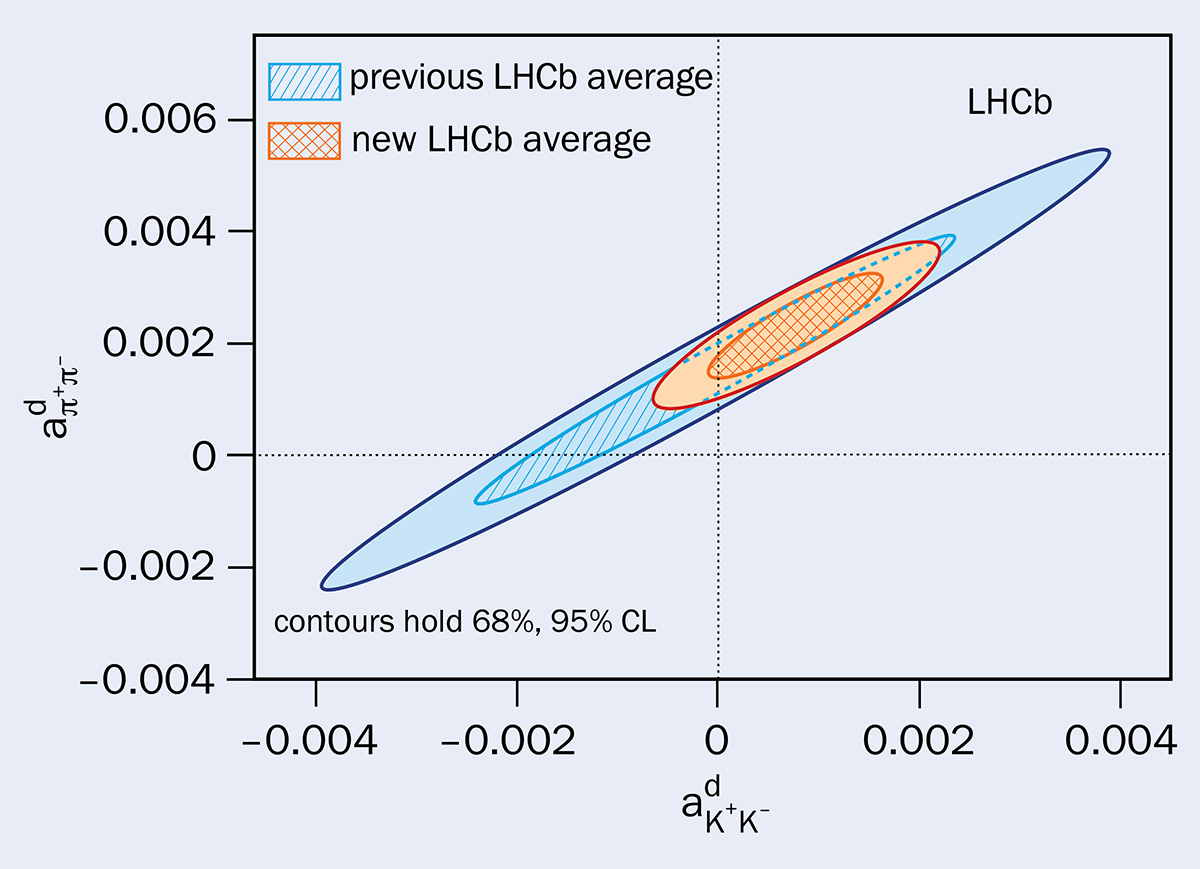
At the 41st ICHEP conference in Bologna on 7 July, the LHCb collaboration announced a new measurement of the individual time-integrated CP asymmetry in the D0 →K–K+ decay using the data sample collected during LHC Run 2. The measured value, ACP(K–K+)=[6.8±5.4(stat)±1.6(syst)]×10–4, is almost three times more precise than the previous LHCb determination obtained with Run 1 data. This was thanks not only to a larger data sample but also the inclusion of additional control channels Ds+ →K– K+ π+ and Ds+ →Ks0 K+. Together with the previous control channels, D+ →K– π+ π+ and D+ →Ks0 π+, these decays allow the separation between tiny signals of CP asymmetries from the much larger bias due to the asymmetric meson production and instrumental effects.
The combination of the measured values with the previously obtained ones of ACP(K–K+) and ΔACP by LHCb allowed the determination of the direct CP asymmetries in the D0 →π– π+ and D0 →K– K+ decays: [23.2±6.1]×10–4 and [7.7±5.7]×10–4, respectively, with correlated uncertainties (ρ=0.88). This is the first evidence of direct CP violation in an individual charm–hadron decay (D0→π– π+), with a significance of 3.8σ.
The sum of the two direct asymmetries, which is expected to be equal to 0 in the limit of s–d quark symmetry (called U-spin symmetry), is equal to [30.8±11.4]×10–4. This corresponds to a departure from U-spin symmetry of 2.7σ. In addition, this result is essential to the theory community in the quest to clarify the theoretical picture of CP-violation in the charm system. Since the measurement is statistically limited, its precision will improve with the larger dataset collected during Run 3.
The cryogenic infrastructure of the Large Hadron Collider (LHC) at CERN is the most complex helium refrigeration system of all the world’s research facilities.
The operation of the LHC’s cryogenic system was initiated in 2008 after reception testing and a first cool down to 1.9 K. This webinar will cover information on the design, operational experiences and main challenges linked to the accelerator, along with the physics requirements.
During the first stage, the operation team had to learn about the responsivity and limitations of the system. They then had to manage stable operation by maintaining the necessary conditions for the superconducting magnets, RF cavities, electrical feed boxes, power links and detector devices, thus contributing to the physics programme and the discovery of the Higgs boson in 2012.
One of the most challenging parameters impacting the cryogenics was the beam-induced heat load that was taken up, beginning during the second operation period (Run 2) of the LHC in 2015 with increased beam parameters. A complicated optimisation of the configuration of the cryogenic system was successfully applied to cope with these requirements.
Run 3 (preparation for which started in 2020) required the handling of several hundred magnet training quenches towards the nominal beam energy for physics production.
Now, after several years of operational experience with steady state and transient handling, the cryogenic system is being optimised to provide the necessary refrigeration, whilst incorporating the all-important aspect of energy preservation.
In conclusion, there will be a brief discussion of the next four years of operation.
Krzysztof Brodzinski is a senior staff member in the cryogenics group at the technology department at CERN. He is a mechanical engineer with a specialisation in refrigeration equipment, and graduated from Cracow University of Technology in Poland. Krzysztof joined the LHC cryogenic design team in 2001, has been a member of the cryogenic operation team since 2009 and in 2019 was mandated as a section leader of the cryogenic operation team for the LHC, ATLAS and CMS. He is also involved in the engineering of the cryogenic system for the HiLumi LHC RF deflecting cavities project, as well as participating in the ongoing FCC cryogenics study.
Why not watch our other related Higgs boson anniversary webinars?
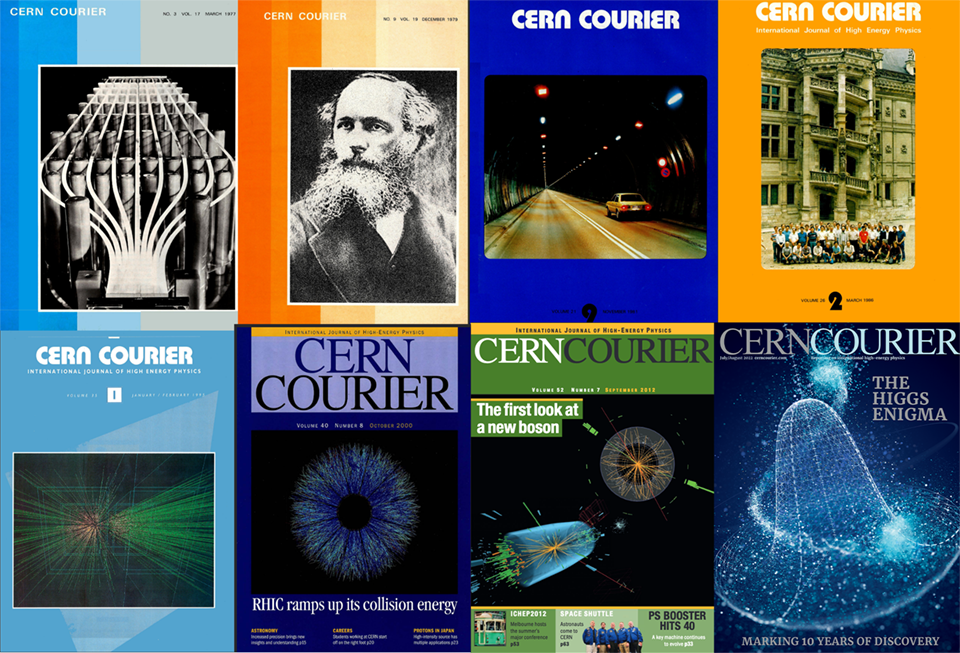
It was March 1977 when the hypothetical Higgs boson first made its way onto the pages of this magazine. Reporting on a talk by Steven Weinberg at the Chicago Meeting of the American Physical Society, the editors noted the dramatic success of gauge theories in explaining recent discoveries at the time — beginning with the observation of the neutral current at CERN in 1973 and the “new physics” following the J/ψ discovery at Brookhaven and Stanford the following year, observing: “The theories also postulate a set of scalar particles in a similar mass range… If Higgs bosons exist, they will affect particle behaviour at all energies. However, their postulated interactions are even weaker than the normal weak interactions. The effects would only be observable on a very small scale and would usually be drowned out by the stronger interactions.”
The topic clearly drew the attention of readers, as just a few issues later, in September 1977, the editors delved deeper into the origins of the Higgs boson and its role in spontaneous symmetry breaking, offering Abdus Salam’s “personal picture” to communicate this abstruse concept: “Imagine a banquet where guests sit at round tables. A bird’s eye view of the scene presents total symmetry, with serviettes alternating with people around each table. A person could equally well take a serviette from his right or from his left. The symmetry is spontaneously broken when one guest decides to pick up from his left and everyone else follows suit.”
Within a year, CERNCourier was on the trail of how the Higgs boson might show itself experimentally. Reporting on a “Workshop on Producing High Luminosity Proton–Antiproton Storage Rings” held at Berkeley, the April 1978 issue stated: “As well as the intermediate boson, the proton–antiproton colliders could give the first signs of the Higgs particles or of other unexpected states. While the discovery of weak neutral currents and charm provided impressive evidence for the gauge-theory picture that unifies electromagnetic and weak interactions, one prediction of this picture is the existence of spinless Higgs bosons. If these are not found at higher energies, some re-thinking might be required.” In the December 1978 issue, with apologies to Neil Armstrong, the Courier ran a piece titled “A giant LEP for mankind”. The hope was that with LEP, physicists had the tool to explore in depth the details of the symmetry breaking mechanism at the heart of weak interaction dynamics.
The award of the 1979 Nobel Prize in Physics to Weinberg, Glashow and Salam for the electroweak theory received full coverage in December that year, with the Courier expressing confidence in the Higgs: “Another vital ingredient of the theory which remains to be tested are the Higgs particles of the spontaneous symmetry breaking mechanism. Here the theory is still in a volatile state and no firm predictions are possible. But this mechanism is crucial to the theory, and something has to turn up.”
A Higgs for the masses
To many people, wrote US theorist Sam Treiman in November 1981, the Higgs particle looks somewhat artificial — “a kind of provisional stand-in for deeper effects at a more fundamental level”. Four years later, “with several experiments embarking on fresh Higgs searches”, Richard Dalitz and Louis Lyons organised a neatly titled workshop “Higgs for the masses” to review the theoretical and experimental status. Another oddity of the Higgs, wrote Lyons, is that unless it is very light (less than 10–17 eV), the Higgs should make the universe curved, “contributing more to the cosmological constant than the known limit permits”. Lower limits (from spontaneous symmetry breaking) and higher limits (from the unitarity requirement) open up a wide range of masses for the Higgs to manoeuvre — between 7 and 1000 GeV, he noted. “From time to time, new ‘bumps’ and effects are tentatively put forward as candidate Higgs, but so far none are convincing.”
LEP’s electroweak adventure reached a dramatic climax in the summer of 2000, with hints that a light Higgs boson was showing itself. In October, the machine was granted a stay of Higgs execution. Alas, the signal faded, and the final curtain fell on LEP in November — a “LEPilogue” heralding the beginning of a new era: the LHC.
Discussions about a high-energy hadron collider were ongoing long before: ICFA’s Future Perspectives meeting at Brookhaven in October 1987 noted two major hadron collider projects on the market: “the US Superconducting Supercollider, with collision energies of 40 TeV in an 84 kilometre ring, and the CERN Large Hadron Collider, with up to 17 TeV collision energies”. In December 1994, shortly after CERN turned 40, Council provided the lab with “The ultimate birthday present“: the unanimous approval of the LHC. A quarter of a century later, the LHC started up and brought particle physics to the world.
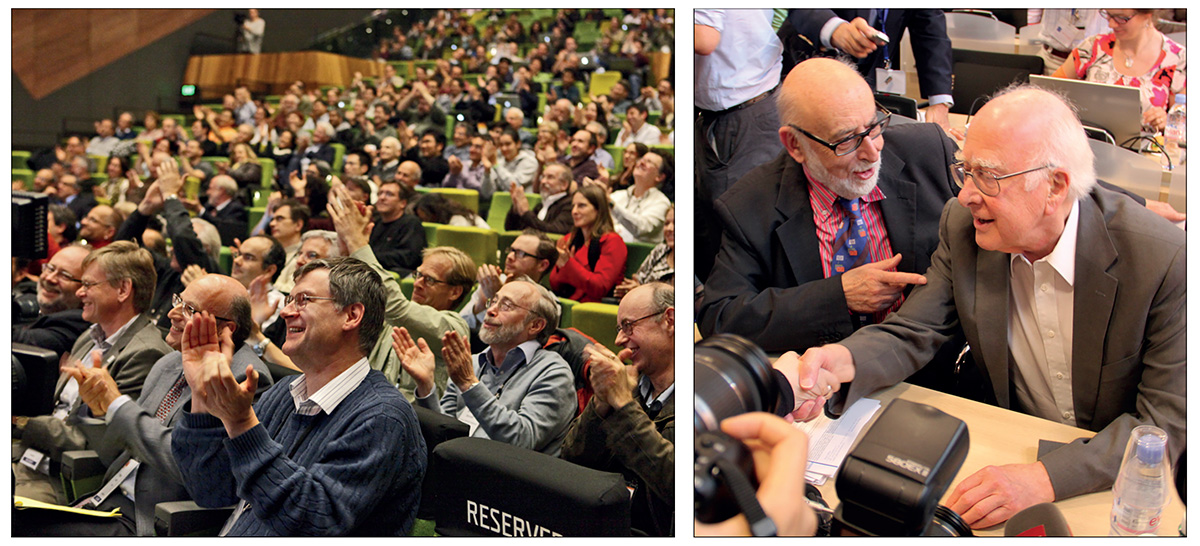
Together with LEP data, Fermilab’s CDF and DØ experiments and the LHC 2011 measurement campaign narrowed down the possible mass range for the Higgs boson to be between 115 and 127 GeV. First tantalising hints of the Higgs boson were presented on 13 December 2011. The quest remained open for another half a year, until Director-General Rolf Heuer, following the famous talks by ATLAS and CMS spokespersons Fabiola Gianotti and Joe Incandela, concluded: “As a layman I would say: I think we have it” on 4 July 2012. It was a day to remember: a breakthrough discovery rooted in decades of work by thousands of individuals that rocked the CERN auditorium and reverberated around the world. A new chapter in particle physics had begun…
To mark the 10th anniversary of this momentous event, from Monday 4 July the Courier will be exploring the theoretical and experimental effort behind the Higgs-boson discovery, the immense progress made by ATLAS and CMS in our understanding of this enigmatic particle, and the deep connections between the Higgs boson and some of the most profound open questions in fundamental physics.
Wherever the Higgs boson leads, CERN Courierwill be there to report!
Ten years ago, a few small bumps in ATLAS and CMS data confirmed a 48 year-old theoretical prediction, and particle physics hasn’t been the same since. Behind those sigmas was the hard work, dedication, competence and team spirit of thousands of experimentalists and accelerator physicists worldwide. Naturally it was a triumph for theory, too. Peter Higgs, François Englert, Carl Hagen and Gerald Guralnik received a standing ovation in the CERN auditorium on 4 July 2012, although Higgs insisted it was a day to celebrate experiment, not theory. The Nobel prize for Englert and Higgs came a year later. Straying from tradition for elementary-particle discoveries, the citation explicitly acknowledged the experimental effort of ATLAS and CMS, the LHC and CERN.
The implications of the Higgs-boson discovery are still being understood. Ten years of precision measurements have shown the particle to be consistent with the minimal version required by the Standard Model. Combined with the no-show of non-Standard Model particles that were expected to accompany the Higgs, theorists are left scratching their heads. As we celebrate the collective effort of high-energy physicists in discovering the Higgs boson and determining its properties, another intriguing journey has opened up.
Marvelously mysterious
As “a fragment of vacuum” with the barest of quantum numbers, the Higgs boson is potentially connected to many open questions in fundamental physics. The field from which it hails governs the nature of the electroweak phase transition in the early universe, which might be connected with the observed matter–antimatter asymmetry; as the only known elementary scalar particle, it could serve as a portal to other, hidden sectors relevant to dark matter; its couplings to matter particles — representing a new interaction in nature — may hold clues to the puzzling hierarchy of fermion masses; and its interactions with itself have implications for the ultimate stability of the universe.
Nobody knows what the Higgs boson has in store
With the LHC and its high-luminosity upgrade, physicists have 20 years of Higgs exploration to look forward to. But to fully understand the shape of the Brout–Englert–Higgs potential, the couplings of the Higgs boson to Standard Model particles and its possible connections to new physics, a successor collider will be needed. It is fascinating to picture future generations of particle physicists working as one with astroparticle physicists, cosmologists, quantum technologists and others to fill out the details of this potential new vista, with colliders driving progress alongside astrophysical, cosmological and gravitational-wave observatories. Future colliders aren’t just about generating knowledge, argues Anna Panagopoulou of the European Commission, but are “moonshots” delivering a competitive edge in technology, innovation, education and training — opening adventures that inspire young people to enter science in the first place.
Nobody knows what the Higgs boson has in store. Perhaps further studies will confirm the scenario of a Standard-Model Higgs and nothing else. The sheer number and profundity of known unknowns in the universe would suggest otherwise, think theorists. The good news is that, in the Higgs boson, physicists have clear measurement targets – and in principle the necessary theoretical and experimental machinery – to explore such mysteries, building upon the events of 4 July 2012 to reach the next level of understanding in fundamental physics.
The search for the Higgs boson is the kind of adventure that draws many young people to science, even if they go on to work in more applied areas. I first set out to become a nuclear physicist, and even applied for a position at CERN, before deciding to specialise in electrical engineering and then moving into science policy. Today, my job at the European Commission (EC) is to co-create policies with member states and stakeholders to shape a globally competitive European research and innovation system.
Large research infrastructures (RIs) such as CERN have a key role to play here. Having visited CERN for the first time last year, I was impressed not just by the basic research but also by the services that CERN provides the collaborations, its relationships with industry, and its work in training and educating young people. It is truly an example of what it means to collaborate on an international level, and it helped me understand better the role of RIs in research and innovation.
Innovation is one of three pillars of the EC’s €95.5 billion Horizon Europe programme for the period 2021–2027. The first pillar is basic science, and the second concerns applied research and knowledge diffusion. Much of the programme’s focus is “missions” geared to societal challenges such as soil, climate and cancer, driven by the UN’s 2030 Sustainable Development Goals. So where does a laboratory like CERN fit in? Pillar one is the natural home of particle physics, where there is well established support via European Research Council grants, Marie Skłodowska-Curie fellowships and RI funding. On the other hand, the success of the Horizon Europe missions relies on the knowledge and new technologies generated by the RIs.
We view the role of RIs as driving knowledge and technology, and ensuring it is transferred in Europe – acting as engines in a local ecosystem involving other laboratories and institutes, hospitals and schools, attracting the best people and generating new labour forces. COVID-19 is a huge social challenge that we also managed to address using basic research, RIs and opening access to data. This is a clear socioeconomic impact of current research and also data collected in the past.
Open science is a backbone of Horizon Europe, and an area where particle physics and CERN in particular are well advanced. I chair the governance board of the European Open Science Cloud, a multi-disciplinary environment where researchers can publish, find and re-use data, tools and services, in which CERN has a long-standing involvement.
Indeed, the EC has established a very strong collaboration with CERN across several areas. Recently we have been meeting to discuss the proposed Future Circular Collider (FCC). The FCC is worthwhile not just to be discussed but supported, and we are already doing so via significant projects. We are now discussing possibilities in Horizon Europe to support more technological aspects, but clearly EU money is not enough. We need commitment from member states, so there needs to be a political decision. And to achieve that we need a very good business plan that turns the long-term FCC vision into clearly defined short-term goals and demonstrates its stability and sustainability.
Societal impact
Long-term projects are not new to the EC: we have ITER, for example, while even the neutrality targets for the green-deal and climate missions are for 2050. The key is to demonstrate their relevance. There is sometimes a perception that people doing basic research are closed in their bubble and don’t realise what’s going on in the “real” world. The space programme has managed to demonstrate over the years that there are sufficient applications providing value beyond its core purpose. Nowadays, with issues of defence, security and connectivity rising up political agendas, researchers can always bring to the table that their work can help society address its needs. For big RIs such as the FCC we need to demonstrate first: what is the added value, even if it’s not available today? Why is it important for Europe? And what is the business plan? The FCC is not a typical project. To attract and convince politicians and finance ministers of its merits, it has to be presented in terms of its uniqueness.
The FCC brings to mind the Moon landings
The FCC brings to mind the Moon landings. Contrary to popular depictions, this was a long-term project that built on decades of competitive research from different countries. Yes, it was a period during the Cold War, but it was also the basis of fruitful collaboration. If we don’t dare to spend money on projects that bring us to the future then we lose, as Europe, a competitive advantage.
Many of the most arbitrary aspects of the Standard Model of particle physics (SM) are intimately connected to the scalar sector of the theory. The SM comprises just one scalar particle, the Higgs boson, and assumes a specific scalar potential (the famous “Mexican hat”) to define the dynamics of electroweak (EW) interactions. But the fact that the Higgs boson acquires a non-zero vacuum expectation value that defines the mass scale of EW interactions (around 100–200 GeV) is assumed, not explained, by the SM. Indeed, why the Higgs-boson mass is constrained to be at the EW scale, while quantum corrections should push it to much higher values (the so-called naturalness problem, see Naturalness after the Higgs), is not justified by any symmetry of the SM. At the same time, the SM assumes that fermion masses are generated via arbitrary Yukawa-type interactions with the scalar field but it does not explain the hierarchy of couplings or masses that we observe, nor the specific flavour structure that arises from the presence of just one scalar field.
Future colliders are vital to push the precision Higgs programme to the next level
The scalar sector of the SM may therefore be seen as a messenger of a more fundamental theory that replaces the SM at energies beyond the EW scale and turns apparent arbitrariness into logical consequences. After all, the mechanism of EW symmetry breaking as realised in the SM via the Brout–Englert–Higgs (BEH) field is just the simplest possible way to generate massive EW gauge bosons and fermions while preserving gauge symmetry. The scalar potential could be more complicated, for example involving multiple scalar fields, as is common in many beyond-the-SM (BSM) theories. This would result in a richer pattern of stable and metastable minima and influence the nature of the EW phase transition. A first-order phase transition, together with extra sources of CP violation beyond what is implied by the SM, could explain the origin of the matter–antimatter asymmetry of the universe via EW baryogenesis (see Electroweak baryogenesis). Understanding the origin of the EW scale is thus key to connecting very different realms of particle physics and cosmology, and the question we face while we look into the future of collider physics.
Game changer
The discovery of the Higgs boson during Run 1 of the LHC has been a game changer in the exploration of new physics beyond the EW scale. The measurement of the Higgs-boson mass has added the last missing input parameter to precision global fits of the SM, which now provide a very powerful tool to constrain BSM scenarios. Thanks to an unprecedented level of precision reached in both theory and experiment, the measurement of Higgs-boson couplings to EW gauge bosons (W, Z) and to the first two generations of quarks and leptons (t, b, τ, µ) from Run 2 data has already constrained their deviations from SM expectations to within 5–20%, with the best accuracy reached for the couplings to the gauge bosons. Based on these results, the High-Luminosity LHC (HL-LHC) is projected to constrain the effects of new physics on Higgs-boson couplings to EW gauge bosons to 1–2%, and to heavy quarks and fermions to 3–5%. If no anomalies are found, this level of accuracy will push the lower bound on the scale of new physics into the TeV ballpark. Vice versa, the detection of possible anomalies may point to the presence of new physics at the TeV scale, possibly just around the corner.
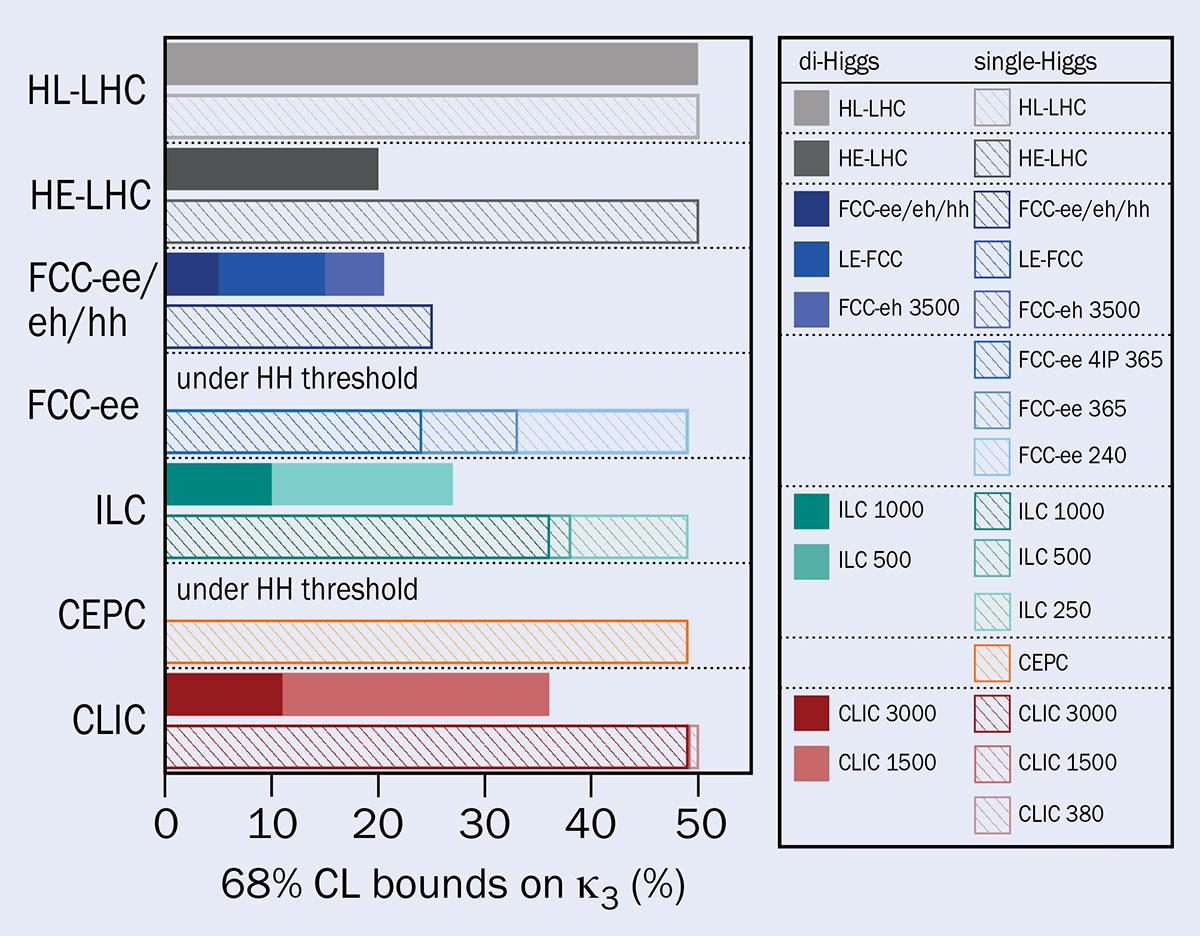
On the other hand, testing the SM scalar potential will still be challenging even during the HL-LHC era. The shape of the BEH potential can be tested by measuring the Higgs-boson self-interactions corresponding to its cubic and quartic terms. In the SM, these interactions are strictly proportional to the Higgs-boson mass via the vacuum expectation value of the BEH field. Deviations from the SM are searched for via Higgs pair production and radiative corrections to single-Higgs measurements. Although the LHC and HL-LHC promise to provide evidence for di-Higgs production, the extraction of the Higgs self-coupling from such measurements will be statistically limited.
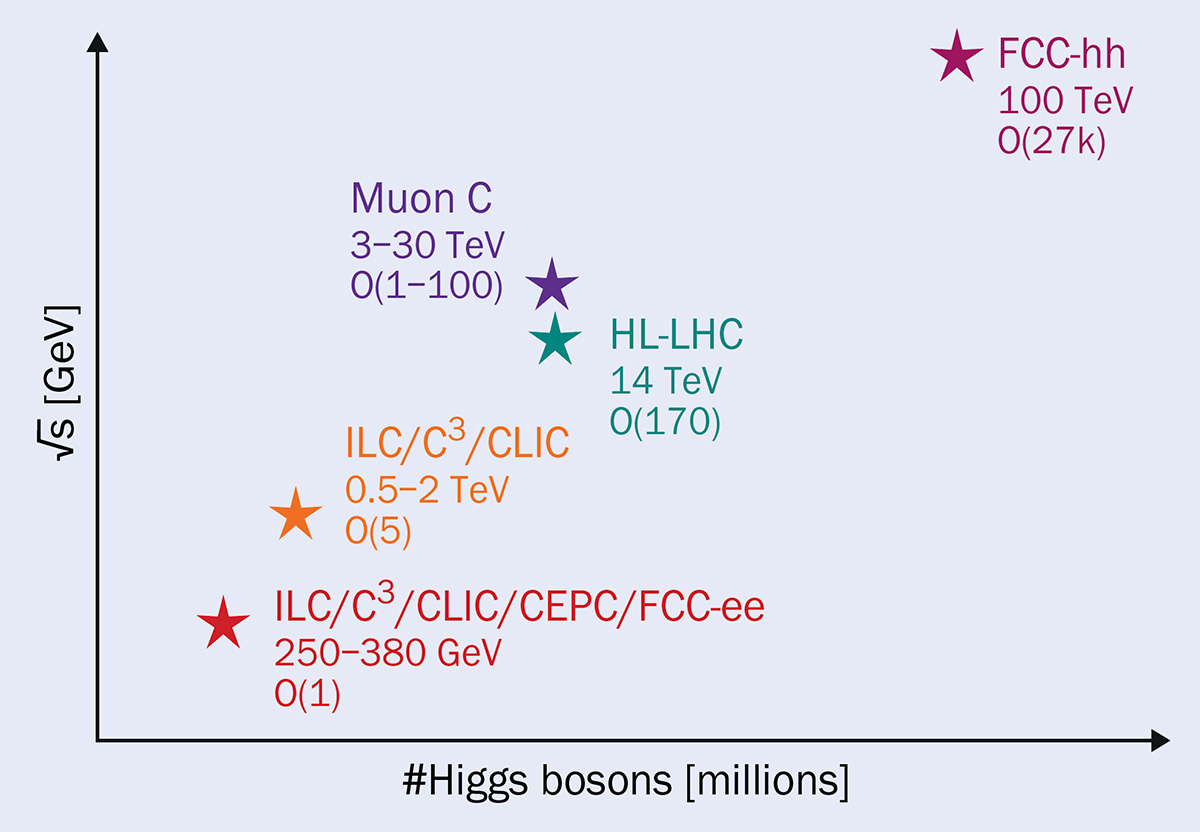
Future colliders are vital to push the precision Higgs programme to the next level. While the type and concept of the next collider is yet to be decided, all proposed facilities would deliver a huge number of Higgs bosons over their lifetime, operating at different and well targeted centre-of-mass energies (see “At a glance” figure). They can complement one another and, staggered over a period of the next few decades, provide the missing elements of the EW puzzle.
Among future lepton colliders under study, circular e+e– colliders (CEPC, FCC-ee) are expected to operate at lower energies between 90–350 GeV with very high luminosities, while linear e+e– colliders (ILC, C3, CLIC) offer both low- and high-energy phases generally with slightly lower luminosities. Combined with data from the HL-LHC, these “Higgs factories” would enable the SM, including most Higgs couplings, to be stress-tested below the per-cent level and in cases at or below the per-mille level. In particular, FCC-ee operating at the s-channel Higgs resonance (125 GeV) has the capability to provide bounds on couplings as small as the electron Yukawa coupling, while linear e+e– colliders operating at 550–600 GeV and above could substantially improve on the top-quark Yukawa coupling with respect to the HL-LHC. A possible muon collider, operated either as a Higgs factory at 125 GeV or as a high-energy discovery machine at 3–10 TeV, is estimated to reach similar precisions on Higgs couplings to other particles as e+e– machines.
Finally, high-energy lepton colliders (ILC 1000, CLIC 3000 and a 3–30 TeV muon collider) and very high-energy hadron colliders (FCC-hh at 100 TeV) would reach enough statistics and energy to measure the Higgs self-coupling and investigate the nature of the BEH potential, either via di-Higgs or single-Higgs production (see “Self-coupling” figure). With an aggressive Higgs physics programme they may also reach enough sensitivity to probe the cubic and quartic terms in the BEH potential separately.
Almost half a century after it was predicted, the LHC delivered the Higgs boson in spectacular style on 4 July 2012. Over the next 15–20 years, the machine and its luminosity upgrade will continue to enable ATLAS and CMS to make great strides in understanding the Higgs boson’s properties. But to fully exploit the discovery of the Higgs boson and explore its mysterious relation to new physics beyond the EW scale, we will need a successor collider.
Referring to the field equation of general relativity Rμν – ½ Rgμν = κTμν , Einstein is reported to have said that the left-hand side, constructed from space–time curvature, is “a palace of gold”; while the right-hand side, which parameterises the energy and momentum of matter, is by comparison “a hovel of wood”. Present-day physics has arrived at much more concrete ideas about the right-hand side than were available to Einstein. It is fair to say that some of it has come to look quite palatial, and fully worthy to stand alongside the left-hand side. These are the terms that involve field kinetic energy and gauge bosons, as described by the Standard Model (SM). Their form follows logically, within the framework of relativistic quantum field theory, directly from the principles of local gauge symmetry and relativity. Mathematically, they also speak the same geometric language as the right-hand side. The gauge bosons are avatars of curvature in “internal spaces”, similar to how gravitons are the avatars of space–time curvature. Internal spaces parameterise ways in which fields can vary – and thus, in effect, move – independently of ordinary motion in space–time. In this picture, the strong, weak and electromagnetic interactions arise from the influence of internal space curvature on internal space motion, similar to how gravity arises from the influence of space–time curvature on space–time motion.
The Higgs particle is the only portal connecting normal matter to such phantom fields
The other contributions to Tμν, all of which involve the Higgs particle, do not yet reach that standard. We can aspire to do better! They are of three kinds. First, there are the many Yukawa-like terms from which quark and lepton masses and mixings arise. Then there is the Higgs self-coupling and finally a term representing its mass. These contributions to Tμν contain almost two dozen dimensionless coupling parameters that present-day theory does not enable us to calculate or even much constrain. It is therefore important to investigate experimentally, through quantitative studies of Higgs-particle properties and interactions, whether this ramshackle structure describes nature accurately.
Higgs potential
The Higgs boson is special among the elementary particles. As the quantum of a condensate that fills all space, it is metaphorically “a fragment of vacuum”. Speaking more precisely, the Higgs particle has no spin, no electric or colour charge and, at the level of strong and electromagnetic interactions, normal charge conjugation and parity. Thus, it can be emitted singly and without angular momentum barriers, and it can decay directly into channels free of colour and electromagnetically charged particles, which might otherwise be difficult to access. For these and other, more technical, reasons, the Higgs particle has the potential to reveal new physical phenomena of several kinds.
A unique aspect of the Higgs mass term is especially promising for revealing possible shortcomings in the SM. In quantum field theory, an important property of an interaction is the “mass dimension” of the operator that implements it – a number that in an important sense indicates its complexity. Scalar and gauge fields have mass dimension 1 as do space–time derivatives, whereas fermion fields have mass dimension 3/2. More complicated operators are built up by multiplying these, and the mass dimension of a product is the sum of the mass dimensions of its factors. Interactions associated with operators whose mass dimension is greater than 4 are problematic because they lead to violent quantum fluctuations and mathematical divergences. Whereas all the other terms in the SM Lagrangian arise from operators of mass dimension 4, the Higgs mass term has mass dimension 2. Thus it is uniquely open to augmentation by couplings to hypothetical new SU(3) × SU(2) × U(1) singlet scalar fields, because the mass dimension of the augmented interaction can be 3 or 4 – i.e. still “safe”. The Higgs particle is the only portal connecting normal matter to such phantom fields.
Why is this an interesting observation? There are three main reasons: two broadly theoretical, one pragmatic. First of all, the particles that are generally considered part of the SM carry a variety of charge assignments under the gauge groups SU(3) × SU(2) × U(1) that govern the strong and electroweak interactions. For example, the left-handed up quark is charged under all three groups, while the right-handed electron carries only U(1) hypercharge. Thus it is not only logically possible, but reasonably plausible, that there could be particles that are neutral under all three groups. Such phantom particles might easily escape detection, since they do not participate in the strong or electroweak interactions. Indeed, there are several examples of well-motivated candidate particles of that kind. Axions are one. Since they are automatically “dark” in the appropriate sense, phantom particles could contribute to the astronomical dark matter, and might even dominate it, as model-builders have not failed to notice. Also, many models of unification bring in scalar fields belonging to representations of a unifying gauge group that contains SU(3) × SU(2) × U(1) singlets, as do models with supersymmetry. Only phantom scalars are directly accessible through the Higgs portal, but phantoms of higher spin, including right-handed neutrinos, could cascade from real or virtual scalars.
Mysterious values
Second, the empirical value of the Higgs mass term is somewhat mysterious and even problematic, given that quantum corrections should push it to a value many orders of magnitude higher. This is the notorious “hierarchy problem” (see Naturalness after the Higgs). Given this situation, it seems appropriate to explore the possibility that part (or all) of the effective mass-term of the SM Higgs particle arises from more fundamental couplings upon condensation of SU(3) × SU(2) × U(1) singlet scalar fields, i.e. the emergence of a non-zero space-filling field, as occurs in the Brout–Englert–Higgs mechanism.
The portal idea leads to concrete proposals for directions of experimental exploration
Third, the portal idea leads to concrete proposals for directions of experimental exploration. These are of two basic kinds: one involves the observed strength of conventional Higgs couplings, the other the kinematics of Higgs production and decay. Couplings of the Higgs field to singlets that condense will lead to mixing, altering numerical relationships among Higgs-particle couplings and masses of gauge bosons, and of fermions from their minimal SM values. Also, the Higgs-field couplings to gauge bosons and fermions will be divided among two or more mass eigenstates. Since existing data indicates that deviations from the minimal model are small, the coupling of normal matter to the “mostly but not entirely” singlet pieces could be quite small, perhaps leading to very long lifetimes (as well as small production rates) for those particles. Whether or not the phantom particles contribute significantly to cosmological dark matter, they will appear as missing energy or momentum accompanying Higgs particle decay or, through Bremsstrahlung-like processes, when they are produced.
We introduced the term “Higgs portal” to describe this circle of ideas in 2006, triggering a flurry of theoretical discussion. Now that the portal is open for business, and with larger data samples in store at the LHC, we can think more concretely about exploring it experimentally.
At around 10:30 a.m. on 4 July 2012, two remarkable feats of theoretical and experimental physics reached an apex in the CERN auditorium. One was the work of a few individuals using the most rudimentary of materials, the other a global endeavour involving thousands of people and the world’s most powerful collider. Forty-eight years after it was predicted, the CMS and ATLAS collaborations presented conclusive evidence for the existence of a new elementary particle, the Higgs boson, the cornerstone of the electroweak Standard Model.
“It took us several years to recover,” says CMS experimentalist Chiara Mariotti, who was co-convener of the collaboration’s Higgs group at the time. “For me there was a strong sense of ‘Higgs blues’ afterwards! On the other hand, the excitement was also productive. Immediately after the discovery we managed to invent a new method to measure the Higgs width, with a precision more than 200 times better than what we were thinking – a real breakthrough.”
Theoretically, the path to the Higgs boson had been paved by the early 1970s, building on foundations laid by the pioneers of quantum field theory and superconductivity. When Robert Brout and François Englert, and independently Peter Higgs, published their similarly titled papers on broken symmetry and the mass of gauge bosons in 1964, nobody took much notice. One of Higgs’s manuscripts was even rejected by an editor based at CERN. The profound consequences of the Brout–Englert–Higgs (BEH) mechanism – that the universe is pervaded by a scalar field responsible for breaking electroweak symmetry and giving elementary particles their mass (see “The Higgs, the universe and everything” panel) – only caught wider attention after further Nobel-calibre feats by Steven Weinberg, who incorporated the BEH mechanism into electroweak theory developed also by Abdus Salam and Sheldon Glashow, and by Gerard ’t Hooft and Martinus Veltman, who proved that the unified theory was mathematically consistent and capable of making testable predictions (see A triumph for theory).
Over to CERN
The first bridge linking the BEH mechanism to the real world was sketched out in CERN’s theory corridors in the form of a 50-page-long phenomenological profile of the Higgs boson by John Ellis, Mary Gaillard and Dimitri Nanopoulos published in 1976. The discovery of neutral currents in 1973 by Gargamelle at CERN, and of the charm quark at Brookhaven and SLAC in 1974, had confirmed that the Standard Model was on the right track. Despite their conviction that something like the Higgs boson had to exist, however, Ellis et al. ended their paper on a cautionary, somewhat tongue-in-cheek note: “We apologise to experimentalists for having no idea what is the mass of the Higgs boson… and for not being sure of its couplings to other particles, except that they are probably all very small. For these reasons we do not want to encourage big experimental searches for the Higgs boson, but we do feel that people performing experiments vulnerable to the Higgs boson should know how it may turn up”.
As it turned out, discovering and measuring the electroweak bosons would drive three major projects at CERN spanning three decades: the SPS proton–antiproton collider, LEP and the LHC. Following Carlo Rubbia and Simon van der Meer’s ingenious modification of the SPS to collide protons and antiprotons, greatly increasing the available energy, the UA1 and UA2 collaborations confirmed the existence of the W boson on 25 January 1983. The discovery of the slightly heavier Z boson came a few months later. The discoveries made the case for the Higgs boson stronger, since all three bosons hail from the same scalar field (see panel).
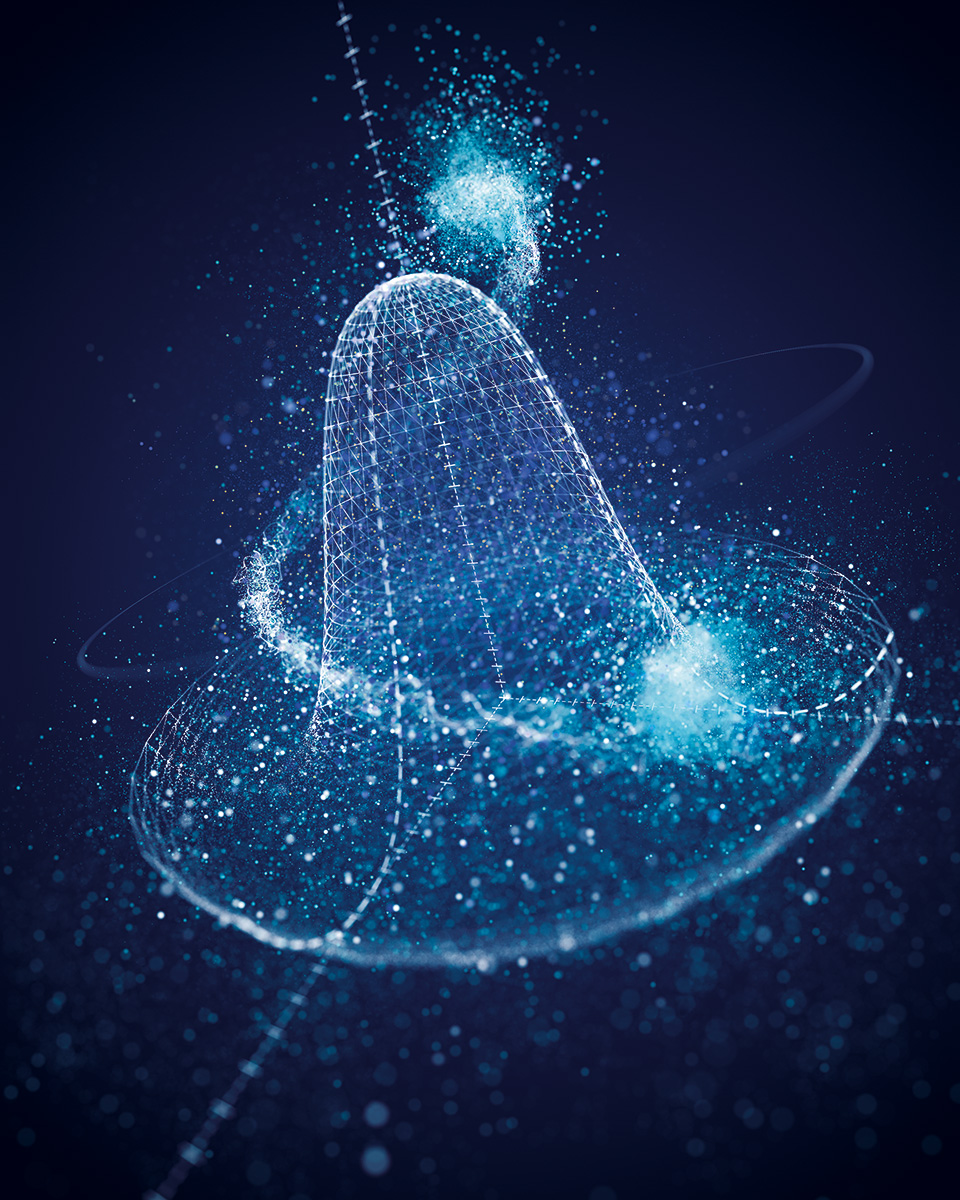
The Higgs boson is the excitation of a featureless condensate that fills all space – a complex scalar field with a shape resembling a Mexican hat. The universe is pictured as being born in a symmetric state at the top of the hat: the electromagnetic and weak forces were one, and particles moved at the speed of light. A fraction of a nanosecond later, the universe transitioned to a less symmetric but more stable configuration in the rim of the hat, giving the universe a vacuum expectation value of 246 GeV.
During this electroweak symmetry- breaking process, three of the BEH field’s components were absorbed to generate polarisation states, and thus masses, for the W and Z bosons; the other component, corresponding to a degree of freedom “up and down” the rim of the hat, is the Higgs boson (see “Lifting the lid” image). The masses of the fermions are generated via Yukawa couplings to the BEH field, implying that mass is not an intrinsic property of elementary particles.
The roots of the BEH mechanism lie in the phenomenon of spontaneous symmetry breaking, which is inherent in superconductivity and superfluidity. In 1960, Yoichiro Nambu and then Jeffrey Goldstone introduced spontaneous symmetry breaking into particle physics, paving the way for taming the weak interaction using gauge theory, like electromagnetism before it. Four years later, Robert Brout and Franҫois Englert and, independently, Peter Higgs, showed that a mathematical obstacle called the Goldstone theorem, which implied the existence of unobserved massless particles, is a blessing rather than a curse for gauge theories: the degrees of freedom responsible for the troublesome massless states generate masses for the heavy gauge bosons that mediate the short-range weak interaction (see A triumph for theory).
LEP, along with the higher energy Tevatron collider at Fermilab, offered Higgs hunters their first serious chance of a sighting. Dedicated analysis groups formed in theexperiments. For a decade they saw nothing. Then, on 14 June 2000, LEP’s final year of scheduled running, ALEPH reported a Higgs candidate at around 114–115 GeV, followed soon by a second and third event. LEP was granted a one-month extension. On 16 October, L3 announced a candidate. By 3 November ALEPH had notched up a 2.9σ excess. A request to extend LEP by one year was made, but there was deadlock at CERN. Five days later, Director-General Luciano Maiani announced that LEP had closed for the last time, so as not to delay the LHC. In addition to determining the properties of the W and Z bosons in detail and confirming the existence of electroweak radiative corrections, LEP had planted a flag in energy below which the Higgs would not be found.
Muscling a discovery
In 1977, CERN Director-General John Adams had the foresight to make the LEP tunnel large enough to accommodate a TeV hadron collider capable of probing the scale of electroweak symmetry breaking. Spurred on by the W and Z discoveries, finding or ruling out the Higgs boson became the central goal of the LHC, greatly influencing the designs of the ATLAS and CMS detectors during the 1990s. Tens of millions of people worldwide watched as the first proton beams were threaded through the machine on 10 September 2008. While the LHC had other goals, the quest for the Higgs boson and the origin of mass resonated with non-experts and brought particle physics to the world.
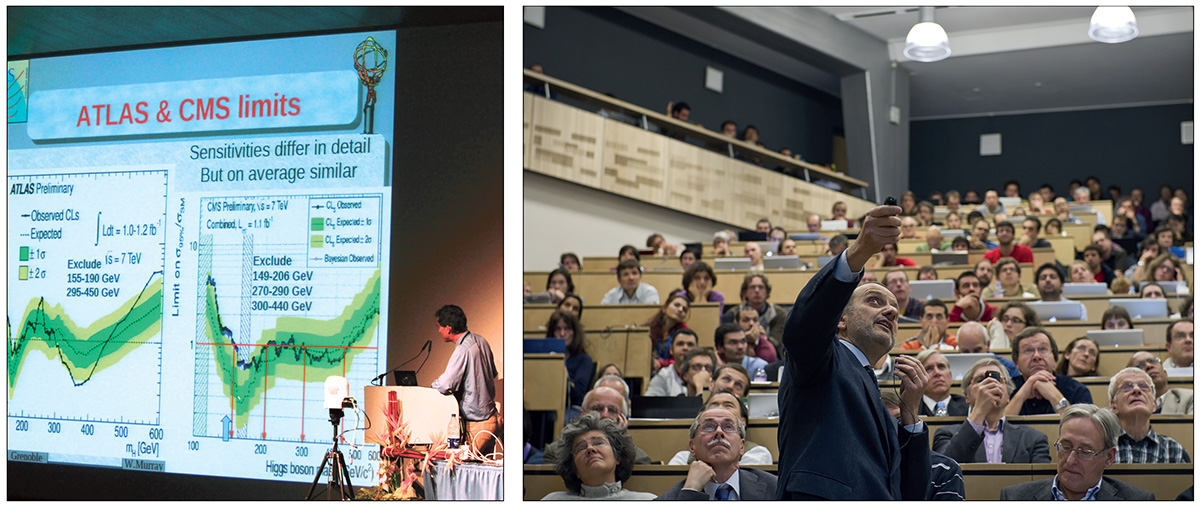
It was a bumpy start (see The bumpy ride to the bump), but high-energy LHC data began to flood in on 10 March 2010. By the time of the European Physical Society high-energy physics conference in Grenoble in July 2011, ATLAS and CMS were ready to offer a peek of their results. Practically, the search for the Higgs came down to a process of excluding mass ranges in which no signal had been seen. ATLAS and CMS had shrunk the allowed range and found a number of events hinting at a Higgs boson with a mass of about 142 GeV. “We both saw a bump at the same place, and we had champagne after the talks,” recalls Kyle Cranmer, co-coordinator of the ATLAS Higgs combination group at the time. “We weren’t confident then, but we were optimistic.” Fermilab’s Tevatron collider was also sensitive to a Higgs in the upper mass range and its CDF and D0 experiments pioneered many of the analysis methods that were used in ATLAS and CMS. Just four years earlier, they had hinted at a possible signal at 160 GeV, only for it to disappear with further data. Was the US machine about to make a last-gasp discovery and scoop the LHC?
The media were hot on the sigma trail. On 13 December 2011, the LHC experiments updated their findings: ATLAS constrained the Higgs to lie in the range 116-130 GeV, and CMS to lie in the range 115-127 GeV. For some, a light Higgs boson was in the bag. Others were hesitant. “There was a three-sigma excess when combining all the channels, but there were also less significant excesses in other mass regions,” recalls Mariotti. “I maybe also wanted not to believe it, in order not to be biased when analysing the data in 2012. And maybe because somehow if the Higgs was not there, it would have been really thrilling, much more challenging for us all.”
The following year, with the LHC running at a slightly higher energy, the collaborations knew that they would soon be able to say something definitive about the low-mass excess of events. From that moment, CMS decided not to look at the data and instead to redesign its analyses on simulated events “blinded”. On the evening of 14 June, all the analysis groups met separately to “open the box”. The next day, they shared their results with the collaboration. The two-photon and four-lepton channels had a beautiful peak at the same place. “It was like a very strong punch in the stomach,” says Mariotti. “From that moment it was difficult to sleep, and it was hard not to smile!”
The quest for the Higgs boson and the origin of mass resonated with non-experts and brought particle physics to the world
Members of both collaborations were under strict internal embargoes concerning the details. ATLAS unblinded its di-photon results late on 31 May, revealing a roughly 2σ excess. By 19 June it had grown to 3.3σ. The four-lepton group saw a similar excess. “My student Sven Kreiss was the first person in ATLAS to combine the channels and see the curve cross the 5σ threshold,” says Cranmer. “That was on 24 June, and it started to sink in that we had really found it. But it was still not clear what we would claim or how we would phrase things.” Amazingly, he says, he was not aware of the CMS results. “I was also not going out of my way to find out. I was relishing the moment, the excitement, and the last days of uncertainty. I also had more important things to do in preparation for the talk.”
With the rumour mill in overdrive, a seminar at CERN was called for 4 July, also the first day of the ICHEP conference in Melbourne. Peter Higgs and François Englert, and Carl Hagan and Gerald Guralnik (who, with Tom Kibble, also arrived at the mass-generating mechanism), were to be there. The collaborations were focused only on their presentations. It had to be a masterpiece, says Mariotti. The day before, the CMS and ATLAS Higgs conveners met for coffee. They revealed nothing. “It was really hard not to know. We knew we had it, but somehow if ATLAS did not have it or had it but at a different mass, it all would have been a big disillusion.”
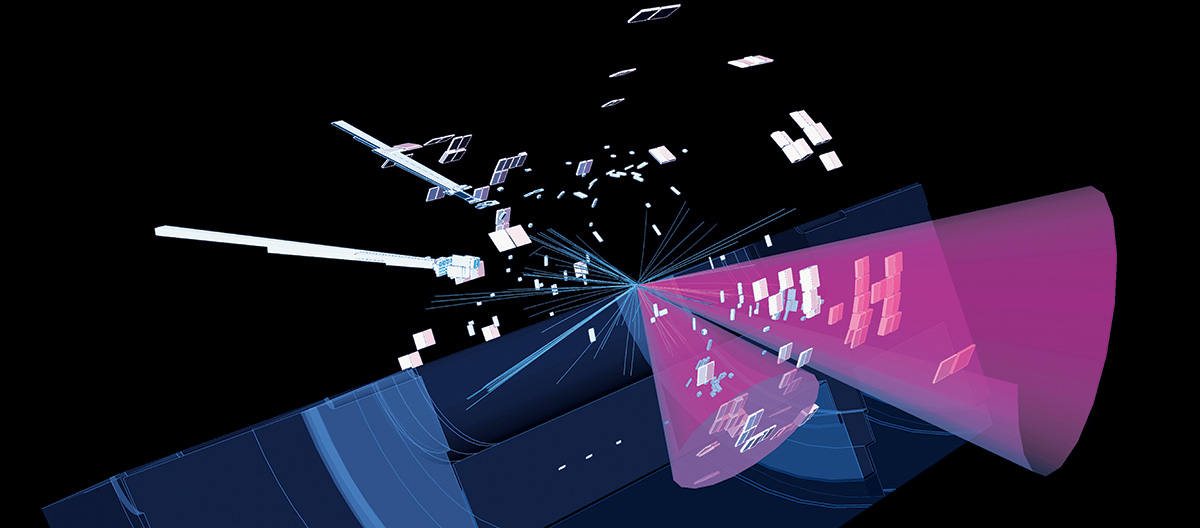
Many at CERN decided to spend the night of 3 July in front of the auditorium so as not to miss the historic moment. CMS spokesperson Joe Incandela was first to guide the audience through the checks and balances behind the final plots. Fabiola Gianotti followed for ATLAS. When it was clear that both had seen a 5σ excess of events at around 125 GeV, the room erupted. Was is it really the Higgs? All that was certain was that the particle was a boson, with a mass where the Standard Model expected it. Seizing the moment, and the microphone, Director-General Rolf Heuer announced: “As a layman, I would now say ‘I think we have it’, do you agree?” It was a spontaneous decision, he says. “For a short period between the unblindings and the seminar, I was one of the few people in the world, just with research director Sergio Bertolucci, in fact, who was aware of both results. We would not have announced a discovery had one experiment not come close to that threshold.”
The summer of 2012 produced innumerable fantastic memories, says Marumi Kado, ATLAS Higgs-group co-convener at the time and now a deputy spokesperson. “The working spirit in the group was exceptional. Each unblinding, each combination of the channels was an incredible event. Of course, the 4 July seminar was among the greatest.” In CMS, says Mariotti, there was a “party-mood” for months. “Every person thought, correctly, that they had played a role in the discovery, which is important, otherwise very large experiments cannot be done.”
The path from here
Ten years later, ATLAS and CMS measurements have shown the Higgs boson to be consistent with the minimal version required by the Standard Model. Its couplings to the gauge bosons and the heaviest three fermions (top, bottom and tau) have been confirmed, evidence that it couples to a second-generation fermion (the muon) obtained, and first studies of Higgs–charm and Higgs–Higgs couplings reported (see The Higgs boson under the microscope). However, data from Run 3, the High-Luminosity LHC and a possible Higgs-factory to follow the LHC, are needed to fully test the Standard-Model BEH mechanism (see The Higgs after LHC).
Every person thought, correctly, that they had played a role in the discovery, which is important, otherwise very large experiments cannot be done
Events on 4 July 2012 brought one scientific adventure to a close, but opened another, fascinating chapter in particle physics with fewer theoretical signposts. What is clear is that precision measurements of the Higgs boson open a new window to explore several pressing mysteries. The field from which the Higgs boson hails governs a critical phase transition that might be linked to the cosmic matter–antimatter asymmetry (see Electroweak baryogenesis); as an elementary scalar, it offers a unique “portal” to dark or hidden sectors which might include dark matter (see Through the Higgs portal); as the arbiter of mass, it could hold clues to the puzzling hierarchy of fermion masses (see The origin of particle masses); and its interactions govern the ultimate stability of the universe (see The Higgs and the fate of the universe). The very existence of a light Higgs boson in the absence of new particles to stabilise its mass is paradoxical (see Naturalness after the Higgs). Like the discovery of the accelerating universe, Nima Arkani-Hamed told the Courier in 2019, it is profoundly “new” physics: “Both discoveries are easily accommodated in our equations, but theoretical attempts to compute the vacuum energy and the scale of the Higgs mass pose gigantic, and perhaps interrelated, theoretical challenges. While we continue to scratch our heads as theorists, the most important path forward for experimentalists is completely clear: measure the hell out of these crazy phenomena!”
Often in physics, experimentalists observe phenomena that theorists had not been able to predict. When the muon was discovered, theoreticians were confused; a particle had been predicted, but not this one. Isidor Rabi came with his famous outcry: “who ordered that?” The J/ψ is another special case. A particle was discovered with properties so different from the particles that were expected, that the first guesses as to what it was were largely mistaken. Soon it became evident that it was a predicted particle after all, but it so happened that its features were more exotic than was foreseen. This was an experimental discovery requiring new twists in the theory, which we now understand very well. The Higgs particle also has a long and interesting history, but from my perspective, it was to become a triumph for theory.
From the 1940s, long before any indications were seen in experiments, there were fundamental problems in all theories of the weak interaction. Then we learned from very detailed and beautiful measurements that the weak force seemed to have a vector-minus axial-vector (V-A) structure. This implied that, just as in Yukawa’s theory for the strong nuclear force, the weak force can also be seen as resulting from an exchange of particles. But here, these particles had to be the energy quanta of vector and axial-vector fields, so they must have spin one, with positive and negative parities mixed up. They also must be very heavy. This implied that, certainly in the 1960s, experiments would not be able to detect these intermediate particles directly. But in theory, we should be able to calculate accurately the effects of the weak interaction in terms of just a few parameters, as could be done with the electromagnetic force.
Electromagnetism was known to be renormalisable – that is, by carefully redefining and rearranging the mass and interaction parameters, all observable effects would become calculable and predictable, avoiding meaningless infinities. But now we had a difficulty: the weak exchange particles differed from the electromagnetic ones (the photons) because they had mass. The mass was standing in the way when you tried to do what was well understood in electromagnetism. How exactly a correct formalism should be set up was not known, and the relationship between renormalisability and gauge invariance was not understood at all. Indeed, today we can say that the first hints were already there by 1954, when C N Yang and Robert Mills wrote a beautiful paper in which they generalised the principle of local gauge invariance to include gauge transformations that affect the nature of the particles involved. In its most basic form, their theory described photons with electric charge.
Thesis topic
In 1969 I began my graduate studies under the guidance of Martinus J G Veltman. He explained to me the problem he was working on: if photons were to have mass, then renormalisation would not work the same way. Specifically, the theory would fail to obey unitarity, a quantum mechanical rule that guarantees probabilities are conserved. I was given various options for my thesis topic, but they were not as fundamental as the issues he was investigating. “I want to work with you on the problem you are looking at now,” I said. Veltman replied that he had been working on his problem for almost a decade; I would need lots of time to learn about his results. “First, read this,” he said, and he gave me the Yang–Mills paper. “Why?” I asked. He said, “I don’t know, but it looks important.”
That, I could agreewith. This was a splendid idea. Why can’t you renormalise this? I had convinced myself that it should be possible, in principle. The Yang–Mills theory was a relativistic quantised field theory. But Veltman explained that, in such a theory, you must first learn what the Feynman rules are. These are the prescriptions that you have to follow to get the amplitudes generated by the theory. You can read off whether the amplitudes are unitary, obey dispersion relations, and check that everything works out as expected.
Many people thought that renormalisation – even quantum field theory – was suspect. They had difficulties following Veltman’s manipulations with Feynman diagrams, which required integrations that do not converge. To many investigators, he seemed to be sweeping the difficulties with the infinities under the rug. Nature must be more clever than this! Yang–Mills seemed to be a divine theory with little to do with reality, so physicists were trying all sorts of totally different approaches, such as S-matrix theory and Regge trajectories. Veltman decided to ignore all that.
Solid-state inspiration
Earlier in the decade, some investigators had been inspired by results from solid-state physics. Inside solids, vibrating atoms and electrons were described by nonrelativistic quantum field theories, and those were conceptually easier to understand. Philip Anderson had learned to understand the phenomenon of superconductivity as a process of spontaneous symmetry breaking; photons would obtain a mass, and this would lead to a remarkable rearrangement of the electrons as charge carriers that would no longer generate any resistance to electric currents. Several authors realised that this procedure might apply to the weak force. In the summer of 1964, Peter Higgs submitted a manuscript to Physical Review Letters, where he noted that the mechanism of making photons massive should also apply to relativistic particle systems. But there was a problem. Jeffrey Goldstone had sound mathematical arguments to expect the emergence of massless scalar particles as soon as a continuous symmetry breaks down spontaneously. Higgs put forward that this theorem should not apply to spontaneously broken local symmetries, but critics were unconvinced.
The journal sent Higgs’s manuscript out to be peer reviewed. The reviewer did not see what the paper would add to our understanding. “If this idea has anything to do with the real world, would there be any possibility to check it experimentally?” The correct question would have been what the paper would imply for the renormalisation procedure, but this question was in nobody’s mind. Anyway, Higgs gave a clear and accurate answer: “Yes, there is a consequence: this theory not only explains where the photon mass comes from, but it also predicts a new particle, a scalar particle (a particle with spin zero), which unlike all other particles, forms an incomplete representation of the local gauge symmetry.” In the meantime, other papers appeared about the photon mass-generation process, not only by François Englert and Robert Brout in Brussels, but also by Tom Kibble, Gerald Guralnik and Carl Hagen in London. And Sheldon Glashow, Abdus Salam and Steven Weinberg were formulating their first ideas (all independently) about using local gauge invariance to create models for the weak interaction.
I started to study everything from the ground up
At the time spontaneous symmetry breaking was being incorporated into quantum field theory, the significance of renormalisation and the predicted scalar particles were hardly mentioned. Certainly, researchers were not able to predict the mass of such particles. Personally, although I had heard about these ideas, I also wasn’t sure I understood what they were saying. I had my own ways of learning how to understand things, so I started to study everything from the ground up.
If you work with quantum mechanics, and you start from a relativistic classical field theory, to which you add the Copenhagen procedure to turn that into quantum mechanics, then you should get a unitary theory. The renormalisation procedure amounts to transforming all expressions that threaten to become infinite due to divergence of the integrals, to apply only to unobservable qualities of particles and fields, such as their “bare mass” and “bare charge”. If you understand how to get such things under control, then your theory should become a renormalised description of massive particles. But there were complications.
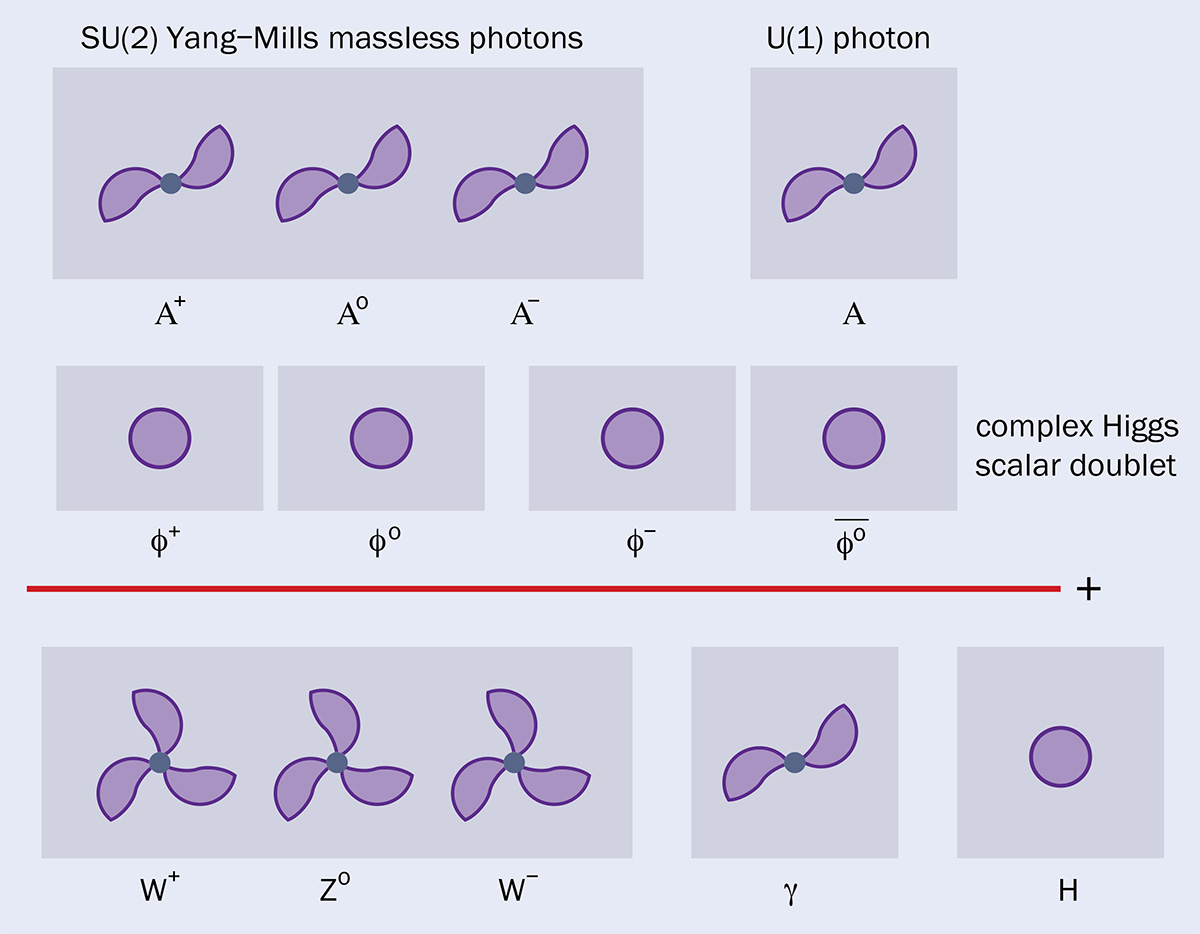
The infinities that require a renormalisation procedure to tame them originate from uncontrolled behaviour at very tiny distances, where the effective energies are large and consequently the effects of mass terms for the particles should become insignificant. This revealed that you first have to renormalise the theory without any masses in them, where also the spontaneous breakdown of the local symmetry becomes insignificant. You had to get the particle book-keeping right. A massless photon has only two observable field components (they can be left- or right-rotating), whereas a massive particle with the same spin can rotate in three different ways. One degree of freedom did not match. This was why an extra field was needed. If you wanted massive photons with electric charges +, 0 or –, you would need a scalar field with four components; one of these would represent the total field strength, and would behave as an extra, neutral, spin-0 particle – the observable particle that Higgs had talked about – but the others would turn the number of spinning degrees of freedom of the three other bosons from two to three each (see “Dynamical” figure).
One question
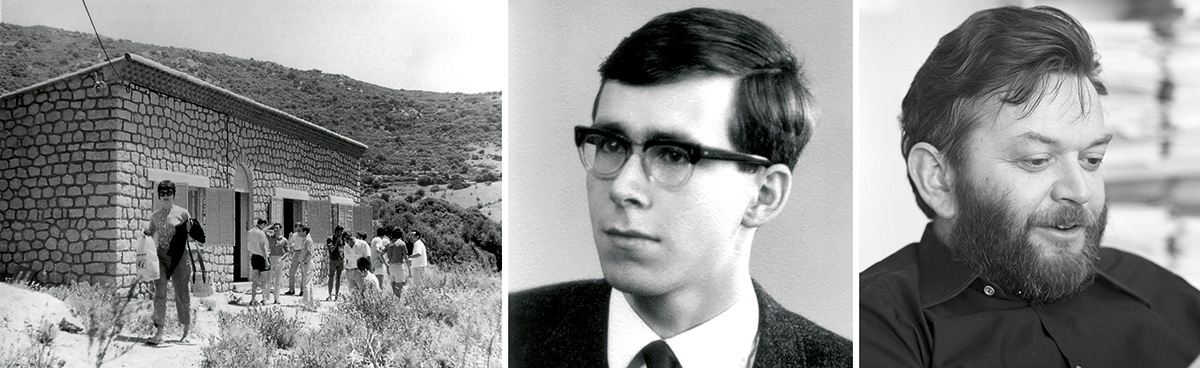
In 1970 Veltman sent me to a summer school organised by Maurice Lévy in a new science institute at Cargèse on the French island of Corsica. The subject would be the study of the Gell–Mann–Lévy model for pions and nucleons, in particular its renormalisation and the role of spontaneous symmetry breaking. Will renormalisation be possible in this model, and will it affect its symmetry? The model was very different from what I had just started to study: Yang–Mills theory with spontaneous breaking of its symmetry. There were quite a few reputable lecturers besides Lévy himself: Benjamin Lee and Kurt Symanzik had specialised in renormalisation. Shy as I was, I only asked one question to Lee, and the same to Symanzik: does your analysis apply to the Yang–Mills case?
Both gave me the same answer: if you are Veltman’s student, ask him. But I had, and Veltman did not believe that these topics were related. I thought that I had a better answer, and I fantasised that I was the only person on the planet who knew how to do it right. It was not obvious at all; I had two German roommates at the hotel where I had been put, who tried to convince me that renormalisation of Feynman graphs where lines cross each other would be unfathomably complicated.
Veltman had not only set up detailed, fully running machinery to handle the renormalisation of all sorts of models, but he had also designed a futuristic computer program to do the enormous amount of algebra required to handle the numerous Feynman diagrams that appear to be relevant for even the most basic computations. I knew he had those programs ready and running. He was now busy with some final checks: if his present attempts to check the unitarity of his renormalised model still failed, we should seriously consider giving this up. Yang–Mills theories for the weak interactions would not work as required.
But Veltman had not thought of putting a spin-zero, neutral particle in his model, certainly not if it wasn’t even in a complete representation of the gauge symmetry. Why should anyone add that? After returning from Cargèse I went to lunch with Veltman, during which I tried to persuade him. Walking back to our institute, he finally said, “Now look, what I need is not an abstract mathematical idea, what I want is a model, with a Lagrangian, from which I can read off the Feynman diagrams to check it with my program…”. “But that Lagrangian I can give you,” I said. Next, he walked straight into a tree! A few days after I had given him the Lagrangian, he came to me, quite excited. “Something strange,” he said, “your theory isn’t right because it still isn’t unitary, but I see that at several places, if the numbers had been a trifle different, it could have worked out.” Had he copied those factors ¼ and ½ that I had in my Lagrangian, I wondered? I knew they looked odd, but they originated from the fact that the Higgs field has isospin ½ while all other fields have isospin one.
No, Veltman had thought that those factors came from a sloppy notation I must have been using. “Try again,” I asked. He did, and everything fell into place. Most of all, we had discovered something important. This was the beginning of an intensive but short collaboration. My first publication “Renormalization of massless Yang–Mills fields”, published in October 1971, concerned the renormalisation of the Yang–Mills theory without the mass terms. The second publication that year, “Renormalizable Lagrangians for massive Yang–Mills fields,” where it was explained how the masses had to be added, had a substantial impact.
There was an important problem left wide open, however: even if you had the correct Feynman diagrams, the process of cancelling out the infinities could still leave finite, non-vanishing terms that ruin the whole idea. These so-called “anomalies” must also cancel out. We found a trick called dimensional renormalisation, which would guarantee that anomalies cancel except in the case where particles spin preferentially in one direction. Fortunately, as charged leptons tend to rotate in opposite directions compared to quarks, it was discovered that the effects of the quarks would cancel those of the leptons.
The fourth component
Within only a few years, a complete picture of the fundamental interactions became visible, where experiment and theory showed a remarkable agreement. It was a fully renormalisable model where all quarks and all leptons were represented as “families” that were only complete if each quark species had a leptonic counterpart. There was an “electroweak force”, where electromagnetism and the weak force interfere to generate the force patterns observed in experiments, and the strong force was tamed at almost the same time. Thus the electroweak theory and quantum chromodynamics were joined into what is now known as the Standard Model.
Be patient, we are almost there, we have three of the four components of this particle’s field
This theory agreed beautifully with observations, but it did not predict the mass of the neutral, spin-0 Higgs particle. Much later, when the W and the Z bosons were well-established, the Higgs was still not detected. I tried to reassure my colleagues: be patient, we are almost there, we have three of the four components of this particle’s field. The fourth will come soon.
As the theoretical calculations and the experimental measurements became more accurate during the 1990s and 2000s, it became possible to derive the most likely mass value from indirect Higgs-particle effects that had been observed, such as those concerning the top-quark mass. On 4 July 2012 a new boson was directly detected close to where the Standard Model said the Higgswould be. After these first experimental successes, it was of utmost importance to check whether this was really the object we had been expecting. This has kept experimentalists busy for the past 10 years, and will continue to do so for the foreseeable future.
The discovery of the Higgs particle is a triumph for high technology and basic science, as well as accurate theoretical analyses. Efforts spanning more than half a century paid off in the summer of 2012, and a new era of understanding the particles, their masses and interactions began.
To provide the best experiences, we use technologies like cookies to store and/or access device information. Consenting to these technologies will allow us to process data such as browsing behavior or unique IDs on this site. Not consenting or withdrawing consent, may adversely affect certain features and functions.
Functional
Always active
The technical storage or access is strictly necessary for the legitimate purpose of enabling the use of a specific service explicitly requested by the subscriber or user, or for the sole purpose of carrying out the transmission of a communication over an electronic communications network.
Preferences
The technical storage or access is necessary for the legitimate purpose of storing preferences that are not requested by the subscriber or user.
Statistics
The technical storage or access that is used exclusively for statistical purposes.The technical storage or access that is used exclusively for anonymous statistical purposes. Without a subpoena, voluntary compliance on the part of your Internet Service Provider, or additional records from a third party, information stored or retrieved for this purpose alone cannot usually be used to identify you.
Marketing
The technical storage or access is required to create user profiles to send advertising, or to track the user on a website or across several websites for similar marketing purposes.




 Krzysztof Brodzinski is a senior staff member in the cryogenics group at the technology department at CERN. He is a mechanical engineer with a specialisation in refrigeration equipment, and graduated from Cracow University of Technology in Poland. Krzysztof joined the LHC cryogenic design team in 2001, has been a member of the cryogenic operation team since 2009 and in 2019 was mandated as a section leader of the cryogenic operation team for the LHC, ATLAS and CMS. He is also involved in the engineering of the cryogenic system for the HiLumi LHC RF deflecting cavities project, as well as participating in the ongoing FCC cryogenics study.