Novel accelerator concepts will play an important role in future accelerators for high-energy physics. Two relevant scenarios being explored in the framework of the European Union I.FAST project are the generation of relativistic single electrons with gigahertz repetition rate for dark-matter searches, and the rapid acceleration of muons with GV/m accelerating fields for experiments at the energy frontier. The topical workshop “Gigahertz Rate and Rapid Muon Acceleration”, held in Bern from 10 to 13 December 2023, addressed the latest developments in these and related topics.
The first part of the workshop was devoted to dark-matter searches and dielectric laser acceleration (DLA). For dark-matter searches, multiple experiments are proposed across different classes (muons vs electrons and positrons, appearance vs disappearance experiments, etc), and an adequate background rejection is important. Promising advanced accelerator technologies are DLA for single electrons – perhaps also muons – and plasma-wakefield accelerators for muons and pions.
Some dark matter-experiments look for an appearance that requires a high flux of incoming particles. For electrons, the standard is set by BDX at JLab, for protons by the proposed SHiP experiment at CERN, and for photons by the proposed Gamma Factory at CERN. In addition, appearances could be seen at existing collider experiments such as the LHC. Other dark-matter experiments search for disappearance. They rely on DC-like electron beams, with prominent examples being LDMX at SLAC and the newly proposed DLA–DMX at PSI. A DC-like muon beam could be explored by the M3 experiment at Fermilab.
Paolo Crivelli (ETH Zürich) described the NA64 experiment as one of the most prominent examples of ongoing accelerator-based dark-matter searches, and presented the first results using a high-energy muon beam. The proposed LDMX experiment at SLAC, presented by Silke Möbius (University of Bern), may set a new standard for indirect dark-matter searches, while advanced concepts employing dielectric laser acceleration, in particular when integrating the accelerating structure with laser oscillator, could achieve many orders of magnitude higher rates of single high-energy electrons entering into an LDMX-type detector.
Uwe Niedermayer (TU Darmstadt), Stefanie Kraus (University Erlangen-Nürnberg) and Raziyeh Dadashi (PSI/EPFL) reviewed the state of the art in DLA plus future plans. Yves Bellouard (EPFL) discussed advances in high-repetition-rate lasers and micro/nano-structures, which suggests that the proposed combined laser-accelerator structures are within reach. Of course, the detector time resolution would also need to be improved tremendously to keep pace with the higher rate of the accelerator.
Acceleration and decay
The second part of the workshop was devoted to the plasma acceleration of non-ultra relativistic and rapidly decaying particles, such as muons and pions. Vladimir Shiltsev (Fermilab) and Daniel Schulte (CERN) presented tentative parameters and ongoing R&D efforts towards a muon collider. Shiltsev also discussed the intriguing possibility of low-emittance muon sources based on plasma-wakefield accelerators, while Alexander Pukhov (Heinrich Heine University Düsseldorf) and Chiara Badiali (IST Lisbon) discussed how plasma acceleration could bring slow particles, such as muons, to relativistic velocities.
The workshop fostered numerous heated discussions and uncovered unresolved issues, which included the “Bern controversy” regarding the ultimate limits of luminosity for PeV energies. Muons are considered particles of choice for future accelerators at the energy frontier. Both low- and high-energy muons have useful applications. Is there an Angstrom limit to the beam diameter? Are tiny beta functions possible? Can plasmas help to overcome such limitations? Understanding and modelling non-point-like particle luminosity is another important topic, also relevant for the Gamma Factory.
The workshop showed how advanced accelerator concepts can jump-start dark-sector searches
The final part of the workshop assembled a roadmap and perspective. DLA studies are to be maintained and, if possible, accelerated. A reasonable target is achieving a gradient of 500 MeV/m and an energy gain of 0.05 GeV in five years on a single wafer, while an integrated DLA laser oscillator could be foreseen five to seven years from now. Plasma-wakefield acceleration of muons could conceivably be tested either at CERN–AWAKE or PSI. It was proposed, as a first step, to put a solid target or tape into the AWAKE set up.
The gamma factory, presented by Witek Krasny (LPNHE), was recognised as an intense source of polarised muons and positrons. For muon-acceleration studies, the dephasing issue, linked to the muons’ non-ultrarelativistic energy, seems to be resolved. A demonstrator experiment for muon plasma acceleration is called for. Open questions include when and where?
Overall, the Bern workshop showed how advanced accelerator concepts can jump start dark-sector searches and muon/pion acceleration. High-repetition-rate acceleration of single electrons for dark-matter searches, using dielectric laser accelerators, and applying high-gradient plasma acceleration to muon and/or pion beams, are intriguing and far-forward looking topics.
On 20 February the Belle II detector at SuperKEKB in Japan recorded its first e+e– collisions since summer 2022, when the facility entered a scheduled long shutdown. During the shutdown, a new vertex detector incorporating a fully implemented pixel detector, together with an improved beam pipe at the collision point, was installed to better handle the expected increases in luminosity and backgrounds originating from the beams. Furthermore, the radiation shielding around the detector was enhanced, and other measures to improve the data-collection performance were implemented.
Belle II, for which first collisions were recorded in the fully instrumented detector in March 2019, aims to uncover new phenomena through precise analysis of the properties of B mesons and other particles produced by the SuperKEKB accelerator. Its long-term goal is to accumulate a dataset 50 times larger than that of the former Belle experiment.
Since being delivered to the International Space Station (ISS) by Space Shuttle Endeavour in 2011, the Alpha Magnetic Spectrometer (AMS-02) has recorded more than 200 billion cosmic-ray events with energies extending into the multi-TeV range. Although never designed to be serviceable, a major intervention to the 7.5 tonne detector in 2019/2020, during which astronauts replaced a failing cooling system, extended the lifetime of AMS significantly (CERN Courier March/April 2020 p9). Now, the international collaboration is preparing a new mission to upgrade the detector itself, by adding an additional tracker layer and associated thermal radiators. If all goes to plan, the upgrade will allow physicists to gather key data relating to a mysterious excess of cosmic rays at high energies.
Precise dataset
The increasingly precise AMS-02 dataset reveals numerous unexplained features in cosmic-ray spectra (CERN Courier December 2016 p26). In particular, a high-energy excess in the relative positron flux does not follow the single power-law behaviour expected from standard cosmic-ray interactions with the interstellar medium. While known astrophysical sources such as pulsars cannot yet be ruled out, the spectrum fits well to dark-matter models. If the excess events are indeed due to the annihilation of dark-matter particles, a smoking gun would be a high-energy cut-off in the spectrum. By increasing the AMS acceptance by 300%, the addition of a new tracker layer is the only way that the experiment can gather the necessary data to test this hypothesis before the scheduled decommissioning of the ISS in 2030.
“By 2030 AMS will extend the energy range of the positron flux measurement from 1.4 to 2 TeV and reduce the error by a factor of two compared to current data,” says AMS spokesperson Sam Ting of MIT. “This will allow us to measure the anisotropy accurately to permit a separation between dark matter and pulsars at 99.93% confidence.”
Led by MIT, and assembled and tested at CERN/ESA with NASA support, AMS is a unique particle-physics experiment in space. It consists of a transition radiation detector to identify electrons and positrons, a permanent magnet together with nine silicon-tracker layers to measure momentum and identify different particle species, two banks of time-of-flight counters, veto counters, a ring-image Cherenkov counter and an electromagnetic calorimeter.
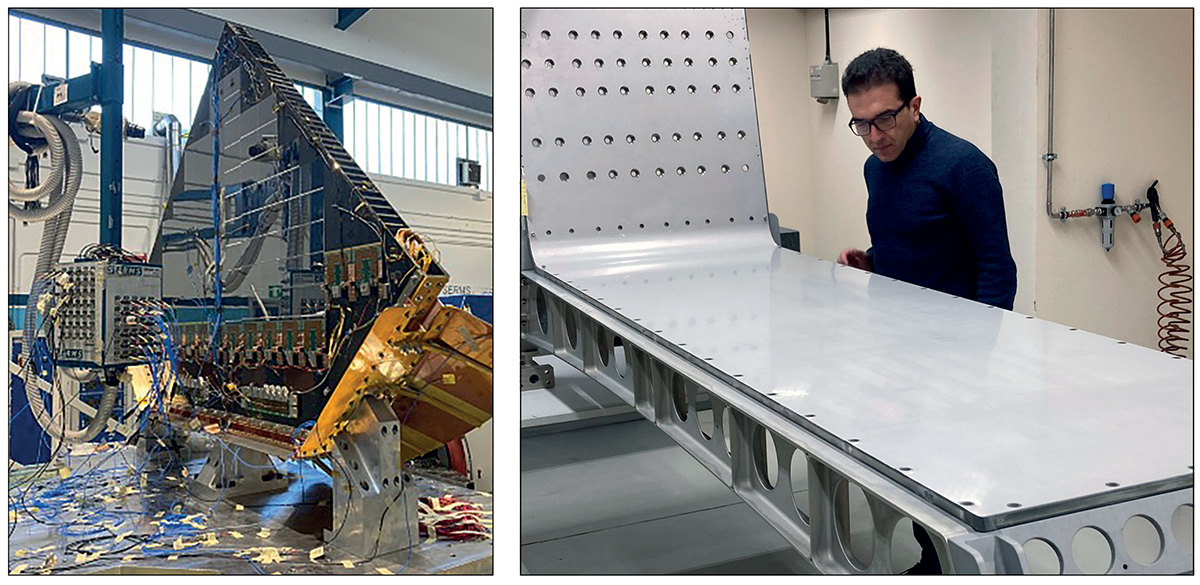
The additional tracker layer, 2.6 m in diameter, 30 cm thick and weighing 250 kg, will be installed on the top-most part of the detector. The tracking sensors will populate the opposite faces of an ultralight carbon plane specifically developed for AMS to fulfil thermoelastic stability requirements, surrounded by an octagonal carbon frame that also provides the main structural interface during launch. The powering and readout electronics for the new layer will generate additional heat that is rejected to space by radiators at its periphery. Two new radiators will therefore be integrated into the detector prior to the installation of the layer, while a third, much larger power-distribution radiator (PDS) will also be installed to recuperate the performance of one of the AMS main radiators, which has suffered degradation and radiation damage after 13 years in low-Earth orbit. In January, a prototype of the PDS, manufactured and supported by aerospace company AIDC in Taiwan, was delivered to CERN for tests.
First steps for the upgrade took place in 2021, and the US Department of Energy together with NASA approved the mission in March 2023. The testing of components and construction of prototypes at institutes around the world is proceeding quickly in view of a planned launch in February 2026. The silicon strips, 8 m2 of which will cover both faces of the layer, were produced by Hamamatsu and are being assembled into “ladders” of different lengths at IHEP in Beijing. These are then shipped to INFN Perugia in Italy, where they are joined together to form a quarter plane. Once fully characterised, the eight quarters will be installed at CERN on both faces of the mechanical plane and integrated with electronics, thermal hardware and the necessary brackets. Crucial for the new tracker layer to survive the harsh launch environment and to maintain, once in orbit, the sensor within five microns relative to ground measurements, are the large carbon plane and the shielding cupolas, developed at CERN, as well as the NASA brackets that will attach the layer module to AMS. This hardware represents a major R&D programme in its own right.
By 2030 AMS will extend the energy range of the positron flux measurement from 1.4 to 2 TeV and reduce the error by a factor of two
Following the first qualification model in late 2023, consisting of a quarter of the entire assembled layer, AMS engineers are now working towards a full-size model that will take the system closer to flight. The main tests to simulate the environment that the layer will experience during launch and once in orbit are vibrational and thermal-vacuum, to be performed in Italy (INFN PG) and in Germany (IABG), while the sensors’ position in the layer will be fully mapped at CERN and then tested with beams from the SPS, explains AMS chief engineer Corrado Gargiulo of CERN: “Everything is going very, very fast. This is a requirement, otherwise we arrive too late at the ISS for the upgrade to make sense.”
The new module is being designed to fit snuggly into the nose of a SpaceX Dragon rocket. Once safely delivered to the ISS, a robotic arm will dispatch the module to AMS where astronauts will, through a series of extravehicular activities (EVAs), perform the final mounting. Training for the delicate EVAs is well underway at NASA’s Johnson Space Center. Nearby, at the Neutral Buoyancy Laboratory, the astronauts are trained in a large swimming pool on how to attach the different components under the watchful eyes of safety and NASA divers, among them Gargiulo (see “Space choreography” images). As with the EVAs required to replace the cooling system, a number of custom-built tools and detailed procedures have to be developed and tested.
“If the previous ones were considered high-risk surgery, the EVAs for the new upgrade are unprecedented for the several different locations where astronauts will be required to work in much tighter and less accessible spaces,” explains Ken Bollweg, NASA manager of AMS, who is leading the operations aspect.
CERN has been burrowing beneath the French–Swiss border for half a century. Its first major underground project was the 7 km-circumference Super Proton Synchrotron (SPS), constructed at a depth of around 40 m by a single tunnel boring machine (TBM). This was followed by the Large Electron–Positron (LEP) collider at an average depth of around 100 m, for which the 27 km tunnel was constructed between 1983 and 1989 using three TBMs and a more traditional “drill and blast” method for the sector closest to the Jura mountain range. With a circumference of 90.7 km, weaving through the molasse and limestone beneath Lake Geneva and around Mont Salève, the proposed Future Circular Collider (FCC) would constitute the largest tunnel ever constructed at CERN and be considered a major global civil-engineering project in its own right.
Should the FCC be approved, civil engineering will be the first major on-site activity to take place. The mid-term review of the FCC feasibility study schedules ground-breaking for the first shafts to begin in 2033, after which it would take between six and eight years for each underground sector to be made available for the installation of the technical infrastructure, the machine and the experiments.
Evolving engineering
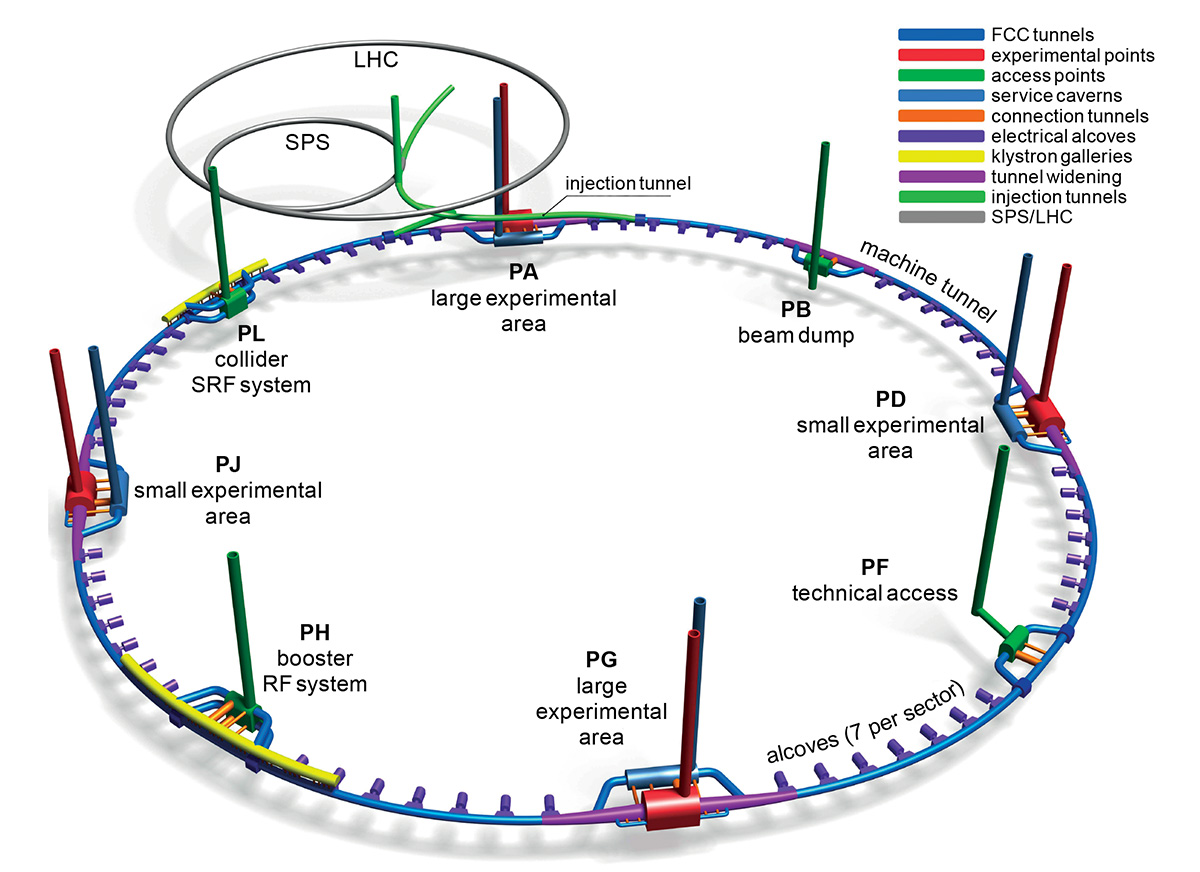
Since the completion of the FCC conceptual design report in 2018, several significant changes have been made to the civil engineering. These include a 7 km reduction in the overall circumference of the main tunnel, a reduction in the number of surface sites from 12 to eight, and a reduction in the number of permanent shafts from 18 to 12 (two at each of the four experiment sites, one at each of the four technical sites). A temporary shaft will also be required for the construction of the transfer tunnel connecting the injection system to the FCC tunnel, although it may be possible to re-use an existing but unused shaft for this purpose. Additional underground civil engineering for the RF systems will also be required. The diameter of the main tunnel (5.5 m) and its inclination (0.5%) remain unchanged, resulting in a tunnel depth that varies between approximately 50 m – where it passes under the Rhône River – and 500 m – where it passes beneath the Borne plateau on the eastern side of the study site.
The tunnel would be constructed using up to eight TBMs, which are able to excavate and install the tunnel lining in a single-pass operation. Desktop studies show that the geology that would be encountered during most of the underground construction would be favourable, since the molasse rock is usually watertight and can be easily supported using a range of standard rock-support measures. The main beam tunnel will, however, need to pass through about 4.4 km of limestone, which may require the drill-and-blast method to be utilised. These geological assumptions need to be confirmed via a major in situ site investigation campaign planned for 2024–2025.
Two sizes of experiment cavern complexes are envisaged, serving both the lepton and hadron FCC stages. One includes a cavern to house the largest planned FCC-hh detector with dimensions of 35 × 35 × 66 m (similar to the existing ATLAS cavern) and the other a 25 × 25 × 66 m cavern to house the smaller FCC-ee detectors (similar to the CMS cavern). A second cavern 25 m wide and up to 100 m long would be required at each experiment area to house various technical infrastructure, while a 50 m-thick rock pillar between the detector and the service caverns would provide electromagnetic shielding from the detector as well as the overall structural stability of the cavern complex. Numerous smaller caverns and interconnecting tunnels and galleries will be required to link the main structures, and these are expected to be excavated using road-header machines or rock breakers.
Conceptual layouts for two of the eight new surface sites have been prepared under a collaboration agreement with Fermilab, and studies of the experiment site at Ferney-Voltaire in France and the technical site at Choulex/Presinge in Switzerland have been undertaken. The requirements for other surface sites will be developed into preliminary designs in the second half of the feasibility study. In addition, several locations have been investigated for a new high-energy linac, which has been proposed as an alternative to using the SPS as a pre-injector for the FCC, with the most promising site located close to the existing CERN Prévessin site.
Feasibility campaign
As an essential step in demonstrating the feasibility of underground civil-engineering works for the FCC, CERN has been working with international consultants and the University of Geneva to develop a 3D geological model using information gathered from previous borehole and geophysical investigations. To improve this understanding, a targeted campaign of subsurface investigations using a combination of geophysical analyses and deep-borehole drilling has been planned in the areas of highest geological uncertainty. The campaign, which is currently being tendered with specialist companies, will commence in 2024 and continue into 2025 to ensure that the results are available before the end of the feasibility study. About 30 boreholes will be drilled and used in conjunction with 80 km of seismic lines to investigate the location of the molasse rock, in particular under Lake Geneva, the Rhône river and in those areas where limestone formations may be close to the planned tunnel horizon.
On the surface, there is scope for staging the construction of buildings. All the buildings that are only required for the FCC-hh phase would be postponed, but the land areas needed for them would be reserved and included in the overall site perimeter. Buried networks, roads and technical galleries would be designed and constructed such that they can be extended later to accommodate the FCC-hh structures.
With a total of around 15 million tonnes of rock and soilto be excavated, sustainability is a major focus of the FCC civil-engineering studies. To this end, in the framework of the European Union co-funded FCC Innovation Study, CERN and the University of Leoben launched an international challenge-based competition, “Mining the Future”, in 2021 to identify credible and innovative ways to reuse the molasse. The results of the competition include the use of limestone for concrete production and stabilisation of constructions within the project, the re-use of excavated materials to back-fill quarries and mines, the transformation of sterile molasse into fertile soil for agriculture and forestry, the production of bricks from compressed molasse, and the development of novel construction materials with molasse ingredients for use in the project as far as technically suitable. The next step is the implementation of a pilot “Open Sky Laboratory” permitting the demonstration of the separation techniques of the winning consortium (led by BG engineering), and collaboration with CERN’s host states and other stakeholders to identify suitable locations for its use. In addition, the FCC feasibility study is working towards a full assessment to minimise the carbon footprint during construction.
The civil-engineering plans for the FCC project have been presented several times to the global tunnelling community, most recently at the 2023 World Tunnel Congress in Athens. The scale and technical complexity of the project is creating a great deal of interest from designers and contractors, and has even triggered a dedicated visit to CERN from the executive committee of the International Tunnelling Association, which reinforces the significant progress that has been made.
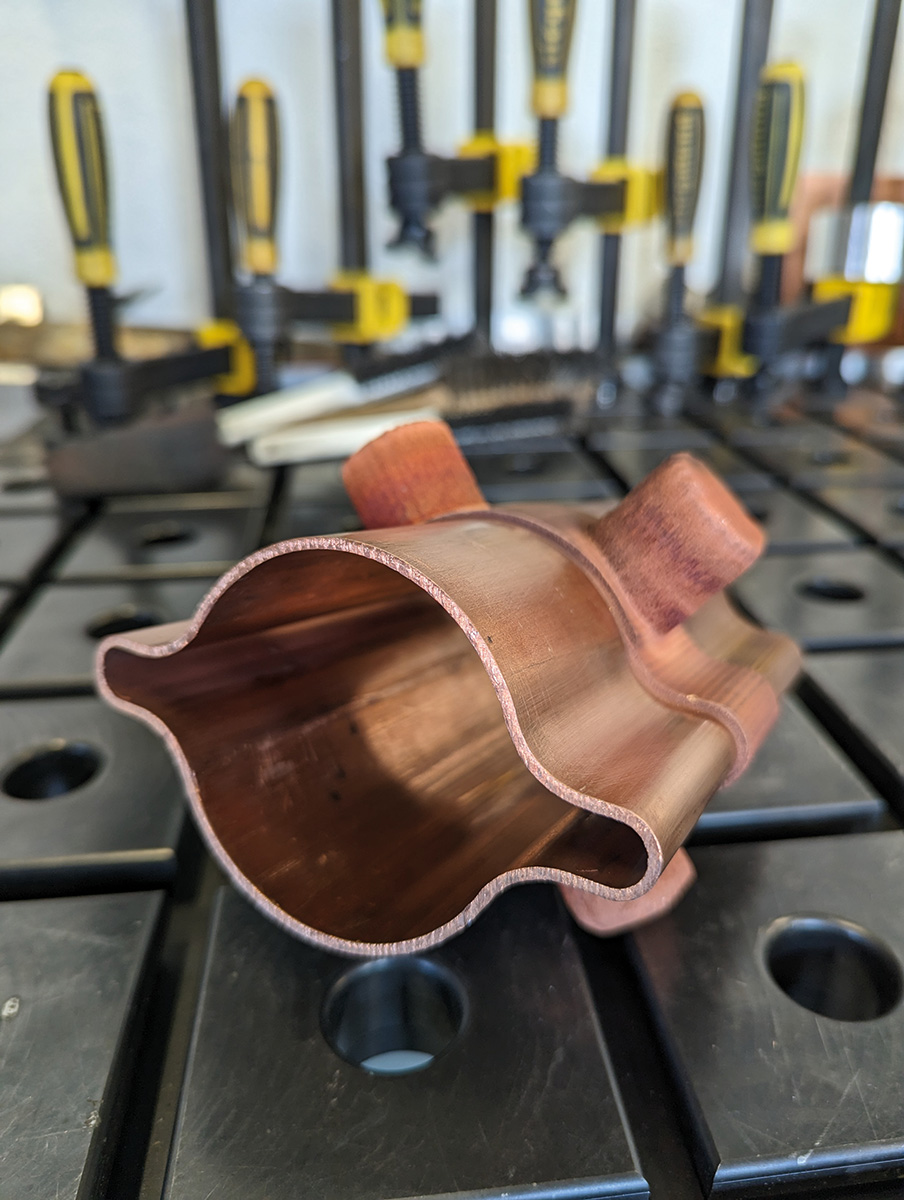
The CERN vacuum group has been actively designing components for the FCC-ee vacuum system. Among them are 3D-printed synchrotron-radiation absorbers (SRAs), cold-sprayed copper “bosses”, which could be machined to obtain weld- and flange-free beam position monitor button electrodes (pictured), and plasma-sprayed thin titanium tracks to be used as a radiation-hard bake-out heating system. In parallel, a collaboration with a spin-off company from the University of Calabria is dealing with the implementation of shape-memory alloy flanges. The design of a 2 m-long vacuum chamber extrusion with one SRA is almost finalised, and a soon-to-be-built prototype will be tested at the KARA light source at KIT. We have also begun studying a vacuum chamber with a smaller inner diameter compared to the FCC-ee baseline, including its impact on the machine–detector interface and the booster. The length of the vacuum sectors has been optimised, and their integration in the overall tunnel design is under study. The vacuum group is also looking forward to prototyping the required NEG-coating set-up, as the vacuum chambers could be up to 12 m long and coating them in a vertical position, as is usually done, would be difficult, especially for industry when moving to mass production.
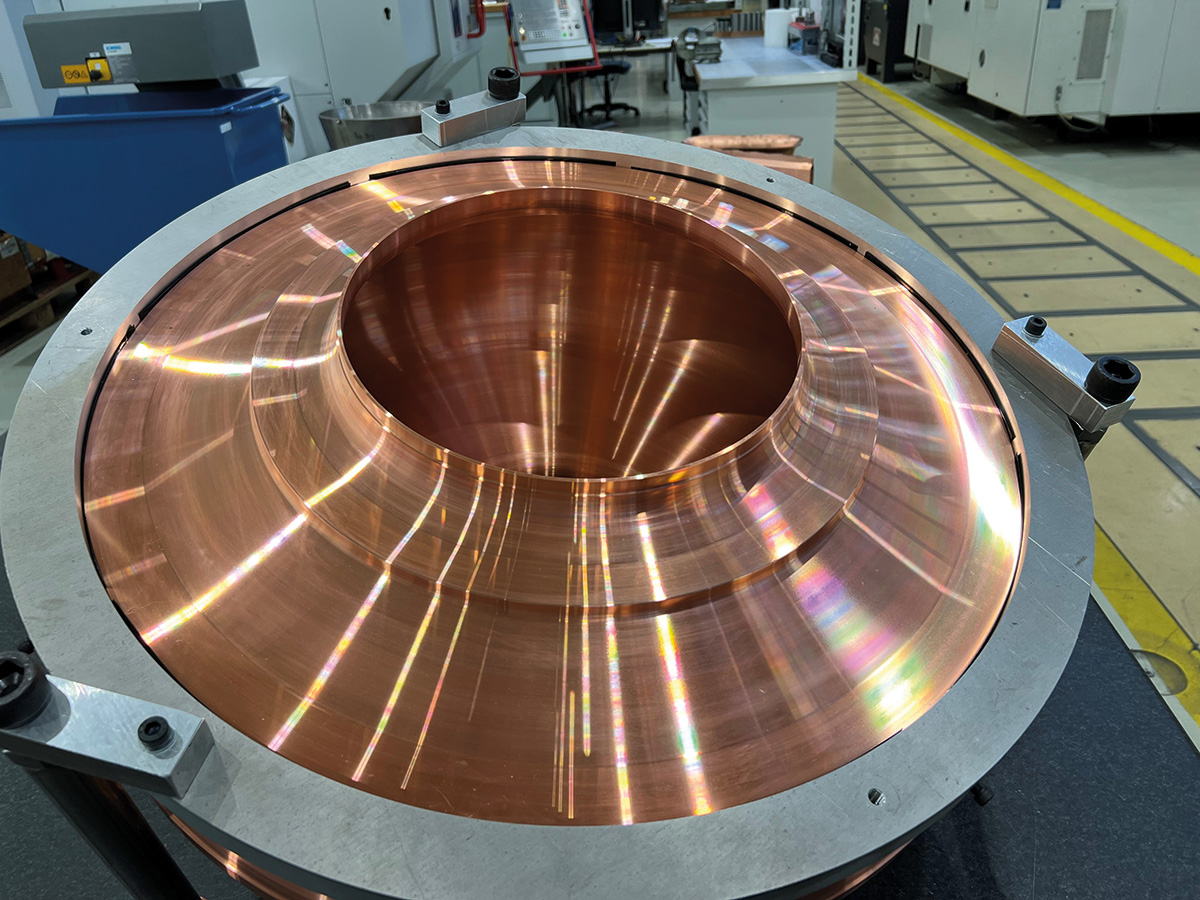
A key goal of R&D for the FCC superconducting radio-frequency (SRF) system, conducted by the CERN SY–RF, TE–VSC and EN–MME groups, is to optimise Nb/Cu technology for the fabrication of the cavities. Achieving high SRF performance in thin-film-coated cavities requires minimising substrate defects. Previous experiences show that imperfections located around electron beam welds in areas subjected to high magnetic field areas can constrain the quality factor of Nb/Cu cavities. To surpass the current limitations of Nb-coated cavities, a seamless configuration along with higher substrate quality and shape conformity is a promising alternative. Instead of traditional shaping methods such as deep-drawing or spinning, the ongoing use of techniques such as hydroforming and machining directly from the bulk material shows high potential for valuable results without altering the substrate. Moreover, it ensures effectiveness, repeatability and precision in the final shape of the cavity. Based on the impressive RF performance obtained from seamless Nb-coated 1.3 GHz cavities manufactured at CERN from bulk copper, the CERN teams are confident that such spectacular results will be repeated with a 400 MHz cavity (pictured) that is being machined as a preliminary prototype for the FCC RF study.
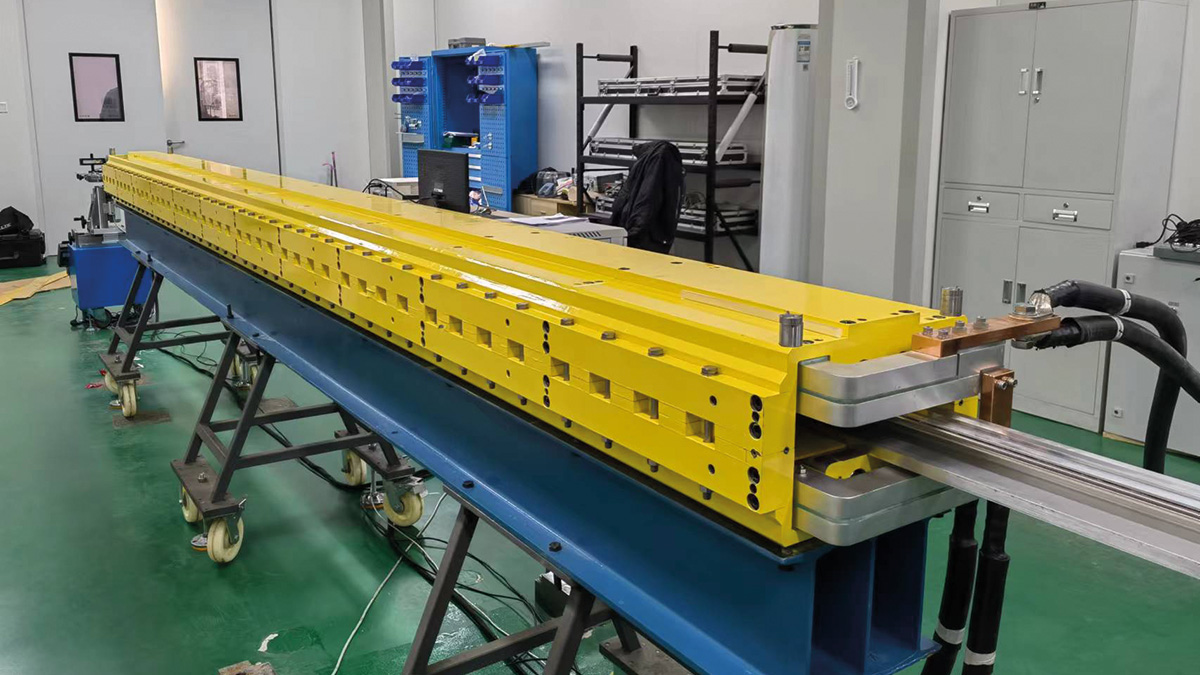
At the end of 2023, the first demonstrator of a high-temperature superconductor (HTS) sextupole designed for the FCC-ee arcs was fabricated at CERN (pictured). Built using novel technology from a CERN spin-off company, the magnet adopts a “canted cosine theta” design and is the first such device to use HTS rare-earth barium copper oxide (ReBCO) tape as its conductor – something that was long considered technically challenging. The main advantage of such a magnet is that ohmic losses (a significant source of electric power consumption for a normal-conducting accelerator) are reduced to zero, whereas refrigeration losses are much reduced compared to low-temperature-superconductor devices. Other advantages include increased performance due to the possibility of “nesting” magnets together, which is not possible for normal-conducting magnets that use iron to shape their magnetic fields. The increase in performance is such that up to 40% of the cost of the system can be recovered from the lower required RF voltage and therefore a smaller number of accelerating RF cavities. The magnet is the fruit of a CERN–PSI collaboration called FCCee-HTS4, funded through the CHART consortium in Switzerland. Future plans include the winding of the magnet at CERN, followed by tests for magnetic performance and quality.
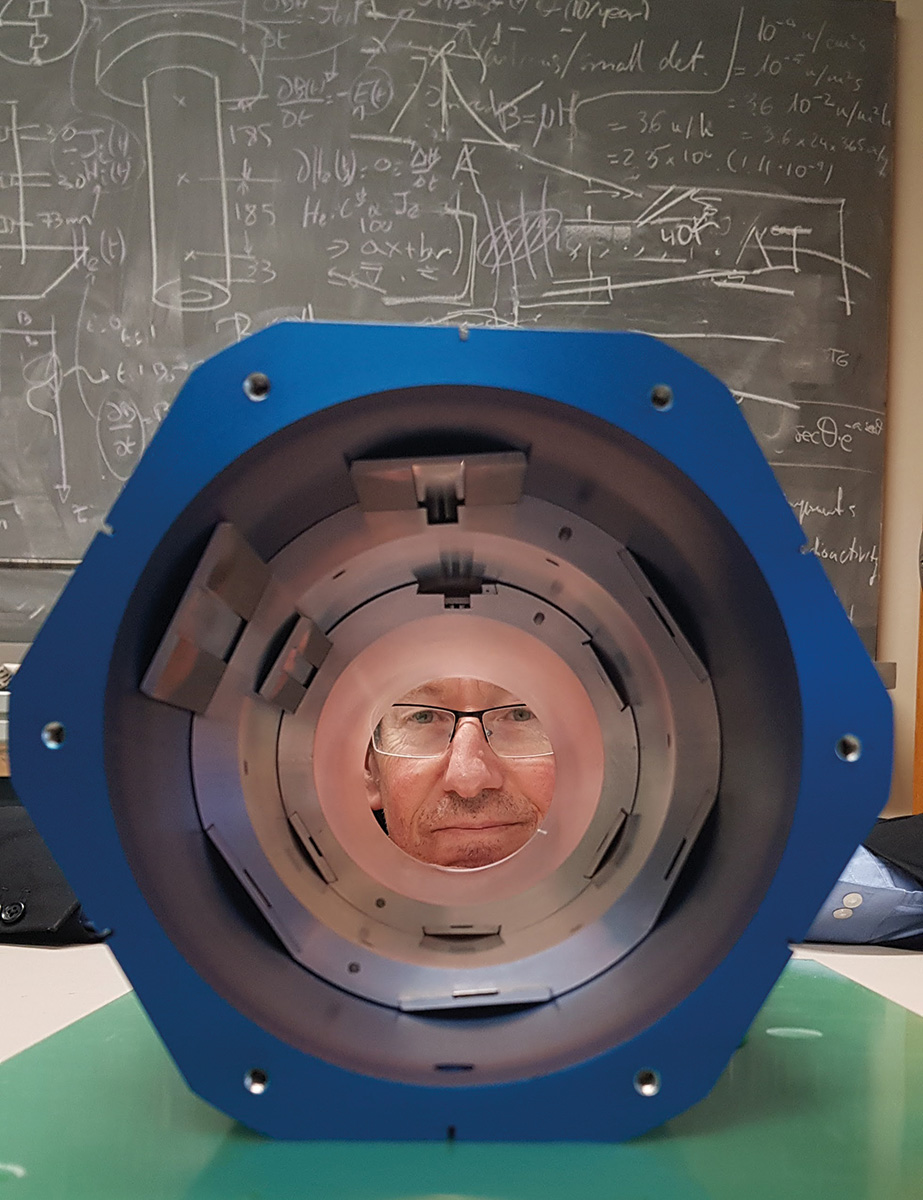
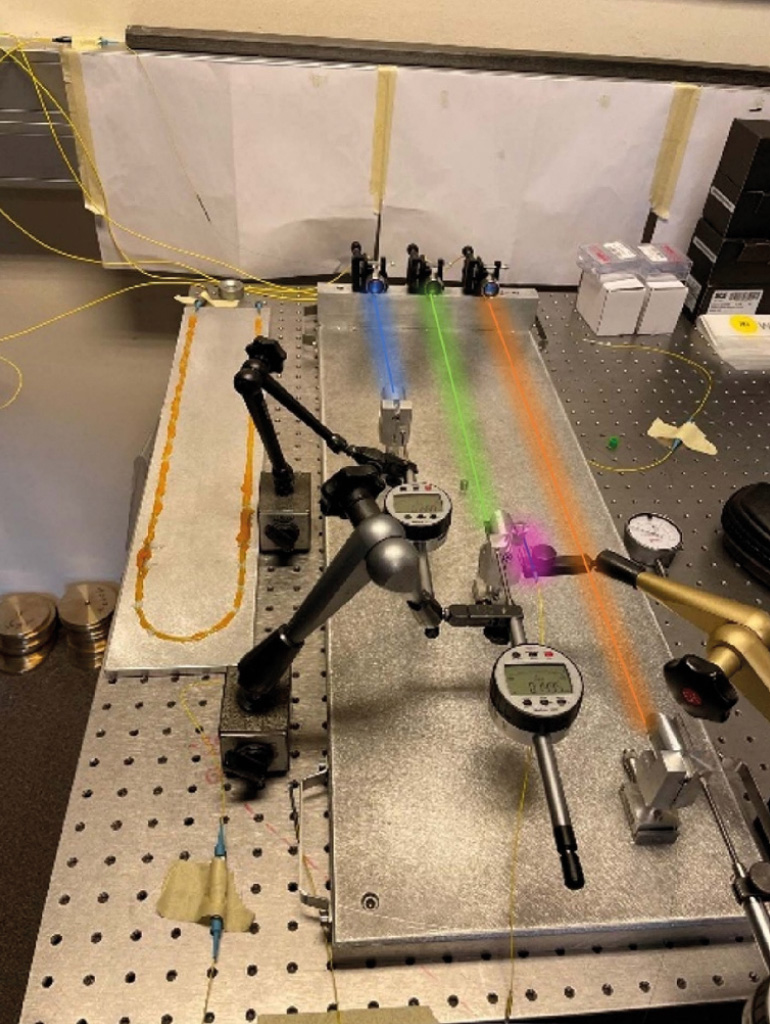
Designed to meet strict alignment requirements in the FCC-ee interaction points, the Machine Detector Interface (MDI) alignment system is a key element of the feasibility study. Challenging conditions – including extremely low temperatures, elevated radiation levels and limited space – hinder the deployment of standard survey equipment and sensors in this important region. New and exotic techniques and sensing systems have therefore been studied. The main solution, called in-lined multiplexed and distributed frequency scanning interferometry (IMD–FSI), uses an interferometer with a wavelength-sweeping laser source to measure multiple lengths along a single optical fibre, simultaneously and independently. A network of fibres can then be installed in a helical pattern to monitor the shape of components inside the MDI, such as the support of the screening solenoid. A prototype IMD–FSI system (pictured) has proved extremely promising, and the next step is a full fibre network implementation on a cylinder. This system could also be implemented in other regions of the collider, for example to monitor sensitive tunnel sections or other civil-engineering structures such as towers, dams and bridges.
To uncover the fundamental laws of the universe and its evolution is a great human endeavour. The most effective way to achieve this goal in particle physics is via powerful, high-energy accelerators. The July 2012 discovery at CERN of the Higgs boson with a mass of 125 GeV opened a door to an unknown part of the universe. The Higgs boson is not only at the heart of the Standard Model (SM) but is also at the centre of many mysteries. These include the large hierarchy between the weak and the Planck scales, the nature of the electroweak phase transition, the origin of mass, the naturalness problem, the stability of the vacuum, and many other related fundamental questions about nature beyond the SM, such as the origin of the matter–antimatter asymmetry and the nature of dark matter.
Precise measurements of the Higgs boson’s properties serve as probes into the underlying fundamental physics principles of the SM and beyond. For this reason, in September 2012 Chinese scientists proposed the Circular Electron–Positron Collider (CEPC) and the Super proton–proton Collider (SppC) as an international, large science project hosted in China to match the grand goals of particle physics, complementary to linear and muon colliders. Around the same time, physicists at CERN proposed the Future Circular Collider (FCC) staged across electron-positron (e+e–) and hadron-hadron operations.
Since then, the global high-energy physics community has reached consensus on the importance of an e+e– Higgs factory as the next collider after the LHC. In Europe, the 2020 update of the European strategy for particle physics concluded that a Higgs factory is the highest priority, while the US Snowmass 2021 community study and subsequent P5 report released in December 2023 also stressed the importance of overseas Higgs factories. CEPC scientists have actively contributed to both exercises. Meanwhile in Japan, which proposed to host an International Linear Collider (ILC) Higgs factory in 2012, a new baseline design to start at a collision energy of 250 GeV instead of 500 GeV was presented in 2017.
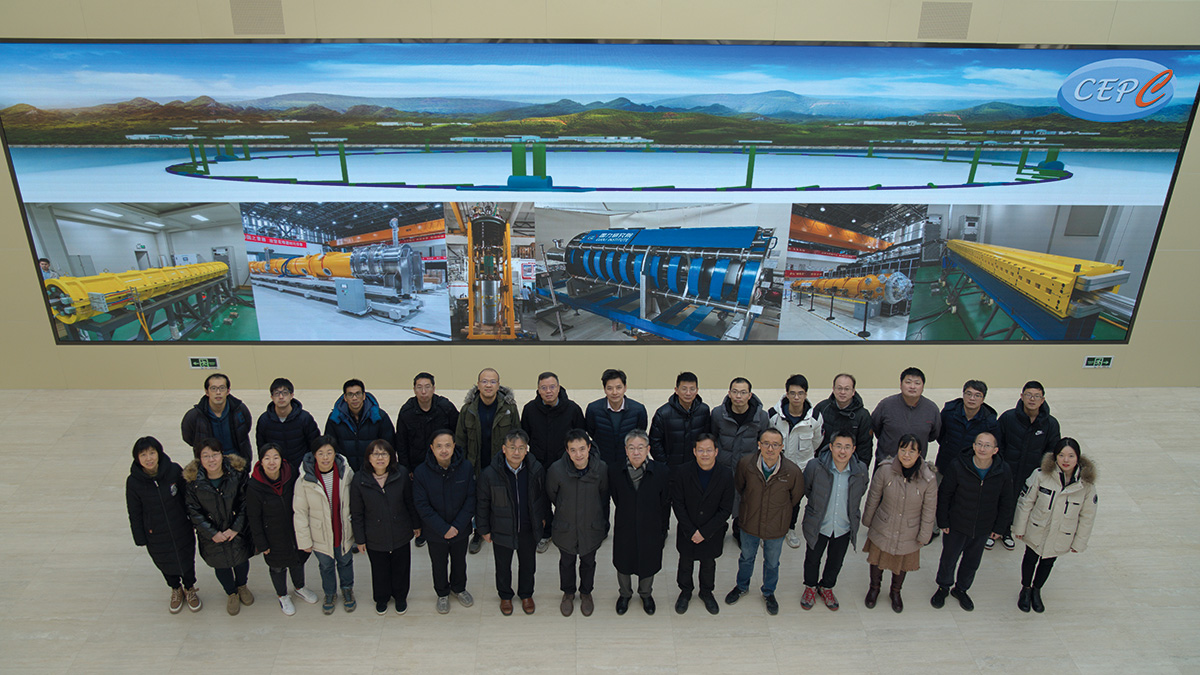
In China, both the 464th and 572th Xiangshan Science Conferences in 2013 and 2016 concluded that “CEPC is the best approach and a major historical opportunity for the national development of an accelerator-based high-energy physics programme”. In 2023, CEPC was identified as the top future particle accelerator in the planning study conducted by the Chinese Academy of Sciences (CAS). This followed an April 2022 statement by the International Committee for Future Accelerators (ICFA) that “reconfirms the international consensus on the importance of a Higgs Factory as the highest priority for realising the scientific goals of particle physics” and expressed support for Higgs-factory proposals worldwide. Five years after the publication of a conceptual design report in November 2018, a technical design report (TDR) for the CEPC accelerator – numbering more than 1000 pages and representing the first such report for a Higgs factory based on a circular collider – has now been completed.
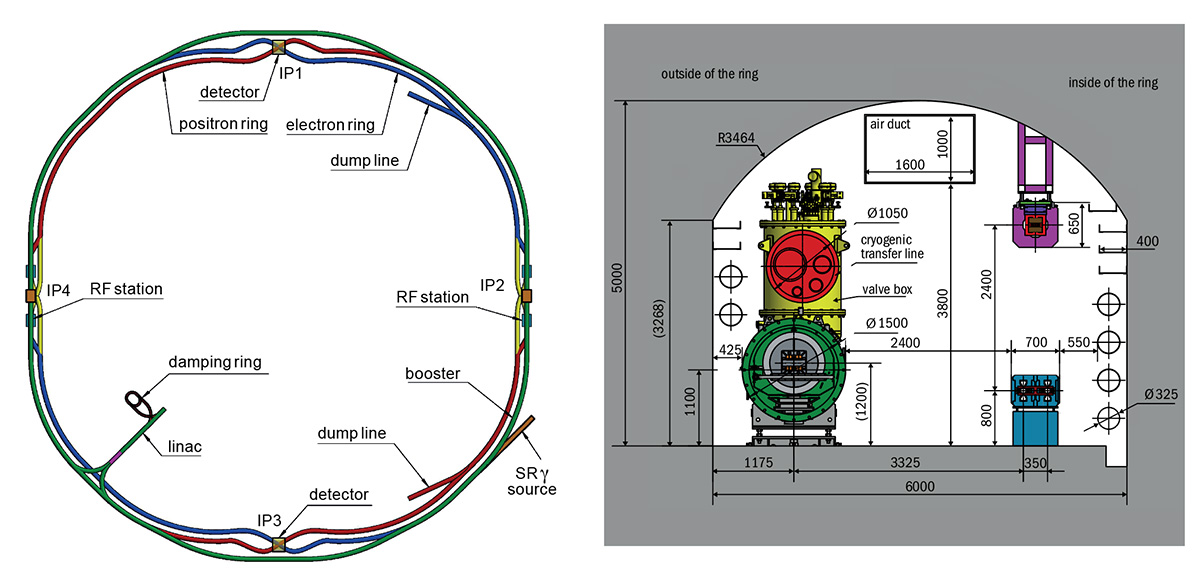
CEPC is a circular Higgs factory comprising four accelerators: a 30 GeV linac, a 1.1 GeV damping ring, a booster with an energy up to 180 GeV, and a collider operating at four different energy modes corresponding to ZH production (240 GeV), the Z-pole (91 GeV), the W+W– threshold (160 GeV) and the tt threshold (360 GeV). The machines are connected by 10 transport lines. While the linac and damping ring would be constructed on the surface, the booster and collider would be situated in an underground ring with a circumference of 100 km, reserving space for a later hadron collider, SppC.
CEPC in focus
The CEPC collider features a double-ring structure, with electron and positron beams circulating in opposite directions in separate beam pipes and colliding at two interaction points where large detectors will be installed. The 100 km-circumference full-energy CEPC booster, positioned atop the collider in the same tunnel, functions as a synchrotron featuring a 30 GeV injection energy and an extraction energy equal to the beam collision energy. To maintain constant luminosity, top-up injection will be employed. The 1.8 km-long linac, which serves as an injector to the booster, accelerates both electrons and positrons using S- and C-band radio-frequency systems, equipped with a damping ring to reduce positron emittance. As an alternative option, polarisation schemes are also under study.
A follow-up to CEPC is SppC, a proton–proton collider with a centre-of-mass energy of up to 125 TeV. The tunnel, primarily consisting of hard rock that will be excavated using either a tunnel boring machine or drill-and-blast methods, allows the SppC to be installed without removing the CEPC. This unique layout opens exciting long-term possibilities for electron–proton and electron–ion physics in addition to the CEPC’s e+e– and the SppC’s proton–proton and ion–ion physics operations. Furthermore, the CEPC would be configured to operate as a high-energy synchrotron-radiation light source with two gamma-ray beamlines, extending the usable synchrotron-radiation spectrum to unprecedented energy (from 100 keV to more than 100 MeV) and brightness ranges. The 30 GeV injection linac can also produce a high-energy X-ray free electron laser by adding an undulator.
Dedicated goals
The CEPC operation plan and physics goals follow a “10-2-1-5” scheme, dedicating 10 years as a Higgs factory, two years as a Z factory, one year as a W factory and possibly an additional five years’ operation at the ttthreshold. The four collision modes (corresponding to H, Z, WW and tt production) have a baseline synchrotron radiation power of 30 MW per beam. Luminosity upgrades are also considered by increasing the synchrotron-radiation power per beam up to 50 MW, reaching a luminosity of 8 × 1034 at 240 GeV. With the upgraded luminosity plan, 4.3 million Higgs bosons, 4.1 trillion Z bosons, 210 million W bosons and 0.6 million ttpairs would be produced in the two CEPC detectors.
After the completion of the CEPC conceptual design report, the accelerator entered a five-year-long TDR study during which the design was further optimised. The resulting report, released on 25 December 2023, emphasises the optimal luminosity, coverage of H, Z, W and ttenergies, and the full spectrum of technology R&D, civil-engineering designs, industrial and international collaborations and participation.
Smaller emittances at the interaction points have been adopted to increase the luminosities, dynamic apertures including various errors for four energies match the design goals, beam–beam and collective effects have been verified, and the machine–detector interface has been optimized with a 20 cm-diameter central beryllium pipe at the interaction points. The booster has adopted a theoretical minimum emittance-like lattice design with an injection energy raised to 30 GeV and output energy of up to 180 GeV.
CEPC accelerator R&D has been conducted in synergy with the fourth-generation 6 GeV High Energy Photon Source project at IHEP in Beijing. These R&D activities cover the collider and booster magnets, superconducting quadrupoles for the insertion regions, NEG-coated vacuum chambers, superconducting cryomodules, cryogenic systems, continuous-wavelength high-efficiency klystrons, magnet power supplies, mechanics, S-band and C-band linac and positron source, damping ring, instrumentation and feedbacks, control system, survey and alignment, radiation protection and environmental aspects.
CEPC is the best approach and a major historical opportunity for the national development of an accelerator-based high-energy physics programme
As three examples, firstly the CEPC booster 1.3 GHz 8 × 9-cell cavity cryomodule has been shown to reach a quality factor/accelerating gradient of 3.4 × 10¹⁰/23 MVm–1, surpassing the booster specification (see “CEPC technologies”, left image). Secondly, the CEPC 650 MHz one-cell cavity reached 2.3 × 10¹⁰/41.6 MVm–1 at 2 K with electrical-polishing treatment and 6.3 × 10¹⁰/31 MVm–1 with medium-temperature treatment. Thirdly, three collider-ring 650 MHz, 800 kW continuous-wavelength high-efficiency klystrons have been developed at IHEP, where the second klystron (see “CEPC technologies”, right image) has reached an efficiency of 77.2% at 849 kW in pulsed mode compared with the design value of 77% at 800 kW in CW mode. The third klystron is a multibeam klystron with a design goal of 80.5%, and its electron source is currently undergoing tests. The achievements of the CEPC accelerator TDR are also a result of strong industrial participation and contributions, via the CEPC industrial promotion consortium.
High-energy ambitions
As part of future strategic technology R&D in high-energy physics and beyond, the CEPC team has proposed an alternative beam-driven plasma injector with beam energies from 10 to 30 GeV. To develop and demonstrate the necessary plasma technologies, such as positron acceleration, staged acceleration and high beam qualities for future linear colliders, IHEP initiated a plasma acceleration experimental programme in September 2023 using the injector linac of BEPCII (a 1.89 GeV e+e– collider with a luminosity of 1033 cm–2s–1) and experimental facilities funded by CAS to the tune of RMB 0.12 billion ($17 million).
The SppC, in conjunction with the CEPC, would not only provide unprecedented precision on Higgs-boson measurements but explore a significantly larger region of the new-physics landscape, propelling our understanding of the physical world to new heights. A future hadron collider is both more costly than a Higgs factory and more technically challenging. Critical issues such as high-field (20 T or higher) superconducting magnets, synchrotron radiation in a cryogenic environment and a sophisticated beam-collimation system for quench protection must be adequately addressed before construction can begin.
High-field magnets based on high-temperature iron-based superconductors are proposed as the key development path for the SppC. This technology has a much higher magnetic field potential (>30 T) and lower cost than the NbTi/Nb3Sn technologies used nowadays, and significant progress has been made, together with industry, during the past eight years. In 2016 more than 100 m of iron-based “7-core” tape was fabricated, reaching a current density of 450 A/mm2 at 10 T and 4.2 K in 2022.
The SppC is expected to achieve a peak luminosity of 1035 cm–2s–1 per interaction point and an integrated luminosity of approximately 30 ab–1, assuming two interaction points and a runtime of 20–30 years. To further reduce the energy consumption of SppC and CEPC (which has a total power consumption of 262 MW at the ZH energy with a synchrotron-radiation power of 30 MW per beam), various countermeasures are under study.
From 2019 to 2022, CEPC accelerator activities were guided by an International Accelerator Review Committee. In June and September 2023, the CEPC accelerator international TDR and cost review were carried out at Hong Kong University of Science and Technology, while the civil-engineering cost was reviewed by a domestic committee in June 2023. The total CEPC cost is estimated at RMB 36.4 billion ($5.15 billion), with accelerator, infrastructure and experiments taking up RMB 19 billion, 10.1 billion and 4 billion, respectively. Among all the CEPC candidate sites, three – Qinhuangdao, Huzhou and Changsha – have been studied in the TDR.
At the end of October 2023, the CEPC international advisory committee supported the conclusion of the TDR review that the accelerator team is well prepared to enter an engineering design report (EDR) phase. The following month, CEPC–SppC proposals were presented at the ICFA Seminar at DESY, declaring the completion of the CEPC accelerator TDR.
Concerning the technology and status of the CEPC detectors, a full spectrum R&D programme has been carried out, spanning the pixel vertex detector, silicon tracker, time projection chamber and drift chamber, time-of-flight detector, calorimeters, high-temperature superconducting solenoid and mechanical design, among others. This R&D also benefits from past experiences with BESIII (in particular concerning the drift chamber and superconducting magnet) and from the High-Luminosity LHC upgrades for ATLAS and CMS (such as the silicon-strip detector and high-granularity calorimeter). The CEPC detector TDR reference design began in January 2024 and will be completed in mid-2025 within the EDR phase (2024–2027).
EDR and schedule
The aim is to present the CEPC proposal (including accelerator, detector and engineering) for selection by the Chinese government around 2025, with construction to start in around 2027 and to be completed around 2035. A preliminary accelerator EDR plan has been established and is to be reviewed by the International Accelerator Review Committee in 2024.
The SppC, in conjunction with the CEPC, would propel our understanding of the physical world to new heights
Concerning CEPC development towards construction, CAS is planning for China’s 15th “five-year plan” for large science projects, for which a steering committee chaired by the CAS president was established in 2022. High-energy physics and nuclear physics, one of eight fields in the plan, has selected nine proposals that have been reviewed in an open and international way. CEPC is ranked first, with the smallest uncertainties by every committee (including domestic committees and an international advisory committee). A final report has been submitted to CAS for consideration.
CEPC has always been envisioned as an international big-science project, and participation is warmly welcomed both in scientific and industrial ways. The CEPC accelerator TDR represents the efforts of thousands of domestic and overseas scientists and engineers. Such a facility would play an important role in future plans of the worldwide high-energy physics community, deepening our understanding of matter, energy and the universe to an unprecedented degree while facilitating extensive research and collaboration to explore the frontiersof technology.
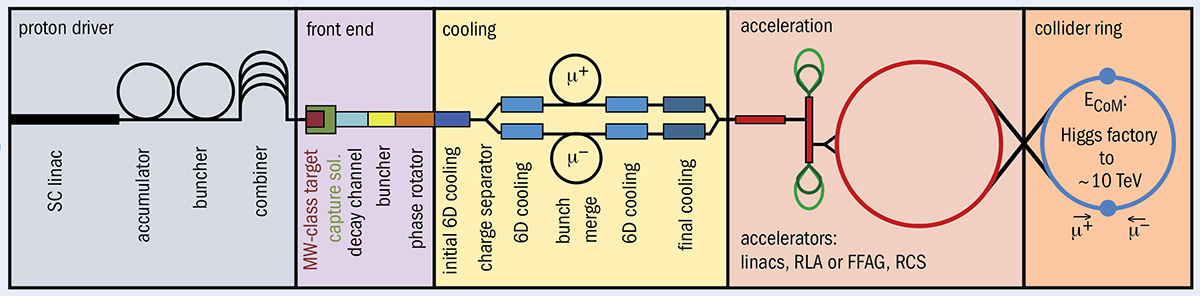
The physics landscape has changed. We have not seen signs of new particles above the Higgs-boson mass. Typical limits are now well above 1 TeV based on LHC data, which means we need to look for the new physics that we anticipate at higher energies. The consensus during the recent US Snowmass process was that we should aim for 10 TeV in the centre-of-mass. A muon collider has the feature that its expected wall-plug power scales very favourably as you go to the multi-TeV scale. While significant technology development is required to establish the overall feasibility, performance and cost of such a machine, our current performance estimates make it a very interesting candidate. This motivates an active R&D and design programme to validate this approach.
Why was the US Muon Accelerator Program (MAP) discontinued a decade ago?
MAP was approved in early 2011 to assess the feasibility of the technologies required. By 2014, the community had just discovered the Higgs boson and was focused on pursuing a Higgs factory. Mature concepts based on superconducting (ILC) and normal-conducting (CLIC) linear-collider technologies were at hand, and these approaches envisioned subsequent energy upgrades that would enable the exploration of a new-particle spectrum extending into the TeV scale. Because of the relatively low mass of the Higgs, work was also going into a large circular collider design that would represent minimal technical risk. A muon collider, a concept with much lower overall maturity level and with significantly different operating characteristics, did not appear to provide a timely path to realising the Higgs factory.
The other application of interest involving muon–accelerator technologies was the neutrino factory. However, the field concluded that a long-baseline neutrino experiment based on the “superbeam source” represented the best path forward. In a constrained budget environment, the concepts being pursued by MAP didn’t have sufficient priority and support to continue.
What do we know so far about the feasibility of a muon collider?
As the MAP effort concluded, several key R&D and design efforts were nearing completion and were subsequently published. These included demonstrations of normal-conducting RF cavities in multi-Tesla magnetic fields operating with >50 MV/m accelerating gradients, simulated 6D cooling-channel designs capable of achieving the necessary emittance cooling for collider applications, and a measurement of the cooling process at the international Muon Ionization Cooling Experiment (MICE). While MICE only characterised the performance of a partial cooling cell, the precise measurements provided by its tracking detector system confirmed that the muons behaved consistently with the cooling process as described in the simulation codes that were employed to design the cooling channel for a high-brightness muon source.
Any future collider operating at the energy frontier will have to be supported by a global development team
Another key advance was detailed simulations of the performance of a muon-collider detector in the lead-up to the last European strategy update. These efforts, utilising the beam-induced background samples prepared by MAP, demonstrated that useful physics results could be obtained with reasonable assumptions about the performance of the individual elements of the detector.
How are things going with the International Muon Collider Collaboration (IMCC)?
The IMCC, led by CERN with European funding support from the MuCol project, presently coordinates global activities towards R&D and design. The collaboration’s input has been crucial in developing the technically limited timeline towards a multi-TeV muon collider as outlined in the accelerator R&D roadmap commissioned by the European Laboratory Directors Group. The IMCC is making excellent progress towards a reference design for the muon-collider complex as well as defining a cooling demonstrator. An interim report is currently being prepared. However, current funding levels for the effort correspond to roughly half of the estimated levels required to achieve the technically limited timeline. With the strong support for pursuing an energy-frontier muon collider in the US, it is hoped that a fully global effort will be able to support the effort at levels that much more closely match the requirements of a technically limited timeline.
How does the IMCC relate to the P5 recommendations for reinvigorated muon collider R&D at Fermilab?
Any future collider operating at the energy frontier will have to be supported by a global development team, and the issue of where such a machine can be sited will depend on a complex set of circumstances that we certainly can’t predict now. The fundamental goal is to identify the technology and one or more sites where it can be deployed so that we are able to continue our exploration of the fundamental building blocks and processes in the universe for all humankind. Thus, the current IMCC activities are fully aligned with the aspiration expressed by P5 to explore the option for conducting muon collider R&D in the US and exploring the possibility of Fermilab as a host site for a future machine.
What are the key accelerator challenges to be overcome?
While there are a number of challenging subsystems to engineer, the most novel aspect of the machine remains the ionisation cooling channel. Demonstration of the beam operations of a cooling module at high beam intensity will be necessary to give us confidence that the technology is robust enough for high-energy physics applications. In addition to this absolutely unique subsystem of the muon collider, we require detailed end-to-end simulations of the overall machine performance, detailed engineering conceptual designs for all key components, and successful engineering demonstrations of suitable-scale prototypes for several critical systems. These include the target, the fast-ramping magnet system for the high-energy accelerator stages, the large-aperture collider ring magnets that must be adequately shielded against the decay products of the muon beams, and detector subsystems that can robustly operate in an environment with the beam-induced backgrounds from the muon decays.
And the detector challenges?
Tremendous progress in detector technology has resulted from the design and operation of the LHC detectors. Further progress in obtaining precision physics measurements in very high-occupancy environments as we prepare for the HL-LHC provides confidence for the detector requirements of a muon collider, which will have to deal with similar hit rates. While the details of the occupancy in the detectors for these two types of machine are not identical, the concepts being implemented for better time and spatial segmentation appear quite effective for both.
A particular feature of the muon collider detector is the “shielding nozzle” that was first introduced in MAP to protect the innermost detector elements. These nozzles impact the overall physics performance by limiting the near-axis coverage. However, with detailed detector performance studies underway, we are now in a position to carry out detailed detector and shielding studies to optimise these elements for overall physics performance.
How is the vast neutrino flux being addressed?
The very high-energy muon beams in a collider result in a narrow cone of neutrinos being produced in the forward direction as they circulate around the collider ring. When the beams are moving through dipoles, the constant change in transverse direction helps to dilute this flux, but any straight sections in the ring effectively act as a high-energy neutrino source that shines in a specific direction. The tremendous flux of neutrinos from a straight section of a TeV-scale collider are expected to create ionising radiation wherever they exit Earth’s surface. Thus, there are a set of mitigation strategies incorporated into the design effort to make sure that there are absolutely no risks. This includes minimising the number of straight sections, incorporating magnet-movers that allow the vertical trajectories of the beams to be changed slowly throughout the collider, and ensuring that the beams do not exit in populated areas.
What does the timeline for a 10 TeV muon collider look like?
We need to deliver a complete end-to-end reference design in time for the next European strategy update and for the US interim panel review that was recommended in the P5 report. A conceptual design report (CDR) for a demonstrator facility then has to be completed such that construction could begin by around 2030. Over the course of the next decade, the engineering design concepts for each subsystem have to be prepared and prototyping R&D has to be carried out, while also producing a CDR for the high-energy facility, including detailed performance simulations. By the late 2030s, the demonstrator facility and prototyping programme would enable detailed technical specifications for all key systems. Upgrades to the demonstrator facility could be necessary to further clarify performance and technical specifications. The final steps would be to complete a technical design that incorporates results from the demonstrator programme and to develop site-specific plans for the labs that would like to be considered as potential hosts for the facility. The start of 10 TeV collider operations would then be guided by a physics-driven plan, including potential intermediate stages, but likely at least a decade after construction approval.
The current schedule puts physics operations of a high-energy muon collider about five years earlier than an FCC-ee. Is this realistic?
I would characterise these two timelines as being of different types. The FCC-ee timeline is based on an integrated plan for CERN, while the 3 TeV muon collider is explicitly a technically limited plan which assumes that a sufficient funding profile can be provided, and that there are no external constraints that could impact deployment. In other words, the muon-collider timeline remains an aspiration, whereas the FCC-ee timeline attempts to build-in actual deployment constraints.
What is the estimated cost of a 10 TeV muon collider?
At present, the cost estimates rely on broad extrapolations from existing collider systems. While these extrapolations suggest that a multi-TeV muon collider may well be one of the most cost-effective routes to the energy frontier, the uncertainties remain large. To deliver a “realistic” cost estimate, we will require a complete end-to-end reference design, engineering conceptual designs for all of the unique systems required, detailed cost estimates for the engineering conceptual designs and extrapolated cost estimates for the remaining “standard” accelerator systems. With the present technically limited schedule as prepared by the IMCC, this would suggest that a detailed and realistic cost estimate could be available around the end of this decade.
How does a high-energy muon collider fit into the global picture?
There are multiple ways this can fit. At present, we need to acknowledge that the R&D for the magnets for a high-energy proton–proton machine, such as those being pursued in Europe and China, still require an extensive R&D programme. This is likely a multi-decade effort in and of itself, and is commensurate with the timescales needed to carry out muon-collider R&D and design work. Having more than one technology option on the table to achieve our ultimate physics goals is a necessity. Furthermore, the complementarity between lepton- and hadron-collider paths may be needed to support our overarching scientific goals.
A detailed and realistic cost estimate could be available around the end of this decade
From a somewhat different point of view, the potential applications of a high-intensity muon source extend beyond colliders. The technology offers improved performance and new opportunities for other scientific goals such as a high-performance source for future neutrino and charged lepton flavour violation experiments, materials science and active interrogation of complex structures, among others. Clarifying the broader context for the technology is currently being pursued within the IMCC effort.
The Open Web Search project was started by a group of people who were concerned that navigation in the digital world is led by a handful of big commercial players (the European search market is largely dominated by Google, for example), who don’t simply offer their services out of generosity but because they want to generate revenue from advertisements. To achieve that they put great effort into profiling users: they analyse what you are searching for and then use this information to create more targeted adverts that create more revenue for them. They also filter search results to present information that fits your world view, to make sure that you come back because you feel at home on those web pages. For some people, and for the European Commission in the context of striving for open access to information and digital sovereignty, as well as becoming independent of US-based tech giants, this is a big concern.
How did the project come about?
In 2017 the founder of the Open Search Foundation reached out to me because I was working on CERN’s institutional search. He had a visionary idea: an open web index that is free, accessible to everyone and completely transparent in terms of the algorithms that it uses. Another angle was to create a valuable resource for building future services, especially data services. Building an index of the web is a massive endeavour, especially when you consider that the estimated total number of web pages worldwide is around 50 billion.
You could argue that unbiased, transparent access to information in the digital world should be on the level of a basic right
A group of technical experts from different institutes and universities, along with the CERN IT department, began with a number of experiments that were used to get a feel for the scale of the project. For example, to see how many web pages a single server can index and to evaluate the open source projects used for crawling and indexing web pages. The results of these experiments were highly valuable when it came to replying to the Horizon Europe funding call later on.
In parallel, we started a conference series, the Open Search Symposia (OSSYM). Two years ago there was a call for funding in the framework of the European Union (EU) Horizon Europe programme dedicated to Open Web search. Together with 13 other institutions and organisations, the CERN IT department participated and we were awarded a grant. We were then able to start the project in September 2022.
What are the technical challenges in building a new search engine?
We don’t want to copy what others are doing. For one, we don’t have the resources to build a new, massive data centre. The idea is a more collaborative approach, to have a distributed system where people can join depending on their means and interests. CERN is leading work-package five “federated data infrastructure”, in which we
and our four infrastructure partners (DLR and LRZ in Germany, CSC in Finland and IT4I in the Czech Republic) provide the infrastructure to set up the system that will ultimately allow the index itself to be built in a purely distributed way. At CERN we are running the so-called URL frontier – a system that oversees what is going on in terms of crawling and preparing this index, and has a long list of URLs that should be collected. When running the crawlers, they report back on what they have found on different web pages. It’s basically bookkeeping to ensure that we coordinate activities and don’t duplicate the efforts already made by others.
Open Web Search is said to be based on European values and jurisdiction. Who and what defines these?
That’s an interesting question. Within the project there is a dedicated work package six titled “open web search ecosystem and sustainability” that covers the ethical, legal and societal aspects of open search and addresses the need for building an ecosystem around open search, including the proper governance processes for the infrastructure.
The legal aspect is quite challenging because it is all new territory. The digital world evolves much faster than a legislator can keep up! Information on the web is freely available to anyone, but the moment you start downloading and redistributing it you are taking on ownership and responsibility. So you need you take copyright into account, which is regulated by most EU countries. Criminal law is more delicate in terms of the legal content. Every country has its own rules and there is no conformity. Overall, European values include transparency, fairness for data availability and adhering to democratic core principles. We are aiming at including these European values into the core design of our solution from the very beginning.
What is the status of the project right now?
The project was launched just over a year ago. On the infrastructure side the aim was to have the components in place, meaning having workflows ready and running. It’s not fully automated yet and there is still a lot of challenging work to do, but we have a fully functional set-up, so some institutes have been able to start crawling; they feed the data and it gets stored and distributed to the participating infrastructure partners including CERN. At the CERN data centre we coordinate the crawling efforts and provide advanced monitoring. As we go forward, we will work on aspects of scalability so that there won’t be any problems when we go bigger.
What would a long-term funding model look like for this project?
You could argue that unbiased, transparent access to information in the digital world that has become so omnipresent in our daily lives should be on the level of a basic right. With that in mind, one could imagine a governmental funding scheme. Additionally, this index would be open to companies that can use it to build commercial applications on top of it, and for this use-case a back-charging model might be suitable. So, I could imagine a combination of public and usage-based funding.
In October last year the Open Search Symposium was hosted by the CERN IT department. What was the main focus there?
This is purposely not focused on one single aspect but is an interdisciplinary meeting. Participants include researchers, data centres, libraries, policy makers, legal and ethical experts, and society. This year we had some brilliant keynote speakers such as Věra Jourová, the vice president of the European Commission for Values and Transparency, and Christoph Schumann from LAION, a non-profit organisation that looks to democratise artificial intelligence models.
Ricardo Baeza-Yates (Institute for Experiential Artificial Intelligence, Northeastern University) gave a keynote speech about “Bias in Search and Recommender Systems” and Angella Ndaka (The Centre for Africa Epistemic Justice and University of Otago) talked about “Inclusion by whose terms? When being in doesn’t mean digital and web search inclusion”, the challenges of providing equal access to information to all parts of the world. We also had some of the founders of alternative search engines joining, and it was very interesting and inspiring to see what they are working on. And we had representatives from different universities looking at how research is advancing in different areas.
I see the purpose of Open Web Search as being an invaluable investment in the future
In general, OSSYM 2023 was about a wide range of topics related to internet search and information access in the digital world. We will shortly publish the proceedings of the nearly 25 scientific papers that were submitted and presented.
How realistic is it for this type of search engine to compete with the big players?
I don’t see it as our aim or purpose to compete with the big players. They have unlimited resources so they will continue what they are doing now. I see the purpose of Open Web Search as being an invaluable investment in the future. The Open Web Index could pave the way for upcoming competitors, creating new ideas and questioning the monopoly or gatekeeper roles of the big players. This could make accessing digital information more competitive and a fairer marketplace. I like the analogy of cartography: in the physical world, having access to (unbiased) maps is a common good. If you compare maps from different suppliers you still get basically the same information, which you can rely on. At present, in the digital world there is no unbiased, independent cartography available. For instance, if you look up the way to travel from Geneva to Paris online, you might have the most straightforward option suggested to you, but you might also be pointed towards diversions via restaurants, where you then might consider stopping for a drink or some food, all to support a commercial interest. An unbiased map of the digital world should give you the opportunity to decide for yourself where and how you wish to get to your destination.
The project will also help CERN to improve its own search capabilities and will provide an open-science search across CERN’s multiple information repositories. For me, it’s nice to think that we are helping to develop this tool at the place where the web was born. We want to make sure, just as CERN gave the web to the world, that this is a public right and to steer it in the right direction.
Spin-polarised particle beams are commonly used in particle and nuclear physics to test the Standard Model or to map out hadronic resonances. Until now, their production has relied on conventional radio-frequency-based accelerators. Laser–plasma interactions and beam-driven plasma acceleration have been shown to be feasible methods for obtaining high-energy particle beams over much shorter distances. Despite much progress in understanding the underlying phenomena of plasma-based acceleration, however, its ability to produce polarised beams has remained unproven.
Ten years ago, a group from Forschungszentrum Jülich and Heinrich-Heine University Düsseldorf in Germany proposed a concept for producing highly polarised electron, proton or ion beams through plasma acceleration based on the use of polarised targets. Here the spins of the particles to be accelerated are already aligned before plasma formation. Although the method seems simple in principle, it requires careful consideration of various technical challenges associated with maintaining and utilising polarisation in a plasma environment. After all, spin alignments typically require low temperatures, making it counter-intuitive that they could endure in a 108 K plasma for long enough to have practical applications.
A 2020 theoretical study of the scaling laws for the depolarisation times revealed the feasibility of polarised particle acceleration in strong plasma fields. Dozens of numerical simulations led to the conclusion that polarised beams from plasma acceleration should be within reach, with hadron beams requiring the simplest implementation. This is because hadrons have much smaller magnetic moments and, therefore, their spin alignment in the plasma magnetic fields is much more inert compared to electrons. Also, from the target point-of-view, polarised nuclei can be provided more easily than electrons.
In an experiment at the PHELIX petawatt laser at GSI Darmstadt, the Jülich–Düsseldorf group has now provided the first evidence for an almost complete persistence of nuclear polarisation after plasma acceleration to MeV energies. The group used an up-to 50% polarised 3He gas-jet target, which was irradiated by 2.2 ps laser pulses each with an energy of about 50 J. The polarisation of the accelerated 3He ions was measured with two identical polarimeters, optimised for short ion bunches from plasma acceleration and mounted perpendicular to the laser axis. For those cases where the nuclear spins in the target gas were aligned perpendicular to the flight direction of the helium ions, an angular asymmetry of the scattered particles in the polarimeters was observed, which is in line with a transversal polarisation of the accelerated 3He ions. No such asymmetries were found for the unpolarised gas.
The team now plans to repeat the experiments at PHELIX with higher gas polarisation and the use of a shorter (0.5 mm instead of 1.0 mm) gas-jet target. This would have the advantage that the 3He ions are dominantly emitted in the direction of the laser beam and at significantly higher energies (10–15 MeV). “For even higher laser intensities (> 10 PW), we have proposed a scheme based on shock acceleration to produce > 100 MeV polarised 3He beams,” says Markus Büscher of Jülich. “Also, a polarised hydrogen-chloride gas target for laser- or beam-driven acceleration of polarised proton and electron beams is being developed.”
Plastic scintillator detectors are used extensively in high-energy physics experiments because they are cost-effective and enable sub-ns particle tracking and calorimetry. The next generation of plastic-scintillator detectors aims to instrument large active volumes with a fine 3D segmentation, raising major challenges for both production and assembly. One example is the two-tonne “super fine-granularity detector”, an active target made of two million 1 × 1 × 1 cm3 scintillating cubes at the T2K neutrino experiment in Japan. Scaling up this intricate workflow or aiming for more precise segmentation calls for technological innovation.
Enter the 3DET (3D printed detector) R&D collaboration at CERN. Also involving ETH Zurich, the School of Management and Engineering Vaud in Yverdon-les-Bains and the Institute for Scintillation Materials in Ukraine, 3DET is advancing additive-manufacturing methods to create plastic scintillator detectors that do not require post-processing and machining, thereby significantly streamlining the assembly process.
The 3DET collaboration has now passed a major milestone with a completely 3D-printed monolithic detector comprising active plastic scintillator cubes, the reflective coating to make the cubes optically independent, and the holes to insert wavelength-shifting optical fibres through the whole structure. Without the need for additional production steps, the prototype can be instrumented with fibres, photocounters and readout electronics right after the printing process to produce a working particle-physics detector. The team used the device to image cosmic rays with a scintillation light yield and cube-to-cube optical separation of the same quality as state-of-the-art detectors, and the results were confirmed with beam tests at the T9 area.
“This achievement represents a substantial advance in facilitating the creation of intricate, monolithic geometries in just one step. Moreover, it demonstrates that upscaling to larger volumes should be easy, cheaper and may be produced fast,” write authors Davide Sgalaberna and Tim Weber of ETH Zurich. “Applications that can profit from sub-ns particle tracking and calorimetry in large volumes will be massive neutrino detectors, hadronic and electromagnetic calorimeters or high-efficiency neutron detectors.”
To provide the best experiences, we use technologies like cookies to store and/or access device information. Consenting to these technologies will allow us to process data such as browsing behavior or unique IDs on this site. Not consenting or withdrawing consent, may adversely affect certain features and functions.
Functional
Always active
The technical storage or access is strictly necessary for the legitimate purpose of enabling the use of a specific service explicitly requested by the subscriber or user, or for the sole purpose of carrying out the transmission of a communication over an electronic communications network.
Preferences
The technical storage or access is necessary for the legitimate purpose of storing preferences that are not requested by the subscriber or user.
Statistics
The technical storage or access that is used exclusively for statistical purposes.The technical storage or access that is used exclusively for anonymous statistical purposes. Without a subpoena, voluntary compliance on the part of your Internet Service Provider, or additional records from a third party, information stored or retrieved for this purpose alone cannot usually be used to identify you.
Marketing
The technical storage or access is required to create user profiles to send advertising, or to track the user on a website or across several websites for similar marketing purposes.