On 13 February, US President Barack Obama unveiled his administration’s budget request for fiscal year 2013, which begins on 1 October 2012. The budget for the Department of Energy’s Office of Science would increase by 2.4 per cent to $4.992 billion, but high-energy physics would be reduced by 1.8 per cent to $777 million. In the next step, the two chambers of the US Congress will take up the negotiations to arrive at a final budget.
The proposed cuts in high-energy physics would hit two long-term programmes the hardest: the Long-Baseline Neutrino Experiment (LBNE) and the US R&D programme for the International Linear Collider (ILC). The budget for LBNE would drop to $10 million from $21 million in the current year. The collaboration had requested an increase to advance its plans to search for CP-violation in neutrino interactions by sending neutrinos from Fermilab to a detector in South Dakota (Steps forward for new long-baseline experiment).
Funding for the US ILC R&D programme is eliminated in the request, a cut of $20 million. While the current ILC R&D phase will end this year, the next phase would have helped to advance accelerator technologies that would benefit projects such as Fermilab’s Project X proton accelerator and Berkeley’s Next-Generation Light Source.
Some programmes would fare much better. Funding for non-accelerator physics programmes would increase by $13 million to ramp-up engineering and design efforts for the Large Synoptic Survey Telescope camera project and R&D funding for next-generation dark-matter experiments. The US contribution to the upgrades of the Belle-II detector at KEK in Japan would remain on track, along with near-term neutrino and muon research programmes at Fermilab.
New members of the top-level management talk to Antonella Del Rosso about the CMS model for running a large collaboration, as they prepare for the start of the LHC’s run in 2012.
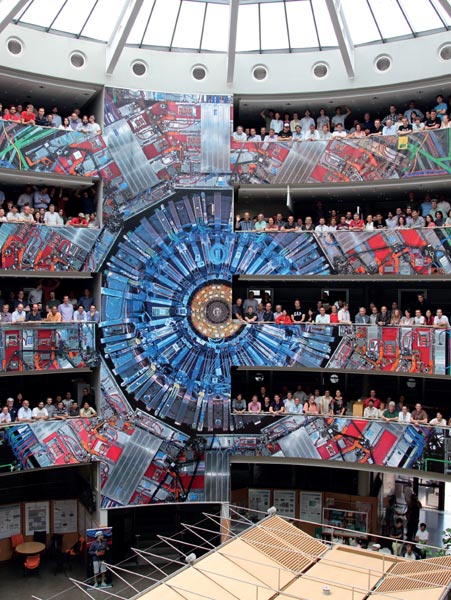
Trying to uncover the deepest mysteries of the universe is no trivial task. Today, the scientific collaborations that accept the challenge are huge, complex organizational structures that have their own constitution, strict budget control and top management. CMS, one of two general-purpose experiments that study the LHC collisions, provides a good example of how this type of scientific complexity can be dealt with.
The collaboration has literally thousands of heroes
Tiziano Camporesi
The CMS collaboration currently has around 4300 members, with more than 1000 new faces joining in the past three years. Together they come from some 170 institutes in 40 countries and six continents. Each institute has specific tasks to complete, which are agreed with the management leading the collaboration. “The collaboration is evolving all of the time. Every year we receive applications from five or so new institutes that wish to participate in the experiment,” says Joe Incandela of the University of California Santa Barbara and CERN, who took over as spokesperson of the CMS collaboration at the start of 2012. “The Collaboration Board has the task of considering those applications and taking a decision after following the procedures described in the CMS constitution. All of the participating institutes are committed to maintaining, operating, upgrading and exploiting the physics of the detector.”
Once they become full members of the collaboration, all institutes are represented on the Collaboration Board – the true governing body of CMS. (In practice, small institutes join together and choose a common representative.) The representatives can also vote for the spokesperson every two years. “To manage such a complex structure that must achieve very ambitious goals, the collaboration has so far always sought a spokesperson from among those people who have contributed to the experiment in some substantial way over the years and who have demonstrated some managerial and leadership qualities,” notes deputy-spokesperson Tiziano Camporesi of CERN . “We often meet film-makers or journalists who tell us that they want to feature a few people. They want to have ‘stars’ who can be the heroes of the show but we always tell them that the collaboration has literally thousands of heroes. I have often heard it said that we are like an orchestra: the conductor is important but the whole thing only works if every single musician plays well.”
Although two years may seem to be a short term, Joao Varela – who is a professor at the Instituto Superior Técnico of the Technical University of Lisbon and also deputy-spokesperson – believes that there are many positive aspects in changing the top management rather frequently. “The ‘two-years scheme’ allows CMS to grant this prestigious role to more people over time,” he says. “In this way, more institutes and cultures can be represented at such a high level. There is a sense of fairness in the honour being shared across the whole community. Moreover, each time a new person comes in, by human nature he/she is motivated to bring in new ideas.”
As good as the idea is to rotate people in the top management, the CMS collaboration is currently analysing the experience already accumulated to see if things can be improved. “So far deputies have always been elected as spokespersons and this has ensured continuity even during the short overlap. I was myself in physics co-ordination, then deputy and finally spokesperson. Even so, I am learning many new things every day,” points out Incandela.
At CMS the spokesperson also nominates his/her deputies and many of the members of the Executive Board, which brings together project managers and activity co-ordinators. “The members of the Executive Board are responsible for most of the day-to-day co-ordination work that is a big part of what makes CMS work so well,” explains Incandela. “Each member is responsible for managing an organization with large numbers of people and a considerable budget in some cases. Historically, the different projects and activities were somewhat isolated from one another, so that members of the board didn’t really have a chance or need to follow what the other areas were doing. With the start of LHC operations in 2008 this began to change and now people focus on broader issues.” To improve communication among the members of the Executive Board, the new CMS management also decided to organize workshops. “These have turned out to be fantastic events,” says Camporesi. “At the meetings, we discuss important and broad issues openly, from what is the best way to do great physics to how to maintain high morale and attract excellent young people to the collaboration.”
To keep the whole collaboration informed about the outcomes of such strategic meetings and other developments in the experiment in general, the CMS management organizes weekly plenary meetings. “I report once a week to the whole collaboration: we typically have anywhere from 50 to 250 people attending, plus 100–200 remote connections. We are a massive organization and the weekly update is a quick and useful means of keeping everybody informed,” adds Incandela.
The scientific achievements of CMS prove not only that a large scientific collaboration is manageable but also that it is effective. In January this year a new two-year term began for the CMS collaboration, which also renewed all of the members of top management. This is a historic moment for the experiment because many potential discoveries are in the pipeline. “This is my third generation of hadron collider – I participated in the UA2 experiment at CERN’s SPS, CDF at Fermilab’s Tevatron and now CMS at the LHC. When you are proposing a new experiment and then building it, the focus is entirely on the detector,” observes Incandela. “Then, when the beam comes, attention moves rapidly to the data and physics. The collaboration is mainly interested in data and the discoveries that we hope to make. We must ensure the high performance of the detector while providing the means for extremely accurate but quick data analysis. However, although almost everything works perfectly, there are already many small things in the detector that need repairing and upgrading.”
It is obviously important if we discover things. But is also important if we don’t see anything
Joao Valera
The accelerator settings for the LHC’s 2012 run, decided at the Chamonix Workshop in February, will mean that CMS has to operate in conditions that go beyond the design target. “The detector will face tougher pile-up conditions and our teams of experts have been working hard to ensure that all of the subsystems work as expected. It looks like the detector can cope with conditions that are up to 50% higher than the design target”, confirms Camporesi. “Going beyond that could create serious issues for the experiment. We observe that the Level1 trigger starts to be a limitation and the pixel detector starts to lose data, for instance.” CMS is already planning upgrades to improve granularity and trigger performance to cope with the projected higher luminosity beyond 2014.
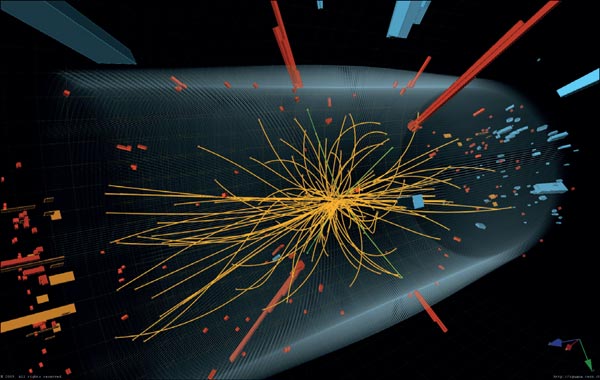
Going to higher luminosity may be a big technical challenge but it does mean reducing the times to discoveries. “The final word on the Higgs boson is within reach, now measurable in terms of months rather than years. And for supersymmetry, we are changing the strategy. In 2010–2011, we were essentially searching for supersymmetric partners of light quarks because they were potentially more easily accessible. This approach didn’t yield any fruit but put significant constraints on popular models. A lot of people were discouraged,” explains Varela. “However, what we have not ruled out are possible relatively light supersymmetric partners of the third-generation quarks. The third generation is a tougher thing to look for because the signal is smaller and the backgrounds can be higher. By increasing the energy of the collisions to 4 TeV one gains 50–70% in pair production of supersymmetric top, for instance, while the top-pair background rises by a smaller margin. Having said this, and given the unexplored environment, it is obviously important if we discover things. But it is also important if we don’t see anything.”
There is a long road ahead because the searches will continue at higher LHC energies and luminosities after 2014, but the CMS collaboration plans to be well prepared.
The first “high-energy” accelerators were constructed more than 80 years ago. No doubt they represented technological challenges and major achievements even though, seen from a 2012 perspective, the projects involved only a few people and small hardware set-ups. For many of us, making a breakthrough with just a few colleagues and some new equipment feels like a dream from a different era. Nowadays, frontier research in particle physics requires huge infrastructures that thrill the imagination of the general public. While people often grasp only a fraction of the physics at stake, they easily recognize the full extent of the human undertaking. Particle-physics experiments and accelerators are, indeed, miracles of technology and major examples of worldwide co-operation and on-site teamwork.
Looking ahead
Studies on future accelerators and particle-physics experiments at the energy or luminosity frontier now span several decades and involve hundreds, if not thousands, of participants. This means that, while progress is made with the technical developments for a future facility, the physics landscape continues to evolve. The key example of this is the way that current knowledge is evolving quickly thanks to measurements at the LHC. As a result, it is impossible to predict decades in advance what the best machine option will be to expand our knowledge. Pursuing several options and starting long-term R&D well in advance is therefore essential for particle physics because it allows the community to be prepared for the future and to make informed decisions when the right moments arise.
For the post-LHC era, several high-energy accelerator options are already under study. Beyond high-luminosity extensions of the LHC programme, new possibilities include: a higher-energy proton collider in the LHC tunnel, as well as various electron–positron colliders, such as the International Linear Collider (ILC) and the Compact Linear Collider (CLIC); and a muon collider. There is typically much cross-fertilization and collaboration between these projects and there is no easy answer when it comes to identifying who has contributed to a particular project.
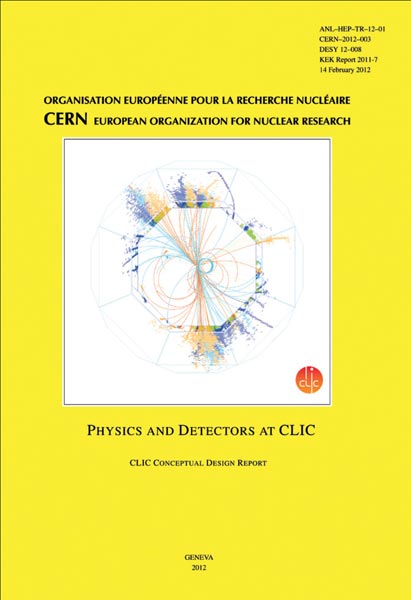
When, some months ago, we were discussing the authoring of the CLIC conceptual design report, we faced exactly such a dilemma. The work on the CLIC concept has been ongoing for more than two decades – clearly with a continuously evolving team. On the other hand, the design of an experiment for CLIC has drawn heavily on studies carried out for experiments at the ILC, which in turn have used results from earlier studies of electron–positron colliders. Moreover, we also wanted both the accelerator studies and the physics and detector studies to be authored by the same list.
We looked at how others had dealt with this dilemma and found that in some cases, such as in the early studies for LHC experiments, protocollaborations were taken as a basis for authoring, while others, such as the TESLA and Super-B projects, have invited anyone who supports the study to sign. For the CLIC conceptual design report we opted for a list of “signatories”. Those who have contributed to the development are invited to sign alongside those wishing to express support for the study and the continuation of the R&D. Here non-exclusive support is meant: signing-up for CLIC is not in contradiction with supporting other major collider options under development.
The advantage of the signatories list is that it provides the opportunity to cover a broader range of personal involvements and avoids excluding anyone who feels associated or has been associated with the study. The drawback of our approach is that the signatories list does not pay tribute in a clear way to individual contributions to the study. This recognition has to come from authoring specialized notes and publications that form the basis of what is written in the report.
The signatories list covers both the CLIC accelerator and the report for the physics and detector conceptual design. Already exceeding 1300 names in February, it demonstrates that – even if all eyes are on LHC results – simultaneous R&D for the future is considered important.
Are there better ways of doing this? As the projects develop, the teams are becoming more structured and this helps – at least partly – towards creating appropriate author lists. The size of the teams and the particular timescale of the projects will, however, remain much larger than the first accelerator projects in our field, and it is likely that striking the right balance between openness and inclusiveness and, on the other hand, restrictions and procedures in this matter will continue to be a difficult subject.
By A M Zagoskin Cambridge University Press
Hardback: £45 $80
E-book: $64
Quantum engineering has emerged as a field with important potential applications. This book provides a self-contained presentation of the theoretical methods and experimental results in quantum engineering. It covers topics such as the quantum theory of electric circuits, the quantum theory of noise and the physics of weak superconductivity. The theory is complemented by up-to-date experimental data to help put it into context.
By Tommy Ohlsson Cambridge University Press
Hardback: £38 $65
E-book: $52
Quantum physics and special relativity theory were two of the greatest breakthroughs in physics during the 20th century and contributed to paradigm shifts in physics. This book combines these two discoveries to provide a complete description of the fundamentals of relativistic quantum physics, guiding the reader from relativistic quantum mechanics to basic quantum field theory. It gives a detailed treatment of the subject, beginning with the classification of particles, the Klein–Gordon equation and the Dirac equation. Exercises and problems are featured at the end of most chapters.
By Kai Zuber CRC Press
Hardback: £82
E-book: $129.95
When Kai Zuber’s text on neutrinos was published in 2003, the author correctly predicted that the field would see tremendous growth in the immediate future. Now, revised and expanded to include the latest research, conclusions and implications, Neutrino Physics, Second Edition delves into neutrino cross-sections, mass measurements, double-beta decay, solar neutrinos, neutrinos from supernovae and high-energy neutrinos, as well as new experimental results in the context of theoretical models. It also provides an entirely new discussion on the resolution of the solar-neutrino problem, the first real-time measurement of solar neutrinos below 1 MeV, geoneutrinos and long-baseline accelerator experiments.
By Laurent Lellouch, Rainer Sommer, Benjamin Svetitsky, Anastassios Vladikas and Leticia F Cugliandolo Oxford University Press
Hardback: £47.50 $85.50
This book is based on the lectures delivered at the XCIII Session of the École de Physique des Houches, held in August 2009. The aim of the event was to familiarize the new generation of PhD students and postdoctoral fellows with the principles and methods of modern lattice field theory, which aims to resolve fundamental, non-perturbative questions about QCD without uncontrolled approximations. The emphasis is on the theoretical developments that have shaped the field and turned lattice gauge theory into a robust approach to the determination of low-energy hadronic quantities and of fundamental parameters of the Standard Model.
By Valeri P Frolov and Andrei Zelnikov Oxford University Press
Hardback: £55 $98.50
For many years, black holes have been considered interesting solutions of the theory of general relativity with a number of amusing mathematical properties. Now, following the discovery of astrophysical black holes, Einstein’s gravity has become an important tool for their study. This text combines physical, mathematical and astrophysical aspects of black-hole theory. It also contains “standard” material on black holes as well as new subjects, such as the role of hidden symmetries in black-hole physics, and black holes in space–times with large extra dimensions.
By S Giani, C Leroy and P G Rancoita (eds.) World Scientific
Hardback: £137 $210
E-book: $273
The 12th ICATPP conference was aimed at promoting contacts between scientists involved in solar-terrestrial physics, space physics, astroparticle physics and cosmology from both the theoretical and the experimental approaches. The conference was devoted to physics and the physics requirements; a survey of theoretical models and performances of detectors; astroparticle physics; astrophysics research; and the space environment. It also covered the use of cosmic rays to extend the scientific research experience to teachers and students with air-shower arrays and other techniques.
By R Ragaini (eds.) World Scientific
Hardback: £112 $170
E-book: $221
This volume in The Science and Culture Series: Nuclear Strategy and Peace Technology, edited by Antonino Zichichi, is the proceedings of a seminar focusing on planetary emergencies that was held in Erice in August 2010. Talks ranged from “The Evolving Nuclear Weapon Threat to Society” by Richard L Garwin to “Carbon Dioxide, Friend or Foe” by William Happer. Scientists in all fields, politicians and decision-makers in ministries of foreign affairs, science and interior and security, as well as international organizations, will find this an interesting resource.
To provide the best experiences, we use technologies like cookies to store and/or access device information. Consenting to these technologies will allow us to process data such as browsing behavior or unique IDs on this site. Not consenting or withdrawing consent, may adversely affect certain features and functions.
Functional
Always active
The technical storage or access is strictly necessary for the legitimate purpose of enabling the use of a specific service explicitly requested by the subscriber or user, or for the sole purpose of carrying out the transmission of a communication over an electronic communications network.
Preferences
The technical storage or access is necessary for the legitimate purpose of storing preferences that are not requested by the subscriber or user.
Statistics
The technical storage or access that is used exclusively for statistical purposes.The technical storage or access that is used exclusively for anonymous statistical purposes. Without a subpoena, voluntary compliance on the part of your Internet Service Provider, or additional records from a third party, information stored or retrieved for this purpose alone cannot usually be used to identify you.
Marketing
The technical storage or access is required to create user profiles to send advertising, or to track the user on a website or across several websites for similar marketing purposes.