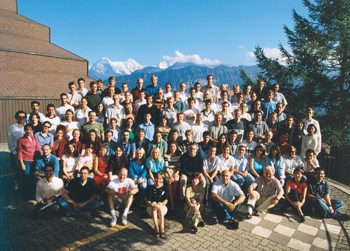
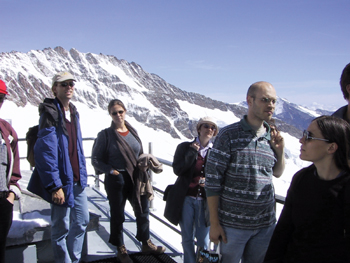
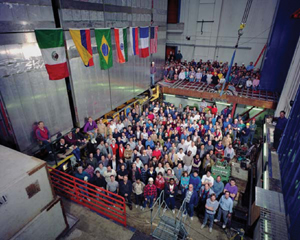
For the first time since its inception nearly 40 years ago, the European School of High-Energy Physics was held in Switzerland at Beatenberg in the Bernese Oberland. Running from 26 August to 8 September, it attracted 95 students from 30 countries. This year’s event was organized in association with the University of Bern, with Klaus Pretzl as school director. Funds for students from former Soviet Union countries came from the INTAS international association.
These schools have become a major event in the particle physics calendar. The tradition began in 1962 with a one-week course at St Cergue, Switzerland, for young students and senior physicists using the emulsion technique at CERN. The 1963 school also took place at St Cergue, but with the emphasis on physics rather than on techniques.
In 1964 the courses moved outside Switzerland and the programme was extended to include bubble chamber as well as emulsion techniques. By 1965 the focus had switched to teaching theoretical elementary particle physics to young experimentalists, where it has remained ever since.
International participation widened in 1970 when the school was held in Finland, in collaboration with the Joint Institute for Nuclear Research (JINR), which is based in Dubna, near Moscow. The following year, JINR organized a school in Bulgaria, in collaboration with CERN, after which biennial joint schools continued up to and including 1991, when the last JINR-CERN school has held in the Crimea in the USSR.
With the changed political scene in Europe, schools continued to be organized jointly every year, but under the title European School for High-Energy Physics, and with a four-year cycle consisting of three annual schools in CERN member states and the fourth in a JINR member state.
In 1993 the first such school took place, appropriately, in Zakopane, Poland, a member state of both CERN and JINR. Since then the school has been held in Sorrento, Italy (1994); Dubna, Russia (1995); Carry-le-Rouet, France (1996); Menstrup, Denmark (1997); St. Andrews, Scotland (1998); Bratislava, Slovakia (1999); Caramulo, Portugal (2000); and Beatenberg, Switzerland (2001).
A major step towards “transparent” particle physics has come from a new scheme that opens up data collected by the D0 experiment at Fermilab’s Tevatron proton-antiproton collider.
When physicists started to study the behaviour of the atomic nucleus 90 years ago, they carefully watched scintillating screens for the tiny flashes produced as alpha particles were scattered by nuclear targets. The scintillating screen was the detecting medium and the experimenters’ own eyes provided the “read-out”.
Later came track chambers, such as cloud and bubble chambers. These were of immense appeal because physicists could directly see what happened in particle interactions. However, these instruments have been relegated to science museums, and today’s research relies instead on fast electronics. When today’s high-energy particle beams are made to collide, the big detectors surrounding the collision point are the physicists’ “eyes”.
One of the big challenges facing a newborn baby is to make sense of all of the jumbled visual signals that it sees and to learn to recognize and interpret patterns – people, objects and their surroundings. In the same way, the physicists operating a large electronic detector have to convert the raw impulses received by the various detector components and be able to say, for example, that a certain bunch of signals represents a 50 GeV pion travelling in a certain direction. Tracking is still there but the tracks are the results of computers analysing the impulses recorded in successive layers of the detector rather than direct “snapshots”.
Analysing the results of an experiment thus has to be carried out by physicists who “know” the detector. Another physicist who is not intimately acquainted with the detector but who has a hypothesis and wants to test this against actual data has to ask physicists from the experiment for help.
In the new development – called Quaero from the Latin for “I search” – the interpretation of certain datasets collected by the Fermilab D0 experiment from 1992 to 1996 has already been done and is openly available to other physicists to use as a testbed for models and theories. The data are classified according to the type of particles produced and include several of the datasets that led to the discovery of the top quark at Fermilab in 1995. This opening up of carefully collected data has become standard practice in astronomy.
Chicago physicist Bruce Knuteson, who masterminded Quaero, is currently at CERN to see if similar procedures can be established for the data archives of the four big experiments at CERN’s LEP electron-positron collider, which closed last year. He is optimistic. Electrons and positrons are pointlike, so electron_positron collisions are “cleaner” and less complicated than the proton-antiproton interactions studied at the Tevatron. Protons and antiprotons are in fact bunches of quarks and gluons, each of which can have its own collision products.
In the past, testing a model against actual data could take at least a few years. Quaero can do this in an hour. Until now there was no way of publishing a complete dataset of a high-energy physics experiment. Published plots show data in just two dimensions, making it difficult for another physicist to take the data as presented in a publication and translate them into some other context. The Quaero paper has been accepted for publication in Phsical Review Letters.
If Quaero is extended to LEP data, then anyone who wants will be able to sift for Higgs particles or other physics.
According to a recently released report by the American Institute of Physics (AIP) Center for the History of Physics, there are many problems facing the documentation of collaborative research. These range from the way in which the contributions of distinguished individuals (or records of a project conducted by one institution) are preserved, to the fact that, almost without exception, research institutions and federal science agencies fail to provide adequate support to programmes to save records of significant research.
To help to find solutions, the AIP History Center has issued Documenting Multi-Institutional Collaborations – the final report of its decade-long study of multi-institutional collaborations in physics and allied fields.
The main recommendations of the report are that:
* scientists and others should take special care to identify past collaborations that have made significant contributions;
* research laboratories and other centres should set up a mechanism to secure records of future significant experiments;
* institutional archives should share information.
The long-term study focused on high-energy physics, space science, geophysics, ground-based astronomy, materials science, medical physics, nuclear physics and an area called computer-mediated collaborations. The main goal of the project was to learn enough about these transient communities to be able to advise on how to document them.
The study was built on interviews with more than 600 scientific collaborators; numerous site visits to archives, records offices and US federal agencies; and advice from working groups of distinguished scientists, archivists, records officers, historians and sociologists. The study group gathered and analysed data on characteristics of collaborations, such as their formation, decision-making structures, communication patterns, activities and funding.
According to the report, scientists in multi-institutional collaborations are well aware that their way of doing research is unlike that of others working alone or in small groups. All too often, however, scientists fail to realize how records needed to document research are prone to destruction. It may appear to them that their recollections and those of their colleagues are sufficient. This is thought to be unfortunate from the standpoint of present needs. From the standpoint of the future it is disastrous, for even the imperfect recollections will die with the scientists and later generations will never know how some of today’s important scientific work was done. For particle physics, the report has some specific suggestions.
Core records
The report makes a broad distinction between “core records” — those records to be saved for all collaborations — and records to be saved for “significant collaborations”. The definitions of the former are slanted towards traditional US procedures with Department of Energy or National Science Foundation funding for experiments carried out at major US laboratories. However, these can be paraphrased unambiguously for a more global audience without too much trouble.
The additional records for significant collaborations include correspondence between the experiment spokesperson, the experiment collaboration and laboratory administrators. Intracollaboration meetings, collaboration groups, interinstitutional committees, and project management and engineering documents are also deemed to be important under this heading.
eds Monique Bordry and Pierre Radvanyi, EDP Science, ISBN 2868835252.
Frédéric Joliot-Curie, a major French scientific figure, was born in 1900 and the 100th anniversary of his birth called for a special celebration. This took place on 9-10 October 2000 at the Collège de France, where he was a professor until his death in 1958 and where he long communicated his insight and enthusiasm to the many members of his laboratory.
The symposium consisted of three series of formal talks, each followed either by numerous testimonies from many of those who had the privilege to work with Joliot Curie, or know him well, or by round-table discussions with invited participants. These three main themes covered artificial radioactivity (the discovery for which he, together with his wife Irène, received the 1935 Nobel Prize for Chemistry), nuclear energy, and social and political commitments.
Joliot-Curie was not only a great scientist but he also played a key role in the early development of nuclear energy in France, and was for more than two decades a very important figure in French political and social circles.
The symposium was opened by Hubert Curien, former president of the CERN council, and closed by an address from Minister of Research Roger-Gérard Schwartzenberg. A plaque commemorating the discovery of artificial radioactivity was unveiled at the Institut du Radium.
This beautifully edited book brings together the texts of all of the invited talks, testimonies and round-table presentations during the symposium. It is in French except for two historical texts in English. The book pays ample tribute to Joliot-Curie but also provides much topical matter. It not only brings the past alive, but also shows in a brilliant and well documented way how many questions on which Joliot-Curie strongly made his mark are still very important today. There are many historical photographs and a good biographical summary. The cover is graced by a Picasso portrait.
by Aneesh V Manohar and Mark B Wise, Cambridge University Press, ISBN 0521642418 (hbk) £40/$64.95.
Most of the achievements in the understanding of the physics of particles containing heavy quarks date from the past decade, both on the experimental and on the theoretical side. More and more precise measurements of b hadron properties carried out at CESR, LEP and the Tevatron colliders have gone in parallel with the development of the Heavy Quark Effective Theory (HQET), which has become the key tool for a quantitative description of the interactions of heavy particles. Such important theoretical developments were up to now documented in a fairly large number of papers, published over the years by the pioneers of the field. Manohar and Wise now provide us with a valuable textbook on heavy quark physics. The presentation of the material is clear and concise, covering the majority of the fundamental theoretical results currently available in the field.
The book starts with a review of the Standard Model. A discussion of spin-flavour symmetry follows, including the implications for the heavy hadron spectroscopy and for the hadron production rates in the heavy quark hadronization. Then HQET is developed, first at one loop in the infinite mass limit, then including radiative corrections and 1/mQ corrections. Many important results are derived, such as the heavy meson decay constants, the form factors in the semileptonic decay of B mesons to D and D* mesons, and the semileptonic decays of Lb to Lc baryons (heavy-to-heavy currents) and Lc to L (heavy-to-light).
Chiral perturbation theory is also discussed, deriving the matrix elements for the semileptonic decay of heavy-to-light mesons, as well as corrections to heavy-to-heavy transitions (BÆ D(*)en). The powerful operator product expansion formalism is finally developed and used to calculate inclusive weak decays of b hadrons.
Some of the calculations are reported step by step, especially when they involve techniques and subtleties developed for the purpose that have become key tools in HQET. Each chapter is complemented with problems that are non-trivial applications of the theory discussed, and a collection of bibliographical references.
The book is aimed at readers with a solid background in quantum field theory who are aiming to get acquainted with the techniques of HQET. The illuminating discussions of the approximations and assumptions made at each step, and of their implications on the validity of the results derived, make it valuable reading for all physicists who want to get a better insight into heavy quark physics, even without going through all of the calculations.
Heavy quark physics is now entering an exciting new era in which high-luminosity machines will significantly improve our experimental knowledge, demanding corresponding progress in the precision of theoretical predictions. This text provides a concise and systematic summary of today’s knowledge, and will stay as a bibliographical milestone while new developments take place.
edited by M Shifman, three volumes, World Scientific, ISBN 9810244452, set £112.
As would be expected from such a meticulous editor (see The Supersymmetric World – The Beginnings of the Theory edited by G Kane and M Shifman, World Scientific, ISBN 981024522X), these three volumes contain a wealth of well-prepared and highly valuable information. They bring together 33 reviews covering all aspects of the analytical aspects of the theory of quantum chromodynamics (QCD), assembled to mark the 75th birthday of Boris Ioffe. The majority of the work provides an encyclopedia of QCD that is useful for students and for research workers.
The first part of the work is more historical, and it includes contributions from Ludwig Faddeev on quantizing Yang-Mills fields, and from David Gross on the discovery of asymptotic freedom and the emergence of QCD. These are followed by an amusing aside by Shifman: “How the asymptotic freedom of the Yang-Mills Field could have been discovered three times before Gross, Wilczek and Politzer, but was not”.
Introducing all of this is the material specifically on Ioffe and on events in Russia at the end of the 20th century, with very useful editorial explanations. After the introductory festschrifts, Boris Ioffe’s Top Secret Assignment (which won the 1999 Novy Mir prize after being published in that magazine) and Yuri Orlov’s Snapshots from the 1950s (based on excerpts from Orlov’s book Dangerous Thoughts – William Morrow 1991, New York) are full of fascinating insights.
Imagine the ultimate high-energy physics project – 10 times as powerful as CERN’s mighty LHC collider. This ambitious goal, which is aiming for a hadron collider with a collision energy of 200-1000 TeV and with a luminosity as high as 1036, is the theme of Antonino Zichichi’s foreword to this book. The vision of the multihundred TeV “ultimate collider”, the Eloisatron, is supported by the conviction that no energy threshold well beyond the Standard Model seems near.
The book is dedicated to the memory of Tom Ypsilantis and gives a full description of a workshop held in Erice, Sicily, at the end of 1999 on superconducting materials for future high-energy colliders. This marked the return of a full European perspective of the Eloisatron workshops, after a period during which the European community had been busy designing the LHC, while our US colleagues emerged from the trauma of the cancelled SSC and set up a new programme that is now focused on the VLHC.
With the LHC on track to produce physics by 2006, European scientists began to look beyond the present horizon. The workshop provided an excellent forum where materials scientists met with accelerator specialists to exchange information and to focus R&D towards common goals.
Superconductivity is the key accelerator technology, and the communities striving for high field (magnets) and for high gradient (radiofrequency cavities) exploit the absence of electrical resistance at low temperatures. In the reverse direction, high-energy physics has provided the right environment (and resources) to achieve real progress in applied superconductivity, by developing high-critical current density cables with fine filaments and achieving mass-production. A good example is magnetic resonance imaging (MRI), which could not have progressed from a laboratory-scale experiment to a general medical technique without the impetus of high-energy physics cryogenics.
At the Erice workshop, Philippe Lebrun, head of CERN’s LHC division, addressed the problem of technical management of megascience projects and described what we are learning with the LHC, the first global accelerator project, and reviewed the main machine subsytems, including the powerful cryogenics needed to keep some 50,000 tons of superconducting magnets at 1.9 K – the coldest point of the universe and twice as cold as the relic cosmic microwave radiation. Also for the LHC, Tom Taylor covered the vigorous technical effort that is under way to design and build the LHC’s superconducting components to conform to stringent energy and luminosity requirements, and the room for improvements.
Kjell Johnsen, the designer of CERN’s ISR, the first hadron collider, reviewed the tentative feasibility study of the Eloisatron, just 10 years after it was issued, showing that the machine, although very ambitious, is technically feasibly with a 300 km ring where some 16,000 dipoles reaching 10 Tesla can provide 100 TeV proton beams (200 TeV collisions).
On basic superconductivity, C Grimaldi (Lausanne) introduced the present understanding of high-temperature superconductors (HTS), stressing that much work still needs to be done, but the reward would be the cheap and easy cryogenics of liquid nitrogen.
J Halbrittner (Karlsruhe) described the detailed analysis of radiofrequency losses in superconducting cavities, showing the present superiority of bulk niobium cavities over sputtered ones for very high power.
Superconducting cavities for frontier colliders were the topic of an extensive review by H Padamsee (Cornell) on the impressive progress with bulk niobium and niobium-sputtered copper cavities. With proper selection and treatment of the material, the road is open to 40 MV/m and a TeV electron_positron superconducting linear collider. A Cassinese (INFM-Naples) described microwave measurements of superconducting films of niobium and niobium-tin, stressing the need to understand surface resistance.
L Rossi (Milan) turned to the design and characteristics of accelerator magnets, highlighting the demands on superconductor performance to build 5-15 T dipole and quadrupole magnets. He included an overview of worldwide R&D for magnets beyond the LHC-phase1, emphasizing the necessity of a vigorous effort to improve niobium-tin characteristics to reach a critical current of 1000 A/mm2 at 18 T (LHC-phase1 material reaches this level at 8 T and 4.2 K) and showed the novel magnet designs being explored in the US for VLHC studies.
The Japanese effort on doped niobium-tin reinforced with a copper-niobium matrix was covered by K Watanabe (IMR, Tohoku) who showed the potential of this technique to overcome the problems posed by the brittleness of niobium-tin. Japan is also leading the effort on the less brittle niobium-aluminium superconductor, and K Inoue (NRIM, Tsukuba) described the potential of the recently developed, rapid-quenching and transforming process. Although very difficult, this process could achieve interesting current densities.
For HTS, K Salama (Houston) reviewed the fabrication technique for bismuth- and yttrium-based, silver-stabilized superconducting tapes, reporting an improvement in critical current of almost an order of magnitude using suitable heat treatment. His former assistant, L Martini (ENEL-Ricerca, Milan), reported on his unique “accordion-folding method” to produce short (0.1-1 m) Bi-2223 samples with a very low silver content, useful for low-consumption multi-kA current leads (needed in large quantities for the LHC).
J Scudiere (American Superconductor Corporation) reviewed the results obtained by the leading company in HTS development and production. The impressive results on short samples have yet to be reproduced in long samples. However, for fields above 18 T, HTS could become a viable alternative to niobium within a few years. He highlighted the necessity of reasonable homogeneity and reliability of such a delicate (ceramic) material under “industrial” conditions and indicated that a production rate of at least 2000 km/year of tapes is needed to reduce prices to a reasonable level. Considering that such a quantity is approximately equivalent to about 50 LHC dipoles, major projects are needed to drive this promising material to market (as for MRI). Finally, C M Friends (BICC General Superconductors) reported on 13 kA HTS current leads for the LHC and the development of Bi-2223 tapes and of round wires (radial filaments) for low losses in AC conditions.
The book gives the impression that accelerator technology is far from saturation and there is plenty of room yet for exciting developments and significant breakthroughs. On an optimistic note, in the two years since the workshop was held, the increase in conductor performance from LHC values to final goals is already half-achieved. A field of 14.5 T at 4.2 K was attained earlier this year at Berkeley in a short model with a new niobium-tin coil configuration.
by Jagdish Mehra, World Scientific, ISBN 9810243421, two-volume set £56.
Jagdish Mehra has spent much of his long career carefully documenting the development of quantum mechanics and the people involved. One of the results is his monumental work (with Helmut Rechenberg) The Historical Development of Quantum Theory. The six-volume/nine-book series, completed last year, is imposing. His other contributions include the collected works of Eugene Wigner; books on Einstein, Hilbert and general relativity; and the more popular The Beat of a Different Drum, a biography of Richard Feynman.
His new collection brings together 37 essays, based on his invited lectures, mostly covering modern physics – relativity, quantum theory and quantum mechanics, spin and statistics, quantum electrodynamics, elementary particles – and physicists – Einstein, Planck, Gibbs, Bohr, Sommerfeld, Bose, de Broglie, Pauli, Heisenberg, Dirac, Schrödinger, Wigner and Landau.
Mehra is a scientists’ historian who understands concepts and traces their evolution, as well as the personalities involved.
In the introduction to the book, he explains his own fascination with literature, philosophy and history and his quest to reconcile these with his solid grounding in physical science.
This year’s venue for the European Physical Society’s biennial Europhysics Conference on High-Energy Physics was the new campus of Eotvos University in Budapest, Hungary. From 41 countries, nearly 600 registered participants and more than 100 registered “accompanying persons” attended the scientific and social events.
As well as the traditional parallel and plenary sessions with all of the physics developments (most of which have already been reported in CERN Courier), the meeting included several innovations. One was an open session of the European Committee of Future Accelerators (ECFA) in which ECFA chairman Lorenzo Foa presented the draft of an ECFA report on the future of European accelerator-based particle physics. Another innovation came when many outsiders were attracted to talks by two leading Hungarian high-energy physicists. To avoid language difficulties, the talks were presented in parallel, one in Hungarian, and the other in English. Julius Kuti (UC San Diego and an external member of the Hungarian Academy of Sciences) spoke on the cosmic significance of particle physics and Teraflop computing. Alex Szalay (Johns Hopkins and a member of the Hungarian Academy of Sciences) gave a talk on megamaps of the universe.
Within the framework of the CERN-Asia Fellows and Associates programme, CERN offers three grants every year to young east, south-east and south Asia* postgraduates under the age of 33, enabling them to participate in its scientific programme in the areas of experimental and theoretical physics and accelerator technologies. The appointment is for one year, which might exceptionally be extended to two years.
Applications will be considered by the CERN Fellowship Selection Committee at its meeting on 29 January 2002. An application must consist of a completed application form, on which should be written “CERN-Asia Programme”; three separate reference letters; and a curriculum vitae including a list of scientific publications and any other information regarding the quality of the candidate. Applications, references and any other information must be provided in English only.
Applications should reach the Recruitment Office at CERN before 5 November 2001. Application forms can be obtained from the Recruitment Service, CERN, Human Resources Division, 1211 Geneva 23, Switzerland; e-mail Recruitment.Service @cern.ch; fax +41 22 767 2750.
The CERN-Asia Fellows and Associates programme also offers a few short-term associateship positions to scientists aged under 40 who wish to spend a fraction of the year at CERN or a Japanese laboratory and who are “on leave of absence” from their institute. Applications are accepted from scientists who are nationals of the east, south east and south Asian* countries and from CERN researchers who are nationals of a CERN member state.
*Candidates are accepted from the east, south-east and south Asian countries of Afghanistan, Bangladesh, Bhutan, Brunei, Cambodia, China, India, Indonesia, Japan, Korea, the Laos Republic, Malaysia, the Maldives, Mongolia, Myanmar, Nepal, Pakistan, the Philippines, Singapore, Sri Lanka, Taiwan, Thailand and Vietnam.
To provide the best experiences, we use technologies like cookies to store and/or access device information. Consenting to these technologies will allow us to process data such as browsing behavior or unique IDs on this site. Not consenting or withdrawing consent, may adversely affect certain features and functions.
Functional
Always active
The technical storage or access is strictly necessary for the legitimate purpose of enabling the use of a specific service explicitly requested by the subscriber or user, or for the sole purpose of carrying out the transmission of a communication over an electronic communications network.
Preferences
The technical storage or access is necessary for the legitimate purpose of storing preferences that are not requested by the subscriber or user.
Statistics
The technical storage or access that is used exclusively for statistical purposes.The technical storage or access that is used exclusively for anonymous statistical purposes. Without a subpoena, voluntary compliance on the part of your Internet Service Provider, or additional records from a third party, information stored or retrieved for this purpose alone cannot usually be used to identify you.
Marketing
The technical storage or access is required to create user profiles to send advertising, or to track the user on a website or across several websites for similar marketing purposes.