Flash! The Hunt for the Biggest Explosions in the Universe by Govert Schilling, Cambridge University Press, ISBN 0521800536, £18.95 ($28.00).
The Biggest Bangs: The Mystery of Gamma-Ray Bursts, The Most Violent Explosions in the Universe by Jonathan I Katz, Oxford University Press, ISBN 0195145704, £18.95 ($28.00).
Our understanding of fundamental physics has historically been closely tied to observations of the cosmos. These two books tell the unfinished story of one of the greatest challenges in contemporary astrophysics: the origin of gamma-ray bursts (GRBs), which appear to be the most energetic events in the universe. It’s an exciting story and well worth telling, especially to the lay public.
In 1687, Isaac Newton published his universal theory of gravitation. For well over 200 years it reigned supreme, because it appeared to describe completely all of the observed motions of the planets and other astronomical objects in the heavens. As it turned out, of course, even this enormous advance – achieved by “standing on the shoulders of giants”, as Newton famously remarked – is by no means the entire story. And what a story it has turned out to be. For even though Newtonian dynamics works most of the time, it lacks the capacity to describe – let alone predict – many of the gravitational phenomena that are at the frontiers of research in astrophysics today.
In 1915, Einstein published his general theory of relativity. In attempting to explain a discrepancy between theory and observation in the perihelion of Mercury, and by incorporating into Newtonian dynamics his special theory of relativity, Einstein created a dynamics that revolutionized our understanding of the universe. Earlier, in 1905, Einstein taught us that energy and mass are equivalent, and he introduced the concept of space-time. Then in 1915, he showed that the stress-energy tensor of space-time was a response to its curvature – or, in John Wheeler’s phrase, “matter tells space-time how to bend, and curved space-time tells matter how to move.” Einstein’s theory went on to predict the existence of phenomena such as the bending of light in a gravitational field, gravitational radiation, neutron stars and black holes, among others. Here, as in much of modern science, the truth really is stranger than fiction.
Gamma-ray bursters are one of the strangest phenomena of all. They were discovered by accident in the late 1960s, using satellites created to search for violations of the nuclear test-ban treaty. Since then they have been a source of great mystery, and have had their share of scientific competition and controversy. We now know that GRBs, which occur at a rate of about one per day and are uniformly distributed over the sky, are at cosmological distances and must be by far the most energetic phenomena in the universe since the Big Bang itself. However, reaching these conclusions took 30 years and the combined efforts of the worldwide astrophysical community, using a panoply of the most modern instruments and theoretical developments, as well as rapid communication via the Internet and the Web.
Visual and highly accessible, Schilling’s book is a masterpiece of lay scientific reporting. He is the author of more than 20 previous books and hundreds of articles on astronomical subjects (it shows; the prologue alone is almost worth the price of the book). Beginning with the initial discovery of GRBs by Ray Klebesadel and Roy Olson circa 1970, the reader is artfully led down the path that science often takes – one of tantalizing data, missteps, blind alleys, wishful thinking, raging competition, broken dreams – and for some, great success. Along the way we meet all of the major players in the GRB drama, and are skillfully introduced to all of the relevant scientific history, theoretical concepts and experimental findings. By the end, we’ve learned how it was determined that GRBs are uniform across the sky (from the BATSE detector on the Compton Gamma Ray Observatory), how it was determined that GRBs are at cosmological distances (by learning, using the BeppoSAX satellite, how to observe GRB afterglows at optical and radio wavelengths, which in turn allowed the determination of redshifts), and how it was concluded that these objects are so enormously energetic.
On these last issues, the fact that GRBs wink in and out of existence so quickly made it imperative to share the position data from BATSE and BeppoSAX as rapidly and broadly as possible, so that the afterglows would be bright enough for spectral analysis. The Internet and the Web provided the means to do this, and the data provided the basis for the fully automatic wide-angle optical search systems known as LOTIS and ROTSE. The theoretical constructs discussed include the relativistic fireball model and magnetars, among others. My only quibble is that given the obvious care that the author devoted to his task, it’s too bad the proof-reading was not better, as there are quite a few typos. However, the book is very well translated from the Dutch, and makes for superb reading.
Jonathan Katz’s book is differently oriented. Rather than spend as much time on the historical aspects, he devotes a great deal of effort to elucidating the science surrounding GRBs, as well as the technical details of various detection systems. My opinion is that while these parts are very well done, it is all rather too much for a lay reader. Instead it might be very useful for classes of undergraduate physics or astronomy students. The kinds of explanations that Katz provides are not often found in the textbooks, and would provide excellent supplementary information. However, there is a significant amount of complaining about NASA and NSF decision-making, as well as gratuitous remarks about other people’s careers. This material does nothing to advance the book’s main purpose, and would have been much better left out.
Both books contain very useful glossaries, guides to other sources and literature, and are well indexed. Each has a great deal to offer to its respective audience.
The Linac Coherent Light Source (LCLS) project at the Stanford Linear Accelerator Center (SLAC), which passed the US Department of Energy’s “Critical Decision 1” process in October 2002, has been allocated $6 million (€5.5 million) in the budget for fiscal year 2003 to start engineering design activities. The project is a proposed multi-institutional collaboration for an X-ray free-electron laser (XFEL) using electron beams from the SLAC linac, and operating in the 0.15-1.5 nm wavelength region.
The XFEL will receive a beam of electrons accelerated through the final third of the SLAC linac. The electron beam will then make a single pass through a 122 m undulator, to generate a laser-like X-ray beam 10 billion times brighter than the light currently produced at the Stanford Synchrotron Radiation Laboratory. The design and construction cost for the LCLS project is estimated at around $220 million, and the construction schedule calls for full operation by September 2008.
In Europe meanwhile, the German Science Council has recommended DESY’s TESLA project as worthy of support, in a report that assessed nine large-scale facilities for basic research in the natural sciences. In a previous evaluation statement, the Science Council had asked for further details on the superconducting electron-positron linear collider with respect to international funding and co-operation, and also for a revised technical proposal for the TESLA X-ray laser with a separate linear accelerator. DESY sent the corresponding papers to the Science Council in October.
In response to the latest report, Albrecht Wagner, chairman of the DESY Directorate, said: “We are very glad that the Science Council changed its first positive statement about TESLA to the German federal government to a recommendation, and we are looking forward to hearing the upcoming evaluations, since we have complied with the conditions posed by the Science Council.” The final decision of the federal government regarding the TESLA project is expected this year.
The Joint Accelerator Conferences Website, (JACoW) is a website located at CERN with a mirror site at KEK, where the proceedings of accelerator conferences are published. It is also an international collaboration in the electronic publication of accelerator conference proceedings, which has led to the development and maintenance of templates for the preparation of electronic contributions to conference proceedings. Through editor and author education, it has contributed greatly to facilitating and speeding up the publication of electronic versions of conference proceedings.
JACoW came into being following the Web publication of the proceedings of the fifth European Particle Accelerator Conference (EPAC’96) when Ilan Ben-Zvi, chair of the US Particle Accelerator Conference (PAC’99) Program Commit- tee, proposed the idea of a joint PAC/EPAC website for the publication of the proceedings. Since then it has pioneered electronic publications in the accelerator field. The CYCLOTRONS, DIPAC, ICALEPCS and LINAC series of conferences have all joined the collaboration, with more in the pipeline. While the number of published proceedings now stands at 17, the project for scanning PAC conference proceedings from the pre-electronic era is rapidly swelling this number.
Because JACoW is not simply a list of URLs to other websites, each conference series is required to deliver a full set of files prepared in portable document format (PDF), according to JACoW specifications. A unique feature of the JACoW site is the custom interface that allows full Boolean searches in the metadata (the hidden fields in the PDF files), in addition to the standard full text search, across all papers presented at all major accelerator conferences.
The JACoW collaboration is now turning its attention to the database infrastructure requirements to run the scientific programmes of conferences – covering all actions from submission of abstracts through to submission of papers, with automated procedures for the preparation of files for publication on the Internet.
In collaboration with Institute of Physics Publishing (IOPP), the International School for Advanced Studies (SISSA) has launched the Journal of Cosmology and Astroparticle Physics (JCAP). The new electronic journal is a sibling of JHEP, the Journal of High Energy Physics, which has proved highly successful as a modern paperless peer-reviewed journal. With distinguished advisory and editorial boards, the aim is for JCAP to emulate JHEP’s success.
The procedure for submitting a paper to JCAP is simple and straightforward, and is identical to that of JHEP. Software performs all the steps in the editorial procedure: the submission of papers, their assignment to the appropriate editors, the review by referees, the contacts between editors, referees and the Executive Office, the revision, proofreading and publication of papers, and the administration of the journal. Editors, referees and authors have personal Web pages, where they run the editorial procedure or check the status of the papers. The editorial work is carried out by the Executive Office based at SISSA. Accepted papers are then published on the IOPP website.
For the first year JCAP will be free for everyone, and will then be made available at a low subscription rate. In the case of JHEP, recent changes with the introduction of a low-cost subscription for institutions, mean that the costs of the journal will be spread over all countries that can contribute to its publication. ICTP pays a modest sum to ensure that developing countries get access to JHEP for free.
Last September, the European Committee for Future Accelerators (ECFA) visited Bulgaria for the first time, as part of an ECFA mission to survey at first hand the status of particle physics in CERN member states. The visit was to Sofia, beautifully situated in a valley overlooked by Mount Vitosha and the Balkan range. Sofia has a history going back thousands of years, and counts the Thracian Serdi tribe, the Romans and the Byzantines among its previous occupants.
The academician Blagovest Sendov, a renowned mathematician and vice-president of the Bulgarian parliament, welcomed the committee. He recalled his own first contact with CERN; in 1986, as chair of the Bulgarian Science Foundation, he approved a grant of SwFr3 million (€2 million) for the participation of Bulgarian scientists and engineers in the L3 experiment at CERN. Sendov explained his appreciation of CERN’s important role in the development of science and technology in the modern world, particularly in Bulgaria. While praising the laboratory’s remarkable contributions in the domain of information technology, he recalled that the very first electronic digital computer was actually invented by an American of Bulgarian origin. John Vincent Atanasoff, who lived from 1903 to 1995, received a PhD in theoretical physics and went on to collaborate with electrical engineering student Clifford Berry, building what later came to be called ABC (the Atanasoff-Berry computer).
Following the welcoming ceremony, the status of particle physics and closely related areas was presented in a number of talks by Bulgarian scientists. A key player in the scientific research sector is the Bulgarian Academy of Sciences (BAS), which was formally established in 1911, but has its roots in a society founded in 1869. Today it is an autonomous national association, and runs a number of institutes, laboratories and other independent research centres. It funds and carries out research in collaboration with universities (primarily the University of Sofia) as well as independently. Its activities are organized in 11 departments, including physical, chemical, mathematical and engineering sciences.
Jordan Stamenov, director of the Institute for Nuclear Research and Nuclear Energy (INRNE) of the BAS, gave an overview of experimental high-energy physics in Bulgaria. The study of cosmic rays began as early as the 1950s by placing nuclear emulsions at an observatory situated on Mussala, the highest peak on the Balkan Peninsula (2925 m above sea level). Later, extended air showers in the energy range 1013-1017 eV were studied high in the Tien-Shan Mountains of Kazakhstan. The Mussala and Tien-Shan sites are still used for a variety of cosmic-ray and astroparticle physics experiments.
Bulgarian particle physicists initially carried out their research primarily using facilities in the former Soviet Union. Bulgaria was one of the founding states of the Joint Institute for Nuclear Research (JINR) in Dubna in 1956, and has been an active partner in many experiments there. From the early 1970s, Bulgarian scientists also began participating in experiments at CERN, mainly through JINR. For example, three Bulgarian physicists and one mathematician took part in the NA4 deep-inelastic muon scattering experiment in the 1980s, as members of the JINR group in the Bologna-CERN-Dubna-Munich-Saclay (BCDMS) collaboration.
Vladimir Genchev described Bulgarian involvement with the CMS experiment in preparation for the Large Hadron Collider (LHC). Bulgarians have been involved with CMS since the beginning, initially concentrating on the software. Bulgarian physicists did the Monte Carlo simulation of the CMS hadron calorimeter, and also took part in the optimization of its design and performance. Later they oversaw the production of the calorimeter’s brass absorber plates by Bulgarian industry. Bulgarians also took on major responsibility for the production, assembly and testing of 125 so-called resistive plate chambers. This is partially funded by the Bulgarian Ministry of Education and Science. Some 27 Bulgarian physicists and engineers have been involved in these efforts. Bulgarians also participate in the ATLAS project, as part of the JINR group.
Leander Litov of the University of Sofia reviewed Bulgarian participation in fixed-target experiments at CERN, such as NA48, NA49 and HARP. The Bulgarian group in HARP, for example, includes 12 people, and there are as many students participating in the experiments. Bulgarians also participate in the COSY experiments at Germany’s Jülich laboratory, where they study collisions between protons and light ions. This work has been partially funded through a bilateral agreement between Germany and Bulgaria.
Fulfilling potential
Bulgaria is a young nation in terms of higher education. The St Kliment Ohridski University of Sofia was founded as a Higher Pedagogical School in 1888. In 1904, by a royal decree from Prince Ferdinand, grandfather of the current prime minister of Bulgaria, the school was transformed into Bulgaria’s first state university. The University of Sofia is a leading institution for the education of young scientists, as well as for fundamental and applied physics research. ECFA delegates were impressed by the high level of scientific education of Bulgarian physicists, and by the quality as well as quantity of work they perform, in spite of a lack of resources. It was felt that there is a great deal of potential in the Bulgarian particle physics community, but not enough resources to realize it.
Matters related to LHC computing and the GRID project, from a Bulgarian point of view, were presented by Vladimir Dimitrov of the Faculty of Mathematics and Informatics at Sofia University. Bulgaria will not build a Tier 1 centre; a possibility that is being discussed is to create two Tier 2 centres for the Balkan countries – one in Greece and one in Bulgaria. One piece of good news is that there will soon be a 6 Mb/s data transfer line to the BAS, with the possibility of an increase to 622 Mb/s at a relatively small cost later on. It is very likely that all Bulgarian universities and research institutes will be optically connected to one another in the near future.
A a mutual smooth collaboration between CERN and the Bulgarian Ministry of Education and Science is of vital importance.
In Bulgaria, there are a number of small accelerators for industrial and medical applications. There is substantial know-how in accelerator physics, but funding is meagre. Furthermore, the facilities for medical physics and radiotherapy are inadequate given the health needs of the country. There is a strong wish to construct a neutron therapy facility, but this would mean overcoming obstacles related to the widespread fear of radiation in officialdom.
Matey Mateev, head of the Department of Theoretical Physics at the University of Sofia, reported on the status of theoretical physics in Bulgaria. Historically, almost all of the staff members in the field were trained at the Dubna, Moscow or St Petersburg theory schools. Research in theoretical particle physics is carried out at the University of Sofia, the BAS, the University of Plovdiv and the University of Shumen. The range of topics covered is broad, ranging from mathematical physics (for example conformal field theory) to topics directly applicable to experiments, such as the partonic spin content of the nucleon, or calculation of energy levels of the antiprotonic helium atom (studied experimentally by the ASACUSA collaboration at CERN). The Bulgarian theoretical particle physics community has strong ties with those in several other countries, in particular France, Germany, Italy, the UK and the US, as well as with CERN. Many theorists are grateful to Ivan Todorov for his pioneering leadership in creating a strong school of theoretical physics in Bulgaria.
Joining CERN in 1999 was a milestone for Bulgaria – it was essential not only for the development of high-energy physics in the country, but also for nuclear physics, electronics, informatics and other disciplines of importance for the future of the Bulgarian scientific community. This point was raised many times during the ECFA visit. The student representative, Stefan Piperov, also emphasized how he had been attracted to particle physics not only because of the fundamental nature of the subject, but also because of the opportunity to visit CERN. However, there was also a general feeling of discontent that promises given to Bulgarian physicists by the authorities had not been fulfilled. It was clear that the government faces a difficult economical situation. Nonetheless, it was also obvious that with more support, Bulgarian physicists, engineers and technicians could reach their full potential. To this end, a mutual smooth collaboration between CERN and the Bulgarian Ministry of Education and Science is of vital importance. The existing link between advanced technology and particle physics would then stimulate Bulgarian industry and technology, and be a valuable investment in the future economic development of the country.
This year has marked the passing away of two great former director-generals of CERN, Willibald Jentshcke on 11 March and Viki Weisskopf on 21 April. On 17 September, CERN hosted a symposium to remember Viki, a great physicist and a beloved director.
I was pleased to see many former colleagues of Viki’s, particularly those who were members of the Scientific Policy Committee, and I wish to thank the speakers and the representatives of Viki’s family, who kindly accepted to be the protagonists that afternoon.
I was not at CERN during the time of Viki’s mandate – from August 1961 to December 1965 – but everyone I know who recalls this golden age for CERN is unanimous in celebrating his qualities, his understanding and his commitment to both particle physics and the laboratory.
Viki retained a strong attachment to CERN well after leaving office, and this was reciprocated by anyone who had the privilege to meet him, or to attend one of his famous lectures in the laboratory’s academic training programme. He kept a house in the French village of Vesancy, close to the laboratory, and I have fond memories of conversations with him during the summers he spent there. Viki was also very much a part of the local community in Vesancy, which bestowed on him the title of honorary fireman. At first sight, this may seem a trifle for someone of Viki’s calibre, but I know that it meant a lot to him and to the people of Vesancy.
Director-generals, as you know, have to take care of practical things, such as balancing the budget, and I’m sure I don’t need to tell you that this has been a major preoccupation of my mandate.
“It is hoped that the governments will soon indicate their confidence in the future of the laboratory by granting the necessary funds to support this programme. It is only by doing this that it will be possible to maintain in Europe this vital and fundamental branch of science, now on the threshold of new insights into the basic structure of natural matter.” Although this sentence would be quite appropriate today, it was in fact written by Viki in the introduction to the CERN annual report of 1964.
It is reassuring for me to share somehow the experience of a great director-general of the past, but also the feeling of contributing to the preparation of the tools for fundamental discoveries of the future. Through his steadfast support and advocacy for CERN, Viki laid the foundations for the successes that have followed. Through his openness, he paved the way for the global collaboration in particle physics of which CERN is an indispensable part. And through his humanity – to paraphrase the great French physicist Louis Leprince-Ringuet – he defined the spirit of CERN. Nearly 40 years after he stepped down as CERN’s director-general, he remains a hard act to follow.
I would like to thank Cecilia Jarlskog, who organized the symposium, and Daniel Treille, who advised us both.
Viki Weisskopf was a great director-general. I will try to illustrate his greatness, first by presenting the size and difficulties of the job that he faced, and the results that he and CERN obtained, and then how his special character and abilities showed up in his ways of working which made it all possible.
I will cover a period of about six years, starting more than 40 years ago in 1960, when maybe some of you were not yet born, when CERN was going through a rapid growing-up process under Viki’s guidance. I am giving you mainly my memories, so some of the details may be incorrect and much is omitted, but not, I hope, the general spirit of what happened.
Let me set the scene with a summary of what happened at CERN during this period to show you the problems that Viki, as director-general, had to handle in less than five years, starting from scratch, and how I fitted into his work.
The starting point
Before 1960, CERN had effectively two separate structures: industrial – at the proton synchrotron (PS) machine run by John Adams, which was still under construction; and academic – in the early research programme around the SC machine with Gilberto Bernadini and others.
Early in 1960, PS experiments had just started and the future structure of the lab was being hotly debated. Then the laboratory’s director-general, Cornelis Bakker, died in an accident and Adams was appointed director-general in his place. Adams instituted a structure for the whole laboratory, with 12 operating divisions and a staff-type board of directors to assist the director-general. The board had two members for research, one of them being Viki, one for administration and one for applied physics. I had been Adams’s chief technical assistant all through the PS programme, so he knew that I was best fitted for a staff (not a line) job and chose me as the member for applied physics in his directorate.
These organizational upheavals throughout 1960 were then complicated by Viki’s serious car accident, which sent him back to the US for several months, and by the UK insisting that Adams should come back to run the UK fusion programme. In mid-1961 the Council, still largely composed of the wise men who had founded CERN, appointed Viki as director-general, and I began to work closely with him in areas outside the physics programmes where he did not feel well informed, or immediately interested.
I did not know him at all well at that time, nor he me, and he had not chosen me for that job, so it was good luck that our ways of working matched so well. However, they did match, and I became his informal contact and assistant in many fields that stretched the term “applied physics” to cover accelerators, budget planning, computers, data analysis, European long-term plans, finance committees and on through the alphabet. Today I will speak as one who saw things as a floating planner, Kjell Johnsen will speak as one on the ground who actually did the work, without which plans are nothing.
Viki was faced with four major strategic jobs: to steer a potentially explosive research programme following the highly successful start of the PS machine; to see that the short- and long-term technical infrastructures were planned and built; to get the necessary resources; and to keep the member states and people happy.
We should not underestimate the size and difficulty of these jobs in a Europe that was still recovering from the war, with scientists in many countries lacking experience, with pre-war national traditions often strong, with the need to incorporate new staff rapidly into the expanding programmes and with high-energy physics as a completely new field for many people.
The research programme
This first job was the most exciting and satisfying for him personally, and it is a pity that there is not a physicist here to report on how he did it, with his lectures and discussions with physicists, his frequent contacts inside and outside CERN to identify and resolve problems, and bring in new people. In talking to him I could see that he had several principles: to include many physicists belonging to outside labs and give them the same or greater importance as the existing CERN staff; to encourage the build-up of collaborations, not of national groups; to prevent theoreticians and experimenters getting separated. In looking at a building plan with my assistant Gabriel Minder he said: “If they can’t share offices, at least make them share the library and the lavatories.”
The absence of infrastructure planning and of adequate resources were both urgent problems from the start. The annual budget was going to overrun a previously fixed three-year total, with the UK delegation as usual calling for a ceiling, if not worse. The success of the PS and Brookhaven AGS machines, along with development work in CERN, the US and the USSR, made it clear that large experimental equipment was needed soon and that much larger and more exciting machines were feasible at reasonable costs for the longer-term future.
To handle the budget problem, the Council set up a working party early in 1962 under the Dutch delegate Jan Bannier, which I fed with data on science expenditures in the member states and CERN programme needs for four years ahead. I was amused how, by plotting national-science cost forecasts on logarithmic paper, their straight-line 20-25% per annum growth rates surprised the group and made our proposed 13% look modest. The committee recommended, and the Council approved, the famous four-year rolling-budget procedure named after Bannier, together with figures for the first four years that allowed us to make a good start on the four-year programme of work that we had presented.
That programme implied that the original facilities at the PS machine and for experiments would be inadequate in the medium term, and that an improvement programme then being studied, with capital expenses starting in 1966, had to be funded from a continuing growth in the budget. In particular, the arrival of large bubble chambers, two to be built at CERN, required an adventurous step into data analysis and large computing power, with techniques and thinking not well understood by many physicists.
Long-term programmes and politics
The Accelerator Research Division, of which Kjell Johnsen was a leading member, had already helped to prepare a paper for the Scientific Policy Committee (SPC) in 1961, which outlined the possibilities of much larger PS machines and of colliding proton beams as ways of reaching higher energy interactions.
Similar design work was already under way in the US. To advance discussions and decisions on such proposals, Viki asked Edoardo Amaldi to run a European committee (the European Committee for Future Accelerators) with very active CERN participation, to analyse and propose a Europe-wide policy for new accelerators, both national and international. It reported in 1963 and its proposal was to build a 300 GeV PS machine and to build the intersecting storage rings (ISR) at CERN on the recent extension of the CERN site into France. This hotted up the existing vigorous discussions inside CERN, which Kjell will refer to in his talk. The ISR would require another source of money, and a supplementary programme had to be added to the CERN convention with the agreement of the member states, with the additional financial, legal and political work that this implied.
Achieving this extension was but one of the problems of keeping the member states happy. High-energy physics was moving towards a concentration of accelerators onto a very few sites, with the possibility of building the next big machine either in Europe or as a single world project. It was altering the functions of national laboratories, and replacing small university groups with large collaborations. All of these trends were difficult to understand and digest by physicists, administrations and treasuries, and needed continuous attention at high level to keep things moving on stably. The SPC had an important role in spreading the word, but also in informing the CERN management of the realities out there.
Viki was insistent in setting up collaboration and contacts worldwide, with fellowships for non-member-state physicists, and in particular maintaining active contacts with the USSR despite the Cold War.
In parallel, the rate of change affected CERN staff, who also needed and received attention from Viki to explain and encourage, particularly in service and administrative areas where staff did not see the immediate results and success of their labours. He made a point of visiting labs and workshops and talking with staff everywhere. He liked to tell the story of when he told a visiting bigwig that he could not see him then because he was going to visit a workshop.
At the end of Viki’s term, in December 1965, the result of intensive work in all of these areas was a coordinated laboratory programme, with accelerators running well above design specification; a corresponding research programme with a growing international participation; the start of an equipment-development programme for future experiments; the lab’s medium term assured by the addition of the French site and the decision to build the ISR; active European work towards a 300 GeV machine; a budget process satisfactory to CERN and to the member states; and, to support all of this, agreed budgets amounting to some SwFr 3000 million (€2000 million) at today’s prices, covering the following five to six years. In parentheses, this gave an annual expenditure reaching SwFr 700 million in today’s prices, to be compared with SwFr 1000 million today. CERN has been a remarkably modest demander of the member states’ resources over the years since then.
How was it done and managed? The work was done by hundreds of highly skilled people in the divisions and managed in detail by the division leaders. They largely prepared their own work by participating in a system of subject-planning committees, with members from outside CERN where appropriate. The staff and manpower needs had to be presented over past and future four-year periods, which could be coordinated in my central planning office in a consistent format, with enough detail to see how each of perhaps 10 activities in a division had evolved and were evolving, along with statements on the progress of work. I did not ask for finer details, which were the business of divisional planners preparing the activity costs and estimates.
This was the material that allowed me to draft the four-year budget papers for review and modification in top-level management meetings inside CERN, which were then sent to the Council and its committees for decisions.
Where Viki came in
At last I can come to Viki functioning as director-general. In this long story that I have related, he appears only occasionally, and this is an important fact in showing what he did do and what he didn’t need to do. The latter, in fact, involves most of the work at CERN during his mandate.
I exclude here the time he spent with the physicists in meetings and lectures in CERN and outside. This, I think, was what kept him happy amid the other problems.
As director-general he would, however, intervene actively for major policy decisions – such as choosing the ISR; for limited issues where personal problems or policy divergences could not be overcome in normal negotiations; and where he wished a particular idea of his to be adopted. He was much less directly involved in medium-sized problems, which he had delegated to the middle and upper management levels, leaving them in peace, provided that they kept in line with generally agreed programme policies, and giving himself time to think.
How was he able to do this? First, by assuring himself of the quality of his senior staff – he was intuitively and by experience an excellent judge of character. He would weed out or sideline, usually in a very humane way, staff that he did not think fit for the posts that they were holding. On the other side, to the others he would delegate real power, let them do their work unhindered, support them in trouble if needed, all the time showing his trust that they were working for the good of CERN and its programme. In this way he encouraged people to grow and shine. I think his title of DG – director-general – could equally well have been read as delegator-general.
He did of course keep himself informed on what was happening, where signs of trouble might be appearing, which he did by his informal conversations throughout the laboratory and outside. He would discuss with me the progress of planning and how well forecasts were holding up, so he had access to the picture at all times at my planning level, and he would talk directly to divisions and chair top-level meetings.
From time to time, when worried, he would talk to me about some point where he felt he had made a mistake or hurt someone, and my answer, which he has repeated to others, was: “Put your regretter on zero,” which seemed to cheer him up.
By not getting involved in micromanagement and by referring problems first to the responsible senior staff, he had time to think and to carry out the real jobs of a director-general, which I have listed.
He was very explicit in publicly stressing the importance of all of the branches of CERN staff – physicists, engineers, technicians and services alike – in the success of CERN’s work. He made personal friends at all levels that lasted after he left, whom he would meet when he came back to Geneva and to his summer house at Vesancy in France. He was made an honorary fireman there, and given a helmet.
One further quality of a great director-general that I have not mentioned so far is the ability to guess right at the critical moment and stick with his intuition, which Viki showed in forcing through the decision to build the ISR. Although the project was absolutely new and technically hazardous, he ignored a large fraction of his own staff and a negative evaluation made in the US. His comment on this was: “Why did we start CERN? Only to imitate what the Americans do?” I don’t think he could have foreseen, rationally, that it and the extraordinary technical success of the project would lead to the replacement of large-proton-accelerator programmes everywhere by colliders, the present stage being the Large Hadron Collider (LHC) at CERN.
What would the future have been like if he had lost his nerve and faith in the ISR? Both continents would most likely have tied up their resources for years building bigger very-high-intensity synchrotrons, stopping at the 1000 GeV level – a not very promising long-term future for high-energy physics compared with what the ISR was able to open up for CERN with the proton-antiproton programme and now the LHC. The physics community owes an enormous debt of gratitude to Viki for his intuition, courage and success in taking what I believe was the most important decision in his whole scientific career. It would be nice to see it publicly acknowledged by the CERN Council and others.
It is sometimes said of someone that he or she was the right person in the right place at the right time. Never have I seen this more clearly than with Viki Weisskopf’s role as director-general at CERN. He was just the person needed, with his knowledge, his enthusiasm and his international network. With this and more, he had so much to give to CERN, but he probably also had in mind that this young, international institution that needed him might reward him with a very positive response to his special leadership.
The timing was important. In summer 1961, when Viki took over, CERN was perhaps not in a crisis but was nevertheless going through some very important transitions – a kind of puberty – with its uncertainties of direction.
Our founding fathers had done a wonderful job in creating this laboratory. They had selected a daring but very successful programme of accelerator construction. They had given us an unusually sound convention and had established a solid trust within the member states. CERN was considered, therefore, as a very successful organization in 1961, with one of the two best performing accelerators in the world. There were, however, a few aspects that the founding fathers had not foreseen or analysed in depth. Let us look at some issues that had surfaced by 1961.
One was the cost of operating such a laboratory. It became clear that the costs would be much higher than the member-state governments had anticipated, and a considerable amount of convincing was urgently needed. Viki and his collaborators succeeded in this.
Integration
Another aspect was how to integrate the high-energy physics groups in the universities and other laboratories in the member states into the experimental programme of CERN. Viki’s predecessors had arranged the formal framework for this, but the practice had to be established and much suspicion had to be overcome. Viki was superbly suited for this, being liked and trusted on all sides. In this connection I like to quote Viki’s own opening words in his last report to the Council in December 1965: “I would like to talk about the work of CERN. In fact, I will have to talk about the work of Europe. You cannot distinguish between the work in high-energy physics at CERN and in Europe. The work in Europe depends on CERN and the work of CERN depends on Europe.” This was Viki’s conviction and I feel that he must take much credit for the relative smoothness with which this integration process proceeded.
Let us then dwell for a while on, perhaps, the most important aspect of the situation that Viki faced at CERN in 1961, which occupied him during his whole reign, and which, in my subjective view, led to his greatest success, namely the long-term programme of CERN. First, I’ll give you a very short summary of the history of how the programme had developed.
A suitable starting point is the International Accelerator Conference in 1956, at which a number of new ideas on accelerators were presented, mainly from the US and the USSR. Soon afterwards, CERN set up an Accelerator Research Group within the proton synchrotron (PS) division to study (and catch up on) some of these ideas. After a few years of study, this group discarded most of the ideas, judging them to be unrealistic, at least within a reasonable timescale. From 1959 almost all of CERN’s accelerator research effort went into colliding proton beams. The study was first oriented towards a two-way fixed-field alternating gradient approach (an idea that was first developed by the Midwestern Universities Research Association). However, when the PS came into operation with the promise of much more intense beams than we had dared to hope for, attention moved to storage rings with beams injected from the PS. The feasibility study gave very promising results and at the end of 1960 four senior members of the Accelerator Research (AR) Division, as it was now called, wrote a report demonstrating the performance that one might expect from such a project, which was later named the Intersecting Storage Rings (ISR).
By early 1961, however, things started to go wrong. The enthusiasm of the AR Division became contagious and spread to the directorate, which issued a document (with much the same content as the report referred to above) to the Scientific Policy Committee (SPC) in the spring. This caused, more or less, an explosion among the particle physicists at CERN, who claimed that they had not been properly consulted and (rightly) insisted that their view should have been taken into account before such important matters went to the SPC. This criticism reached the ears of the SPC, which consequently gave the report a cold reception. The directorate had to make a temporary retreat.
This was an unfortunate start. Whether or not it negatively influenced the further process is guesswork. Let me remark that Viki had, if I remember correctly, little direct involvement in this early process because of his unfortunate car accident. However, we in the AR Division had had the pleasure of describing to him and discussing with him our results. There was no doubt that the possibility of reaching the very high centre-of-mass energy in this, in principle, simple and relatively cheap way, had caught his imagination.
Broadening the approach
During the early part of his tenure as director-general, Viki broadened the approach to the future programme in two important ways. He first asked us, as a parallel effort, to design a PS of considerably higher energy than the actual PS. This became the 300 GeV programme. Later, the improvement programme for the PS was also introduced, including, in particular, a higher-energy injector. All of this became an integrated programme where Viki carefully avoided giving one part precedence over another, although it was clear that he had a time priority in mind with the ISR first in line.
Near the end of Viki’s mandate he got the CERN Council on his side with the miraculous result that it was persuaded to accept, more or less, Viki’s programme as a whole.
Meanwhile, he widened the consultations on the programme significantly. All groups of the community were pulled in. CERN physicists were encouraged to participate. To get all particle physicists in Europe involved, Viki created the European Committee for Future Accelerators, which still plays an important role. He even called in the founding fathers for consultation. And, of course, the SPC had regular and sometimes heated discussions on the subjects. One important aspect of all of these deliberations was that Viki never let the ISR get pushed off the agenda despite the active physics community pressing him to do so. I must admit that these discussions were vigorous and sometimes the hardest that I have ever participated in. Let us leave it at that and go to the well-known final outcome.
Near the end of Viki’s mandate he got the CERN Council on his side with the miraculous result that it was persuaded to accept, more or less, Viki’s programme as a whole. This meant that the PS improvement programme could start in 1966, ISR construction would start the same year, and the 300 GeV project was part of the programme, but time-shifted with respect to the ISR and with an undetermined schedule. In my opinion this was the greatest of Viki’s achievements as director-general.
Let us look a little at the consequences of his persistent efforts to make the ISR part of the laboratory’s future. First, the construction was a success and the performance went well beyond what had been foreseen, particularly in luminosity, but also in such things as clean beam conditions, operational flexibility and even energy.
Burning enthusiasm
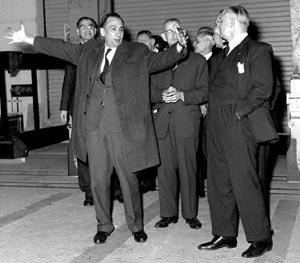
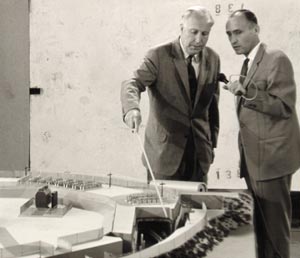
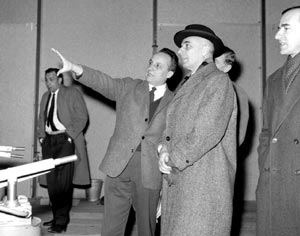
Viki was, of course, the main speaker at the inauguration of the ISR in October 1971 (see figure 2). I take this opportunity to quote a few sentences from this speech because they are so typical of his general, visionary way of thinking. He summed up his enthusiasm for the ISR as follows: “My deep belief in the fundamental importance of our growing insight into the basic structure of matter. My deep conviction that the physicists of Europe can and should be not only on par with other scientific communities but that they should be ahead, at least in some aspects. My deep sentimental attachment to CERN. This unique social and political experiment, which brings together people from many different nations in a life full of intellectual creativity; moreover it happens to be located in one of the most beautiful spots on our planet.” This is Viki in a nutshell. Figure 3 shows him after the ceremony inspecting the ISR with friends and colleagues.
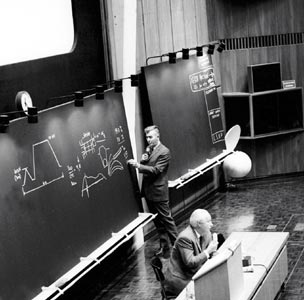
The significance of the ISR for the future of particle physics is also worth dwelling on. In doing so I prefer again to quote Viki’s own words rather than use my own. So we move on to the closure ceremony of the ISR in June 1984 at which again, naturally, Viki was a speaker. In figure 1, we see him on this occasion and I quote from his speech: “The really important thing about the ISR is its success as an instrument, because that fact did change the landscape of high-energy physics. First it was considered only as a window into the future. This was the historical significance of this first hadron collider. It showed the possibility of doing high-energy physics at much higher energies in the centre-of-mass system, where we can better observe what really happens because of the wider angular spread of the secondaries. After this was done, colliders became the fashion of the day. Today we have one more hadron collider at the SPS at a much higher energy. This again was a European first. But it was nothing other than a continuation of the ISR adventure. In a few years there will be a similar device at Fermilab, the Tevatron, with an even higher energy. The future plans of which we hear – in America the SSC, in Europe the plans for hadrons in the LEP tunnel – are further extensions of the ISR idea.”
Imagine that Viki had disappeared sometime between 1961 and 1964. The ISR would have died and the positive development described above would not have taken place.
This is definitely the direction that the development has taken: only colliders are in the picture for future hadron accelerator installations, some already operating, like the Tevatron at Fermilab, HERA at DESY and Brookhaven’s RHIC, with others under construction (CERN’s LHC). One can only guess how the development would have gone if CERN had not embarked on the ISR, but at best such speculations are pretty grim, when we remember that nobody else at that time was prepared to undertake such a venture.
Let us return to Viki’s role. Imagine that Viki had disappeared sometime between 1961 and 1964. The ISR would have died and the positive development described above would not have taken place. In short, his role was essential, and not only CERN but the whole particle-physics community has much to thank him for.
I had the privilege to work for Viki during his period at CERN. He was an unusually inspiring boss. His enthusiasm was contagious. When I joined CERN about 10 years before he became director-general, I was, of course, attracted by the scientific and technological challenges. However, 50% of the attraction was the opportunity to participate in this international collaboration. Viki, more than anybody, struck a resonance on this point with me and, I am sure, with most of our colleagues. CERN and Europe can be grateful to Viki for so successfully guiding this organization and the people involved through a very crucial period of its life.
The previous speakers have reviewed well the different facets of Viki’s rich and full life; Viki the great physicist and Viki the director-general of CERN at a crucial time in the history of the organization. The title that has been given to me for this talk corresponds to that of one of Viki’s popular books – Knowledge and Wonder: the Natural World As Man Knows It, to be more explicit – and I understood that to be an invitation to talk about Viki the humanist, namely a scientist with a very wide range of interests, a strong willingness to share his passion for science with others and much concern for present human problems. Knowledge and Wonder starts with a quote from Francis Bacon, which conveys Viki’s great enthusiasm in talking to others about science, namely: “For all knowledge and wonder (which is the seed of knowledge) is an impression of pleasure in itself.” When referring to his concern about society at large, I shall focus on his role as an indefatigable advocate for less tension and a better understanding among nations threatened by the danger of a nuclear war and I shall also partly cover his actions towards disarmament.
I have always had a great admiration for Viki. For me he first appeared as a monument, when I was a green physicist reading Blatt and Weisskopf and, when I had the chance to do it, listening to some of his brilliant talks at conferences. I later very much appreciated the friendship that we eventually developed. I consider this friendship as a great privilege and I cherish its memory.
Just after his death, I was asked to write a note for the CERN bulletin and a more extensive one for the CERN website. I was happy to collect some good appreciations expressed to me by several readers. One of the most moving ones came from a Large Hadron Collider engineer who said in his email: “Dear colleague, I had the fortune to read attentively your words caused by the passing of Dr V Weisskopf. I am sure that if he had read them, wherever he may be now he would have felt happy to know what impression he left. Thanks for letting me have the chance to read such nice words about a nice person I never met.” Yet, I did not feel at all like I was overdoing anything when writing about Viki. I was simply speaking with my heart, as he had much earlier asked me to do when he had wished me to speak in Vesancy after the death of Ellen, his first wife. I can but hope that this address also carries well the emotion and feeling of admiration which I passed on in the note in the bulletin, though I shall focus on only some aspects of his life and great talents.
Viki the humanist
Speaking about Viki the humanist, I would actually like to start again with an anecdote that I mentioned in my note in the bulletin. This was more than 20 years ago, when Viki came to CERN and to Paris to give the first series of the Gregory lectures, which had been set up to honour the memory of Bernard Gregory, who had succeeded him as director-general of CERN. During this lecture series, he came to address a large audience at the Ecole Polytechnique but, as he was due to start, there was some trouble with the sound system that took a few minutes to fix. Viki had to wait but, spotting a grand piano that had been left in a corner of the stage, he went to it and started to play. The audience was overwhelmed. His love for music, his musical talents and his great musical culture are well known. As he once said: “When life is hard, there are two things which make it worth living: Mozart and quantum mechanics.”
Viki was a great physicist and he had a passion for physics, which he so much wanted to pass on to others. But when he addressed a wide audience, it could be hard to dissociate his passion for physics from other passions as he often tried to convey his broad love for human scientific endeavour and human culture, physics being only one part of it. This he has done in many essays and in books written for a general audience. As he once said: “I owe much to the cultural tradition of Vienna, from Mozart and Beethoven to Freud and Boltzmann.” He did so much to show that physics is not producing an alienated individual in a world dominated by science and technology and in which everything is reduced to impersonal scientific facts.
Science is great, but science is not everything. He once illustrated that through an analysis of the appreciation that one may have for a Beethoven sonata, describing it first in an interesting but limited way in the realm of present science alone but to conclude that there is nothing like the emotion that it triggers in ourselves when listening to it. He also often left the ivory tower of science to express his views on many crucial issues, willing to do as much as possible for the benefit of humankind and, in particular, using all his influence to temper the great threats of the Cold War. As he said on several occasions: “Human existence is based on two pillars: compassion and knowledge. Compassion without knowledge is ineffective; knowledge without compassion is inhuman.” This emphatic sentence, a famous Viki quote, can be found in several instances in his writing with – sometimes – curiosity, interestingly, replacing knowledge.
Compassion is key
Viki told us that it is a privilege to be a physicist but also that it carries important duties: duties to inform on what science is all about; duties to warn against the dangers that could come from the irresponsible and even evil use of scientific knowledge; duties to feel concerned with the involvement of science in the events of the day; and duties to pass on to the new generation the spirit of research which we so much appreciate. As he once said: “We need basic science not only for the solution of practical problems but also to keep alive the spirit of this great human endeavour. If our students are no longer attracted by the sheer interest and excitement of the subject, we were delinquent in our duty as teachers.” How bound should we feel today by all these duties, and in particular by the last one, when the number of physics majors entering university is on the decline in the whole industrialized world?
Viki was much concerned about science and society issues. As he said: “The human problems caused by the ever increasing development of a science-based technology are too threatening and they overshadow the significance of fundamental science as a provider of deeper insight into nature.” And he added: “This puts the scientist in the midst of social and political life and strife and he has the obligation to be the guardian, the contributor and the advocate of scientific knowledge and insight.” Continuing with his own words, I may add: “Science cannot develop unless it is pursued for the sake of pure knowledge and insight. It will not survive unless it is used intensely and wisely for the betterment of humanity and not as an instrument of domination by one group over another.”
Viki magnificently conveyed his passion for research as a great human endeavour. In his essay “The significance of science”, he quotes Ecclesiastes: “And I gave my heart to seek and search out by wisdom concerning all things that are done under heaven. This sore task hath God given to the sons of man to be exercised herewith.” But, much aware of the dangers that could be brought by an evil use of knowledge, he also summarized his worries quoting again Ecclesiastes: “For in much wisdom is much grief and he that increaseth knowledge increaseth sorrow.” No wonder he did so much to emphasize the positive aspects of knowledge and insight and warn against evil uses, while stressing that compassion should keep a key role. As Hans Bethe put it in his preface to Physics in the 20th Century: “Having devoted so much of his life to compassionate endeavour, Weisskopf is most qualified to raise his voice for knowledge now, when so many people call for compassion alone, ignoring or even regarding knowledge as dangerous.” This is an important task, which he left us to continue with continuous effort at “catching the chance of achieving a better world”.
This longing for a better world was already clear in his youth and in particular in the way he conducted some militant actions through well applauded pantomimes that he performed with socialist friends in post First World War Austria. Even though music and eventually physics became his primary passions, his concern about society always remained on his mind, often reinforced by Bohr’s own attitude and actions about human problems. His work on the bomb, which had represented an extremely exciting period in his life, left him with a bitter aftertaste. “We were proud of our achievements, yet we were hindered with the realization that we were responsible for creating the most destructive weapon ever devised,” he said. “The consequence of my work on the atomic bomb and its impact on the world of the future weighed on my conscience.”
The arms race
In 1944 Viki became one of the founders of the Federation of Atomic Scientists, whose aim was to warn the public of the dreadful consequences of a nuclear war and to support the peaceful use of atomic energy. He soon also became a member of the Emergency Committee of Scientists initiated by Leo Szilard, which, under the chairmanship of Einstein, had a similar goal. It eventually led, in the late 1950s, to the highly valuable Pugwash meetings, which allowed Western and Eastern scientists to maintain an extremely useful dialogue at the time of the Cold War and in which he played an active role. He helped to create the Bulletin of Atomic Scientists with its unique coverage of questions associated with nuclear policies, arms controls and disarmaments. Bohr’s dream of the internationalization of nuclear matters was blown away by the widespread but short-lasting belief that Western supremacy was here to stay; by the Russian bomb, coming already in 1949; and by the H-bomb developed and exploded on both sides in 1951. Yet Viki kept an unfailing commitment to telling governments and citizens about the great danger of an arms race that had started and kept amplifying.
It was only by the late 1970s and early 1980s that the idea of the absolute impossibility of “winning” a nuclear war was recognized, not only by the public but also by governments. By the 1990s Viki could at long last say: “I am grateful to have lived to see our efforts to make this a more peaceful world seem to bear fruit…Perhaps a time is coming when the nuclear arms race of the past decades will be regarded as a serious case of collective mental disease that was cured just in time.” By that time, tests in the atmosphere had been banned, the ABM treaty had been brought in and the East-West thaw was paving the way to mutual disarmament.
Viki’s own and latter important actions towards that lofty goal had strongly used his membership in the Pontifical Academy. He had been elected to it in 1976, the same year that he was elected to the Soviet Academy of Sciences, something that he considered as keeping a proper balance. He used the latter position to support Sakharov and the former one was instrumental in his helping to shape the attitude that the Pope soon took, publicly underlining the great threat to mankind that resulted from the on-going nuclear arms race. I still remember listening to the Pope’s New Year address in 1980. I had seen much of Viki just before in connection with his Gregory lectures, and when the Pope came to mention the nuclear threat I could not refrain from exclaiming: “But these are Viki’s words!” If I may say that now it is because the Pope himself said that he had come to his stand on that matter by “listening to what his scientists had told him”. Viki was of course teased by journalists about his particular role in all that but he would respond: “The Pope is inspired by God and not by a Viennese Jew.” His actions were well recognized and he was awarded the Public Welfare Medal of the US National Academy of Sciences in 1991.
I would like to close this section with a lighter anecdote. Viki’s militant actions in the late 1940s, his past socialist stand in Vienna and his two long visits to the Soviet Union in the 1930s could have raised serious suspicions during the McCarthy era. This was apparently not the case, perhaps because he had always denounced vigorously the Stalinist excesses that he had witnessed first-hand at a time when André Gide was writing in the same spirit his Return from the USSR. Viki came to Paris in 1950 to spend a semester at the Sorbonne. As an American professor he had come in September but to discover that, in those days, nothing started seriously before November. He then decided to leave with his family for a wandering vacation through Europe leaving no specific address. Learning through the newspapers of the disappearance of Bruno Pontecorvo, who resurfaced soon after in the Soviet Union, he was afraid that people might think he was following a similar track and he telegraphed immediately to Paris to say that he would certainly be there for the beginning of his course.
Art and science
When preparing for this talk I read, or in most cases read once again, some of Viki’s popular books, two of which are actually collections of essays. I read in particular The Joy of Insight, his autobiography, out of which come many of the previous quotes. I also read The Privilege of Being a Physicist,Physics in the 20th Century and, of course, Knowledge and Wonder. I enjoyed very much that reading and re-reading. In my career, I have had to give many talks and write several essays about science in a general context, though lacking much of Viki’s insight, knowledge and experience. I realize now, however, that many things that I have chosen to emphasize in my talks were actually from his writings. This showed me how influential Viki had been on my thinking about science and society and the value of research, and this made me realize my debt for all that I had learned from him and taken as my own.
“Art and science”, which I took here as an intermediate title, is probably the first of his wide audience essays I read, more than 20 years ago. It is very typical of his style when discussing science in a general context and, in that instance, opposing art and science in a Bohrian way to show that, if there are great differences, there are also important similarities in the two intellectual approaches and that one should rather stress their complementarity. He starts by writing: “What could be more different than science and art? Science is considered a rational, objective, cool study of nature; art is often regarded as a subjective, irrational expression of feelings and emotions.” But he adds: “One can just as well consider scientific discoveries as the products of imagination, of sparks of sudden insight, whereas art could be viewed as the product of painstaking work, carefully adding one part to the other by rational thinking.” He goes on to discuss points of convergence and divergence, with many poetic and scientific quotes on the way, to conclude on complementarity, a complementarity between reason and passion, mystery being another form of reality and adding: “No wonder scientists are attracted by the fugues of Bach.”
He makes the point that science and art both respond to our urge for sense, meaning and hope, quoting Goethe who said: “He who has art and science also has a religion, but those who do not have them better have religion.” He concludes with the words: “There may come a day when scientific and artistic meanings will combine and help to bring forth that ground swell of meaning and value for which there is so great a need. The growing awareness of this need is in itself an important element that brings people together and creates common values and even elation.” Viki always acknowledged how much he learned from Bohr and his complementarity approach, which he liked to apply to walks of life other than quantum mechanics. A complementarity between precision and truth – Klarheit und Wahreit – often shows up in his essays.
I remember enjoying reading “Art and science”, which he also used in one of his Gregory lectures and in several other talks, and when, some years later, I was asked for a contribution to a book presented to him on his 80th birthday, I wrote a similar essay with Bohrian complementarity on “Myth and science” with illustrations from Dürer. Great was my pleasure when I learned that he had appreciated it. Viki should probably have been happy to hear of the success of a recent venture, masterminded by Ken McMullen of the London Institute, which brought to CERN several well-known artists coming for a while to collect inspiration for pieces of art which they then conceived and produced, and which have been shown together in much appreciated exhibitions in London, Rome, Geneva and soon to be shown in Lisbon.
Knowledge and wonder
With Knowledge and Wonder we meet a different, but also typical, facet of Viki’s writing for a wide audience. In this case, the book is about science alone. Yet it has a very broad coverage since, after presenting our place in space and in time, the forces met in nature, atomic structure and quantum physics, it turns to chemistry and life sciences, illustrating magnificently the great unifying view provided by quantum mechanics. Viki has the same enthusiasm and the same eloquence at all levels of what he refers to as the “quantum ladder”, going from the very low energies of metabolism and genetics to the very high ones of particle physics. Different structures occur at rather sharply different steps, thus eliminating the Boltzmann paradox of equipartition of energy when considering finer and finer constituents. He shows equally well how it was a great discovery to find that uncharged matter actually does consist of a combination of positive and negative electricity and an impressive moment in the scientific endeavour when proof was found, here on Earth, that the Earth had not existed forever.
Viki is most eloquent on the intrinsic value of science. Science is truly universal, the same questions are asked by all those involved in science, the same joy of insight is experienced when a new aspect of deeper coherence is found in the fabric of nature.
Hans Bethe
His presentation of quantum mechanics is a masterpiece. It is clear that quantum mechanics cannot be understood in terms of so-called classical concepts, and calls for a new way of thinking. But, whereas so many popular texts choose to emphasize the lack of certitude that quantum mechanics seems to bring to our description of the world, with its uncertainty relations and predictions in terms of probabilities only, he beautifully stresses the fact that, at long last, one has an understanding for the stability of the atom, the identical nature of all atoms of the same species and the automatic regeneration of the initial atomic structure after any perturbation. Such fundamental properties, on which all observed structures actually depend, could not be understood in classical terms, following a planetary analogy, which is often wrongly emphasized. The world as a whole is actually governed by quantum theory acting at different levels of the quantum ladder. So, rather than making our world more “uncertain”, quantum mechanics makes it more definite. It is the cause of the dependability of the world to which we are accustomed.
In his brilliant coverage of the different structures in the universe, Viki exhibits his typical way of clarifying complicated matters relying on the proper orders of magnitude. One reads between the lines the frequent use of Weisskopf’s units, whereby numerical factors of order one, and even 2π, can be set equal to unity and that to a decent approximation. His unique mastering of such an approach made him once recognized as “the Los Alamos oracle”.
Knowledge and Wonder is, as Hans Bethe put it: “a delightful book in which Viki appears as an exquisite interpreter of science”. He added: “Viki is most eloquent on the intrinsic value of science. Science is truly universal, the same questions are asked by all those involved in science, the same joy of insight is experienced when a new aspect of deeper coherence is found in the fabric of nature.”
Viki was the eloquent advocate of the role that science can take in bringing people together, and this brings me to the last topic that I would like to cover.
A prominent citizen of the world
As Hans Bethe also wrote in his introduction to Physics in the 20th Century, one of Viki’s main tasks of compassion was his fostering of international collaboration: “It is at CERN that he accomplished his most important goal, namely to make scientists from the many nations of Western Europe work together in a common task and, more difficult, to satisfy the governments of all of these nations that this co-operation was worthwhile both scientifically and politically. He also encouraged collaboration with Eastern scientists as much as possible.” Louis Leprince-Ringuet said: “The spirit of CERN is his creation.” Viki’s actions have beautifully demonstrated that scientific endeavour has so many co-operative aspects that it makes the scientific community supranational, because it transcends national and political differences. We benefit so much today from that spirit of co-operation.
Viki was always optimistic about the role and virtue of scientific collaboration. He referred to physicists as: “This happy breed of men, having a common task and believing – let me say religiously – in the explicability of nature.” In the late 1940s and early 1950s he had been instrumental in helping the first East-West contacts and in particular in obtaining visas for Soviet physicists coming to conferences in the US.
He wrote in his essay on Madame Curie – prepared for her centennial – soon after he left CERN and when the Cold War was still raging: “We must keep the doors of our laboratories wide open and foster the spirit of supranationality and human contact, of which the world is much in need. It is our duty to stick together in spite of mounting tensions and threatening wars in the world today. The present deterioration in the political world is a stronger-than-ever reason for closer scientific collaboration. The relationship between scientists must remain beyond the tensions and the conflicts of the day, even if these conflicts are as serious and frustrating as they are today. The world community of scientists must remain undivided, whatever actions are taken or whatever views are expressed in the societies in which they live. We need this unity as an example for collaboration and understanding, as an intellectual bridge between the divided parts of mankind and as a spearhead towards a better world.”
He lived to see this emphatic vision bear fruit. Extensive scientific collaboration certainly contributed to the thaw between East and West, as illustrated in great detail by the CERN-Dubna joint exhibition, “Science bringing nations together”, which started its travels in Oslo six years ago.
Influencing society
There is, however, a long way between the laws of physics and those of human behaviour. In one of his essays Viki quoted Max Born, saying: “Intellect distinguishes between the possible and the impossible, but reason distinguishes between the sensible and the senseless. Even the possible can be senseless.” Science is great but it is not enough when dealing with human behaviour. In another essay, he quoted Niels Bohr, who said: “The steady and incessant growth of our understanding of material structures may have helped to steady the minds of the scientists who live in this century of turmoil and upheaval. It did not have that influence on society as such.”
There is a great temptation to transfer the methods that were so successful in natural science directly to social and political problems. But this is not possible for the most important problems.
Viki Weisskopf
There is certainly room for pessimism even for an enthusiastic physicist much concerned about the situation of the world. As Viki said himself: “There is a great temptation to transfer the methods that were so successful in natural science directly to social and political problems. But this is not possible for the most important problems.” Yet, we should still be inspired by his drive for international collaboration, his concern about the future of humankind and achieving a better understanding among nations, and we should remain courageous. We should try to follow the example that he has set for us, in particular through his courageous and unfailing actions to temper the arms race. We should not be discouraged and I would like to conclude with yet another famous Weisskopf quote: “There is always hope for hope.”
I am delighted to be here to say a few words on behalf of Viki’s family – Duscha his wife, who is here; my brother Tom and his wife Sue; Viki’s five grandsons, his great grandson and great grand daughter. Fortunately Viki lived to see her arrive – he loved his grandsons but yearned for that girl.
I must start by saying that CERN was one of the highlights of his life. He loved both being here and the work that he could help to make happen. We have heard much today from others about the scientific details; as family, we know how happy and excited he was to come back to Europe when he assumed the position of director-general. This led to many years of having a second home in Vesancy – he and my mother spent close to 4 months there every year – and working at CERN. It was a perfect balance, and for all of us it has meant having a home here as well.
I would like to say a few words about Viki as we knew him, and about the intersection of Viki’s work and mine – teaching and learning (I was a teacher of children, I teach teachers now, and have been deeply involved with science education for the past 20 years). Then I would like to share with you some quotations that come from the hundreds of letters that we have received since Viki’s death.
A passion for sharing
There are many here who knew Viki as lecturer, teacher and advisor, and know some of the qualities that he brought to his work with young scientists. But I want to say a few things about his passion for sharing what he knew with non-scientists of all ages and why I think he was so good at it. In 1973, in a short review of the book The Nature of Light and Color in the Open Air by M Minnaert for a little education magazine called Outlook, Viki wrote: “Minnaert’s book is like a fresh breeze flowing through the physics literature. In it we find discussions of the reflection of the sun on a wind-blown surface of a lake, the colors at sundown, the shadows of the leaves on a tree. We learn how and why we see the scratches on a windowpane; what makes the color of puddles, rivers, lakes, the sea, the clouds, the sky…There are 233 entries, each discussing an interesting phenomenon of color and light outdoors, most of which we have seen. It is surprising, however, how rarely we have bothered to think of an explanation, although we consider ourselves scientifically minded, and should search for an explanation of every phenomenon we see.”
He went on to write: “Perhaps it is just the advanced state of development of modern physics which leads to the large gap between concepts and the immediate perception and appreciation of the phenomena themselves…[The book] brings us back to the things we enjoy observing because they are part of nature and because they are beautiful. It teaches us not only to admire what we see but also to think about causes and relations. It embodies the human attitude toward the world around us, to observe and understand. The importance of Minnaert’s book is that it shows how understanding adds to the beauty and richness of natural phenomena…[He] shows us what physics really is: love of nature, broadened by an ever-increasing knowledge of the causes of things.” Viki could write these words because he believed and lived them so profoundly. This love of nature and absolute belief that understanding only enriched this appreciation was basic to Viki’s delight in, and often passionate sharing of, what he knew, understood and questioned, as was his interest in how others thought and tried to understand the world.
Food for thought
In our home, growing up, dinner-table conversation was not about what you did in school today. It was about interesting questions, and thoughts about those questions. By the time the grandchildren arrived, these became “Viki questions”. We would arrive weekly for dinner with several stored up over the week. Why did the moon have a halo round it the other night? How come the remote-controlled car couldn’t get up the hill? Why did the aeroplanes sometimes have white tails and sometimes not? “Ah”, he would say, “that’s an interesting question.” And he would proceed to ask what they thought and then explain the answer.
And I remember a moment in Italy, when my brother and I were teenagers and had just arrived in Naples with our car for Viki’s first year at CERN. We had a flat tyre and immediately he and Tom put their heads together to try to convert the American measurement of pressure to the metric measurement to be able to fill the tyre properly. Meanwhile I had taken the European gauge and measured the other tyres and come up with an instant answer to the problem. I tell this not because of my role, but because this was a story Viki loved and would tell over and over.
I have another anecdote about when I was a senior in high school. My 19 classmates (all women) and I had a young male physics teacher teaching us what was, at that time, a very experimental physics programme that had been developed under the leadership of Gerald Zacharias from MIT and others. The teacher was young and inexperienced. Occasionally on weekends, six or seven of us would gather in Viki’s study at home and he would help us to understand and begin to enjoy what we were studying. We would arrive on Monday with our homework problems in hand, secure in our new understanding only to get it back quite frequently marked wrong. Imagine the young teacher who then had to deal with the daughter of Victor Weisskopf telling him that her father had said: “Ach, it’s close enough; it’s only a factor of two.”
Fostering interest in science
Viki’s book Knowledge and Wonder is another example of his enthusiasm for sharing science with lay people. It was written after a seminar series for the parents of students at the school I attended. It was another way for him to bring to non-scientists not just the facts but the delight in phenomena and the joy of understanding them. He wrote: “The idea was to sketch out the present scientific understanding of natural phenomena and to try to show the universality of that understanding and its human significance.” He knew the problems: “Scientific knowledge is hard to communicate to the non-scientist; there is so much to be explained before one can come to the essential point. All too often the layman cannot see the forest, but only the trees. The difficulties, however, should not prevent, or even discourage scientists from tackling the job in different ways. This book is one way of giving the uninitiated an idea of the greatest cultural achievement of our time.”
Science is not a necessary but disagreeable means to increase our competitive position in the world.
Viki Weisskopf
Quite naturally, but perhaps less known, Viki was deeply interested in and concerned about pre-college education – an interest we discussed more and more as my career progressed. He was deeply concerned that the science in schools was turning children and young people away from science, both as a field and as a part of human culture.
He said the following to a group of Illinois science and maths teachers in 1984: “Science is not a necessary but disagreeable means to increase our competitive position in the world. No, it is an important part of the humanities because it is based on a human trait that distinguishes us from animals: to be curious and interested in what goes on around us. We must foster that attitude, an attitude of exploration, of wonder, of joy, of insight…There are no pat answers to any kinds of questions; there is no flat knowledge, but there is involvement, curiosity and insight. This open attitude in science fosters a different approach also in other fields of human activity and culture. It is the art of discovery; of questioning, of wonder, of trying to understand. And it will give our youngsters a much fuller and more uplifting life. It will give them a new sense and a new meaning to their existence, which is so sorely missing today.” As I work in the field of education, I could have had no better preparation and guidance than having had Viki as my father.
Tributes
Now let me turn to the words of others. Since Viki died we have received letters from around the world and from people in many walks of life and from different times and places in Viki’s life. They are individually unique and beautiful, but the theme that emerges over and over is an appreciation for his deep humanity; his kindness, integrity; desire to share and to listen; and his genuine delight in and respect for people. We had, of course, letters in other languages. As Duscha and I read them, she would occasionally say, as she translated the German for me: “There is no English word for that.” For those who speak German, here are a few words she loved: “seine freundliche Zuwendung, Gute, Verstandnisberietschaft und weise Heiterkeit…”
I hope those whose words I quote will forgive me if I take short passages from long and wonderful letters. Some of the quotations are from members of the scientific community who will be familiar to many of you, but others are from people who knew Viki outside of his science. It is especially these I want to share.
Here are a few tributes from the physics world: “The passing of Viki leaves a huge hole in the constellation of stars that created 20th-century physics. Insight, exuberance, the right mix of Austro-Yiddish wit, wisdom in leadership…warmth. What a guy.” Leon Lederman, Fermilab.
“He was a great scientist and also a loveable man – a rare combination…He was also willing to listen to the suggestions of a much less experienced and accomplished person, not just tolerantly but with open-mindedness and attention. In such conversations he simply treated me as a partner in an investigation.” Abner Shimony, Wellesley College and Boston University.
“To us, as to all who knew him over the many decades, he was a constant source of optimism and wisdom, and there is now nobody like him in our circles.” Gerald Holton, Harvard University.
“Viki was one of the few best men I ever knew. Such a brilliant, talented, wise and at the same time charming, kind, humanistic person and caring friend.” Evgenii Feinberg, Lebedev Institute.
“Viki was a wonderful, warm individual. Just thinking of him and his way, whenever I start to get a mean feeling about a colleague in physics, I can immediately banish it.” Gerry Brown, CUNY Stony Brook.
“Our every meeting was a human and intellectual pleasure and gain. He was a glorious original from the old world who radiated knowledge and kindness in the new world.” Fritz Stern, historian, Columbia University.
“Viki contributes profoundly, to all of us who knew him, his extraordinary gifts as a scientist and a generous and thoughtful and dear person. His exemplary understanding helped his fellow beings comprehend and contribute to bring about a life worth living.” Leon Kirchner, Department of Music, Harvard University.
“He was a man who people felt inevitably drawn to by his charm, joie de vivre and his Gute.” Ernest Bergel, psychiatrist.
“Viki’s humane splendour shines in my memory.” Arthur Solomon, Harvard Medical School.
“Viki was so wonderful to me as to all. He would talk about the follies of the world to me with that special combination of urgency and laughter. That is, he saw clearly what governments and the rest of the world needed to do – but he understood the imperfections of mankind.” Anthony Lewis, New York Times.
Another tribute came without words. At the end of his life, Viki would walk a block or so from his house. He would sit part way on the stone wall in front of one of the houses. As time went by the people who lived in the house would come out and say hello. Soon they brought out and left two lawn chairs where Viki could sit; one of them would come out and sit in the other chair and they would talk. When Viki died, Octo and Harriet Bernett put vases of flowers on the chairs for several days.
And finally, a few words from a wonderful woman – Cambridge born – a nurse who helped Duscha care for Viki for the seven years before he died.
“He was a gentle and kind man. I enjoyed being with him everyday…He introduced me to Mozart, opera and the stars.” Jean O’Connor.
We received another letter from Francoise Ulam. Some years ago when her husband the mathematician Stan Ulam died, a close friend of his and Viki’s, David Hawkins, wrote to Stan’s wife. She sent his words to us on Viki’s death: “Those who live richly have many strings, many linkages to the world. Their lives are woven into the world’s fabric, its lattice of associations. When they leave, there is a big hole in the lattice, a tear in the fabric; these holes and tears remain, they simply can’t vanish, and this simple fact is the source of all our concerns for mortality.”
t could easily be argued that what initiated Viki’s love and passion for science was his love and passion for the night sky and all of the things in it.
Marc Weisskopf
I cannot end these remarks without coming back to Vesancy, which he so loved. My brother and I will keep the Vesancy house. We love it as do our children and, we hope, the next generation as well. One of the favourite stories from someone who received many many honours during his life was about an honour Viki received in 1972. In Viki’s words: “I was greatly pleased when, in 1972, Vesancy gave me an honour that I value at least as much as any of my scientific awards. I was made sappeur – pompier honoraire (honorary fireman) in a big celebration in the old castle. During the ceremonial part of the evening, I was given a fireman’s helmet and a diploma, and a little girl in a white dress gave Ellen a large bouquet.” I know he meant this seriously and it so delightfully reflects his love of people, of community and of this beautiful setting.
And to end: Viki’s first publication when he was 15 years old was about the stars. Here are the words of his grandson, Marc: “It could easily be argued that what initiated Viki’s love and passion for science was his love and passion for the night sky and all of the things in it. His telescope [a gift from CERN] was one of his most prized possessions. Beyond Being Earth Day when he passed away, it was also the beginning of a brief period that occurs less than once in a lifetime, when all of the planets in the solar system are lined up on the Western sky so that they all can be seen (5 with the naked eye and the others with a small telescope) I have images of Viki skipping from planet to planet happy as a clam as he springboards onto other things.”
To provide the best experiences, we use technologies like cookies to store and/or access device information. Consenting to these technologies will allow us to process data such as browsing behavior or unique IDs on this site. Not consenting or withdrawing consent, may adversely affect certain features and functions.
Functional
Always active
The technical storage or access is strictly necessary for the legitimate purpose of enabling the use of a specific service explicitly requested by the subscriber or user, or for the sole purpose of carrying out the transmission of a communication over an electronic communications network.
Preferences
The technical storage or access is necessary for the legitimate purpose of storing preferences that are not requested by the subscriber or user.
Statistics
The technical storage or access that is used exclusively for statistical purposes.The technical storage or access that is used exclusively for anonymous statistical purposes. Without a subpoena, voluntary compliance on the part of your Internet Service Provider, or additional records from a third party, information stored or retrieved for this purpose alone cannot usually be used to identify you.
Marketing
The technical storage or access is required to create user profiles to send advertising, or to track the user on a website or across several websites for similar marketing purposes.