Comsol -leaderboard other pages

Topics

Exact Methods in Low-Dimensional Statistical Physics and Quantum Computing: Lecture Notes from the Les Houches Summer School: Volume 89, July 2008

By Jesper Jacobsen, Stephane Ouvry, Vincent Pasquier, Didina Serban and Leticia Cugliandolo (eds.)

Oxford University Press

Hardback: £45 $85

9780199574612

Recent years have shown spectacular convergences between traditional techniques in theoretical physics and methods emerging from modern mathematics, such as combinatorics, topology and algebraic geometry. These techniques, and in particular those of low-dimensional statistical models, are instrumental in improving the understanding of emerging fields, such as quantum computing and cryptography, complex systems, and quantum fluids. This book sets these issues into a larger and more coherent theoretical context than is currently available, through lectures given by international leaders in the fields of exactly solvable models in low-dimensional condensed matter and statistical physics.

Lectures on light: Nonlinear and Quantum Optics using the Density Matrix

By Stephen C Rand

Oxford University Press

Hardback £39.95 $75

51L4GpXO25L

This book attempts to bridge in one step the enormous gap between introductory quantum mechanics and the research front of modern optics and scientific fields that make use of light. Hence, while it is suitable as a reference for the specialist in quantum optics, it will also be useful to non-specialists from other disciplines. With a unique approach it introduces a single analytic tool, the density matrix, to analyse complex optical phenomena encountered in traditional as well as cross-disciplinary research. It moves from elementary to sophisticated topics in quantum optics, including laser tweezers, laser cooling, coherent population transfer, optical magnetism and squeezed light.

NIST Handbook of Mathematical Functions

By Frank W J Olver, Daniel W Lozier, Ronald F Boisvert and Charles W Clark, (eds.)

Cambridge University Press

Hardback £65 $99 Paperback £35 $50

51UDu9abd5L._SX371_BO1,204,203,200_

Modern developments in theoretical and applied science depend on knowledge of the properties of mathematical functions, from elementary trigonometric functions to the multitude of special functions. Using them effectively requires practitioners to have ready access to a reliable collection of their properties. This handbook results from a 10-year project conducted by the National Institute of Standards and Technology with an international group of expert authors and validators. Printed in full colour, it is destined to replace its predecessor, the classic but long-outdated Handbook of Mathematical Functions, edited by Abramowitz and Stegun. It includes a DVD with a searchable PDF of each chapter.

BCS: 50 Years

By Leon N Cooper and Dmitri Feldman (eds.)

World Scientific

Hardback: £84 $135 Paperback: £40 $65

CCboo1_02_11

More than 50 years after John Bardeen, Leon Cooper and Robert Schrieffer – BCS – published their now famous theory of superconductivity, and 100 years since the discovery of superconductivity, the key concepts have become the basis of a vast and ever-increasing field of investigation, both theoretical and experimental.

This exceptionally well written and edited book celebrates and reviews the state of BCS theory and experiment. The many chapters on the history and early experiments (written by Bardeen, Cooper, and Schrieffer, as well as others) are all very clear and readily accessible to a high-energy physicist, despite containing a wealth of detail. The content continues well beyond the usual applications of BCS theory and there are extensive discussions of extensions of BCS, especially in the light of attempts to understand the new high Tc superconductors.

Experimentalists will especially enjoy the chapter by John Clarke on “SQUIDS: Then and Now”, which contains a beautiful discussion of the early development of the superconducting quantum interference device (SQUID), including some really makeshift laboratory set-ups. I particularly enjoyed his description of trying to get a thin, mechanically stable insulating film for a Josephson junction and his colleague Paul Wraight saying: “How about a blob of solder on a piece of niobium wire? Solder is a superconductor and you keep telling me that niobium has a surface oxide layer.” Remarkably this simple idea worked, with several junctions formed on the crude device. Brian Pippard quipped that it looked as though a slug had crawled through the window overnight and died, and so the term SLUG came into use for what was dubbed a “superconducting low-inductance undulatory galvanometer”. The chapter goes on to cover applications including magnetocardiography, magnetoencephalography, precision gyroscopes, geophysics, qubits, and searches for galaxy clustering and axions.

There is plenty in this book for the particle physicist: Gordon Baym covers BCS theory for atomic nuclei, neutron stars and quark matter; Yiochiro Nambu discusses mass gaps and symmetry breaking; Frank Wilczek writes on BCS theory in QCD at high densities and gives a particularly nice discussion of colour-flavour locking, as well as abelian and nonabelian anyons. In the final chapter Steven Weinberg gives a personal overview “From BCS to the LHC”.

All 23 chapters are by outstanding physicists (including many Nobel prize-winners) and all were fascinating to read. I would highly recommend this book to anyone and everyone as a wonderful review of a powerful unifying concept that covers an enormous range of phenomena.

Council looks forward to new members and new physics

CCnew1_01_11

The opening of CERN to new members was top of the agenda when delegates met in December for the 157th session of the CERN Council. Formal discussions can now begin with Cyprus, Israel, Serbia, Slovenia and Turkey for accession to membership, while Brazil’s candidature for associate membership was also warmly received.

“It is very pleasing to see the increasing global support for basic science that these applications for CERN membership indicate,” said CERN’s director-general, Rolf Heuer. “Basic science responds to our quest to understand nature and provides the very foundations of future innovation.”

Established in 1954 by 12 European states, CERN had grown to have 20 member states by the end of the 1990s, with many countries from beyond the European region also playing an active role. Discussions on opening CERN to membership from outside Europe – while at the same time allowing CERN to participate in future projects beyond Europe – reached a conclusion at the Council’s session in June 2010.

Under the scheme agreed on in June, associate membership is an essential prerequisite for membership. Countries may therefore apply for associate membership alone, or associate membership as a route to membership. At the recent meeting in December, Council formally endorsed model agreements for both cases. These will serve as the basis for negotiations with candidates, which could lead to CERN welcoming its first associate members as early as later this year. Currently, any country may apply for membership or associate membership of CERN, and if CERN wishes to participate in projects outside Europe, mechanisms are also now in place to make that possible.

CCnew2_01_11

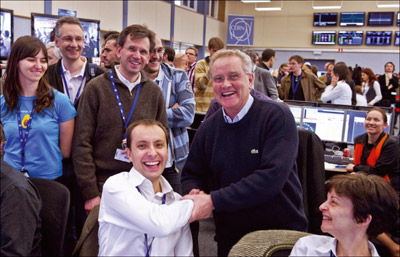
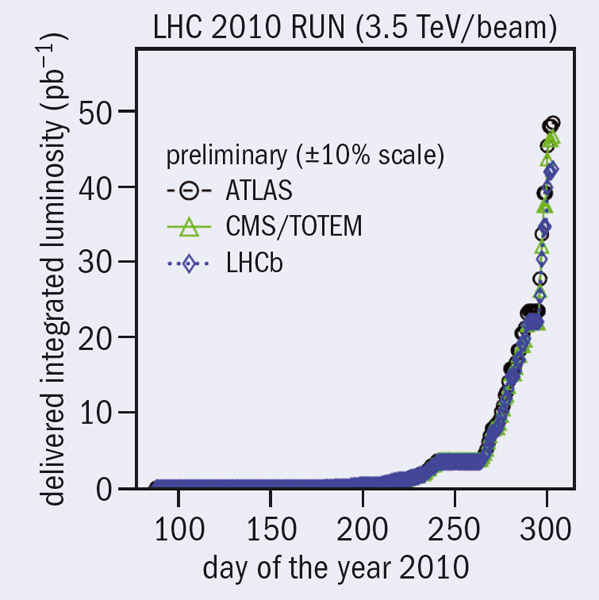
The other highlight of the December Council meeting was the success of the LHC in 2010. The LHC experiments have already published dozens of scientific papers on the basis of the data collected during the year. The results not only re-establish the physics of the Standard Model, but also take the first steps into new territory.

“The performance of the LHC this year has by far exceeded our expectations,” said Michel Spiro, president of the CERN Council. “This bodes extremely well for the coming years.”

The LHC switched off for 2010 on 6 December. Details of the 2011 LHC run and plans for 2012 will be set following a special workshop to be held in Chamonix on 24–28 January, while the first beams of 2011 are scheduled for mid-February.

CERN Courier has a new look

CERN Courier has changed several times during its 50 years of existence, most noticeably with different cover designs and variations in layout. Now, for the first time in a decade, its look has changed once again.

The previous design dated back to 1998, when IOP Publishing took over the production work on the magazine and introduced a more dynamic layout and distinct pages for News and Features, as well as regular sections, such as Astrowatch and Bookshelf, which have since grown to include Sciencewatch, Archive and the back page Viewpoint or Inside Story.

The new design by Andrew Giaquinto and Jesse Karjalainen of IOP Publishing retains this structure but brings a cleaner, more contemporary appearance. At the same time it maintains the authoritative style appropriate to the magazine that will continue to serve the worldwide particle-physics community, in particular as CERN extends geographically. We hope that you, the reader, enjoy the new look.

ATLAS observes striking imbalance of jet energies in heavy ion collisions

CCnew3_01_11

The ATLAS experiment has made the first observation of an unexpectedly large imbalance of energy in pairs of jets created in lead-ion collisions at the LHC (G Aad et al. 2010). This striking effect, which is not seen in proton–proton collisions, may be a sign of strong interactions between jets and a hot, dense medium (quark-gluon plasma) formed by the colliding ions.

Concentrated jets of particles are formed in the head-on (central) collisions of lead ions at the LHC. The jets materialize from the hadronization of quarks and gluons scattered from the protons and neutrons in the colliding ions. If a quark-gluon plasma is formed in the collisions of the high-energy ions, then as the jets materialize they will traverse this hot, dense medium. In so doing they should lose energy to the medium through multiple interactions, in a process called jet quenching.

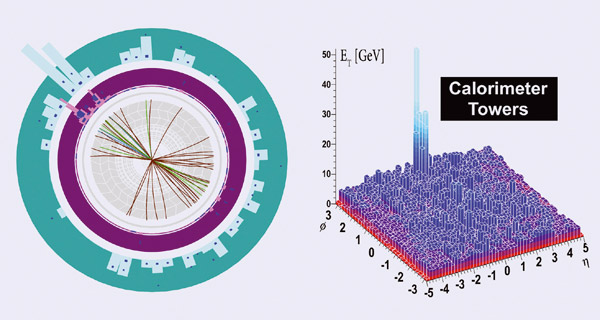
The jets are most often produced in pairs (dijets) travelling in opposite directions with equal transverse energies, but if the jets travel different distances before escaping the medium, then their energies will no longer be equal. Experiments at the Relativistic Heavy Ion Collider at Brookhaven observed signs of this effect in single-particle distributions; however, the result from ATLAS represents the first direct observation of energy loss by jets, and the first in which the effect is visible on an event-by-event basis (figure 1).

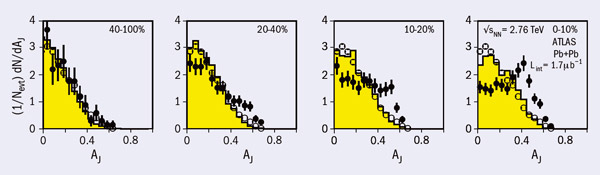
The excellent angular coverage, segmentation and energy resolution of its calorimeters make ATLAS well suited to measuring jets. For this analysis, the collaboration looked at a sample of 1693 events with at least one jet having transverse energy greater than 100 GeV. They then characterized the difference in energy in the dijets by the ratio of the difference of the jet energies to the sum of the energies. In studying this dijet asymmetry ratio they found that it varies as a function of the centrality of the colliding nuclei, as figure 2 shows, where the fraction of events with a given asymmetry is plotted versus the measured asymmetry for four different ranges of centrality, the most central events in the plot at the right and the least central at the left.

CCnew4_01_11

The plots show the asymmetry for lead-ion collisions at 2.76 TeV/nucleon in the centre-of-mass and for 7 TeV proton–proton collisions together with the prediction from a Monte Carlo simulation that does not include interactions between the jets and the medium. The measured asymmetry clearly increases with centrality: the distribution broadens and the mean shifts to higher values. To confirm the effect, the collaboration performed numerous studies to verify that events with large asymmetry are not produced by energy fluctuations, background, or detector effects.

The observation of this centrality-dependent dijet asymmetry by ATLAS has a natural interpretation in terms of QCD energy loss and may point to a strong energy loss by the jets in the quark-gluon plasma. The asymmetry has also been reported by the CMS collaboration and a related effect in single particle distributions has been reported by the ALICE collaboration, at a seminar at CERN together with ATLAS on 2 December. The result, together with others presented at the seminar, marks the beginning of a broad and exciting programme of heavy-ion physics at the LHC.

CMS announces first results of search for SUSY

CCnew5_01_11

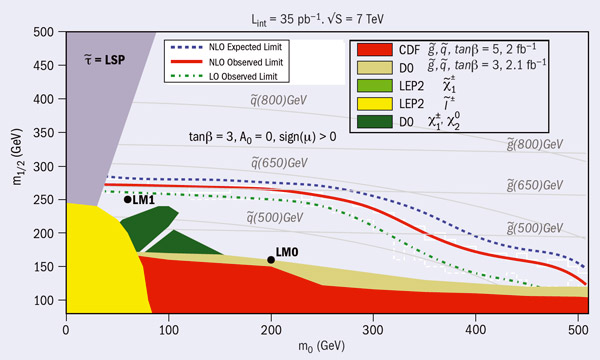
At the “LHC end-of-year jamboree” at CERN on 17 December, the CMS collaboration announced the first results of its search for supersymmetry (SUSY) at the LHC.

SUSY is one of the strong candidates for physics beyond the Standard Model that could be detected in proton–proton collisions at the LHC. If it exists in nature, it could solve many of the outstanding issues in particle physics, such as the gauge hierarchy problem. SUSY can reveal itself through the production of new heavy particles and so could deliver a natural candidate particle to explain the large density of dark matter in the universe.

This first result is based on proton–proton collision events with multiple jets and missing transverse energy. The dataset corresponded to an integrated luminosity of 35 pb–1 collected between March and October 2010 at a centre-of-mass energy of 7 TeV. Large, missing transverse energy is a key characteristic of SUSY event candidates, reflecting the supposition that the lightest SUSY particle is expected to be neutral, stable, and weakly interacting – thereby escaping detection.

After stringent cuts to reduce the background arising from Standard Model processes that can fake missing transverse energy or that may contain escaping neutrinos, 13 events remained. The collision data also allowed estimates of the expected numbers of background events from Standard Model processes and these are consistent with the number of observed events. As a consequence, the present data do not yet show evidence for SUSY; however, they significantly extend previous search results.

The figure illustrates the reach of the CMS analysis with respect to other experiments in the plane of the universal scalar and gaugino masses (m0 and m1/2, respectively) at the grand unified theory scale of the constrained minimal supersymmetric extension of the Standard Model (CMSSM), after just one year of LHC data-taking. The observed limit significantly improves those set previously by other experiments, thus further constraining the masses of SUSY particles.

Physicists are now looking forward to the 2011 physics run at the LHC, which is expected to bring a data sample that could be as much as two orders of magnitude larger than the present one.

Antihydrogen scoops award for breakthroughs

Research at CERN’s Antiproton Decelerator (AD) has made important breakthroughs in experimental techniques for studying antihydrogen in the laboratory. On 17 November, in a paper published in Nature, the ALPHA collaboration announced that it had successfully trapped atoms of antihydrogen for the first time. Then, on 6 December, the ASACUSA collaboration published results in Physical Review Letters on a technique that should allow the production of a beam of antihydrogen. Recognition of these achievements soon followed in the scientific media, with the award of Physics World‘s “2010 Breakthrough of the Year” on 20 December.

Both ALPHA and ASACUSA aim to measure precisely the spectrum of antihydrogen and compare it with that of hydrogen. Any small difference would cast light on the imbalance between matter and antimatter in the universe today. The first nine atoms of antihydrogen were produced at CERN in 1995. Then, in 2002, the ATHENA and ATRAP experiments at the AD showed that it was possible to produce large quantities of cold (i.e. very low velocity) antihydrogen, thus opening up the possibility of conducting detailed studies. However, the challenge remained of producing the antihydrogen in such a way that its spectrum could be analysed.

The strategy being pursued in the ALPHA experiment, which evolved from ATHENA, is to make cold antihydrogen and then hold the neutral antiatoms in a superconducting magnetic trap similar to those used for high-precision atomic spectroscopy. The ultimate aim is to measure 1s–2s transitions for comparison with the latest results in hydrogen. The ALPHA trap consists of an octupole and two solenoidal “mirrors”, which together create a magnetic field that confines the antiatoms by interacting with their magnetic moments. Silicon detectors surrounding the trap record the annihilations of any trapped antihydrogen once it is released. In the studies reported in November, the collaboration observed 38 annihilations (Andreson et al. 2010).

The ASACUSA experiment is following a different approach aimed at studying hyperfine transitions in antihydrogen, which involve much smaller energy differences and hence microwave rather than laser spectroscopy. The technique does not require the antiatoms to be trapped, so the collaboration is taking steps towards extracting a beam of antihydrogen in a field-free region for high-resolution spectroscopy. The December paper reports success in producing cold antihydrogen in a so-called “cusp” trap, an essential precursor to making a beam. This trap consists of a superconducting anti-Helmholtz coil and a stack of multiple ring electrodes (Enomoto et al. 2010). The next step will involve extracting a spin-polarized antihydrogen beam along the axis of the trap.

Italian government approves SuperB

The Italian government has selected the SuperB project as one of its “flagship projects” in Italy for the coming years and has delivered initial funding as a part of a multiyear programme. Proposed by INFN, the project has already attracted interest from many other countries, with physicists from Canada, Germany, France, Israel, Norway, Poland, Russia, Spain, the UK and the US already taking part in the design effort.

SuperB will be an asymmetric electron–positron collider with a peak luminosity of 1036 cm–2 s–1. Such a high luminosity will allow the indirect exploration of new effects in the physics of heavy quarks and flavours at energy scales up to 10–100 TeV, through the studies at only 10 GeV in the centre-of-mass of large samples of B, D and τ decays. At full power, SuperB should be able to produce 1000 pairs of B mesons, the same number of τ pairs and several thousands of D mesons every second.

The key advances in the collider design come from recent successes at the DAΦNE collider at INFN/Frascati, at PEP-II at SLAC and at KEKB at KEK. These include new concepts in beam manipulation at the interaction region known as the “crab waist” scheme, which has been tested at DAΦNE.

The aim of the SuperB project is to conduct top-level basic research, while developing innovative techniques with an important impact for technology and other research areas. In this respect, the Instituto Italiano di Tecnologia is co-operating on SuperB with INFN. The accelerator will also be used as a high-brilliance light source, equipped with several photon channels, allowing the scientific programme to include the physics of matter and biotechnology.

bright-rec iop pub iop-science physcis connect