Since its discovery at CERN in 1983 (CERN Courier November 1983 p355), the W boson has been one of the most thoroughly studied particles in high-energy physics – yet some of its rarest decay modes remain unobserved. The CMS experiment has recently carried out a search for its decay into three light charged hadrons, using 420 fb–1 of proton–proton collision data recorded between 2016 and 2025. The result sets an upper limit on the branching fraction that excludes a large range within the theoretical expectation, constraining certain models of these rare decays.
While decays of the W boson into hadrons are the most common, they are also exceptionally complex. The process of hadronisation, in which quarks transform into detectable particles like pions and kaons, typically produces around 30 final-state particles in a single W-boson decay. Consequently, reconstructing the parent W boson and studying its properties with high precision is significantly more difficult than for leptonic decay modes.
In its recent study, the CMS experiment focused on a much cleaner and rarer signature: W-boson decays into three light charged hadrons. This decay offers the highest potential of observation among low-multiplicity exclusive modes, as it combines a clean, fully charged final state with a relatively high rate, well above that of competing processes such as decay into a photon and a pion. Observing it would provide valuable new insights into quantum chromodynamics, particularly the behaviour of factorisation and form factors at high energies.
To identify these events, charged hadrons are reconstructed either from isolated particle tracks in the detector or as hadronically-decaying tau leptons, since a common decay mode of the tau lepton produces a charged pion together with a neutrino.
The study focused on a much cleaner and rarer signature
The analysis requires events with at least three hadron candidates. The two candidates with the highest transverse momentum are reconstructed as hadronically-decaying tau leptons, whilst the third may also be reconstructed as an isolated charged-particle track. This strategy both expands the accessible phase space – by taking advantage of the lower transverse momentum threshold for isolated tracks – and suppresses background contributions through stricter momentum requirements for hadronically-decaying tau leptons. The sensitivity is further improved using a dedicated DeepTau machine-learning classifier, which helps distinguish hadronically-decaying tau leptons from jets.
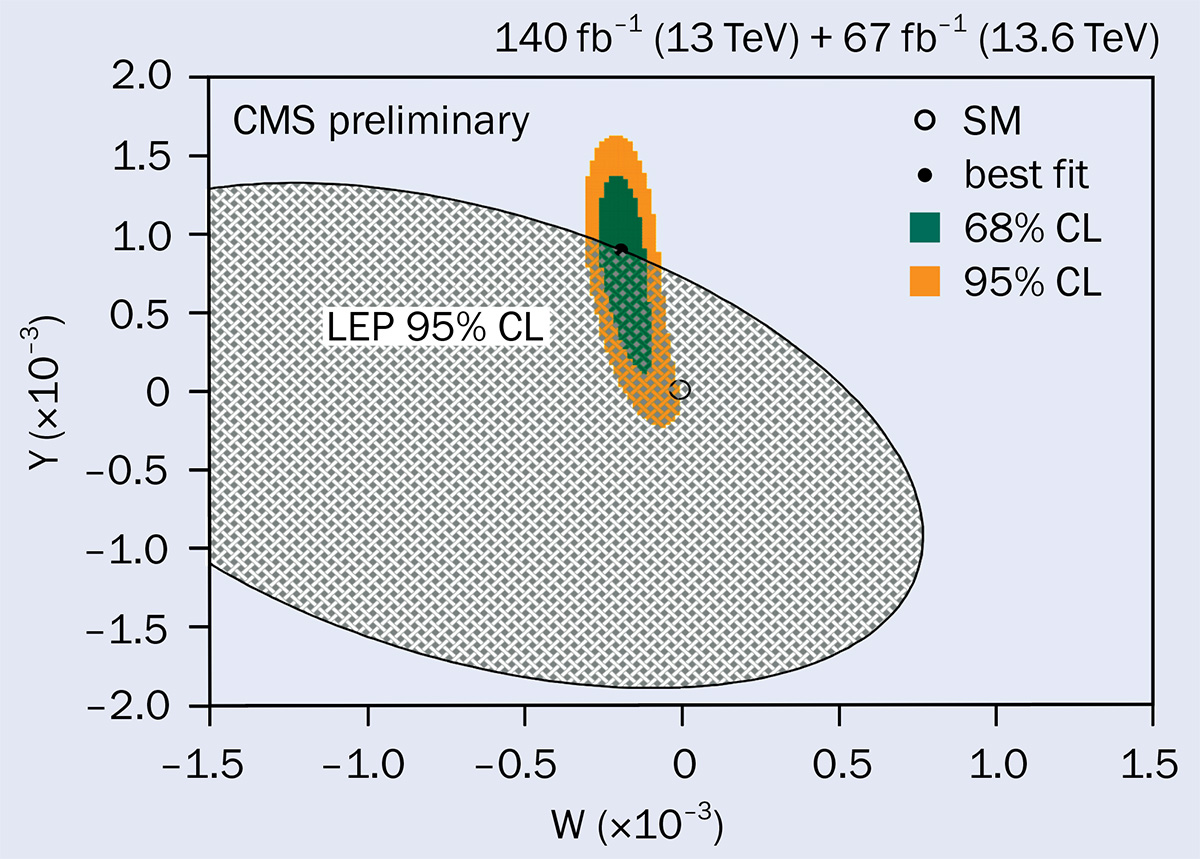
The search is performed by examining the invariant mass of the hadrons (see figure 1). No significant excess of events with W bosons decaying into three charged hadrons is observed. The most stringent 95% CL upper limit on the branching fraction of the W boson to three light charged hadrons is set at 3.0 × 10⁻⁷, while theory estimates a branching fraction in the vicinity of 10–5–10–7.
The decay of the W boson into a low-multiplicity exclusive state probes an interesting dynamical domain at the boundary of perturbative and non-perturbative QCD physics, where theorists strongly need experimental input. Although the signal has not yet been observed, the result already constrains certain models of this rare W-boson decay. As larger datasets become available, these rare decay modes offer a new window on the dynamics of the strong interaction.
The LHCb collaboration has reported the observation of the doubly charmed baryon Ξ+cc, the first new particle found with the upgraded LHCb detector. The result completes the isospin doublet of the doubly charmed baryons, allowing the two states to be compared directly in mass, lifetime and decay channel. The Ξ+cc contains two charm quarks and a down quark, and is the isospin partner to the Ξ++cc baryon, much as the neutron is to the proton. Yet unlike the neutron, which is more massive than the proton, the Ξ+cc is expected to be lighter than the Ξ++cc, because electromagnetic effects outweigh the down–up quark mass difference.
The two states also differ in their lifetimes. The Ξ+cc is predicted to decay about six times faster than the Ξ++cc, owing to an additional W-exchange contribution and to interference between decay amplitudes. Precise measurements of their masses and lifetimes, therefore, test the heavy-quark dynamics at work inside baryons.
The experimental search for the Ξ+cc baryon has a long history. In 2002, the SELEX collaboration at Fermilab claimed to have observed it, a result that has not been confirmed by subsequent searches at FOCUS, BaBar, Belle and LHCb. Meanwhile, the LHCb collaboration observed the Ξ++cc baryon using proton–proton collisions recorded at a centre-of-mass energy of 13 TeV in 2016. The LHCb detector was then upgraded during the second long shutdown of the LHC (2019–2021), to maintain its performance while operating at around five times the instantaneous luminosity of Runs 1 and 2. The online trigger system, in which the interesting signals are selected from a huge number of proton–proton collisions at the LHC in real time, was also upgraded, increasing the efficiency for selecting hadronic decays by more than a factor of two.
The observation demonstrates the enhanced capabilities of the upgraded LHCb experiment
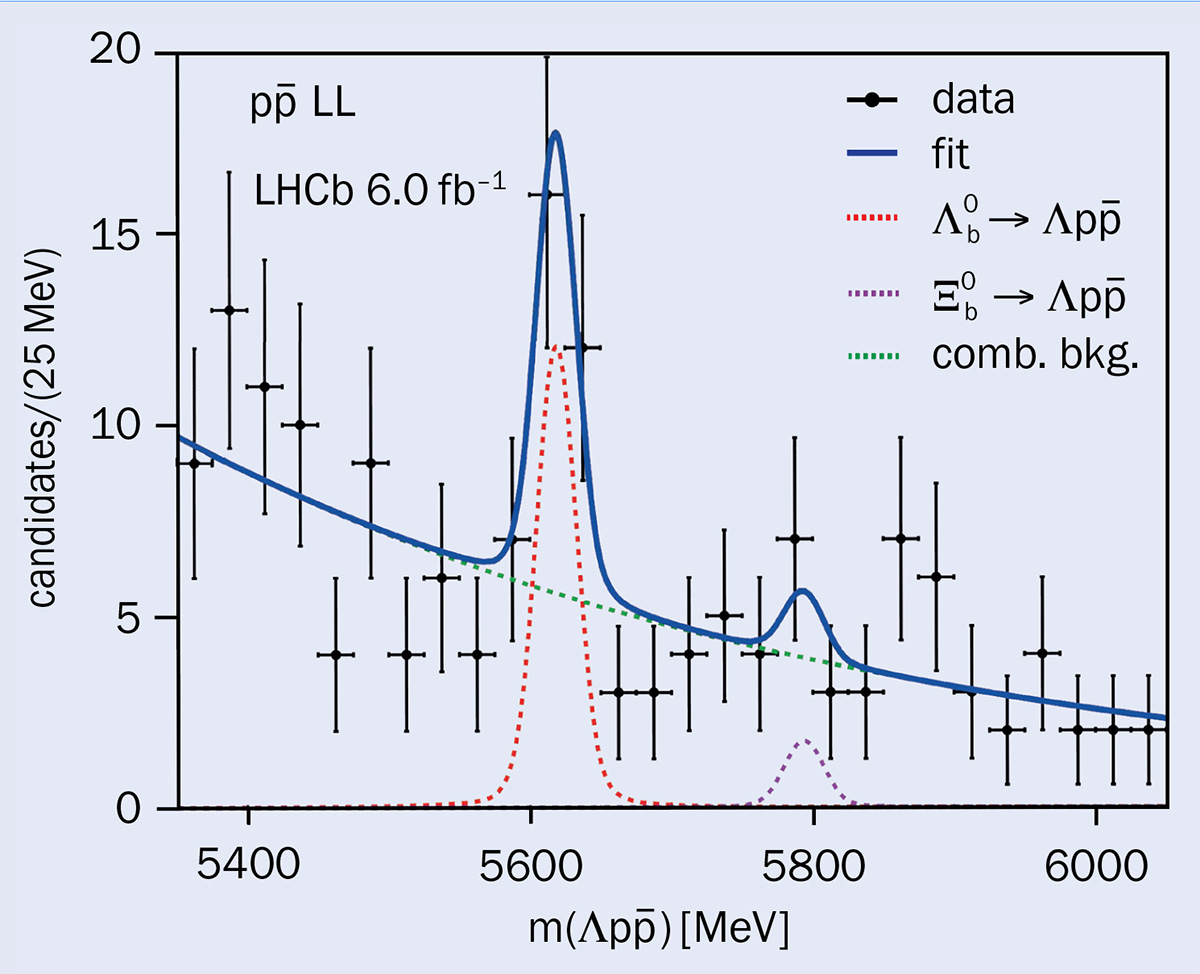
The new LHCb search used proton–proton collision data recorded at a centre-of-mass energy of 13.6 TeV in 2024. The Ξ+cc baryon was reconstructed through its decay to the Λ+cK–π+ final state in a blind analysis, designed to avoid any experimenter bias. A topologically similar decay of the Ξ++cc baryon, Ξ++cc→Λ+cK–π+π+, was used as a control mode for developing the event-selection strategy and calibrating the mass measurement. More than 8000 Ξ++cc candidates were reconstructed in the 2024 dataset, corresponding to an efficiency increase of about a factor of four relative to Run 2.The measured Ξ++cc mass was found to be consistent with the average of previous measurements.
Once the analysis was finalised, the Ξ+cc signal region was unblinded and examined. A structure with a statistical significance exceeding seven standard deviations was observed (see figure 1), corresponding to more than 900 Ξ+cc candidates. The corresponding efficiency is about two and a half times higher than that achieved during Run 2, with the smaller improvement relative to Ξ++cc reflecting the shorter lifetime of the Ξ+cc baryon.
The collaboration also performed a precision measurement of the Ξ+cc mass and the difference between the masses of the two doubly charmed baryons. The Ξ+cc mass was measured to be 3619.97 ± 0.83 (stat) ± 0.26 (syst)+1.90–1.30 (lifetime) MeV, with a difference of –1.77 ± 0.84 (stat) ± 0.15 (syst)+1.90–1.30(lifetime) MeV from that of the Ξ++cc, compatible with theoretical predictions. It was also about 100 MeV higher than the one reported by the SELEX collaboration, disfavouring the interpretation of that state as the Ξ+cc baryon.
The observation of the Ξ+cc baryon completes the isospin doublet of the doubly charmed baryons. It also demonstrates the enhanced capabilities of the upgraded LHCb detector and its trigger system, laying the groundwork for hadron spectroscopy studies with data taken in Run 3.
When lead nuclei collide at the LHC, they create tiny droplets of quark–gluon plasma, an extremely hot and dense state of matter in which quarks and gluons are no longer confined within protons and neutrons. Although these droplets exist for only a tiny fraction of a second, they expand collectively before cooling into the particles detected by the ALICE experiment. One of the clearest signatures of this collective motion is the elliptic flow, which quantifies how particles preferentially emerge along certain directions in the plane transverse to the collision axis.
ALICE has now measured, for the first time, the elliptic flow of the hypertriton (3ΛH) in lead–lead collisions at √sNN = 5.36 TeV, and compared the results with those of anti-3He, a more compact nucleus of similar mass (about 3 GeV). A bound state of a proton, a neutron and a Λ hyperon, the hypertriton is among the most weakly bound nuclei known. As a result, it is significantly larger than ordinary nuclei – while the radius of 3He is about 1.96 fm, the distance between the deuteron core and the Λ hyperon in the hypertriton is of the order of 10 fm. Measurements of the hypertriton flow thus provide a unique opportunity to test whether such a large and loosely bound nucleus follows the collective motion of the medium in the same way as more compact ones.
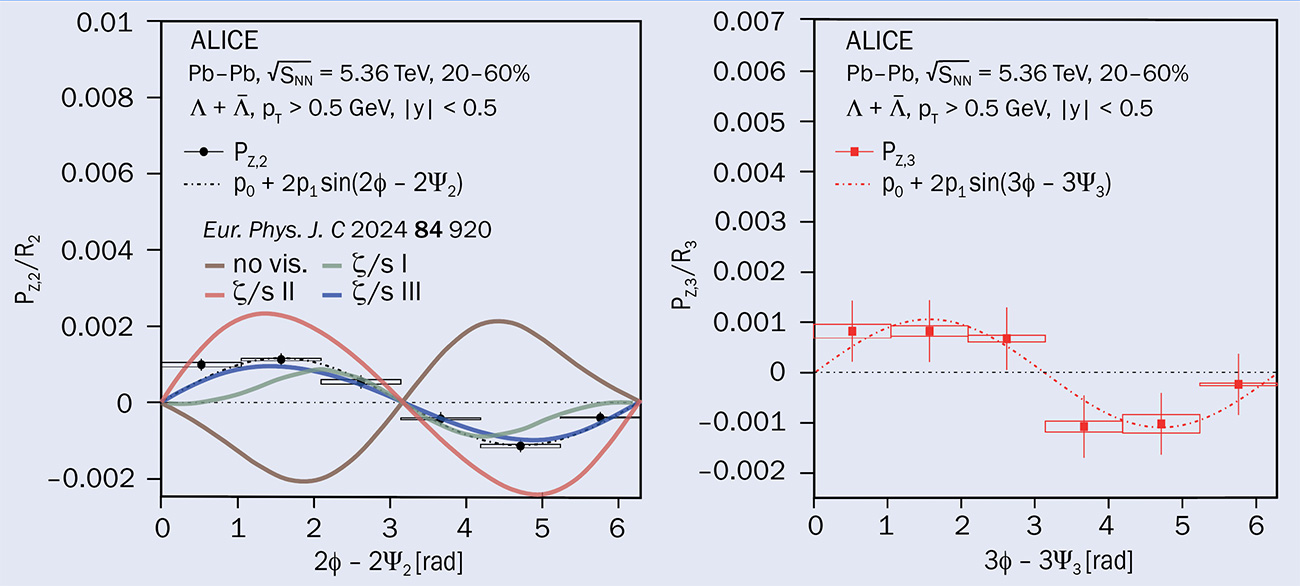
The analysis is based on approximately five billion lead–lead collisions recorded in 2023. 3He candidates are identified by measuring their specific energy loss in the ALICE Time-Projection Chamber, complemented by information from the Inner Tracking System. Hypertriton candidates are reconstructed through their decay into 3He and a charged pion. To distinguish the tiny signal from the much more abundant particles produced at the collision vertex, the analysis identifies a secondary vertex, displaced from the point of collision, where the hypertriton decay happened. Despite their very different sizes and binding energies, the measured elliptic flow of the hypertriton is found to be consistent with that of the 3He (see figure 1).
The 3He measurement reaches unprecedented precision and shows an increase in elliptic flow with transverse momentum, exceeding 0.5 at intermediate and high transverse momenta in the 40–60% centrality interval. Such large values suggest that larger azimuthal modulations contribute to the full angular pattern of 3He production. This behaviour arises naturally in coalescence models, in which light nuclei are formed near kinetic freeze-out by the coalescence of already formed nucleons. In this picture, their collective motion reflects the combined motion of their constituents. The combination of several flowing nucleons can then reshape the nucleus’s final azimuthal distribution, producing the large observed modulation.
Theoretical models reproduce the 3He flow only when a coalescence stage is included, providing strong evidence that light nuclei are not simply born as complete objects at hadronisation, but are assembled from nucleons at a later stage of the collision. Together, the new measurements provide a coherent picture of how composite objects emerge from the hot and dense medium created in high-energy nuclear collisions. Light nuclei appear to carry the collective motion of their constituents, and their elliptic flow is largely governed by the dynamics of the expanding medium. Even for the loosely bound hypertriton, the acquired flow remains insensitive to the large spatial size of the final nucleus. These results establish light nuclei as powerful probes of how and when composite matter forms in heavy-ion collisions.
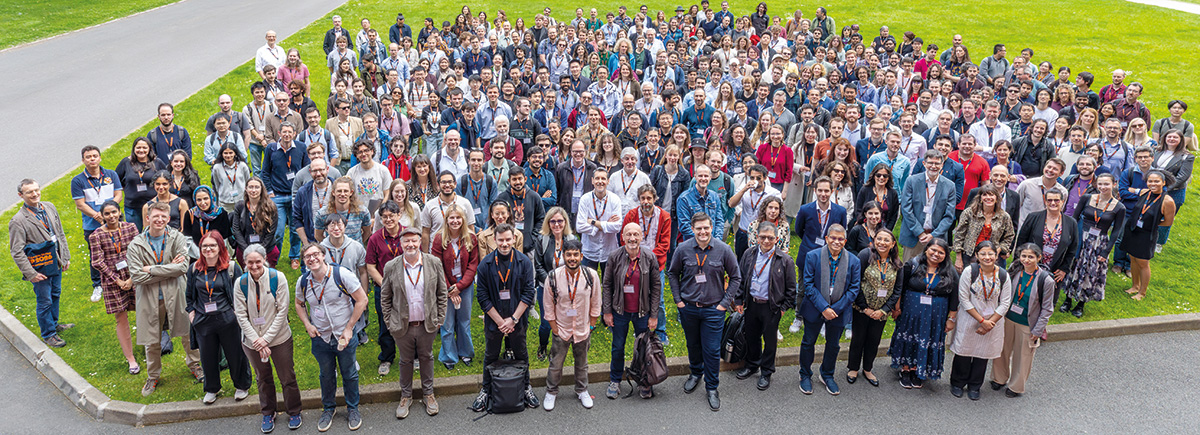
The Quantum Observables for Collider Physics 2026 workshop, held at CERN from 20 to 24 April, was the third edition of a series that began at the Galileo Galilei Institute in Florence in 2023 – now brought to the heartland of high-energy physics. Around 100 invited specialists from across the world gathered to take stock of a programme that has grown, with surprising speed, from a mere theoretical curiosity into a substantial body of experimental results.
The study of quantum observables with colliders is not starting from scratch. Phenomena such as oscillations and CP violation in neutral meson systems, or quantum interference in decay amplitudes and entanglement between B mesons at the Υ(4S) resonance, have been under scrutiny for decades. The novelty lies in the systematic application of the conceptual vocabulary of quantum information science – entanglement witnesses, Bell inequalities, quantum state tomography, and magic and decoherence as observables – to the highest-energy collisions accessible today.
Catalogue of entanglement
The most sharply focused experimental news came from the Higgs sector, where both ATLAS and CMS reported evidence that the two Z bosons produced in Higgs decays are entangled. Tairan Xu (University of Michigan) presented the ATLAS result, with an observed significance of 4.7σ. Jeffrey Davis (Johns Hopkins University) reported the CMS analysis, which measured spin correlations and extracted helicity fractions within an effective-field-theory framework. Together, the two results mark the Higgs boson’s entry into the catalogue of entanglement sources at the LHC.
In the top sector, CMS presented a full tomographic characterisation of the top quark–antiquark quantum state, with Otto Hindrichs (University of Rochester) showing the reconstructed spin-density-matrix elements across the full kinematic range of Run 2. Fiona Jolly (DESY) presented complementary ATLAS measurements, probing quantum-information observables in top-quark pairs. What has changed since the first edition of the workshop is the ambition, with early proof-of-principle measurements giving way to precise reconstructions of the full quantum state.
What has changed since the first edition of the workshop is the ambition
One of the most striking results came from the STAR experiment at RHIC, presented by Zhoudunming Tu (BNL). The measurement reports spin correlations of Λ–Λ hyperon pairs in proton–proton collisions at a centre-of-mass energy of 200 GeV, with a clear angular dependence that existing predictions do not fully describe. Elsewhere, Dmitri Kharzeev (Stony Brook University) argued that partons within a proton approach maximal entanglement at high energies. Their entanglement entropy then becomes directly observable in final-state multiplicities, making structure functions themselves carriers of quantum information. Beatrix Hiesmayr (University of Vienna), whose earlier work on entanglement and Bell-inequality violations in neutral kaon systems helped lay the foundations of the field, provided perspectives from the meson sector that grounded the newer collider-based results.
Marcel Vos (IFIC Valencia) showed that, at a future lepton collider, the entanglement of the top spins in e+e–→ ttg events is expected to fall with the gluon’s energy, vanishing near the kinematic endpoint. This would be a computable, measurable signature of decoherence from real gluon emission. Lian-Tao Wang (University of Chicago) offered a striking reinterpretation, according to which decoherence due to soft, collinear radiation in high-energy collisions can be understood as a renormalisation-group flow.
Two-faced
Several talks explored whether entanglement suppression and enhanced symmetry are two faces of the same phenomenon. Ian Low (Northwestern University) showed, in an abstract spin-system setting, that entanglement reaches a minimum precisely where the Hamiltonian acquires an enlarged symmetry. Carlos Wagner (University of Chicago), Kamila Kowalska (NCBJ Warsaw), and Spencer Chang (University of Oregon) pressed the question from the collider side, asking whether the causal arrow runs from symmetry to entanglement or vice versa. The discussion remained productively unresolved.
A dedicated session on Bell tests reflected a field that has matured in its self-understanding. After a period of a rapid proliferation of proposals, there is now broad agreement on what is and is not achievable at a collider: entanglement can be established, Bell-violating quantum states can be witnessed, but a loophole-free Bell test – of the kind achieved with photons in a standard laboratory setting – is structurally out of reach with existing techniques. The community has, by and large, made peace with this distinction, and is now focusing on what can actually be done.
The next generation of colliders promises a significant step forward
Many contributions pushed the programme’s conceptual boundaries outward. Vlatko Vedral (University of Oxford) argued that laboratory interference experiments could test quantum effects in the gravitational field, while Nikos Mavromatos (King’s College London) explored entangled squeezed states of gravitons – associated with black-hole environments – as a potential probe of quantum gravity. David Kaiser (MIT) recounted how foundational debates about Bell inequalities, pursued by an unlikely group of physicists in 1970s California, eventually catalysed the cosmic Bell experiments. The account served as a reminder that questions dismissed as purely philosophical have a habit of becoming precision science.
On a longer timescale, the next generation of colliders promises a significant step forward. Tao Han (University of Pittsburgh) made the case that FCC-ee and CEPC would deliver large statistical samples in cleaner conditions than the LHC, and that beam polarisation in lepton colliders would open access to quantum process tomography of fermion pairs. Paweł Horodecki (Gdańsk University of Technology) emphasised that, by controlling the initial quantum state, this technique could enable tests of subtle deformations of quantum mechanics – possible extensions of the theory that state tomography alone cannot reach. Yoshitaka Hatta (BNL) and Kun Cheng (University of Pittsburgh) pointed to a further frontier at Brookhaven’s Electron–Ion Collider, where polarised beams will allow the partonic structure of the proton to be probed through its entanglement content.
Phrases overheard in the corridors, in the panel sessions and at the well-attended poster session captured the mood: “That’s fascinating,” “I disagree with you,” and “Let’s talk over coffee.” As Yoav Afik (University of Chicago) observed, the field has grown from a handful of proposals into a genuine international programme. The questions being asked are real ones, and the answers, when they come, will sharpen our understanding of quantum mechanics at the highest accessible energies. The next edition of the workshop will be in Chicago.
From 18 to 22 May 2026, the 28th annual PLANCK conference – held in conjunction with the 6th EuCAPT Symposium – brought more than 250 theoretical physicists to CERN to confront a set of dilemmas that are, at root, about scale. Where should the hunt for dark matter focus, when its mass might span 90 orders of magnitude? Why is the Higgs mass so tiny compared to the Planck scale, with no signs of a mechanism to stabilise the gap? Can one learn about particle production in the early universe, when evidence is spread thinly over the farthest sky?
Microscopic to galactic
Faced with these puzzles, theorists are seeking answers from systems ranging from the microscopic to the galactic. Jordy de Vries (NIKHEF) discussed novel methods to look for subtle differences in how the strong force affects matter and antimatter using tiny molecular dipole moments. At the opposite end, Kai Schmitz (Münster University) reported on work using the rhythms of pulsars spread across the Milky Way to detect gravitational waves produced in the first moments after the Big Bang.
The framework of effective field theory (EFT) threaded through the conference. By capturing the physics at a given scale and folding higher-scale effects into a handful of parameters, it proves ubiquitously powerful for advancing complex calculations. Giulia Isabella (UCLA) presented new results applying scattering methods – originally developed for particle physics – to calculate gravitational-wave signals from black hole mergers. Mikael Chala (University of Granada) discussed the use of EFTs in calculations of thermal phase transitions, such as those that occurred in the early universe. Anders Eller Thomsen (University of Bern) presented precision calculations of the Standard Model EFT used to predict subtle effects of undiscovered particles with masses beyond the energy range of the LHC.
The electroweak scale, at which electroweak symmetry breaks and particles acquire mass through the Brout–Englert–Higgs mechanism, continues to play a unique role across a variety of fundamental puzzles. The possibility that a strong electroweak phase transition led to a universe filled with matter was discussed in talks by Jorinde van de Vis (CERN), Dave Sutherland (University of Glasgow) and Maria Cristina Fiore (University of Granada), anticipating future tests of this scenario with gravitational waves, Higgs measurements and resonance searches.
A highly varied field, united around big questions
The idea of a “WIMP miracle”, in which the observed abundance of dark matter is due to a weakly interacting particle with mass around the electroweak scale, is one of the most compelling and long-standing dark-matter explanations. Weishuang Linda Xu (Stanford University) presented work interpreting gamma-ray observations of the galactic centre, arguing that this dark-matter framework can be fully tested once the next generation of telescopes comes online.
Many talks presented novel model-building ideas, including some related to the recent burst of activity around models explaining the observed hierarchies in fermion masses, many of which answer other theoretical puzzles. Marta Zamoro (Autonomous University of Madrid) showed how both the mass hierarchies and the strong CP problem could be explained through a model with extra copies of the Standard Model QCD group. Javier Lizana (University of Castilla–La Mancha) and Simone Marciano (University of Valencia) presented different models in which a dark-matter candidate arises within theories predicting hierarchical fermion masses. Each of these predicts novel phenomena, particularly in flavour-changing processes that could be measured at LHCb.
PLANCK 2026 presented a picture of a highly varied field, united around big questions and emerging techniques. Speakers and participants looked towards the new opportunities offered by upcoming measurements, colliders and telescopes, building a theoretical toolkit to interpret their insights across all scales.
The 17th International Particle Accelerator Conference (IPAC’26) took place from 17 to 22 May 2026 in Deauville, a charming small town in Normandy, France. The event drew 1520 registered participants, including 264 students, from more than 40 countries. The programme ranged across flagship high-energy accelerator projects, synchrotron light sources, novel acceleration techniques, and the underlying technologies and beam dynamics.
Present facilities and beyond
In his opening talk, Robin Ferdinand (GANIL) reviewed the installations, activities and plans at the host institute GANIL, which provides a large variety of ion beams. Next, CERN Director-General Mark Thomson outlined CERN’s priorities and future vision, from the implementation and exploitation of the HL-LHC to the FCC-ee, the proposed next high-energy physics flagship project (see CERN Council updates the European Strategy). He set out the aim of bringing FCC-ee to a state where it can be proposed for approval in 2028.
With facilities transitioning from third- to fourth-generation, synchrotron light sources stood out as a particularly active field – as reflected in a plenary talk by Laurent Chapon (Argonne National Laboratory), director of the Advanced Photon Source. Later contributions returned to topics such as the preparation for the fourth-generation SOLEIL II, the rapid and successful commissioning and first operation of SLS 2.0 at PSI, and the plans for MAX 4U, an upgrade even beyond the fourth generation.
The opening plenary sessions also included a talk by Masashi Otani (KEK) on a proof-of-principle demonstration of a method to produce and accelerate low-emittance positive muon beams (see CERN Courier July/August 2018 p8). A status report by Natalia Milas (ESS) on the commissioning of the ESS highlighted key milestones and steady progress towards first beam on target in 2027.
Presentations on proposed and operational high-energy flagship facilities included a review of linear colliders by Steinar Stapnes (University of Oslo), a report by Jörg Wenninger (CERN) on the luminosity records achieved by the LHC, a progress report by Paul Jurj (Imperial College London) on ongoing muon collider studies and a final review by Michiko Minty (BNL) on a quarter of a century of RHIC (see CERN Courier May/June 2026 p10), whose infrastructure will be largely reused for the Electron–Ion Collider.
Robert Apsimon’s (Lancaster University) presentation on the innovative “ghost collider” drew wide interest among participants. By superimposing electron and positron bunches, it mitigates the strong non-linear forces of conventional collisions at the interaction point (IP) and suppresses beam loading along the energy-recovery linacs. A second feature is the energy transfer between the electron and positron bunches, so that their energy in the return arcs is slightly more than half that at the IP, strongly reducing synchrotron radiation losses.
This edition also saw a significant increase in contributions on machine learning and artificial intelligence (AI), indicating a shift in the development of next-generation accelerators. Several presentations reported substantial progress, particularly through the use of simulated datasets, and potential improvements in commissioning workflows and strategies, as demonstrated at the HIAF complex in China. Thorsten Hellert (LBNL) discussed the growing role of generative AI in accelerator operations, showcasing agentic frameworks enabling natural-language interaction with machines. In the closing plenary, a broader perspective further emphasised that machine learning is increasingly being integrated into accelerator design, optimisation and control, moving toward more autonomous, data-driven facilities.
Advanced acceleration techniques were widely covered, with multiple sessions dedicated to plasma-based acceleration. Medical applications were also discussed, including tests with a mixed helium-carbon beam at MedAustron to develop monitoring techniques in hadron therapy (see The Swiss Army knife of beam simulation), presented by Elisabeth Renner (TU Wien). Also featured were noteworthy contributions on nonlinear beam dynamics, ranging from higher-dimensional resonances and phase-space topology to novel methods for analysing complex beam motion in modern accelerators.
Science and society
The theme of sustainability, as a societal and political necessity to be taken into account when designing future projects, ran through the programme, including the “engagement with industry” session. It also motivated the presentation by Igor Syratchev (CERN) on the development of the TRISTRON, an RF source proposed to increase efficiency.
The conference reached a record 35% of female speakers, and a well-attended equal-opportunities session drew about 380 participants to discuss the main factors limiting gender parity in accelerator science and beyond. In addition to multiple plenary and parallel sessions, scientific results were presented in more than 1500 posters throughout the conference, encouraging in-depth one-to-one discussions. The event also featured a large industrial exhibition, with 113 exhibitors, two media partners and six institutional exhibitors.
The discussions, new collaborations and inspiring contributions shared at IPAC’26 demonstrate the continued strong interest in the particle accelerator field and provide solid foundations for future advances in accelerator science and its applications. The next three IPACs will be held in May 2027 in Detroit, June 2028 in Tokyo and May 2029 in Liverpool.
The 16th Workshop on Critical Point and Onset of Deconfinement (CPOD26), held at CERN from 13 to 17 April 2026, brought together more than 100 researchers focused on the phase structure of strongly-interacting matter. The workshop continued the long-running CPOD series, which centres on understanding how and when ordinary hadronic matter transforms into quark–gluon plasma (QGP), and whether a critical point exists in the QCD phase diagram.
The series adopts a plenary-only format, to encourage unified discussion across theory and experiment and bridge gaps between different approaches to the same underlying questions. In this same spirit, the programme emphasised clarity and synthesis rather than specialised talks for a narrow audience. Many of the review talks were devoted to emerging subfields, making it easier to connect developments across traditionally separate areas.
Critical point
The central scientific theme was the search for the hypothetical QCD critical point, where the smooth crossover between hadronic matter and the QGP gives way to a genuine first-order transition, deconfining and chiral-restoring at once. Identifying it remains one of the most important open problems in high-energy nuclear physics.
Speakers examined how matter behaves under extreme temperature and density – conditions recreated in relativistic heavy-ion collisions. While lattice QCD provides invaluable results at vanishing net-baryon density, extending these calculations to high net-baryon density remains difficult due to the infamous “sign problem”. Still, new exclusion limits were presented, ruling out parts of the phase diagram as possible locations for the critical point.
On the experimental side, several contributions highlighted results from ongoing heavy-ion programmes, probing a wide range of observables with beam-energy and system-size scans. These efforts are designed to uncover non-trivial structures in the excitation functions of observables that might signal critical behaviour – or the onset of deconfinement. Particular attention was given to event-by-event fluctuations and correlations, as well as to methodology, since signals can be distorted by the dynamical evolution of the collision system.
Central were, of course, the properties of the QGP. Presentations addressed transport coefficients, collective flow, dileptons and the role of fluctuations in the QGP, aiming to understand how such properties vary across different regions of the phase diagram. The connection between early-time dynamics and final-state observables was a recurring theme, with hydrodynamic and transport models playing an important role.
A key takeaway from CPOD26 was the importance of integrating multiple approaches
Understanding hadronisation – the transition from QGP back to hadrons – is essential for linking theoretical descriptions of deconfined matter to experimental measurements. Various models of particle production and freeze-out were compared, with emphasis on how they affect fluctuation observables and potential signatures of critical phenomena. Subtler effects, such as possible indications of isospin-symmetry breaking, were also noted.
The workshop’s scope extended to dense QCD matter in astrophysical environments, particularly in neutron stars, with observations from modern astrophysics providing complementary constraints on the QCD equation of state at high density. This interdisciplinary perspective highlighted how insights from astrophysics and heavy-ion collisions can inform each other, contributing to a more complete picture of the phase diagram.
Looking to the future, several talks focused on new experimental facilities and detector upgrades. Speakers discussed developments at the FAIR complex at GSI – home to the CBM and HADES experiments – and at CERN, including the proposed new fixed-target experiment NA60+/DICE, the upgrade of NA61/SHINE and the next-generation ALICE 3 detector for the HL-LHC. The possibility of a fixed-target experiment at the Electron–Ion Collider (EIC) was also discussed. These efforts aim to improve sensitivity to rare signals and extend coverage into previously unexplored regions of the phase diagram.
Intriguing hints
A key takeaway from CPOD26 was the importance of integrating multiple approaches, especially given the uncertainty about the existence and location of the critical point. Experimental hints are intriguing but not yet conclusive, and theoretical predictions still face challenges in achieving quantitative agreement with data. The need for new, precise measurements at collision energies between 3 and 10 GeV was stressed throughout the workshop.
By bringing together diverse perspectives in a focused and collaborative setting, CPOD26 highlighted both how far the community has progressed in refining its tools and how much remains to be understood about the fundamental behaviour of strongly interacting matter. The next workshop is planned in Lanzhou (China), on 16–20 August 2027.
From 27 to 29 May 2026, LoopFest returned to Brookhaven National Laboratory, where the conference series started in 2002. Since then, LoopFest has been held each year across universities and national laboratories in the US and, more recently, Canada. With around 60 participants, this year’s edition provided a forum for discussing the latest results in precision quantum field theory (QFT), along with their applications to interpreting current experimental results and anticipating the precision reach of future experiments, primarily in collider physics. Its cousin event, the Loops and Legs symposium, was hosted last April in Bayreuth, Germany.
Talks highlighted impressive developments in multi-loop and multi-leg calculations, in matching fixed-order higher-order calculations with multi-purpose parton-shower event generators, and in the evaluation of parton distribution functions for precision measurements. Areas central to the precision-physics programme of the LHC, such as differential measurements of Higgs-boson and top-quark processes, received particular attention, while dedicated talks turned to future e+e– machines. There, the main challenge will be for theory to equal the extreme experimental accuracy expected for electroweak precision observables.
Exquisite control
Matching the precision of the High-Luminosity LHC and future e+e– colliders is vital for future discoveries. This endeavour will require exquisite control of theoretical predictions, at the (sub)percent and permille level, respectively, and already poses issues that are both technical and conceptual. Most importantly, aiming for extreme precision could not only enable the indirect discovery of new physics, but also lead to new insights into the fundamental structures of quantum field theory. Several talks stressed this point, some reviewing cutting-edge studies of amplitudes in N = 4 super Yang–Mills theories, others the impact of recent advances in quantum amplitudes for gravitational waves from black-hole scattering.
If anomalies emerge from precision studies, their interpretation will be equally challenging. Multiple contributions traced the state of the art of Standard Model effective field theory (SMEFT) calculations. SMEFT extends the Standard Model with a series of higher-dimensional operators built from its own fields, so that the imprint of unknown heavy particles is captured by small shifts in couplings. It is a common way to explore physics beyond the Standard Model under very general assumptions.
A dedicated effort to provide the dimension-6 SMEFT Lagrangian at the first non-trivial order of quantum corrections is reaching completion and will become a fundamental building block for future studies. Results from a global fit of the SMEFT Lagrangian – including, for the first time, a broad spectrum of electroweak, Higgs-boson, top-quark, Drell-Yan, di-boson and flavour observables – were presented as a proof of concept of how the SMEFT could help explore models of new physics.
New ways to apply artificial intelligence/machine learning and quantum information science have opened up
Finally, the focus shifted to how the groundbreaking ideas that have transformed the theoretical calculation of scattering amplitudes have also opened new ways to apply artificial intelligence/machine learning (AI/ML) and quantum information (QI) science. This is creating new opportunities to rethink how loop calculations are performed, potentially overcoming longstanding computational bottlenecks and enabling qualitatively new approaches and conceptual frameworks. For instance, recent work has explored the application of reinforcement learning, supervised regression and self-supervised learning to some of these problems.
At the same time, generative models – including normalising flows and diffusion-inspired methods – have already demonstrated impressive gains in Monte Carlo integration and importance sampling, the random-sampling methods used to evaluate the high-dimensional integrals underlying cross-section predictions. Since precision QFT calculations are quantum-mechanical at heart, a genuinely quantum computation of precision scattering opens the door to synergies with QI studies of collider processes. Some talks asked how far a future quantum computer could help study QFT processes from a QI perspective, to best exploit the precision data produced by colliders like the LHC.
Extended reach
Overall, LoopFest conveyed the impressive theoretical progress achieved in recent years, enabling the exploration of new physics through precision measurements at current and future experiments. Ground-breaking methods developed during the last two decades have progressed rapidly and are now entering a mature phase, providing a robust framework within which future technical and conceptual challenges can be identified and addressed. Combined with new emergent technologies such as AI/ML and QI, this could extend the reach of current precision-physics programmes far beyond expectations.
Etam, Victor Hess discovered cosmic rays on a historic balloon flight in 1912. More than a century later, why is measuring them at the poles interesting?
Etam Noah Near the equator, the Earth’s magnetic field deflects the lower-energy cosmic rays arriving from space, while at the poles those same particles stream almost freely down the field lines. Although this latitude dependence has been known since the 1930s, ground-level measurements from the polar caps themselves are remarkably scarce, which is exactly the gap we wanted to close. After all, the origin of cosmic rays – at energies many orders of magnitude beyond those of the LHC – is still debated, and their secondary products continue to provide an accessible, free-of-charge source for both fundamental and applied research. CERN’s CLOUD experiment, for example, has shown that cosmic-ray-induced ionisation can influence aerosol nucleation, with implications for climate modelling.
How far north had anyone measured muons before?
Etam In 2018, the Polarquest2018 expedition (CERN Courier December 2018 p30) sailed the 18 m aluminium yacht Nanuq into the Svalbard archipelago, carrying a scintillator detector built at CERN by high-school students from Italy, Switzerland and Norway as part of the Extreme Energy Events (EEE) network proposed by Antonino Zichichi in 2004. Polarquest2018 reached 82°07′ N, setting what was then the northernmost published ground-level muon record. Around the same time, the Dutch Clean2Antarctica expedition wheeled a solar-powered cart instrumented with a HiSPARC scintillator panel from Nikhef to the South Pole, across 1200 km of Antarctic ice. Both projects were as much about education and environmental advocacy as they were about physics, which is also the spirit behind Cosmic Pi.
James Devine The story goes back to a weekend project at the 2012 CERN Webfest. There, we wired together an Arduino microcontroller, an Android phone and a single Geiger-Müller tube borrowed from the ERGO project, to demonstrate a low-cost approach to distributed cosmic-ray timing over the public internet. Our prototype was crude. Android’s USB accessory ecosystem was barely usable at the time, but it convinced us that the idea was sound. The project resumed in 2014 under the code name X1 at THE Port, a hackathon hosted at CERN’s IdeaSquare. The explicit target was to switch from Android to the new Raspberry Pi single-board computer – and to release all designed components as open hardware and open source.
And how does the detector actually work?
James The principle is simple. Each unit has two plastic scintillator slabs, one above the other, each read out by a silicon photomultiplier. A particle passing straight through both, lights them up together, and that coincidence is what picks out muons and rejects the stray background, which usually triggers only one of them. A microcontroller timestamps each event with help from a satellite navigation receiver down to 65 ns, while the Raspberry Pi handles the internet connection and logs all the data.
From the start, you wanted the detector to be cheap and widely accessible. How has that worked out?
James Not in the way we planned. We had initially hoped to crowd-fund production for less than $500 a unit, but six years of supply problems put that out of reach. The first major hiccup in the global semiconductor supply chain occurred in 2020, when COVID-19-related shutdowns at chip fabrication plants massively restricted the flow of much-needed components. This worsened in 2022, with Russia’s invasion of Ukraine. Unrestrained enthusiasm for AI has driven further chip shortages, making it almost impossible – and very expensive – to obtain a Raspberry Pi. DRAM prices have increased by more than five times in just one year. So we changed strategy, and focused on building small batches of detectors to ship as prizes to runners-up in CERN’s Beamline for Schools (BL4S) competition. More than a hundred units have now been distributed to schools and individual experimenters around the world.
So how did one of them end up on a polar expedition?
James Almost by accident. In the autumn of 2023, I got a call from Paola Catapano (CERN), leader of Polarquest2018. She had been contacted by the Transglobal Car Expedition (TGCE), which was attempting to cross both the north and south poles by car. The idea was to take the EEE detectors from the Nanuq expedition along, but they were too big to fit in the polar vehicles. Her question was straightforward: could a detector designed for the classroom survive being driven onto the sea ice, and would it be ready for the start of the expedition, in January 2024?
And, of course, the answer was yes. How did you prepare?
James The expedition was, by any measure, an incredible logistical challenge. It covered more than 92,000 km across 42 countries, including a 6000 km Arctic crossing and a 7200 km Antarctic crossing, with ambient temperatures swinging from −50 °C to +50 °C. No previous wheeled expedition had reached the geographic North Pole – and we had a very short time to get ready. So we improvised. First, I called around some other educational cosmic-ray projects to see if anyone had suitable hardware. We soon concluded that the spare parts left over from BL4S would be the best option. We knew our detectors should behave acceptably down to at least –20 °C, and we did the only test available: we put them in a domestic chest freezer overnight, and any that were still working in the morning were sent on the expedition. They were repackaged into rugged Pelican-style cases to protect against water ingress and vibration, and each was named after a polar explorer or vessel: Nansen, Amundsen, Scott, Nobile and Erebus. The last honours the HMS Erebus, which sailed to both polar regions.
Etam, how did the detectors hold up out there?
Etam As James said, we carefully packed and tested every unit before sending it out – along with as many spare parts as we could think of. The constant vibration during long overland transits can affect solder joints and the points where each scintillator’s light reaches its sensor. And then there was the extreme environment. We didn’t expect all the detectors to make it, so we were very pleased to see that three of them successfully recorded data for almost the entire North Pole leg. Power, a modest 5 W per detector, came from the expedition vehicles, and the data was relayed back to Geneva over our Starlink satellite link, a piece of infrastructure unavailable to our 2018 polar predecessors. The most surreal moment of the journey was perhaps a live call with the team at the North Pole, including expedition leader Vasily Shakhnovsky, while detector data was streaming in real time to our servers.
And what did all that data add up to?
Etam The dataset covers 10 January to 12 May 2024, along a route from North America through the Arctic, to the North Pole and onward to Greenland. It includes per-second muon event counts, along with associated GPS coordinates, temperature, humidity, pressure, accelerometer and magnetometer readings. The key result is a continuous, geo-tagged record of secondary muon flux extending to 90° N, surpassing Polarquest’s 82°07′ N by nearly eight degrees of latitude.
The expedition then turned to Antarctica. What does the second pole bring?
Etam Of the units that worked in the Arctic, only one returned usable data from the Antarctic, a reminder of how tough a multi-year, multi-vehicle expedition is, even for ruggedised hardware. Yet that one unit covered Cape Town to the South Pole and back to the equator through South America. Taken together, the two datasets total 6.7 GB – a comprehensive latitude scan of secondary muon flux from approximately 90° N, crossing the equator, to approximately 90° S (see “Pole to pole” figure), all collected with the same instrumentation. Thanks to it, we can compare measurements without cross-calibration uncertainties dominating the result. The muon rate changes most clearly with latitude, but the scan also sets it against altitude, pressure, magnetic field and temperature. We hosted a workshop for high school students analysing the North Pole data at the CERN Science Gateway. We haven’t discovered anything new, but we are nonetheless very proud of what we achieved, and grateful to the expedition team for taking our detectors along.
James, how much of Cosmic Pi is open for others to build on?
James Cosmic Pi is a volunteer project, with contributors donating their own time alongside their regular work. In keeping with its origins, everything is open. The board designs are published under CERN OHL v1.2, an open-hardware licence that lets anyone reproduce and modify them. The firmware, dashboards and analysis notebooks are under GPL-3.0, the standard free-software licence, and the raw and sanitised datasets are openly available on Zenodo. We also ran outreach events along the route and kept close links with the CREDO citizen-science consortium.
Looking back over more than a decade, what did you set out to do, and where did you end up?
James We set out to make a cutting-edge cosmic-ray detector available to the whole world, and we ended up going on a fantastic journey and measuring around the whole world instead. It’s been a challenge, and an exciting one at that.
Jim Peebles won the Nobel Prize in Physics in 2019 for his work on the foundations of cosmology. Looking back at the state of his field in the early 1960s, he did not paint a pretty picture. Cosmology was, he recalled, “a limited subject … with two or three numbers.” He added, “A science with two or three numbers always seemed to me to be pretty dismal.” It was even worse than Peebles made it out to be. One of those numbers – the main number for many people – was the Hubble constant, named after Edwin Hubble, which quantified the expansion rate of the universe. Since the late 1920s, there had been a systematic campaign to measure the Hubble constant with ever-increasing precision. Yet, as the astronomer Allan Sandage showed in a 1962 review of the topic, there was no real agreement. Some astronomers found that the Hubble constant was 113 (in units of kilometres per second per megaparsec), with an uncertainty of about five. Others were getting 75, with an uncertainty of 25. Given the uncertainties, the results were remarkably discrepant – or “discordant”.
By the mid-1990s, the situation wasn’t much different. I remember attending the Critical Dialogues in Cosmology conference in Princeton in 1996, at which Wendy Freedman advocated a “high” value of the Hubble constant (above 70), while Gustav Tammann pushed for a low value (around 50). In a heated debate, they were at each other’s throats, and it became clear that the different camps weren’t going to agree, nor were they going to concede. By the early 2000s, the “Hubble battles” seemed to have ended, and a consensus was emerging that the Hubble constant was around 70. That is, until measurements became so precise that “discordance” re-emerged. This is the situation we find ourselves in now. Measurements that probe the early universe by looking at the cosmic microwave background yield a “low” value of the Hubble constant of 67, while methods that examine the late universe by measuring the properties of variable stars and supernovae give us a “high” value of 74. These numbers seem close, but the uncertainties have come down so dramatically that the difference matters.
It is a mesmerising story that has been in the background of my career as a cosmologist. On the one hand, we want the tension to go away, to see it resolved, given how successful the cosmological model is. On the other, for the more theoretically minded, there is hope that this is tantalising evidence for new physics, an undiscovered fundamental property of the universe yet to be uncovered. There is yet another possibility, which sounds much less scientific, namely that the protagonists throughout the ages have become wedded to their own favourite values, preventing convergence. Having met many of them, I can vouch that they are strong and fascinating characters.
Jim Baggott’s Discordance is an attempt to describe the history of cosmology throughout the past century or more. It covers a lot of ground and delves into some of the less explored aspects of the story. For example, he describes the “Harvard computers”, a cohort of women working at the Harvard College Observatory who played an instrumental role in establishing the foundations for the distance indicators crucial in measuring the Hubble constant. Henrietta Leavitt stands out as the person who unearthed the period-luminosity relation for Cepheid variables, which are at the heart of the current Hubble debates.
He also rightly describes what I call the “golden age of cosmology”, from when Peebles and others first began building accurate mathematical models of the large-scale structure of the universe to the modern measurements of the cosmic microwave background. I grew up during this era and have been lucky enough to witness firsthand this remarkable success story, a beautiful example of theory and observation coming together. This is physics and astronomy at their best. It is not all about discordance.
What I missed was a more in-depth analysis of what is going on, of how the different camps work and interact with each other. The characters are interesting, and it would have been good to get to know them better and understand what drives them. As it stands, they are mostly two-dimensional protagonists in a whistle-stop tour through the history of cosmology. Often, I found myself reading the book as if it were a layperson’s review article, a simplified version of what one might find in the Reviews of Modern Physics or Physics Reports. The result is a useful and easy way to get up to date on what is going on in cosmology, but no more than that.
To provide the best experiences, we use technologies like cookies to store and/or access device information. Consenting to these technologies will allow us to process data such as browsing behavior or unique IDs on this site. Not consenting or withdrawing consent, may adversely affect certain features and functions.
Functional
Always active
The technical storage or access is strictly necessary for the legitimate purpose of enabling the use of a specific service explicitly requested by the subscriber or user, or for the sole purpose of carrying out the transmission of a communication over an electronic communications network.
Preferences
The technical storage or access is necessary for the legitimate purpose of storing preferences that are not requested by the subscriber or user.
Statistics
The technical storage or access that is used exclusively for statistical purposes.The technical storage or access that is used exclusively for anonymous statistical purposes. Without a subpoena, voluntary compliance on the part of your Internet Service Provider, or additional records from a third party, information stored or retrieved for this purpose alone cannot usually be used to identify you.
Marketing
The technical storage or access is required to create user profiles to send advertising, or to track the user on a website or across several websites for similar marketing purposes.