Less than one in 10 billion positively-charged kaons decay into a pion and a neutrino–antineutrino pair. The NA62 experiment has now measured the rate of this rare process with an uncertainty 40% smaller than its previous result and a central value closer to the Standard Model (SM) prediction (CERN Courier November/December 2024 p11).
“The K+ → π+νν decay is a golden mode of flavour physics,” says NA62 spokesperson Giuseppe Ruggiero. “It is highly suppressed in the SM, but its branching ratio can be predicted to better than 10% precision. The decay is also highly sensitive to new physics, with many models predicting dramatic changes to the branching ratio. Such modifications may come from indirect effects of new physics at or above the 100 TeV scale.”
The scarcity of the decay called for a kaon factory. At NA62, a high-intensity proton beam from the Super Proton Synchrotron strikes a beryllium target, producing around 500 million secondary particles per second. About 6% are positively charged kaons. From that flux, the experiment must isolate the signal against backgrounds many orders of magnitude larger. The first 5σ observation, on data collected through 2022, was reported in 2024. The branching ratio came out at (13.0+3.3–3.0) × 10–11, consistent within 1.7σ with the SM prediction of around 8 × 10–11, despite a central value about 50% higher. Two years of additional data have now doubled the signal sample, and the central value has come down to (9.6+1.9–1.8) × 10–11, reaching a sub-20% precision.
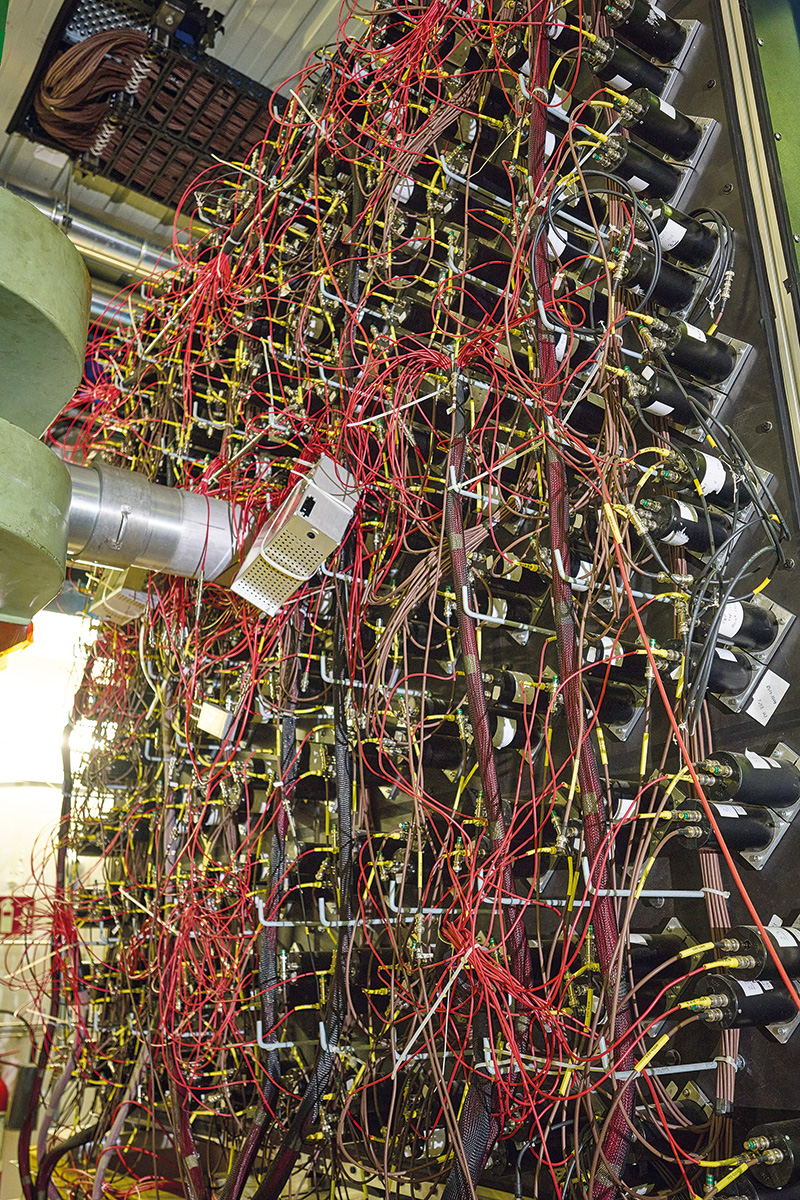
Two new machine-learning techniques drove the increase in precision. “Reconstructing beam particles in the harsh environment of up to a gigahertz of incoming particles is challenging,” says Joel Swallow of CERN, lead data analyst of the study. “To tackle this, we deployed a transformer encoder to pick out a kaon as it enters the experiment. Meanwhile, a combined convolutional and feed-forward neural network was developed for pion identification, which effectively uses images of the energy deposits in the calorimeters to more efficiently and accurately identify pions.”
Two new machine-learning techniques drove the increase in precision
“Had the central value stayed where it was, the precision of the new measurement would have been sensitive to a 3σ excess,” says Ruggiero. “If there had been an excess that large, this measurement was perfectly positioned to find it. Evidently, nature is a bit more subtle.”
The new result tightens constraints on beyond-SM scenarios that would have predicted larger branching ratios, including those involving leptoquarks or heavy Z′ bosons. Still, the dominant uncertainty remains statistical, and additional data from 2025 and 2026 will improve the precision further.
The neutral counterpart, KL → π0νν , has yet to be observed. The current upper limit on its branching ratio, set by Japan’s KOTO experiment at J-PARC, sits two orders of magnitude above the SM prediction. “Measuring both the charged and neutral modes is important,” says Ruggiero. “Together, they enable a fully independent reconstruction of the unitarity triangle from kaon decays alone. Even if, in the end, the charged mode is consistent with the SM, it does not rule out significant enhancements from new physics to the neutral mode.” The proposed KOTO-II, at J-PARC, is targeting a measurement of KL → π0νν in the 2030s.
Further reading
NA62 Collab. 2026 arXiv:2604.12649.