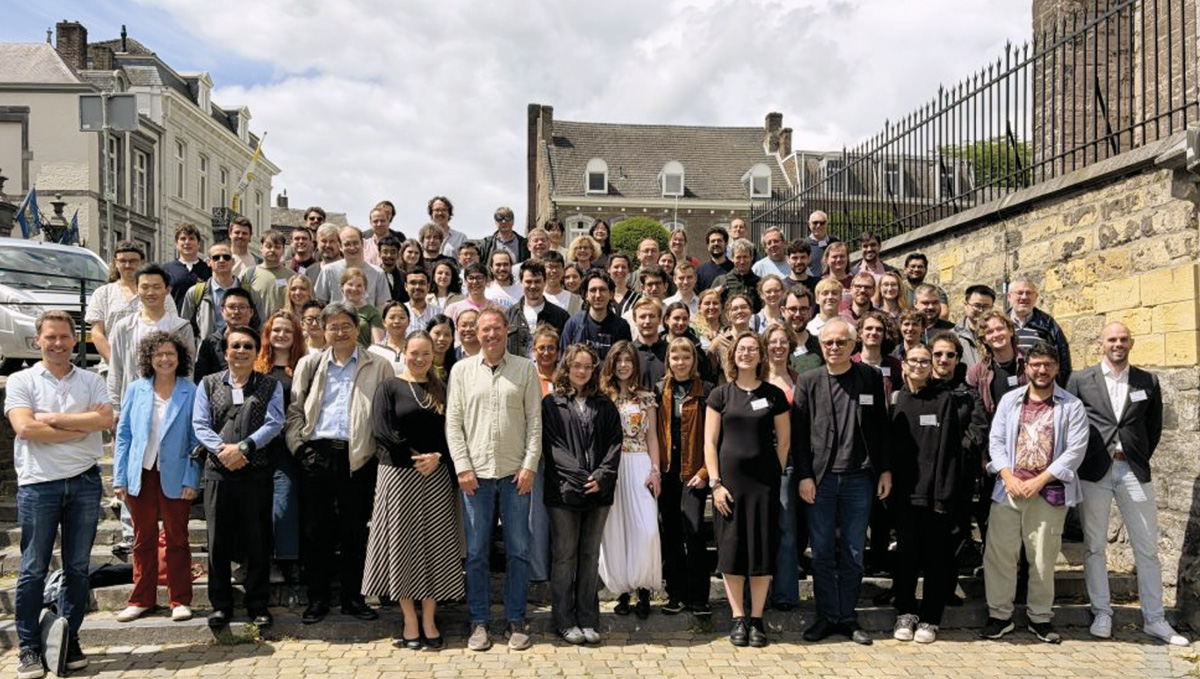
The 21st International Conference on B-Physics at Frontier Machines, Beauty 2026, took place from 1 to 5 June in the charming setting of St. Jan’s Church in Maastricht, the Netherlands. Maastricht University and Nikhef, the Dutch National Institute for Subatomic Physics, welcomed around 100 participants from all over the world for a programme ranging from CP violation and rare decays to spectroscopy, the production of heavy-flavoured hadrons and the prospects for quark-flavour studies at the High-Luminosity LHC (HL-LHC), Belle II, the Super Tau Charm Facility (STCF) and the Future Circular Collider (FCC).
Powerful probes
Heavy-flavour decays, in particular those of hadrons containing b quarks, offer powerful probes for testing the Standard Model (SM) and searching for new physics at the high-precision frontier. Reviewing the latest results in this field and discussing its future directions has been the central goal of the Beauty conference series since its first edition, held in Prague in 1993. This year, the LHC experiments showed an impressively broad range of new results.
LHCb reported a new study of the highly suppressed flavour-changing neutral-current decay B+ → π+μ+μ–, based on data from Runs 1 and 2 of the LHC, as well as early results from Run 3. Notably, the other LHC experiments are also contributing a growing breadth of flavour results. For example, CMS presented its first study of CP violation in the “golden mode” B0 → J/ψKS, which is sensitive to the unitarity-triangle angle β. To control hadronic uncertainties in the interpretation of this result, the analysis also determined CP-violating observables in the sister mode B0s → J/ψKS to record precision.
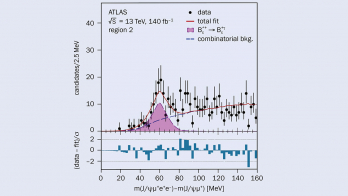
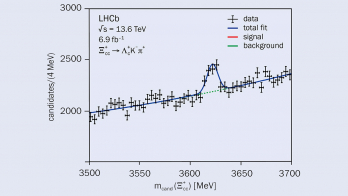
The collaborations also reported on their achievements in hadron spectroscopy, including through the observation by ATLAS of a low-lying excited Bc meson (see Hyperfine splitting in the Bc system). The conference hosted the exciting announcement of LHCb’s discovery of the doubly charmed baryon Ω+cc (CERN Courier July/August 2026 p12), a result that showcases the improved capabilities of the upgraded Run-3 detector. This particle completes the family of doubly charmed ground-state baryons, extensively studied by theorists since the 1970s. Interesting in themselves, these and other multi-charmed baryons may also serve as important probes of the quark–gluon plasma at ALICE and other experiments in the HL-LHC era. Beyond the LHC, participants heard about the impressive studies of lower-mass hadrons possible at BESIII in Beijing, including the X(2370), a tantalising candidate for the elusive glueball (see A case for pure glue).
The LHC experiments showed an impressively broad range of new results
The event featured more talks from Belle II than any previous edition, reflecting the steadily improving performance of the SuperKEKB accelerator, which has delivered a dataset at the Υ(4S) resonance that now exceeds that collected by the earlier Belle experiment. One of the most striking results was a measurement of the time-dependent CP-violating asymmetry in B0 → π0π0 decays, exploiting a novel technique that circumvents the need to reconstruct the decay vertex of the signal B meson and exploits the quantum-entanglement of the two beauty mesons produced in the Υ(4S) decay.
First observed in 1947, kaons were fundamental in establishing flavour physics as a discipline, and remain of high interest today. A report was given of the ongoing measurement programme of the super-rare decay K+ → π+νν at CERN’s NA62 (CERN Courier May/June 2026 p9), and on the prospects for observing the even more suppressed neutral-kaon analogue KL → π0νν at the KOTO experiment in Japan, predicted to occur only three times every 100 billion decays.
A flavour of the future
The final day of the conference turned to the future, laying out how the upgrades of the LHC experiments for Run 4 and beyond will enable substantial increases in sensitivity. Complementary studies, targeting decays with neutrals and missing energy, will take place at Belle II, while the STCF in China, if realised, would extend them to lower energies. On a longer timescale, the FCC, proposed to begin operation at CERN in the 2040s, would open up rich flavour opportunities, in particular with a vast sample of b hadrons produced at the Z resonance.
A key aspect of the event was the close interaction between theorists and experimentalists, fostered by 14 invited theory talks ranging from the global flavour-physics landscape to lattice QCD and models with Z′ bosons and invisible particles. Furthermore, the next generation took central stage through new sessions dedicated to early-career researchers, including lightning talks and posters presented by Maastricht University BSc students. The week left no doubt that flavour physics remains a vibrant field and a key player in the search for physics beyond the SM.