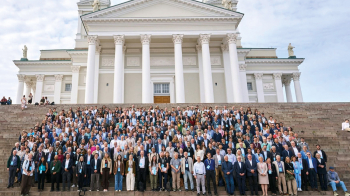
While particle physics accounts for only a small share of global emissions, its laboratories have long worked to reduce their footprint, showing how cutting-edge science can be pursued sustainably. The fifth Sustainable HEP conference, held online from 8 to 10 July, attracted more than 220 participants worldwide to take stock of that effort, and of the ingenious technologies meant to carry it forward.
Environmental impact
Archana Sharma (CERN) highlighted a fundamental shift in the questions asked of gaseous detectors in high-energy physics. In the 1970s, the challenge was to detect particles at all, while the LHC era demanded survival in extreme conditions. Today, minimal environmental impact has joined the list of priorities. Emissions from the LHC detector systems have already fallen over the past decade, thanks to gas recuperation, recirculation and the use of climate-friendly alternatives to traditional gas mixtures. Future facilities, Sharma stressed, should be designed for sustainability from the outset, rather than retrofitted later. Her point was echoed across the sessions. Contributions covered the operation of resistive-plate chambers in CMS and ATLAS, along with the EcoGas@GIF++ collaboration, which tests eco-friendly mixtures under LHC-like irradiation at CERN’s Gamma Irradiation Facility. Others explored material choices for future detectors, from high-strength copper alloys to greener shielding and cryogenics.
Future facilities should be designed for sustainability from the outset
Accelerators and other large-scale projects received similar attention. Ben Shepherd (STFC) reported on the activities of the Laboratory Directors Group’s sustainability working group, comparing the environmental impact of proposed colliders from construction to decommissioning. He described efforts to avoid environmental impacts where possible, reduce those that cannot be avoided, and compensate for the remainder, spanning civil engineering, procurement and energy optimisation. Examples include heat-recovery systems, energy-recovery linacs, and the growing use of high-temperature superconductors and permanent magnets.
Veronique Boisvert (Royal Holloway) briefed participants on the sustainability recommendations of the European Strategy for Particle Physics update, the roadmap defining Europe’s priorities for future particle-physics research and facilities. William van Sprolant (CvS énergies sàrl) presented the ULISSE Project, an exploratory large-scale initiative aiming at storing CERN’s summer waste heat in Lake Geneva for use in winter. Speakers presented initiatives across the field including Nikhef’s laboratory-wide roadmap, the iSAS programme on energy-efficient accelerating technology, sustainability work at the Electron–Ion Collider and life-cycle studies at LHCb. Other presentations covered methane recovery from livestock emissions and updates from the SC4RC computing conference.
Scientific computing came under the same scrutiny. Contributions included a particularly clear introduction to Fast Generative Simulation for HEP from Henry Day-Hall (DESY), alongside discussions of current and future efforts to shrink its carbon footprint by optimising the use of resources, improving simulation efficiency and adopting GPU-based systems, whose parallel architecture delivers more computation per watt. Participants heard of the power-efficient operation of large-scale computing facilities through the Worldwide LHC Computing Grid, which links centres around the world to process LHC data, carbon-aware computing schedules in ATLAS and the GreenPhysECS project, aimed at designing energy-efficient computing architectures for future facilities.
From physics to sustainability
As in previous editions, voices from beyond particle physics widened the view. Juan Pablo Cordero (University of York) presented open-source predictive models for transparent food policy-making. This year’s conference hosted a panel session featuring five speakers, who shared their experiences of transitioning from physics to sustainability. They cited adaptability, continuous learning and collaboration as the skills that helped them move into their new fields.
Lasting change requires ambitious policies and collective solutions
In his keynote speech, climate scientist Jagadish Shukla (George Mason University) discussed the science, politics and ethics of climate change. Those who have contributed least to global warming, he reminded participants, will suffer most and earliest. Yet he argued for hope, grounded in technological progress and shared effort. Lasting change requires ambitious policies and collective solutions, as the antidote to climate anxiety, he concluded, is climate action.