The High-Luminosity LHC is expected to return to society nearly twice what it costs, before a single discovery is counted. Massimo Florio and Jessica Catalano explain the economics behind this number.

Aparticle collider is among the most ambitious projects a society can take on, and one whose worth is hard to capture in conventional economic terms. The instinctive argument for such machines rests on the knowledge they may produce, but no economist can attach a probability, let alone a monetary value, to a discovery that has not yet happened. For decades, this apparent impasse left funding decisions to the scientific case and to mostly qualitative socioeconomic narratives.
In 1945, Vannevar Bush, science adviser to two US presidents, identified the value of basic research in the foundations it may lay for practical progress. Robert Wilson, asked in Congress in 1969 whether the facility that became Fermilab would help defend the United States, answered that it would not, except by making the country worth defending. Reasoning of this kind is no longer enough on its own, and must now be backed by more quantitative evidence. The European Commission and national funding agencies, such as UK Research and Innovation (UKRI) and France Stratégie, expect proposers of large research infrastructures to provide detailed cost-benefit analyses (CBAs), estimating their projects’ societal returns.
The most thorough evaluation of this kind yet performed concerns the LHC and its high-luminosity upgrade (HL-LHC), which entered the main installation phase when the machine completed its third run on 27 June 2026 (CERN Courier July/August 2026 p8). Four years of work will refit the ring with new hardware, including advanced focusing magnets, crab cavities to increase the collision rate and superconducting power lines. The corresponding CBA, developed over more than a decade at the University of Milan and CSIL, rests on a set of carefully chosen assumptions that provide crucial context for interpreting its results.
Discovery set aside
A CBA asks whether an investment’s benefits to society exceed its costs over a defined horizon. Any value available now is worth more than the same amount later, if only because it can earn a return in the meantime, so costs and benefits arising in different future years cannot simply be added: each must be scaled down, or “discounted”, the further ahead it lies. The inverse happens for past values, which must be “capitalised”. The difference between discounted (or capitalised) benefits and costs then yields the net present value (NPV), and a positive expected NPV indicates that the project passes the test. For the HL-LHC CBA, the accounting window ran from 1993, when expenditure attributable to the LHC programme began, to 2038, the machine’s expected end of operations at the time of the analysis, since revised to 2041. All sums, after discounting or capitalising at the 3% rate recommended by the European Commission for public projects, were expressed in constant 2016 Swiss francs, removing the effect of inflation.
Two methodological choices defined the whole exercise. The first was to set discoveries aside. Scientific outcomes at the frontier are subject to what economists call Knightian uncertainty: no probability distribution can be assigned to them, and any attempt to price the discovery of new physics would be arbitrary. The analysis, therefore, excluded the intrinsic value of scientific results altogether and asked a narrower, more disciplined question: do the measurable side effects of the investment – such as the training of early-stage researchers or the technological gains of supplier firms – repay its cost on their own? In this sense, the test was deliberately conservative. Whatever knowledge the machine ultimately produces comes on top of, not inside, the calculated return.
The second choice concerns the counterfactual scenario. An upgrade cannot be assessed against a baseline of no machine at all. The LHC exists either way. The counterfactual scenario assumed an LHC that continues without the luminosity boost, under ordinary maintenance, until its discovery potential is exhausted. In the study’s timeline, that point was conjectured to fall in 2030. Data-taking then ceases, staff are redeployed and the tunnel is kept safe but idle. Constructing this alternative future in detail, down to its cost profiles, researcher numbers and procurement volumes, was among the hardest challenges of the study. It is also what allows every result to be read in incremental terms, as the difference between a world with and one without the high-luminosity upgrade.
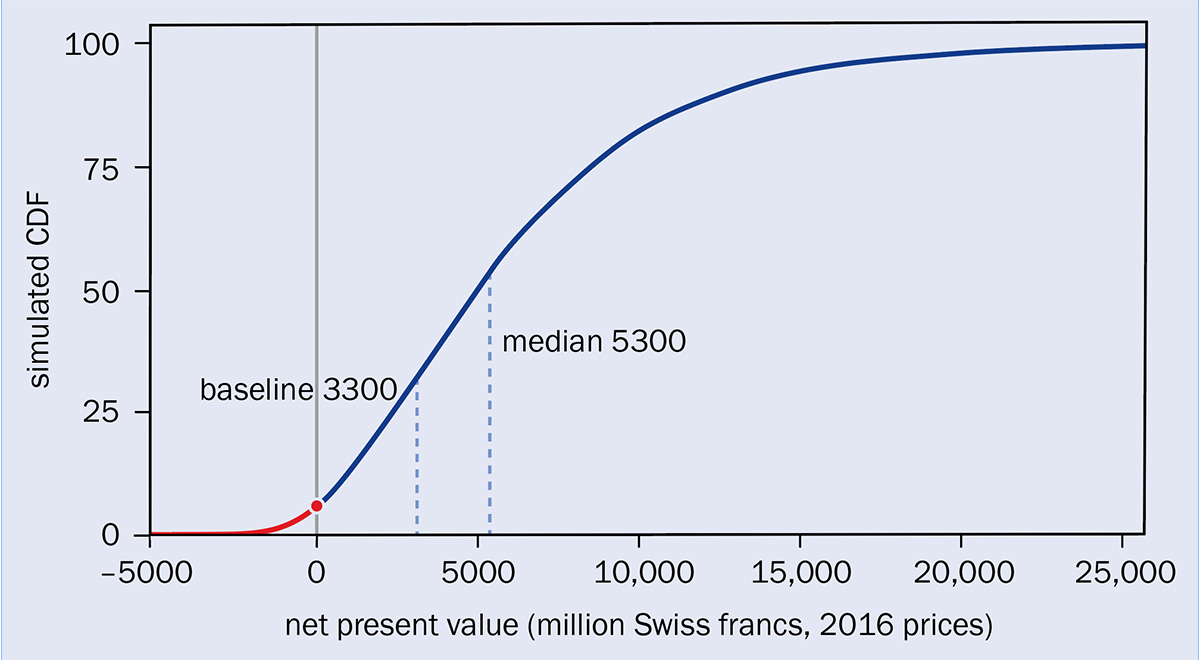
Uncertainty was handled through Monte Carlo simulation. Fifteen critical parameters, among them the early-stage researchers’ salary premium, the suppliers’ sales multiplier, visitor numbers, taxpayers’ willingness to pay and total costs, were treated as random variables. Their distributions were calibrated from data where possible, and from earlier studies and structured expert judgement where they were not. Fifty thousand simulation runs then generated a probability distribution for the project’s NPV (see “Odds on” figure).
That distribution, rather than any point estimate, is what the model ultimately delivers to decision-makers. Against the LHC counterfactual, the HL–LHC incremental NPV is positive: each Swiss franc invested returns about 1.8 francs in societal benefits, and the chance of a positive social return is 94%.
Human capital
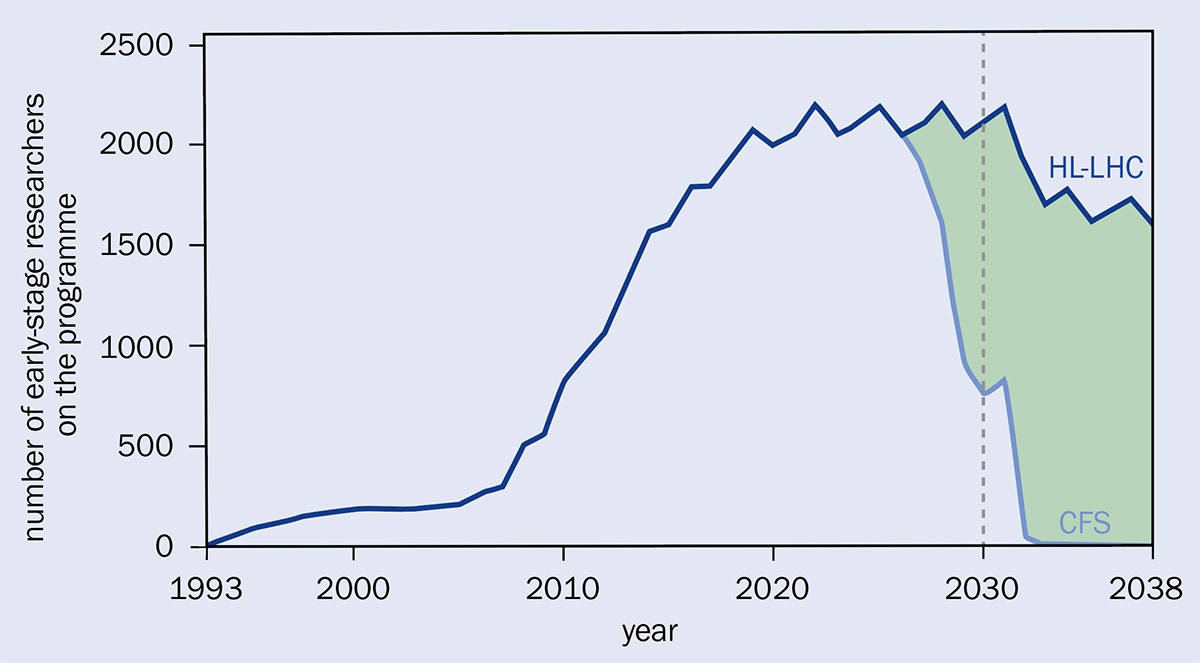
When the two scenarios are compared, the most valuable benefit of the HL-LHC to society is the people it trains (see “Measuring value” figure). Early-stage researchers, from technical, doctoral and postdoctoral trainees to young registered users of the experiments, acquire frontier technical and collaborative skills that employers reward for the rest of their careers. The benefit was measured as the lifetime salary premium these individuals earn relative to comparable peers who never passed through CERN, estimated from surveys of current students, alumni and more than 330 team leaders. Because a career lasts decades, benefits accruing to the final 2038 cohort extend to around 2080, long after the machine has been switched off.
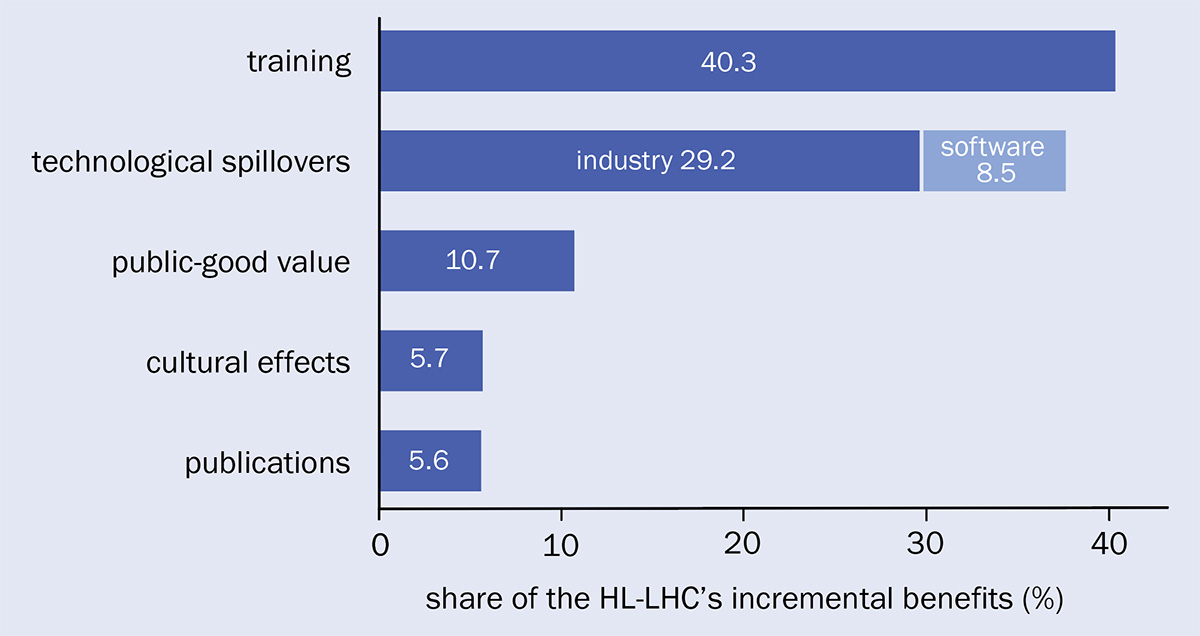
In incremental terms, the salary premium for early-stage researchers accounts for roughly 40% of incremental benefits, the single largest share. The analysis assumes that employers pay the premium because training and hands-on experience make people more productive, so the figure is taken to gauge the value of skills flowing into the economy. The counterfactual clarifies why the share is so large: without the upgrade, the pipeline of early-stage researchers collapses once data-taking ends, whereas the HL–LHC keeps training thousands more through the 2030s (see “Two futures” figure). The FCC Feasibility Study predicts similar effects (CERN Courier May/June 2025 p9).
Each Swiss franc invested in the HL-LHC returns about 1.8 francs in societal benefits, and the chance of a positive social return is 94%
A new study of CERN’s overall impact over the past 25 years corroborates the pattern. In the 2025 CERN alumni survey, 95% of the almost 1000 respondents said that their experience at CERN had helped advance their careers, in fields ranging from software development to information technology, mechanical and industrial engineering, academia and financial services.
Technological spillovers
About 38% of the HL–LHC’s incremental benefits arise from technological spillovers. Firms that win high-tech procurement contracts learn from working with CERN and the experimental collaborations, file patents, refine processes and open new markets. The learning shows up as higher sales and profits in their business with customers other than CERN. The evidence base here is unusually rich, triangulated from a long-run econometric study of supplier accounts before and after their first CERN contract, a survey of more than 650 suppliers, and over two dozen in-depth case studies. In the model, each franc of high-tech procurement returns about three francs to the supplier in extra turnover or saved costs, a ratio first measured in surveys of CERN’s contractors in the 1980s, and confirmed by new evidence.
A second kind of spillover is software released freely to the world. Updated packages initially developed for the LHC programme, such as ROOT and Geant4, were valued at what users would otherwise have paid for commercial equivalents.
Colliders and culture
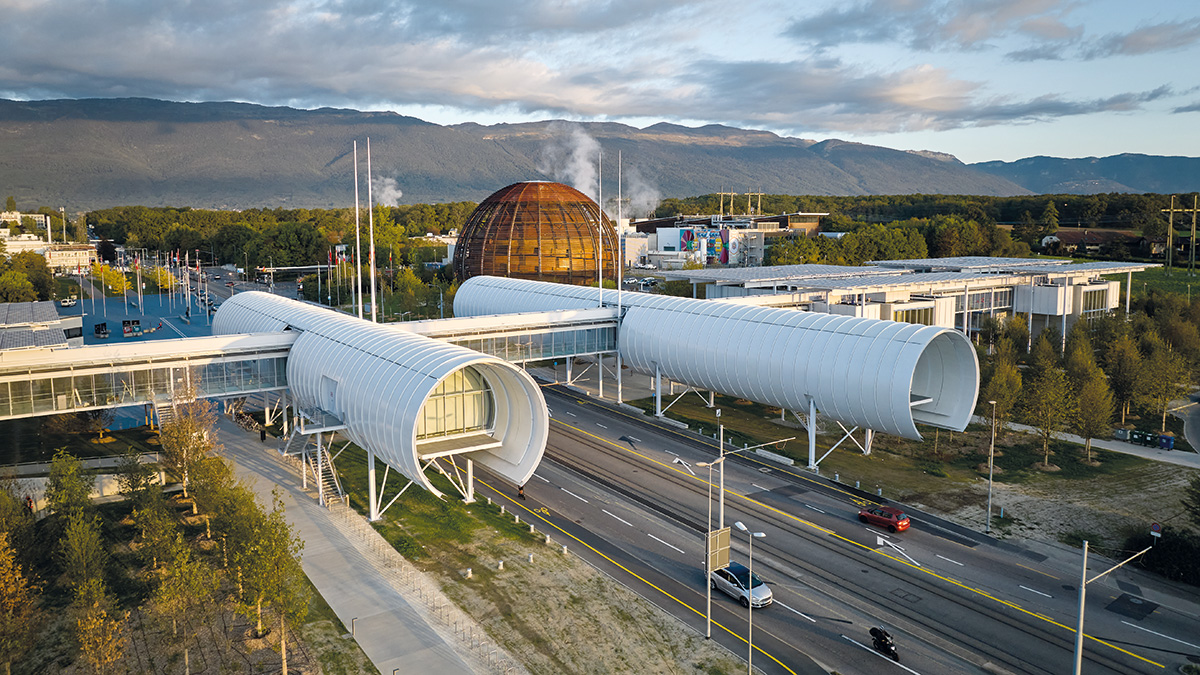
A particle collider is also a cultural asset. About 5.7% of the HL–LHC’s incremental benefits stem from cultural engagement – mostly people travelling to the Geneva site or attending CERN’s touring exhibitions (see “Worth the trip” image). These are valued through the travel cost method, a standard technique that infers what an experience is worth from what visitors spend to reach it: fares, time, tickets. Websites, social media, volunteer computing, films and popular books are counted too, though each contributes far less than the visits. Visitor numbers rise and fall with discovery announcements and with CERN’s own capacity to attract and receive an audience, which makes outreach strategy part of the calculation.
Publications
Scientific publications might seem the most natural benefit of a research infrastructure, yet in the accounting their value is limited. The reason lies in methodology. What is measured is not the content of the papers, which would smuggle discovery value back in, but the volume of scientific production and its uptake. A paper’s production cost, in terms of its authors’ salaries, is assumed to cancel against the value of the time spent writing it, evaluated at what those hours would otherwise have earned, so that its net benefit comes entirely from downstream citations. A paper never cited is worth zero. The category matters less for its size than for what its treatment reveals about the method’s discipline: even the most visible benefit of science is valued only through observable, countable channels.
Public-good value
The final category captures the value citizens place on fundamental knowledge being created at all, analogous to the existence value of biodiversity or cultural heritage. This item accounts for about 11% of the incremental benefits and is estimated through direct taxpayer surveys. In February 2018, a representative sample of French adults was asked whether they would accept a specific, small annual tax rise to fund a new accelerator, the alternative being that research at the LHC gradually winds down. Across models, the average willingness to pay exceeded the €2.70 that a French adult contributed to CERN through taxes in 2017. Earlier experiments with students in Italy, France, Spain and the UK, a later survey of Swiss taxpayers, and more recent studies in eight further countries – with more than 10,000 respondents in total – all point in the same direction.
The French survey also exposed an awareness gap. Only 46% of respondents had heard of CERN before the interview, compared with 89% for UNESCO, 86% for NASA and 77% for France’s own CNRS. Prior awareness was among the strongest predictors of willingness to pay, and the gap leaves headroom for the public value of CERN’s fundamental science to grow.
A sharper picture
Readers of earlier presentations on the socioeconomic impact of the HL–LHC will recognise these categories of benefits (CERN Courier September 2018 p51), but the picture has now sharpened in four ways. First, the analysis has fully embraced a probabilistic approach, with quantified simulation errors. Second, risk itself has become an object of analysis. Since cost overruns are the classic killer of Big Science, with the 1993 cancellation of the Superconducting Super Collider being a key example, the studies built a pessimistic scenario, pinning total costs above the reference value. Even then, the probability of a positive NPV stays around 80%. Third, the headline shares are now read strictly against the counterfactual, and the effect is remarkable. Cultural engagement, 13% of the HL–LHC’s total benefits, falls to about 6% incrementally, because some visitors come to CERN regardless of whether the upgrade happens. Publications rise from 2% to about 6%, because additional papers are only written if the machine runs. Fourth, the environmental dimension has more recently been incorporated into the evaluation of Big Science projects. A case in point is the FCC Feasibility Study, which accounts for the carbon footprint of construction and operation on the cost side, and for energy-efficiency technologies developed for the machine on the benefit side.
A conservative floor
The honest conclusion is double-edged. A social CBA of Big Science does not tell us whether the HL-LHC will find new physics, and no econometric methodology can. What it establishes is a floor. Even with new discoveries valued at zero, and under conservative assumptions throughout, the upgrade is very likely to repay society more than it costs, principally through the people it trains and the firms it transforms.
The HL-LHC is very likely to repay society more than it costs, principally through the people it trains and the firms it transforms
The approach is also portable. It has travelled from proton colliders to hadron therapy, synchrotron light sources, a protein database, the Einstein Telescope and Earth-observation satellites. Any major research infrastructure can be assessed the same way, provided the critical variables can be identified – their plausible ranges established from data and expert judgement – and the temptation to price potential discoveries resisted. Each application, moreover, feeds the next, since parameters estimated ex-post for one facility become the calibration base for appraising another. The economics of science, a young field grown alongside more than a decade of dialogue with CERN scientists, advances much like the instruments it studies.
Further reading
M Florio 2019 Investing in Science: Social Cost-Benefit Analysis of Research Infrastructures (MIT Press).
A Bastianin et al. 2023 Appl. Econ. 55 5768.
CSIL and CERN 2025 Zenodo 10.5281/zenodo.15421975.
G Catalano et al. 2026 Zenodo 10.5281/zenodo.21072658.