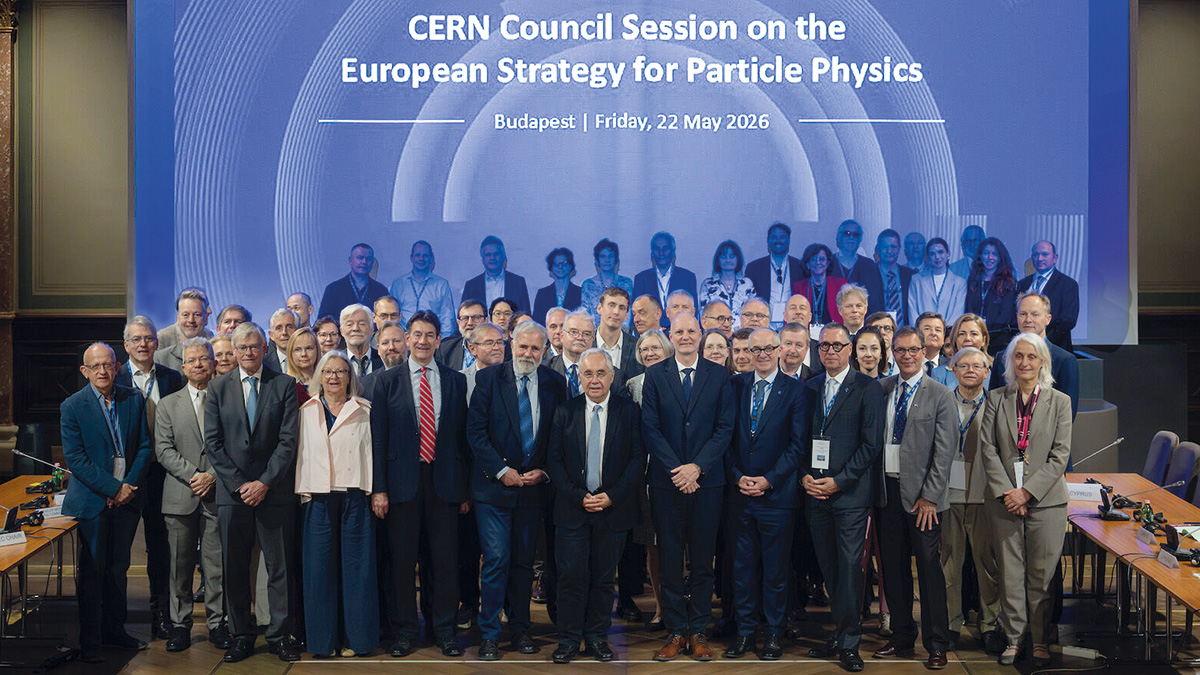
On 22 May, at a dedicated session in Budapest, the CERN Council updated the European Strategy for Particle Physics. The update confirms the full exploitation of the scientific potential of the LHC, through the completion of its high-luminosity upgrade (HiLumi), as the highest medium-term priority for European particle physics. For the longer term, it recommends the electron–positron Future Circular Collider (FCC-ee) as the preferred option for the next flagship project at CERN, thereby maintaining Europe’s leadership in the field. A decision on the FCC-ee itself is targeted for 2028.
Critical importance
“The European Strategy reiterates the critical importance of the High-Luminosity LHC, which will use advanced accelerator and detector technologies to fully exploit the scientific potential of this incredible machine in the coming years,” said Mark Thomson, CERN Director-General. “Beyond HiLumi LHC, the FCC-ee would be a visionary global research infrastructure for the next decades that will deepen our knowledge of the fundamental building blocks of the universe through ultra-precise measurements of the Higgs boson and other elementary particles. CERN’s task now is to steer this unprecedented project towards a decision by the CERN Council.”
According to the Strategy, the FCC-ee would offer the broadest exploratory programme in fundamental physics. The feasibility study, published in March 2025 (CERN Courier May/June 2025 p9), describes a baseline machine in a 90.7-kilometre ring, running at four centre-of-mass energies: the Z pole, the WW threshold, the ZH production peak and the top-quark pair threshold. Over a 15-year programme, it would be expected to yield some 6 × 10¹² Z bosons, 2.4 × 10⁸ W-boson pairs, 2.7 × 10⁶ Higgs bosons and 2 × 10⁶ top-quark–antiquark pairs.
“The high-energy physics community and the CERN Council have been united for this critical update of the European Strategy for Particle Physics, and the FCC-ee has emerged as the preferred flagship project to maintain CERN’s world-leading role in collider physics and technology in the decades to come,” said Costas Fountas, Council president. “I wish the CERN management the greatest success in implementing the Council resolution between now and the 2028 target decision date.”
The FCC-ee would be a visionary global research infrastructure that will deepen our knowledge of the fundamental building blocks of the universe
The 2026 update follows more than two years of intense work by the European particle-physics community, under the auspices of the European Strategy Group. Initiated in March 2024, the process aimed to develop a concrete plan to advance fundamental physics by constructing a new flagship project at CERN, and drew on more than 260 written submissions. It builds on the 2020 update, which emphasised the importance of ensuring Europe’s continued scientific and technological leadership, and recommended an electron–positron “Higgs factory” as the highest-priority next facility after the LHC reaches the end of its operational lifetime in 2041.
In addition to updating the Strategy, the Council has invited CERN management to initiate discussions with the relevant authorities and entities in the Member and Associate Member States, as well as non-Member States and the European Union, with a view to developing a financially feasible funding plan for the possible FCC-ee project. In the next two years, CERN management will provide annual reports on the implementation of the Strategy update and the necessary information to support national decision-making processes so that the Council will be in a position, by 2028, to take a decision on the FCC-ee, taking into account elements such as the scientific, technical and financial feasibility of the project, as well as results from the public consultation exercises in CERN’s host states, France and Switzerland.
Strong engagement
“The Strategy process has seen a very strong engagement of the particle-physics community and has led to a very clear conclusion: the FCC-ee, if approved, would deliver the world’s broadest high-precision particle-physics programme, its technical feasibility has been demonstrated by the comprehensive FCC feasibility study, and its scope and cost are well defined,” said Karl Jakobs, Strategy secretary. “It would also pave the way for a possible future hadron collider reusing the tunnel and much of the infrastructure, providing direct discovery reach well beyond the 10 TeV parton energy scale.”