Climate models typically assume sulphuric acid is the only vapour driving the formation of aerosol particles that seed marine clouds. In a paper published in Nature on 24 June, the CLOUD (Cosmics Leaving Outdoor Droplets) collaboration at CERN reports that a second vapour, methanesulphonic acid (MSA), drives the process just as effectively in cold marine air. Particle formation over cool oceans may therefore run up to ten times, and particle growth up to twice, as fast as models predict.
The condensation of water vapour in the atmosphere into droplets requires a cloud condensation nucleus (CCN), a suspended speck of liquid or solid matter larger than about 50 nm. More than half of all CCN form when trace low-volatility vapours cluster spontaneously, a process called nucleation. In 1987, Robert Charlson, James Lovelock, Meinrat Andreae and Stephen Warren proposed that some nucleating vapours could come from oceanic life. In their “Gaian” picture, tiny algae called phytoplankton release dimethyl sulphide (DMS) from the ocean surface, and its oxidation products seed clouds, which in turn shade the waters below and help regulate the climate. The oxidation of DMS yields two acids in comparable amounts, sulphuric acid and MSA. While the former has been known for many years to drive particle nucleation, the role of the latter has long remained unclear.
Nucleation
MSA’s capacity to nucleate was first tested in the 1980s, at concentrations orders of magnitude above the typical 105 to 107 molecules per cubic centimetre of marine air. Later studies concluded that MSA could not compete with sulphuric acid in the real atmosphere, and experimental attention faded for two decades. Interest revived when MSA kept turning up inside small marine particles, but composition alone could not distinguish between nucleation and condensational growth of pre-existing aerosol particles. The next step called for controlled experiments under atmospheric conditions.
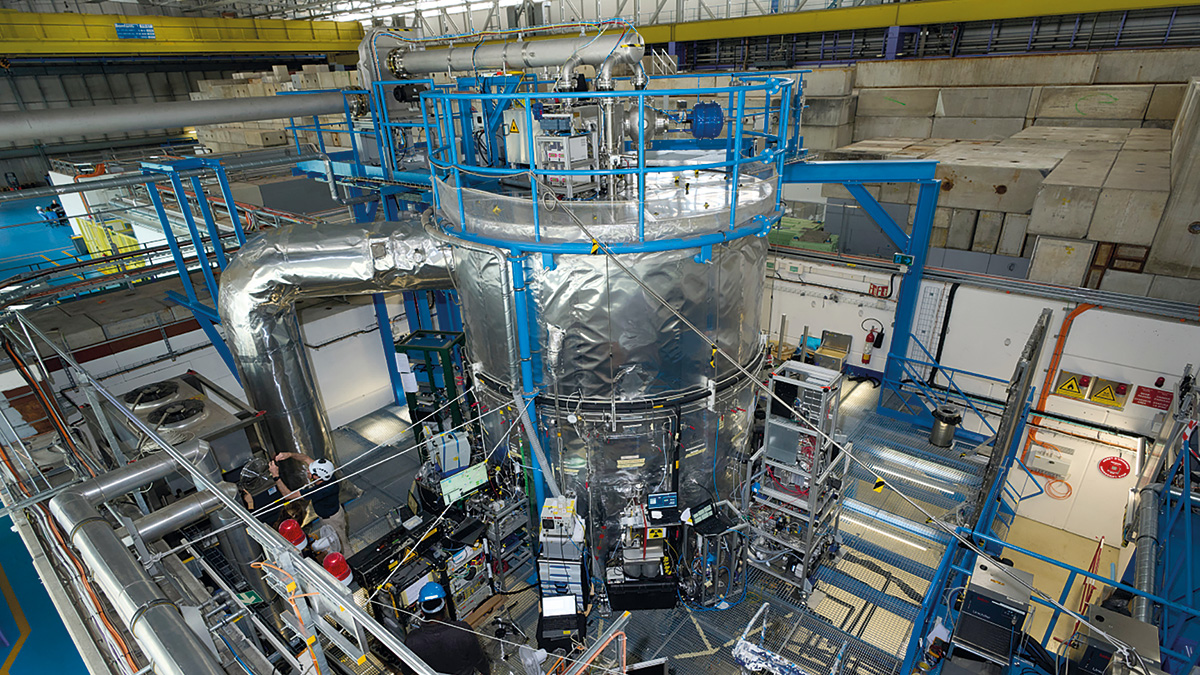
“CLOUD is essentially a highly controlled artificial atmosphere,” says Rima Baalbaki of the University of Helsinki and the Cyprus Institute, who co-led the study, “filled with ultrapure air made from liquid nitrogen and oxygen, in which temperature, humidity, ionisation and trace gases are adjusted to reproduce conditions from the boundary layer to the lower stratosphere.” Settling the question also demanded realistic vapour concentrations and instruments that watch every step at once, from the precursor gases through the first clusters to the grown particles. “No previous experiment had brought all these elements together,” she adds.
CLOUD is essentially a highly controlled artificial atmosphere
For sulphuric acid to nucleate at atmospheric concentrations, a base vapour such as ammonia is needed to form acid-base pairs that suppress the particle’s evaporation. CLOUD tested whether MSA can play a similar role, dialling MSA, sulphuric acid and ammonia up and down across the temperature range of marine air. At +9 °C, no MSA appeared in the embryonic molecular clusters. At –10 °C the picture changed: MSA entered the very first clusters, paired with ammonia, and nucleated without any sulphuric acid, while mixed clusters of both acids with ammonia were the most abundant of all. Without a base vapour, MSA contributed nothing to nucleation, even at –52 °C. However, once the first few molecules had clustered, ammonia was no longer required for MSA to drive rapid particle growth, limited only by the molecular arrival rate.
“What changes below –10 °C is the balance between cluster growth and evaporation,” explains Baalbaki. “At warmer temperatures, MSA molecules may collide and form a cluster, but they tend to evaporate before additional molecules can attach. Cooling lowers MSA’s saturation vapour pressure, so the molecules remain together long enough for others to join.” Cooling also raises the MSA yield from DMS oxidation, so the mechanism should matter most over polar oceans and in the upper troposphere.
Missing source
“Aircraft campaigns over the Atlantic and Pacific oceans have found a major unexplained source of nucleated particles at high altitude, which grow as they descend to seed low-latitude marine clouds that strongly influence Earth’s albedo,” says CLOUD spokesperson Jasper Kirkby. “Furthermore, for more than a decade, models have underestimated CCN over the Southern Ocean by roughly a factor of two. With this study, we have likely identified MSA as the key missing source of CCN for both.” CLOUD had previously reached a similar conclusion over land, linking abundant particle formation observed by research aircraft high above tropical rainforests to forest-emitted isoprene (CERN Courier January/February 2025 p5).
The collaboration has made an initial evaluation of the impact of their new measurements on CCN concentrations over the Arctic and Antarctic regions. Adding their measured mechanisms to a global model, they find that MSA may close much of the gap in CCN concentrations that causes current climate models to run unrealistically warm over the Southern Ocean.
Most of the key players are probably now known
The stakes reach beyond the poles. Emissions of sulphur dioxide from fossil fuels, which provide most atmospheric sulphuric acid, are being cut because fine-particle pollution causes millions of premature deaths each year. However, these same particles also cool the climate by making clouds brighter and more extensive. “Aerosols have short lifetimes, so as we stop producing them they will disappear rapidly and then temperatures will rise further,” says Kirkby. “Most climate models consider only particles nucleated from sulphuric acid, so they predict much less cloud as anthropogenic emissions fall. The overarching conclusion from CLOUD studies over the last 15 years is that the biosphere is much more capable than previously thought of producing abundant aerosol particles over both land and sea. So, as anthropogenic aerosol particles fall with emission controls, the biosphere should partially buffer the reduction more effectively, and the additional aerosol warming of the climate should be less than presently expected. But now we need to quantify it with model studies based on the CLOUD measurements.”
Experiments at intermediate temperatures must still pin down where MSA begins to nucleate, and a companion CLOUD study shows that with dimethylamine, a stronger base than ammonia, MSA forms particles at +5 °C and speeds sulphuric-acid nucleation tenfold to a hundredfold. “Particle physicists are careful about saying we’re done,” adds Kirkby. “We are not close to a ‘Standard Model’ of atmospheric aerosol formation, but most of the key players in particle nucleation and growth are probably now known. A major goal over the next few years is to prepare systematic parameterisations of our CLOUD measurements for climate models. And no doubt there are still more surprises in store for us along the way.”
Further reading
R Baalbaki et al. 2026 Nature 655 1204.
H Klebach et al. 2026 Environ. Sci.: Atmos. 6 1028.
J Shen et al. 2024 Nature 636 115.