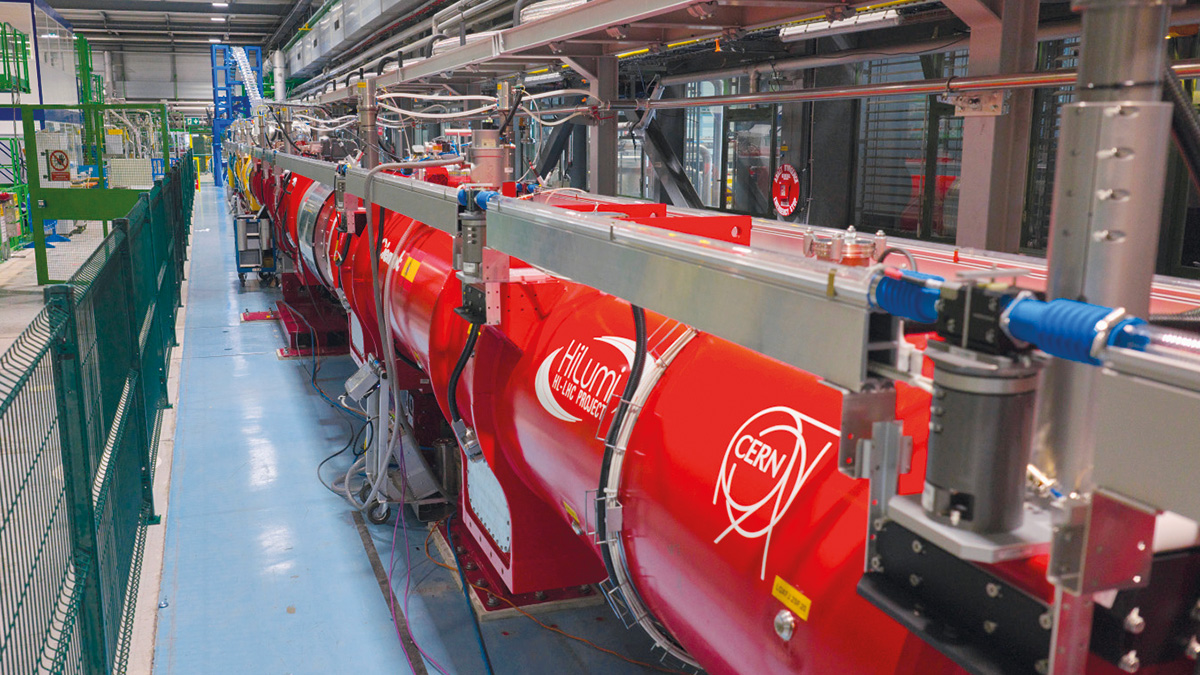
CERN has carried out a successful full-scale test of the focusing magnets for the High-Luminosity LHC (HL-LHC). On 8 July 2026, the new superconducting quadrupole magnets at CERN’s Inner Triplet (IT) String facility reached their nominal operating current of 16,230 amperes without a quench. The result validates a key element of the magnet technology that will be installed on either side of the ATLAS and CMS interaction points during the LHC’s third Long Shutdown (LS3).
Known as inner triplet magnets, the new focusing quadrupoles have been in development for more than a decade (CERN Courier May 2016 p31). Their role is to squeeze proton beams just before they collide, increasing the number of proton–proton interactions and hence the accelerator’s luminosity. The new magnets have a much larger aperture than those currently installed in the LHC, 150 millimetres compared with 70, providing the space required to accommodate the new beam optics.
Peak fields
The quadrupoles use niobium–tin (Nb3Sn) superconducting coils in place of the niobium–titanium (Nb–Ti) used in the present LHC magnets (see “Ten thousand magnets later”). Nb3Sn allows the coils to reach peak fields of around 11.3 T, roughly 35% higher than those of the current generation (CERN Courier March/April 2026 p30). When the HL-LHC starts, the quadrupoles will become the first Nb3Sn magnets to be used in a working accelerator.
Before a superconducting magnet can be put into operation, it must first undergo a process known as training, which consists of gradually increasing the current during successive powering cycles. As the process unfolds, small mechanical movements within the coils can trigger losses of superconductivity known as quenches. Repeated cycles allow the coils to settle into a mechanically stable configuration, and the magnet to reach progressively higher currents. The ability to retain this trained performance is called memory.
“Good memory is a key performance requirement for accelerator magnets, as it minimises commissioning time, cryogenic consumption and operational delays,” explains Susana Izquierdo Bermudez, who leads CERN’s Large Magnet Facility, where the new superconducting magnets were developed and assembled.
Good memory is a key performance requirement for accelerator magnets
The quadrupoles are only part of the system under test. All 17 electrical circuits of the IT String were also successfully powered to their operating currents. The separation dipole, which will steer the two beams apart after they pass the interaction point, reached its nominal current after only a few training quenches. The corrector-magnet circuits likewise reached their target currents, both individually and in combined operation.
Superconducting magnets store large amounts of energy, which must be safely removed if a quench occurs. During the tests, the machine-protection systems successfully extracted and dissipated up to 38 MJ of stored magnetic energy into the helium bath that keeps the magnets at their operating temperature of 1.9 K.
Big data
“The successful powering of all circuits marked the completion of the IT String hardware commissioning phase,” explains Samer Yammine, responsible for IT String operations. “The campaign generated a vast amount of data that we are now analysing to better understand how all the systems interact.” The results of the analyses – which cover the superconducting magnets, cold powering system, power converters, quench detection and protection, cryogenics, vacuum, controls and alignment – will help refine the commissioning and operations procedures for the HL-LHC.
Further tests of the superconducting circuits, machine cycles, electromagnetic coupling and alignment will be followed by a warm-up to room temperature and a second cooldown ahead of a new round of testing. “This second operational campaign in September will primarily focus on validating the commissioning procedures and analysis tools, as well as demonstrating the reproducibility of the integrated system performance,” remarks Marta Bajko, head of the IT String facility. “We will test the systems under conditions close to those of the future HL-LHC.”