 Read article 'Long hot summer'
Long hot summer
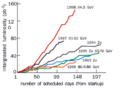
Smooth running at CERN's LEP electronpositron collider, now at 189 GeV collision energy (94.5 GeV per beam), is reflected in a fast climbing, integrated luminosity curve.

 Read article 'Long hot summer'
Smooth running at CERN's LEP electronpositron collider, now at 189 GeV collision energy (94.5 GeV per beam), is reflected in a fast climbing, integrated luminosity curve.
 Read article 'High vacuum'
While the 27 km tunnel for the LEP electron–positron collider at CERN was being prepared, the Courier described non-evaporable getters used for its vacuum system.
 Read article 'French green light for LHC civil engineering'
Progress on CERN's next major particle accelerator, the Large Hadron Collider (LHC), took another step forward recently when French Prime Minister Lionel Jospin signed the decree allowing LHC civi...
 Read article 'LEP helps fill CKM matrix'
New evidence from CERN's Large ElectronPositron collider (LEP) sheds more light on the way quarks can transform.
 Read article 'SLC perched on a high'
The Stanford Linear Collider has generated its last Z particle unless the US government provides more money. But it crowned its act with a flourish.
 Read article 'ALEPH coil hits the road'
The giant 1.5 T superconducting solenoid for the ALEPH experiment at LEP demanded special tooling for winding, impregnation, fitting and transport, as the July 1987 issue reported.
 Read article '400 GeV machine vacuum and r.f. progress'
With construction of the Super Proton Synchrotron in full swing, the May 1975 issue of the Courier published a progress report on its vacuum and radio-frequency systems.
 Read article 'Much ado about nothing'
In November 1972, CERN’s Roger Calder described in detail the unprecedented vacuum system of the world’s first hadron collider, the Intersecting Storage Rings.
 Read article 'The Synchrocyclotron and the PS: a comparison'
In the summer of 1960, the Courier compared and contrasted the 600 MeV Synchrocyclotron and the 28 GeV Proton Synchrotron