Igor Anatolievich Golutvin, an outstanding scientist who founded new directions and research techniques in particle physics, died on 13 September 2023.
Born on 8 August 1934 in Moscow, Golutvin graduated from MIPT in 1957 and started his work at JINR in 1958. Several generations of detectors for large-scale physics facilities were developed under his supervision at the JINR Synchrophasotron, the IHEP accelerator in Serpukhov, and at the Proton Synchrotron and the LHC at CERN.
Golutvin became one of the pioneers of the CMS experiment, driving the cooperation of Russia and other JINR member states via the Russia and Dubna Member States (RDMS) CMS collaboration. Over the past 30 years, under his supervision, RDMS physicists have completed the development of unique detectors for CMS. Igor was also instrumental in initiating Grid computing for CMS in Russia. He was awarded the 2014 Cherenkov Prize of the Russian Academy of Sciences for his outstanding contribution to the development of CMS. In recent years, he played an important role in the preparation of upgrades for CMS, in particular concerning the calorimeters.
During his work at JINR, Golutvin established a scientific school and trained a team of active, qualified physicists and engineers. Within the framework of cooperation between CMS Russia and other JINR member states, he brought together like-minded people with the aim of preserving Russian scientific schools, built unique teams of engineers and physicists, and developed favourable conditions for attracting gifted young physicists, which he saw as extremely important for the implementation of long-term scientific projects.
Igor was a member of the equipment committee of the International Committee for Future Accelerators, an editorial board member of the journal Nuclear Instruments and Methods, a directorate member of the CMS collaboration at CERN, head of the collaboration of the institutes of Russia and JINR in CMS, and the organiser and head of numerous international and Russian scientific conferences and symposia.
He was also a professor/full member of the Russian Academy of Engineering Sciences, Russian Academy of Natural Sciences, International Academy of Sciences, Honoured Scientist of the Russian Federation and chief researcher for CMS at VBLHEP. For many years of fruitful work, Golutvin was awarded numerous state and scientific awards and prizes.
2024 marks CERN’s 70th anniversary, with a packed programme of events that connect CERN’s heritage with its exciting future. This will culminate in a grand celebration for the CERN community on 17 September followed by a high-level official ceremony on 1 October. Kicking off proceedings in CERN Science Gateway on 30 January is a public event exploring CERN’s science. Two events on 7 March and 18 April will showcase how innovation and technologies in high-energy physics have found applications in daily life and medicine, while the transformative potential of global collaboration is the topic of a fourth public event in mid-May. Events in June and July will focus on open questions in the field and on the future facilities needed to address them, and public events will also be organised in CERN’s member states and beyond. The full programme can be found at: cern70.web.cern.ch/.
Internationally known theorist Marcello Ciafaloni passed away in Florence, Italy on 8 September 2023. Born in 1940 in the small town of Teramo in southern Italy, he was admitted for his higher education to the selective Scuola Normale Superiore in Pisa where he graduated in 1965. Since 1980 he was a full professor in theoretical physics at the University of Florence.
As a research associate at Berkeley (1969–1970) and a fellow at CERN (1972–1974), Ciafaloni initially focused his research on high-energy soft hadronic physics and produced important results in the context of Reggeon field theory. Towards the end of the seventies, he shifted his attention to perturbative QCD, in particular to hard processes and small-x physics where sophisticated re-summation techniques are needed. Since then, and throughout his career, he produced many fundamental results in perturbative QCD, including his single-author contribution to the celebrated CCFM equation (where the first C stands for his name), an important ingredient for QCD-based event generators.
Since 1987, Ciafaloni added a second dimension to his research spectrum by devoting part of his activity to the gravitational scattering of strings, a thought-experiment for understanding string theory’s version of quantum gravity. This work originated from one of his periodic visits to the CERN TH division and involved, besides Marcello, Daniele Amati and myself.
The so-called ACV collaboration carried on until 2007 (with long visits by Marcello at CERN in 1995 and 2001), but my own collaboration with Marcello continued until 2018, when his health started deteriorating. More recently, the techniques used for this “academic” problem turned out to be relevant for describing real black-hole mergers and the ensuing gravitational radiation.
I had the great privilege of working with Marcello on many occasions throughout his career. His deep knowledge of physics and his passion were only matched by his amazing technical skills. He had set very demanding standards for himself and pursued them with great intellectual honesty and much generosity towards his students and collaborators. His passing is a big loss for our community.
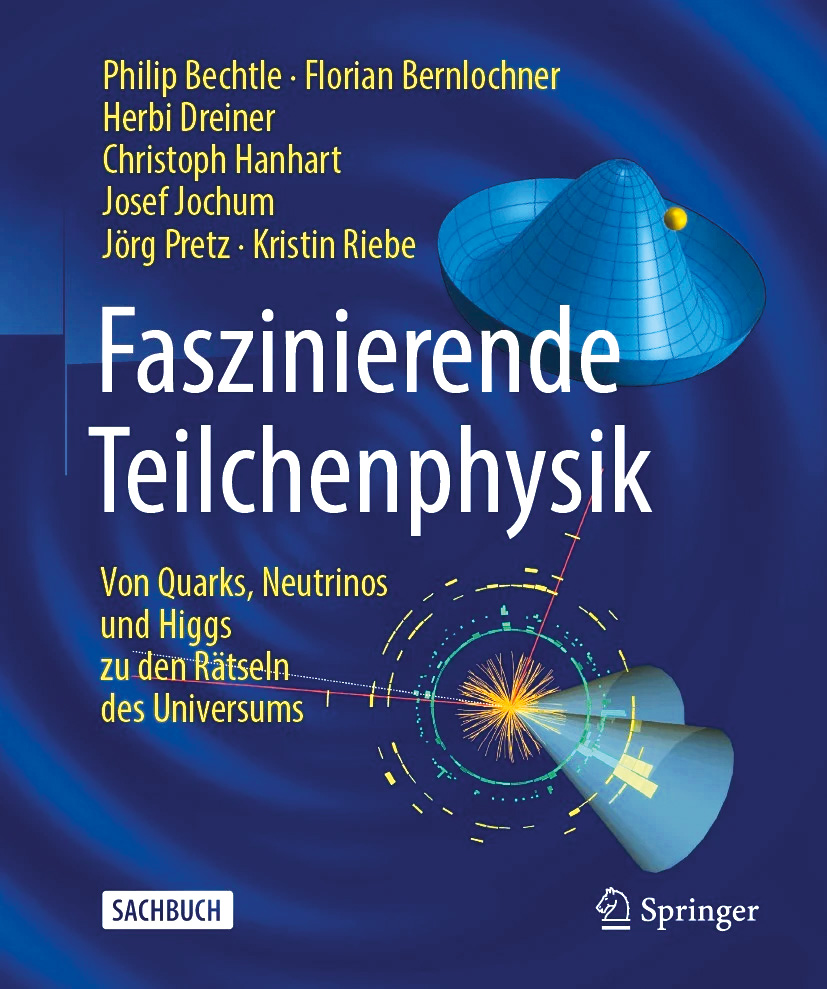
Faszinierende Teilchenphysik is certainly not the first popular book about elementary particle physics, and it won’t be the last. But its unique and clever structure make it stand out.
Think of it as a collection of short stories, organised in 12 chapters covering all ground from underlying theories and technologies to the limits of the Standard Model and ideas beyond it. The book begins with a gentle introduction to the world of particles and finishes by linking the infinitely small to the infinitely large. Each double-page spread within these chapters features a different topic in particle physics, its players, rules of play, tools, concepts and mysteries. Turn a page, and you find a new topic.
Among these 150 spreads, which are referred to as “articles” by the diverse team of authors, the reader can learn about neutrinos, lattice QCD, plasma acceleration, Feynman diagrams, multi-messenger astronomy and much more. Each one manages to convey both the fascination of the subject as well as all the central ideas and open questions within the two allocated pages. This makes for a great way of reading: the article about antimatter, for example, cross-references to the article about baryogenesis, so flip from page 18 to page 304 to dig deeper into the antimatter mystery. Not sure what a baryon is? Check the glossary, then maybe jump on the article about matter and antimatter, CP violation or symmetries. There is no need to read this book from cover to cover. On the contrary, browsing is so deeply embedded in its concept that it even features a flip-book illustration of a particle collision on the bottom right-hand-side of each spread. With a bit more care for captivating illustrations and graphic design, it could pass as a Dorling Kindersley-style travel guide to particle physics.
The authors, who are based at different universities and labs in Germany, have backgrounds covering theoretical and experimental particle physics, astroparticle physics, accelerator and nuclear physics, and science communication.They have obviously put as much thought into this publication as they put in hours, because they manage to write about each topic in a way that is easy to follow, even if it’s hard to digest. Puns, comparisons to everyday life and drawings to accompany the articles make for a full browsing experience, and the references within the text and at the bottom of each page show how everything is connected deep down.
When I received Faszinierende Teilchenphysik for review, one of the authors jokingly accompanied it with the words “this book is meant for retired engineers and for aunts looking for a present for their science-student-to-be nieces.” That may well be the case, but this book’s target audience is much wider. Physics fans and amateurs will enjoy sinking their teeth into a new world of interlinked topics; undergraduates will value it as a quick reference source that is less obscure and more fun to read than Wikipedia; and physics professionals will find it a useful refresher for topics beyond their expertise. The book even dedicates its final article to those questioning whether it is worth spending money and brain power on tiny particles, ending with a passionate case for the many benefits of fundamental research – not just spin-offs such as tumour therapy or artificial intelligence, but in pushing boundaries of knowledge outward.
And if you’re afraid that your school German might let you down, don’t worry: the English edition is already in the works and due to come out in 2024.
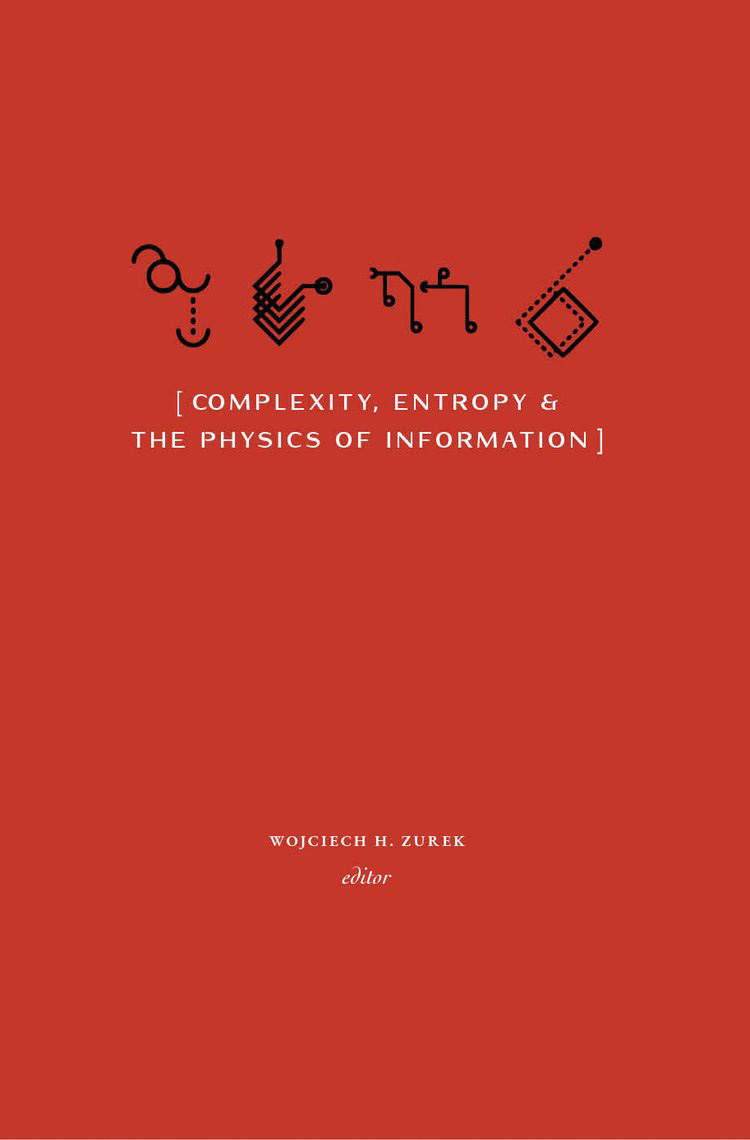
“This quantum business is so incredibly important and difficult that everyone should busy himself with it,” wrote Einstein in a 1908 letter, cited by John Wheeler at the workshop “Complexity, Entropy and the Physics of Information” held at the Santa Fe Institute in 1989. More than a century after Einstein’s letter, many fundamental questions connecting physics and information remain unanswered.
The book Complexity, Entropy and the Physics of Information consists of 32 essays capturing the talks given at the Santa Fe workshop. Building on the fundamental work by Claude Shannon, the aim of the workshop was to explore fundamental questions relating to the foundations of quantum theory and quantum information science. Most of the questions raised are still relevant today, as many contributions to this two-volume reprint of proceedings demonstrate.
The workshop started with Wheeler’s famous talk “It from bit”, in which he aimed to “deduce the quantum from existence”. Those remain a guiding principle in the life of a researcher in the field. Indeed, in a talk at the QTML 2023 conference held at CERN, Max Welling (University of Amsterdam) motivated his recent work on “General Message Belief Propagation” for quantum computations using Wheeler’s principle, linking machine-learning models to thermodynamics.
William Wootters’ contribution, on the other hand, builds on the work of John Bell, who showed that quantum mechanics is inherently non-local, i.e. that correlations between spatially separated systems are stronger than what is allowed in a hidden-variable theory. In contrast, Wootter focusses on the locality of quantum mechanics – specifically stating that local measurements on parts of a system and correlations between those measurements allow the state of an ensemble to be determined. Furthermore, Benjamin Schumacher presents his thoughts on the “physics of communication” and discusses the connections between information and entropy. He promotes the idea that “it is not the number of available signals but rather their distinguishability that matters in communication.”
Wojciech Zurek focusses on the implications of a quantum measurement, which converts a collection of possible alternatives to a definite outcome and thus decreases the statistical entropy. In this regard, he discusses the connections between physical and statistical entropy (Shannon entropy) and the algorithmic information content of the data (Kolmogorov complexity). Applications in non-equilibrium systems highlight the fundamental cost of information erasure that was first mentioned by Landauer in 1961.
Charles Bennett asks “what is complexity?” and presents various suitable notions for a “formal measure of complexity” based on computational theory, information theory and thermodynamics. He thus highlights the notion of “logical depth”, which is the execution time needed to generate the object of interest by a near-incompressible universal computer program. The behaviour of complexity measures in dynamical systems exhibiting self-organisation and phase transitions are also discussed.
A noteworthy collection of essays
Tommaso Toffoli explores whether the principles of mechanics are universal and fundamental because they emerge from an extremely fine-grained underlying structure, in which case they would be of mathematical rather than physical origin. This mode of thought is in line with statistical mechanics, where laws emerge due to collective effects in systems with many elements.
In his contribution, Edwin Jaynes focuses on the meaning of probability in quantum mechanics, which he regards not as a “physically real thing” but relevant for quantifying the role of incomplete information and the precision with which a theory is able to predict results. In case of its infiniteness, the theory is unable to predict this quantity and, hence, the uncertainty is infinite. But he stresses that it does not mean that the physical quantity is infinite.
This is just snapshot of the many rich contributions. Besides quantum information theory, the book also touches on cosmology, quantum gravity and dynamical systems. An introduction from Seth Lloyd, who attended the Santa Fe workshop, also provides valuable context to the significance of the proceedings.
Complexity, Entropy and the Physics of Information forms a noteworthy collection of essays linking information, computation and complexity, as well as physics and especially quantum mechanics. As it contains many individual essays grouped thematically, readers may pick out topics based on their own interest. I would recommend this work for anyone who is interested in this area, especially researchers and students working in quantum physics and computational theory.
Bikash Sinha, a pioneer in the field of quark–gluon plasma and the early universe, passed away on 11 August 2023 at the age of 78. His influence on heavy-ion physics is woven into the fabric of not only the ALICE experiment but also the broader field.
Bikash Sinha was born on 16 June 1945 in Kandi, Murshidabad in the state of West Bengal, India. After graduating in physics from Presidency College, Kolkata in 1964, he went to the UK where he completed the natural sciences Tripos course at King’s College, Cambridge in 1967, and then gained a PhD in nuclear physics from the University of London in 1970. He returned to India on invitation from nuclear physicist Raja Ramanna and joined the Bhabha Atomic Research Centre (BARC) in 1976.
In the early 1980s Bikash started working in high-energy physics, particularly relativistic heavy-ion collisions and the formation of quark–gluon plasma. He was appointed director of the Variable Energy Cyclotron Centre in 1987 and held concurrent charge as director of Saha Institute of Nuclear Physics from 1992 to 2009. He received numerous awards and honours, including the Padma Shri Award in 2001 and the Padma Bhusan Award (the third-highest civilian award in the Republic of India) in 2010 for his significant contributions to science and technology. He had also been a member of the scientific advisory council to the Indian prime minister.
As the director of two major institutes in Kolkata, Bikash promoted research in different fields of science. In nuclear and particle physics, his efforts put India on the global map, and he was a strong supporter of the engagement of India with the international community via programmes at CERN. Early on, he broke through scientific bureaucracy to press the need for a multi-agency funding model for the nascent collaborations taking shape for the SPS WA93/WA98 experiments. Subsequently, India’s contributions expanded to the LHC, to RHIC at Brookhaven National Laboratory, and then to FAIR at GSI in Germany.
From modest beginnings in the early 1990s – armed with only a handful of collaborators, students and borrowed equipment, but a grand vision and unbeatable spirit – Bikash nourished and led the Indian team to become a major pillar of ALICE, and of heavy-ion physics more broadly. He embraced every challenge, be it the MANAS chip for the large muon chambers or the photon multiplicity detector, made possible on account of his generous attitude in promoting talents and giving chances to youngsters.
As an individual, Bikash was a synthesis of science, culture, philosophy and society. He initiated the medical cyclotron in Kolkata for the diagnosis and treatment of prostate cancer, and was inspired by the works of the great Indian poet and Nobel Laureate Rabindranath Tagore. In May 2022 he fused his passions for science and art in a one-of-a-kind international conference Microcosmos, Macrocosmos, Accelerator and Philosophy (CERN Courier July/August 2023 p22).
In 1988 Bikash initiated a very successful international conference series on the Physics and Astrophysics of Quark Gluon Plasma, and in 2008 he organised and chaired the annual Quark Matter conference in 2008 held in Jaipur, India. Along the way, his efforts paved the way for India to become one of the most prominent non-member-state participants at CERN, culminating in its accession to associate member in 2017.
While the passing of Bikash leaves an undeniable void, his legacy is a vibrant and thriving team that is primed to continue the journey he embarked upon. We will always remember him for his charismatic personality, great kindness, openness and generosity. We honour his memory, and with deepest condolences we extend our sympathy to his family.
Electrical engineer Philippe Bernard, who made notable technical and managerial contributions across the various sectors at CERN in which he worked, passed away on 10 October 2023.
Born in 1935, Philippe completed his studies at the prestigious Ecole supérieure d’éléctricité in 1956. He began working at CERN in 1962 as engineer-in-charge of the Proton Synchrotron. He went on to design and develop radio-frequency (RF) separators, making substantial contributions to the improvement of these devices that provide well-selected secondary beams. This was particularly important in the early 1970s for experiments with the CERN 2 m hydrogen chamber, the Saclay-built Mirabelle chamber at Serpukhov, and the Big European Bubble Chamber at CERN.
Realising the potential of superconductivity for RF structures, Philippe, together with Herbert Lengeler, was entrusted by CERN Director-General John Adams to develop RF cavities for CERN accelerators in 1978. A vigorous programme with international participation led to the development of five-cell cavities, first made of pure niobium and, later, of niobium sputtered on the more stable copper-substrate to produce robust cavities. This allowed accelerating fields of up to 7 MV/m to be reached.
After tests of prototypes at PETRA (DESY) and the Super Proton Synchrotron, 320 such cavities were produced for the Large Electron-Positron collider (LEP) using niobium-film technology. In the framework of the LEP2 upgrade programme, which started in 1987, these cavities were gradually added to the complement of normal-conducting cavities, which were partially replaced. This enabled an increase in the electron and positron beam energy from 46 GeV in 1989 to 104 GeV by 2000. In addition to this successful development, in the late 1990s Philippe took a strong interest in the design and development of a system of coupled superconducting cavities as a sensitive detector of gravitational waves.
Philippe was also involved in numerous CERN-wide activities, including chairing the purchasing policy monitoring board and serving as president of the CERN health insurance scheme (CHIS). He also served as president and vice-president of the CERN Pensioners’ Association during a critical period.
His open mind, his wide-ranging views and his solid technical knowledge made Philippe a recognised leader. His critical and thoughtful attitude made him a respected discussion partner for the CERN management. Philippe’s commitment to CHIS and to long-term improvements in the social conditions of CERN and ESO staff was widely appreciated and acknowledged. We remember him as a generous, witty and vivacious friend.
Although a brief period of hubris and short-sightedness at the end of the Cold War led some in the West to proclaim “the end of history” and a path to a unified global community, underlying and historically ever-present geopolitical tensions have surfaced again, perhaps as strongly as in the past. At the same time, the past decades have witnessed increased education of talented scientists and technologists across the globe, including in low- and middle-income countries that were once outside the leading science communities. To address the science and technology challenges of our time, we need to find ways to steady the ship to best navigate this changing global scene.
Just as CERN was born out of the ashes of global destruction and disarray – a condition that called for collaboration out of necessity – we propose that the resurgence of nationalism along with pressing challenges such as climate change, disease and artificial intelligence call for stronger scientific communities. At the time of CERN’s founding 70 years ago, European physicists, especially in sub-atomic physics, faced marginalisation. Devastated European countries could not separately fund the “big science” facilities necessary to do cutting-edge research. Moreover, physicists were divided by national loyalties to countries that had been enemies during the war. In the period that followed, it seemed that subatomic research would be dominated by the US and the USSR. Worse, it seemed all too likely that the nationalistic agendas in those nations would push for advances in catastrophic new military technologies.
The creation and operation of CERN in that environment was monumental. CERN brought together scientists from various countries, eventually extending beyond Europe. It greatly advanced basic knowledge in fundamental physics and spun-off practical technologies such as the web and medical equipment. It has also served as a template (greatly underused in our view) for other international science and technology organisations such as SESAME in the Middle East. Today, the challenges for global cooperation in science and technology are different from those facing the founders of CERN. Mostly Western Europeans, with a few US supporters, they shared the discipline of subatomic physics and included Nobel Laureates and other highly respected people who were able to enlist the help of supportive diplomats in the various founding states.
Moment for change
The current geopolitical moment calls forth the need for more CERN-like organisations, just as occurred in that brief post-war moment. New global institutes and organisations to address global problems will have to span a broad range of countries and cultures. They will have to overcome techno-nationalistic opportunism and fears, and deal with potential capture by multinational enterprises (as happened with the response to COVID).
New global institutes and organisations to address global problems will have to span a broad range of countries and cultures
Since its founding, CERN has increasingly shown the ability to cross cultural and political boundaries – most nations of the world have sent scientists to participate in CERN projects, and non-European countries such as India, Pakistan and Turkey are associate members. Some mention the importance of facility cafeterias and other venues where scientists from different countries can meet and have unofficial discussions. CERN has striven to keep decision-making separate from national interests by having a convention that precludes its involvement in military technologies, and by having decisions about projects made primarily by scientists. It has strong policies regarding the sharing of intellectual property developed at its facilities.
CERN’s contributions to basic science and to various important technologies is undisputed. We suggest its potential contributions to the organisation of global science and technology cooperation also deserve greater attention. A systematic examination of CERN’s governance system and membership should be undertaken and compared with the experiences of others. Analysing how the CERN model fits social science-studies of design principles, it is clear that the CERN success brings important additional principles for when the common-pool resources are science and technology, and members come from diverse cultural backgrounds. CERN has addressed issues of bringing together scientists from countries that may have competing techno-nationalistic agendas, providing shelter against not only government but also multinational enterprises. It has focused on non-military technologies and on sharing its intellectual property. It is time that this organisational experience is rolled out for even greater common good.
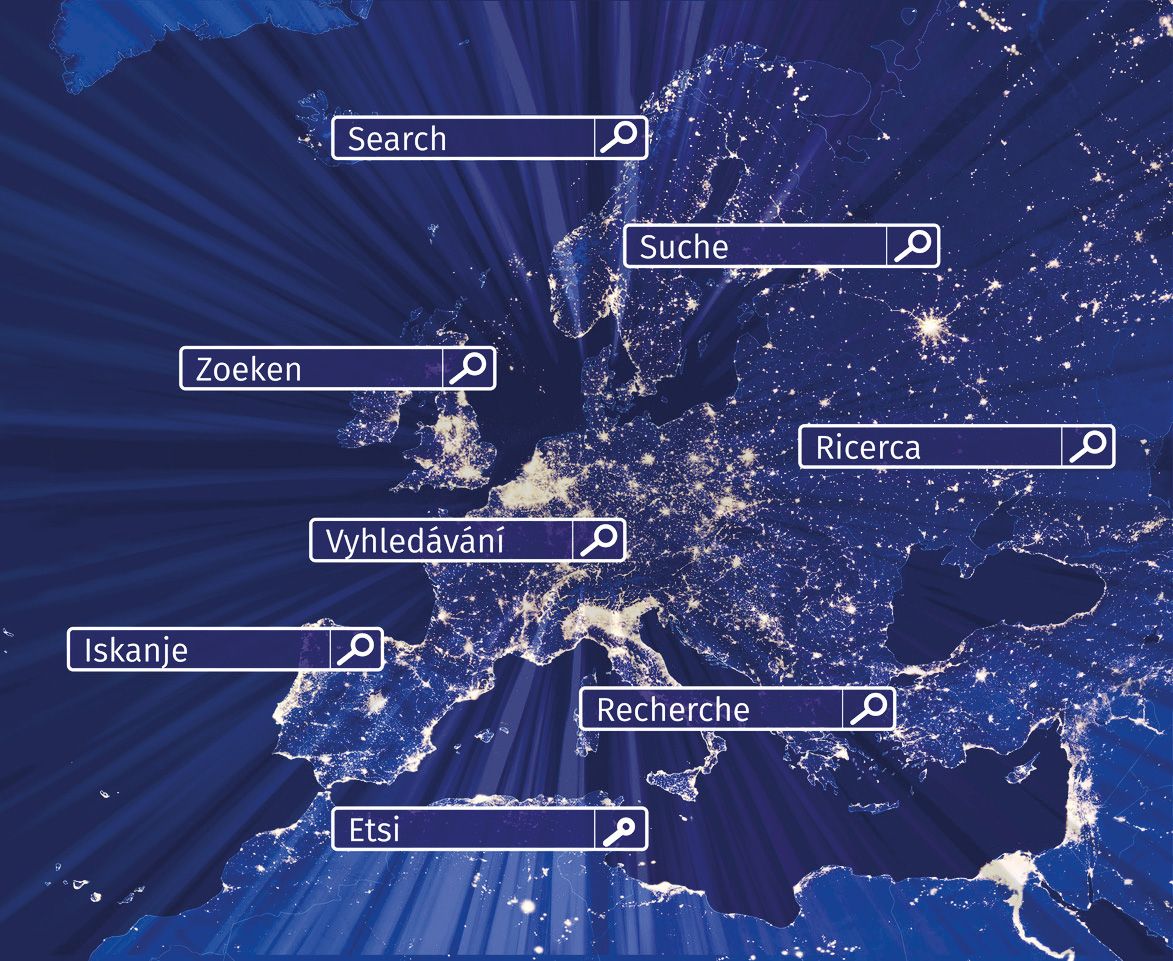
The Open Web Search project was started by a group of people who were concerned that navigation in the digital world is led by a handful of big commercial players (the European search market is largely dominated by Google, for example), who don’t simply offer their services out of generosity but because they want to generate revenue from advertisements. To achieve that they put great effort into profiling users: they analyse what you are searching for and then use this information to create more targeted adverts that create more revenue for them. They also filter search results to present information that fits your world view, to make sure that you come back because you feel at home on those web pages. For some people, and for the European Commission in the context of striving for open access to information and digital sovereignty, as well as becoming independent of US-based tech giants, this is a big concern.
How did the project come about?
In 2017 the founder of the Open Search Foundation reached out to me because I was working on CERN’s institutional search. He had a visionary idea: an open web index that is free, accessible to everyone and completely transparent in terms of the algorithms that it uses. Another angle was to create a valuable resource for building future services, especially data services. Building an index of the web is a massive endeavour, especially when you consider that the estimated total number of web pages worldwide is around 50 billion.
You could argue that unbiased, transparent access to information in the digital world should be on the level of a basic right
A group of technical experts from different institutes and universities, along with the CERN IT department, began with a number of experiments that were used to get a feel for the scale of the project. For example, to see how many web pages a single server can index and to evaluate the open source projects used for crawling and indexing web pages. The results of these experiments were highly valuable when it came to replying to the Horizon Europe funding call later on.
In parallel, we started a conference series, the Open Search Symposia (OSSYM). Two years ago there was a call for funding in the framework of the European Union (EU) Horizon Europe programme dedicated to Open Web search. Together with 13 other institutions and organisations, the CERN IT department participated and we were awarded a grant. We were then able to start the project in September 2022.
What are the technical challenges in building a new search engine?
We don’t want to copy what others are doing. For one, we don’t have the resources to build a new, massive data centre. The idea is a more collaborative approach, to have a distributed system where people can join depending on their means and interests. CERN is leading work-package five “federated data infrastructure”, in which we
and our four infrastructure partners (DLR and LRZ in Germany, CSC in Finland and IT4I in the Czech Republic) provide the infrastructure to set up the system that will ultimately allow the index itself to be built in a purely distributed way. At CERN we are running the so-called URL frontier – a system that oversees what is going on in terms of crawling and preparing this index, and has a long list of URLs that should be collected. When running the crawlers, they report back on what they have found on different web pages. It’s basically bookkeeping to ensure that we coordinate activities and don’t duplicate the efforts already made by others.
Open Web Search is said to be based on European values and jurisdiction. Who and what defines these?
That’s an interesting question. Within the project there is a dedicated work package six titled “open web search ecosystem and sustainability” that covers the ethical, legal and societal aspects of open search and addresses the need for building an ecosystem around open search, including the proper governance processes for the infrastructure.
The legal aspect is quite challenging because it is all new territory. The digital world evolves much faster than a legislator can keep up! Information on the web is freely available to anyone, but the moment you start downloading and redistributing it you are taking on ownership and responsibility. So you need you take copyright into account, which is regulated by most EU countries. Criminal law is more delicate in terms of the legal content. Every country has its own rules and there is no conformity. Overall, European values include transparency, fairness for data availability and adhering to democratic core principles. We are aiming at including these European values into the core design of our solution from the very beginning.
What is the status of the project right now?
The project was launched just over a year ago. On the infrastructure side the aim was to have the components in place, meaning having workflows ready and running. It’s not fully automated yet and there is still a lot of challenging work to do, but we have a fully functional set-up, so some institutes have been able to start crawling; they feed the data and it gets stored and distributed to the participating infrastructure partners including CERN. At the CERN data centre we coordinate the crawling efforts and provide advanced monitoring. As we go forward, we will work on aspects of scalability so that there won’t be any problems when we go bigger.
What would a long-term funding model look like for this project?
You could argue that unbiased, transparent access to information in the digital world that has become so omnipresent in our daily lives should be on the level of a basic right. With that in mind, one could imagine a governmental funding scheme. Additionally, this index would be open to companies that can use it to build commercial applications on top of it, and for this use-case a back-charging model might be suitable. So, I could imagine a combination of public and usage-based funding.
In October last year the Open Search Symposium was hosted by the CERN IT department. What was the main focus there?
This is purposely not focused on one single aspect but is an interdisciplinary meeting. Participants include researchers, data centres, libraries, policy makers, legal and ethical experts, and society. This year we had some brilliant keynote speakers such as Věra Jourová, the vice president of the European Commission for Values and Transparency, and Christoph Schumann from LAION, a non-profit organisation that looks to democratise artificial intelligence models.
Ricardo Baeza-Yates (Institute for Experiential Artificial Intelligence, Northeastern University) gave a keynote speech about “Bias in Search and Recommender Systems” and Angella Ndaka (The Centre for Africa Epistemic Justice and University of Otago) talked about “Inclusion by whose terms? When being in doesn’t mean digital and web search inclusion”, the challenges of providing equal access to information to all parts of the world. We also had some of the founders of alternative search engines joining, and it was very interesting and inspiring to see what they are working on. And we had representatives from different universities looking at how research is advancing in different areas.
I see the purpose of Open Web Search as being an invaluable investment in the future
In general, OSSYM 2023 was about a wide range of topics related to internet search and information access in the digital world. We will shortly publish the proceedings of the nearly 25 scientific papers that were submitted and presented.
How realistic is it for this type of search engine to compete with the big players?
I don’t see it as our aim or purpose to compete with the big players. They have unlimited resources so they will continue what they are doing now. I see the purpose of Open Web Search as being an invaluable investment in the future. The Open Web Index could pave the way for upcoming competitors, creating new ideas and questioning the monopoly or gatekeeper roles of the big players. This could make accessing digital information more competitive and a fairer marketplace. I like the analogy of cartography: in the physical world, having access to (unbiased) maps is a common good. If you compare maps from different suppliers you still get basically the same information, which you can rely on. At present, in the digital world there is no unbiased, independent cartography available. For instance, if you look up the way to travel from Geneva to Paris online, you might have the most straightforward option suggested to you, but you might also be pointed towards diversions via restaurants, where you then might consider stopping for a drink or some food, all to support a commercial interest. An unbiased map of the digital world should give you the opportunity to decide for yourself where and how you wish to get to your destination.
The project will also help CERN to improve its own search capabilities and will provide an open-science search across CERN’s multiple information repositories. For me, it’s nice to think that we are helping to develop this tool at the place where the web was born. We want to make sure, just as CERN gave the web to the world, that this is a public right and to steer it in the right direction.
Magnetic monopoles are hypothetical particles that possess a magnetic charge. In 1864 James Clerk Maxwell assumed that magnetic monopoles didn’t exist because no one had ever observed one. Hence, he did not incorporate the concept of magnetic charges in his unified theory of electricity and magnetism, despite their being fully consistent with classical electrodynamics. Interest in magnetic monopoles intensified in 1931 when Dirac showed that quantum mechanics can accommodate magnetic charges, g, allowed by the quantisation condition g = Ne⁄2α = NgD, where e is the elementary electric charge, α is the fine structure constant, gD is the fundamental magnetic charge and N is an integer. Grand unified theories predict very massive magnetic monopoles, but several recent extensions of the Standard Model feature monopoles in a mass range accessible at the LHC. Scientists have explored cosmic rays, particle collisions, polar volcanic rocks and lunar materials in their quest for magnetic monopoles, yet no experiment has found conclusive evidence thus far.
Signature strategy
The ATLAS collaboration recently reported the results of the search for magnetic monopoles using the full LHC Run 2 dataset recorded in 2015–2018. Magnetic charge conservation dictates that magnetic monopoles are stable and would be created in pairs of oppositely charged particles. Point-like magnetic monopoles could be produced in proton–proton collisions via two mechanisms: Drell–Yan, in which a virtual photon from the collision creates a magnetic monopole pair; or photon-fusion, whereby two virtual photons scattering off proton collisions interact to create a magnetic monopole pair. Dirac’s quantisation condition implies that a 1gD monopole would ionise matter in a similar way as a high-electric-charge object (HECO) of charge 68.5e. Hence, magnetic monopoles and HECOs are expected to be highly ionising. In contrast to the behaviour of electrically charged particles, however, the Lorentz force on a monopole in the solenoidal magnetic field encompassing the ATLAS inner tracking detector would cause it to be accelerated in the direction of the field rather than in the orthogonal plane – a trajectory that precludes the application of usual track-reconstruction methods. The ATLAS detection strategy therefore relies on characterising the highly ionising signature of magnetic monopoles and HECOs in the electromagnetic calorimeter and in the transition radiation tracker.
This is the first ATLAS analysis to consider the photon-fusion production mechanism
The ATLAS search considered magnetic monopoles of magnetic charge 1gD and 2gD, and HECOs of 20e, 40e, 60e, 80e and 100e of both spin-0 and spin-½ in the mass range 0.2–4 TeV. ATLAS is not sensitive to higher charge monopoles or HECOs because they stop before the calorimeter due to their higher ionisation. Since particles in the considered mass range are too heavy to produce significant electromagnetic showers in the calorimeter, their narrow high-energy deposits are readily distinguished from the broader lower-energy ones of electrons and photons. Events with multiple high-energy deposits in the transition radiation tracker aligned with a narrow high-energy deposit in the calorimeter are therefore characteristic of magnetic monopoles and HECOs.
Random combinations of rare processes, such as superpositions of high-energy electrons, could potentially mimic such a signature. Since such rare processes cannot be easily simulated, the background in the signal region is estimated to be 0.15 ± 0.04 (stat) ± 0.05 (syst) events through extrapolation from the lower ionisation event yields in the data.
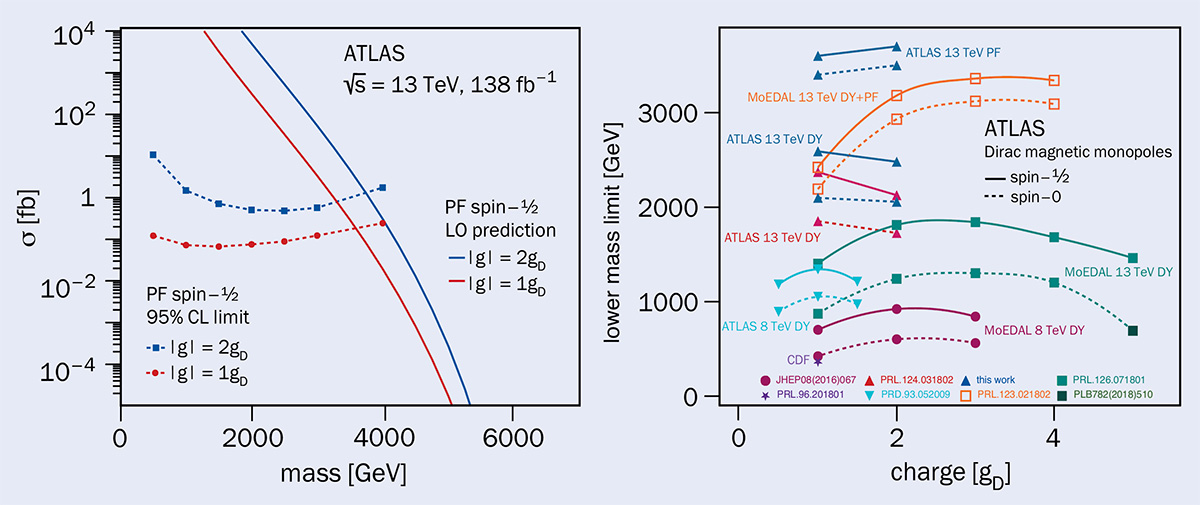
With no magnetic monopole or HECO candidate observed in the analysed ATLAS data, upper cross-section limits and lower mass limits on these particles were set at 95% confidence level. The Drell–Yan cross-section limits are approximately a factor of three better than those from the previous search using the 2015–2016 Run 2 data.
This is the first ATLAS analysis to consider the photon-fusion production mechanism, the results of which are shown in figure 1 (left) for spin-½ monopoles. ATLAS is also currently the most sensitive experiment to magnetic monopoles in the charge range 1-2gD, as shown in figure 1 (right), and to HECOs in the charge range of 20–100e. The collaboration is further refining search techniques and developing new strategies to search for magnetic monopoles and HECOs in both Run 2 and Run 3 data.
To provide the best experiences, we use technologies like cookies to store and/or access device information. Consenting to these technologies will allow us to process data such as browsing behavior or unique IDs on this site. Not consenting or withdrawing consent, may adversely affect certain features and functions.
Functional
Always active
The technical storage or access is strictly necessary for the legitimate purpose of enabling the use of a specific service explicitly requested by the subscriber or user, or for the sole purpose of carrying out the transmission of a communication over an electronic communications network.
Preferences
The technical storage or access is necessary for the legitimate purpose of storing preferences that are not requested by the subscriber or user.
Statistics
The technical storage or access that is used exclusively for statistical purposes.The technical storage or access that is used exclusively for anonymous statistical purposes. Without a subpoena, voluntary compliance on the part of your Internet Service Provider, or additional records from a third party, information stored or retrieved for this purpose alone cannot usually be used to identify you.
Marketing
The technical storage or access is required to create user profiles to send advertising, or to track the user on a website or across several websites for similar marketing purposes.