Comsol -leaderboard other pages

Topics

QGP production studied at record energies

CMS figure 1

The very-high-energy densities reached in heavy-ion collisions at the LHC result in the production of an extremely hot form of matter, known as the quark-gluon plasma (QGP), consisting of freely roaming quarks and gluons. This medium undergoes a dynamic evolution before eventually transitioning to a collection of hadrons. But the details of this temporal evolution and phase transition are very challenging to calculate from first principles using quantum chromodynamics. The experimental study of the final-state hadrons produced in heavy-ion collisions therefore provides important insights into the nature of these processes. In particular, measurements of the pseudorapidity (η) distributions of charged hadrons help in understanding the initial energy density of the produced QGP and how this energy is transported throughout the event. These measurements involve different classes of collisions, sorted according to the degree of overlap between the two colliding nuclei; collisions with the largest overlap have the highest energy densities.

In 2022 the LHC entered Run 3, with higher collision energies and integrated luminosities than previous running periods. The CMS collaboration has now reported the first measurement using Run 3 heavy-ion data. Charged hadrons produced in lead–lead collisions at the record nucleon–nucleon centre-of-mass collision energy of 5.36 TeV were reconstructed by exploiting the pixel layers of the silicon tracker. At mid-rapidity and in the 5% most central collisions (which have the largest overlap between the two colliding nuclei), 2032 ± 91 charged hadrons are produced per unit of pseu­dorapidity. The data-to-theory comparisons show that models can successfully predict either the total charged-hadron multiplicity or the shape of its η distribution, but struggle to simultaneously describe both aspects.

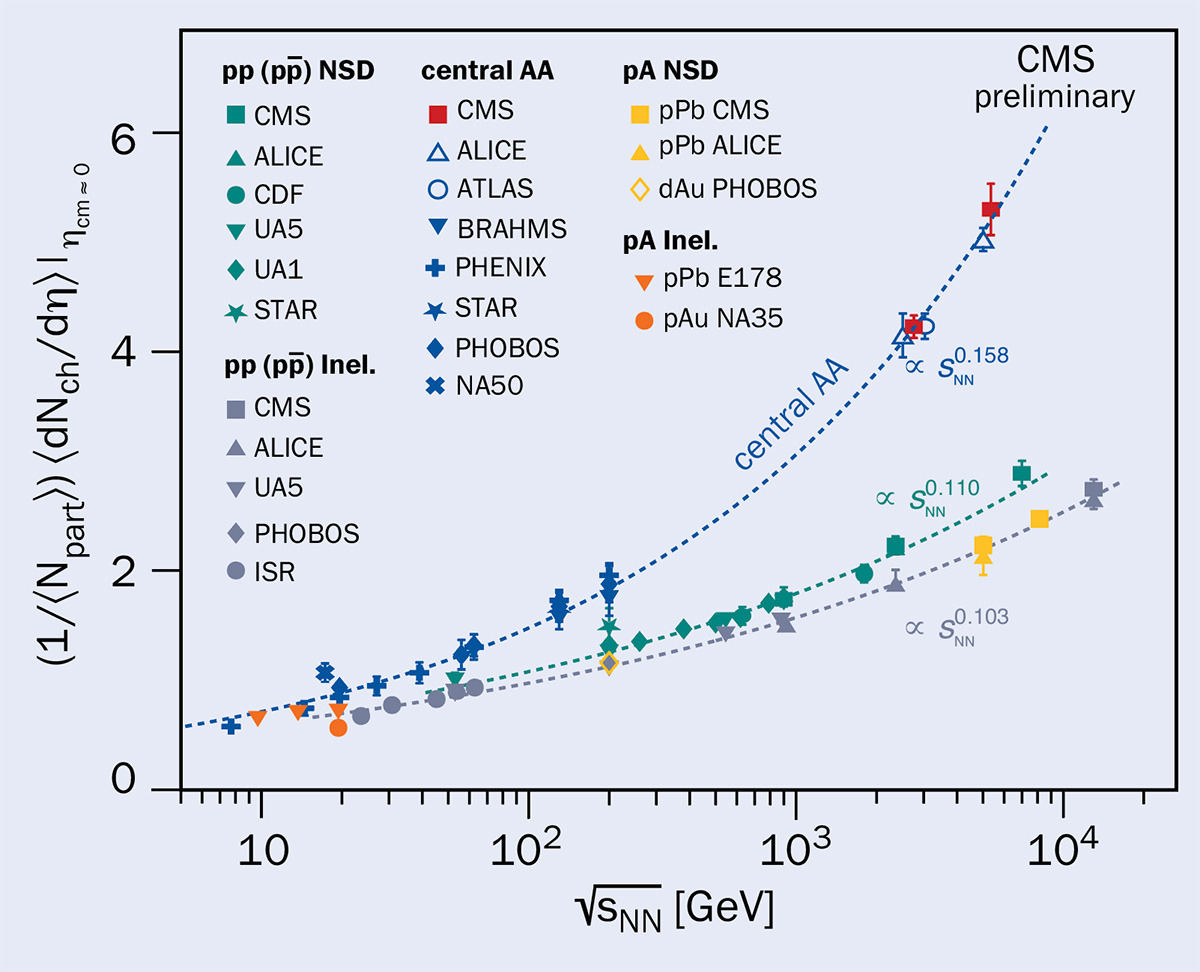
Previous measurements have shown that the mid-rapidity yield of charged hadrons in proton-proton and heavy-ion collisions are comparable when scaled by the average number of nucleons parti­cipating in the collisions,〈Npart〉. Figure 1 shows measurements of this quantity in several collision systems as a function of collision energy. It was previously observed that central nucleus–nucleus collisions exhibit a power-law scaling, as illustrated by the blue dashed curve; the new CMS result agrees with this trend. In addition, the measurement is about two times larger than the values of proton–proton collisions at similar energies, indicating that heavy-ion collisions are more efficient at converting initial-state energy into final-state hadrons at mid-rapidity.

This measurement opens a new chapter in the CMS heavy-ion programme. At the end of 2023 the LHC delivered an integrated luminosity of around 2 nb–1 to CMS, and more data will be collected in the coming years, enabling more precise analyses of the QGP features.
Dielectrons take the temperature of Pb–Pb collisions

ALICE figure 1

Collisions between lead ions at the LHC produce the hottest system ever created in the lab, exceeding those in stellar interiors by about a factor of 105. At such temperatures, nucleons no longer exist and quark–gluon plasma (QGP) is formed. Yet, a precise measurement of the initial temperature of the QGP created in these collisions remains challenging. Information about the early stage of the collision gets washed out because the system constituents continue to interact as it evolves. As a result, deriving the initial temperature from the hadronic final state requires a model-dependent extrapolation of system properties (such as energy density) by more than an order of magnitude.

In contrast, electromagnetic radiation in the form of real and virtual photons escapes the strongly interacting system. Moreover, virtual photons – emerging in the final state as electron–positron pairs (dielectrons) – carry mass, which allows early and late emission stages to be separated.

Radiation from the late hadronic phase dominates the thermal dielectron spectrum at invariant masses below 1 GeV. The yield and spectral shape in this mass window reflects the in-medium properties of vector mesons, mainly the ρ, and can be connected to the restoration of chiral symmetry in hot and dense matter. In the intermediate-mass region (IMR) between about 1 and 3 GeV, thermal radiation is expected to originate predominantly from the QGP, and an estimate of the initial QGP temperature can be derived from the slope of the exponential spectrum. This makes dielectrons a unique tool to study the properties of the system at its hottest and densest stage.

A new approach to separate the heavy-flavour contribution experimentally has been employed for the first time at the LHC

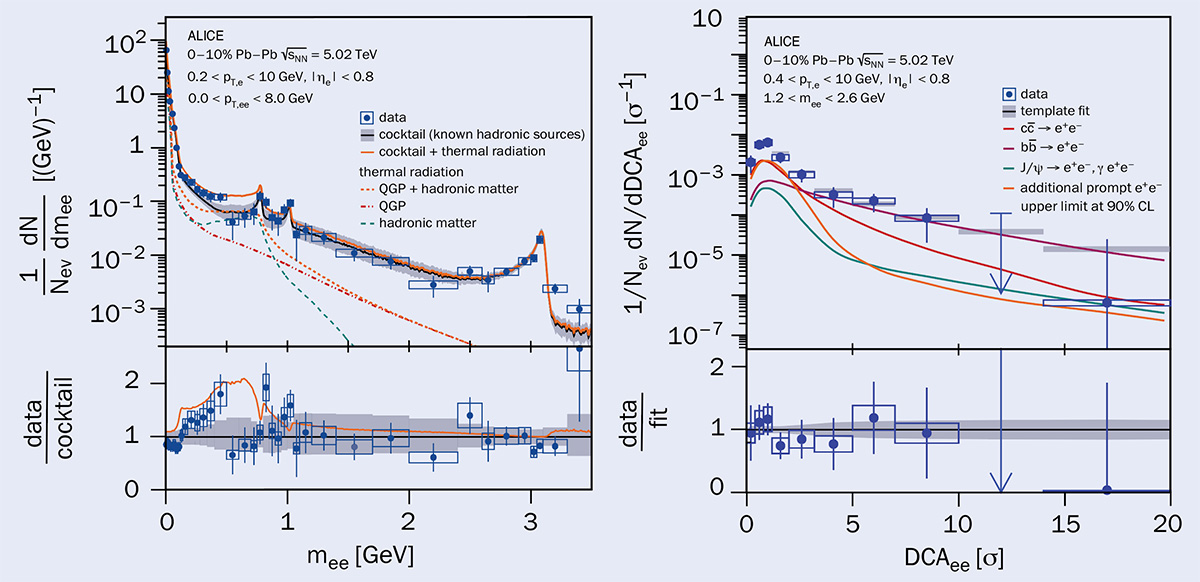
At the LHC, this measurement is challenging because the expected thermal dielectron yield in the IMR is outshined by a physical background that is about 10 times larger, mainly from semileptonic decays of correlated pairs of cc or bb hadrons. In ALICE, the electron and positron candidates are selected in the central barrel using complementary information provided by the inner tracking system (ITS), time projection chamber and time-of-flight measurements. Figure 1 (left) shows the dielectron invariant-mass spectrum in central lead–lead (Pb–Pb) collisions. The measured distribution is compared with a “cocktail” of all known contributions from hadronic decays. At masses below 0.5 GeV, an enhancement of the dielectron yield over the cocktail expectation is observed, which is consistent with calculations that include thermal radiation from the hadronic phase and an in-medium modification of the ρ-meson. Between 0.5 GeV and the ρ mass (0.77 GeV) a small discrepancy between the data and calculations is observed.

In the IMR, however, systematic uncertainties on the cocktail contributions from charm and beauty prevent any conclusion being drawn about thermal radiation from QGP. To overcome this limitation, a new approach to separate the heavy-flavour contribution experimentally has been employed for the first time at the LHC. This approach exploits the high-precision vertexing capabilities of the ITS to measure the displaced vertices of heavy-quark pairs. Figure 1 (right) shows the dielectron distribution in the IMR compared to template distributions from Monte Carlo simulations. The best fit includes templates from heavy-quark pairs and an additional prompt dielectron contribution, presumably from thermal radiation. This is the first experimental hint of thermal radiation from the QGP in Pb–Pb collisions at the LHC, albeit with a significance of 1σ.

Ongoing measurements with the upgraded ALICE detector will provide an unprecedented improvement in precision, paving the way for a detailed study of thermal radiation from hot QGP.

Resolving asymmetries in B0 and B0s oscillations

In the Standard Model (SM), CP violation originates from a single complex phase in the 3 × 3 Cabibbo–Kobayashi–Maskawa (CKM) quark-mixing matrix. The unitarity condition of the CKM matrix (Vud V*ub + Vcd V*cb + Vtd V*tb = 0, where Vij are the CKM matrix elements) can be represented as a triangle in the complex plane, with an area proportional to the amount of CP violation in the quark sector. One angle of this triangle, γ = arg (–Vud V*ub/ Vcd V*cb), is of particular interest as it can be probed both indirectly under the assumption of unitarity and in tree-level processes that make no such assumption. Its most sensitive direct experimental determination is currently given by a combination of LHCb measurements of B+, B0, B0s decays to final states containing a D(s) meson and one or more light mesons. Decay-time-dependent analyses of tree-level B0s → D∓s K± and B0 → D∓π± decays are sensitive to the angle γ through CP violation in the interference between mixing and decay amplitudes. Thus, comparing the value of γ obtained from tree-level processes with indirect measurements of γ and other unitary triangle parameters in loop-level processes provides an important consistency check of the SM.

LHCb figure 1

Measurements using neutral B0 and B0s mesons are particularly powerful because they resolve ambiguities that other measurements cannot. Due to the interference between B0(s) – B0(S) mixing and decay amplitudes, the physical CP-violating parameters in these decays are functions of a combination of γ and the relevant mixing phase, namely γ + 2β in the B0 system, where β = arg(–Vcd V*cb/ Vtd V*tb), and γ–2βs in the B0s system, where βs = arg(–Vts V*tb/ Vtd V*tb). Measurements of these physical quantities can therefore be interpreted in terms of the angles γ and β(s), and γ can be derived using independent determinations of the other parameter as input.

The LHCb collaboration recently presented a new measurement of B0s → D∓s K± decays collected during Run 2. This is a challenging analysis, as it requires a decay time-dependent fit to extract the CP-violating observables expressed as amplitudes of the four different decay paths that arise from B0s and – B0s to D∓s K± final states. Previously, LHCb measured γ in this decay using the Run 1 dataset, obtaining γ = 128 +17–22°. The B0s – B0s oscillation frequency ∆ms must be precisely constrained in order to determine the phase differences between the amplitudes. In the Run 2 measurement, the established uncertainty on ∆ms would have been a limiting systematic uncertainty, which motivated the recent LHCb measurement of ∆ms using the flavour-specific B0s → D–s π+ decays from the same dataset. Combined with Run 1 measurements of ∆ms, this has led to the most precise contribution to the world average and has greatly improved the precision on γ in the B0s → D∓s K± analysis. Indeed, for the first time the four amplitudes are resolved with sufficient precision to show the decay rates separately (see figure 1).

The angle γ is determined using inputs from other LHCb measurements of the CP-violating weak phase –2βs, along with measurements of the decay width and decay-width difference. The final result, γ = 74 ± 11°, is compatible with the SM and is the most precise determination of γ using B0s meson decays to date.

Leading in collaborations

Are we at the vanguard of every facet of our field? In our quest for knowledge, physicists have charted nebulae, quantified quarks and built instruments and machines at the edge of technology. Yet, there is a frontier that remains less explored: leadership. As a field, particle physics has only just begun to navigate the complexities of guiding our brightest minds.

Large-experiment collaborations such as those at the LHC achieve remarkable feats. Indeed, social scientists have praised our ability to coordinate thousands of researchers with limited “power” while retaining individual independence. Similarly, as we continuously optimise experiments for performance and quality, and there also exist opportunities to refine behaviours and practices to facilitate progress and collective success.

A voice for all

Hierarchies in any organisation can inadvertently become a barrier rather than a facilitator of open idea exchange. Often, decision-making is confined to higher levels, reducing the agency of those implementing actions and leading to disconnects in roles and responsibilities. Excellence in physics doesn’t guarantee the interpersonal skills that are essential for inspiring teams. Moreover, imposter syndrome infects us all, especially junior collaborators who may lack soft-skills training. While striving for diversity we sometimes overlook the need to embrace different personality types, which, for example, can make large meetings daunting for the less outspoken. Good leadership can help navigate these challenges, ensuring that every voice contributes to our collective progress.

Leadership is not management (using resources to get a particular job done), nor is it rank (merely a line on a CV). It is guidance and influence of others towards a shared vision – a pivotal force as essential as any tool in our research arsenal. Good leadership is a combination of strategic foresight, emotional intelligence and adaptive communication; it creates an inclusive environment where individual contributions are not commanded but empowered. These practices would improve any collaboration. In large physics experiments this type of leadership is incidental instead of being broadly acknowledged and pursued.

Luckily, leadership is a skill that can be taught and developed through training. True training is a craft and is best delivered by experts who are not just versed in theory but are also skilled practitioners. Launched in autumn 2023 based on the innovative training approach of Resilient Leaders Elements, a new course “Leading in Collaborations” is tailored specifically for our community. The three-month expert-facilitated course includes four half-day workshops and two one-hour clinics, addressing two main themes: “what I do”, which equips participants with decision-making skills to set clear goals and navigate the path to achieving them; and “who I am”, which encourages participants to channel their emotions positively and motivate both themselves and others effectively. The course confronts participants with the question “What is leadership in a large physics collaboration?” and provides a new framework of concepts. Through self-assessment, peer-feedback sessions, individualised challenges and buddy-coaching, participants are able to identify blind spots and hidden talents. A final assessment shows measurable change in each skill.

The first cohort of 20 participants, displaying a diverse mix of physics experience from various institutions and nationalities, was welcomed to the programme at University College London on 14 and 15 November 2023. More than half of the participants were women – in line with the programme’s aim to ensure that those often overshadowed are given the visibility and support to become more impactful leaders. The lead facilitator, Chris Russell, masterfully connected with the audience via his technical physics background and proceeded to build trust and impart knowledge in an open and supportive atmosphere. When discussing leadership, the initial examples given cited military and political figures; reframing led to a participant’s description of a conductor giving their orchestra space to play through an often-rehearsed tough section as an example of great leadership.

Crucial catalyst

Building on the experience of the first cohort, the aim is to offer the programme more broadly so that we can encourage common practice and change the culture of leadership in large collaborations. Given that the LHC hosts the largest collaborations in physics, the programme also hopes to find a home within CERN’s learning and development portfolio.

The Leading in Collaborations programme is a crucial catalyst in the endeavour to ensure that our precious resources are wielded with precision and purpose, and thus to amplify our collective capacity for discovery. Join the leadership revolution by being the leader you wish you had, no matter your rank. Together, we will become the cultural vanguard!

First TIPP in Africa a roaring success

The Conference of Technology and Instrumentation in Particle Physics (TIPP) is the largest conference of its kind. The sixth edition, which took place in Cape Town from 4 to 8 September 2023 and attracted 250 participants, was the first in Africa. More than 200 presentations covered state-of-the-art developments in detector development and instrumentation in particle physics, astroparticle physics and closely related fields. 

“As South Africa, we regard this opportunity as a great privilege for us to host this year’s edition of the TIPP conference,” said minister of higher education, science and innovation Blade Nzimande during an opening address. He was followed by speeches from Angus Paterson, deputy CEO of the National Research Foundation, and Makondelele Victor Tshivhase, director of the national research facility iThemba LABS.

The South African CERN (SA–CERN) programme within the National Research Foundation and iThemba LABS supports more than 120 physicists, engineers and students that contribute to the ALICE, ATLAS and ISOLDE experiments, and to theoretical particle physics. The SA–CERN programme identifies technology transfer in particle physics as key to South African society. This aligns symbiotically with the technology innovation platform of iThemba LABS to create a platform for innovation, incubation, industry collaboration and growth. For the first time, TIPP 2023 included a dedicated parallel session on technology transfer, which was chaired by Massimo Caccia (University of Insubria), Paolo Giacomelli (INFN Bologna) and Christophe De La Taille (CNRS/IN2P3).

The scientific programme kicked off with a plenary presentation on the implementation of the ECFA detector R&D roadmap in Europe by Thomas Bergauer (HEPHY). Other plenary presentations included overviews on bolometers for neutrinos, the Square Kilometre Array (SKA), technological advances by the LHC experiments, NaI experiments, advances in instrumentation at iThemba LABS, micro-pattern gaseous detectors, inorganic and liquid scintillator detectors, noble liquid experiments, axion detection, water cherenkov detectors for neutrinos, superconducting technology for future colliders and detectors, and the PAUL facility in South Africa.

A panel discussion between former CERN Director-General Rolf Heuer (DESY), Michel Spiro (IRFU) and Manfred Krammer (CERN), Imraan Patel (deputy director general of the Department of Science and Innovation), Angus Paterson and Rob Adam (SKA) triggered an exchange of insights about international research infrastructures such as CERN and SESAME for particle physics and science diplomacy.

Prior to TIPP2023, 25 graduate students from Botswana, Cameroon, Ghana, South Africa and Zambia participated in a school of instrumentation in particle, nuclear and medical physics held at iThemba LABS, comprising lectures, hands-on demonstrations, and insightful presentations by researchers from CERN, DESY and IJCLAB, which provided a global perspective on instrumentation.

A bright future for the Higgs sector

The 13th Higgs Hunting workshop, organised in Orsay and Paris from 11 to 13 September 2023, was a timely opportunity to gather theorists and experimentalists interested in recent results related to the Higgs sector. While the large 140 fb–1 dataset collected by the ATLAS and CMS experiments during LHC Run 2 is still being exploited to measure the Higgs-boson properties in more detail, the first results based on Run 3 data collected since 2022 were also shown, along with searches for phenomena beyond the Standard Model.

Experimental highlights focused on the latest results from CMS and ATLAS. CMS presented a new measurement of the associated production of a Higgs boson with top quarks decaying into b quarks, while ATLAS showed a new measurement of the associated production of a vector boson and a boosted Higgs boson in fully hadronic final states. A major highlight was a new CMS measurement of the Higgs-boson mass in the four-lepton decay channel, reaching the highest precision to date in a single decay channel as well as placing indirect constraints on the Higgs-boson width. Precision measurements were also shown in the framework of effective field theory, which allows potential subtle deviations with respect to the Standard Model to be probed. A small number of intriguing excesses observed, for instance, in the search for partners of the Higgs boson decaying into W-boson or photon pairs were also extensively discussed.

Following a historical talk on the “long and winding road” that led particle physicists from LEP to the discovery of the Higgs boson by Steve Myers, who was CERN director of accelerators and technology when the LHC started up, a dedicated session discussed Higgs-physics prospects at colliders beyond the High-Luminosity LHC (HL-LHC). Patrizia Azzi (INFN Padova) presented the experimental prospects at the proposed Future Circular Collider, and Daniel Schulte (CERN) described the status of muon colliders, highlighting the strong interest within the community and leading to a lively discussion.

The latest theory developments related to Higgs physics were discussed in detail, starting with state-of-the-art predictions for the various Higgs-boson production modes by Aude Gehrmann-De Ridder (ETH Zurich). Andrea Wulzer (CERN) overviewed the theory prospects relevant for future collider projects, while Raffaele Tito D’Agnolo (IPhT, Saclay) presented the connections between the properties of the Higgs boson and cosmology and Arttu Rajantie (Imperial College) focused on implications of the Higgs vacuum metastability on new physics. Finally, a “vision” talk by Matthew McCullough (CERN) questioned our common assumption that the Higgs boson discovered at the LHC is really compatible with Standard Model expectations, considering the current precision of the measurements of its properties.

During several experimental sessions, recent results covering a wide range of topics were presented – in particular those related to vector-boson scattering, since their high-energy behaviour is driven by the properties of the Higgs boson. The Higgs-boson self-coupling was another topic of interest. The best precision on this measurement is currently achieved by combining indirect constraints from processes involving a single Higgs boson together with direct searches for the rare production of a Higgs-boson pair. While the Run 3 data set will provide an opportunity to further improve the sensitivity to the latter, its observation is expected to take place towards the end of HL-LHC operations. Finally, Stéphanie Roccia (LPSC) presented the implications of experimental measurements of the neutron electron dipole moment on the CP-violating couplings of the Higgs boson to fermions, absent in the Standard Model. Concluding talks were given by Massimiliano Grazzini (University of Zurich) and Andrea Rizzi (University and INFN Pisa). The next Higgs Hunting workshop will be held in Orsay and Paris from 23 to 25 September 2024.

Golden anniversaries in Spain

The golden jubilees of the International Meeting on Fundamental Physics (IMFP23) and the National Centre for Particle Physics, Astroparticles and Nuclear Physics (CPAN) Days were celebrated from 2 to 6 October 2023 at Palacio de la Magdalena in Santander, Spain, organised by the Institute of Physics of Cantabria (IFCA). More than 180 participants representing the entire Spanish community in these disciplines, together with several international researchers, convened to foster cooperation between Spanish research groups and identify key priorities.

The congress started with parallel meetings on LHC physics, astroparticle physics, nuclear physics and theoretical physics. Two extra sessions were held, one covering technology transfer and the other discussing instrumentation R&D aimed at supporting the HL-LHC, future Higgs factories, and other developments in line with the European strategy for particle physics. The opening ceremony was followed by a lecture by Manuel Aguilar (CIEMAT), who gave an overview of the past 50 years of research in high-energy physics in Spain and the IMFP series. The first edition, held in Formigal (Spanish Pyrenees) in February 1973, was of great significance given the withdrawal of Spain from CERN in 1969, which put high-energy physics in Spain in a precarious position. The participation of prestigious foreign scientists in the first and subsequent editions undoubtedly contributed to the return of Spain to CERN in 1983.

LHC physics was one of the central themes of the event, in particular the first results from Run 3 as well as improvements in theoretical precision and Spain’s contribution to the HL-LHC upgrades. Other discussions and presentations focused on the search for new physics and especially dark-matter candidates, as well as new technologies such as quantum sensors. The conference also reviewed the status of studies related to neutrino oscillations and mass measurements, as well as searches for neutrinoless double beta decay and high-energy neutrinos in astrophysics. Results from gamma-ray and gravitational-wave observatories were discussed, as well as prospects for future experiments.

The programme included plenary sessions devoted to nuclear physics (such as the use of quantum computing to study the formation of nuclei), QCD studies in collisions of very high-energy heavy ions and in neutron stars, and nuclear reactions in storage rings. New technologies applied in nuclear and high-energy physics and their most relevant applications, especially in medical physics, complemented the programme alongside an overview of observational cosmology.

Roundtable discussions focused on grants offered by the European Research Council, R&D strategies and, following a clear presentation of the perspectives of future accelerators by ECFA chair Karl Jacobs (University of Freiburg), possible Spanish strategies for future projects with the participation of industry representatives. The congress also covered science policy, with the participation of the national programme manager Pilar Hernández (University of Valencia).

Prior to the opening of the conference, 170 students from various schools in Cantabria were welcomed to take part in an outreach activity “A morning among scientists” organised by IFCA and CPAN, while Álvaro de Rújula (University of Boston) gave a public talk on artificial intelligence. Finally, an excellent presentation by Antonio Pich (University of Valencia) on open questions in high-energy physics brought the conference to a close.

Widening Balkan bridges in theory

Twenty years ago, the participants of the UNESCO-sponsored Balkan Workshop BW2003 in Vrnjačka Banja, Serbia came to a common agreement on the creation of the Southeast European Network in Mathematical and Theoretical Physics (SEENET-MTP). The platform for the network was provided by the 1999–2003 Julius Wess initiative “Wissenschaftler in Global Verantwortung” (WIGV), which translates to “scientists in global responsibility”. Starting with a focus on the former Yugoslavia, WIGV aimed to connect and support individual researchers, groups and institutions from all over the Balkan region. The next natural step was then to expand the WIGV initiative to bridge the gap between the southeast region and the rest of Europe. Countries to the east and south of former Yugoslavia – such as Bulgaria, Greece, Romania and Turkey – have a reasonably strong presence in high-energy physics. On the other hand, they share similar economic and scientific problems, with many research groups facing insufficient financing, isolation and lacking critical mass.

The SEENET–MTP network has since grown to include 24 institutions from 12 countries, and more than 450 individual members. There are also 13 partner institutions worldwide. During its 20 years of existence, the network has undertaken: more than 20 projects; 30 conferences, workshops and schools; more than 360 researcher and student exchanges and fellowships; and more than 350 joint papers. Following initial support from CERN’s theoretical physics department, a formal collaboration agreement resulted in the joint CERN–SEENET–MTP PhD training programme with at least 150 students taking part in the first two cycles from 2015 to 2022. Significant support also came from the European Physical Society and ICTP Trieste, and the third cycle of the PhD programme will start in June 2024 in Thessaloniki, Greece.

Networking is the most promising auxiliary mechanism to preserve and build local capacity in fundamental physics in the region

Unfortunately, the general focus on (Western) Balkan states has shifted during the past few years to other parts of the world. However, networking is the most natural and promising auxiliary mechanism to preserve and build local capacity in fundamental physics in the region. The central SEENET-MTP event in this anniversary year, the BWXX workshop held in Vrnjačka Banja from 29 to 31 August 2023, marked the endurance of the initiative and offered 30 participants an opportunity to consider topics such as safe supersymmetry breaking (B Bajc, Slovenia), string model building using quantum annealers (I Rizos, Greece), entropy production in open quantum systems (A Isar, Romania), advances in noncommutative field theories and gravity (M Dimitrijević Ćirić, Serbia), and the thermodynamic length for 3D holographic models and optimal processes (T Vetsov, Bulgaria).

A subsequent meeting held during an ICTP workshop on string theory, holography and black holes from 23 to 27 October 2023, partially supported by CERN, invited participants to brainstorm about future SEENET–MTP activities – the perfect setting to trace the directions of this important network’s activity in its third decade.

Machine-learning speedup for HL-LHC

The fourth edition of the Fast Machine Learning for Science Workshop was hosted by Imperial College London from 25 to 28 September 2023, marking its first venture outside the US. The series was launched in response to the need for microsecond-speed machine-learning inference for the High-Luminosity LHC (HL-LHC)  detectors, in particular in the hardware trigger systems of the ATLAS and CMS experiments. Achieving this level of speed requires non-standard and generally custom hardware platforms, which are traditionally very challenging to program. While machine learning is becoming widespread in society, this ultrafast niche is not well served by commercial tools. Consequently, particle physicists have developed tools, techniques and an active community in this area.

The workshop gathered almost 200 scientists and engineers in a hybrid format. Students, including undergraduates, and early-career researchers were strongly represented, as were key industry partners. A strong aim of the conference was to engage scientific communities outside particle physics to develop areas where the tools and techniques from particle physics could be game-changing.

The workshop focused on current and emerging techniques and scientific applications for deep learning and inference acceleration, including novel methods for efficient algorithm design, ultrafast on-detector inference and real-time systems. Acceleration as a service, hardware platforms, coprocessor technologies, distributed learning and hyper-parameter optimisation. The four-day event consisted of three workshop-style days with invited and contributed talks, and a final day dedicated to technical demonstrations and satellite meetings.

The tools and techniques from particle physics could be game-changing

The interdisciplinary nature of the workshop – which encompassed particle physics, free electron lasers, nuclear fusion, astrophysics, computer science and biology – made for a varied and interesting agenda. Attendees heard talks on how fast machine learning is being harnessed to speed up the identification of gravitational waves, and how it is needed to handle the high data rates and fast turnaround of experiments at free-electron lasers. In the medical arena, speakers addressed the need for faster image processing and data analysis for diagnosis and treatment, and the use of fast machine learning in biology to search for known and unknown features in large, heterogeneous datasets. The use of machine learning in control systems and simulations was discussed in the context of laser-driven accelerators and nuclear-fusion experiments, while in theoretical physics the application of machine learning to solve the electron wave equation in condensed matter, working towards a detailed and fundamental understanding of superconductivity, was presented.

Industry partners including AMD, Graphcore, Groq and Intel discussed current- and future-generation hardware platforms and architectures, and facilitated tutorials on their development toolchains. Researchers from Groq and Graphcore presented their latest dedicated chips for artificial-intelligence applications and showed that they have interesting applications to problems in particle physics, weather forecasting, protein folding, fluid dynamics, materials science and solving partial differential equations. AMD and Intel demonstrated the flexibility of their FPGA platforms and explained how to optimise them for scientific machine-learning applications.

A highlight of the social programme was a public lecture from Grammy Award-winning rapper Lupe Fiasco, who discussed his work with Google on large-language models. The workshop will return to the US next year, before landing in Zurich in 2025.

Keeping it cool at Cornell

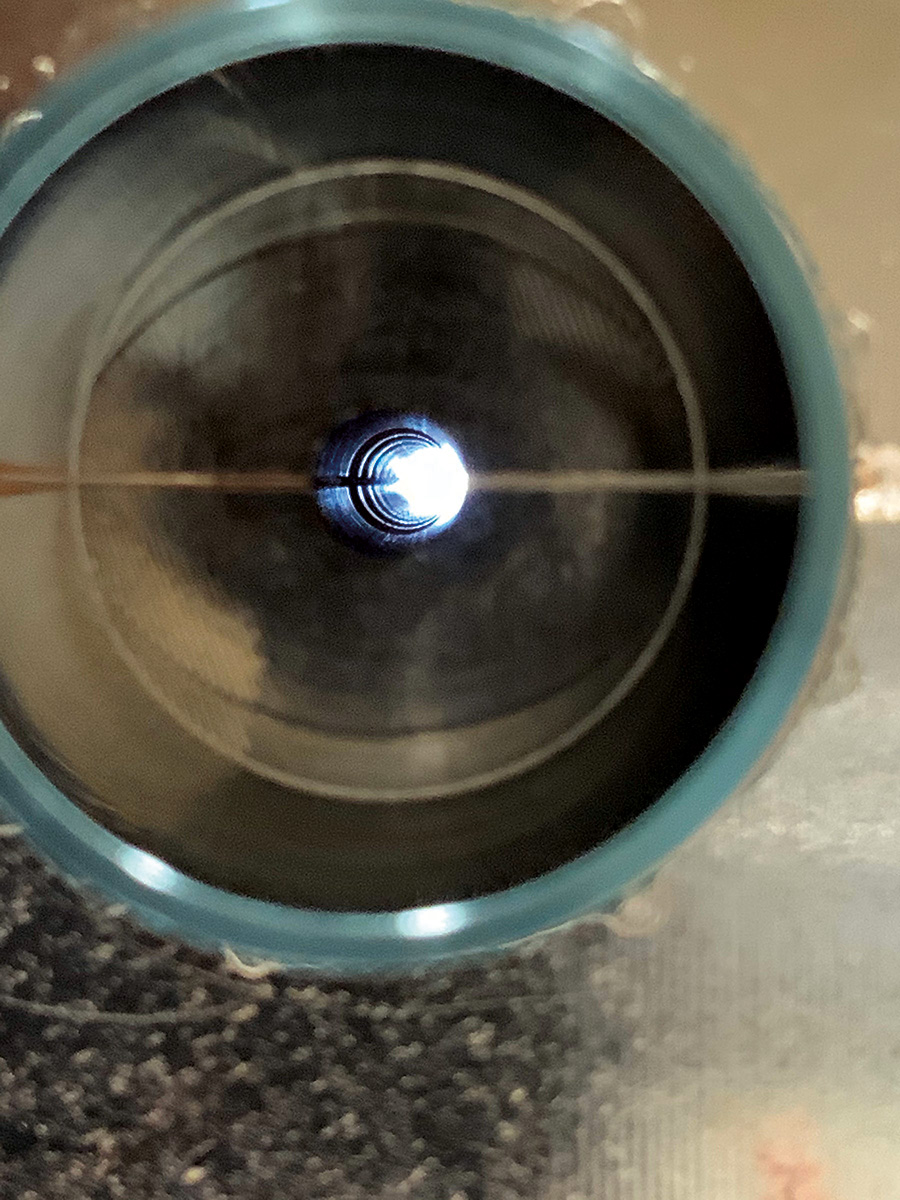
The electron beam tunnel for a cool-copper linac

The first ICFA Beam Dynamics workshop on Cold Copper Accelerator Technology and Applications was held at Cornell University from 31 August to 1 September 2023. Nearly 100 people came together to discuss the technology and explore next directions for R&D. Originally conceived at SLAC as an attractive approach to a linear-collider Higgs factory (dubbed the Cool Copper Collider, C3), interest in the technology has expanded to other areas.

Following opening presentations by Julia Thom-Levy (Cornell associate vice provost for research and innovation) and Jared Maxson (who leads the cold copper programme at Cornell), Emilio Nanni (SLAC) presented an overview of radio-frequency (RF) breakthroughs using cold copper cavities. He described three major advantages over conventional materials such as superconducting niobium: increased material conductivity at cryogenic temperatures (a reduction in resistance by a factor of three), significant reduction in pulsed heating, and improved yield strength and thermal diffusion. Combined, these lead to a high potential acceleration gradient of 70–120 MV/m, and an estimated 8 km footprint for a 550 GeV Higgs factory.

The optimised C-band cavity design enables a novel coupling of RF signals into each of the 40 cells along the cavity. A 9 m-long cryomodule would provide 1 GeV of acceleration. Some challenges identified for future R&D in the coming years are vibration control, meeting linac alignment specifications of 10 microns, and reducing the cost via optimised RF. Other applications of cold-copper technology include an ultra-compact free-electron laser (FEL) with 10–100 fs timing resolution as well as synergies with other proposed colliders such as ILC and FCC, where it could be used for positron production or as an injector, respectively. Walter Wuensch (CERN) summarised the extensive work over the past two decades on high-field limitations to copper performance. Breakdowns, field emission current and pulsed heating are fundamental limitations to performance, along with some practical ones such as limited RF power, conditioning time, small-aperture requirements, wakefields, power feeds and cooling capacity. Wuensch concluded that the community has a reasonably good understanding of copper, but that the demands for higher gradients and more performant cavities require careful optimisation.

The accelerator R&D community has a reasonably good under-standing of copper, but the demands for higher gradients and more performant cavities require careful optimisation

The workshop also delved into the details of cryomodule design, fabrication and damping, as well as the progress of relevant developments at LANL and INFN Frascati. Numerous industry participants gave presentations, including researchers from Radiabeam, Scandinova, Canon, EEC Permanent Magnets and Calabazas Creek.

Day two started with Caterina Vernieri (SLAC) presenting the C3 ambition for a Higgs factory based on extensive, recently published studies. Jamie Rosenzweig (UCLA) presented the design for an ultra-compact FEL and Paul Gueye (Michigan State) provided an overview of a potential high-gradient linac at the Facility for Rare Isotope Beams. Sami Tantawi (SLAC) presented potential medical applications of the technology, aimed at FLASH and very-high-energy-electron treatment modalities. Xi Yang (BNL) reviewed ultrafast electron diffraction devices and how moving from keV to MeV energies using compact copper accelerators could open new research opportunities. A session devoted to sustainability at CERN was covered by Maxim Titov (CEA Saclay), while Sarah Carsen (Cornell) presented the renewable programme at Cornell, which includes lake-source cooling of the campus and CESR accelerator complex, 28 MW of installed solar power, as well as geothermal plans. The successful mini-workshop concluded with a request to complete a report summarising the R&D discussions and post them on the Indico workshop site.

The accelerator R&D community awaits the P5 report (see p7) and the resulting strategies of the Department of Energy and National Science Foundation for accelerator research over the next decade.

bright-rec iop pub iop-science physcis connect