
Comsol -leaderboard other pages

Topics

Unprecedented progress in energy-efficient RF

Forty-five experts from industry and academia met in the magnificent city of Toledo, Spain from 23 to 25 September 2024 for the second workshop on efficient RF sources. Part of the I.FAST initiative on sustainable concepts and technologies (CERN Courier July/August 2024 p20), the event focused on recent advances in energy-efficient technology for RF sources essential to accelerators. Progress in the last two years has been unprecedented, with new initiatives and accomplishments around the world fuelled by the ambitious goals of new, high-energy particle-physics projects.

Out of more than 30 presentations, a significant number featured pulsed, high-peak-power RF sources working at frequencies above 3 GHz in the S, C and X bands. These involve high-efficiency klystrons that are being designed, built and tested for the KEK e–/e+ Injector, the new EuPRAXIA@SPARC_LAB linac, the CLIC testing facilities, muon collider R&D, the CEPC injector linac and the C3 project. Reported increases in beam-to-RF power efficiency range from 15 percentage points for the retro­fit prototype for CLIC to more than 25 points (expected) for a new greenfield klystron design that can be used across most new projects.

A very dynamic area for R&D is the search of efficient sources for the continuous wave (CW) and long-pulse RF needed for circular accelerators. Typically working in the L-band, existing devices deliver less than 3 MW in peak power. Solid-state amplifiers, inductive output tubes, klystrons, magnetrons, triodes and exotic newly rediscovered vacuum tubes called “tristrons” compete in this arena. Successful prototypes have been built for the High-Luminosity LHC and CEPC with power efficiency gains of 10 to 20 points. In the case of the LHC, this will allow 15% more power without an impact on the electricity bill; in the case of a circular Higgs factory, this will allow a 30% reduction. CERN and SLAC are also investigating very-high-efficiency vacuum tubes for the Future Circular Collider with a potential reduction of close to 50% on the final electricity bill. A collaboration between academia and industry would certainly be required to bring this exciting new technology to light.

Besides the astounding advances in vacuum-tube technology, solid-state amplifiers based on cheap transistors are undergoing a major transformation thanks to the adoption of gallium-nitride technology. Commercial amplifiers are now capable of delivering kilowatts of power at low duty cycles with a power efficiency of 80%, while Uppsala University and the European Spallation Source have demonstrated the same efficiency for combined systems working in CW.

The search for energy efficiency does not stop at designing and building more efficient RF sources. All aspects of operation, power combination and using permanent magnets and efficient modulators need to be folded in, as described by many concrete examples during the workshop. The field is thriving.

ICFA talks strategy and sustainability in Prague

ICFA, the International Committee for Future Accelerators, was formed in 1976 to promote international collaboration in all phases of the construction and exploitation of very-high-energy accelerators. Its 96th meeting took place on 20 and 21 July during the recent ICHEP conference in Prague. Almost all of the 16 members from across the world attended in person, making the assembly lively and constructive.

The committee heard extensive reports from the leading HEP laboratories and various world regions on their recent activities and plans, including a presentation by Paris Sphicas, the chair of the European Committee for Future Accelerators (ECFA), on the process for the update of the European strategy for particle physics (ESPP). Launched by CERN Council in March 2024, the ESPP update is charged with recommending the next collider project at CERN after HL-LHC operation.

A global task

The ESPP update is also of high interest to non-European institutions and projects. Consequently, in addition to the expected inputs to the strategy from European HEP communities, those from non-European HEP communities are also welcome. Moreover, the recent US P5 report and the Chinese plans for CEPC, with a potential positive decision in 2025/2026, and discussions about the ILC project in Japan, will be important elements of the work to be carried out in the context of the ESPP update. They also emphasise the global nature of high-energy physics.

An integral part of the work of ICFA is carried out within its panels, which have been very active. Presentations were given from the new panel on the Data Lifecycle (chair Kati Lassila-Perini, Helsinki), the Beam Dynamics panel (new chair Yuan He, IMPCAS) and the Advanced and Novel Accelerators panel (new chair Patric Muggli, Max Planck Munich, proxied at the meeting by Brigitte Cros, Paris-Saclay). The Instrumentation and Innovation Development panel (chair Ian Shipsey, Oxford) is setting an example with its numerous schools, the ICFA instrumentation awards and centrally sponsored instrumentation studentships for early-career researchers from underserved world regions. Finally, the chair of the ILC International Development Team panel (Tatsuya Nakada, EPFL) summarised the latest status of the ILC Technological Network, and the proposed ILC collider project in Japan.

ICFA noted interesting structural developments in the global organisation of HEP

A special session was devoted to the sustainability of HEP accelerator infrastructures, considering the need to invest efforts into guidelines that enable better comparison of the environmental reports of labs and infrastructures, in particular for future facilities. It was therefore natural for ICFA to also hear reports not only from the panel on Sustainable Accelerators and Colliders led by Thomas Roser (BNL), but also from the European Lab Directors Working Group on Sustainability. This group, chaired by Caterina Bloise (INFN) and Maxim Titov (CEA), is mandated to develop a set of key indicators and a methodology for the reporting on future HEP projects, to be delivered in time for the ESPP update.

Finally, ICFA noted some very interesting structural developments in the global organisation of HEP. In the Asia-Oceania region, ACFA-HEP was recently formed as a sub-panel under the Asian Committee for Future Accelerators (ACFA), aiming for a better coordination of HEP activities in this particular region of the world. Hopefully, this will encourage other world regions to organise themselves in a similar way in order to strengthen their voice in the global HEP community – for example in Latin America. Here, a meeting was organised in August by the Latin American Association for High Energy, Cosmology and Astroparticle Physics (LAA-HECAP) to bring together scientists, institutions and funding agencies from across Latin America to coordinate actions for jointly funding research projects across the continent.

The next in-person ICFA meeting will be held during the Lepton–Photon conference in Madison, Wisconsin (USA), in August 2025.

Isolating photons at low Bjorken x

ALICE figure 1

In high-energy collisions at the LHC, prompt photons are those that do not originate from particle decays and are instead directly produced by the hard scattering of quarks and gluons (partons). Due to their early production, they provide a clean method to probe the partons inside the colliding nucleons, and in particular the fraction of the momentum of the nucleon carried by each parton (Bjorken x). The distribution of each parton in Bjorken x is known as its parton distribution function (PDF).

Theoretical models of particle production rely on the precise knowledge of PDFs, which are derived from vast amounts of experimental data. The high centre-of-mass energies (√s) at the LHC probe very small values of the momentum fraction, Bjorken x. At “midrapidity”, when a parton scatters with a large angle with respect to the beam axis, and a prompt photon is produced in the final state, a useful approximation to Bjorken x is provided by the dimensionless variable xT = 2pT/√s, where pT is the transverse momentum of the prompt photon.

Prompt photons can also be produced by next-to-leading order processes such as parton fragmentation or bremsstrahlung. A clean separation of the different prompt photon sources is difficult experimentally, but fragmentation can be suppressed by selecting “isolated photons”. For a photon to be considered isolated, the sum of the transverse energies or transverse momenta of the particles produced in a cone around the photon must be smaller than some threshold – a selection that can be done both in the experimental measurement and theoretical calculations. An isolation requirement also helps to reduce the background of decay photons, since hadrons that can decay to photons are often produced in jet fragmentation.

The ALICE collaboration now reports the measurement of the differential cross-section for isolated photons in proton–proton collisions at √s = 13 TeV at midrapidity. The photon measurement is performed by the electromagnetic calorimeter, and the isolated photons are selected by combining with the data from the central inner tracking system and time-projection chamber, requiring that the summed pT of the charged particles in a cone of angular radius 0.4 radians centred on the photon candidate be smaller than 1.5 GeV/c. The isolated photon cross-sections are obtained within the transverse momentum range from 7 to 200 GeV/c, corresponding to 1.1 × 10–3 < xT < 30.8 × 10–3.

Figure 1 shows the new ALICE results alongside those from ATLAS, CMS and prior measurements in proton–proton and proton–antiproton collisions at lower values of √s. The figure spans more than 15 orders of magnitude on the y-axis, representing the cross-section, over a wide range of xT. The present measurement probes the smallest Bjorken x with isolated photons at midrapidity to date. The experimental data points show an agreement between all the measurements when scaled with the collision energy to the power n = 4.5. Such a scaling is designed to cancel the predicted 1/(pT)n dependence of partonic 2 → 2 scattering cross-sections in perturbative QCD and reveal insights into the gluon PDF (see “The other 99%“).

This measurement will help to constrain the gluon PDF and will play a crucial role in exploring medium-induced modifications of hard probes in nucleus–nucleus collisions.

R(D) ratios in line at LHCb

LHCb figure 1

The accidental symmetries observed between the three generations of leptons are poorly understood, with no compelling theoretical motivation in the framework of the Standard Model (SM). The b → cτ–ντ transition has the potential to reveal new particles or forces that interact primarily with third-generation particles, which are subject to the less stringent experimental constraints at present. As a tree-level SM process mediated by W-boson exchange, its amplitude is large, resulting in large branching fractions and significant data samples to analyse.

The observable under scrutiny is the ratio of decay rates between the signal mode involving τ and ντ leptons from the third generation of fermions and the normalisation mode containing μ and νμ leptons from the second generation. Within the SM, this lepton flavour universality (LFU) ratio deviates from unity only due to the different mass of the charged leptons – but new contributions could change the value of the ratios. A longstanding tension exists between the SM prediction and the experimental measurements, requiring further input to clarify the source of the discrepancy.

The LHCb collaboration analysed four decay modes: B0 → D(*)+ℓ–νℓ, with ℓ representing τ or μ. Each is selected using the same visible final state of one muon and light hadrons from the decay of the charm meson. In the normalisation mode, the muon originates directly from the B-hadron decay, while in the signal mode, it arises from the decay of the τ lepton. The four contributions are analysed simultaneously, yielding two LFU ratios between taus and muons – one using the ground state of the D+ meson and one the excited state D*+.

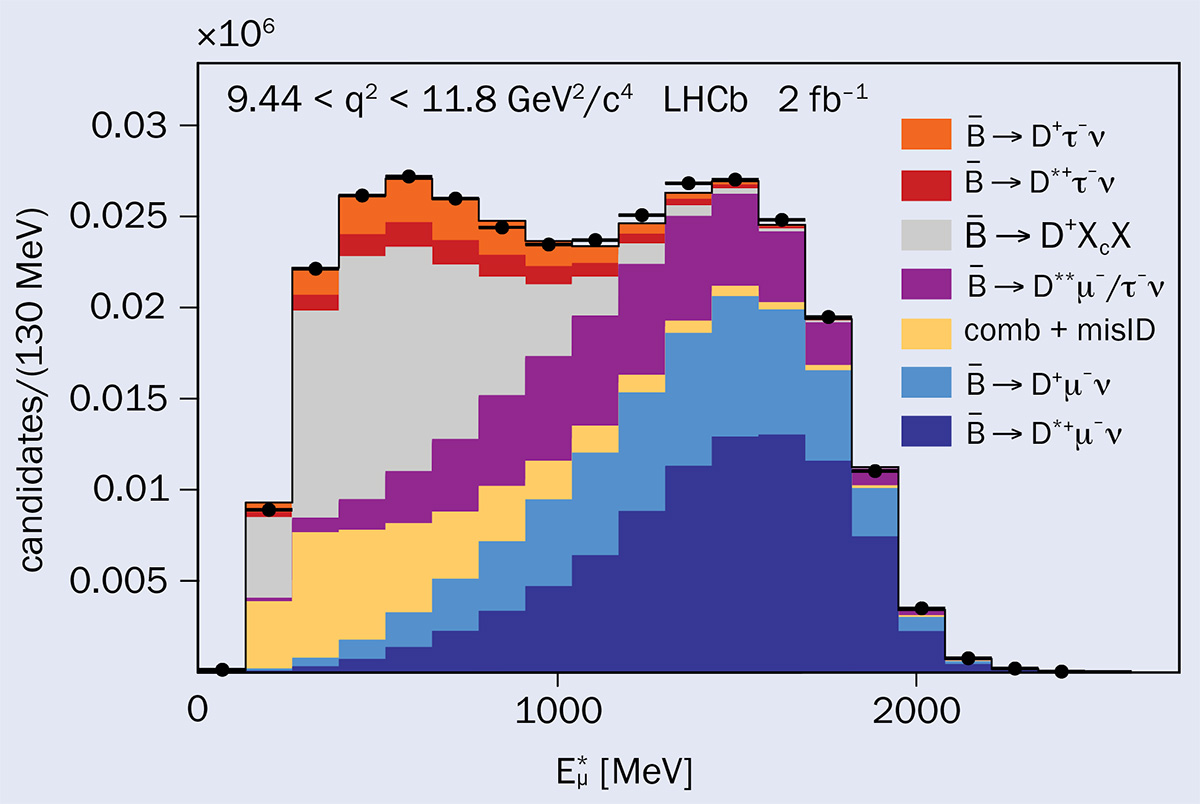
The control of the background contributions is particularly complicated in this analysis as the final state is not fully reconstructible, limiting the resolution on some of the discriminating variables. Instead, a three-dimensional template fit separates the signal and the normalisation from the background versus: the momentum transferred to the lepton pair (q2); the energy of the muon in the rest frame of the B meson (Eμ*); and the invariant mass missing from the visible system. Each contribution is modelled using a template histogram derived either from simulation or from selected control samples in data.

This constitutes the world’s second most precise measurement of R(D)

To prevent the simulated data sample size from becoming a limiting factor in the precision of the measurement, a fast tracker-only simulation technique was exploited for the first time in LHCb. Another novel aspect of this work is the use of the HAMMER software tool during the minimisation procedure of the likelihood fit, which enables a fast, but exact, variation of a template as a function of the decay-model parameters. This variation is important to allow the form factors of both the signal and normalisation channels to vary as the constraints derived from the predictions that use precise lattice calculations can have larger uncertainties than those obtained from the fit.

The fit projection over one of the discriminating variables is shown in figure 1, illustrating the complexity of the analysed data sample but nonetheless showcasing LHCb’s ability to distinguish the signal modes (red and orange) from the normalisation modes (two shades of blue) and background contributions.

The measured LFU ratios are in good agreement with the current world average and the predictions of the SM: R(D+) = 0.249 ± 0.043 (stat.) ± 0.047 (syst.) and R(D*+) = 0.402 ± 0.081(stat.) ± 0.085 (syst.). Under isospin symmetry assumptions, this constitutes the world’s second most precise measurement of R(D), following a 2019 measurement by the Belle collaboration. This analysis complements other ongoing efforts at LHCb and other experiments to test LFU across different decay channels. The precision of the measurements reported here is primarily limited by the size of the signal and control samples, so more precise measurements are expected with future LHCb datasets.

Rapid developments in precision predictions

High Precision for Hard Processes in Turin

Achieving a theoretical uncertainty of only a few per cent in the measurement of physical observables is a vastly challenging task in the complex environment of hadronic collisions. To keep pace with experimental observations at the LHC and elsewhere, precision computing has had to develop rapidly in recent years – efforts that have been monitored and driven by the biennial High Precision for Hard Processes (HP2) conference for almost two decades now. The latest edition attracted 120 participants to the University of Torino from 10 to 13 September 2024.

All speakers addressed the same basic question: how can we achieve the most precise theoretical description for a wide variety of scattering processes at colliders?

The recipe for precise prediction involves many ingredients, so the talks in Torino probed several research directions. Advanced methods for the calculation of scattering amplitudes were discussed, among others, by Stephen Jones (IPPP Durham). These methods can be applied to detailed high-order phenomenological calculations for QCD, electroweak processes and BSM physics, as illustrated by Ramona Groeber (Padua) and Eleni Vryonidou (Manchester). Progress in parton showers – a crucial tool to bridge amplitude calculations and experimental results – was presented by Silvia Ferrario Ravasio (CERN). Dedicated methods to deal with the delicate issue of infrared divergences in high-order cross-section calculations were reviewed by Chiara Signorile-Signorile (Max Planck Institute, Munich).

The Torino conference was dedicated to the memory of Stefano Catani, a towering figure in the field of high-energy physics, who suddenly passed away at the beginning of this year. Starting from the early 1980s, and for the whole of his career, Catani made groundbreaking contributions in every facet of HP2. He was an inspiration to a whole generation of physicists working in high-energy phenomenology. We remember him as a generous and kind person, and a scientist of great rigour and vision. He will be sorely missed.

AI treatments for stroke survivors

Data on strokes is plentiful but fragmented, making it difficult to exploit in data-driven treatment strategies. The toolbox of the high-energy physicist is well adapted to the task. To amplify CERN’s societal contributions through technological innovation, the Unleashing a Comprehensive, Holistic and Patient-Centric Stroke Management for a Better, Rapid, Advanced and Personalised Stroke Diagnosis, Treatment and Outcome Prediction (UMBRELLA) project – co-led by Vall d’Hebron Research Institute and Siemens Healthineers – was officially launched on 1 October 2024. The kickoff meeting in Barcelona, Spain, convened more than 20 partners, including Philips, AstraZeneca, KU Leuven and EATRIS. Backed by nearly €27 million from the EU’s Innovative Health Initiative and industry collaborators, the project aims to transform stroke care across Europe.

The meeting highlighted the urgent need to address stroke as a pressing health challenge in Europe. Each year, more than one million acute stroke cases occur in Europe, with nearly 10 million survivors facing long-term consequences. In 2017, the economic burden of stroke treatments was estimated to be €60 billion – a figure that continues to grow. UMBRELLA’s partners outlined their collective ambition to translate a vast and fragmented stroke data set into actionable care innovations through standardisation and integration.

UMBRELLA will utilise advanced digital technologies to develop AI-powered predictive models for stroke management. By standardising real-world stroke data and leveraging tools like imaging technologies, wearable devices and virtual rehabilitation platforms, UMBRELLA aims to refine every stage of care – from diagnosis to recovery. Based on post-stroke data, AI-driven insights will empower clinicians to uncover root causes of strokes, improve treatment precision and predict patient outcomes, reshaping how stroke care is delivered.

Central to this effort is the integration of CERN’s federated-learning platform, CAFEIN. A decentralised approach to training machine-learning algorithms without exchanging data, it was initiated thanks to seed funding from CERN’s knowledge transfer budget for the benefit of medical applications: now CAFEIN promises to enhance diagnosis, treatment and prevention strategies for stroke victims, ultimately saving countless lives. A main topic of the kickoff meeting was the development of the “U-platform” – a federated data ecosystem co-designed by Siemens Healthineers and CERN. Based on CAFEIN, the infrastructure will enable the secure and privacy preserving training of advanced AI algorithms for personalised stroke diagnostics, risk prediction and treatment decisions without sharing sensitive patient data between institutions. Building on CERN’s expertise, including its success in federated AI modelling for brain pathologies under the EU TRUST­roke project, the CAFEIN team is poised to handle the increasing complexity and scale of data sets required by UMBRELLA.

Beyond technological advancements, the UMBRELLA consortium discussed a plan to establish standardised protocols for acute stroke management, with an emphasis on integrating these protocols into European healthcare guidelines. By improving data collection and facilitating outcome predictions, these standards will particularly benefit patients in remote and underserved regions. The project also aims to advance research into the causes of strokes, a quarter of which remain undetermined – a statistic UMBRELLA seeks to change.

This ambitious initiative not only showcases CERN’s role in pioneering federated-learning technologies but also underscores the broader societal benefits brought by basic science. By pushing technologies beyond the state-of-the-art, CERN and other particle-physics laboratories have fuelled innovations that have an impact on our everyday lives. As UMBRELLA begins its journey, its success holds the potential to redefine stroke care, delivering life-saving advancements to millions and paving the way for a healthier, more equitable future.

Dark matter: evidence, theory and constraints

Dark Matter: Evidence, Theory and Constraints

Cold non-baryonic dark matter appears to make up 85% of the matter and 25% of the energy in our universe. However, we don’t yet know what it is. As the opening of many research proposals state, “The nature of dark matter is one of the major open questions in physics.”

The evidence for dark matter comes from astronomical and cosmological observations. Theoretical particle physics provides us with various well motivated candidates, such as weakly interacting massive particles (WIMPs), axions and primordial black holes. Each has different experimental and observational signatures and a wide range of searches are taking place. Dark-matter research spans a very broad range of topics and methods. This makes it a challenging research field to enter and master. Dark Matter: Evidence, Theory and Constraints by David Marsh, David Ellis and Viraf Mehta, the latest addition to the Princeton Series in Astrophysics, clearly presents the relevant essentials of all of these areas.

The book starts with a brief history of dark matter and some warm-up calculations involving units. Part one outlines the evidence for dark matter, on scales ranging from individual galaxies to the entire universe. It compactly summarises the essential background material, including cosmological perturbation theory.

Part two focuses on theories of dark matter. After an overview of the Standard Model of particle physics, it covers three candidates with very different motivations, properties and phenomenology: WIMPs, axions and primordial black holes. Part three then covers both direct and indirect searches for these candidates. I particularly like the schematic illustrations of experiments; they should be helpful for theorists who want to (and should!) understand the essentials of experimental searches.

The main content finishes with a brief overview of other dark-matter candidates. Some of these arguably merit more extensive coverage, in particular sterile neutrinos. The book ends with extensive recommendations for further reading, including textbooks, review papers and key research papers.

Dark-matter research spans a broad range of topics and methods, making it a challenging field to master

The one thing I would argue with is the claim in the introduction that dark matter has already been discovered. I agree with the authors that the evidence for dark matter is strong and currently cannot all be explained by modified gravity theories. However, given that all of the evidence for dark matter comes from its gravitational effects, I’m open to the possibility that our understanding of gravity is incorrect or incomplete. The authors are also more positive than I am about the prospects for dark-matter detection in the near future, claiming that we will soon know which dark-matter candidates exist “in the real pantheon of nature”. Optimism is a good thing, but this is a promise that dark-matter researchers (myself included…) have now been making for several decades.

The conversational writing style is engaging and easy to read. The annotation of equations with explanatory text is novel and helpful, and  the inclusion of numerous diagrams – simple and illustrative where possible and complex when called for – aids understanding. The attention to detail is impressive. I reviewed a draft copy for the publishers, and all of my comments and suggestions have been addressed in detail.

This book will be extremely useful to newcomers to the field, and I recommend it strongly to PhD students and undergraduate research students. It is particularly well suited as a companion to a lecture course, with numerous quizzes, problems and online materials, including numerical calculations and plots using Jupyter notebooks. It will also be useful to those who wish to broaden or extend their research interests, for instance to a different dark-matter candidate.

The B’s Ke+e–s

The Implications of LHCb measurements and future prospects workshop drew together more than 200 theorists and experimentalists from across the world to CERN from 23 to 25 October 2024. Patrick Koppenburg (Nikhef) began the meeting by looking back 10 years, when three and four sigma anomalies abounded: the inclusive/exclusive puzzles; the illuminatingly named P5′ observable; and the lepton-universality ratios for rare B decays. While LHCb measurements have mostly eliminated the anomalies seen in the lepton-universality ratios, many of the other anomalies persist – most notably, the corresponding branching fractions for rare B-meson decays still appear to be suppressed significantly below Standard Model (SM) theory predictions. Sara Celani (Heidelberg) reinforced this picture with new results for Bs → φμ+μ– and Bs → φe+e–, showing the continued importance of new-physics searches in these modes.

Changing flavour

The discussion on rare B decays continued in the session on flavour-changing neutral-currents. With new lattice-QCD results pinning down short-distance local hadronic contributions, the discussion focused on understanding the long-distance contributions arising from hadronic resonances and charm rescattering. Arianna Tinari (Zurich) and Martin Hoferichter (Bern) judged the latter not to be dramatic in magnitude. Lakshan Madhan (Cambridge) presented a new amplitude analysis in which the long and short-distance contributions are separated via the kinematic dependence of the decay amplitudes. New theo­retical analyses of the nonlocal form factors for B → K(*)μ+μ– and B → K(*)e+e– were representative of the workshop as a whole: truly the bee’s knees.

Another challenge to accurate theory predictions for rare decays, the widths of vector final states, snuck its way into the flavour-changing charged-currents session, where Luka Leskovec (Ljubljana) presented a comprehensive overview of lattice methods for decays to resonances. Leskovec’s optimistic outlook for semileptonic decays with two mesons in the final state stood in contrast to prospects for applying lattice methods to D-D mixing: such studies are currently limited to the SU(3)-flavour symmetric point of equal light-quark masses, explained Felix Erben (CERN), though he offered a glimmer of hope in the form of spectral reconstruction methods currently under development.

LHCb’s beauty and charm physics programme reported substantial progress. Novel techniques have been implemented in the most recent CP-violation studies, potentially leading to an impressive uncertainty of just 1° in future measurements of the CKM angle gamma. LHCb has recently placed a special emphasis on beauty and charm baryons, where the experiment offers unique capabilities to perform many interesting measurements ranging from CP violation to searches for very rare decays and their form factors. Going from three quarks to four and five, the spectroscopy session illustrated the rich and complex debate around tetraquark and pentaquark states with a big open discussion on the underlying structure of the 20 or so discovered at LHCb: which are bound states of quarks and which are simply meson molecules? (CERN Courier November/December 2024 p26 and p33.)

LHCb’s ability to do unique physics was further highlighted in the QCD, electroweak (EW) and exotica session, where the collaboration has shown the most recent publicly available measurement of the weak-mixing angle in conjunction with W/Z-boson production cross-sections and other EW observables. LHCb have put an emphasis on combined QCD + QED and effective-field-theory calculations, and the interplay between EW precision observables and new-physics effects in couplings to the third generation. By studying phase space inaccessible to any other experiment, a study of hypothetical dark photons decaying to electrons showed the LHCb experiment to be a unique environment for direct searches for long-lived and low-mass particles.

Attendees left the workshop with a fresh perspective

Parallel to Implications 2024, the inaugural LHCb Open Data and Ntuple Wizard Workshop, took place on 22 October as a satellite event, providing theorists and phenomenologists with a first look at a novel software application for on-demand access to custom ntuples from the experiment’s open data. The LHCb Ntupling Service will offer a step-by-step wizard for requesting custom ntuples and a dashboard to monitor the status of requests, communicate with the LHCb open data team and retrieve data. The beta version was released at the workshop in advance of the anticipated public release of the application in 2025, which promises open access to LHCb’s Run 2 dataset for the first time.

A recurring satellite event features lectures by theorists on topics following LHCb’s scientific output. This year, Simon Kuberski (CERN) and Saša Prelovšek (Ljubljana) took the audience on a guided tour through lattice QCD and spectroscopy.

With LHCb’s integrated luminosity in 2024 exceeding all previous years combined, excitement was heightened. Attendees left the workshop with a fresh perspective on how to approach the challenges faced by our community.

From spinors to supersymmetry

From Spinors to Supersymmetry

This text is a hefty volume of around 1000 pages describing the two-component formalism of spinors and its applications to particle physics, quantum field theory and supersymmetry. The authors of this volume, Herbi Dreiner, Howard Haber and Stephen Martin, are household names in the phenomenology of particle physics with many original contributions in the topics that are covered in the book. Haber is also well known at CERN as a co-author of the legendary Higgs Hunter’s Guide (Perseus Books, 1990), a book that most collider physicists of the pre and early LHC eras are very familiar with.

The book starts with a 250-page introduction (chapters one to five) to the Standard Model (SM), covering more or less the theory material that one finds in standard advanced textbooks. The emphasis is on the theoretical side, with no discussion on experimental results, providing a succinct discussion of topics ranging from how to obtain Feynman rules to anomaly-cancellation calculations. In chapter six, extensions of the SM are discussed, starting with the seesaw-extended SM, moving on to a very detailed exposition of the two-Higgs-doublet model and finishing with grand unification theories (GUTs).

The second part of the book (from chapter seven onwards) is about supersymmetry in general. It begins with an accessible introduction that is also applicable to other beyond-SM-physics scenarios. This gentle and very pedagogical pattern continues to chapter eight, before proceeding to a more demanding supersymmetry-algebra discussion in chapter nine. Superfields, supersymmetric radiative corrections and supersymmetry symmetry breaking, which are discussed in the subsequent chapters, are more advanced topics that will be of interest to specialists in these areas.

The third part (chapter 13 onwards) discusses realistic supersymmetric models starting from the minimal supersymmetric SM (MSSM). After some preliminaries, chapter 15 provides a general presentation of MSSM phenomenology, discussing signatures relevant for proton–proton and electron–positron collisions, as well as direct dark-matter searches. A short discussion on beyond-MSSM scenarios is given in chapter 16, including NMSSM, seesaw, GUTs and R-parity violating theories. Phenomenological implications, for example their impact on proton decay, are also discussed.

Part four includes basic Feynman diagram calculations in the SM and MSSM using two-component spinor formalism. Starting from very simple tree-level SM processes, like Bhabha scattering and Z-boson decays, it proceeds with tree-level supersymmetric processes, standard one-loop calculations and their supersymmetric counterparts, and Higgs-boson mass corrections. The presentation of this is very practical and useful for those who want to see how to perform easy calculations in SM or MSSM using two-component spinor formalism. The material is accessible and detailed enough to be used for teaching master’s or graduate-level students.

A valuable resource for all those who are interested in the extensions of the SM, especially if they include supersymmetry

The book finishes with almost 200 pages of appendices covering all sorts of useful topics, from notation to commonly used identity lists and group theory.

The book requires some familiarity with master’s-level particle-physics concepts, for example via Halzen and Martin’s Quarks and Leptons or Paganini’s Fundamentals of Particle Physics. Some familiarity with quantum field theory is helpful but not needed for large parts of the book. No effort is made to be brief: two-component spinor formalism is discussed in all its detail in a very pedagogic and clear way. Parts two and three are a significant enhancement to the well known A Supersymmetry Primer (arXiv:hep-ph/9709356), which is very popular among beginners to supersymmetry and written by Stephen Martin, one of authors of this volume. A rich collection of exercises is included in every chapter, and the appendix chapters are no exception to this.

Do not let the word supersymmetry in the title to fool you: even if you are not interested in supersymmetric extensions you can find a detailed exposition on two-component formalism for spinors, SM calculations with this formalism and a detailed discussion on how to design extensions of the scalar sector of the SM. Chapter three is particularly useful, describing in 54 pages how to get from the two-component to the four-component spinor formalism that is more familiar to many of us.

This is a book for advanced graduate students and researchers in particle-physics phenomenology, which nevertheless contains much that will be of interest to advanced physics students and particle-physics researchers in boththeory and experiment. This is because the size of the volume allows the authors to start from the basics and dwell in topics that most other books of that type cover in less detail, making them less accessible. I expect that Dreiner, Haber and Martin will become a valuable resource for all those who are interested in the extensions of the SM, especially if they include supersymmetry.

Intensely focused on physics

The High Luminosity Large Hadron Collider, edited by Oliver Brüning and Lucio Rossi, is a comprehensive review of an upgrade project designed to boost the total event statistics of CERN’s Large Hadron Collider (LHC) by nearly an order of magnitude. The LHC is the world’s largest and, in many respects, most performant particle accelerator. It may well represent the most complex infrastructure ever built for scientific research. The increase in event rate is achieved by higher beam intensities and smaller beam sizes at the collision points.

Brüning and Rossi’s book offers a comprehensive overview of this work across 31 chapters authored by more than 150 contributors. Due to the mentioned complexity of the HL-LHC, it is advisable to read the excellent introductory chapter first to obtain an overview on the various physics aspects, different components and project structure. After coverage of the physics case and the upgrades to the LHC experiments, the operational experiences with the LHC and its performance development are described.

The LHC’s upgrade is a significant project, as evidenced by the involvement of nine collaborating countries including China and the US, a materials budget that exceeds one billion Swiss Francs, more than 2200 years of integrated work, and the complexity of the physics and engineering. The safe operation of the enormous beam intensity represented a major challenge for the original LHC, and will be even more challenging with the upgraded beam parameters. For example, the instantaneous power carried by the circulating beam will be 7.6 TW, while the total beam energy is then 680 MJ – enough energy to boil two tonnes of water. Such numbers should be compared with the extremely low power density of 30 mW/cm3, which is sufficient to quench a superconducting magnet coil and interrupt the operation of the entire facility.

The book continues with descriptions of the two subsystems of greatest importance for the luminosity increase: the superconducting magnets and the RF systems including the crab cavities.

The High Luminosity Large Hadron Collider

Besides the increase in intensity, the primary factor for instantaneous luminosity gain is obtained by a reduction in beam size at the interaction points (IPs), partly through a smaller emittance but mainly through improved beam optics. This change results in a larger beam in the superconducting quadrupoles beside the IP. To accommodate the upgraded beam and to shield the magnet coils from radiation, the aperture of these magnets is increased by more than a factor of two to 150 mm. New quadrupoles have been developed, utilising the superconductor material Nb3Sn, allowing higher fields at the location of the coils. Further measures include the cancellation of the beam crossing angle during collision by dynamic tilting of the bunch orientation using the superconducting crab cavities that were designed for this special application in the LHC. The authors make fascinating observations, for example regarding the enhanced sensitivity to errors due to the extreme beam demagnification at the IPs: a typical relative error of 10–4 in the strength of the IP quadrupoles results in a significant distortion in beam optics, a so-called beta-beat of 7%.

Chapter eight describes the upgrade to the beam-collimation system, which is of particular importance for the safe operation of high-intensity beams. For ion collimation, halo particles are extracted most efficiently using collimators made from bent crystals.

The book continues with a description of the magnet-powering circuits. For the new superconducting magnets CERN is using “superconducting links” for the first time: cable sets made of a high-temperature superconductor that can carry enormous currents on many circuits in parallel in a small cross section; it suffices to cool them to temperatures of around 20 to 30K with gaseous helium by evaporating some of the liquid helium that is used for cooling the superconducting magnets in the accelerator.

Magnetic efforts

The next chapters cover machine protection, the interface with the detectors and the cryogenic system. Chapter 15 is dedicated to the effects of beam-induced stray radiation, in particular on electronics – an effect that has become quite important at high intensities in recent years. Another chapter covers the development of an 11 Tesla dipole magnet that was intended to replace a regular superconducting magnet, thereby gaining space for additional collimators in the arc of the ring. Despite considerable effort, this programme was eventually dropped from the project because the new magnet technology could not be mastered with the required reliability for routine operation; and, most importantly, alternative collimation solutions were identified.

Other chapters describe virtually all the remaining technical subsystems and beam-dynamics aspects of the collider, as well as the extensive test infrastructure required before installation in the LHC. A whole chapter is dedicated to high-field-magnet R&D – a field of utmost importance to the development of a next-generation hadron collider beyond the LHC.

Brüning and Rossi’s book will interest accelerator physicists in that it describes many outstanding beam-physics aspects of the HL-LHC. Engineers and readers with an interest in technology will also find many technical details on its subsystems.

bright-rec iop pub iop-science physcis connect