Researchers at the US Department of Energy’s Thomas Jefferson National Accelerator Facility (JLab) have produced first light from their 10 kW free-electron laser (FEL). This device has been upgraded from the “1 kW infrared demonstration” FEL that broke power records by delivering 2.1 kW of infrared light in 1999. Only one-and-a-half years after the 1 kW FEL was dismantled, the newly improved FEL, designed to produce 10 kW of infrared and 1 kW of ultraviolet light, is undergoing commissioning with the goal of producing 10 kW by the end of the summer.
As part of its mission to probe deep inside the atom’s nucleus with electrons, JLab has developed superconducting technology for accelerating electrons, and this offers two commanding cost advantages for FELs. The laser can stay on for 100% of the time instead of only 1% or 2%, and more than 90% of the energy that is not converted to useful light in a single pass can be recycled.
The FEL upgrade project is funded by the US Department of Defense’s Office of Naval Research (ONR), Air Force Research Laboratory and the Joint Technology Office. The navy’s interest in this technology is the development of an electrically driven tunable laser that can operate at infrared wavelengths, where light is most efficiently transmitted in the atmosphere. This would have potential applications in shipboard defence.
During the two-and-a-half years that the 1 kW FEL operated, it broke all existing power records for tunable high-average power lasers. It was used by more than 30 different research groups representing the navy, NASA, universities and industry for a variety of applications. These ranged from the investigation of new cost-effective methods for producing carbon nanotubes and understanding the dynamics of hydrogen defects in silicon, to investigating how proteins transport energy.
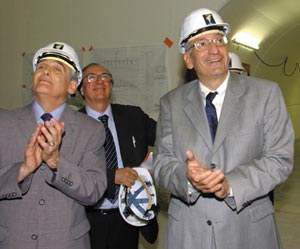
A new test stand for radio-frequency (RF) couplers is operating at the French Laboratoire de l’Accélérateur Linéaire (LAL, CNRS/IN2P3) in Orsay. The facility, which was constructed and equipped within the framework of a co-operation agreement between the IN2P3 and DESY, was officially inaugurated on 7 July, in the presence of Michel Spiro, director of the IN2P3, and Albrecht Wagner, chairman of the DESY Directorate. It includes a class 10 cleanroom, a vacuum furnace, a system for the production of ultra-clean water, and a 5 mW modulator/klystron ensemble. The test stand has been built for the preparation and conditioning of high-power RF couplers for the TESLA project.
The international TESLA collaboration currently comprises 49 institutes from 12 countries, which are working together under the leadership of DESY to develop the technology for a superconducting linear accelerator. This accelerator technology will provide the basis for two major projects: a free-electron laser for X-ray radiation (XFEL) that is to be built through European collaboration, and an electron-positron linear collider (TESLA), which is under study as an international project. The superconducting linear collider would require around 20,000 of the RF couplers being tested at Orsay. The same couplers would also be used on the X-ray free-electron laser. The first high-power tests of prototype couplers in Orsay began in early spring this year.
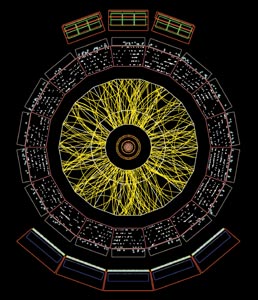
With the advent of Brookhaven’s RHIC, ultrarelativistic heavy-ion physics has entered a new era of collider experiments. This will continue at CERN with the Large Hadron Collider (LHC) experiments and in particular ALICE, which is dedicated to the study of heavy-ion physics. At the LHC the centre-of-mass energy will increase by a factor of about 30 relative to RHIC energies. In collisions of two lead nuclei at the LHC, the energy density is expected to be up to one order of magnitude higher than that reached at RHIC. As a consequence, strongly interacting matter is predicted to be well within the high-temperature QCD phase, where quarks and gluons are deconfined far above the phase transition point.
The recent results from Brookhaven show that at the energies accessible at RHIC it is possible to probe the dense nuclear matter produced in gold-gold collisions through hadron production at high transverse momentum. The observation of a strong attenuation in the production of high transverse-momentum particles indicates the presence of a very dense initial state through which high-momentum partons have to plough their way into the vacuum.
Heavy-ion collisions at the LHC will not only allow access to much higher energy density, they will also probe this dense matter with a larger variety of hadron production processes at an order of magnitude higher transverse momentum. This puts the LHC in a perfect position for a detailed characterization of the properties of hot and dense QCD matter, as discussed by many theorists working in the field at the recent workshop held at CERN on “Hard probes in heavy-ion collisions at the LHC”. ALICE will gain insight into both the physics of parton densities close to phase space saturation and the collective dynamical evolution of this dense nuclear environment. At LHC energies, the hard processes will contribute significantly to the total cross-section. The attenuation of the hard strongly interacting probes, which will be produced at sufficiently high rates, can be used to study the early stages of the collision. Weakly interacting probes will also become accessible and provide important benchmarks against which signals of the quark-gluon plasma can be searched for. The ratio of the lifetime of the quark-gluon plasma state to the time for thermalization is expected to be significantly larger than at RHIC, so that parton dynamics will dominate the expansion of the fireball and the collective features of the hadronic final state.
The ALICE collaboration of about 1000 physicists and engineers from about 80 institutes in 28 countries around the world has already entered the construction phase of the detector. The main challenge of the experiment is to cope with the highest particle multiplicities anticipated in the lead-lead collisions and measure up to 15,000 particles in the ALICE central detector. The construction of the main components of the detector is advancing well, and the experiment will be ready to take the first data with the start-up of the LHC in 2007.
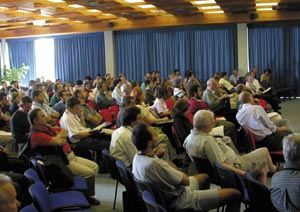
The final week of May saw the traditional gathering of the Frontier Detectors for Frontier Physics Conference (FD4FP) at the 9th Pisa Meeting on Advanced Detectors. The meeting was the sixth to be held on the island of Elba, and more than 300 participants – including physicists and representatives of the high-tech industries involved in the R&D of high-energy particle physics – discussed the latest results from the work that lies at the core of experimental particle physics: the design, building and running of particle detectors.
The 250 oral and poster contributions were divided among seven sessions covering different aspects of the field: calorimetry, tracking with solid-state devices, tracking with gaseous detectors, detectors for fundamental physics and astroparticle physics, front-end electronics, trigger and data acquisition, and particle identification. As has been the case for many years, a special session was also devoted to the application of particle detectors and particle-physics techniques to other fields.
The first day – opened by Lello Stefanini of Pisa, chairman of the FD4FP Executive Board, and Umberto Dosselli of Padova, on behalf of the International Advisory Committee – saw Richard Wigmans of Texas Technical summarize the current state of detector R&D. Wigmans stressed the growing importance of the use of particle detectors in other fields, first and foremost in astroparticle physics. This is a trend that is not only supplying different areas of research with new tools, but that also provides new challenges for detector builders. Guido Altarelli of CERN presented a clear view of the physics that lies ahead, that is, the basis for R&D in the field. Looking to the future, Les Robertson of CERN discussed the prospects and needs of computing in the era of the Large Hadron Collider (LHC), and also described the aims and status of the Grid. Rolf Heuer of Hamburg brought the audience up to date with worldwide initiatives and new ideas about the linear collider and how it can be established as a global project.
Whilst it is almost impossible to summarize a week full of presentations and discussions, and give proper recognition to everyone, a selection of the contributions should give a flavour of the topics discussed. For example, in the Gas Detectors session, Werner Riegler from CERN presented a detailed study of the behaviour of resistive plate chambers. By going back to the drawing board and slowly but carefully studying space charge effects, he showed how a suppression factor of 107 for the collected charge can be explained in these devices.
Talks on experiences with large solid-state detectors highlighted the obstacles to be overcome when running such devices. Contributions by BaBar and CDF showed that only ingenuity, dedication and a continuous R&D effort can provide “smooth” data taking, as the unexpected (to be understood as the “not thought of”) is always round the corner! As Brian Petersen of Stanford described, the excellent performance of the BaBar vertex detector is due to daily dedication as well as vigorous R&D. In this context, it was a pleasure to listen to William Ashmanskas of Chicago describe the excellent performance of the CDF trigger on secondary vertices – a device first presented at the Pisa Meeting in 1984. This provided an encouraging message for the LHC groups who are now building astonishingly large detectors that will shed light on the Higgs particle and other new physics.
R&D is the cornerstone on which detectors are built, and Valeri Saveliev of DESY/Obninsk State showed how continuous efforts in the field of solid-state photomultipliers is now paying off. Ready-to-use devices are now available and provide a new tool for the physics of the future.
The quest for detectors for the new generation of experiments (both ground and space based) for astroparticle physics has found a response in the particle-physics community. At Elba, several presentations tackled the complex issues of the deployment of large and elaborate devices both on Earth and in space. From the well-advanced AMS experiment to be installed on board the International Space Station, to the Auger Observatory being built and commissioned in Argentina, the techniques born in high-energy physics are being used to unveil the secrets of the universe. The search for gravitational waves requires much more than Newton’s apple, and those commissioning the large interferometers Ligo and Virgo are already thinking ahead, as described by Riccardo DeSalvo from Caltech.
While the use of results from particle physics in medicine is a well-established tradition that began with X-rays, participants in the large conference room of Hotel Hermitage had the chance to find out about aspects of the application of particle-physics techniques in other fields. Roberto Pani of Rome presented the efforts involved in the transfer of technology from high-energy physics to industry (the Italian “IMI Project”), while Jean-Marie Le Goff from CERN explained the basics of such efforts. On a lighter note, Carl Haber from LBL showed how metrology and pattern recognition, developed to build the ATLAS vertex detector, can provide the opportunity to listen to old, invaluable recordings that might otherwise be lost forever.
R&D on detectors would not be so fruitful without the involvement of industry. Representatives from high-tech firms all over the world displayed their products in individual stands throughout the week and discussed their current and future projects in plenary sessions as well as private conversations.
For those who were unable to attend the conference, a live webcast was available and this can still be seen on the website at www.pi.infn.it/pm/2003, along with the full conference programme.
Mozambique was the host to an extraordinary event in July involving African heads of state, leading medical experts and major funding agencies for health and development. Uniquely, this interaction was part of a special session of the summit of the African Union, and the participants spoke from different venues around the world via communication technologies.
The incoming president of the African Union, President Chissano of Mozambique, presided over the conference, which saw African heads of state interacting with key stakeholders, including the World Health Organization (WHO), the World Bank, the UK Department for International Development, the US government and the Gates Foundation. This is the first time that heads of state have opened their doors to the world in such a way as a formal part of any international summit. The African Union showed tremendous initiative in leading the way on this, and the technology facilitated it in a way that increased the interaction and input from the major international agencies.
Mozambique also demonstrated its technological capacity to host such an event, using ISDN, several satellite systems and digital radio to link the summit, which was held in the capital Maputo, with 22 African nations, Geneva, London, New York, Washington, DC, and Dublin, via videoconference. Graça Machel moderated the discussion from Maputo. The Interactive Health Network organized the event, which was also broadcast around the world on the Web, radio and television. CERN participated with the WHO from Geneva, where CERN’s Manjit Dosanjh was in the chair.
The outcome of this unique combination of technology was a highly interactive session that resulted in a new declaration on the role of African states in combating HIV, malaria and tuberculosis. The Prime Minister of Mozambique, Pascoal Mocumbi, Peter Piot of UNAIDS and African heads of state representing each region, all gave key addresses on this important topic. President Olusegun Obasanjo of Nigeria outlined the role of the New Partnership for Africa’s Development (NEPAD), and President Yoweri Museveni of Uganda spoke of his country’s approach to reducing the incidence of HIV. The session showed a new way forward for governance and global interaction in setting policy for the critical issues in health and development.
As a follow up to this event, the Interactive Health Network and the International eHealth Association are collaborating with CERN in an effort to establish a pan-African health communications network for HIV, malaria and tuberculosis, with awareness, education, research, clinical care and effective policy implementation as central goals.
I see three key elements in this network. First, it should provide access to essential information on best practice and evidence-based medicine. International agencies currently rely mainly on information generated outside of Africa in making decisions. However, evidence-based practice in other countries does not necessarily apply to Africa. Exchange of information must occur between health professionals within Africa to ensure that the best information is available and used appropriately. This will require a unique integration of education, research and point-of-care access, with communication between researchers and clinicians that maximizes the experience of patients and clinicians working in their own environment in Africa.
A second key element is the prevention of illness through effective communication. The most effective public health initiatives so far have been led by Africans promoting measures to reduce the rate of infection at the grass-roots level. The Ugandan approach to the HIV epidemic is one such example. Radio, television and satellite can all be effective means of transmitting essential public health messages, giving communities the education they need to help themselves.
Thirdly, the network must facilitate meaningful policy making by empowering leaders. Policy makers and leaders can only make decisions based on the information available to them. Familiarity with the experiences of other healthcare systems can help avoid repeating the mistakes of others. Transparency and effective leadership are thus inseparable, and can be promoted through effective communications.
Africa has a unique opportunity to “leap-frog” its policies with respect to information and communication technologies (ICTs). It has the potential to benefit more than any other region from innovative ICT use in health. There are many underutilized networks in Africa that can make ICTs available in even the most remote areas, and their use can help to achieve health equity in Africa.
•CERN will host a conference in December to discuss the potential uses for ICTs in health and other fields. Co-organized by ICSU, TWAS and UNESCO, the Role of Science in the Information Society will precede the World Summit on the Information Society, as a side event to the summit.
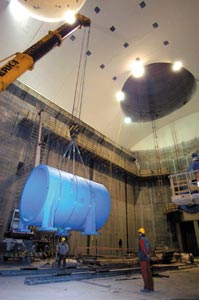
The ATLAS cavern has become the first new experimental cavern for the Large Hadron Collider (LHC) to be handed over to CERN by civil-engineering contractors. On 4 June, this important milestone on the road to the planned start-up of the LHC in 2007 was celebrated in an official inauguration ceremony attended by Pascal Couchepin, president of the Swiss Confederation.
Some 35 m wide, 55 m long and 40 m high, the ATLAS cavern is literally the size of a cathedral – the nave of Canterbury Cathedral in the UK would fit neatly inside. Excavation of the cavern began in 2000 and has pushed civil engineering to new limits.
Once the top part of the cavern had been excavated, it was concreted and the resulting vault suspended from 38 steel cables anchored in galleries 25 m above.
Excavation of the remaining 28 m depth was then resumed and completed by the end of April 2002. The cavern has since been lined with concrete and services such as electricity, ventilation and water have been installed. The handover of the cavern to CERN signals the beginning of the installation of the 44 m long, 22 m high ATLAS detector, with the first components set to be lowered into the cavern later this year.
On 20 June, in its 125th session, the CERN Council received confirmation that the LHC and its detectors are on schedule for start-up in 2007, and that the LHC Computing Grid (LCG) project is about to reach a major milestone. CERN’s director-general, Luciano Maiani, presented a comprehensive review of the status of the LHC project, which he underlined by saying that management is more committed than ever to the current LHC schedule. Maiani said that the major difficulties with the accelerator and detectors have been resolved, and that there is now a clear path to the project’s completion. “All of the problems we encountered in 2002 have been overcome,” he said, “although there remain hurdles to overcome, there is no showstopper. We can confirm with fewer reservations than last year that the LHC will start-up in spring 2007.”
Maiani also drew attention to the LCG project, which will make an important step forward in distributed computing technology on 1 July when it deploys an operational computing Grid for the LHC. Negotiations are also underway with the European Union for the “Enabling Grids for E-science in Europe” (EGEE) project, which aims to create a Europe-wide Grid infrastructure by combining the many Grid initiatives across the continent.
The Council also heard from Robert Aymar, CERN’s director-general elect, who presented his proposal for a new organizational structure for the laboratory. His plans are based on a recommendation by the External Review Committee that he chaired in 2001 and 2002. The new structure is intended to ensure continuity and build on existing strengths at CERN, while at the same time implementing changes at the higher levels appropriate to CERN’s current objectives. The main features of the new structure are short lines of management and a restricted directorate consisting of the director-general (Aymar), a chief scientific officer, with the functions of deputy director-general, and a chief financial officer. Jos Engelen, currently director of NIKHEF, has been named as the chief scientific officer. CERN’s current divisions will be regrouped into a smaller number of departments, while functions including safety, technology transfer and public communication will be moved into the director-general’s office.
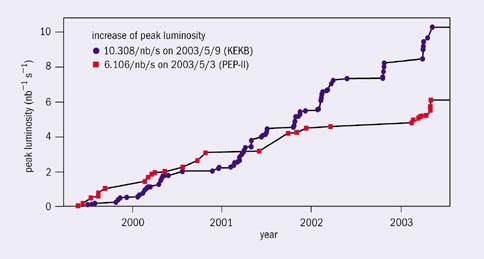
On 9 May, the KEKB accelerator achieved a major breakthrough by being the first colliding-beam facility to reach a peak luminosity above 1034 cm-2 s-1, a long-sought milestone in accelerator physics. This accomplishment will boost KEK’s programme of investigating CP violation and searching for beyond-the-Standard-Model effects in the Bbar-B system. Almost all such studies require the largest possible samples of B-meson pairs, so the single most important factor in their success is high luminosity. A luminosity of 1034 cm-2 s-1 corresponds to a B-meson pair production rate of 10 per second, and under normal operating conditions this would yield approximately 100 million B-meson pairs per calendar year.
In order to increase the luminosity, the intensity of both the electron and positron beams must be increased, and each must be squeezed to the smallest possible size. Achieving these two conditions simultaneously presents a severe technological challenge to the accelerator design team. To tackle these problems, the KEKB group, which started construction of their machine in 1994, incorporated a number of new technologies. Among them are finite-angle crossing for the collision region, a lattice design with a 2.5 π phase advance per cell, superconducting RF cavities that can tolerate large beam currents, and normal RF cavities coupled with attachments that have 10 times more energy-storage capacity than the accelerating cavity proper (called ARES cavities). The luminosity target set for KEKB at the outset was 1034 cm-2 s-1, which at the time was considered by many to be an unrealistically ambitious goal.
The commissioning of KEKB was reasonably smooth, with the luminosity reaching 20% of its design value in one and a half years. This was already highly successful in comparison with many past accelerator projects, where progress in the early stages could be laboriously slow. KEKB’s luminosity has steadily increased ever since, as the KEKB team have worked to solve the many problems they have encountered along the way.
Three categories of problems have been the most persistent and difficult to overcome. The first class of problems is related to the high beam currents. KEKB has frequently experienced serious trouble such as the breakdown and heating of the vacuum components. Vacuum chambers in the interaction region and beam abort sections, movable masks (for removing beam tails) and bellows, etc, were broken several times due to higher order mode (HOM) power from the beams, synchrotron radiation, or simply being hit by the beams themselves. The KEKB team solved these problems one by one, by developing revised versions of the components, reinforcing the cooling power and protection mechanisms, and by taking other counter-measures.
The second category of problems was a nagging blowup of the positron beam, believed to be caused by a photoelectron cloud. In the end, the KEKB team covered 2300 m (more than 90% of the free region) along the 3000 m positron ring with a solenoid winding that was designed to produce a small axial magnetic field to disperse the cloud.
The third problem category was beam blowup due to the beam-beam effect. This is a well known and common problem in colliding beam accelerators, and a huge amount of effort has been devoted since the design phase of KEKB to mitigate this blowup. The most important progress at KEKB on this issue is a special choice of betatron tunes. It turned out that making the horizontal tunes of both rings approach half-integer resonance was very effective in raising the luminosity. This effect is explained as a dynamic focusing effect by the beam-beam interaction, and is well reproduced by the beam-beam simulations. To enable this very close approach to the half-integer resonance, corrections for machine errors were crucially important.
Reaching the 1034 design luminosity in four years is a remarkable achievement. KEKB operates with 1284 bunches in both electron and positron rings, with averaged bunch spacing of 3.77 RF buckets. The currents are 1.5 and 1.1 A for the positron and electron beams, respectively, and these correspond to 58 and 100% of the design currents. Vertical beta functions at the interaction point are 5.8 and 7 mm for the positron and electron rings, respectively, which are even smaller than the design value of 10 mm. The vertical beam-beam parameters are 0.066 and 0.050 for the positron and electron beams, respectively, which are very close to (or higher than) the design value of 0.052. The fractional part of the horizontal tunes are 0.506 and 0.513 for the positron and electron beams, respectively.
The remarkable success of the KEKB project is an indication of not only the highest level of achievement in KEK’s accelerator technology, but also of the highest levels in numerous branches of industry that support KEK. The experience gained in the KEKB project will be of great value in the development of a future linear collider.
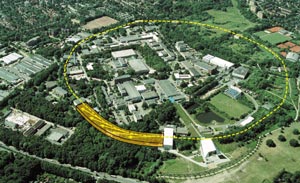
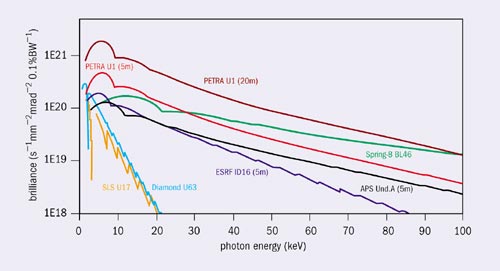
DESY is to convert its storage ring PETRA into one of the most modern third-generation X-ray sources in the world. “PETRA III” is expected to provide the highest brilliance of any storage ring-based X-ray source until the first linac-driven sources begin operating.
At present, more than 2000 physicists, chemists, biologists, geologists, and researchers working in the fields of materials science or life sciences, use the facilities at DESY’s Hamburg Synchrotron Radiation Laboratory, HASYLAB, for experiments with soft and hard X-ray radiation in basic and applied research. As a second-generation synchrotron radiation source, however, DESY’s current “workhorse”, DORIS III, is not comparable in terms of brilliance with modern third-generation hard X-ray sources such as the ESRF in Grenoble, APS in Argonne or Spring-8 in Japan. In order to remain competitive in the synchrotron radiation sector, DESY has therefore decided to convert PETRA as soon as the HERA physics programme is completed, from 2007 onwards.
PETRA was successfully used for particle physics from 1978 to 1986, and since then, as PETRA II, it has been part of the injector chain for DESY’s HERA collider. In addition, it also supplies intense X-ray light from one undulator to three experimental test stations. The upgrade of PETRA will require the total rebuilding of one-eighth of the storage ring to provide the electron-beam optics for nine straight sections, each of which will offer space for one 5 m long or two 2 m long insertion devices – “wiggler” and “undulator” magnets in which synchrotron radiation of high brilliance will be generated. Depending on the exact outline of the beamlines, about 13 experimental stations with independently tunable insertion devices will become available.
A positron energy of 6 GeV is currently predicted, with a beam current of at least 100 mA. This means that the energy of the synchrotron radiation photons will reach up to more than 100 keV. The installation of a number of damping wigglers, with a total length of 100 m in the empty long straight sections of the storage ring, will allow the upgraded facility to provide an emittance as small as 1 nm rad. Such a small emittance is essential for the generation of highly brilliant high-energy photons in arrangements of undulator magnets. Compared with a number of other synchrotron radiation storage rings, an upgraded PETRA storage ring with damping wigglers offers the best basis for a low-emittance, high-brilliance synchrotron radiation source at higher particle energies. Only the “Ultimate Storage Ring” study carried out by the ESRF machine group, which describes an ideal storage ring-based light source and energy recovery linac-driven sources at high particle energies will be able to provide smaller emittances.
To ensure reliable machine operation and a beam lifetime limited only by intrinsic positron beam parameters, PETRA’s existing vacuum system and a large portion of the infrastructure have to be replaced, and planning for a detailed layout of the new experimental hall is currently underway. The German federal government approved the PETRA upgrade project in February 2003 and agreed to finance it with €120 million. A formal proposal for the upgrade will be completed by the end of 2003, after the input of a series of workshops with potential users, so that reconstruction can begin as planned in January 2007.
On 5 May, four “naked” high-purity germanium detectors were installed in liquid nitrogen in the GENIUS Test Facility (GENIUS-TF) at the Gran Sasso Underground Laboratory. This is the first time this novel technique for background reduction in searches for rare decays is being tested under realistic background conditions.
The goal of the GENIUS-TF, led by Hans Volker Klapdor-Kleingrothaus of Heidelberg, is to test detector techniques for the GENIUS project, which will search with extreme sensitivity for cold dark matter, double beta decay and low-energy solar neutrinos. In its dark-matter version, GENIUS will operate 40 naked germanium crystals (100 kg) in a 12 x 12 m tank of liquid nitrogen.
In the test facility the naked crystals sit on a plate made from a special type of Teflon, within a thin-walled copper box filled with 70 litres of purified liquid nitrogen. The copper is thermally shielded by 20 cm of special low-activity Styropor, surrounded by a 15 tonne shield of electrolytic copper (10 cm thick) and 35 tonnes of lead (20 cm thick). The complete set-up has a neutron shield of 10 cm boronpolyethylene. A digital data acquisition system allows the simultaneous measurement of energy, pulse shapes and other parameters of individual events.
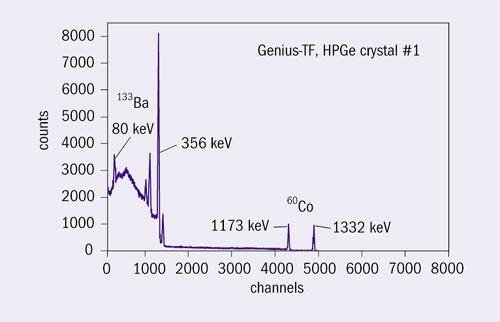
On the day they were installed, the four detectors – a total of 10 kg of high-purity natural germanium – were tested with radioactive sources of 60Co and 228Th. They showed good energy resolution and it was found that microphonics in the liquid nitrogen is not a problem.
Besides testing construction parameters, one of the first goals of GENIUS-TF will be to investigate the signal of cold dark matter reported by the DAMA collaboration in 1999, which could originate from the modulation of the WIMP flux by the motion of the Earth relative to the Sun.
To provide the best experiences, we use technologies like cookies to store and/or access device information. Consenting to these technologies will allow us to process data such as browsing behavior or unique IDs on this site. Not consenting or withdrawing consent, may adversely affect certain features and functions.
Functional
Always active
The technical storage or access is strictly necessary for the legitimate purpose of enabling the use of a specific service explicitly requested by the subscriber or user, or for the sole purpose of carrying out the transmission of a communication over an electronic communications network.
Preferences
The technical storage or access is necessary for the legitimate purpose of storing preferences that are not requested by the subscriber or user.
Statistics
The technical storage or access that is used exclusively for statistical purposes.The technical storage or access that is used exclusively for anonymous statistical purposes. Without a subpoena, voluntary compliance on the part of your Internet Service Provider, or additional records from a third party, information stored or retrieved for this purpose alone cannot usually be used to identify you.
Marketing
The technical storage or access is required to create user profiles to send advertising, or to track the user on a website or across several websites for similar marketing purposes.