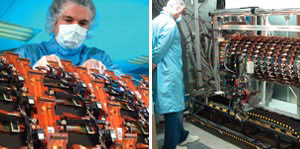
Particle physicists in the UK have completed the first critical element of the largest semiconductor tracker ever built, the ATLAS SCT, which is to form the innermost core of the giant detector that will operate at CERN’s Large Hadron Collider (LHC). The SCT will track charged particles to an accuracy of better than 20 μm over its diameter of 1 m. In all, more than 200 physicists and engineers from 12 countries have taken 10 years to bring the project to this stage.
The ATLAS SCT consists of 60 m2 of silicon detectors in the form of four concentric barrels and two end-caps. Each of the four barrels is tiled with hundreds of silicon detector modules measuring about 6 x 12 cm, 710 of which were built by a collaboration involving the Rutherford Appleton Laboratory (RAL), the Universities of Birmingham and Cambridge, UK, and Queen Mary College, London. The remaining modules have been provided by similar collaborations in Japan, the US and Scandinavia. All four barrels of the SCT are being assembled in the UK using components from a total of 37 institutes worldwide.
The first completed barrel has now been populated with all of its 384 silicon modules. Each module contains four silicon wafers mounted on a thermal pyrolytic graphite baseboard with a flexible circuit hybrid strip containing 12 application-specific integrated circuits. The three outer barrels will carry progressively more modules, with the fourth and final barrel containing 672 silicon modules. Overall, the SCT is divided into 6 million channels and every channel has its own amplifier and data buffer.
The fabrication of the ATLAS barrel modules has been a technically challenging project. The very stringent mechanical, thermal and electrical performance demanded by the ATLAS physics programme is already tough, but on top of that the modules will have to survive in a very-high-radiation environment at -10 °C for 10 years, providing continuous operation without failure. The team at RAL has been working in purpose-built cleanrooms, with separate areas for the construction of the mechanical components, for the state-of-the-art bonding facility where the components are integrated, and for electrical test and characterization. The completed modules are then sent from RAL to collaborating UK universities for burn-in testing, and finally to Oxford for mounting onto the barrel.
The UK team has also been working on the barrel structure. These lightweight structures were built in Germany and came to RAL via the University of Geneva. At RAL, the electrical services, optical read-out fibres, custom bi-phase cooling circuits and alignment systems are added to each barrel. The barrels are then sent to Oxford in custom refrigerated transporters where the modules are mounted onto the barrels with remarkable accuracy.
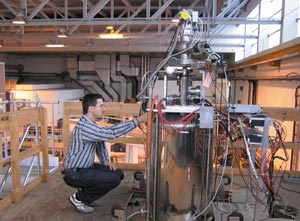
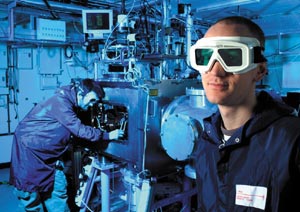
After the venerable Cooler Ring at the Indiana University Cyclotron Facility (IUCF) passed on to accelerator heaven in autumn 2002, the polarized beam team, led by Alan Krisch, crossed the Atlantic to continue their spin-manipulation work at COSY, the cooler synchrotron at the Forschungszentrum in Jülich (figure 1). As part of the SPIN@COSY collaboration, they have been improving the polarization capabilities of the 3.5 GeV/c proton and deuteron storage ring.
Recently, the collaboration – from Michigan and Brookhaven in America, COSY, Bonn and Hamburg in Germany, and KEK and J-PARC in Japan – has used a new ferrite RF-dipole magnet to flip the spins of stored 2.1 GeV/c protons with almost no polarization loss.
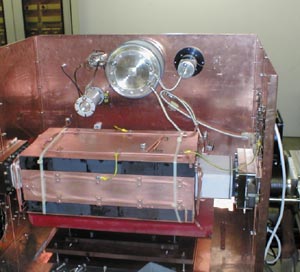
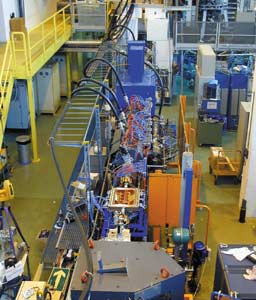
The ferrite-core water-cooled RF-dipole (figure 2) was designed and built by Maria Leonova, a graduate student at Michigan, and Alexander Schnase, a COSY/J-PARC electrical engineer. It was coupled to a sophisticated RF high-voltage supply to form a highly tuned L-C circuit, which produced a transverse RF magnetic-field integral of about 1.5 Tmm peak-to-peak.
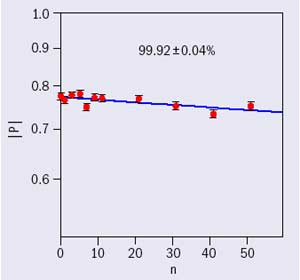
This gave a higher spin flip efficiency (99.92 ± 0.04%) than the air-core RF-dipole used for the spin-flipping of polarized deuterons and protons during SPIN@COSY’s first runs in February and April 2003. The total polarization loss was only about 3% after 51 spin flips (figure 3), which allows many spin-flips of polarized proton or electron beams while they are stored for billions of turns.
This spin-flipping would greatly reduce almost all systematic errors in spin asymmetry experiments, which is very important for scattering experiments in storage rings with stored polarized beams, such as Brookhaven’s Relativistic Heavy Ion Collider (RHIC), HERA at DESY, COSY and the MIT-Bates facility in Massachusetts.
Combining an earlier IUCF spin-flipping experiment at 489 MeV/c with this higher-energy 2.1 GeV/c experiment at COSY leads to a “prediction” that a slightly stronger RF-dipole magnet – only about 35% stronger than the small RF dipole used already – should give at least the same 99.92% spin-flip efficiency to the polarized protons stored in the 100-250 GeV RHIC and perhaps someday in Japan’s 50 GeV J-PARC facility and CERN’s 7 TeV Large Hadron Collider. This is because the spin-flipping strength of a transverse RF-dipole is almost invariant under the Lorentz transformation from an accelerator’s stationary frame to the highly relativistic rest frame of each beam proton, where each proton’s spin observes the RF-dipole’s strength, which controls the efficiency of the spin-flips.
As an observer state of CERN, India is collaborating in many aspects of the Large Hadron Collider (LHC) project – building components of the accelerator as well as constructing detectors for various experiments. In the ALICE experiment, India is participating in the forward di-muon spectrometer (FMS) and in particular has responsibility for the design, fabrication and supply of the custom VLSI chip required for the spectrometer’s front-end electronics.
ALICE will study lead ion collisions at the LHC, where the production of the heavy quarkonia, such as the upsilon and its excited states, is expected to be suppressed. This is regarded as one of the strongest signals for the formation of a quark-gluon plasma.
Here, the yields of the upsilons will be measured by detecting their decays to two muons and determining the momenta of the muons though their bending in the field of a dipole magnet. The upsilon resonances will show up as “peaks” in the reconstructed invariant mass spectrum over a background of various other sources.
The tracks of the muons through the magnetic field will be measured in the FMS by a set of multiwire proportional chambers with finely segmented cathode pads. Muons passing through the detectors will produce signals on these pads, and their tracks will be reconstructed from a measurement by the front-end electronics of the charges deposited on the pads. Because of the high packing density and low noise required of the electronics readout, it is essential that the front-end electronics is realized in form of a custom-designed VLSI chip – the MANAS (Multiple Analog Signal processor).
The design of the MANAS chip, based on the GASSIPLEX chip developed by Jean Claude Santiard at CERN, started in late 1997 at the Saha Institute of Nuclear Physics (SINP), Kolkata, and a memorandum of understanding was signed between SINP and Semiconductor Complex Ltd (SCL), Chandigarh, for the fabrication of the chip. Inside this chip, the signal from the detector is amplified by a charge-sensitive amplifier, processed by a deconvolution filter and shaping amplifier, tracked and stored, then finally read out via a multiplexer.
The final set of masks for fabrication of the MANAS-1.2-1 prototype was released by Bikash Sinha, SINP, in October 1999 and the first prototype ceramic packaged chips were delivered by SCL in March 2000. Extensive bench tests at SINP and CERN on the prototype chips were performed, followed by a beam test of the chip, mounted on a prototype detector for the second of the tracking stations (developed and fabricated at SINP) and exposed to a 7 GeV proton beam.
The results of these bench tests showed that the first prototype satisfied most of the design criteria. Two modified iterations of the design then corrected the problems found in the first prototype.
By January 2002, 1500 pre-production chips, MANAS-1.2-3, were sent to several institutes collaborating in the ALICE FMS for more extensive tests, both in the lab and in test beams. The main features of this state-of-the-art chip are the low noise level (640 electrons rms), small gain fluctuations, large dynamic range (500 to -275 fC), radiation tolerance and the low sensitivity of parameters to temperature variations.
The production readiness review for the MANAS chip was held in October 2003, and was based on results from various laboratories. More than 100 000 chips will be delivered by January 2005, after stringent quality and performance tests by the foundry, SCL in Chandigarh.
The MANAS chip is a definite success story for R&D and fabrication for high-technology VLSI development in India. It has already initiated more R&D activity in VLSI technology in India, and a large number of useful applications are being planned, including accurate image processing.
The atomic mass of a nucleus is important in a wide range of physics, as it conveys information on the nuclear binding energy. It is a unique property of each of the more than 3000 known nuclides. Now, experiments at ISOLTRAP at CERN’s ISOLDE facility have reached a level of precision where the mass measurements for extremely short-lived radionuclides are significant for fundamental studies that touch upon the very foundations of the Standard Model. Two recently published sets of measurements on neutron-deficient magnesium and rubidium nuclides concern the conserved-vector-current hypothesis of the weak interaction and the unitarity of the Cabibbo-Kobayashi-Maskawa (CKM) quark-mixing matrix.
According to the quantum-field theory of the electroweak interaction, the weak interaction has two components, a vector and an axial-vector part. In a manner analogous to electromagnetism, currents can be associated with each of these components, and the vector current is exactly conserved. This postulate is equivalent to the statement that the weak force is not influenced by the strong force and that the weak vector coupling constant is thus truly constant.
By careful choice of a particular weak decay whose initial and final states respect certain selection rules (so-called superallowed decays), the vector part of the interaction can be studied selectively. Within this subclass of decays, the nuclear matrix element depends only on the isospin, so a comparison of the Ft values (also called comparative half-lives) allows a direct comparison of the vector coupling constant.
An experimental value for the comparative half-life of a decay can be deduced from high-precision measurements of its atomic mass and its partial half-life
An experimental value for the comparative half-life of a decay can be deduced from high-precision measurements of its atomic mass and its partial half-life. In order to obtain truly comparable quantities, two small calculated corrections must also be taken into account. These describe radiative and spin flip effects, as well as a lack of overlap between the decaying nucleon and its daughter.
The mean of the Ft values of all decay pairs with the same isospin, together with the fundamental vector coupling constant from muon decay, can furthermore be used to calculate the first element Vud of the CKM matrix. Using this value, the most precise determination of Vud available today, the unitarity test of the quark mixing matrix currently fails by two standard deviations.
The ISOLTRAP experiment at ISOLDE is at the forefront of a new class of experiments that perform mass measurements on trapped exotic nuclides using the time-of-flight cyclotron resonance technique. For this purpose, a beam of radionuclides produced and mass-separated with ISOLDE is first accumulated and bunched. The ions are then mass-selectively cooled, before the mass of the radionuclides is measured via the cyclotron frequency in a precision Penning trap.
Now a team from Germany, France, the US and Canada has measured the masses of 74Rb and 74Kr as well as 22Mg and 22Na with unprecedented precision, ranging from 6 x 10⁻⁸ for the very short-lived 74Rb (T½=65 ms) to 1 x 10⁻⁸ for 22Na (T½=2.6 y) (Kellerbauer et al. 2004, Mukherjee et al. 2004). 74Rb is the shortest-lived radionuclide that has ever been studied in a Penning trap. The comparative half-lives obtained for the superallowed decays of 74Rb and 22Mg agree well with the previously known Ft values, thus confirming the CVC hypothesis in this new mass region and for isospin projection Tz=-1, respectively. However, improved calculations of one of the theoretical corrections (74Rb) and more precise measurements of the partial half-life (22Mg) are required before these data can have an impact on the test of CKM unitarity.
If you can look into the seeds of time,
And say which grain will grow and which will not… Macbeth I, 3
Experiments with radioactive beams are attracting a great deal of interest these days. In the US, a radioactive-beam facility – the Rare Isotope Accelerator (RIA) – has been approved as one of the top-priority projects in physics for new construction. In Europe, there are several new projects that are well advanced in securing funding, such as SPIRAL 2 in France and the Facility for Antiproton and Ion Research (FAIR) in Germany. In the next decade, a high-intensity installation called EURISOL could become a powerful successor to CERN’s ISOLDE (Isotope Separator On Line).
In the year of CERN’s 50th anniversary, it is interesting that the field had its beginnings at the organization 40 years ago. Even earlier, an experiment carried out at Niels Bohr’s Institute in Copenhagen in 1951 had proved the feasibility of connecting an electromagnetic isotope separator to a cyclotron. Its scientific aims lay primarily with neutrino physics, but a decade later it was becoming clear that the same technique would allow an attack on the problem of unstable nuclei with very short lifetimes, which were predicted theoretically. It was also clear that this would require a major effort. During 1963-64, CERN’s director-general, Victor Weisskopf, consulted leading European nuclear physicists, and early in 1964 he issued a call for proposals for nuclear experiments at CERN’s 600 MeV Synchrocyclotron (SC).
There was already an informal European network active in the areas of isotope separators and nuclear structure, and within this a collaboration emerged to prepare a proposal for studying unstable nuclei. Among its prominent members in the early phase were René Bernas (Orsay), Wolfgang Gentner (Heidelberg), Karl Ove Nielsen (Aarhus), Alexis C Pappas (Oslo) and Goesta Rudstam (Uppsala). Later the same year, a proposal prepared by the collaboration was presented to Weisskopf, and on 17 December 1964 he invited the groups to go forward with the proposed programme.
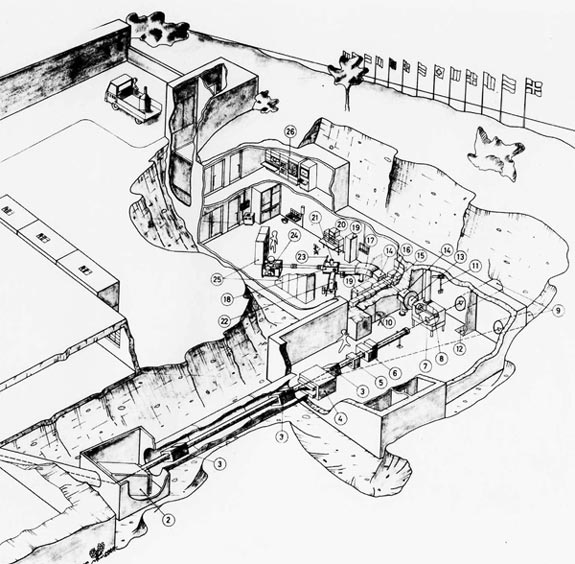
On 16 October 1967, the first experiments were carried out at ISOLDE. The experimental arrangement that had emerged from the collaboration’s interactions with the leaders of the SC Division, Giorgio Brianti and Ernst Michaelis, is shown in figure 1. An important and far-sighted feature of the design was that the extracted proton beam was taken to a shielded area approximately 6 m below ground in order to reduce the external radiation levels, although this increased the construction costs considerably. Without this feature, it would have been impossible for ISOLDE to make use of the 100 times stronger beam that became available after the SC Improvement Programme (SCIP) in 1973-74.
The SC closed in the early 1990s, and the ISOLDE facility moved to the PS Booster where, at the time, there was sufficient capacity to enable operation with an average of 2 μA of protons at 1 and 1.4 GeV. The pulsed proton beam from the PS Booster initially caused major concerns, as many target types deteriorated quickly owing to the high instantaneous beam power. Technical improvements and inventions would eventually help to overcome these problems, turning the pulsed beam into a unique feature for release measurements of radioactive species from the targets and for physics that could benefit from a semi-pulsed radioactive beam.
Technical development to keep CERN at the leading edge in this field has always been important at ISOLDE. The development of a Resonant Ionization Laser Ion Source (RILIS) in collaboration with the Institute of Spectroscopy in Troitsk (Russian Academy of Sciences) had already started while ISOLDE was still at the SC, and the decision to continue this work has proved essential for the facility’s competitiveness. Today the RILIS system can be used to selectively ionize 25 elements, and it is now employed in more than half of the physics shifts that the facility delivers. The development of a two-stage target with a durable primary target directly hit by the proton beam – resulting in a shower of neutrons irradiating UC and ThC secondary targets – has also been essential. With this type of target, the total yield of secondary radioactive ions is smaller, but the suppression of many reaction channels in the secondary target results in a pure beam of fission fragments. The technique was first proposed by Jerry Nolen of Argonne National Laboratory, and is the leading principle for at least two proposals for future radioactive beam facilities, SPIRAL 2 in France and SPES in Italy.
The fundamental understanding of the nucleus requires precision measurements of its properties at the edge of stability, and this requires that the radioactive beams are accelerated to energies of several million electron-volts per nucleon. In the 1990s, a collaboration between several European institutes proposed a compact linear accelerator for radioactive ions at ISOLDE, the Radioactive Beam Experiment (REX). This system, in particular the low-energy part, is highly innovative. The radioactive ions from ISOLDE are delivered at 60 keV predominantly in charge state 1+. At REX the ions are captured in one of the world’s largest Penning traps (REX trap) and subsequently undergo cooling and side-band cooling; both techniques have been developed at the ISOLDE ISOLTRAP experiment. In the next stage, the ions are injected into an Electron Beam Ion Source (EBIS) for charge-state multiplication. This is an ultra-high vacuum system with an intense electron beam guided by a strong magnetic field. The ions are trapped in the electron beam and will lose electrons through collisions. The fact that the EBIS system operates at a very good vacuum results in a pure and highly charged radioactive ion beam in which only isobaric contaminants from the previous stages can potentially cause pollution of the beam.
A mass separator after the trap-EBIS system permits the selection of a charge state for further acceleration in a linear accelerator. This device is very compact thanks to the high charge states used, and consists of a radiofrequency quadrupole (RFQ) followed by an interdigital H-type (IH) structure and multi-gap resonators. It is very similar to LINAC 3 at CERN, which is used for the heavy-ion programme, the main differences being that at REX-ISOLDE the isotopes accelerated are frequently changed and the beam intensities are very low. The main experimental device operating at REX is MINIBALL, a compact and highly efficient array of segmented germanium detectors. In recent experiments the pure beams have permitted precise measurements of the shape of nuclei that are very rich in neutrons, such as 32Mg, 78Zn and 126Cd. The results are very encouraging and show that the full REX system is unique and provides a powerful tool for the investigation of the structure of exotic nuclei.
ISOLDE’s success has two main ingredients. First, CERN provides the infrastructure and manpower that make it possible to operate a large facility serving many users, and second, the collaboration of many European physics institutes leads to a broad programme of a high scientific quality that justifies the effort. ISOLDE is today delivering some 350 eight-hour shifts of radioactive ion beams per year. The variety and availability of such beams far exceeds that of any other low-energy facility in the world.
The ISOLDE collaboration remains a major driving force behind the evolution of the facility, and it makes an important contribution to both its operation and its development. The large amount of knowledge in target and ion-source chemistry and technologies that has accumulated over many years has resulted in 700 isotopes from 70 elements being available at ISOLDE. Combined with important technical developments such as the RILIS and REX, this makes ISOLDE a unique facility at the forefront of research in nuclear physics and allied fields. ISOLDE is also well integrated in the European research structure through the EURONS infrastructure initiative.
The future of ISOLDE and REX-ISOLDE will be determined by the proposed upgrades of the injector accelerators at CERN to provide a primary proton beam of much higher intensity. The ISOLDE hall is currently being extended, and CERN is undertaking a major consolidation of the facility itself, including a new laboratory for target handling. In addition, plans are under way to increase the energy of the REX post-accelerator and make highly charged and cooled beams available for other experiments. ISOLDE also plays a central role in the European Union design study for the third-generation radioactive ion-beam project EURISOL. CERN would be an ideal site for this facility, with unique synergies with other areas of research through the multi-megawatt proton driver that is required. The link to neutrino physics within EURISOL (the beta-beam concept) makes an interesting connection to where it all began in Copenhagen – the study of neutrinos through nuclear methods that demonstrates the close alliance between nuclear and particle physics.
In 1981, D Allan Bromley of Yale University, later science advisor to President George H Bush, wrote in an external assessment requested by the CERN Directorate: “The question sometimes arises as to why other major activities of the scope of ISOLDE have not been mounted in the US and elsewhere. I believe that the answer is rather simple. The ISOLDE group got such a head start on the rest of the world activity in this field that people were very reluctant to attempt to mount a competitive operation.” Since then the field of radioactive ion-beam physics has expanded enormously, and ISOLDE’s lead has been followed by major investment in new facilities in three continents.
Further reading
P G Hansen 1996 “The SC: ISOLDE and Nuclear Structure” in History of CERN vol. III ed. John Krige (Elsevier) 327.
Author: Peter Butler, CERN, P Gregers Hansen, National Superconducting Cyclotron Laboratory and Department of Physics and Astronomy, Michigan State University, and Mats Lindroos, CERN.
The US Department of Energy (DOE) has placed Jefferson Lab in Newport News, Virginia, on a path towards a major upgrade of the Continuous Electron Beam Accelerator Facility (CEBAF). In April, the DOE announced “critical decision zero” (CD-0) for the laboratory’s proposal to double the superconducting accelerator’s energy from 6 to 12 GeV, add a fourth experimental hall and upgrade equipment in the three existing halls. This step establishes the “mission need” and moves the upgrade into a formal project-definition phase.
CEBAF already offers unique capabilities for investigating the quark-gluon structure of hadrons, particles that interact via the nuclear strong force. The accelerator’s scientific users number in excess of 2000, and more than half of these users are currently active on experiments. Because user demand far exceeds available beam time, the backlog for each experimental hall is at least three years. Since operations began nearly a decade ago, more than 100 experiments have been completed, deepening understanding of strongly interacting matter.
Nevertheless, careful study by users and by the US Nuclear Science Advisory Committee has shown that a straightforward, comparatively inexpensive upgrade of CEBAF offers tantalizing prospects for achieving still deeper understanding. Accordingly, Facilities for the Future of Science: A Twenty-Year Outlook,published by the DOE (p13) in November 2003, recommended the 12 GeV upgrade as a near-term priority. In plain language, the 20 year plan explained why: “Quarks are the particles that unite to form protons and neutrons, which, with electrons, combine to form the atoms that make up all the matter that we are familiar with. As yet, scientists are unable to explain the properties of these entities – why, for example, we do not seem to be able to see individual quarks in isolation (they change their natures when separated from each other) or understand the full range of possibilities of how quarks can combine together to make up matter.”
The physics reach
Experiments at CEBAF have already led to a better understanding of a variety of aspects of the structure of nucleons and nuclei and the nature of the strong force. These include the distributions of charge and magnetization in the proton and neutron; the distance scale where the underlying quark and gluon structure of strongly interacting matter emerges; the evolution of the spin structure of the nucleon with distance; the transition between strong and perturbative quantum chromodynamics (QCD, the field theory of quarks and gluons); the size of the constituent quarks; and possible new states of strongly interacting matter. The upgrade will allow important new thrusts in these areas, generally involving the extension of measurements to substantially higher values of momentum transfer, probing correspondingly smaller distance scales. Moreover, many experiments that can run at a currently accessible momentum transfer will run more efficiently at higher energy, consuming less beam time.
The higher energy of 12 GeV will also mean qualitative changes for CEBAF’s physics reach in two areas in particular. First, the upgrade will cross the threshold above which the origins of quark confinement can be investigated. Specifically, 12 GeV will enable the production of certain “exotic” mesons, the discovery and spectrum of which will establish the origin of quark confinement as being due to the formation of QCD flux tubes, and the spectrum of which encodes information about the mechanism within QCD that is responsible for their formation. If these exotic mesons are not found, their absence will seriously challenge our present understanding of “strong” QCD, and the meson spectra that will be accumulated with unprecedented statistics (including spectra of mesons containing strange quarks and antiquarks) will provide essential information for revising that theory.
A second important area will be the direct exploration of the quark-gluon structure of hadrons and nuclei. It is known that inclusive electron scattering at the high momentum and energy transfers available at 12 GeV is governed by elementary interactions with quarks and gluons. CEBAF’s original design energy was adequate for entering the deep inelastic scattering regime but continuous 12 GeV beams will provide clean access to hadron structure throughout the entire “valence quark region”. This will allow exploitation of the generalized parton distributions so as to experimentally access both the correlations in the quark wavefunctions of the hadrons and their transverse momentum distributions. The higher-energy beams will also allow precise identification of the limits of the long-standing nucleon- and meson-based description of nuclei, as well as full access to and characterization of the transition from this description to the underlying quark-gluon description.
The experimental environment
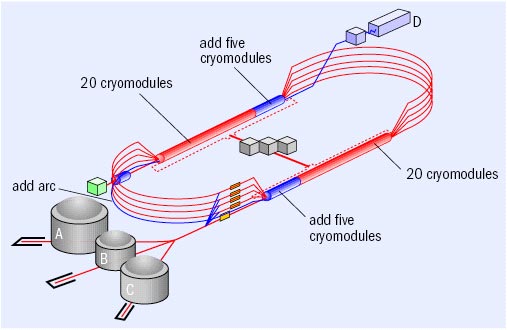
The CEBAF accelerator consists of a pair of superconducting radiofrequency linacs linked by recirculation arcs for up to five acceleration passes. It serves three experimental halls with simultaneous, continuous-wave beams, originally with a final energy of up to 4 GeV but now with one of up to 6 GeV thanks to incremental improvements in cryomodule technology. The complex experimental programme often requires independent beams to the three halls, each with fully independent current, a dynamic range of 105, high beam polarization and “parity quality” constraints on energy and position. To meet these varied demands, the machine undergoes about one change in configuration per week and must routinely operate at 5.5 GeV or higher.
For the upgrade, a new hall (Hall D) will be built at the end of the accelerator opposite the present Halls A, B and C. There, experimenters will use collimated beams of linearly polarized photons at 8-9 GeV, produced by coherent bremsstrahlung from 12.1 GeV electrons. To send a beam of that energy to that location requires a sixth acceleration pass through one of the linacs. This means adding a recirculation beamline to one of the arcs, and also requires augmenting the accelerator’s present 20 cryomodules with 10 new, higher-performing ones. Maximum energy for five passes will rise to 11 GeV for the three original halls, with experimental equipment upgraded in each. The 2 K helium refrigeration plant will be upgraded to 10.1 kW from the present 4.8 kW.
In December 2002, the DOE Office of Science asked the Ad-hoc Facilities Subcommittee of the US Nuclear Science Advisory Committee (NSAC) to review all proposed projects once again. The report declared the science programme of the 12 GeV upgrade “absolutely central” to progress in the field, and the project “ready for construction”. The remaining R&D will be focused on optimizing cost and increasing technical contingency. With this year’s CD-0 decision, Jefferson Lab is moving the project forward with enthusiasm.
For the more distant future, research needs beyond the 12 GeV upgrade are also being considered. That science would require high luminosity and still higher energies. Essential concepts and technology advances are under study.
• For more information see the “CEBAF @ 12 GeV” link at the website www.jlab.org.
On 5 October, technicians at NIKHEF, the Dutch National Institute for Nuclear Physics and High Energy Physics, glued the last layer of aluminium drift tubes on the 101st and final ATLAS precision muon chamber to be assembled in Amsterdam. Ninety-six of these chambers make up the full set of the “Barrel Outer Large” chambers, which comprise the major part of the third and outer layer of the ATLAS barrel muon system.
During three years of chamber assembly, following many years of R&D work, some 42 000 “monitored drift tubes” 30 mm in diameter and 5 m long have been produced. A semi-automatic wiring machine equipped the tubes with a total of 200km of tungsten sense wire, as well as 84 000 end plugs.
The tubes were then subjected to a number of tests on the precision of the wire location and wire tension, leak tightness under 3 bar pressure, and the ability to stand a high voltage on the sense wire with small dark current.
Tubes passing the quality test were glued into layers of up to 72 tubes in parallel; the full muon chambers consist of two sets of three layers of tubes each, separated by a spacer of precise dimensions.
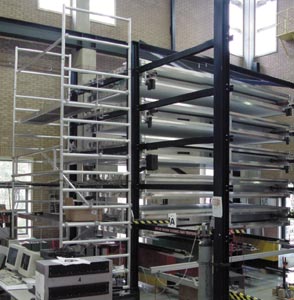
In order to measure high-momentum muons accurately at the LHC, precision and control have been the key words in chamber assembly. Within the chamber dimensions of up to 5x2m, the tubes needed to be mounted with a precision of 20μm. In order to achieve this, precision jigs were used on a granite table inside a temperature- and humidity-controlled clean room. The positions of the tubes were constantly monitored during assembly, exploiting the NIKHEF RASNIK alignment system.
The muon chambers are currently being equipped with gas-distribution services and electronics. As from October, sets of five chambers are being routinely tested in a dedicated cosmic-ray test stand, into which the ATLAS muon-detector control system, the RASNIK alignment system and the ATLAS read-out electronics are also integrated.
From December onwards, the chambers will be shipped to CERN, where they will be mounted together with trigger chambers (resistive plate chambers) in a common support. The first of these assemblies will be mounted in ATLAS in mid-May 2005.
Three teams, in the UK, the US and France, have reported breakthroughs in the laser-driven plasma acceleration of electrons. For the first time researchers have been able to create conditions such that the accelerated beam has a low divergence and small spread in energy. This paves the way towards the practical development of compact “table-top” particle accelerators for a variety of applications.
The idea of harnessing the high electric fields generated in laser-driven plasma waves in order to accelerate electrons was first proposed by Toshi Tajima and John Dawson in 1979. The basic principle is to direct an intense laser pulse into a plasma, which sets the plasma electrons oscillating, so creating a relativistic plasma wave in the wake of the pulse. Fields of more than 100GeVm-1-thousands of times greater than achieved with conventional accelerators-can be set up in this way and charged particles can be accelerated as they “surf” the plasma wave. With the advent of high-brightness lasers, this technique of laser wakefield acceleration has in the past decade been demonstrated in several different experiments. In 2003, Karl Krushelnick led a European Union-funded collaboration between the Laboratoire d’Optique Appliquée at the Ecole Polytechnique in Paris, Imperial College London and the Rutherford Appleton Laboratory (RAL) that achieved electron energies of 350MeV over distances of only 1 mm or so in a plasma driven by ultra-short, intense laser pulses. However, the beams produced have had a broad spread in energy (as much as 100%) due to wavebreaking, making them of limited practical use.
In the latest work, the three groups have found different techniques to overcome this problem and localize large numbers of electrons with respect to the plasma wave. The beams generated are much closer to being monoenergetic, with energy spreads down to less than 10%. These findings are described in suCCEessive papers in the same edition of Nature, following earlier reports, for example at the 11th workshop on Advanced Accelerator Concepts in June.
Krushelnick and colleagues from Imperial College, Strathclyde University, the University of California, Los Angeles, and RAL have used the Astra laser in RAL’s Central Laser Facility to focus ultrashort (40fs), intense (0.5J) laser pulses onto a supersonic jet of helium gas. At the same time they have been able to vary the density of the plasma created by varying the pressure of the gas jet. As the plasma density is increased, “wavebreaking” starts to oCCEur, where electrons break free from the plasma wave and can then be accelerated by the remaining wave. At densities below 7×1018cm-3, no energetic electrons emerged from the plasma, but at higher densities the team detected electrons with energies up to 100MeV. Moreover, the energy spectrum measured with a magnetic spectrometer showed narrow spikes.
By carefully controlling the density and increasing the laser power, the team has produced energy spectra with single, narrow peaks, in which the energy spread is as small as 3%, for energies in the range 50-80MeV (Mangles et al. 2004). The researchers explain their observations in terms of “controlled wavebreaking”. Wavebreaking is not always catastrophic and a number of the electrons in the plasma wave can break from the wave, reduce its amplitude but still maintain the wave structure. The differences in the observed spectra correspond to timing of the injected electrons into this relativistic (but decaying in amplitude) plasma wave. For high densities, the wake-field is several plasma wavelengths in duration. SuCCEessive plasma periods can accelerate trapped electron bunches to different energies, producing the multiple spikes in the spectrum. For the single spike feature, it is likely that only the first plasma oscillation is driven to breaking point.
A similar approach has been taken by Malka’s group, building on their previous work in which they demonstrated that they could produce well-collimated energetic beams using laser-driven wakefields, although the beams still had a broad energy spread. In the latest work, the group creates a plasma “bubble” in the wake of a laser pulse that has been compressed by self-focusing. Wave-breaking at the walls of the bubble releases electrons that are accelerated together within the bubble. This technique has allowed the group to claim acceleration of a beam of only 10 mrad divergence, with a total charge of 0.5±0.2 nC at an energy of 170±20 MeV (Faure et al. 2004).
In the US, meanwhile, Wim Leemans and colleagues in the L’OASIS (Laser Optics and Accelerator Systems Integrated Studies) group at the Lawrence Berkeley National Laboratory have taken a different approach. They have created a plasma density channel in hydrogen gas, which is denser towards the edges and serves to guide the driving laser pulse. This overcomes the natural weakening of the pulse caused by diffraction as it propagates thereby extending the distance available for acceleration. Although the L’OASIS team used a laser spot about three times smaller than the one used by the UK and French groups, and hence a diffraction distance roughly ten times shorter, the use of the plasma channels kept the laser beam tightly focused and so highly intense at the entrance of the plasma channel.
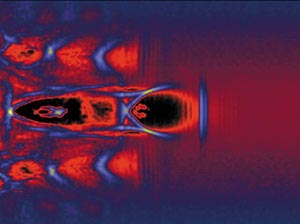
In this method, a first “igniter” pulse forms a narrow “wire” of plasma, which a second “heater” pulse enters from the side, expanding it into a broader channel. Lastly, 500 ps later, an intense “driver” pulse is sent through the channel, and this excites the plasma waves that ultimately accelerate electrons from the plasma. By carefully controlling the laser and plasma-channel parameters, the team observed acceleration of electron bunches with a narrow energy spread, for example ±2% at an energy of 86 MeV and 3 mrad (FWHM) divergence, containing around 0.3-0.5 nC of charge (Geddes et al. 2004). The normalized emittance was estimated to be of the order of 1-2π mm-mrad (rms). Once again several factors seem to be involved in keeping the energy spread small, with the most important one being the control of the acceleration distance to match the dephasing distance, i.e. the distance where the electrons start to outrun the wave. Simulations of the process with the particle-in-cell code VORPAL indicate that the laser pulse first self-steepens while propagating in the plasma. As a result larger amplitude waves are excited as the laser pulse propagates deeper into the channel. When the wave amplitude reaches levels sufficient to trap background electrons and the acceleration process is extended to the dephasing distance, momentum bunching oCCEurs and this results in a narrow energy spread for the beam. Combined with sufficient beam loading to suppress trapping in trailing accelerating buckets, this leads to the quality of the electron beams observed, with low divergence and energy spread.
These results represent a great achievement, but all three groups point to the need for further work, on efficiency and shot-to-shot stability for example. Also it is still far from clear as to how an accelerator based on this technique could be “staged” to reach the teravolt energies now generally required for research at the high-energy frontier. However, the results provide great hope for progress towards compact, high-brightness machines operating in the giga-electronvolt region. These would have many applications, for example in materials science, ultrafast chemistry and medicine.
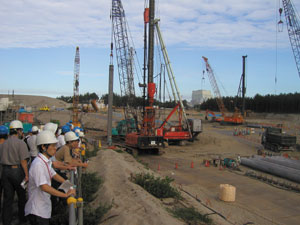
Tokai in Japan, which is located on the Pacific coast about 140km northeast of Tokyo and 70 km northeast of the KEK laboratory, is the site of J-PARC, the Japan Proton Accelerator Research Complex. This new facility is based on a 50 GeV proton synchrotron (PS) and, with a beam power of 0.6 MW, will be the most powerful machine at such energies when it starts operation in 2008. Under construction since 2001, J-PARC is being built jointly by two institutes, KEK and the Japan Atomic Energy Research Institute (JAERI). On 2-4 August this year potential users had the opportunity to find out more about the facility when the 3rd International Workshop on Nuclear and Particle Physics at J-PARC (NP04) was held in Tokai.
NP04 followed two similar workshops, in 2001 in Tsukuba and in 2002 in Kyoto, but was special in that it provided the first occasion for future users to discuss a wide range of issues, including the expected performance of the machine and the arrangement of beam lines. They could also voice their wishes and concerns about the type of organization that will govern relationships between them and the J-PARC management. In addition, the workshop provided a wide tour d’horizon of the future physics programmes.
The workshop was divided roughly into four wide domains: strangeness nuclear physics, nuclear hadron physics, kaon rare decays and muon rare decays. When there was overlap between these topics some of the parallel sessions were given in joint sessions covering two or three topics. These physics programmes represent the backbone of research in nuclear and particle physics at the new facility, and most are a continuation of the physics for which KEK has earned its high reputation. The presentations did not include other important programmes for the future facility, in particular neutrino oscillations, which were covered in a separate workshop at KEK on 24-26 August, and a wide range of more application-oriented studies involving neutrons, muon spin rotation and transmutation of nuclear waste.
The first day consisted of plenary sessions devoted to overviews of the accelerator, projected beam lines and physics topics. These were followed by parallel sessions on the mornings of the second and third days. On the afternoon of the second day a visit to the J-PARC construction site gave the participants, most of whom will be future users, the opportunity to view the tremendous progress made by the construction team.
The afternoon of the third and final day was devoted to a discussion of institutional matters. Shoji Nagamiya, director of the J-PARC project, presented the overall framework, and relations with users were discussed by Tadafumi Kishimoto from Osaka University. Kishimoto is a member of a new body called the J-PARC Users Consultative Committee, which is made up of representatives of the different fields, including three representatives from industry and non-voting members of the J-PARC management.
Jen-Chieh Peng from Illinois explained the role of the Nuclear and Particle Physics Facility Committee (NPFC). This is in effect a pre-programme advisory committee, whose duty has been until now to review the 30 letters of intent involving more than 480 authors – including around 60% from foreign institutions – and to advise J-PARC management about machine and beam-line issues based on this review. One of the special tasks of the NPFC was to review the neutrino proposal – whose temporary name is T2K, for Tokai-to-Kamioka, in analogy with the now famous K2K (KEK-to-Kamioka) experiment – which aims to shoot a high-energy neutrino beam towards the SuperKamiokande detector located 295 km away near the coast of the Sea of Japan. Following this review, and the high grade given by the NPFC to the proposal, this project has been funded as an additional facility by the Japanese government.
The NPFC was also charged with classifying the letters of intent into three categories: Day 1 experiments, Phase I experiments and Phase II (and beyond) experiments. Day 1 experiments were selected for their outstanding interest coupled with the fact that they can be realized at the start of J-PARC, within the timeline and budget available for the experimental facilities. Two projects were selected that make partial use of equipment already used at KEK for strangeness nuclear physics.
Phase I experiments are those of great scientific interest that can be done with J-PARC Phase I – PS energy of 30GeV, maximum beam power of 0.45MW for the slow-extracted beam in the hall of initial size – but which require beam lines and/or detectors that are not yet available or financed. Phase II experiments will require not only an extended hall and upgraded beam lines but also the final performance of J-PARC when the injection energy will be pushed to 400MeV, instead of 180MeV in Phase I, and the PS will reach its ultimate energy of 50GeV. Many letters of intent proposed far-reaching additions to the initial facility, including muons (as in the PRISM project) and high-intensity neutrino beams and antiprotons.
The final session was a lively discussion between users and J-PARC management about the roles in the new organization of KEK and JAERI – who finance about 43 and 57% of the new facility, respectively – and about their relationship with the J-PARC Centre, the future body for J-PARC management. An important issue being through which channel future experimental equipment will be funded.
In conclusion, all the participants seemed enthusiastic about the organization and the high level and number of exchanges during this historic workshop. The three days were densely packed, with not much time for tourist distractions, the exception being the beautiful banquet, a much-appreciated Japanese tradition. Another workshop will be organized in 2005 or 2006 as J-PARC comes closer to final completion, and all physicists interested in the new facility will be encouraged to attend.
The International Committee for Future Accelerators (ICFA) has accepted that superconducting technology should be used for a future electron-positron linear collider in the energy range 0.5 to 1.0 TeV – now to be known as the International Linear Collider. In making this decision, ICFA unanimously followed the advice of the International Technology Recommendation Panel (ITRP), which had been charged last November with evaluating and then choosing between two possible technologies, generally referred to simply as “warm” and “cold”.
The two technologies, which have been developed in America, Asia and Europe over the past decade, differ mainly in their accelerating structures. In the “warm” version the accelerating cavities are normally conducting and operate at room temperature, while the “cold” technology is based on superconducting cavities that work at a temperature of 2 K.
The normally conducting technology, which has been developed jointly by the Next Linear Collider and Global Linear Collider collaborations, operates at a frequency of 11.4 GHz, in the “X-band” range, with copper accelerating cavities. It would require a tunnel up to 30 km long, with a second parallel tunnel to house the klystrons needed to generate the radiofrequency accelerating fields.
At 1.3 GHz the operating frequency of the accelerating cavities for the superconducting technology, developed by the TESLA collaboration, lies in the “L-band” region. Such a machine would require a longer tunnel, up to 40 km long. However, with superconducting niobium, the transfer of power from the drive klystrons to the electron and positron beams is highly efficient, and nearly all the power is transmitted to the beam; in the warm technology only around one-third of the power is transmitted.
In November last year ICFA’s International Linear Collider Steering Committee (ILCSC) appointed the ITRP, comprising 12 experts from America, Asia and Europe under the chairmanship of Barry Barish from the California Institute of Technology. The panel met six times as it progressed from initial planning through visits to test facilities at DESY, KEK and SLAC, to its final deliberations and a conclusion. The members of the panel essentially gave up their normal work for six months while they interacted intensively with the international particle-physics community and with each other. They finally presented their recommendation to ICFA and the ILCSC at a special meeting in Beijing on 19 August. ICFA’s endorsement was announced on the following day at the ICHEP’04 meeting in Beijing.
“Both the ‘warm’ X-band technology and the ‘cold’ superconducting technology would work for a linear collider,” explains Barish. “Each offers its own advantages and each represents many years of R&D by teams of extremely talented and dedicated scientists and engineers. At this stage it would be too costly and time consuming to develop both technologies toward construction. The decision was not an easy one, because both technologies were well advanced and we knew the selection would have significant consequences for the participating laboratories.”
To help arrive at a recommendation, the panel developed a matrix of evaluation criteria. These included issues of cost and schedule as well as technical and physics operation issues. In the end the superconducting technology had features that tipped the balance in its favour, some of which stem from its lower frequency. The ITRP did however recognize the importance of the work that has been done on warm technology.
In addition to the much lower power consumption of superconducting technology, the panel cited the large cavity aperture and long bunch interval, which simplify operations, reduce the sensitivity to ground motion, permit inter-bunch feedback and may enable increased beam current. They also concluded that the main linac and radiofrequency systems are of lower risk. The construction of the superconducting X-ray free-electron laser will provide prototypes and test many aspects of the linac, and the industrialization of most of the major components for such a linac is already underway.
The panel was keen to stress that it had interpreted its mandate as being to choose a technology not a design. The decision by ICFA to accept the panel’s recommendation will now allow the next big step to be taken, to develop the technical design for the International Linear Collider as rapidly as possible. The ILCSC has already secured an agreement that America, Asia and Europe will work together under a central team, and a director and site for the team are now being sought.
To provide the best experiences, we use technologies like cookies to store and/or access device information. Consenting to these technologies will allow us to process data such as browsing behavior or unique IDs on this site. Not consenting or withdrawing consent, may adversely affect certain features and functions.
Functional
Always active
The technical storage or access is strictly necessary for the legitimate purpose of enabling the use of a specific service explicitly requested by the subscriber or user, or for the sole purpose of carrying out the transmission of a communication over an electronic communications network.
Preferences
The technical storage or access is necessary for the legitimate purpose of storing preferences that are not requested by the subscriber or user.
Statistics
The technical storage or access that is used exclusively for statistical purposes.The technical storage or access that is used exclusively for anonymous statistical purposes. Without a subpoena, voluntary compliance on the part of your Internet Service Provider, or additional records from a third party, information stored or retrieved for this purpose alone cannot usually be used to identify you.
Marketing
The technical storage or access is required to create user profiles to send advertising, or to track the user on a website or across several websites for similar marketing purposes.