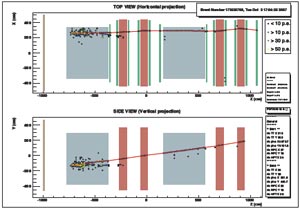
The first neutrino event of the 2007 run of the CERN Neutrinos Gran Sasso (CNGS) facility was recorded on 2 October, when one of the many millions of neutrinos in the beam from CERN interacted in the OPERA detector in the Gran Sasso National Laboratory, 730 km away in Italy. The interaction occurred in one of nearly 60,000 “bricks” already installed in the detector and provided the first detailed event image in high-precision emulsion.
There is now plenty of evidence that neutrinos oscillate between three “flavour” states, associated with the charged leptons: electron, muon and τ. Several experiments have observed the disappearance of the initial neutrino flavour but “direct appearance” of a different flavour remains a major missing piece of the puzzle. The CNGS beam consists of muon-neutrinos, and the observation in OPERA of a few τ-neutrino interactions among many muon-neutrino events will provide the long-awaited proof of neutrino oscillation.
In 2006, OPERA collected about 300 neutrino events during the commissioning run of the CNGS facility (Acquafredda et al. 2006). However, these did not include information about the event-vertex recorded in the thousands of small “bricks”, each made of a sandwich of lead plates and nuclear emulsion films, which make up the “heart” of OPERA. The emulsion technique allows the collaboration to measure the neutrino interaction vertices with high precision. Installation of the bricks continues daily and the total is nearing the halfway mark, ultimately reaching 150,000 bricks with a total mass of 1300 tonnes.
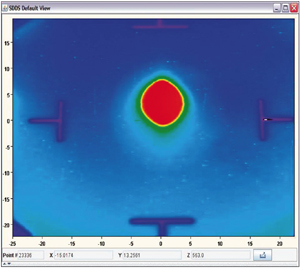
The event of 2 October was the first to be registered in a brick, and some 37 more events occurred in the following days. An automated system immediately removed the bricks containing these events from the detector. They were then dispatched to the various laboratories of the OPERA collaboration, which are equipped with the automatic microscopes required to scan the emulsion films and make relevant measurements. Figure 2 shows the microscope display for one of these events, representing a volume of only a few cubic millimetres but rich in valuable information for the OPERA physicists.
This is a crucial milestone in an enterprise that started about 10 years ago. The OPERA detector was designed and realized by a large team of researchers from all over the world (Belgium, Bulgaria, Croatia, France, Germany, Israel, Italy, Japan, Korea, Russia, Switzerland, Tunisia and Turkey), with strong support from CERN, INFN, Japan and the main European funding agencies. Numerous hi-tech industrial companies were also involved in the supply of the many parts of the equipment necessary for building the large detector.
Three years after the initial commissioning of the SPS-to-LHC transfer line, TI 8, the second transfer line, TI 2, has passed its first test with beam. Just as for TI 8 in October 2004, a low-intensity proton beam travelled down the entire new line at the first attempt.
The two LHC injection lines have a combined length of 5.6 km and comprise around 700 warm (normally conducting) magnets. While around 70 magnets were recuperated from earlier installations at CERN, the majority were produced by the Budker Institute for Nuclear Physics in Novosibirsk, as part of Russia’s contribution to the LHC project.
TI 2 leads from the extraction in long straight section 6 (LSS6) of the SPS to the injection point on the LHC for clockwise beam, which is near the interaction region for the ALICE experiment at Point 2. To transfer beam to the LHC, LSS6 has a new fast extraction, which underwent commissioning in 2006 and further testing in 2007. Following the extraction, the beam passes for 150 m through the TT60 line, formerly used for transfer to the West Area, before entering the TI 2 line in its purpose-built 3 m diameter tunnel.
Installation of the TI 2 beamline started at the beginning of 2005 in the upstream part of the new tunnel, followed by initial hardware commissioning that summer. However, as the downstream part of the TI 2 tunnel served as a transport path for the main LHC magnets, it had to remain free of beamline elements until the LHC magnets were all in place. With the descent of the last magnet in April 2007, installation of the TI 2 line resumed, reaching completion at the beginning of August. This was followed by some eight weeks of hardware commissioning for the whole beamline.
The beam test, which took place over a 22 hour period, started early on 28 October. The commissioning team first prepared a single-bunch beam of 5 × 10⁹ protons and set the TI 2 line to the SPS energy before tuning the SPS extraction. Then, when they retracted the beam dump near the extraction, the beam travelled without any steering straight through the 2.7 km of beamline components to the temporary dump installed near the end of the TI 2 tunnel. During the time remaining, the team made a range of basic measurements; after an initial analysis the basic parameters are looking good, indicating that there are no major errors in the line.
One of the most fragile detectors for the LHCb experiment has been successfully installed in its final position. Installing the Vertex Locator (VELO) in the underground experimental cavern at CERN proved to be a challenging task for the collaboration.
The VELO is a precise particle-tracking detector that surrounds the collision point inside the LHCb experiment. At its heart are 84 half-moon-shaped silicon sensors, each connected to its electronics via a system of 5000 bond wires. These sensors are located close to the collision point, where they will play a crucial role in detecting b quarks.
The sensors are grouped in pairs to make a total of 42 modules arranged in two halves around the beamline in the VELO vacuum tank. A 0.3 mm thick aluminium sheet provides a shield between the silicon modules and the primary beam vacuum, with no more than 1 mm of leeway to the silicon modules. Custom-made bellows enable the VELO to retract from its normal position 5 mm from the beamline to a distance of 35 mm. This flexibility is crucial during the commissioning of the LHC beam.
The VELO project involves several institutes of the LHCb collaboration, including Nikhef, EPFL Lausanne, Liverpool, Glasgow, CERN, Syracuse and MPI Heidelberg. In particular, the sensor modules were constructed at the University of Liverpool, and Nikhef provided the special foil that interfaces with the LHC vacuum.
At a brief ceremony on 7 November deep in the LHC tunnel CERN’s director-general, Robert Aymar, sealed the last interconnection between the collider’s main magnet systems. This is the latest milestone in commissioning the LHC, which is scheduled to start up in 2008. The ceremony marks the end of a two-year programme of work to connect all of the main dipole and quadrupole magnets in the machine, a complex task that included both electrical and fluid connections.
The 27 km circumference LHC is divided into eight sectors, each of which can be cooled down to the operating temperature of 1.9 K and powered up independently. The first sector was cooled down and powered up in the first half of 2007 and has now been warmed up for minor modifications. This was an important learning process, allowing subsequent sectors to be commissioned more quickly. Four more sectors will be cooling by the end of 2007 and the remaining three sectors that have not been cooled will begin the process early in 2008.
To cool the magnets, more than 10,000 tonnes of liquid nitrogen and 130 tonnes of liquid helium will be brought into use through a cryogenic system, which includes more than 40,000 leak-tight welds.
If all goes well, the first beams could be injected into the LHC in May 2008, and circulating beams established by June or July. With a project of this scale and complexity, however, the transition from construction to operation is a lengthy process. Every part of the system has to be brought on stream carefully, with each subsystem and component tested and repaired, if necessary. “If for any reason we have to warm up a sector, we’ll be looking at the end of summer rather than the beginning,” warns project leader Lyn Evans.
On 13 October, members of the Daya Bay Collaboration and government officials from China and the US Department of Energy held a groundbreaking ceremony for the Daya Bay Reactor Neutrino experiment at the Daya Bay Nuclear Power Facility, located in Shenzhen, Guangdong Province, about 55 km north-east of Hong Kong in Southern China. The experiment is poised to investigate the least well known sector of the recently discovered phenomenon of neutrino mixing.
In recent years, several experiments have discovered that the three flavours of neutrino can oscillate among themselves – a result of the mixing of mass eigenstates. Among the three mixing angles required to describe the oscillation, θ13 is the least well known. Besides determining the amount of mixing between the electron-neutrino and the third mass eigenstate, θ13 is a gateway to the future study of CP violation in neutrino oscillation.
To date, the best limit on θ13 is sin22θ13 < 0.17, reported by the CHOOZ reactor neutrino experiment using one detector on a baseline of 1.05 km. However, the current understanding of neutrino oscillation indicates that the disappearance of reactor antineutrinos at a distance of about 2 km would provide an unambiguous determination of θ13. This is the goal of a new generation of reactor neutrino experiments utilizing at least two detectors at different baselines. Such a near–far configuration eliminates most of the reactor-related systematic errors and some of the detector-related systematic uncertainties.
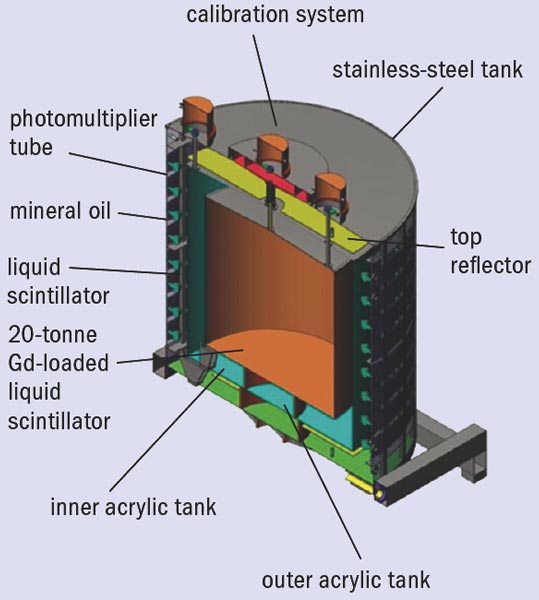
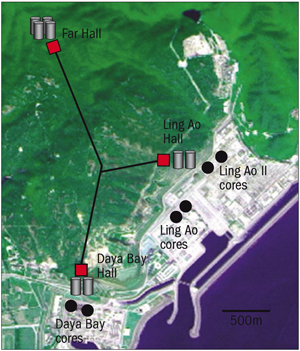
The Daya Bay experiment should discover neutrino oscillation due to θ13 mixing and measure sin22θ13 to an unprecedented sensitivity of better than 0.01 at 90% CL – an order of magnitude better than the present limits. The experiment will look for electron antineutrinos from the reactors via the inverse beta-decay reaction in a gadolinium-doped liquid scintillator target (figure 1). In the reaction, an electron-antineutrino interacts with a proton (hydrogen in the scintillator), producing a positron and a neutron. The energy of the antineutrino is determined by measuring the energy loss of the positron in the scintillator. The collaboration will extract the value of sin22θ13 by comparing the fluxes and energy distributions of the observed antineutrino events in the near and the far halls (figure 2).
The ceremony on 13 October marks the beginning of civil construction near the Daya Bay and Ling Ao reactors, the sources of the electron-antineutrinos for the experiment. When the Ling Ao II nuclear power plant is commissioned by 2011, the three pairs of reactors will be one of the most powerful nuclear-energy facilities in the world. Three underground experimental halls connected by long tunnels will be excavated in the nearby mountains, which will shield the experiment from cosmic rays. In each hall, the antineutrino detectors (two in each near hall and four in the far site) will be deployed in a water pool to protect the detectors from ambient radiation. Together with resistive plate chambers above, the water pool also serves as a segmented Cherenkov counter for identifying cosmic-ray muons.
The project is now ready to begin manufacturing and mass production of the detector components. The first experimental hall is scheduled to be ready by the end of 2008. Commissioning of the detectors in this hall will take place in 2009. Construction will continue for about two years, with installation of the last detector scheduled for 2010.
• The Daya Bay Collaboration consists of 35 institutions with more than 190 collaborators from three continents. The project is supported by the funding agencies in China and the US, and is one of the largest co-operative scientific projects between the two countries. Additional funding is being provided by the other countries and regions, including Hong Kong, Taiwan, the Czech Republic and Russia.
The 22nd Particle Accelerator Conference, PAC ’07, held in Albuquerque on 25–29 June was one of the largest yet. Nearly 1400 participants and 70 vendor companies attended, and more than 1400 papers were published, again demonstrating the important and prolific work that worldwide collaborations are doing in a multidisciplinary field. In all, it was a great success. This article briefly reports the highlights.
The high-energy frontier is still luring particle physicists and challenging accelerator designers and builders, with the next big step being the LHC at CERN. Following the accumulation of several minor delays, CERN dropped the plan for a low-energy run of the new collider later this year. The schedule foresees the commissioning of the machine at full energy starting in spring 2008. At the conference, talks and posters dealt with schemes for optimizing the performance of the LHC, as well as the potential for upgrades.
Meanwhile, US efforts at RHIC at the Brookhaven National Laboratory (BNL) now include luminosity improvements that will require the development of a facility at the cutting edge of beam cooling. Estimates suggest that electron cooling will require electron energies up to 54 MeV at an average current of 50–100 mA, and in a particularly bright electron beam. The aim is to generate this electron beam in a superconducting energy-recovery linac (ERL) using a superconducting RF gun with a laser–photocathode. An intensive R&D programme is currently underway. There are also plans for RHIC to produce 200 GeV polarized protons routinely, once there is a better understanding of the effects of polarization loss owing to intrinsic high-energy spin resonances. The acceleration of electrons at the proposed e-RHIC will allow continuity in the experimental programme, followed earlier at HERA, the electron–proton collider at DESY that shut down in July after 16 successful years of operation.
At Fermilab, the luminosity of the Tevatron proton–antiproton collider continues to improve, setting the record for hadron colliders. Fermilab has achieved the first electron cooling of a relativistic hadron beam (8 GeV antiprotons in the Recycler), contributing heavily to the success of Run II at the Tevatron. Studies of ways to improve further the beam–beam compensation efficiency in the Tevatron are also underway. Tests have already demonstrated compensation using electron lenses, paving the way for beam–beam compensation in RHIC and the LHC.
The conference also heard reports on the commissioning of multibatch slip-stacking in the Fermilab main injector. This technique has allowed doubling of the neutrino intensity for the Neutrino beam for the Main Injector (NUMI) project. Incorporating the Recycler for proton accumulation yields a four-fold increase in the neutrino source and may lead to a project dubbed SuperNUMI, although this could face strong competition from the Japan Proton Accelerator Research Complex (J-PARC) and an upgraded CERN Neutrinos to Gran Sasso (CNGS) project. Further steps will be necessary to ensure a leading position for the US in long-baseline neutrino experiments, such as Fermilab’s proposed Project X.
The high-energy frontier brings challenges that can only be met by strong, successful international collaborations. Barry Barish, director of the Global Design Effort for an International Linear Collider (ILC), reviewed the status, plans and main issues towards an ILC project. The Reference Design Report for the ILC, which will be based on superconducting (SC) RF technology, should be released in the coming months. The current baseline configuration uses the TESLA project’s SC cavity shape for the 500 GeV stage and assumes an accelerating gradient of 31.5 MV/m. The R&D programme includes work on alternative cavity shapes that promise higher gradients, but the designs are not yet mature enough to adopt as the baseline. The ILC will complement the LHC by allowing precision measurements at well-defined energy and angular momentum in the same regime, without the complications of the complex composite structure of the protons.
The push towards even higher energies requires innovative approaches. Visiting researchers from the University of California Los Angeles and the University of Southern California are working with researchers at SLAC to investigate plasma wakefield acceleration and have already demonstrated the energy-doubling of the 42 GeV electrons from the three-kilometre long SLAC linac in a plasma device less than a metre long. The implied acceleration gradient of 50 GeV/m is more than three orders of magnitude greater than in the SLAC linac. The same team had presented at PAC ’05 the results of a first demonstration of an energy gain greater than 1 GeV. It is remarkable that they extended their work in such a short time to test the concept of a plasma afterburner for doubling the energy of a beam from a real collider. This concept is expected soon to become a realistic technology for building future accelerators.
Lower energies, higher powers
At low to medium energies, the emphasis is often on achieving higher powers, either in sources or injectors for higher-energy machines or to deliver final beams at lower energies. The conference heard the latest results from commissioning studies at J-PARC and at the Spallation Neutron Source (SNS) at Oak Ridge. Both facilities are producing exciting results and are on track for ramping up to high beam powers. There were also reports on the successful first-stage commissioning of TRIUMF’s Isotope Separation and Acceleration (ISAC) facility, ISAC-II; the status of the Dual-Axis Radiographic Hydrodynamic Test phase II commissioning at the Los Alamos National Laboratory; and the results from commissioning of the proton linac for the Low Energy Neutron Source at Indiana University. Talks about non-scaling, fixed-field alternating gradient (FFAG) accelerators discussed new developments in this class of machine. There were also reports on the status of the Facility for Antiproton and Ion Research (FAIR) at GSI and on the results of longitudinal profile measurements made in the SNS linac.
Invited speakers on the latest source and injector technology looked at the development of reliable high-current, low-emittance injectors for various applications, particularly high-power spallation sources and heavy-ion fusion. Specific topics included GaAs-based photoguns with a high degree of polarization, and laser-driven sources of heavy ions with an emphasis on direct plasma injection into the subsequent accelerator structure. The general design principles for an electron cyclotron resonance (ECR) source of heavy ions were illustrated with a design for an advanced ECR. The meeting also discussed a multi-beamlet injector for a heavy-ion fusion accelerator, as well as the test and production versions of a high-performance electron-beam ion source for very highly charged heavy ions. In addition, contributed papers presented an optically pumped source of polarized H– ions with a very high degree of polarization; new development approaches with RF-driven H– ion sources; model-based optimization of plasma parameters for ECR ion sources; and a comparison of measured and simulated beam inhomogeneities found with ECR ion sources.
Applied accelerators
Accelerator-based facilities support a rich and diverse set of user programmes in basic and applied science, but at the same time there is an increasing number of varied applications for accelerators. The interest in hadron therapy continues to grow around the world as the number of new facilities in both design and construction stages demonstrates. Although cyclotrons and synchrotrons are the technologies of choice for these facilities, efforts to optimize cost and performance have reinvigorated interest in other technologies, such as FFAGs. New concepts for strengthening US national security involving accelerator technology and the production of particle and photon beams are also emerging, as scanning systems are tailored to address specific concerns. In addition, high-power, energy-recovered free-electron lasers (FELs) are enabling new applications for accelerators in research and industry.
The next generation of advanced light sources will provide many exciting research possibilities. Recent advances, such as ERLs, are making intense, broadly tunable sources of X-ray and XUV radiation feasible. These will allow real-time studies of reaction dynamics in chemical systems on the femtosecond timescale – previously thought impossible. The only short-wavelength FEL currently in operation is the FLASH facility at DESY. Important “pump probe” experiments are already underway there to test the theory. Future facilities may lead to quantum-level chemical control and reaction initiation at room temperatures, and may offer new insights into the dynamic behaviour of matter at the atomic level.
The success and continuing progress of three operating FELs based on ERLs (the Jefferson Lab IR FEL, the Japanese Atomic Energy Authority’s FEL and the high-power THz FEL at the Budker Institute for Nuclear Physics) promise many future applications in ERL technology. Besides high-power FELs and light sources, applications also include electron cooling and high-luminosity electron–ion colliders. The challenge will be in achieving high electron source brightness, maintaining high beam brightness during beam transport and acceleration/deceleration, and controlling high and peak current effects in superconducting RF systems. Some of these challenges are already being addressed within the projects now underway to build X-ray FELs at SLAC, Spring-8 and DESY. All three of these XFELs will rely on the principle of self-amplified spontaneous emission, which does not require mirrors and allows wide wavelength tunability. Talks and posters covered current progress at these facilities as well as new concepts based on computer modelling and theory.
As is now the trend, the largest number of contributions at the conference concerned beam dynamics and the accurate computation of electromagnetic fields. Implementation of 3D electromagnetic simulations for complex geometries and processes continues to advance in direct proportion to advances in computer hardware and storage capabilities. The direct link between these calculations and the ability to optimize the performance and operation of modern accelerators is clear. Scientists are developing sophisticated models to address many of the difficult technical issues facing the next generation of machines, such as beam losses and halo formation in high-intensity hadron beams, space-charge driven resonances, tailoring beam phase-space distributions, and understanding electron cloud effects. Talks and posters at the conference presented a broad range of topics, including collective effects and instabilities, developments in codes and simulations, single- and multi-particle dynamics, and beam optics. In particular, the conference heard of the latest simulation and experimental results of bunch compression in high-intensity electron bunches – important for both current and next-generation FEL projects.
Talks on instabilities and feedback emphasized new results in controlling collective effects through wideband feedback and in impedance or instability computation, benchmarked with instability observations. These included the successful demonstration of wideband feedback against electron–proton instability and for longitudinal stochastic cooling of a high-energy bunched beam. Two studies of the suppression of the electron cloud effect have led to in situ tests of TiN/Al-coated flat and grooved chambers and an idea for a distributed, low-impedance clearing electrode. Other contributors described analytical and/or experimental studies of novel instabilities in cooled antiproton beams, the possible interplay between resistive wall and fast beam-ion instability, and vertical instability in a proton bunch tail; they also discussed cures. Finally, impedance computation remains an important subject, in particular the accurate computation of the transverse impedance of LHC collimators verified with beam tests, reduction of taper impedance through nonlinear tapering, and the use of the impedance database computation method to predict accurately single bunch limits and collective effects.
The integration of sophisticated beam modelling and computer controls continues to advance. The conference heard about recent progress in developing software tools for commissioning the SNS, while posters and talks also discussed modern accelerator control architecture and its use in machine and personnel protection. A concluding overview of modern accelerator control systems emphasized the continuing need for global standardization and collaboration. Although construction of the ILC is not imminent, much thought has already been given to the control and operation of this machine of the future.
The next PAC conference will be in Vancouver in June 2009.
On the evening of 4 October, the team in the control room at FLASH, the soft X-ray, free-electron laser facility at DESY, observed lasing at a wavelength of 7 nm for the first time. Just 24 hours later, the team achieved the design value of 6.5 nm. This comes two weeks after the facility had reached the design beam energy of 1 GeV.
In FLASH, superconducting modules accelerate electrons before they pass through an undulator. The aim is for the spontaneous radiation that they emit in the undulator to amplify itself to form free-electron laser radiation pulses. During the latest shutdown, researchers installed the sixth and final accelerator module and replaced another so that the operators could begin to take FLASH to its design energy for the first time.
On 21 September, the DESY team observed a peak around 6 nm in the wavelength spectrum of the spontaneous radiation generated in the undulator. This proved that all six accelerator modules were working as planned and accelerating the electron bunches to an energy of 1 GeV. Then, on 4 October the team observed the first laser pulses at 6.5 nm.
The central tracker detector of the Anti Matter Spectrometer (AMS) arrived at CERN on 25 September ready for assembly with the other components of the experiment. One of the main goals of AMS is to search for antimatter from the early universe. To achieve this, it will fly on board the International Space Station (ISS).
The antiparticles – mainly positrons – that are detected in cosmic rays on Earth or in the atmosphere are almost certainly the by-products of interactions. By going above the atmosphere, AMS should detect any antimatter among the primary cosmic rays. Detection of a significant quantity of antimatter on the ISS would constitute irrefutable proof that there is still an active source of antimatter in the cosmos. AMS will also look for dark matter by trying to detect the annihilation products of the hypothesized supersymmetric particles, and measure more precisely the composition of cosmic rays.
The central tracker was constructed at the University of Geneva and will soon be surrounded by a powerful cryogenic magnet and other high-precision detectors. The assembly and construction of the whole experiment, which will weigh more than 7 tonnes, will be finalized next spring.
AMS must be ready and delivered to the Kennedy Space Centre in Cape Canaveral, Florida, by the end of 2008 at the latest. It will be launched on a space shuttle and will remain on board the ISS for several years.
The ATLAS collaboration recently celebrated installing the last of the eight “big wheels” that form part of the endcap muon spectrometer of the detector. The big wheels harbour ATLAS’s middle layer of muon chambers in the forward region and are one of the last large pieces to be installed. Each is 25 m across, weighs between 40 and 50 tonnes and contains around 80 precision tracking chambers or 200 trigger chambers.
Because of their sheer size, each wheel had to be made in 12 pieces for the trigger planes and 16 pieces for the tracking planes. Designing a suitable support structure was a unique challenge, and the result is a uniquely thin and light structure that is precise to less than a millimetre.
Each wheel was assembled at CERN using components from all over the world. The 100-member collaboration from China, Europe, Israel, Japan, Pakistan, Russia and the US began assembly of components in 2005 and installation in 2006. Now, just two smaller-scale wheels and the end-wall chambers remain to be installed. The big wheels have already begun to take part in test runs using cosmic-ray data that ATLAS performs on a six-weekly basis.
Following a summer shutdown, the National Superconducting Cyclotron Laboratory (NSCL) at Michigan State University is looking ahead to new experiments with fast and reaccelerated beams.
The NSCL is a user facility and during the course of several years and hundreds of users, the list of experimenters’ requests became long enough to warrant a significant reconfiguration of the laboratory’s experimental area. The four-month long reconstruction project, which concluded successfully at the end of September, achieved a number of goals set by the users. These include a new capability to detect neutrons at larger angles to the beam axis and enhanced two-neutron detection; improved means for filtering proton-rich rare isotope beams and studying neutron-deficient nuclei; increased agility and flexibility in delivering beam to the experimental vaults; and performing an array of reaction studies, including precise measurement of neutron time-of-flight.
The reconfiguration, which cost $2.7 million, was the largest construction project at NSCL since the completion of the Coupled Cyclotron Facility seven years ago. During the shutdown, more than 600 tonnes of concrete wall blocks were moved, as well as 1350 tonnes of roof beams. To speed up the rebuilding of the experimental vaults and to make it easier to change the layout of the facility in the future, NSCL installed 18 modular 22.5-tonne wall sections.
Following the reconfiguration, NSCL users now have access to a next-generation radio frequency separator, funded by the US National Science Foundation. The separator has performed well in early tests, for example, in selecting proton-rich isotopes near doubly magic 100Sn .
Laboratory upgrades will continue into 2008 and beyond. Current plans call for the implementation of two gas stoppers – a cyclotron gas stopper and a linear gas cell. The relative performance of each will be measured to determine the most efficient way to stop ions produced in flight and the best option for the NSCL reacceleration superconducting linear accelerator. This linac, being designed for use at NSCL and in a next-generation facility, will be able to reaccelerate thermalized beams of rare isotopes to energies of 3.2 MeV/nucleon with the option to upgrade it to 12 MeV/nucleon over the entire mass range.
To provide the best experiences, we use technologies like cookies to store and/or access device information. Consenting to these technologies will allow us to process data such as browsing behavior or unique IDs on this site. Not consenting or withdrawing consent, may adversely affect certain features and functions.
Functional
Always active
The technical storage or access is strictly necessary for the legitimate purpose of enabling the use of a specific service explicitly requested by the subscriber or user, or for the sole purpose of carrying out the transmission of a communication over an electronic communications network.
Preferences
The technical storage or access is necessary for the legitimate purpose of storing preferences that are not requested by the subscriber or user.
Statistics
The technical storage or access that is used exclusively for statistical purposes.The technical storage or access that is used exclusively for anonymous statistical purposes. Without a subpoena, voluntary compliance on the part of your Internet Service Provider, or additional records from a third party, information stored or retrieved for this purpose alone cannot usually be used to identify you.
Marketing
The technical storage or access is required to create user profiles to send advertising, or to track the user on a website or across several websites for similar marketing purposes.