Comsol -leaderboard other pages

Topics

Accelerators, light sources and all that jazz

CCpac2_10_12

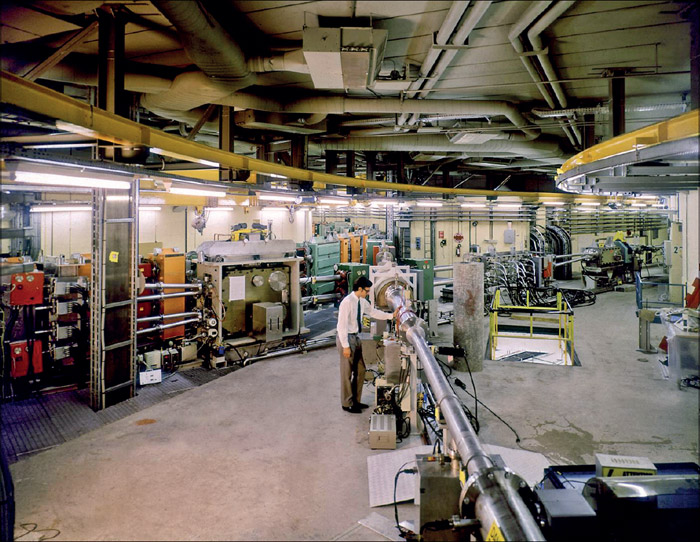
Three years ago, the annual International Particle Accelerator Conference (IPAC) series was launched to reflect the increasingly global effort in the field, with Asia, Europe and North America hosting the meeting on a three-yearly basis. Following meetings in Kyoto (2010) and San Sebastián (2011), it was North America’s turn in 2012. IPAC’12 took place on 20–25 May at the Ernest N Morial Convention Center in New Orleans. True to its international mission, the conference attracted more than 1200 delegates from a diverse cross-section of nationalities, laboratories and areas of expertise. The scientific programme included plenary talks as well as invited and contributed oral presentations, with a healthy balance of speakers representing scientific research efforts from all three global IPAC regions.

Key themes

The conference opening reflected well this international balance and several of the key themes. It began with synchrotron light sources and free-electron lasers (FELs), as Joachim Stohr of the Stanford Radiation Light Source at SLAC highlighted the scientific revolution that is being enabled by X-Ray FELs. CERN’s Steve Myers described the first two years of operation at the LHC – a leading example of high-energy circular colliders, as well as of international collaboration. Accelerator-driven systems for the transmutation of nuclear waste provided one of the latest examples of developing accelerator applications, presented by Dirk Vandeplasche of SCK-CEN. Kenji Saito of KEK put the spotlight on accelerator technology, with a look at future prospects for RF superconductivity. To finish, the opening session moved back to North America and the theme of beam dynamics and electromagnetic fields as Sergei Nagaitsev described the novel concept of the Integrable Optics Test Accelerator that is under development at Fermilab using strong nonlinear magnetic focusing fields.

Proceeding from this synoptic overview, the programme divided into parallel invited oral sessions before the lunch break and contributed oral presentations after lunch. In each case the topical sessions and the topics of the individual speakers had been carefully arranged to avoid overlap of scientific content and/or other interests of the conference delegates. The layout at the New Orleans Convention Center afforded generous space for people to intermingle and easy access between the main hall and parallel sessions.

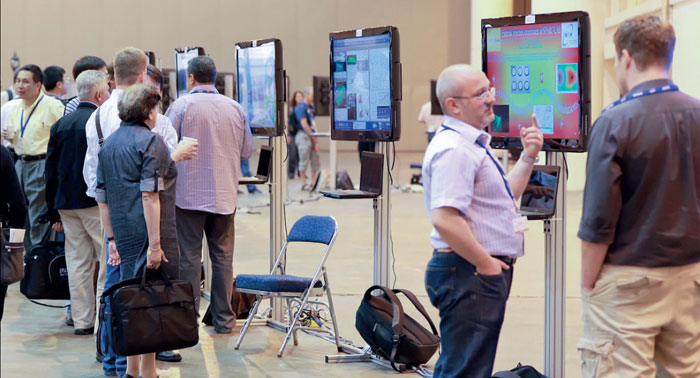
From Monday to Thursday, each afternoon also featured poster sessions arranged by topic in groups named after famous streets of central New Orleans. About 1250 posters were presented in all. A novel electronic poster session was appropriately held on “Bourbon Street” each afternoon. This session consisted of selected posters featuring colourful animated presentations showing complex machine designs, dynamical beam measurements and the results of 3D simulations, with 54 electronic posters in all. The posters were displayed on large flat screens with local PC connection.

A highly successful exhibit featuring 85 separate vendors was also arranged in the centre of the poster sessions, with ample seating arrangements for conversations between participants. The exhibitors generously sponsored a reception on Tuesday for all of the conference delegates and companions, including complimentary drinks and a buffet of Louisiana-style finger foods.
CCpac3_10_12

The programme on Wednesday afternoon contained a special session for industry, covering a range of forward-looking topics. These included projections for future accelerator projects in Asia presented by Zhentang Zhao of the Shanghai Institute of Applied Physics, a look at future medical accelerators by Kiyoshi Yasuoka from the University of Tsukuba and a review of present and future prospects for laser plasma acceleration by Wim Leemans of Lawrence Berkeley National Laboratory. These talks were followed by a review of accelerator-enabled materials development by Wendy Flavell of the University of Manchester, an overview of secondary-beam production by Jens Stadlmann of GSI and the benefits of accelerator R&D to society by Norbert Holtkamp of SLAC.

The IEEE-sponsored event for “Women in Engineering and Science” also took place on Wednesday after the poster sessions. This featured talks covering the demographics of women pursuing careers in engineering and science, personal experiences, objective evaluations and historical perspectives. The talks were delivered by Lia Merminga of TRIUMF, Mei Bei of Brookhaven National Laboratory (BNL), Tracy Morris of Louisiana State University (LSU) and Lorraine Day representing the Center for Advanced Microstructures and Devices (CAMD) at LSU. A buffet reception was held for approximately 50 participants among a display of posters depicting the lives and achievements of outstanding female engineers and scientists.

Thursday afternoon featured the annual awards session and an invited presentation on the LIGO Laser Interferometer Gravity-wave Interferometer by Rainer Weiss of Massachusetts Institute of Technology. Hasan Padamsee from Cornell and Vasili Yakimenko from BNL received the prestigious Particle Accelerator Science Award of the Institute of Electrical and Electronics Engineers/Nuclear and Plasma Science Society (IEEE-NPSS). Erdong Wang from BNL received the IEEE/NPSS student thesis award for studies of secondary emission and the thesis award of the American Physical Society Division of Physics of Beams (APS/DPB) went to Daniel Ratner from SLAC for work on beam dynamics in FELs.
CCpac4_10_12

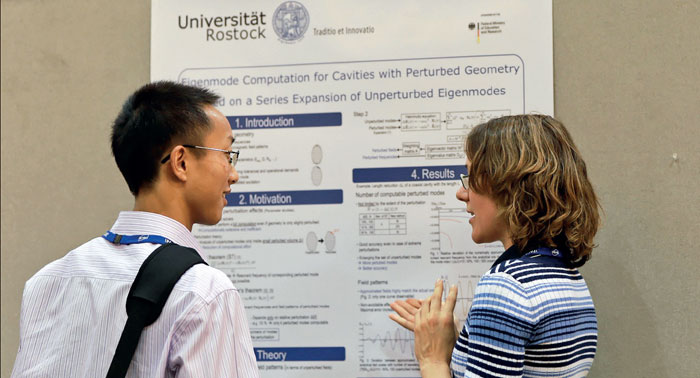
There were also prizes for student posters, exhibited at the Student Poster Session during the conference reception on Sunday. A total of 86 students from around the world received financial support to attend the conference, from the Asian Committee for Future Accelerators, the European Physical Society Accelerator Group and the APS/IEEE. The exhibition attracted an impressive 129 entries, the prizes going to Chen Xu at the Thomas Jefferson National Accelerator Facility (TJNAF) for work on the surface characterization of superconducting radio-frequency cavities and to Theodoros Argyropoulos at CERN for studies of longitudinal single-bunch instability thresholds in the Super Proton Synchrotron.

Parallel satellite meetings were held during the conference for the team behind the Joint Accelerator Conference Website (JACoW), the Joint Universities Accelerator School Advisory Board and the Fixed-Field Alternating Gradient collaboration. The online open-access journal Physical Review Special Topics – Accelerators and Beams (PRST-AB) hosted a “Meet the editors” evening during the conference and held its annual Editorial Board meeting. During the meeting, CERN’s Christine Petit-Jean-Genaz received the first PRST-AB Robert H Siemann Prize, a prize introduced to honour and recognize contributions to the scientific publishing process. A teacher’s day sponsored by the APS took place on the Tuesday. Local high-school science teachers heard from conference speakers during the event, which also included physics demonstrations on topics of current interest in particle accelerators.

The chair’s cocktail reception hosted by conference chair Vic Suller was held in the Mardi Gras World exhibition centre adjacent to the Morial Convention Center. Approximately 250 attended, comprising members of the international Organizing Committee, the Scientific Program Committee and the Local Organizing Committee, as well as support staff, session chairs and invited speakers. The conference banquet took place at the convention centre in the spacious La Nouvelle Orléans ballroom, the evening concluding with enthusiastic dancing to live music by a traditional-style jazz band.

After an invigorating week of accelerator science and engineering, the conference closing session featured plenary talks on the future of X-Ray FELs by Hans Braun from PSI, a review of proton accelerators at the intensity frontier by Paul Derwent from Fermilab and a much anticipated presentation on physics at the LHC – including implications for future high-energy physics programmes – by CERN’s director-general, Rolf Heuer, which foreshadowed the announcement later in the summer of the discovery of a Higgs-like boson at the LHC.

IPAC’12 was closed by the traditional hand-over of the IPAC gavel to the IPAC’13 conference chair, Zhentang Zhao, and the IPAC bell to the chair of the IPAC’13 Science Program Committee, Chuang Zhang. IPAC’13 will take place in Shanghai, with IPAC’14 to follow in Dresden and IPAC’15 in Newport News, Virginia, completing the second three-year cycle through Asia, Europe and North America.

An opportunity to tour the LIGO

On the Saturday after the closing day, participants had the opportunity to tour the laboratory of the Laser Interferometer Gravitational-wave Observatory (LIGO) in Livingston, north of New Orleans – one of the project’s two sites (the other being in Hanford, Washington). Building on Thursday’s guest seminar by Weiss, one of the project’s co-founders, the LIGO staff provided excellent guided tours of the control room, interaction region and a rare opportunity to enter experimental areas that would normally be closed off because of concerns about vibration.

No conference review would be complete without acknowledgment of those who worked for years in advance on the preparations. IPAC’12 was sponsored by the IEEE-NPSS and by the APS-DPB. It was hosted by LSU through its synchrotron-light facility, CAMD, located in Baton Rouge, Louisiana. Particular recognition goes to the small team of CAMD staff who worked diligently behind the scenes to provide local arrangements that spanned the full spectrum of conference needs.

Christine Petit-Jean-Genaz of CERN ran the Scientific Secretariat throughout the organization of the scientific programme, sharing the load with Cathy Eyberger from Argonne National Laboratory and Todd Satogata from TJNAF during the conference. Under their guidance the complete IPAC’12 editorial team, comprising 27 individuals from accelerator laboratories around the world, contributed more than 200 days of work to produce the IPAC’12 conference proceedings, which went online at the JACoW site on 23 July. The IPAC’12 organizers are indebted to the support of the international JACoW team, including its chair Volker Schaa from GSI and deputy Ivan Andrian from Elettra-Sincrotrone Trieste.
Linac4 parts arrive from near and far

CCnew1_09_12

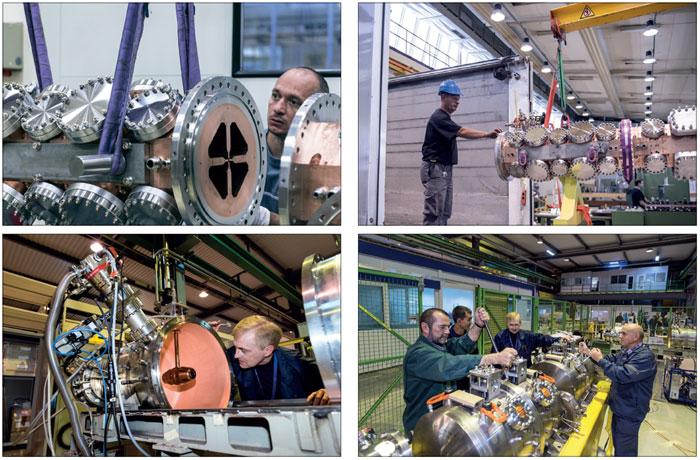
After a journey from Siberia of more than 13,000 km, a special delivery arrived at CERN on 14 September, bringing modules for Linac4, the new four-stage injector being built for the laboratory’s accelerator complex. A month earlier, the first major accelerating stage had made a shorter journey. Built entirely at CERN and designed in collaboration with CEA Saclay, the radio-frequency quadrupole (RFQ) was installed at the accelerator test stand in Building 152.

Linac4, which is the fourth hadron linac to be built at CERN, is set to replace Linac2 in 2017/2018 as the new first link in the acceleration chain for the LHC. Its four accelerating structures will increase the beam energy successively to 3 MeV, 50 MeV and 102 MeV before finally reaching 160 MeV. By accelerating hydrogen ions (H) instead of protons, Linac4 will bring several advantages. The use of H will enable injection into the PS Booster with essentially no losses and the increase in beam energy will allow a doubling of the maximum intensity from the Booster for the same emittance.

The 3-m-long RFQ will accelerate the beam from 45 keV to 3 MeV, directly from the source. The RF field not only accelerates the particles but also bunches them and provides longitudinal and transverse focusing, thereby defining the beam characteristics and the quality for the entire accelerator chain. The Linac4 team is currently performing the RF tuning of the RFQ cavity, while the ion source, which will provide protons for the tests, is being installed and connected. Once both of these steps have been completed, the team will begin testing the RFQ with beam.

The delivery from Siberia consisted of the first two of seven modules for a cell-coupled drift-tube linac (CCDTL). The first of its kind to be used in an accelerator, it will provide the energy increase from 50 MeV to 102 MeV. Weighing 2 tonnes each, the modules were disassembled into six components for transportation. Once at CERN, a visiting Russian team reassembled the modules before carrying out a series of tests. They repeated vacuum tests performed before the modules began their journey and made checks of radio-frequency properties and the alignment of the modules on their supports. Two further modules are due for delivery to CERN in December, while the final three will follow early next year.

The seven CCDTL modules took two and a half years to produce and were made entirely by a team outside CERN. The modules are the result of six years of close collaboration between two Russian research institutes: the All-Russian Institute of Technical Physics in Snezhinsk and the Budker Institute of Nuclear Physics in Novosibirsk, located in south-western and central Siberia. The collaboration was made possible by support from the International Science and Technology Centre, an intergovernmental organization set up in 1992 to help former weapons scientists redirect their skills towards peaceful activities.

• To keep up to date with news on the LHC, Linac4 and other developments, see The Bulletin, http://bulletin.cern.ch.

Celebrations, challenges and business as usual

CCnew2_09_12

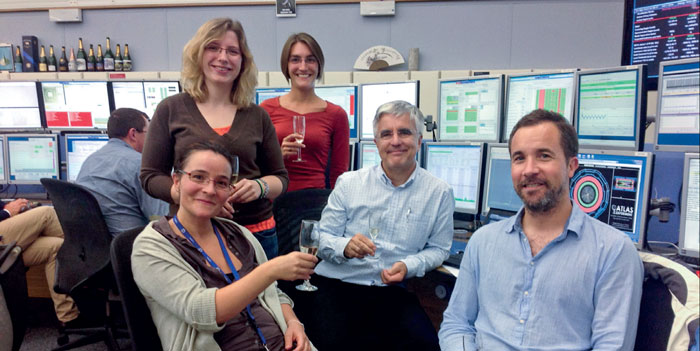
Champagne corks popped on 13 September as the LHC confirmed its potential as a multipurpose machine and successfully switched to a new running mode with proton–ion collisions. This achievement marked the first test with colliding beams in this mode, in preparation for the planned four-week proton–ion run in 2013.

Even though the LHC does not change magnetically, proton–ion operation is a challenge for the LHC RF system and its synchronization with the Super Proton Synchrotron. The proton and ion beams are injected and ramped with different RF frequencies; they then need to be re-phased and locked to provide a stable collision point. Despite a 36-hour break to repair a vacuum leak on one of the LHC wire scanners, the tests went well and the first 4 TeV proton–lead collisions were successfully recorded by the LHC experiments – an outstanding achievement for all of the teams involved (see Successful test of proton–ion collisions in LHCb).

A day later, the machine’s repertoire was extended further to collide “unsqueezed” proton beams at a β* of 1000 m (a measure of the envelope of the beam oscillations) at Points 1 and 5. This is to allow the ALFA and TOTEM experiments, co-located with ATLAS and CMS respectively, to probe proton–proton scattering at low angles (TOTEM extends study of elastic scattering). The tests were followed by a return to routine proton–proton collisions, with the integrated luminosity for the year passing 15 fb–1 in both ATLAS and CMS.

A five-day technical stop – the third this year – began on 17 September for scheduled maintenance and consolidation of systems, but with two out-of-the-ordinary interventions. These involved the replacement of the mirrors and supports of the beam synchrotron light monitors (BSRTs) and the replacement of one of the fast-pulsed kicker magnets used to inject the beam. The BSRTs had been put out of operation because of deformations caused by beam-induced heating. The injection magnets have also suffered from this heating, and waiting for them to cool down can delay the injection process by hours.

In total there are eight injection magnets in the machine. The “hottest” of these was replaced during the technical stop with a new version of the magnet with improved measures to reduce impedance. The LHC will gain some running time from this intervention, which will also allow the new design to be checked under operational conditions. The replacement of the injection magnet was carefully planned and executed successfully in four and a half days, requiring round-the-clock work from all of the teams involved.

It is always challenging to restart after a technical stop, with debugging, testing and requalification of all critical systems. A number of technical problems affected this recovery, which was further slowed down by the need to re-establish good vacuum conditions in the newly installed injection magnet. Once the so-called vacuum “scrubbing” was complete, the normal ramp-up in the number of bunches in the machine took place and nominal conditions were re-established on 30 September.

Despite the rocky restart, the LHC made a good recovery. On 6 October, an integrated luminosity of 286 pb–1 was delivered to the ATLAS and CMS experiments in the space of only 24 hours – a new record.

TOTEM extends study of elastic scattering

A year after publishing first results on proton–proton elastic scattering at a centre-of-mass energy of 7 TeV at the LHC, the TOTEM collaboration now has new measurements based on the analysis of data collected in October 2011. These latest results extend the measurement of the differential elastic cross-section to smaller values of |t|, the four-momentum transfer squared. They also allow a new determination of the elastic and total proton–proton (pp) cross-sections.

CCnew3_09_12

TOTEM, which stands for “TOTal cross-section, Elastic scattering and diffraction dissociation Measurement”, is optimized for making precise measurements of particles that emerge from collisions in the forward direction, close to the direction of the LHC beams. This allows it to probe physics that is not easily accessed by other LHC experiments, in particular elastic pp scattering down to small values of |t|. It detects protons scattered at small angles by using silicon detectors in Roman Pots – movable insertions in the beam pipe that allow the detectors to be brought closer to the beam.

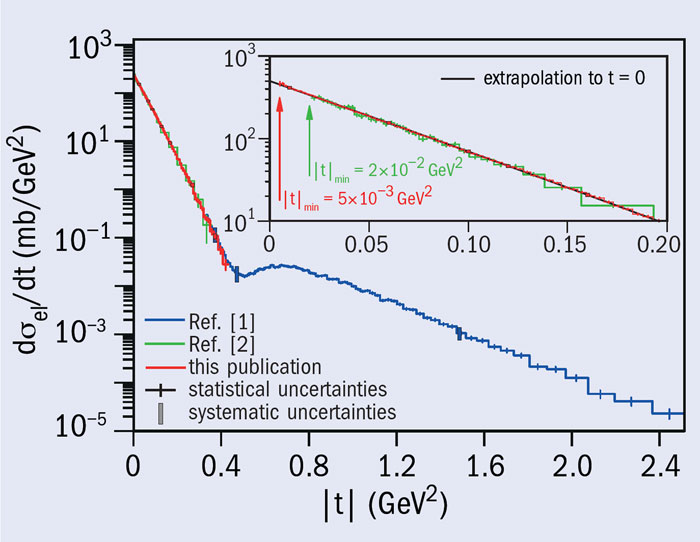
The first measurement of the differential elastic cross-section dσ/dt by TOTEM covered a range 0.36 < |t| < 2.5 GeV2, revealing features similar to those first observed at CERN’s Intersecting Storage Rings in the 1970s: a peak at low |t| with an exponential decrease leading to a pronounced dip, followed by a rounded peak that falls away as a power law. With the data taken in 2011, the collaboration has now extended the measurements down to 0.005 GeV2 – corresponding to scattering angles of some 20 µrad – enabling the observation of 91% of the elastic cross-section and further exploration of the exponential slope of dσ/dt at small |t|.

For these measurements, the Roman Pot detectors had to approach close to the beam centre – to a distance of around five times the transverse size of the beam – during a dedicated run in which the LHC beams were deliberately left relatively wide and straight as they collided, rather than being “squeezed” for maximum luminosity. This involved running the LHC with magnet settings such that the β function, which describes the envelope of the beam oscillations, had a value of β* – the distance to the point where the beam is twice as wide as at the interaction point – of 90 m.

The results show that the slope of dσ/dt remains constant down to 0.005 GeV2, so that an exponential fit with only one constant B = (19.9±0.3) GeV–2 describes all of the range 0.005 < |t| < 0.2 GeV2 (TOTEM collaboration 2012). The small error on B – a result of the high precision of the measurement and the large range of the fit – allows a precise extrapolation over the non-visible cross-section (the remaining 9%) to t = 0. Taken with the luminosity measured by the CMS experiment at the same interaction point, this gives an elastic pp cross-section of 25.4±1.1 mb at a centre-of-mass energy of 7 TeV and, using the optical theorem, yields a value for the total pp cross-section of 98.6±2.2 mb. In addition, the difference between the total and elastic cross-sections gives a precise indirect measurement of the fully inclusive inelastic cross-section, with no dependence on Monte Carlo models, notably in the low-mass extrapolation region.

The measurements are being repeated this year at a centre-of-mass energy of 8 TeV. In addition, the machine optics for a still larger β* of 500–1000 m is being developed, which will enable TOTEM to reach a value of |t| as small as 0.0005 GeV2. This is where the Coulomb and hadronic contributions to the differential cross-sections are about equal, allowing the study of Coulomb-hadronic interference and the determination of the ρ parameter (the ratio of the real to imaginary part of the forward hadronic scattering amplitude). The collaboration is also studying the possibilities for measurements of pp elastic scattering at high values of |t| because these could reveal further diffractive minima, as predicted by some models.

Successful test of proton–ion collisions in LHCb

CCnew6_09_12

Unlike the other three large experiments at the LHC, LHCb did not participate in heavy-ion runs in 2010 and 2011. This was because the forward region covered by the experiment, which corresponds to angles below 20° with respect to the beam axis, has been optimized for the study of heavy quarks in the proton–proton (pp) collisions that the LHC provides for most of the year. In the usual heavy-ion environment, i.e. the collisions of two lead-ion beams (PbPb), the density of tracks in this region would be so high that LHCb’s tracking detectors would be saturated with hits. However, the decision to run with proton–lead-ion (pPb) collisions for the next heavy-ion run opened the door for LHCb to participate, as the track occupancies would to be more similar to the usual pp running.

In the recent test of this mode of operating the LHC, collisions were provided for a few hours in the early morning of 13 September (Celebrations, challenges and business as usual). The LHCb detector worked perfectly during the test, as the figure shows, and it was exciting for the LHCb team to see this new category of events being recorded. The data were analysed quickly and clean signals were reconstructed for decays of KS and Λ decays (long-lived particles containing the strange quark). The signals were found to be even cleaner than equivalent ones extracted from pp data. This was to some extent expected, because the luminosity was low during the test run, so there were only single primary pPb interactions, whereas in pp running there may be four or more primary interactions in the same event in LHCb. However, once the signals had been normalized to the number of primary vertices, there still remained a factor of three or so enhancement in the pPb data compared with pp.

This is a first indication of the interesting physics that can be studied in the full pPb run, currently scheduled for early in 2013. With its high-precision vertex reconstruction and powerful particle-identification capabilities, the LHCb experiment should provide extra information to complement the measurements from the other experiments. In particular, the production rates of heavy-flavour states such as the J/ψ and Υ, or charmed particles, will be of interest in the forward region.

CEBAF: a fruitful past and a promising future

CCceb1_09_12

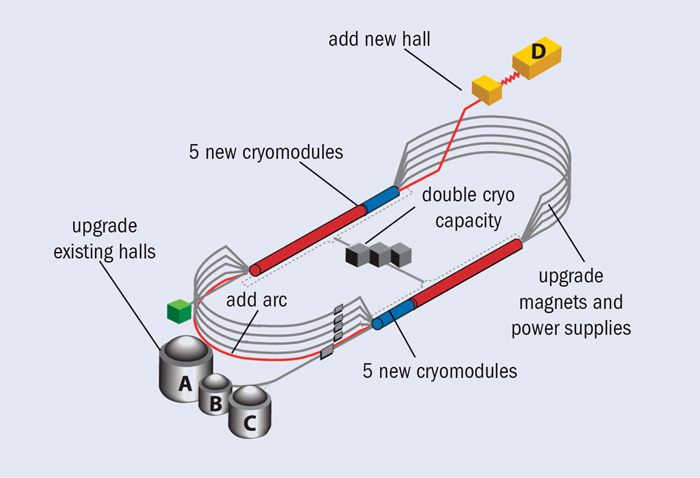
On 18 May, the US Department of Energy’s Jefferson Lab shut down its Continuous Electron Beam Accelerator Facility (CEBAF) after a long and highly successful 17-year run, which saw the completion of more than 175 experiments in the exploration of the nature of matter. At 8.17 a.m., Jefferson Lab’s director, Hugh Montgomery, terminated the last 6 GeV beam and Accelerator Division associate director, Andrew Hutton, and director of operations, Arne Freyberger, threw the switches on the superconducting RF zones that power CEBAF’s two linear accelerators. Coming up next – the return of CEBAF, with double the energy and a host of other enhancements designed to delve even deeper into the structure of matter.Jefferson Lab has been preparing for its 12 GeV upgrade of CEBAF for more than a decade. In fact, discussions of CEBAF’s upgrade potential began soon after it became the first large-scale accelerator built with superconducting RF technology. Its unique design features two sections of superconducting linear accelerator, which are joined by magnetic arcs to enable acceleration of a continuous-wave electron beam by multiple passes through the linacs. The final layout took account of CEBAF’s future, allowing extra space for an expansion.

Designed originally as a 4 GeV machine, CEBAF exceeded that target by half as much again to deliver high-luminosity, continuous-wave electron beams at more than 6 GeV to targets in three experimental halls simultaneously. Each beam was fully independent in current, with a dynamic range from picoamps to hundreds of microamps. Exploiting the new technology of gallium-arsenide strained-layer photocathodes provided beam polarizations topping 85%, with sufficient quality for parity-violation experiments.

Inside the nucleon

CEBAF began serving experiments in 1995, bombarding nuclei with the 4 GeV electron beam. Its physics reach soon far outstripped the initial planned experimental programme, which was historically classified in three broad categories: the structure of the nuclear building blocks; the structure of nuclei; and tests of fundamental symmetry.

CCceb2_09_12

Experiments exploring the structure of the proton led to the discovery that its magnetic distribution is more compact than its charge. This surprising result, which contradicted previous data, generated many spin-off experiments and caused a renewed interest in the basic structure of the proton. Other studies confirmed the concept of quark–hadron duality, reinforcing the predicted relationship between these two descriptions of nucleon structure. Other measurements found that the contribution of strange quarks to the properties of the proton is small, which was also something of a surprise.

Turning to the neutron, CEBAF’s experiments made groundbreaking measurements of the distribution of electric charge, which revealed that up quarks congregate towards the centre, with down quarks converging along the periphery. Precision measurements were also made of the neutron’s spin structure for the first time, as Jefferson Lab demonstrated the power of its highly polarized deuteron target and polarized helium-3 target.

Studies conducted with CEBAF revealed new information about the structure of the nucleon in terms of quark flavour, while others measured the excited states of the nucleon and found new states that were long predicted in quark models of the nucleon. High-precision data on the Δ resonance – the first excited state of the proton – demonstrated that its formation is not described by perturbative QCD, as some theorists had proposed. Researchers also used CEBAF to make precise measurements of the charged pion form-factor to probe its distribution of electric charge. New measurements of the lifetime of the neutral pion were also performed to test the low-energy effective field theory of QCD.

Following the development of generalized parton distributions (GPDs), a novel framework for studying nucleon structure, CEBAF provided an early experimental demonstration that they can be measured using high-luminosity electron beams. Following the upgrade, it will be possible to make measurements that can combine GPDs with transverse momentum distribution functions to provide 3D representations of nucleon structure.

From nucleons to nuclei

In its explorations of the structure of nuclei, research with CEBAF bridges the descriptions of nuclear structure from experiments that show the nucleus built of protons and neutrons to those that show the nucleus as being built of quarks. The first high-precision determination of the distribution of charge inside the deuteron (built of one proton and one neutron) at short distances revealed information about how the deuteron’s charge and magnetization – terms related to its quark structure – are arranged.

CCceb3_09_12

Systematic deep-inelastic experiments with CEBAF have shed light on the EMC effect. Discovered by the European Muon collaboration at CERN, this is an unexpected dip in per-nucleon cross-section ratios of heavy-to-light nuclei, which indicates that the quark distributions in heavy nuclei are not simply the sum of those of the constituent protons and neutrons. The CEBAF studies indicated that the effect could be generated by high-density local clusters of nucleons in the nucleus, rather than by the average density.

Related studies provided experimental evidence of nucleons that move so close together in the nucleus that they overlap, with their quarks and gluons interacting with each other in nucleon short-range correlations. Further explorations revealed that neutron–proton short-range correlations are 20 times more common than proton–proton short-range correlations. New experiments planned for the upgraded CEBAF will further probe the interactions of protons, neutrons, quarks and gluons to improve understanding of the origin of the nucleon–nucleon force.

High-precision data from CEBAF are also helping researchers to probe nuclei in other ways. Hypernuclear spectroscopy, which exploits the “strangeness” degree of freedom by introducing a strange quark into nucleons and nuclei, is being used to study the structure and properties of baryons in the nucleus, as well as the structure of nuclei. Also, the recent measurement of the “neutron skin” of lead using parity-violation techniques will be used to constrain the calculations of the fate of neutron stars.

CCceb4_09_12

CEBAF’s highly polarized, high-luminosity, highly stable electron beams have exhibited excellent quality in energy and position. Coupled with the state-of-the-art cryotargets and large-acceptance precision detectors, this has allowed exploration of physics beyond the Standard Model through parity-violating electron-scattering experiments. Currently, the teams are eagerly awaiting the results of analysis of the experimental determination of the weak charge of the proton.

A bright future

Although the era of CEBAF at 6 GeV is over, the future is still bright. Jefferson Lab’s Users Group has swelled to more than 1350 physicists. They are eager to take advantage of the upgraded CEBAF when it comes back online, with 52 experiments – totalling some six years of beam time – already approved by the laboratory’s Program Advisory Committee (Dudek et al. 2012).

CCceb5_09_12

Jefferson Lab is now shut down for installation of the new and upgraded components that are needed to finish the 12 GeV project. At a cost of $310 million, this will enhance the research capabilities of the CEBAF accelerator by doubling its energy and adding an additional experimental hall, as well as by improving the existing halls along with other upgrades and additions.

Preliminary commissioning of an upgrade cryomodule has demonstrated good results. The unit was installed in 2011 and commissioned with a new RF system during CEBAF’s final months of running at 6 GeV. The cryomodule successfully ran at its full specification gradient, 108 MeV, for more than an hour while delivering beam to two experimental halls. Commissioning of the 12 GeV machine is scheduled to commence in November 2013. Beam will be directed first to Hall A and its existing spectrometers, followed by the new experimental facility, Hall D.

Summer running at the LHC

The LHC has delivered more than twice as many collisions to the ATLAS and CMS experiments this year as it did in all of 2011. On 4 August, the integrated luminosity recorded by each of the experiments passed the 10 fb–1 mark. Last year, they each recorded data corresponding to around 5.6 fb–1. On 22 August this year, the more specialized LHCb experiment passed 1.11 fb–1, the same as its entire data sample for 2011.

The LHC’s peak luminosity had been running 5–10% lower following June’s technical stop. This was mainly owing to a slight degradation in beam quality from the injectors – an issue that was resolved at the beginning of August. The LHC had also been suffering from occasional beam instabilities, which have resulted in significant beam losses. A solution to this second problem lay in finding new optimum machine settings with the polarity of octupole magnets reversed relative to that of recent years. (The octupole magnets are used to correct beam instabilities.)

This reversal, accompanied by an adjustment of the settings in the sextupole magnets, was studied over several days in August. These changes paid off and the beams became more stable when brought into collision, so the bunch currents could be increased from 1.5 × 1011 to 1.6 × 1011 protons per bunch. With this increased bunch intensity, the peak luminosity in ATLAS and CMS reached more than 7.5 × 1033 cm–2 s–1, compared with the maximum peak luminosity of 3.6 × 1033 cm–2 s–1 in 2011.

In addition, successful commissioning of injection and RF-capture using new Super Proton Synchrotron optics (called Q20 optics) has opened the way for even higher bunch intensities. This new optics system has yet to be used operationally.

During the summer runs, the machine regularly enjoyed long fills in the 12- to 15-hour range. This showed the benefits of the extensive consolidation work to mitigate the effects of radiation to electronics in the LHC tunnel and the continuing efforts to improve overall reliability. The LHC is well on its way towards its goal of delivering in the order of 15 fb–1 in 2012. Indeed, at the beginning of September, CMS and ATLAS had already recorded more than 13 fb–1.

BELLA laser achieves 1PW at 1 pulse a second

CCnew12_08_12

The laser system of the Berkeley Lab Laser Accelerator (BELLA) has achieved a world record for laser performance by delivering 1 PW of power in a 1 Hz pulse only 40 fs long. No other laser system has achieved this peak power at such a rapid pulse rate. Although the laser’s average power is only 42.4 W, it achieves the enormous peak power in part through compression into an extremely short pulse. This laser system will drive the acceleration of electron beams in a metre-long plasma channel, with the aim of reaching 10 GeV for the first time with a laser-driven plasma accelerator.

BELLA, conceived of in 2006 by Wim Leemans, head of the Lasers and Optical Accelerator Systems Integrated Studies programme (LOASIS), is nearing completion at the Lawrence Berkeley National Laboratory (LBNL). The facility builds on previous experiments on laser-driven plasma acceleration by the LOASIS programme. It promises to pave the way for developing compact particle accelerators for high-energy physics, as well as table-top free-electron lasers for investigating materials and biological systems. Experiments to demonstrate the production of 10-GeV electron beams are now beginning.

Proton run for 2012 extended by seven weeks

CCnew2_07_12

An important piece of news that was almost lost in the excitement of the Higgs update seminar on 4 July is that the LHC proton run for 2012 is to be extended. On 3 July, a meeting between CERN management and representatives from the LHC and the experiments discussed the merits of increasing the data target for this year in the light of the announcement to be made the following day (4 July: a day to remember). The conclusion was that an additional seven weeks of running would allow the luminosity goal for the year to be increased from 15 to 20 fb–1. This should give the experiments a good supply of data to work on during the LHC’s first long shut-down as well as allow them to make progress in determining the properties of the new particle.

The original schedule foresaw proton running ending on 16 October, with a proton–ion run planned for November. In the preliminary new schedule, proton running is planned to continue until 16 December, with the proton–ion run starting after the Christmas stop on 18 January 2013 and continuing until 10 February.

The PS Booster hits 40

CCpsb1_07_12

On 26 May 1972, the PS Booster (PSB) accelerated its first protons to the design energy of 800 MeV. The running-in team, led by Heribert Koziol, had prepared for this event by already sending beam from the 50 MeV Linac1 through the PSB injection line while the geometers were still busy aligning the ring magnets. Just five months later, the team succeeded in accelerating at half of the design intensity. This achievement was a great relief for the entire staff of the then Synchrotron Injector (SI) division, led by Giorgio Brianti and his deputy, Helmut Reich. However, the path to full intensity proved unexpectedly tough.

The concept of the PSB dates from the mid-1960s, when CERN’s 26 GeV Proton Synchrotron (PS) was getting into its stride and new and demanding clients – the Intersecting Storage Rings (ISR) and the Super Proton Synchrotron (SPS) – were on the horizon. By then, ideas to improve the performance of the PS by raising its output beam intensity from 1012 to 1013 protons per pulse (ppp) were already being considered.

Boosting intensity

Particles in synchrotrons suffer from resonances generated by residual imperfections of the magnetic guide (dipole) and focusing (quadrupole) fields, in particular for certain values of the “tunes” QH, QV (the number of horizontal/vertical oscillations per machine turn). Simple relations of the type mQH + nQV = p, with m and n small integers, are harmful “stop-bands” and must be avoided. In addition, high-intensity beams experience space charge, where the repulsive Coulomb force works against the external focusing and leads to a “Laslett tune-spread”, ΔQ. Studies at the PS (and also at the Alternating Gradient Synchrotron at Brookhaven) established that intensities leading to ΔQ > 0.25 (“space-charge limit”) cannot be digested at injection because they do not keep clear of stop-bands up to order |m| + |n| = 4. At higher (relativistic) energies, the repulsive force becomes weaker while the beam also gets stiffer – so that ΔQ shrinks with rising energy, scaling with 1/βγ2. Therefore, increasing the PS injection energy from 50 to 800 MeV would potentially boost its beam intensity by an order of magnitude.

CCpsb2_07_12

After a study led by the late Werner Hardt of several variants, including a 200 MeV linac and a rapid-cycling synchrotron, a slow-cycling 800 MeV booster synchrotron consisting of four superposed rings was adopted. Its injection energy would still be 50 MeV but each of the four rings could be filled up to the same space-charge limit as the whole PS ring, yielding a factor of 4. In addition, slow cycling would allow for longer bunches, yielding a further factor of 1.5. Hence, the new machine would accommodate – at 50 MeV – 1013 ppp rather than the 1.6 × 1012 ppp accelerated in the PS.

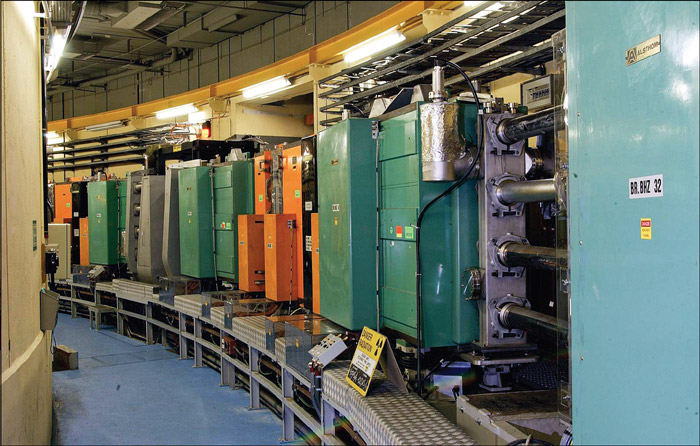
The four rings stacked on top of each other (figure 1), with a radius of 25 m (1/4 of the PS), consist of separate dipoles and quadrupoles (“separated function” magnets) – in contrast to the PS, which has “combined function” dipoles that incorporate gradients. Each of the 32 dipoles and 48 quadrupoles consists of a vertical stack of four magnets with a common yoke, enabling one main power supply to provide the current to all of them in series. An elaborate system of correction loops allows adjustment of the guide and focusing fields in each of the four rings. The 50 MeV beam from Linac1 is distributed vertically and multiturn-injected into each ring. Originally, the RF system for the PSB accelerated five bunches per ring (RF harmonic number h = 5) to an ejection energy of 800 MeV. After being synchronized, the five bunches were horizontally extracted and recombined vertically to form a string of 20 bunches, corresponding to the harmonic number of the PS’s RF system. The transverse optics (“lattice”) of the PSB ring, as well as the injection system and the recombination/transfer line (figure 2), were all designed by the late Claude Bovet.

Construction of the PSB started in 1968, with the centre of the machine lying exactly on the Swiss-French border. Many novel technological challenges had to be addressed, such as: unprecedented requirements on field quality and equality between the superposed magnet gaps; “kicker” magnets with rapid rise/fall times; and stable and reliable power converters operating directly from the grid. The ambitious aims for beam intensity and quality demanded special efforts for mechanical stability, beam diagnostics, vacuum equipment, radiation protection, assuring hands-on maintenance, and general reliability. Moreover, the PSB served as a “guinea pig” for the then innovative computer-control system aimed at monitoring all of the machine parameters.

Design intensity – and beyond

While the quick initial success of the running-in testified to the soundness of the basic choices and the high quality of the construction work, major difficulties later hampered the progress towards design performance. The first was a strong energy-jitter of the beam from Linac1, which was eventually stabilized at the expense of the beam current (50 mA instead of the 100 mA that was specified). With the help of experienced accelerator physicists, Jacques Gareyte and the late Frank Sacherer, the obstacles were addressed one by one. The “working point” (QH, QV) was moved from around (4.8, 4.8) to (4.2, 5.3), mitigating transverse beam blow-up caused by repeated stop-band crossing arising from the synchrotron motion of the protons within the bunch. Furthermore, a fast change of the working point during acceleration proved beneficial, profiting from the shrinking ΔQ (figure 3). Destructive coherent bunch-oscillations were stabilized by “Magnani shaking” and later by a coupled-bunch feedback system. A first pay-off came in 1973, when the search for neutral currents with the Gargamelle bubble chamber benefitted from the increased supply of protons from the PS with the PSB as injector. By 1974 the PS reached 1013 ppp – the design performance of the upgrade programme.

CCpsb3_07_12

However, this is not the end of the story. By 1978, the new Linac2 – still at 50 MeV but with 150 mA beam current – replaced Linac1 and dramatically increased the PSB’s potential, although it took a couple of years to exploit this improvement fully. Installing multipole correctors to eliminate stop-bands allowed intensities with larger tune-spread to be accommodated. The addition of “bunch-

flattening cavities” in the PSB, fostered by the late George Nassibian, lowered the peak density of the bunches and thus ΔQ, enabling an intensity some 25% higher to be accepted. Fast feedback systems compensating unwanted excitations by the bunches on the cavities (“beam loading”), as well as transverse dampers, also proved beneficial, culminating in the PSB’s acceleration of 3 × 1013 ppp by 1985. Now the PS was at pains to digest this beam at 800 MeV, in particular the high-density proton bunches for antiproton production, which were obtained by simultaneously ejecting two PSB rings and adding the bunches vertically in the recombination line, almost doubling their line density. To cope with this, the PSB was promoted to a 1 GeV machine after minor hardware modifications, increasing the PS space-charge limit by a further 25%.

Experiments involving light ions became popular in the early 1980s and the old Linac1 was successfully converted to accelerate oxygen and sulphur ions, deuterons and alpha particles. The PSB followed suit. However, the issue now was not too high an intensity but one that was very low (by three orders of magnitude), which together with new acceleration frequencies challenged the beam diagnostics and RF systems. The low-intensity ion cycles had to be added to the supercycle – during which all beam parameters are modified from cycle to cycle to adapt to the requirements of the end-users. With the advent of a dedicated ion accelerator, Linac3, the PSB made its way up the periodic table to reach lead and, later, indium ions.

When CERN’s first accelerator – the venerable 600 MeV Synchrocyclotron, by then feeding the ISOLDE online separator with protons – came to the end of its life after 33 years of meritorious services, ISOLDE looked for a new source. Following the suggestion to use the PSB’s 1 GeV beam on the many spare cycles available, ISOLDE was relocated at the PSB in 1992: an experimental area of its own was the coming-of-age present for the Booster’s 20th anniversary.

Fit for the LHC

It is a CERN tradition that new machines use existing accelerators as injectors, and the LHC is no exception. Clearly, all of the accelerators of the proton-injector chain – Linac2–PSB–PS–SPS – had to undergo major upgrade programmes to be fit for the new machine. Among the requirements, the beam would have to fit into the tiny LHC aperture while having sufficient intensity to ensure high-luminosity operation. However, this implied a beam-brilliance at injection into the PSB that would lead to an unrealistic space-charge detuning of ΔQ up to 1. This could be reduced to a more acceptable 0.5 by two-batch filling of the PS, but only if each batch could be squeezed into one half of its circumference. Accelerating one rather than five bunches in each PSB ring and applying clever timing of the ejection/recombination kickers made this feasible, although the first batch in the PS has to dwell for 1.2 s on the 1 GeV “front porch”, proving vulnerable to space-charge effects.

A further improvement came from increasing the PSB–PS transfer energy to 1.4 GeV, reducing ΔQ in the PS to 0.2, well below the space-charge limit of 0.25, owing to the 1/βγ2 scaling. Upgrading a machine built for 800 MeV to 1.4 GeV was no minor task. It involved a new main power supply, increased water cooling and a partial renewal of the magnets and their power supplies in the transfer line to the PS. The rings had to be equipped with new h = 1 (2 MHz) cavities and as well as recycled h = 2 (4 MHz) cavities, the former accelerating one bunch in each ring, the latter for bunch flattening or accelerating two bunches a ring for some users. The lion’s share of this upgrade was provided by Canada as part of its contribution to the LHC. Installation of the new hardware in both the PSB and the PS was completed by early 2000 and after a short running-in period the PS complex demonstrated its capability to supply the beams required by the LHC.

CCpsb4_07_12

Owing to its unique four-ring structure, the PSB is a versatile machine that can deliver beams of different energy, intensity, density, shape or time-structure to many users, cycle after cycle. These are grouped in supercycles of various lengths that are adapted to the operation programme. Just for the LHC, some 10 different beams were prepared and made ready to work, all of them with their own intensity (over the range 5 × 109 – 6.5 × 1012 ppp) and emittance characteristics. Other cycles produce up to 3.7 × 1013 protons for ISOLDE, around 2.5 × 1013 protons for the CERN Neutrinos to Gran Sasso project, 1.5 × 1013 protons with small emittances for the Antiproton Decelerator or intensities as low as 2 × 1011 protons for slow extraction from the PS. In particular, the versatility of the recombination line enables the bunches from the four rings to be furnished with different distances between them to satisfy the requirements of the users.

By around 2003, two modifications to beam optics were proposed and put into operation. First, the optics of the 50 MeV injection line were improved so that the dispersion and its derivative vanish at the injection point. This reduces the beam size and the losses in the last leg of the line (where the acceptance was limited) without perturbing the injection efficiency. Second, the working point of the machine was changed to avoid the systematic resonance 3QV = 16, which limited the performance of the outer rings 1 and 4. The quadrant (QH, QV) = (4.2, 4.3) instead of (4.2, 5.3) proved able to accommodate the enormous tune-spread ΔQ of 0.6 (using the same dynamic tune-change during the cycle) despite its apparent drawbacks: namely, the presence of the “Montague” coupling resonance 2Q– 2QV = 0 and the systematic resonances 4QH,V = 16. As a result, the PSB reached a record of 4.2 × 1013 protons accelerated, with the four rings having similar performances (figure 4).

By 2006, when construction of the LHC was in full swing, the operation teams of all of the accelerators moved to a common control room – the CERN Control Centre – to increase the operational efficiency of the LHC and its injector chain. For the PSB team, this meant a change in culture owing to the larger distance between the PS complex and the new control room. However, the merging of the teams proved invaluable for the running-in and operation of the LHC, which uses all of the prepared beams.

The future

The need for beams for the LHC with parameters even more demanding than what is provided today, together with the decision to operate the existing injector complex throughout the lifetime of the LHC, has triggered a major consolidation and upgrade project. As far as the PSB is concerned, the upgrade programme consists of two parts: modifications of the injection for 160 MeV charge-exchange injection from the new Linac4; and an energy upgrade of the PSB rings and extraction/transfer systems to 2 GeV.

CCpsb5_07_12

The benefits of switching from Linac2 (50 MeV protons) to Linac4 (160 MeV H) are twofold. With the increase of beam energy from 50 to 160 MeV, the relativistic βγ2 factor increases by a factor of two – doubling the intensity that can be accumulated within a given emittance and hence beam brilliance (ratio intensity/emittance). The other significant benefit is expected from changing the injection scheme to charge-exchange injection (figure 5). While the current multiturn injection is associated with a beam loss of up to 50% of the intensity on the injection septum, the new scheme will essentially be loss-free (apart from a few per cent owing to the stripping efficiency). Moreover, the new injection scheme will make it possible to tailor emittances by means of “phase-space painting” according to the needs of individual users.

The aim of the further energy upgrade of the PSB to 2 GeV is to reduce space-charge effects at injection into the PS, removing once more this bottleneck in the LHC injector chain. This should increase the beam brilliance throughout the LHC injector chain so that the LHC can reach its ultimate luminosities. The expected gain can be deduced from the values of βγ2 at 2.0 GeV and 1.4 GeV; the factor of 1.63 corresponds to an intensity increase of 60% within given emittance values.

The upgrade to 2 GeV will be the third energy increase in the history of the PSB, having gone in steps from 800 MeV to 1 GeV and then to the current 1.4 GeV. The most important technical challenges will be the operation of the main magnets at field levels that are 30% higher than those at 1.4 GeV, together with the replacement of the main power supply, as well as the upgrade of the extraction and recombination system. Also, many components need modification or replacement to operate in the new parameter range. Following completion of the upgrade, the PSB will – in many parts – be a new machine, without losing its current versatility.

In its 40-year history, the PSB has undergone several upgrades and is today operating with its highest availability and flexibility, and far beyond its original design specifications. The ongoing consolidation and upgrade programme aims to operate the PSB throughout the lifetime of the LHC. This will ensure that it remains one of CERN’s backbone accelerators for the foreseeable future.

bright-rec iop pub iop-science physcis connect