3 June 1999 will mark 50 years since the first beam was accelerated at the Harvard Cyclotron Laboratory (HCL). Originally built for physics research, the lab switched direction and went on to play a dominant role in the development and application of charged-particle radiation therapy.
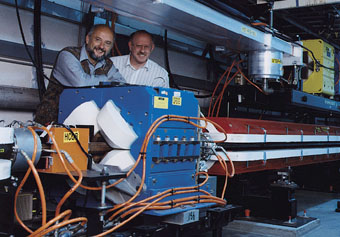
The first Harvard cyclotron, built in 1937, was taken to Los Alamos for the Manhattan Project in 1943 and never returned. Planning for the present lab began in 1946 with the involvement of Kenneth Bainbridge, Robert R Wilson, J Curry Street and Edward M Purcell as well as R W Hickman, then Director of the Physics Laboratory. The US Office of Naval Research (ONR) funded the machine while Harvard paid for the building. Figure 1 shows HCL Deputy Director Lee Davenport and Norman Ramsey, Chairman/Director of the Physics Department’s Cyclotron Committee, with the machine just before its dedication on 15 June 1949. Harry Truman was starting his second term as US President, television and FM radio were gaining in popularity and commercial transistors were still a few years away.
In the synchrocyclotron boom of the 1940s and 50s, the Harvard machine was for a time the third largest in the USA. The 14 foot diameter magnet coils were shipped edgeways from General Electric in western Massachusetts using one of the two deepest flat well railroad cars in the country. The lowest bridge on this route dictated the size of the cyclotron!
Initially the proton energy was 95 MeV, with only weak (scattered) external proton and neutron beams. Many experiments used the internal beam. The physics programme was a mix of proton-nucleus and nucleon-nucleon experiments at what we now call medium energy: much greater than nuclear binding, but below particle production. Counter, emulsion and activation techniques were used. Experimenters included Norman Ramsey, Ralph Waniek, Walter Selove, Jim Meadows and Karl Strauch.
Throughout the physics period there was a host of graduate students, many later achieving recognition in high energy and other fields of physics. Eventually HCL produced some 30 PhD theses and countless articles. William M Preston was named Director in 1953. In the same year Andreas M Koehler arrived, and eventually became de facto Technical Director and chief troubleshooter.
A young British physicist, Richard Wilson, arrived in 1955 to apply the new “regenerative extraction”. HCL emerged from that one-year upgrade the only substantial shutdown in 50 years with 160 MeV protons and external polarized and unpolarized proton beams of respectable intensity.
The physics programme grew steadily, peaking around 1958 with 38 personnel. The annual report for that year describes a new ion source (Koehler), quasi-elastic proton-proton collisions and inelastic proton cross-sections (Strauch et al. ), various polarized proton scattering experiments (Cormack, Palmieri, Ramsey and Wilson et al. ), proton triple scattering (Wilson et al. ) and protondeuteron scattering (Wilson et al. ). Eventually a quasi-monoenergetic neutron beam was built (Measday). The last major physics upgrade was a stochastic extraction system to improve the beam duty factor, leading to the first observation of proton proton bremsstrahlung in 1965 (Gottschalk et al.).
A Medium Energy Electron Cooling workshop (MEEC98) organized recently by the Joint Institute for Nuclear Research (JINR), Dubna, brought together specialists from all over the world, including many of the Novosibirsk cooling pioneers. From Gersh Budker’s initial idea, electron cooling has undergone more than 30 years development. 10 cooler rings are in operation and electron cooling has become a routine tool.
Simon van der Meer’s stochastic cooling scheme has been the technique of choice for controlling proton and antiproton beams of energy higher than about 0.5 GeV (even though its cooling time increases with the intensity). Higher intensities have meant that electron cooling (less dependent on the particle intensity) has had to rise to a new challenge.
In the standard scheme, an electrostatically accelerated (maximum energy 300 keV), magnetically confined electron beam at low temperature is merged with an ion beam in a straight section of the storage ring. The progress concerns mainly an increase of the magnetic field quality and the generation of an intense electron beam at extremely low temperature beam expansion by a factor of up to 8 (at SIS, GSI Darmstadt), 20 (ASTRID, Aarhus), 25 (TSR, Heidelberg), 100 (Cryring, Stockholm and TARN II, Tokyo).
The first proposal to use electron cooling with MeV-range electrons came from Novosibirsk (Kuksanov, Meshkov, Salimov et al., 1986) where a prototype at 1 MeV electron energy was constructed. A 1 amp DC electron beam was obtained in an energy recuperation scheme.
MEEC’s first
The first MEEC project, based on a proposal by T Ellison at Bloomington, Indiana, aimed to increase the luminosity in the ill-fated US Superconducting Supercollider by electron cooling 12 GeV protons in the Medium Energy Booster for that project. Presently the electron cooling of GeV ions is an integral part of a number of modern projects.
At Fermilab, the Tevatron luminosity upgrade programme includes the electron cooling of 9 GeV antiprotons in the Recycler ring to compensate for beam heating during stacking. Electron cooling of 1020 GeV protons in the PETRA storage ring at DESY aims to halve the emittance and boost luminosity in the downstream HERA collider. Electron cooling is also planned to boost luminosity in electronion and ionion collisions at ion energies up to 1.5 GeV/nucleon for light ions and 3.5 GeV for protons in the MUSES project of the Japanese RIKEN radioactive ion beam factory (construction of the first stage of which began in 1998).
Getters are materials with a strong affinity for gases which molecules stick to like fluff to sticky tape. At CERN’s Large Electron-Positron collider, LEP, getters provide ultra-high vacuum. Now a new thin-film alloy developed at CERN promises even better vacuum, and could also spell good news for avid television watchers.
Since the advent of particle storage rings, high-energy physics and vacuum technology have advanced hand-in-hand. Storage rings demand high vacuum so particle beams are not lost through collisions with stray gas molecules, and getter pumps are commonly used. The most widely used getters in accelerators work by heating a titanium filament causing sublimation, the direct conversion of titanium metal to gas. This gas is then deposited on the surrounding vacuum vessel where it traps stray gas molecules in the vacuum chamber.
These so-called sublimation pumps provide a localized pumping action, whereas particle accelerators require distributed pumping. In the 1970s Cris Benvenuti addressed this problem by developing a new way of using getters for CERN’s LEP. The accelerator’s main pumping system is provided by linear strips of non-evaporable getters, NEGs, which cover 23 kilometres of the accelerator’s 27 kilometre ring. They are made of a zirconium-aluminium alloy which is activated by heating to 750 °C. Instead of sublimating the gettering material, heating gives the oxygen enough energy to diffuse into the bulk material, leaving a clean surface to trap any residual gas inside LEP’s beam pipe.
In LEP, vacuum is established by sealing the accelerator’s vacuum chamber, heating to around 150 °C to remove any residual water vapour – the so-called “bake-out”, and pumping with conventional suction pumps. Baking out at 750 °C is not possible, however, because it would damage the vacuum chamber. A gettering material which could be activated at a lower temperature would obviate the need for electrical heating, and thus the need for electrical insulation from the beam pipe.
In the 1970s, the world’s foremost manufacturer of getters, SAES Getters in Milan, developed a gettering material which is activated at 400 °C. This is now widely used in steel vacuum systems which can withstand a high bake-out temperature. In particle accelerators, however, lighter materials are often required. LEP’s vacuum chamber, for example, is made of aluminium and 200 °C is the bake-out limit. Another technology brought to fruition by Benvenuti’s team has provided a way forward. The cavities which pump energy into LEP’s beams rely on superconducting niobium. Early cavities are made of solid niobium, but since only a thin layer is needed, Benvenuti’s team set to work on techniques to coat copper cavities with niobium to the high degree of uniformity required. Their work has resulted in over 90% of the accelerator’s superconducting cavities being made from niobium-coated copper, whilst only 20 are made from solid niobium.
With Benvenuti’s long association with vacuum, it was not long before his team turned its thin-film experience to the gettering question. Three years of development have resulted in two patents and a zirconium-vanadium-titanium alloy, discovered earlier this year, which is fully activated after 24 hours at 200 °C, low enough for any vacuum chamber’s bake-out. Moreover, this new alloy can be used as a thin-film coating of the vacuum chamber walls which gives the added bonus of effectively eliminating or strongly suppressing out-gassing from the underlying vacuum chamber. CERN’s next major accelerator project, the Large Hadron Collider, is currently evaluating the new alloy with a view to using it in certain sections of the accelerator. So what of that good news for television fans? Flat-screen displays are a much-touted new technology, but they have yet to make a significant impact on the market. Liquid-crystal displays are currently the most common, but they are expensive. An alternative technology is field-emission displays, FEDs. These work by using a single field-emission diode to illuminate each pixel of the screen, and they require ultra-high vacuum to work. Benvenuti’s zirconium-vanadium titanium alloy could be just the ticket.
This article was adapted from text in CERN Courier vol. 38, December 1998, pp21–23
In 1987 CERN’s European Muon Collaboration (EMC) revealed a puzzle that has been intriguing particle physicists ever since. The EMC measurements implied that the constituent quarks accounted for only some 30% of the nucleon spin. If the nucleon spin is not carried by quarks, where does it come from?
Several subsequent experiments at CERN and SLAC (Stanford) have given a more precise fix of this total quark contribution to the spin, but without being able to find where or what the missing spin is.
This is where HERMES comes in, a second-generation experiment at DESY’s HERA electron-proton collider which aims to study the origin of nucleon spin via electronnucleon scattering in which both the beam and target particles are spin-oriented (polarized). HERMES does not use HERA in its usual collider mode. It uses instead HERA’s electron (or positron) beams with a specially-designed target, and does not use the HERA proton beam.
Now well into its fourth year of data-taking, HERMES has demonstrated the validity and potential of its new approach and is now taking its first steps towards a solution of the spin puzzle by presenting a preliminary separation of the contributions of the individual quark flavours to the nucleon spin.
At collision energies where contributions due to the weak nuclear force are small enough to be neglected, a polarized electron or positron scatters off a polarized nucleon via the exchange of a virtual photon, which carries polarization from the incoming electron. Due to angular momentum conservation, this photon can interact with a quark in the nucleon only if this is polarized in the opposite direction.
The different spin orientations of beam and target, obtained by flipping the target polarization back and forth, reveal asymmetries in the different reaction rates which eventually yield the spin distributions of the nucleon’s constituents.
As well as its three valence quarks, the overall spin of the nucleon has contributions from its accompanying “sea” quarks and antiquarks, the gluons (which hold the quarks together), plus quark and gluon orbital angular momenta.
Up to now, most experiments have focused on measuring “inclusive” polarized lepton-nucleon scattering, where only the scattered lepton (electron or muon) is detected. This gives only an “overall” spin structure of the nucleon the spin carried by the quarks as a whole, without resolving the individual contributions of each quark.
The great power of HERMES lies in its ability to detect and identify the emerging hadrons in coincidence with the scattered lepton. Since high-energy forward-scattered hadrons are correlated with the struck quark, these hadrons “tag” the flavour of the struck quark. The contributions to the nucleon spin are determined not as a whole, but are separated into the individual quark flavours.
The electrons pass through the gas target repeatedly, yielding plenty of clean data with minimal background contamination by scattering off other polarized or unpolarized nuclei (as is the case with solid targets).
Approved in 1993, the detector – a forward angle spectrometer of conventional design was assembled in the HERA East Hall during winter 1994/95 and commissioned in early summer 1995. It uses HERA’s 27.5 GeV electron/positron beam, naturally polarized transverse to the beam direction. Up- and downstream of HERMES, a pair of spin rotators turns the spins into the longitudinal and back to the transverse direction at every revolution a world premiere in a high-energy electron storage ring first achieved in 1994. This was an absolute precondition for the operation of HERMES.
The HERMES target consists of nuclear polarized gas fed into a thin-walled storage cell inside the HERA electron/positron ring. This new technique increases the surface target density by a factor of 100 compared to a free atomic beam, and allows high target polarization levels without dilution from unpolarized nuclei.
To minimize systematic errors, the target spin orientation is reversed at random intervals. So far, HERMES has been running with polarized helium-3 (1995) and hydrogen targets (1996-97), and deuterium in 1998. The target cell can also be filled with unpolarized gases for the investigation of further nucleon properties unrelated to spin.
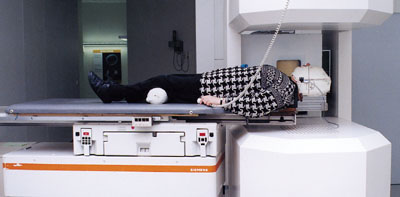
“A bridge has been established between fundamental research and its applications, ” said Hessen State Minister for Science and Art, Christine Hohmann-Dennhardt, speaking at the official inauguration of a new cancer therapy facility at the German national heavy-ion physics laboratory, GSI in Darmstadt, on 15 September. The facility uses carbon ions from GSI’s heavy-ion synchrotron, SIS, to target traditionally difficult-to-operate tumours. The first two patients were treated at GSI last December and are tumour-free. A further nine patients underwent a successful course of therapy in August.
Cancer is second only to cardiovascular disease in the grisly league table of fatal illness. Gene therapy holds out the hope for a cure in the long-term, but in the short-term traditional methods of surgery, chemotherapy and radiotherapy must be used. GSI’s new carbon-ion facility adds a new string to the radiotherapist’s bow, allowing tumours in sensitive areas to be targeted safely and effectively.
The idea of using particle beams for cancer therapy is not new. In 1946, Bob Wilson first realized the potential of the technique when he observed that, unlike photons or electrons, proton beams deposit most of their energy at the end of their paths in the so called Bragg peak. This opened up the possibility of targeting deep-seated tumours, or tumours close to sensitive organs, with much reduced risk to surrounding healthy tissue, by making the dose conform more closely to the volume of the tumour.
The first treatments were performed in 1954 when John Lawrence, Ernest Lawrence’s brother, treated patients with proton beams at Berkeley’s 184-inch synchrocyclotron. Three years later the same laboratory scored another first by turning helium ions to therapeutic use. And Berkeley’s pioneering role wasn’t confined to the United States. In 1956 Lawrence’s friend and colleague Cornelius Tobias was a guest scientist in Sweden. Working with Lars Leksel and Borje Larsson at Uppsala, he helped initiate a programme of surgery and therapy using protons from the University’s cyclotron.
Pioneering
Harvard’s cyclotron laboratory has the longest continuous history of using proton beams to treat patients. The first patients arrived in 1961 and the facility will remain in use until all treatments are transferred to the Northeast Proton Therapy Center, scheduled to receive its first patients in February 1999. Then, having treated over 7000 patients, the Harvard cyclotron will take a well-earned retirement.
The main limitation of these pioneering efforts has been the lack of techniques for shaping the beam Even today particle therapy units use mainly passive beam-shaping systems, such as absorbers or collimators, adapted from photon therapy. These shape the irradiated volume to match a target volume identified by tomographic imaging techniques. Passive methods, however, only permit the same limited conformation of dose to tumour that can be reached with conforming photon therapy.
The GSI facility is the first to provide extremely precise tumour conformity using magnetic beam scanning in two dimensions and by actively varying the energy of the accelerator to give the third dimension. Beam delivery is based on a novel, fully three dimensional, treatment planning system that takes into account the differences in biological efficiency of the beam in different tissues as well as so-called early and late effects. Early effects essentially tumour cell killing are maximized, while late effects complications in healthy tissue are minimized.
After Berkeley and Japan’s Heavy Ion Medical Accelerator, HIMAC, in Chiba, GSI becomes the world’s third ion therapy centre. The laboratory is a relative latecomer to the field, but development of the innovative beam delivery system and treatment planning based on a more profound understanding of radiobiological particle action took more than a decade of intense experimental work. When GSI switched on its first accelerator in 1975, radiation biology experiments were among the first to be performed. Their initial goal was to investigate the biological effects of cosmic radiation during space flight, but the results have been fed into the modern therapy programme. They showed, in what has come to be known as the “Darmstadt hook”, that the microscopic structure of the energy deposition process is far more important in determining biological effects than distinctions between biological systems.
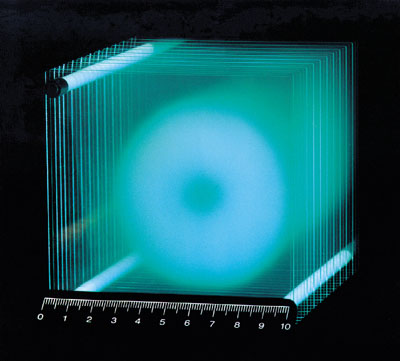
GSI’s fully active beam-scanning system works on much the same principle as a television set, where the picture is built up of lines consisting of individual pixels. Instead of a flat, regular screen, the GSI beam plays on a three-dimensional, irregular tumour. The scanning process, however, is very similar. The tumour is mapped and divided into 3-D pixels, the number of necessary particles is calculated for each pixel, and the beam targeted at that pixel until the calculated number has been delivered.
The deepest layers are targeted first and the energy of the beam is then reduced by the accelerator to position the Bragg peak on successively shallower layers. This procedure requires extremely reliable accelerator operation guaranteeing spatial beam stability of better than one millimetre at the target. Energy and intensity are changed from pulse to pulse, which for the SIS means within a second. To guarantee the required accuracy, an independent control system monitors the beam’s position every 100 microseconds and its intensity every 10 microseconds. If either deviates by more than 2% from what is expected, the beam is shut off within half a millisecond.
Such strict operating conditions are far beyond what is required from the SIS in its regular research role, but routine patient treatment has shown that the accelerator is up to the task. Just a handful of interruptions per day have been provoked by the control system during treatments involving the targeting of tens of thousands of pixels.
GSI in profile
The Darmstadt GSI heavy-ion laboratory is most famous for its discoveries of transuranic elements numbers 107 to 112. These were filtered out from the fusion products resulting from collisions between a heavy-ion beam from the universal linear accelerator, UNILAC, and a target of lead or bismuth.
Element 107, named bohrium after Danish physicist Niels Bohr, was discovered in 1981. Hassium, named after the state of Hessen, followed in 1983, and meitnerium, named after Austrian physicist Lise Meitner, came in 1984. Elements 110 to 112 were discovered between 1994 and 1996 and have yet to be named.
Elements 113 and 114, a predicted hidden “valley of stability” are next on the laboratory’s hit-list. GSI’s main research theme is the investigation of hot, dense nuclear matter in the collisions of heavy ions with stationary targets.
This began in 1975 at the UNILAC which has today been joined by the SIS and the experimental storage ring, ESR. Heavy-ion research has implications for basic nuclear physics as well as for astrophysics and the properties of neutron stars. In
another strand of research using the ESR, scientists can strip off the electron shells from even very heavy atoms. This allows them to study quantum electrodynamics the most precise theory in physics to unprecedented levels of accuracy.
Although GSI is primarily a pure science laboratory, the tumour therapy work is not the only domain of applied physics under study there. Plasma physics, particularly with the goal of producing energy generation through heavy-ion-driven inertial confinement fusion, is also an important part of the laboratory’s work.
As physics experiments get more ambitious, the detectors they use have to keep pace in 1913 Geiger counters, in 1968 Georges Charpak’s multiwire chambers, and more recently, Anton Oed’s microstrip gas chambers. However, the name of the game is always the same to collect and to amplify the electrons knocked out of a gas by charged particles as they pass through.
A new idea, the gas electron multiplier GEM from Fabio Sauli at CERN, continues this tradition. Developed as a way of boosting the performance of microstrip gas chambers, GEMs could soon come into their own.
The objective is to match the harsh running conditions in future experiments, such as those at CERN’s LHC collider, where detectors will have to cope with high data rates and will be exposed to intense bombardment by high-energy particles.
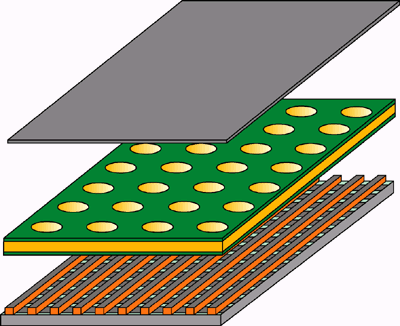
Microstrip gas chambers achieve high precision and high rate by emulating the field structure of multiwire chambers using a sequence of alternating anode and cathode strips on an insulating support. Using photolithography instead of physical wires, the distance between sensitive elements can be reduced to a fraction of a millimetre. A separate electrode gives a drift field to move the electrons towards the amplifying plate.
Increasing the amplification in a microstrip gas chamber to achieve a bigger signal means increasing the operating voltage, but this cannot be continued indefinitely. The energy lost as ionization by charged particles decreases with energy, high energy “minimum ionizing” particles producing relatively small numbers of electrons. High gains are needed to pick up these signals. At these levels, collision by-products such as heavy, slower particles can release substantial additional ionization, resulting in a discharge which could ruin delicate instrumentation.
Chemical piercing
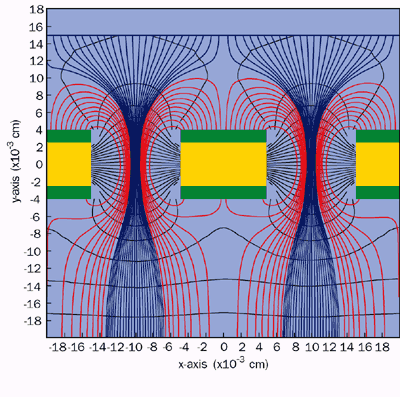
A new solution is GEM a thin sheet of plastic coated with metal on both sides and chemically pierced by a regular array of holes a fraction of a millimetre across and apart. Applying a voltage (about 500 V on 50 microns) across the GEM conducting layers, the resulting high electric field in the holes makes an avalanche of ions and electrons pour through each. The electrons are collected by a suitable device, such as a microstrip gas chamber.
The idea, proposed two years ago, has now been consolidated by development work to produce the GEM sheets with their micro-holes regularly spaced. This know-how was perfected in CERN’s workshops. The resulting GEM layers look like metallic plastic, but are transparent when held up to the light.
The first application of GEM will be in the HERA-B experiment at the HERA electronproton collider at the DESY laboratory in Hamburg,
where GEMs will complement the experiment’s microstrip gas chambers. Several hundred GEM sheets will be supplied by CERN. This approach is also the baseline design for the LHCb experiment at CERN.
Even with a moderate GEM gain, around 30 for HERA-B, the microstrip gas chamber can be operated at a much lower gain, requiring less voltage and therefore being less susceptible to breakdown. However, the overall gain of the tandem device is still optimal.
Sturdier devices have been developed based on a single high gain GEM with printed circuit board readout (where a discharge does less damage), and double GEM configurations with printed circuit board readout where the discharge probability is almost zero. This has been adopted for the small angle tracker of the forthcoming COMPASS experiment at CERN (May 1997).
Several other groups are currently investigating GEM solutions, looking at different configurations, geometries, operating conditions, gas filling etc.
With high gains obtained in purified gases, another possible application is large area photomultipliers capable of picking up single photons. Development in this direction is in collaboration with Israel’s Weizmann Institute and the Budker Institute, Novosibirsk.
GEM-based detectors, like other micro-pattern devices, offer localization to around 40 microns. However, their unique feature is that two co-ordinates can be recorded on the pickup electrode, manufactured using GEM technology. Both x- and y-strips are at ground potential, essential when using high-density readout. Such two-dimensional localization, useful in particle tracking, is necessary for medical imaging.
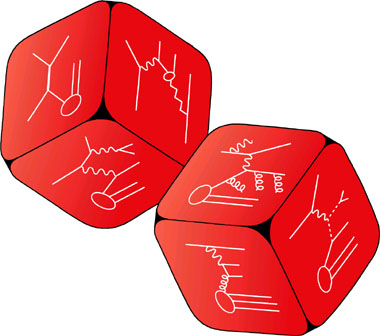
Monte-Carlo programs for computer simulation of complex interactions in high-energy particle collisions are indispensable tools for today’s experiments. Their usefulness includes the extraction of physics and testing theories and models, as well as planning future experiments and analyses. Although the development of such Monte-Carlo simulations are based on theoretical models, it is to a large extent pushed by experimental results.
The H1 and ZEUS experiments at the unique electronproton collider HERA at the German DESY laboratory in Hamburg are now in full swing. They produce data of high quality and increasing precision, which will be further boosted after the forthcoming luminosity upgrade of HERA. This subjects the Monte-Carlos to stringent tests and can reveal important gaps in our understanding, for example when data demonstrate that the Monte-Carlos are deficient.
To push the development of the Monte-Carlo generators, their underlying models and technical solutions, DESY is running a “Monte Carlo Generators for HERA Physics” workshop until early 1999. It was launched with a start up meeting in April with the participation of about 100 experimentalists and theorists.
Welcome
They were welcomed by the DESY research director Albrecht Wagner, who outlined progress on the HERA upgrade in 2000/2001 and noted that there would be yet more data to understand. He encouraged theorists and experimentalists to get together in a coordinated effort to improve their models and develop new ones. To set the scene for the following discussions, H1 and ZEUS experimentalists presented their latest results with the spotlight on problem areas for Monte-Carlos.
Much time was then devoted to various aspects of quantum chromodynamics (QCD), the quantum field theory for the strong interactions of quarks and gluons. The focus was on the connection between the latest theoretical developments and their Monte-Carlo implementation, since it is not easy to transform the theoretical formalism into computer simulation code.
Many different processes are of interest here, such as how to simulate properly the emission of many gluons in a so-called QCD cascade and the resulting final state of observable hadrons. Also of great interest are the attempts to understand the dynamics giving rise to the kinematically biassed “rapidity gap” events discovered at HERA a few years ago.
Another challenge is to understand the transition from photoproduction to deep-inelastic scattering, when the exchanged photon changes from real to virtual. To measure and explain the “resolved” structure of the photon in terms of a quark and gluon content has become a minor industry, and recent HERA data indicate that this structure is important also at higher photon virtuality. Not only does the exchanged photon probe the structure of the proton in HERA, but the partons in the proton also probe the structure of the photon! Monte-Carlo models for exotic processes beyond the Standard Model will become increasingly important as HERA luminosity increases. The search for new physics requires improved precision in the Standard Model calculations of, for example, radiative corrections.
The workshop is not confined to HERA physics, but also considers related problems in other interactions, for example at CERN’s LEP electronpositron collider or Fermilab’s Tevatron. The meeting addressed these topics in 16 plenary and 28 parallel talks. Among them were talks by T Abe, S Baranov, C Berger, R Engel, D Graudenz, G Ingelman, H Jung, Y Kurihara, L Lönnblad, B Pötter, J Rathsman, G Salam, M Seymour, T Sjöstrand, A Solano, H Spiesberger, and L West authors of many of the Monte-Carlo programs used at HERA and elsewhere.
Several working groups were formed to study these issues in depth. These groups meet regularly and the whole workshop had a mid-term meeting in October. The final results will be reported in a meeting at DESY from 15 February 1999.
After achieving its first electronpositron collisions this summer, the PEP-II B-Factory at the Stanford Linear Accelerator Center (SLAC) was formally dedicated on 23 October.
And major advances towards the operation of the BaBar detector are being made. Having installed the instrumented flux return and the superconducting solenoid early this year, the first step of the detector’s integration has been completed by adding the barrel crystal calorimeter and the central drift chamber. Finally, the particle identification system and the forward endcap calorimeter were installed this autumn.
BaBar is now in a scheduled cosmic-ray run which will be concluded early next year with the addition of the silicon vertex tracker and when BaBar will roll into the B-Factory’s colliding electron and positron beams.
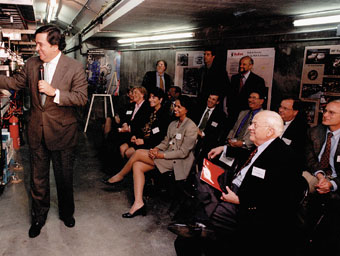
A recent celebration in the assembly area at Brookhaven’s RHIC Magnet Facility marked the completion of magnet production for the laboratory’s RHIC Relativistic Heavy Ion Collider. Among those noting the successful achievement of a milestone within two weeks of a schedule set three years earlier were: RHIC Project Director Satoshi Ozaki; Brookhaven Director John Marburger; Martha Krebs, Director of the Office of Science of the US Department of Energy (DOE); and Acting Director of DOE’s Division of Nuclear Physics Dennis Kovar.
In total, some 1800 RHIC magnets have been assembled and/or tested at the Magnet Facility. These contained over 21 million metres of superconducting wire and required over 900 000 technician hours for manufacture. Installation of the magnets is scheduled to be complete by the end of the year. This will be followed by subsystem tests beginning in January 1999, and beam tests in March. Following partial installation of RHIC detectors, a low intensity engineering run is scheduled for July, when the first collisions in RHIC are expected. After a long and arduous preparation, RHIC will take its place at the forefront of world physics.
Brookhaven’s venerable AGS Alternating Gradient Synchrotron, commissioned in 1960, recently reached a record intensity of 6.82×10¹³ protons/pulse. The AGS will soon take on a new role, supplying beams of ions to feed RHIC.
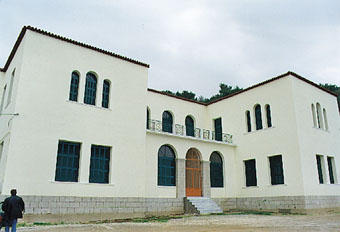
On 10 August, the Greek government formally approved the establishment of a national NESTOR Institute for Deep Sea Research, Technology and Neutrino Astroparticle Physics. Its headquarters are at Pylos in Navarino bay, 300 km south of Athens.
Supported by local, regional and national governments and under the interim directorship of Leo Resvanis, NESTOR’s goal is to build a large underwater neutrino detector for deployment nearby. Development work has been under way for some time.
To provide the best experiences, we use technologies like cookies to store and/or access device information. Consenting to these technologies will allow us to process data such as browsing behavior or unique IDs on this site. Not consenting or withdrawing consent, may adversely affect certain features and functions.
Functional
Always active
The technical storage or access is strictly necessary for the legitimate purpose of enabling the use of a specific service explicitly requested by the subscriber or user, or for the sole purpose of carrying out the transmission of a communication over an electronic communications network.
Preferences
The technical storage or access is necessary for the legitimate purpose of storing preferences that are not requested by the subscriber or user.
Statistics
The technical storage or access that is used exclusively for statistical purposes.The technical storage or access that is used exclusively for anonymous statistical purposes. Without a subpoena, voluntary compliance on the part of your Internet Service Provider, or additional records from a third party, information stored or retrieved for this purpose alone cannot usually be used to identify you.
Marketing
The technical storage or access is required to create user profiles to send advertising, or to track the user on a website or across several websites for similar marketing purposes.