By Mohammad Saleem and Muhammad Rafique CRC Press/Taylor and Francis
Hardback: £44.99
Although group theory has played a significant role in the development of various disciplines of physics, there are few recent books that start from the beginning and then go on to consider applications from the point of view of high-energy physicists. Group Theory for High-Energy Physicists aims to fill that role. The book first introduces the concept of a group and the characteristics that are imperative for developing group theory as applied to high-energy physics. It then describes group representations and, with a focus on continuous groups, analyses the root structure of important groups and obtains the weights of various representations of these groups. It also explains how symmetry principles associated with group theoretical techniques can be used to interpret experimental results and make predictions. This concise introduction should be accessible to undergraduate and graduate students in physics and mathematics, as well as to researchers in high-energy physics.
By Chun Wa Wong Oxford University Press
Hardback: £45 $84.95
Introduction to Mathematical Physics explains how and why mathematics is needed in the description of physical events in space. Aimed at physics undergraduates, it is a classroom-tested textbook on vector analysis, linear operators, Fourier series and integrals, differential equations, special functions and functions of a complex variable. Strongly correlated with core undergraduate courses on classical and quantum mechanics and electromagnetism, it helps students master these necessary mathematical skills but also contains advanced topics of interest to graduate students. It includes many tables of mathematical formulae and references to useful materials on the internet, as well as short tutorials on basic mathematical topics to help readers refresh their knowledge. An appendix on Mathematica encourages the reader to use computer-aided algebra to solve problems in mathematical physics. A free Instructor’s Solutions Manual is available to instructors who order the book.
By Milutin Blagojevićand Friedrich W Hehl (eds.) World Scientific
Hardback: £111 $168 S$222
With a foreword by Tom Kibble and commentaries by Milutin Blagojević and Friedrich W Hehl, the aim of this volume is to introduce graduate and advanced undergraduate students of theoretical or mathematical physics – and other interested researchers – to the field of classical gauge theories of gravity. Intended as a guide to the literature in this field, it encourages readers to study the introductory commentaries and become familiar with the basic content of the reprints and the related ideas, before choosing specific reprints and then returning to the text to focus on further topics.
By Ian D Lawrie CRC Press/Taylor and Francis
Paperback: £44.99
A Unified Grand Tour of Theoretical Physics invites readers on a guided exploration of the theoretical ideas that shape contemporary understanding of the physical world at the fundamental level. Its central themes – which include space–time geometry and the general relativistic account of gravity, quantum field theory and the gauge theories of fundamental forces – are developed in explicit mathematical detail, with an emphasis on conceptual understanding. Straightforward treatments of the Standard Model of particle physics and that of cosmology are supplemented with introductory accounts of more speculative theories, including supersymmetry and string theory. This third edition includes a new chapter on quantum gravity and new sections with extended discussions of topics such as the Higgs boson, massive neutrinos, cosmological perturbations, dark energy and dark matter.
By Anton Rebhan, Ludmil Katzarkov, Johanna Knapp, Radoslav Rashkov and Emanuel Scheidegger (eds.) World Scientific
Hardback: £104
E-book: £135
This book contains invited contributions from collaborators of Maximilian Kreuzer, a well known string theorist who built a sizeable group at Vienna University of Technology (TU Vienna) but sadly died in November 2010 aged just 50. Victor Batyrev, Philip Candelas, Michael Douglas, Alexei Morozov, Joseph Polchinski, Peter van Nieuwenhuizen and Peter Wes are among others giving accounts of Kreuzer’s scientific legacy and original articles. Besides reviews of recent progress in the exploration of string-theory vacua and corresponding mathematical developments, Part I reviews in detail Kreuzer’s important work with Friedemann Brandt and Norbert Dragon on the classification of anomalies in gauge theories. Similarly, Part III contains a user manual for a new thoroughly revised version of PALP (Package for Analysing Lattice Polytopes with applications to toric geometry), the software developed by Kreuzer and Harald Skarke at TU Vienna.
By Alexander W Chao and Weiren Chou (ed.) World Scientific
Hardback: £111
E-book: £144
Of about 30,000 accelerators at work in the world today, a majority of these are for applications in industry. This volume of Reviews of Accelerator Science and Technology contains 14 articles on such applications, all by experts in their respective fields. The first eight articles review various applications, from ion-beam analysis to neutron generation, while the next three discuss accelerator technology that has been developed specifically for industry. The twelfth article tackles the challenging subject of future prospects in this rapidly evolving branch of technology. Last, the volume features an article on the success story of CERN by former director-general, Herwig Schopper, as well as a tribute to Simon van der Meer, “A modest genius of accelerator science”.
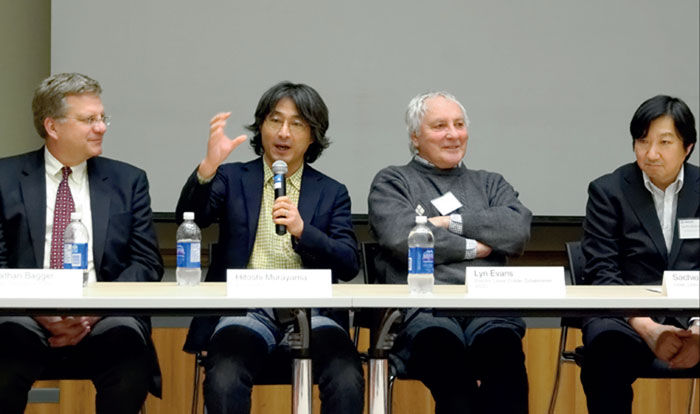
The Compact Linear Collider (CLIC) and the International Linear Collider (ILC) – two studies for next-generation projects to complement the LHC – now belong to the same organization. The Linear Collider Collaboration (LCC) was officially launched on 21 February at TRIUMF, Canada’s national laboratory for particle and nuclear physics.
The ILC and CLIC have similar physics goals but use different technologies and are at different stages of readiness. The teams working on them have now united in the new organization to make the best use of the synergies between the two projects and to co-ordinate and advance the global development work for a future linear collider. Lyn Evans, former project leader of the LHC, heads the LCC, while Hitoshi Murayama, director of the Kavli Institute for the Physics and Mathematics of the Universe, is deputy-director.
The LCC has three main sections, reflecting the three areas of research that will continue to be conducted. Mike Harrison of Brookhaven National Laboratory leads the ILC section, Steinar Stapnes of CERN leads the CLIC section and Hitoshi Yamamoto of Tohoku University leads the section for physics and detectors. The Linear Collider Board (LCB), with the University of Tokyo’s Sachio Komamiya at the head, is a new oversight committee for the LCC. Appointed by the International Committee for Future Accelerators, the LCC met for the first time at TRIUMF in February. The ILC’s Global Design Effort and its supervisory organization, the ILC Steering committee, officially handed over their duties to the LCC and LCB in February but they will continue to work together until the official completion of the Technical Design Report for the ILC.
Both the ILC and CLIC will continue to exist and carry on their R&D activities – but with even more synergy between common areas. These include the detectors and the planning of infrastructure, as well as civil-engineering and accelerator aspects. The projects are at different stages of maturity. The CLIC collaboration published its Conceptual Design Report in 2012 and is scheduled to complete the Technical Design Report, which demonstrates feasibility for construction, in a couple of years.
For the ILC collaboration, which will publish its Technical Design Report in June this year, the main focus is on preparing for possible construction while at the same time further advancing acceleration technologies, industrialization and design optimization. The final version of the report will include a new figure for the projected cost. The current estimate is 7.8 thousand million ILC Units (1 ILC unit is equivalent to US$1 of January 2012), plus an explicit estimate for labour costs averaged over the three regional sites, amounting to 23 million person-hours. With the finalization of the Technical Design Report, the ILC’s Global Design Effort, led by Barry Barish, will formally complete its mandate.
With the discovery of the Higgs-like boson at the LHC, the case for a next-generation collider in the near future has received a boost and researchers are thinking of ways to build the linear collider in stages: first as a so-called Higgs factory for the precision studies of the new particle; second at an energy of 500 GeV; and third, at double this energy, to open further possibilities for as yet undiscovered physics phenomena. Japan is signalling interest to host the ILC.
“Now that the LHC has delivered its first and exciting discovery, I am eager to help the next project on its way,” says Evans. “With the strong support the ILC receives from Japan, the LCC may be getting the tunnelling machines out soon for a Higgs factory in Japan while at the same time pushing frontiers in CLIC technology.”
Michel Borghini, who passed away unexpectedly on 15 December 2012, was at CERN for more than 30 years. Born in 1934, Michel was a citizen of Monaco. He graduated from Ecole Polytechnique in 1955 and went on to obtain a degree in electrical engineering from Ecole Supérieure d’Electricité, Paris, in 1957. He then joined the group of Anatole Abragam at what was the Centre d’Etudes Nucléaires, Saclay, where he took part in the study of dynamic nuclear polarization that led to the development of the first polarized proton targets for use in high-energy physics experiments. It was here that he gained the experience that he was to develop at CERN, to the great benefit of experimental particle physics.
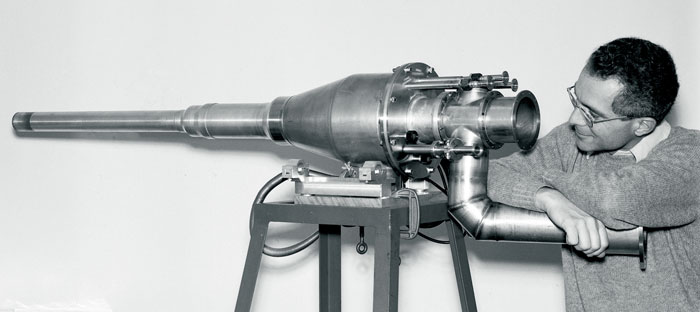
The basic aim with a polarized target is to line up the spins of the protons, say, in a given direction. In principle, this can be done by aligning the spins with a magnetic field but the magnitude of the proton’s magnetic moment is such that it takes little energy to knock them out of alignment; thermal vibrations are sufficient. Even at low temperatures and reasonably high magnetic fields, the polarization achieved by this “brute force” method is small: only 0.1% at a temperature of 1 K and in an applied magnetic field of 1 T. To overcome this limitation, dynamic polarization exploits the much larger magnetic moment of electrons by harnessing the coupling of free proton spins in a material with nearby free electron spins. At temperatures of about 1 K, the electron spins are almost fully polarized in an external magnetic field of 1 T and the application of microwaves of around 70 GHz induces resonant transitions between the spin levels of coupled electron–proton pairs. The effect is to increase the natural, small proton polarization by more than two orders of magnitude. The polarization can be reversed with a slight change of the microwave frequency, with no need to reverse the external magnetic field.
First experiments
In 1962, Abragam’s group, including Michel, reported on what was the first experiment to measure the scattering of polarized protons – in this case a 20 MeV beam derived from the cyclotron at Saclay – off a polarized proton target (Abragam et al. 1962). The target was a single crystal of lanthanum magnesium nitrate (La2Mg3(NO3)12.24H2O or LMN), with 0.2% of the La3+ replaced with Ce3+, yielding a proton polarization of 20%.
Michel moved to CERN three years later, where he and others from Saclay and CERN had just tested a polarized target in an experiment on proton–proton scattering at 600 MeV at the Synchrocyclotron (SC). Developed by the Saclay group for the higher energy beams of the Proton Synchrotron (PS), the target consisted of a crystal of LMN 4.5 cm long with transverse dimensions 1.2 cm × 1.2 cm and doped with 1% neodymium. It was cooled to around 1 K in a 4He cryostat built in Saclay by Pierre Roubeau, in the field of a 1.8 T magnet designed by CERN’s Guido Petrucci and built in the SC workshop. This target, with an average polarization of around 70%, was used in several experiments at the PS between 1965 and 1968, in both pion and proton beams with momenta of several GeV/c. These experiments measured the polarization parameter for π± elastic scattering and for the charge-exchange reaction π–p→π0n at small values of t, the square of the four-momentum transfer, typically, |t| < 1 GeV2.
In LMN crystals, the fraction of free, polarized protons is only around 1/16 of the total number of target protons. As a consequence, the unpolarized protons bound in the La, Mg, N and O nuclei formed a serious background in these early experiments. This background was reduced by imposing on the final-state particles the strict kinematic constraints expected from the collisions off protons at rest; the residual background was then subtracted by taking special data with a “dummy” target containing no free protons.
Michel’s group at CERN thus began investigating the possibility of developing polarized targets with a higher content of free protons. In this context, in 1968 Michel published two important papers in which he proposed a new phenomenological model of dynamic nuclear polarization: the “spin-temperature model” (Borghini 1968a and 1968b). The model suggested that sizable proton polarizations could be reached in frozen organic liquids doped with paramagnetic radicals. Despite some initial scepticism, in 1969 Michel’s team succeeded in measuring a polarization of around 40% in a 5 cm3 sample consisting of tiny beads made from a frozen mixture of 95% butanol (C4H9OH) and 5% water saturated with the free-radical porphyrexide. The beads were cooled to 1 K in an external magnetic field of 2.5 T and the fraction of free, polarized protons in the sample was around 1/4 – some four times higher than in LMN (Mango, Runólfsson and Borghini 1969).
The group at CERN went on to study a large number of organic materials doped with free-paramagnetic radicals, searching for the optimum combination for polarized targets. In this activity, where cryostats based on 3He–4He dilution capable of reaching temperatures below 0.1 K were developed, Michel guided two PhD students: Wim de Boer of the University of Delft (now professor at the Karlsruhe Institute of Technology) and Tapio Niinikoski of the University of Helsinki, who went on to join CERN in 1974. They finally obtained polarizations of almost 100% in samples of propanediol (C3H8O2) doped with chromium (V) complexes and cooled to 0.1 K, in a field of 2.5 T, with 19% free, polarized protons.
In this work, the concept of spin temperature that Michel had proposed was verified by polarizing several nuclei simultaneously in a special sample containing 13C and deuterons. The nuclei had different polarizations but their values corresponded to a single spin temperature in the Boltzmann formula giving the populations of the various spin states.
These targets were used in a number of experiments at CERN, at both the PS and the Super Proton Synchrotron (SPS). They measured polarization parameters in the elastic scattering of pions, kaons and protons on protons in the forward diffraction region and at backward scattering angles; in the charge-exchange reactions K–p → K–0n and pp → nn; in the reaction π–p → K0Λ0; and in proton–deuteron scattering. In all of these experiments, Jean-Michel Rieubland of CERN provided invaluable help to ensure a smooth operation of the targets.
In the early 1970s, Michel also initiated the development of “frozen spin” targets. In these targets, the proton spins were first dynamically polarized in a high, uniform magnetic field, and then cooled to a low enough temperature so that the spin-relaxation rate of the protons would be slow even in lower magnetic fields. The targets could then be moved to the detector, thus providing more freedom in the choice of magnetic spectrometers and orientations of the polarization vector. The first frozen spin target was successfully operated at CERN in 1974.
In 1969, Michel took leave from CERN to join the Berkeley group led by Owen Chamberlain working at SLAC, where he took part in a test of T-invariance in inelastic e± scattering from polarized protons in collaboration with the SLAC group led by Richard Taylor. The target, built at Berkeley, was made of butanol and the SLAC 20 GeV spectrometer served as the electron (and positron) analyser. The experiment measured the up–down asymmetry for transverse target spin for both electrons and positrons. No time-reversal violations were seen at the few per cent level.
Michel took leave to work at SLAC again in 1977, this time on a search for parity violation in deep-inelastic scattering of polarized electrons off an unpolarized deuterium target. Here, he worked on the polarized electron source and its associated laser, as well as on the electron spectrometer. The small parity-violation effects expected from the interference of the photon and Z exchanges were, indeed, observed and published in 1978. Michel then moved to the University of Michigan at Ann Arbor, where he joined the group led by Alan Krisch and took part in an experiment to measure proton–proton elastic scattering using both a polarized target and a 6 GeV polarized beam from the 12 GeV Zero Gradient Synchrotron at Argonne National Laboratory.
Michel was an outstanding physicist, equally at ease with theory and being in the laboratory
Michel left CERN’s polarized target group in 1978, succeeded by Niinikoski. Writing in 1985 on major contributions to spin physics, Chamberlain listed the people that he felt to be “the heroes – the people who have given [this] work a special push” (Chamberlain 1985). Michel is the only one that he cites twice: with Abragam and colleagues for the first polarized target and the first experiment to use such a target; and with Niinikoski, for their introduction of the frozen spin target and showing the advantages of powerful (dilution) refrigerators. Today, polarized targets with volumes of several litres and large 3He–4He dilution cryostats are still in operation, for example in the NA58 (COMPASS) experiment at the SPS, where the spin structure of the proton has been studied using deep-inelastic scattering of high-energy muons. Dynamic nuclear polarization has also found applications in medical magnetic-resonance imaging and Michel’s spin-temperature model is still widely used.
In the 1980s, Michel took part in the UA2 experiment at CERN’s SPS proton–antiproton collider, where he contributed to the calibration of the 1444 analogue-to-digital converters (ADCs) that were used to measure the energy deposited in the central calorimeter. He wrote all of the software to drive the large number of precision pulse-generators that monitored the ADC stability during data-taking.
From 1983 to 1996, he was a member of the Executive Committee of the CERN Staff Association, being its vice-president until 1990 and then its president until June 1996. After retiring from CERN in January 1999, he returned to Monaco where in 2003 he was nominated Permanent Representative of Monaco to the United Nations (New York), a post that he kept until 2005.
Michel was an outstanding physicist, equally at ease with theory and being in the laboratory. He had broad professional competences, a sharp, analytical mind, imagination and organizational skills. He is well remembered by his collaborators for his wisdom and advice, and also for his quiet demeanour and his keen but often subtle, sense of humour. His culture and interests extended well beyond science. He was also a talented tennis player. He will be sorely missed by those who had the privilege of working with him, or of being among his friends. Much sympathy goes to his two daughters, Anne and Isabelle, and to their families.
As the field of high-energy physics moves inexorably towards full open access, under the SCOAP3 agreement, it is worth noting a fact that is often overlooked by the scientific community, namely the concomitant affirmation of the role of scientific journals. Indeed, journals will continue to stand – if not for primary dissemination of information, for the continued, independent and, yes, competitive and occasionally controversial quality assessment. An ecosystem of dedicated journals is precisely what this requires, on top of open pre-“print” archives of equally undisputed role.
Yet, looking at the broader landscape of physics and beyond, open access has quite naturally also brought other changes, namely the emergence of “community journals”. By including a variety of kinds of article, these break with the traditional scheme of long established journals, which are typically devoted to single article types, such as letters, regular articles, technical papers or reviews. To promote and foster this development is precisely the aim of The European Physical Journal C – Particles and Fields (EPJC), where all types of publications relevant to the field of high-energy physics (including astroparticle physics and cosmology) are considered.
EPJC has recently seen a series of significant changes in its editorial board. Since January, Jos Engelen (a former research director at CERN) is the new editor-in-chief of the “Experimental Physics” section. He succeeds Siggi Bethke, who successfully co-ordinated this section of the journal until the end of 2012. A few months earlier, the board of theoretical physics editors of EPJC was significantly enlarged. In addition to the traditional board of editors covering the area of “Phenomenology of the Standard Model and Beyond” (now called Theory-I), which Gino Isidori has co-ordinated since the end of 2011, Ignatios Antoniadis (the current head of the Theory Unit at CERN) has taken charge of a largely new board of editors covering the areas of gravitation, astroparticle physics and cosmology, general aspects of quantum field theories and alternatives (Theory II).
The latter developments take into account in particular the ongoing rapid “merger” of accelerator-based particle physics with astroparticle physics and cosmology. The next step for our journal will thus be to reach out to experimental non-accelerator physics to provide a first unified platform as a “community journal” in this further extended sense.
Next to letters, regular articles and reviews (tutorial, specialist, technical, topical scientific meeting summaries), EPJC is particularly keen to develop its “tools” section. Neither theory nor experiment in the traditional sense, this section is a platform for publishing computational, statistical and engineering physics of immediate and close relevance for understanding technical or interpretational aspects of theoretical and experimental particle physics.
Last but not least, there is another aspect by which EPJC wishes to stand out, namely in terms of quality assessment. Taking a lead from Karl Popper, science is a social enterprise and humans react quite differently depending on whether they are solicited personally to comment on quality and relevance or just passively, e.g. as recipients of mailing lists or other automated systems.
At EPJC, three independent levels exist to ensure quality control, each mediated by direct communication as peers in the field: the editors-in-chief, the editorial board and the referees. All of them will have been involved in the assessment and decision-making process for every single paper, ensuring a personal, unbiased and fair implementation of the refereeing process, which remains at the core of the activity of any reputable journal.
SCOAP3
The SCOAP3 consortium (Sponsoring Consortium for Open Access Publishing in Particle Physics), which aims to convert journals in high-energy physics to open access, has chosen two Springer journals to participate in the initiative. They are the Journal of High-Energy Physics, published for the International School for Advanced Studies (SISSA) in Trieste, Italy, and The European Physical Journal C, published with Società Italiana di Fisica. The selection is the result of an open and transparent tender process run by CERN for the benefit of SCOAP3, in which journal quality, price and publishing services were taken into account
Juan José Gómez Cadenas is the director of the Neutrino Physics Group at Valencia University but is best known by the general public as a novelist – in 2008 he wrote Materia Extraña, a scientific thriller (The incurable attraction of physics) – and as an expert in science popularization. Even in a purely scientific environment he is able to deliver information in a most enjoyable way, as I found when I attended a scientific talk that he gave at CERN.
This same ease in communicating is recognizable in El ecologista nuclear, his book about the topic of renewable and green energy and the role of the nuclear energy. I read the Italian edition of the book and although I noticed that the translation was not always perfect and, especially in some cases, that it did not improve the quality of the reading, I really enjoyed the book and its factual approach to this delicate and controversial topic.
Gómez Cadenas makes his point of view clear in the first chapter: “All that glitters is not green.” This could shock the uninitiated because it immediately leads the reader to face “the problem”: climate change is a “bomb (that) has been activated” and humankind is “playing with fire”. The author does not just present this scenario as an opinion. Rather, he justifies all of his statements with graphs, scientific data and evidence.
The chapters that follow are a journey through the various solutions to the problem, in which he makes a strong case for the use of nuclear energy. Using data and graphs, he successfully proves that “safe” nuclear power is the only viable solution. I emphasize the word “safe” because this is the delicate point that matters most to the general public. Unlike other authors, instead of avoiding talking about the problem of safety, Gómez Cadenas discusses it openly, with constant reference to scientific data.
I like the book; I like the author’s open and honest approach, his competence and his rigorous summaries of a global problem that concern us all. I would recommend reading it before voting for any topic related to the energy problem on our planet.
To provide the best experiences, we use technologies like cookies to store and/or access device information. Consenting to these technologies will allow us to process data such as browsing behavior or unique IDs on this site. Not consenting or withdrawing consent, may adversely affect certain features and functions.
Functional
Always active
The technical storage or access is strictly necessary for the legitimate purpose of enabling the use of a specific service explicitly requested by the subscriber or user, or for the sole purpose of carrying out the transmission of a communication over an electronic communications network.
Preferences
The technical storage or access is necessary for the legitimate purpose of storing preferences that are not requested by the subscriber or user.
Statistics
The technical storage or access that is used exclusively for statistical purposes.The technical storage or access that is used exclusively for anonymous statistical purposes. Without a subpoena, voluntary compliance on the part of your Internet Service Provider, or additional records from a third party, information stored or retrieved for this purpose alone cannot usually be used to identify you.
Marketing
The technical storage or access is required to create user profiles to send advertising, or to track the user on a website or across several websites for similar marketing purposes.