Bluefors – leaderboard other pages

Topics

In retrospect: electron scattering in Amsterdam

The turn of the year was significant for the Dutch NIKHEF laboratory: 1998 was the last year in which data were taken at the institute’s Amsterdam Pulse Stretcher (AmPS). Even before the AmPS was built, funding organizations had decided that it would only be exploited from 1992 to 1998 because it was a heavy load on the Dutch science budget.

amsterdam1_2-99

The first steps towards electron scattering experiments in Amsterdam were taken at the beginning of the 60s when institute director Prof. Gugelot sent his former PhD student Conrad de Vries to Stanford. There, at the cradle of electron scattering, de Vries worked in Robert Hofstadter’s group. The 3 km linear electron accelerator was being designed next door at SLAC. On his return to Amsterdam, de Vries convinced the institute (then called IKO, the Instituut voor Kernfysisch Onderzoek) that electron scattering provided the best possibilities for future nuclear physics experiments.

While de Vries formed a research group and designed experiments, a linear accelerator was constructed in a joint effort by IKO and the Philips company. In 1946 Philips had built the synchrocyclotron at IKO ­ the first in Europe. Now it wanted to gain experience in constructing linear accelerators, thereby using superconductivity. It was an ambitious goal, and when the detectors were ready there were still problems with the accelerator. Long delays were foreseen and de Vries turned to his former colleagues in Stanford. In 1966 the US Atomic Energy Commission approved a plan to send two spare SLAC sections to Amsterdam ­ officially “on permanent loan”. The two 3 metre sections formed a 90 MeV linear accelerator (with the Dutch acronym EVA), which became operational in 1968.

Since the Netherlands could not go for large accelerators or huge projects, de Vries decided to aim for precision measurements. Very precise data on the charge radius of carbon-12 are still standard today. The spatial magnetic distribution was measured for a variety of nuclei, ranging from lithium-6 to indium-115. At these low energies it is difficult to separate the small magnetic contribution from the much larger charge contribution, with one exception: at a scattering angle of 180° only the magnetic component contributes. In a specially built 180° arrangement ­ comparable to the one built by Barber and Peterson at SLAC ­ magnets were used to separate back-scattered electrons from the incoming electron beam. The resulting data were complementary to higher energy results at the 600 MeV electron accelerator (ALS) at Saclay.

From the start it was clear that a larger accelerator than EVA was needed, and the first plans for a medium-energy accelerator (MEA) were submitted at the end of the 60s. The cost of this 500 MeV machine ­ about 40 million guilders for construction ­ was very high by Dutch standards, and the project required much prior organization. Construction started only in 1975 and the first measurements with MEA electrons were made in 1981. In 1973 MEA could deliver up to 40 microamps at a duty factor of 1%. This was lower than the 10% originally aimed for, but much higher than the 0.02% of EVA.

Small storage ring and getters win EPS prizes

The European Physical Society’s Interdivisional Group on Accelerators prizes, awarded at the European Particle Accelerator Conference in Stockholm this year, reflect the traditional resourcefulness and ingenuity that keeps this field of physics so dynamic.

The AUSTRON: Austria’s invitation to Europe

In 1996 the Austrian Government declared its intention to aim for a large-scale international research facility,
and the AUSTRON proposal was submitted by the Ministry of Science and Research to the European Science Foundation (ESF) for assessment.

In November 1997 the ESF panel recommended the AUSTRON project as a potential candidate for a medium- to large-scale international research facility based on a pulsed high-flux neutron spallation source. It was suggested that some aspects of the regional impact and specific issues regarding the instrumentation should be added. The Ministry requested a project group to gather the extra information and to prepare a project proposal for international presentation.

Based on a decision of the Austrian Government dated 20 August 1998, Austria is offering to contribute one-third of the total cost of the AUSTRON, and international partners are now invited to participate. Although the AUSTRON offers obviously attractive and unique possibilities for research with neutrons, extensive political negotiations with potential transnational partners will be needed to conclude such co-financing agreements. The partners may contribute to the project both in cash or in kind. Political as well as financial decisions need to be taken within the next few months.

Around 1000 users of neutron facilities have been identified within the Central European Region (the catchment area of AUSTRON) according to a report by the European Neutron Scattering Association. And the number is growing, particularly in the eastern countries.

In contrast, the number of neutron sources in Europe (today more than 20) will have dropped to less than six by 2015. The proposed AUSTRON project for a pulsed neutron spallation source is a great opportunity for the neutron scattering community in Europe to counteract this developing “neutron gap”.

Accelerator

The AUSTRON is based on an accelerator design using state-of-the-art technologies to allow for a relatively short construction period and a favourable ratio of cost to scientific and technological potential. The proposal is for a 0.5 MW neutron source which can be operated with 10 Hz repetition rate. To generate a proton beam with 1.6 GeV energy per particle and an average beam current of 0.311 mA, the accelerator chain comprises an H­-ion source, a radiofrequency quadrupole and a drift tube linac, providing a final ion energy of 130 MeV, from which the ions enter a rapid-cycling synchrotron via a stripper foil which removes their electrons to enable the acceleration of a high-intensity proton beam to a final energy of 1.6 GeV. Using a dual-frequency magnetic cycle, losses should be kept to about 0.5%, occurring at lowest energies during trapping only.

The operation frequency of the acceleration process has been determined to be 50 Hz. In principle, all neutron scattering instruments could be operated at this repetition rate. Since, however, there is strong emphasis on cold neutron instrumentation, a preference for a lower operation frequency was expressed for these instruments.

This can be achieved by adding an additional storage ring which works as a bunch accumulator for the proton bunches leaving the rapid-cycling synchroton (RCS). With such an installation, stacking of up to four proton bunches is feasible. Extracting these bunches together with the bunch which has just reached its final energy in the RCS gives a 10 Hz source with 1.6 GeV protons (some 2×10¹⁴ protons in total), which deposit 50 kJ per pulse on the spallation target.

The average thermal neutron flux is expected to be 7×10¹² neutrons cm-2 s-1 with a peak flux of some 3.5×10¹⁶. This configuration will make AUSTRON truly unique among present neutron sources. The effective flux for certain classes of neutron instruments will be increased by a factor of 15­-20 compared to present standards.

With more than an order of magnitude higher performance, the exploration of completely new fields of research can be envisaged. Furthermore, the 10 Hz option takes the increasing demand for cold neutron scattering into account and no flux penalty will be experienced by those instruments usually operated at higher frequencies.

Concerning AUSTRON’s relation to the proposed European Spallation Source (ESS ), these facilities will belong to two different generations of neutron sources which will be separated by a decade in time and an order of magnitude in beam power.

austron1_12-98

For the target design, a flat target geometry is proposed. The target material under consideration is solid tungsten/5%-rhenium with its excellent thermal and mechanical properties. The target block will be 10 cm high, 30 cm wide and 60 cm long. Due to the edge-cooling concept, cooling channels are only installed within 2 cm of the top and bottom surfaces.

Calculations of the temperature distribution in the target, based on a 0.5 MW version of AUSTRON running at 50 Hz, yield a maximum of 1200-1300 °C. Edge-cooling is possible under these conditions and an improved cooling system has been designed. Material properties such as ductility, thermal conductivity or self-healing after irradiation damage look favourable for this temperature range. From the present point of view, a 50 Hz, 0.5 MW solid W­5%Re target is feasible. Operation with 10 Hz/0.5 MW leads to a marginal temperature increase of less than 10 °C.

The suggestion has also been made to operate the target at even higher temperatures, above 2000 °C, and to cool by radiation cooling only, which would help to avoid thermally induced stress inside the target block. The final decision on the target design will take place in the design phase immediately after approval of the project.

CERN­Asia Fellows and Associates Programme

Within the framework of the CERN­Asia Fellows and Associates Programme, CERN offers three grants every year to young East, Southeast and South Asia* postgraduates under 33, to participate in its scientific programme in the areas of experimental and theoretical physics and of accelerator technologies. The appointment will be for one year, which might, exceptionally, be extended to two years.

Applications will be considered by the CERN Fellowship Selection Committee at its meeting on 26 January 1999. An application consists of a completed application form on which it should be stated “CERN­Asia Programme”, three separate reference letters, a curriculum vitae including a list of scientific publications and any other information in favour of the quality of the candidate. Applications, reference letters and any other information must be provided in English only.

Application forms can be obtained from: Recruitment Service, CERN, Personnel Division, 1211 Geneva 23, Switzerland. E-mail: “Recruitment.Service@cern.ch“. Fax: +41 22-767 2750. Applications should reach the Recruitment Service at CERN before the deadline of 12 November 1998.

The CERN­Asia Fellows and Associates Programme also offers a few short term Associateship positions to scientists under 40 who wish to spend a fraction of the year at CERN or a Japanese laboratory and who are “on leave of absence” from their institute. Applications are accepted from scientists who are nationals of the East, South-east and South Asian* countries and from members of the CERN personnel who are nationals of a CERN Member State.

*Candidates are accepted from Afghanistan, Bangladesh, Bhutan, Brunei, Cambodia, China, India, Indonesia, Japan, Korea, the Laos Republic, Malaysia, the Maldives, Mongolia, Myanmar, Nepal, Pakistan, the Philippines, Singapore, Sri Lanka, Taiwan, Thailand and Vietnam.

Work on triangle anomaly wins Dirac Medal

The Abdus Salam International Centre for Theoretical Physics (ICTP) in Trieste has awarded its Dirac Medal this year to Stephen Adler of Princeton’s Institute for Advanced Study and Roman Jackiw of MIT. This medal, widely viewed by theorists as highly prestigious, is given each year to scientists who have made outstanding contributions to theoretical physics and mathematics.

Adler and Jackiw are honoured for their work on the “triangle anomaly”. CERN theoretician John Bell, who died in 1990, also played a major role in this work. It underlies the process by which a neutral pion transforms into two photons, the calculation of which was first carried out by Jack Steinberger in 1949. Such processes place severe strains on the underlying formalism ­ hence “anomaly”. For the mathematics to work properly, several such anomalies should mutually cancel, placing important restrictions on modern grand unified theories.

Making a song and dance about physics

The Cernettes have been pulling in the crowds at CERN since 1990 with their unique blend of ’60s pop and physics lyrics from the pen of computer scientist Silvano de Gennaro. Singer­songwriter Lynda Williams is a relative newcomer, but ever since she hit the road in 1996 at the 44th Midwest Solid State Conference her feet have hardly touched the ground.

spice1_11-98

Les Horribles Cernettes are the original physics entertainers. Their name is a play on the title of CERN’s next major particle accelerator, the Large Hadron Collider, and the song Collider was their first hit. It was an anthem to unrequited love in the time of coloured quarks, and it was also a plea from the heart.

Back in 1990 a CERN employee was dating a particle physicist but she hardly ever saw her Romeo because he was always too preoccupied with his experiment. In desperation she asked CERN’s de-facto songwriter in residence, Silvano de Gennaro, to put her tragic tale to music.

Soon after, the Cernettes came together. Michelle Muller, the only original Cernette still in the band, teamed up with Catherine Decosse, Caroline Good and Ruth Rubio Marin. That summer they were on stage for the first time at the CERN Music Club’s annual “Hardronic Festival”. (Mix “hadron” with “hard rock” and that’s what you get.) As they belted out for the first time Collider’s unforgettable refrain, “You don’t go out with other girls either, You only love your collider”, there was more than one amorous physicist blushing with shame. Particle-physics partners the world over must have heaved a collective sigh of recognition at that sad story.

Since their first gig in 1990 the band has never looked back. Over the years Michelle has been joined by Angela Byrne, Angela Higney, Anne MacNabb, Patty McBride, Colette Reilly, Sue Swannel, Linda Timms, and Lynn Veronneau. The Cernettes played to thousands at the World Expo in Seville in 1992. They thrilled them to bits at the Computing in High Energy Physics conference, CHEP’92. They’ve recorded a CD, starred on the Franco German TV channel ARTE, and they still top the bill at the CERN Hardronic Festival. But the final seal of their success came this year with a copy-cat band. All the top groups have them. The Beatles had the Monkeys, Oasis have No-Way-Sis, and at the latest Hardronic festival, the Cernettes had the Canettes (“large beers” in the Geneva dialect). Show me a CERN physicist, male or female, who hasn’t felt their attraction (it’s a strong interaction) and I’ll show you a pig that can fly.

There are many bands out there claiming to be first on the Web, but that honour belongs to the Cernettes whose site includes pictures, sound clips, and even a fan club set up by some ardent admirers in Norway. True, the Cernettes had a head start, being based at the lab where the Web was invented, but they haven’t rested on their cyber-laurels. With their latest number, Surfing on the Web, they’ve made another breakthrough with the world’s first interactive pop video. You’ll need to be equipped with a VRML (Virtual Reality Mark-up Language) browser to get the full benefit, but once you’ve got it you can sail off into cyberspace with your favourite Cernette (but only for as long as the song lasts).

French green light for LHC civil engineering

news1-10-98

Progress on CERN’s next major particle accelerator, the Large Hadron Collider (LHC), took another step forward recently when French Prime Minister Lionel Jospin signed the decree allowing LHC civil engineering work to commence on French territory. This important landmark comes after a long and painstaking study of the environmental impact of the project and follows approval of civil engineering on Swiss territory earlier this year ) where work is already underway.

The LHC collider, scheduled to begin operations in 2005, will be constructed in the 27 kilometre tunnel under the Franco-Swiss frontier, which currently houses CERN’s LEP electron­positron collider.

LHC civil engineering contracts are being awarded in three separate packages. Excluded from these packages is one of the tunnels which will supply the LHC with protons from CERN’s Super Proton Synchrotron accelerator. This tunnel is being built by Switzerland as part of its special host-state contribution to the LHC.

While awaiting the French green light, a collaboration between CERN and the regional directorate for cultural affairs has allowed archaeologists to undertake preliminary excavations at a Roman site adjacent to one of the LHC’s experimental areas. Their findings have pieced together a fascinating picture of life in the area some 1700 years ago. A report will feature in a forthcoming issue.

KODEL establishes Korea as major physics player

Marking the emergence of Korea as a major player on the world physics scene, the Korea Detector Laboratory (KODEL) was established this year under director Sung Keun Park of Korea University, Seoul. Its aim is to carry out research and development for high-energy physics detectors and international high-energy physics programmes, and to provide the infrastructure for the ever-increasing scope of major international high-energy physics projects.

About 11 Korean universities have links with KODEL and participate in the research at Brookhaven, CERN, DESY (Hamburg), Fermilab, GSI (Darmstadt), and KEK (Japan).

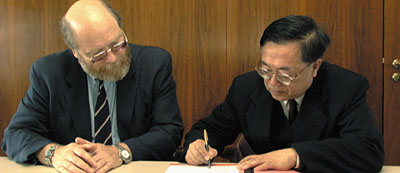
A guest of honour at the KODEL opening ceremony was 1992 Physics Nobel prizewinner Georges Charpak of CERN. His lecture was televised throughout the country.

news2-10-98

While at KODEL, Charpak stressed the importance of research and development for high-energy physics detectors in Korea, and Korea’s collaboration with CERN in the LHC Collider project.

At a news conference Charpak affirmed that present economic problems could be alleviated by higher investment in basic research to provide a solid foundation for future technological advancement.

Charpak also met with the Korean Prime Minister, the Minister of Science and Technology and the Minister of Information and Communication, and gave a talk to the Korean Physical Society entitled “Recent advances on gaseous detectors and their applications for medicine and biology”, a subject for which his enthusiasm never wavers.

KODEL produces prototypes of forward resistive plate chamber for the CMS detector at the LHC and is obtaining very encouraging results. It will be the main Korean laboratory for mass production of these units.

Experiments wanted for CERN neutrino beam to Gran Sasso

The Scientific Committees of the SPS at CERN and of the Gran Sasso laboratories will meet at CERN on 2­4 November for a thorough discussion of the opportunities offered by a neutrino beam pointing from CERN to Gran Sasso. There is a call for ideas for experiments that could exploit this beam to elucidate neutrino masses and mixings. Documents of up to 10 pages describing these experiments, along with a cost estimate, should be submitted to both Committees before 10 October.

To make the meeting more effective, the documents describing appearance and/or disappearance experiments with or without a near station should contain, in the usual Dm2 versus sin22q plot:

i) the exclusion curve if no signal is observed;
ii) the limit curve within which a discovery of neutrino oscillations can be made at the 4 sigma level.

These curves should be based on the reference beams with a shared mode of operation (3×10¹⁹ proton/year on target) and for three years of running.

Documents on the high-energy and low-energy beams, prepared by the CERN/INFN Working Group should soon be available.

US ‘reneges’ on SSC decision

US President Bill Clinton has questioned the momentous decision to cancel the Superconducting Supercollider,
in a recent speech to MIT graduates.

news3-10-98

The world of particle physics was stunned in October 1993, when the US Senate voted to cancel the Superconducting Supercollider (SSC), an 87 kilometre ring then being built in Texas to collide 20 TeV proton beams. On 28 October 1993, the giant machine’s death warrant was officially signed by Clinton. The decision changed the face of world particle physics, with the emerging US involvement more outward looking. A major US commitment now constitutes a significant part of CERN’s LHC proton collider project and its physics programme.

However, on 5 June this year, speaking to graduates at the Massachusetts Institute of Technology, President Clinton said: “Scientific research is a basic prerequisite for growth. Just yesterday in Japan, physicists announced a discovery that tiny neutrinos have mass. Now that may not mean much to most Americans [or anyone else ­ Ed], but it may change our most fundamental theories ­ from the nature of the smallest subatomic particles to how the universe itself works.

“This discovery was made in Japan, but it had the support of of the US Department of Energy. This discovery calls into question the decision … to disband the Superconducting Supercollider, and reaffirms the importance of the work now being done at the Fermi National Accelerator Facility.”

bright-rec iop pub iop-science physcis connect