by David Pines 0 7382 0115 4 (pbk $35) copyright 1963.
Based on an advanced course in the theory of solids at Illinois in 1961, this continues to fill the need to communicate the present view of a solid as a system of interacting particles that, under suitable circumstances, behaves like a collection of nearly independent elementary excitations. The author frequently refers to experimental data. Both the basic theory and the applications largely deal with the behaviour of “simple” metals, such as the alkali metals, rather than the more complicated transition metals and the rare-earths. Problems are included in most chapters.
by Bernard d’Espagnat 0 7382 0104 9 (pbk $35) copyright 1971.
This volume offers a clear and comprehensive account of the fundamental physical implications of the quantum formalism, which deals with non-separability, hidden variable theories, measurement theories and several related problems. Mathematical arguments are presented with an emphasis on simple but adequately representative cases. The conclusion incorporates a description of a set of relationships and concepts that could compose a legitimate view of the world.
by J Robert Schrieffer 0 7382 0120-0 (pbk $35) copyright 1983.
This is considered to be one of the best introductory treatments of superconductivity and has been reprinted because of its enduring value. Based on lectures at the University of Pennsylvania, the fundamentals of the microscopic theory of superconductivity are stressed as a means of providing a framework for detailed applications of microscopic theory to specific problems. It also serves as a foundation for more recent developments.
by P G de Gennes 0 7382 0101 4 (pbk $35) copyright 1966.
From the author’s introductory course at Orsay, this text explains the basic knowledge of superconductivity for both experimentalists and theoreticians. These notes begin with an elementary discussion of magnetic properties of Type I and II superconductors. The microscopic theory is then built up in the Bogoliubov language of self-consistent fields. This book provides the classic, fundamental basis for any work in superconductivity.
by Michio Kaku, Springer (Graduate Texts in Contemporary Physics) 038798589 1 (hbk $49.95).
This edition of Kaku’s book, first published in 1988, ensures the continued availability of a valuable introduction to this field, already heralded in some quarters as the physics of the 21st century. Kaku is professor of theoretical physics at the City College of the City University of New York. A prolific and respected writer of popular science (“Visions: how science will revolutionize the 21st century and beyond”; “Hyperspace: a scientific odyssey through parallel universes, time warps and the tenth dimension”; “Beyond Einstein: the cosmic quest for the theory of the universe” (with Jennifer Trainer)), he is also the author of Quantum Field Theory: a Modern Introduction, and hosts a successful weekly radio science programme.
by S Y Lee (Indiana University), World Scientific 981 02 3710 3 (pbk US$32/£22).
This is a general, introductory text to the, by now, rather wide field of accelerator physics. Circular and linear, low- and high-energy machines accelerating electrons, protons and ions are covered. Synchrotron motion, basic collective effects and synchrotron radiation are described as well.
The book can be strongly recommended for students specializing in accelerator physics, in particular those who appreciate a detailed, formal description of beam optics design and who are likely to use tracking or optics design programs. It should also be useful as a source of reference material for the specialist.
Readers interested in self-study and engineers working on aspects connected with accelerators will probably find the book rather formal, specialized and difficult to read.
Progress in accelerators was, and still is, to a large extent stimulated by the needs of nuclear and particle physicists for higher energies, intensities, luminosities, etc. There is relatively little on these subjects. The beambeam effect is mentioned only briefly and there is no discussion of the definition, knowledge and optimization of beam parameters of interest to users of accelerators.
The 490 pages contain an impressive amount of material and many formulae. Additional details are often given as exercises for the student.
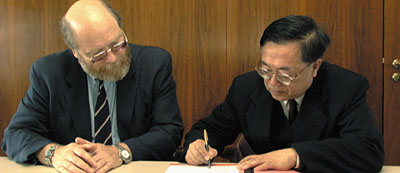
Underlining the worldwide involvement in the programme at CERN’s LHC collider, a milestone agreement brings funding from Chinese bodies for the LHC CMS experiment.
Chinese physicists have long participated in CERN’s programme, notably in the L3 experiment. The new agreement includes the Chinese National Natural Science Foundation, the Institute of High Energy Physics (IHEP) in Beijing, and the universities of Peking and of Science and Technology in Hefei.
A major CMS contribution from China will be the endcap support “carts” for the magnet yoke, which will be made by Chinese industry. A protocol allowing production to begin was signed last year between CERN, acting on behalf of CMS, and the Chinese National Academy of Sciences.
The Chinese will also contribute detector parts, largely via a collaboration between IHEP and Fermilab. A similar collaboration involves Fermilab and the St Petersburg Nuclear Physics Institute in Russia. They will produce cathode strip chambers (CSCs) for the CMS muon-detection system. Fermilab will equip the other institutes with the raw materials and tooling to produce the 648 CSCs. The detector will cover more than 1300 sq. m.
Also covered by the new Chinese agreement is a project involving Peking University that will make a major contribution to resistive-plate chambers (RPCs) for the CMS muon-detection system in collaboration with other institutions, in particular from Italy. RPCs respond rapidly to passing particles and trigger the data acquisition system to read out the detector when interesting collisions occur.
China is also building electronics for the CMS muon detector through a collaboration between Chinese and Italian institutes.
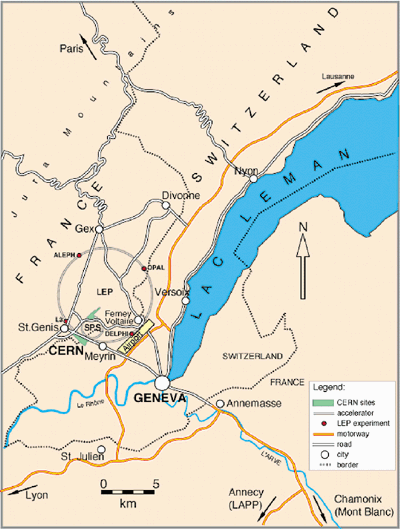
When CERN was established in 1954 to provide European nations with forefront facilities for scientific research, its site was Meyin, a burgeoning satellite city near Geneva, and Switzerland was its sole host state.
In the 1960s, construction of the Intersecting Storage Rings (ISR) extended CERN’s site into France, but only in a limited sense. The land for the construction of the ISR was in France but was linked to the existing Swiss site and the boundary fence was simply extended. The only access to the French ISR territory was via the CERN main gate in Switzerland.
CERN extended into France in a major way with the construction of the 7 km SPS synchrotron in the early 1970s. Initially there were two CERNs: the original CERN I (including the ISR) on the Meyrin site and the new CERN II 3 km away in France at Prévessin. France also became a CERN host state.
Subsequent construction work for the underground 27 km LEP electronpositron collider and the LHC collider enlarged the footprint of CERN both in France and in Switzerland.
With staff levels currently just less than 3000, with some 1000 industrial support staff and about 7000 migratory researchers all over the world who visit periodically, CERN makes a big impact on the local region, simply for day-to-day needs like housing, schooling, shopping, transport and leisure.
In addition is the industrial impact supplying the equipment and services that make CERN work. These contracts are now subject to strict rules that aim for a balanced return for all of CERN’s 19 member states,
and local concerns not to enjoy any particular advantage for purchasing requests and calls for tenders.
Impact on Geneva
During the first 15 years of CERN’s existence, Geneva and Switzerland were the laboratory’s front door. Geneva is a major city with its own commerce, banking, industry and university. The home of the international Red Cross since 1863, its importance increased after the First World War with the establishment of the headquarters of the League of Nations, which in 1946 became the European headquarters of the United Nations (UN) and led to the implantation of several major UN agencies in Geneva.
Throughout its history, Geneva has been a natural crossroads, and this is underlined today by a major airport with excellent links to all major European cities. While many airports are now constructed far from the towns they serve, every visitor to CERN is aware that the airport is only a few kilometres away.
In the 1960s, major international electronics and telecommunications specialists set up regional offices in Geneva. Although this was not directly because of CERN, the laboratory soon benefited. In the 1970s, Geneva established the ZIMEYSA (Zone industrielle Meyrin-Satigny) industrial park on CERN’s doorstep. Meyrin, the airport and the availability of land were the main factors behind this move, but the impressive vista of CERN across the valley undoubtedly helped to attract tenants.
The direct impact of CERN on Geneva is difficult to measure, but the spin-off benefits are huge, and the city is undoubtedly proud of its prestigious resident. On arrival in Geneva by road or by air, signs underline CERN’s presence.
CERN’s extension into France was in the pays de Gex. Cut off from the rest of France by the river Rhône and the Jura mountains, this area has always naturally looked towards Geneva, even though from 1815 Geneva became part of another country. The pays de Gex (département de l’Ain) remained largely rural until relatively recently, when the arrival of first the SPS and then LEP provided a new focus.
Building on these developments, the local authorities set up a new technology park, this time at CERN’s back door. Although a number of firms that had received CERN contracts came in, the authorities were conscious that CERN’s balanced return policy meant that these suppliers would not automatically benefit from increased business. Proximity to Geneva and its communications were the greater attraction.
Today some 60 companies employing some 1000 people work in this park. Only half of these have any relationship with CERN.
Neighbouring France – south of the Rhône
Looking at the map, the Geneva administrative area (canton) appears almost totally surrounded by France, joined to the rest of Switzerland by a neck of territory only a few kilometres wide. To the north of the Rhône, nearer CERN, the neighbouring French territory belongs to the pays de Gex. To the south, away from CERN, is the département of Haute Savoie. While the pays de Gex remained rural, Haute Savoie had a significant industrial tradition, with major towns and prestigious universities nearby at Chambery, Grenoble and Lyon.
An early development as a result of CERN was LAPP, the particle physics laboratory at Annecy, the administrative capital of Haute Savoie, which was set up to exploit both the proximity of CERN and the significant industrial and academic potential of the region. Annecy became home to university departments of the neighbouring département of Savoie.
Rising costs and a shortage of office space in Geneva led in the 1980s to the establishment of the Archamps Business Park in France, immediately south of the city, but from the start a university-level educational dimension and high technology were major features. However, on the other side of Geneva to CERN, the recent opening of a major Geneva ring road linking Haute Savoie with Geneva’s international airport has been a major improvement.
CERN regularly participates in several Archamps educational programmes. Although the impact of Archamps in Haute Savoie is hard to quantify, its concentration of computer expertise led to local secondary schools being prominent among the first to establish Internet use in France.
From Hiroshima to the Iceman: the Development and Applications of Accelerator Mass Spectrometry by Harry E Gove, Institute of Physics Publishing 07503 0557 6 (hbk £50/$99) 07503 05584 (pbk £15/$27).
Invented some 20 years ago, accelerator mass spectrometry (AMS) is one of the newer success stories in the applications of particle accelerators. It provides a powerful, fast and reliable means of measuring long-lived radio-isotopes using only minute samples.
Radiocarbon-14, which has a half-life of 5730 years, was the first isotope to be measured this way, and AMS radiocarbon dating soon became a powerful tool for determining the age of organic material using small samples. Other isotopes are also suitable for AMS.
Radiocarbon dating was invented by Willard Libby in the 1940s and brought him the 1960 Nobel Prize for Chemistry. In its original form, radiocarbon dating counted the actual decays of residual carbon14, requiring relatively large samples of material.
Jolted by news of carbon14 measurements at a Berkeley cyclotron, Gove participated in pioneer AMS measurements at Rochester in 1977, which dramatically showed how the level of carbon14 in commercial charcoal and fossil graphite is different, using milligram samples. It is usually no problem to take a milligram sample from even the most valuable relic.
Giving a reliable measurement of the age of a specimen can be vital input in archaeology, history and mineralogy, as well as being a focus of public interest. Such measurements can settle disputes and separate fact from myth.
One of the most spectacular AMS applications is the dating of the Turin Shroud, and Gove’s earlier book, Relic or Hoax?: Carbon Dating the Turin Shroud, is a scientific account of this work. Multiple AMS measurements gave the origin of the shroud material, widely believed to be of biblical origin, as AD 1325 ±33 years.
In his latest book, Gove casts the AMS net wider, describing the history and instrumentation of the technique, concentrating on electrostatic tandem accelerators, before turning to its application. The analysis examples, described in graphic detail, include radio-relics from Hiroshima and Nakasaki that provided new insights into the mechanisms of radiation damage; North American archaeological remains; modern radioactive waste; the Turin Shroud revisited; Egyptian mummies; “Oetzi”, the neolithic iceman discovered in 1991 in the Alps on the Austrian-Italian border; and the Dead Sea Scrolls.
For the dating of the Turin Shroud, one theory mentioned is that bacteria on cloth continue to ingest carbon14 from the air, making the cloth look younger.
This is a fascinating account of a major particle accelerator application success by an enthusiastic scientist who played a major role in its development. Harry Gove contributed an article on AMS to the special July 1995 Applying the Accelerator issue of CERN Courier.
To provide the best experiences, we use technologies like cookies to store and/or access device information. Consenting to these technologies will allow us to process data such as browsing behavior or unique IDs on this site. Not consenting or withdrawing consent, may adversely affect certain features and functions.
Functional
Always active
The technical storage or access is strictly necessary for the legitimate purpose of enabling the use of a specific service explicitly requested by the subscriber or user, or for the sole purpose of carrying out the transmission of a communication over an electronic communications network.
Preferences
The technical storage or access is necessary for the legitimate purpose of storing preferences that are not requested by the subscriber or user.
Statistics
The technical storage or access that is used exclusively for statistical purposes.The technical storage or access that is used exclusively for anonymous statistical purposes. Without a subpoena, voluntary compliance on the part of your Internet Service Provider, or additional records from a third party, information stored or retrieved for this purpose alone cannot usually be used to identify you.
Marketing
The technical storage or access is required to create user profiles to send advertising, or to track the user on a website or across several websites for similar marketing purposes.