by Dan Green, Cambridge Monographs on Particle Physics, Nuclear Physics and Cosmology, 361 pp, 0 521 66226 5, £65/$100.
The 12th volume of the Cambridge Monograph Series on Particle Physics, Nuclear Physics and Cosmology again concerns particle detectors. In this case the main emphasis is not on the construction of these devices but rather on the underlying physics.
Dan Green has worked in particle detection and identification in many laboratories – from Stony Brook to the ISR, and from Fermilab to the preparation of LHC experiments.
The book begins with a recollection of the size and energy scales involved in different physical processes. The order of magnitude of atomic and nuclear processes is explained by fundamental physics principles and illustrated using everyday examples. The introductory chapter provides the basic numerical data needed to characterize the interaction probabilities of different particle species.
The main body of the book is subdivided into non-destructive measurements, such as time, velocity, ionization, position and momentum measurements, where the interaction of the incident particle transfers very little energy to the detecting medium; and destructive techniques, such as electron and hadron calorimetry, where the lost energy is a significant fraction of the kinetic energy carried by the particle. Characteristic features of different detectors are partially derived using dimensional arguments. For practical operations, rules of thumb are provided.
All of the methods presented aim to identify the incident particles, a goal that can often only be achieved by combining different techniques. Such a complete set of measurements is presented in the final chapter, using the example of a general-purpose detector.
The author successfully explains the operation of each type of detector from first principles, without rigorously deriving the theoretical background. Readers interested in the theory are referred to the appendices.
The presented applications of particle detectors are illustrated with many numerical examples, which clearly show that Green has “hands-on” experience in constructing and optimizing these devices. Some of the home experiments, however, like deflecting the electron beam of a TV set with a permanent magnet, should be treated with caution. This is fine on a black-and-white screen but can produce irreversible damage on a colour TV.
Various interaction processes are visualized using bubble and cloud chamber events, although these old-fashioned detectors are not described in detail. There is no mention of nuclear emulsions, and very little on neutrino interactions, even though the search for neutrino oscillations and the first direct observation of the tau neutrino have demonstrated that exotic and rare processes can breathe new life into old technologies. There is certainly some demand for the basics of neutrino interactions from the growing number of experiments in astroparticle physics.
Many of the instructive diagrams are taken, with good reason, from the relevant chapters of the excellent Review of Particle Physics by the Particle Data Group.
This book presents an attractive and comprehensive introduction to the physics of particle detection. The reader is guided by practical examples from everyday experience. It will be of interest to physics students and will also be a valuable reference for the experienced detector builder. The design of actual particle detectors may be subject to change over the coming years, but the underlying physics principles will stay the same. The book will thus remain useful for some time. The publishers should also be encouraged to issue an affordable paperback edition.
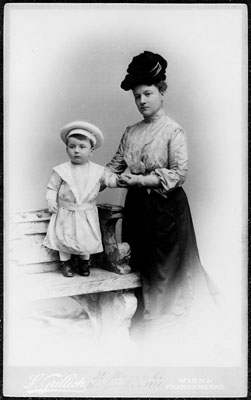
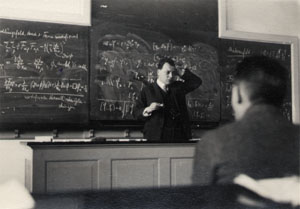
Wolfgang Pauli – long the “conscience of physics” – was professor at ETH-Zürich for 30 years, from 1928 to 1958, except during the Second World War, when he was at Princeton at the Institute for Advanced Study. To honour his centenary, the ETH Library organized a special exhibition, which was first presented at ETH Zürich in April and May.
The exhibition, which beautifully illustrates Pauli’s life, has now moved to CERN where it is on display in the Main Building from 17 August until 26 September. A ceremony in the Council Chamber on Monday 11 September at 4.30 p.m. will include short presentations from Maurice Jacob (chairman of the Pauli Committee), Konrad Osterwalder (Rektor of the ETHZürich), Luciano Maiani (director-general of CERN) and Charles Enz (University of Geneva) on Pauli’s life and legacy.
It is natural that CERN honours in this way one of the greatest physicists of the past century. Pauli acted as custodian of intellectual integrity while the field underwent tremendous development. He discovered the Exclusion Principle, which he formulated in 1924 and for which he was awarded the Nobel prize in 1945. He predicted the existence of the neutrino in 1930. However, he first became known through the publication of his famous 1921 review on relativity, when he was a student of Arnold Sommerfeld’s. Many physicists, including Einstein, much admired this article, later reprinted as a book.
After the centenary exhibition, the next Pauli milestone will be the publication of the authoritative biography by Charles Enz. This should be complete in 2002, “in phase” with the completion of the Herculean task of publishing Pauli’s scientific correspondence.
Wolfgang Pauli left an imposing scientific correspondence. At a time when private correspondence, rather than preprints and e-mail, was instrumental in discussing and maturing ideas, his advice was often solicited and given on many key issues. Pauli maintained a prolific correspondence with the greatest physics minds of his time – Einstein, Bohr, Heisenberg and many others – amounting to several thousand letters.
This correspondence is a mine of information on the development of theoretical physics and is of great value both to physicists interested in history and to historians interested in modern physics. Most of the letters deal with topical physics questions, but they also reflect Pauli’s great interest in philosophy and psychology.
After her husband’s death, Mrs Franca Pauli, helped by Charles Enz, Pauli’s last scientific assistant, began to sort out and administer this scientific legacy and invited friends and colleagues of Pauli to send copies of scientific correspondence. Mrs Pauli relied on the advice and help of Victor Weisskopf, who had been one of Pauli’s first assistants at ETH Zürich and was soon to become director-general of CERN.
In August 1960 Mrs Pauli made a first deed of gift to CERN on behalf of her late husband’s estate. After Mrs Pauli’s death in July 1987, all author rights as well as inherent legal financial claims from the scientific work of Pauli were transferred to CERN. A second formal deed of gift was made in November 1971.
Thus, while CERN has the privilege of being the home of the Pauli Archive – scientific books, reprints, correspondence, manuscripts and photographs, as well as his Nobel Prize and other awards – it also has copyright on all hitherto unpublished works of Pauli and had to assume responsibility for publishing the scientific correspondence. CERN signed a contract with Springer-Verlag for the publication of this correspondence.
The Pauli Committee
After Weisskopf’s mandate as CERN director-general (1961-1965), the responsibility for the Pauli Archive was assigned to a committee chaired by the new director-general, Bernard Gregory. Responsibility for looking after the collection passed to CERN’s Scientific Information Service (including the CERN library).
Weisskopf remained a member of the Pauli Committee, chaired by successive director-generals, until Leon Van Hove was mandated by Herwig Schopper to retain chairmanship of the committee after Van Hove left his director-general position in 1981. I succeeded Van Hove as chairman when he retired from CERN in 1989. My successor is Gabriele Veneziano.
The Pauli Committee was reorganized in 1985. Charles Enz from the University of Geneva joined, shortly followed by H Primas of ETH-Zürich and me, as CERN representative. CERN archivist Roswitha Rahmy was nominated to represent the Scientific Information Service and to look after the collection. This task has been inherited by Anita Hollier.
In 1997 Enz and Primas retired from their university posts and left the committee. They were replaced by W Amrein of Geneva and K Osterwalder of ETH-Zürich. K von Meÿenn had then already joined the committee and R Mumenthaler joined more recently to strengthen the links with the ETH library.
The committee has only one formal meeting per year. Until 1997 this took place when Weisskopf returned to the Geneva area for a traditional vacation.
As well as the archive, CERN has its Pauli Room, where many memorabilia and books are kept. Scholars are welcome to use the archive but there are some restrictions on publishing under their name material that includes extensive quotes from unpublished material.
Another important Pauli collection is in the “Pauliana” archive of the ETH-Zürich Library. This too includes much Pauli correspondence, in particular with Markus Fierz, Carl Jung and Marie-Louise von Franz.
Nevertheless, much Pauli correspondence is still scattered and is being patiently located and retrieved by editors. Recently, many letters have been found in the Oppenheimer files at Princeton and in the Jauch files in Geneva.
The Pauli Committee first concentrated on publishing scientific correspondence. This will eventually consist of four volumes: Wolfgang Pauli, Wissenschaftlicher Briefwechsel mit Bohr, Einstein, Heisenberg u.a. (Scientific Correspondence with Bohr, Einstein, Heisenberg, a.o.), published by Springer-Verlag.
The letters are printed in their original version, dominantly in German to start with but later with increasing use of English. Volume 1, published in 1979 and edited by A Hermann, K von Meÿenn and V Weisskopf, covers 1919 1929 and brings together 242 letters. Volume 2, published in 1985 with K von Meÿenn as editor, includes 364 letters from 1930-1939 together with 15 letters from the preceding period, which were subsequently retrieved. Volume 3, also edited by K von Meÿenn, covers 1940-1949. It includes 486 letters together with 67 from the preceding period. Volumes 1, 2 and 3 include more than 1000 letters.
Volume 4, also edited by K von Meÿenn, covers 1950-1958 and will include more than 2000 letters. It was therefore deemed appropriate to publish it as four separate books. The first, covering 1950-1952, appeared in 1996. It puts together close to 450 letters and bears witness to a new trend – about 100 letters refer to questions of psychology. The second book (1100 pages) came out in 1998. Covering 1953-1954, it includes about 450 letters, 50 of them concerning psychological matters. The third (1955-1956) will appear at the end of this year. The impressive editorial work of K von Meÿenn is recognized this year by the award of the Marc-Auguste Pictet medal.
Pauli and psychology
The inclusion of letters dealing mainly with psychology within the scientific correspondence was much debated by the committee. The scientific publications of Pauli are presented in strictly scientific terms and make no reference to any influence of the psyche in theoretical physics. Nevertheless, Pauli was convinced that science was unable to provide all of the answers.
He was deeply interested in psychology and in particular in the significance of dreams. Dreams were precious guides to him. It was therefore considered proper that the publication of his scientific correspondence should reveal the thinker as a whole and not only the physicist, providing clues about how Pauli reached his ideas, as well as articulating and presenting them in purely logical and analytical arguments.
Despite the interest and value of all of this material, sales are limited and a reasonable price for the books does not cover all costs. It was fortunate that the long-time editor, K von Meÿenn, could be supported for many years by the Deutsche Forschungsgemeinschaft, with extra support provided by the Max Planck Gesellschaft. After a stopgap solution provided by CERN, this support has continued, thanks to the Swiss National Fund and then the ETH. Support to cover part of the publication costs was provided by the Swiss National Fund and later by the Deutsche Forschungsgemeinschaft. This help, which we hope will continue until the end of publication of volume 4, is greatly appreciated. It is one of the tasks of the committee to assure it.
The psychological correspondence of Pauli culminated in his long exchange of letters with C G Jung from 1932 to 1958. This reveals an hitherto poorly known facet of Pauli’s mind. It is fascinating to follow how these two intellectual giants argue from different sides to find mutual enlightment.
This correspondence has been published as Wolfgang Pauli and C G Jung – Ein Briefwechsel 1932-1958. This collection of letters was brought together by C A Meier, with the help of C Enz and M Fierz, and it was first published by Springer-Verlag in 1992. This caters for a rather wider audience and there was no need to engineer additional finance. Sales have even warranted a second print run.
This correspondence is published in the original German, but translations into English (Routledge, London and Princeton University Press), French (Albin Michel, Paris) and Spanish (Alienza Editorial, Madrid) are now available.
This interest prompted a special symposium, held at Monte Verita, Ascona, in June 1993. Its proceedings include the first publication of a remarkable essay by Pauli in which dreams and physics are intertwined. This is The Piano Lesson (Die Klavierstunde), a long letter to Mrs von Franz. The proceedings of the meeting – Der Pauli Jung-Dialog und seine Bedeutung für die moderne Wissenschaft – have been published by Springer-Verlag (1995). The editors are H Altmanspacher, H Primas and E Wertenschlag-Birkhäuser.
Pauli’s deep and brillant grasp of epistemology and the philosophy of science is clearly displayed in the collection of essays Aufsätze und Vorträge über Physik und Erkenntnistheorie, published by Vieweg, Braunschweig in 1961, and in the article “Der Einfluss archetypischer Vorstellungen auf die Bildung naturwissenschaftlicher Theorien bei Kepler”, written with C G Jung, which appeared in Naturerklärung und Psyche, first published by Rascher Verlag, Zürich, in 1952. The latter shows Pauli’s great interest in the archetypes (in the Jungian sense) of Kepler.
Under the auspices of the Pauli Committee, these two publications have been put together in an English translation as W Pauli, Writings on Physics and Philosophy, published by Springer-Verlag in 1992, with editorial work by C Enz and K von Meÿenn and a short Pauli biography by C Enz. They benefited from the careful but unused English translation by R Schlapp, which was made during Pauli’s lifetime. Translations into French, Spanish and Japanese are in progress. In all cases the Pauli Committee insisted that these translations should follow the German originals and not rely on the more readily available English translation.
A separate publication of correspondence between Pauli and Arnold Sommerfeld is now under way as a Deutsche-Forschungsgemeinschaft project.
The expenses of the archive, referencing and preparation for publication are met by the modest income from translation rights. The committee was also glad to support in this way the publication of a volume bringing together the “Schulrat” papers and minutes related to Pauli’s professorship at ETH, once they became publicly available. This ETH Schulratsakten/Pauli, published by ETH-Hochschulverlag, is edited by C Enz, B Glaus and G Oberkofler from the University of Innsbruck Archives. The committee could also help with the publication of a booklet associated with the Pauli centenary exhibition.
The Pauli Committee hopes that all of these endeavours will make for a better understanding and knowledge of the many aspects of a great mind that played such a leading role in the development of modern physics.
by John Campbell, AAS publications, 494pp hbk £25/$40 (obtainable direct from the publisher: AAS publications, PO Box 31-035, Christchurch, New Zealand; e-mail “aas@its.canterbury.ac.nz”).
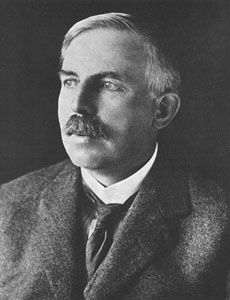
Ernest Rutherford towered over the early 20th-century decryption of the atom. At a series of university settings – Cambridge, McGill, Manchester and then Cambridge again – he masterminded a progression of classic experiments that dramatically revealed the nature of radioactivity, and the structure of the atom and its nucleus. Many of those he had chosen to be his research partners – Blackett, Chadwick, Cockcroft, Geiger and Walton, among others – went on to become physics figureheads in their own right. In Manchester, Rutherford inspired Niels Bohr to abandon the theory of electrons in metals and turn to that of electrons in atoms instead.
Rutherford biographies are not scarce, with inspired memoirs and nostalgic reminiscences by several contemporaries – Allibone, Da Costa Andrade, Oliphant – and the 1983 biography Rutherford, Simple Genius by David Wilson.
The title of Wilson’s book succinctly catches the nature of Rutherford. He was no fiery intellect like many of his central European contemporaries. Instead, his slow but penetrating insight and analysis, and his gift for patient, incisive investigation, isolated key problems and elucidated them.
Rutherford was born in modest surroundings in New Zealand when the country was still being settled. When New Zealand schoolchildren of the late 19th century learned history, they learned British history – there was no New Zealand history. University examination papers were despatched by boat to Britain for marking.
New Zealander John Campbell – he teaches physics at the University of Canterbury – was struck, ashamed even, by the lack of recognition of his nation’s premier scientist and he set out to do something about it. He developed a fitting memorial at Rutherford’s birthplace in Nelson and embarked on this major biography, which fleshed out Rutherford’s New Zealand background. While other epochs in Rutherford’s life have been well documented, his youthin New Zealand has until now been largely overlooked. Compared with 50 sketchy pages in Wilson’s book, perhaps half of Campbell’s book deals with local matters – Rutherford’s birth, schooling, early university education and periodic visits throughout his life. During his studies, Rutherford emerged as a gifted student but no precocious childhood genius.
As well as the focus on New Zealand, there is much valuable additional material in the book – anecdotes, the paradox of how the 20th century’s foremost experimental physicist never received the Nobel Prize for Physics (even before his historic discovery of the atomic nucleus in 1911, he received the Nobel Prize for Chemistry for his work on radioactivity), several major discoveries that were missed at Cambridge in the early 1930s – the positron, induced radioactivity – and finally the bizarre circumstances of his death at the age of only 66. (Details of Rutherford’s death are strangely absent in existing biographies, written when many people still had an upright Victorian attitude.) Rutherford had been influential in key applied research positions in the First World War. What impact would his blustering no-nonsense personality have made in Second World War science and technology?
The book underlines Rutherford’s continual push for higher-energy particles. In a 1927 speech to the Royal Society, he said: “It has long been my ambition to have available for study a copious supply of atoms and electrons which have an individual energy far transcending that of particles from radioactive bodies.” At Cambridge, industrial techniques were exploited in the search for higher voltages – an early example of technology transfer. This ultimately led to Cockcroft and Walton’s accelerator, carried further by Oliphant. However, Rutherford dropped the ball by not acknowledging the arrival of the upstart cyclotron, developed by Ernest Lawrence in the US.
Especially poignant is the description of Rutherford’s undemonstrative romance and marriage to the faithful Mary (“May”) Newton, whom he met while a student in New Zealand and who eventually followed him to Britain after patiently waiting to be summoned.
Campbell’s homely but complete biography of “Ern” is totally in keeping with Rutherford’s own bluntness – a valuable addition to the biography of a key scientific figure. It will be particularly appreciated in New Zealand, even if major world publishers did not agree with this antipodean focus. A shorter 250-page version is thus in the pipeline.
In his Rutherford biography, New Zealand physicist John Campbell has done an immense amount of spadework. Some of this is references in the book, but more complete references are being assigned to public repositories. He says:
“I have filled 10 quarto 120-page record books and three filing cabinet drawers with such notes. These have been willed to the Rutherford Collection at the Alexander Turnbull Library, the historic arm of the National Library of New Zealand. The master manuscript refers to these notes. The biography also draws extensively on the local newspapers of the day, Rutherford family correspondence and the official and unofficial records of the relevant organizations.
“In such a major research, sometimes every paragraph, sentence or even phrase requires a reference or further comment. This is too detailed for most users. In this book only the main points will be referenced due to space considerations.
“A master copy, which includes material edited out of the printed version, will be hand annotated with full references and comments on the sources of every statement. Two years after publication date, thus allowing for the incorporation of any new information which may come to light as a result of the book, I will donate a copy of this master manuscript to public repositories in each country with a Rutherford association. This will make the details more freely accessible to interested people.
“There will be one condition imposed, that for 10 years after the deposition date any person can copy no more than 10 pages per day. After that period copying will be as per the usual custom for the particular archive. During that 10 year period I will invite people seriously interested in Rutherford to purchase their own copy from AAS Publications, PO Box 31-035, Christchurch, New Zealand. Purchasers will be encouraged to donate their copy to any other appropriate public repository.”
Repositories of Master Copies:
Alexander Turnbull Library of the National Library of New Zealand Nelson Provincial Museum Cambridge University Library (Manuscripts) National Library of Scotland Center for the History of Science, Royal Swedish Academy of Sciences, Stockholm Musée Curie (France) McGill University Library (Archives) P L Kapitza Institute for Physical Problems (Moscow) American Institute of Physics, Niels Bohr Library National Library of Australia
The correct prediction of antimatter by Paul Dirac is arguably the most astonishing intellectual achievement of the 20th century. By insisting that quantum theory and special relativity must be consistent, he was able to deduce the generalization of the Schrödinger equation to the Dirac equation. By doing that he was able to give a proximate explanation for spin, and to predict a whole new set of particles, antimatter. That the human mind can discover a previously unknown part of the world is a great achievement. (I largely agree with Antonino Zichichi who argued for Dirac as the most important physicist of the 20th century in Physics World in March.) Gordon Fraser’s lively and interesting book provides a broad treatment of this story, and the history, science and implications of antimatter.
This is a very nice book, totally accessible to any curious reader, yet with occasional thought-provoking pieces even for experts. Fraser keeps a fast pace, explaining the science well but taking care not to dwell too long on any difficult aspect. In a few places I didn’t fully agree with his viewpoint or arguments. I will mention some of these as a service to possible readers, but they do not detract from the value of a successful book.
Publishers are notorious for writing anything they please on book jackets and in publicity. Fraser is not responsible for then remark on the jacket that the book is about how science fiction became fact, which is, of course, the opposite of what happened (the remark is taken from the title of chapter 1, but its meaning is different there), or the charming reference to “Hans van der Meer” in the publicity, mixing up Hans Dehmelt (whose work with traps is described in chapter 11) and Simon van der Meer (who figured out how to get antiprotons in sufficient quantities to make a collider.)
Chapter 1 describes the public excitement about the 1995 discovery of antiatoms, and then begins the history. My impression of one bit of the history differs a little here. Fraser says that at first Dirac thought that the antielectron was the proton. He may be correct, but I have heard over the years that people pushed rather hard on Dirac about where the predicted antielectron was – after all, predicting new particles was not normal then. Dirac defensively remarked that perhaps it was the proton, though he knew that that didn’t make sense.
The next chapter introduces the relevant symmetries, charge conjugation, parity and time reversal, and then provides a quick history from Galileo through Newton to Einstein. It includes the Thornhill portrait of Newton without a wig, which I have seen in the Master’s Lodge of Trinity College, Cambridge – Newton looks much more like a physicist there than in his usual wigged appearances. Here and later the book has a nice way of giving brief descriptions that capture the essence of people.
Chapter 3 is a history of the acceptance of atoms, and the discoveries of the electron, nucleus, proton and neutron. Next is a more thorough biographical treatment of Dirac, with some of the many anecdotes, followed by the development of quantum theory and the Dirac equation. Chapter 5 describes the positron discovery, including the opposition of R A Millikan. That opposition helped to make European physicists more aware that Carl Anderson’s CalTech data could be the antielectron than were the US physicists. There is also a (delightful for a theorist) quote from Rutherford of a sentiment that we still encounter: “It seems to be to a certain degree regrettable that we had a theory of the positive electron before the experiments…I would be more pleased if the theory had appeared after the establishment of the experimental facts.”
Fraser then presents a quick discussion of infinities, renormalization and Richard Feynman, and interesting speculations on Dirac and Feynman’s distinctive personalities and the strong influences of their fathers as they were growing up. The story moves to the development of accelerators and the discovery of the antiproton, and then to quarks. (A minor point: the wording of a sentence on p108 suggests that quarks have a known size, but in fact there is only an upper limit and quarks are expected to be far too small to measure their size directly.) Next comes further discussion of parity violation and then CP violation, leading up to Andrei Sakharov’s statement of the conditions required for an explanation of the mysterious baryon asymmetry of the universe.
Particle colliders, which of course, require expertise in handling antimatter, are brought in and some of their discoveries presented. The only typographic error I found was on p175, where the ratio of the top quark mass to the b-quark mass is about 35, not 300. Chapter 13 is basically on antimatter technology, including PET scans and more. Fraser gets somewhat sensational here, beginning the chapter with a survey of the Reagan era “Star Wars” antimissile programme, and then unfairly relating that to the US plans to build the Superconducting SuperCollider, even seeing a connection to antimatter propulsion proposals and personnel for Star Wars. He also laments the loss of the LEAR antiproton beam at CERN, and perhaps misses an opportunity to discuss the difficulties of doing all science projects in times of limited resources, and of deciding which ones to pursue.
Why the universe is matter and not antimatter is still a mystery. The explanation of the evidence in chapter 14 is very clear. However, there are more approaches that could eventually explain this mystery than the book suggests. The problem is that the calculations are very difficult and the underlying theory is not established. Perhaps most fundamentally, we do not yet know the origin and size of the CP-violating effects that are essential to explain the matter asymmetry. One piece of progress is that we do know now that the Standard Model cannot explain the matter asymmetry of the universe, so new physics must enter. It is likely that the phases that lead to the CP violation needed to generate the matter asymmetry arise when string theories are compactified to three space dimensions and when supersymmetry is broken, but these subjects are not yet well understood. If you think these approaches are somewhat far out, you’ll enjoy Fraser’s speculations on this issue even more.
After several months of negotiations, the UK Particle Physics and Astronomy Research Council has announced the establishment of an Institute for Particle Physics Phenomenology at Durham University. The director designate is James Stirling.
The aim is to establish a broad-based, internationally competitive research activity in a key area. Phenomenology (the analysis, comparison and interpretation of data) is the bridge between theory and experiment. Durham already has a considerable international reputation in this field. The new Institute will set out to make additonal contributions to both the experimental and the wider UK theoretical programmes. Research will encompass accelerator and non-accelerator measurements, and the emphasis of the research should evolve with the UK experimental particle physics programme. Experimentalists will participate in the activities of the new institute, which will host an extensive visitor programme and hold workshops and summer schools for the benefit of the whole UK particle physics community. The institute is expected to start up in October.
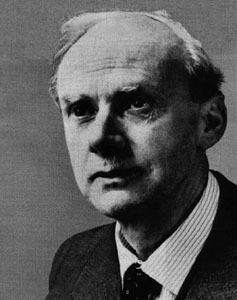
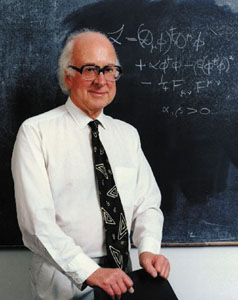
As part of the recent UK Institute of Physics conference, Particle Physics 2000, in Edinburgh, a special symposium was held to celebrate the 70th year of Peter Higgs, after whom the elusive “Higgs field” is named. This field and its particles are responsible for the spontaneous symmetry breaking of the symmetry of electroweak interactions, so that, for example, the W and Z carriers of the weak force are heavy particles, while the electromagnetic photon remains massless. Finding the Higgs particle(s) is today’s major particle physics goal.
The event opened with a talk by current Nobel prizewinner Gerard ‘t Hooft on the early days of gauge theories, in which he reminded the audience that in the 1960s these theories were widely regarded as of little relevance to particle physics. However, his supervisor, Martinus Veltman, insisted that all of his students read an obscure paper from the 1950s by Yang and Mills, so helping the 1970s resurgence of gauge field theories.
In the following talks, Peter Zerwas (DESY) reviewed the phenomenology of the Higgs particle at current and future colliders, and Pedro Texeira-Dias (CERN) described the current experimental search for the Higgs at LEP.
The afternoon concluded with a lively talk by former CERN director-general Chris Llewellyn Smith on his long association with the search for the Higgs boson, which began as the theory convenor of a workshop in 1980. He gave a vivid description of the physics involved in engineering the LHC collider, including a picture of the CERN administration building apparently “relocated” to one of the LHC experimental caverns. He had used this to show the CERN Council how big the pits needed to be, and was asked why he wanted to move the administration building to the pit!
A theme of the meeting was that the Higgs is everywhere. In a public lecture by Frank Close on the origins of asymmetry, Higgs was seen to break the symmetry of an empty Coke can on which Close was balancing, causing Close’s potential to collapse into an asymmetric state.
At the banquet, Ken Peach, director of particle physics at Rutherford Appleton Laboratory, gave a lecture from the pulpit of the former Highland Kirk. In this suitably Calvinist setting, he recalled his misspent youth as a student in Edinburgh, but seemed to remember attending a few field theory lectures by Higgs, which may account for his subsequent career. More recently he recalled an L3 speaker giving a seminar in Edinburgh describing the failure to find a Higgs at LEP, at the end of which it was pointed out that there was in fact a Higgs in the audience.
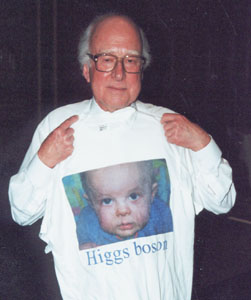
However, the most moving part of the Fest belonged to Higgs, who sported a T-shirt of his grandson, indicating the existence of a second light Higgs (evidence for super-symmetry?). He received an honorary fellowship of the Institute of Physics, and a piece of an LHC magnet from his colleagues, to which he responded in typically modest fashion. Apparently the famous Higgs particle was the result of only three weeks’ work in the mid-1960s. The first two weeks were spent writing a paper and having it rejected by the referee on the grounds that quantum field theory was obscure and of little interest. The referee suggested that the paper might be improved by the addition of some practical consequences of the theory. The third week was spent providing these examples, which included the Higgs particle. The audience, which included a large fraction of graduate students, was suitably awestruck by the idea that a mere three weeks’ work might be sufficient to get a particle named after you.
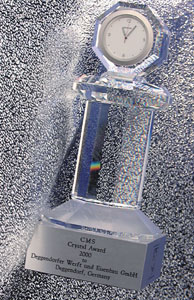
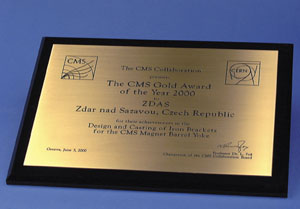
Three contractors involved in CERN’s forthcoming CM experiment’s magnet project became the first beneficiaries of the collaboration’s new awards scheme on 5 June. In the two-tiered scheme, major contractors deemed by the collaboration to have delivered exceptional service will receive the CMS Crystal Award. Other contractors are eligible for the CMS Gold Award.
CMS has initiated the scheme as a motivating factor for all of its contractors, and as a way of rewarding excellence. A panel of five has been established to consider award nominations made by CMS project leaders, and to make recommendations to the experiment’s Collaboration Board. Criteria considered by the panel include strict adherence to the terms and deadlines of a contract, a good working relationship and exceptional performance in terms of innovation.
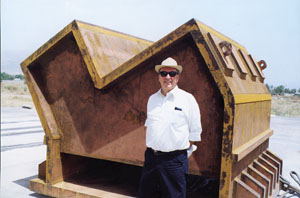
The first three awards were made during a CMS collaboration meeting at CERN. It is no accident that they all went to contractors working on the experiment’s magnet, since that is the furthest advanced component of the new experiment. A Crystal Award went to Germany’s Deggendorfer Werft und Eisenbau (DWE) GmbH, principal contractor for the CMS magnet yoke. DWE delivered the fifth and final wheel for the barrel part of the yoke on time and within budget just before the meeting began. Gold Awards were presented to two of DWE’s subcontractors: Izhora of St Petersburg, which produced the 120 forged iron blocks making up the magnet yoke, and ZDAS of the Czech Republic, which made the brackets that will hold them all together in 12-sided wheels.
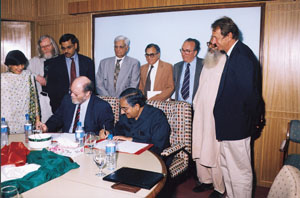
Signed in Islamabad in May was an addendum to the Memorandum of Understanding between CERN and Pakistan, covering increased Pakistani involvement in the CMS experiment for CERN’s LHC collider.
Pakistan is supplying six giant 25 ton support feet for the main “barrel” magnet of the CMS detector, as well as material for the magnet itself. Under the new agreement the National Centre for Physics at Quaid-i-Azam University, Islamabad, will also supply 432 resistive plate chambers (RPCs) for the CMS forward muon system as part of a collaboration that also involves China, Italy, Korea and the US. In addition the front-end electronics boards for RPC read-out will be manufactured in Pakistan.
A major CERN delegation was recently in Pakistan for the signing of the new agreement.
Particle physics in the Czech Republic is maturing fast. This was the message that emerged from the European Committee for Future Accelerators (ECFA) during its continual tour of CERN member states as it recently surveyed national activities at a meeting at the Masaryk Hostel of the Czech Technical University, Prague. (The hostel is named after Tomás Masaryk, who was the first president of the Czechoslovakian Republic, from 1918 to 1935.)
At the ECFA meeting, policy issues in the Czech Republic were presented by M Potucek and Pavel Chraska, respectively deputy chairman and a member of the national Research and Development Council. This agency is proposing new rules for the organization finance of research and development. The keyword in these presentations was “changes”, of which there have already been many since the 1989 “velvet revolution”, but there are more to come.
One major purpose is to make the Czech system more compatible with that of the European Union countries. For example, scientific research was traditionally carried out almost entirely at the institutes of the Academy of Sciences while the universities were “just for teaching”. This has now changed. There has also been a drastic reduction in the number of people employed by the academy, from about 13 000 to about 6500. Several institutes of the academy have been closed.
After several difficult years there is now optimism in the air. The state support of R&D – 0.4% of national GNP in 1999 – is expected to be 0.6% in 2000 and to increase to 0.7% by 2002. One difficult remaining problem concerns how to attract young people, who are badly needed, because the average age in this sector is high. The salaries offered to young people are simply not attractive enough.
The status of high-energy physics in the Czech Republic was reviewed by J Niederle, president of the National Committee for Collaboration with CERN, and by J Hosek. The good news here is that there has been a substantial increase in the number of high-energy physicists in the Czech Republic since the ECFA last visited the country in 1994. The number of theorists has increased from 37 to 51 and that of experimentalists from 39 to 94. This is partially due to the change of orientation of scientists already in the system. The average age of permanently appointed staff is high – 48 for theorists and 51 for experimentalists.
So far the Delphi experiment at LEP has been the central activity of Czech experimental physics. For the future, ATLAS at the LHC will take over this role. However, Czech physicists also take part in a range of other experiments at CERN (ALICE, CERES, DIRAC, ISOLDE, NA57) as well as in several R&D projects. Outside CERN, Czech physicists participate in the D0 experiment at Fermilab and in H1 at DESY. Since 1998 the Czechs have also been involved with the Auger cosmic-ray project.
Across this now wide spectrum – in R&D, detector building, data analysis and theory – Czech physicists make an important contribution to the world particle physics effort in general and to the CERN programme in particular. At the meeting, Czech physicists described this contribution.
The oldest university in central Europe, Charles University in Prague, was founded in 1348 by Charles IV, then Holy Roman Emperor and King of Bohemia. Austrian physicist and philosopher Ernst Mach was a professor there for 28 years (1867-95), during which time he proposed Mach’s principle, which greatly influenced Albert Einstein’s thinking in the formulation of his theory of gravity. Mach also served as rector of the University. Appointed professor at the university in 1911, Albert Einstein became aware there of the importance of tensor calculus for his work on general relativity. His student at Prague was Otto Stern. When Einstein left Prague the following year, he was succeeded by Philipp Frank.
To provide the best experiences, we use technologies like cookies to store and/or access device information. Consenting to these technologies will allow us to process data such as browsing behavior or unique IDs on this site. Not consenting or withdrawing consent, may adversely affect certain features and functions.
Functional
Always active
The technical storage or access is strictly necessary for the legitimate purpose of enabling the use of a specific service explicitly requested by the subscriber or user, or for the sole purpose of carrying out the transmission of a communication over an electronic communications network.
Preferences
The technical storage or access is necessary for the legitimate purpose of storing preferences that are not requested by the subscriber or user.
Statistics
The technical storage or access that is used exclusively for statistical purposes.The technical storage or access that is used exclusively for anonymous statistical purposes. Without a subpoena, voluntary compliance on the part of your Internet Service Provider, or additional records from a third party, information stored or retrieved for this purpose alone cannot usually be used to identify you.
Marketing
The technical storage or access is required to create user profiles to send advertising, or to track the user on a website or across several websites for similar marketing purposes.