by W D McComb, Oxford University Press, ISBN 0 19 850112 9 (pbk).
This a comprehensive textbook sets out to introduce special relativity to mathematicians, mathematical physicists and physicists in a natural way and avoid all “gee-whizz”. There are ample exercises and an introduction to general relativity.
by R Snyder, J Fiala and H J Bunge, Oxford Science Publications, ISBN 0 19 850189 7 (£95, 780 pages).
In the International Union of Crystallography series of monographs, this comprehensive compilation of 31 chapters from different authors looks at the latest developments in X-ray diffraction techniques.
by H V Klapdor-Kleingrothaus and K Zuber, revised edition, Institute of Physics Publishing, ISBN 0 75 030549 5 (pbk £34.99/$59.99, 470 pages).
This is a revised and updated edition, in paperback, of a book that, when it first appeared a few years ago (Bookshelf, Summer 1998), merited the comment “more than just a graduate level textbook…it is also a sign of the times”.
by B K Ridley, Oxford Science Publications (4th edn), ISBN 0 19 850580 9 (pbk £27.50 435 pages).
First published in 1982, this work provides a useful overview of semiconductor physics without indulging in extraneous solid state matters. The idea seems to have found a niche and the book has been repeatedly updated. In view of new developments in quantum entanglement and the interest in quantum computing, the latest edition includes new chapters on charge transport.
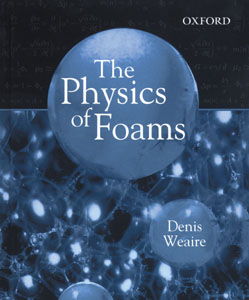
This is a specialized but wonderful monograph that begins: “Pour a bottle of beer. Restraining your thirst for one moment, admire its lively performance (see figure 1.1).” This book is also a lively performance – its authors, from Dublin’s Trinity College, evidently have a knowledge for thirst!
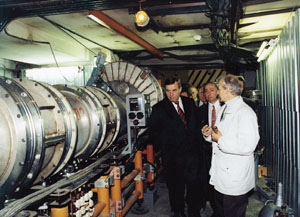
Under a new ruling, the Joint Institute for Nuclear Research (JINR) in Dubna, near Moscow, has the same legal status of an international organization in Russia as CERN enjoys in its host countries.
“On Ratification of the Agreement between the Government of the Russian Federation and JINR on the Location and Terms of Activity of JINR in Russia” was approved by the Russian Parliament on 22 December and signed by the acting president of the Russian Federation Vladimir Putin on 2 January.
On the scientific front, milestones at JINR in 1999 included the first successful test of the beam slow extraction system of the superconducting Nuclotron and also the start up of the new methane cryogenic moderator for experiments with cold neutrons at the IBR-2 reactor.
JINR’s prestigious Bruno Pontecorvo prize for 1999 was awarded to Raymond Davis of Brookhaven for his outstanding achievements in developing the chlorine-argon method for solar neutrino detection.
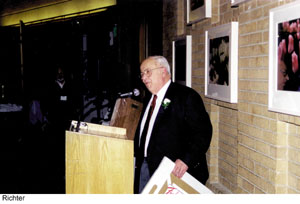
Haim Harari from the Weizmann Institute in Israel said it best: “On occasions like the celebration honouring Burton Richter, the talks require a formula: 30% physics, 30% nostalgia, 30% entertainment and 10% admiration.”
Other speakers at the day-long celebration held at the Stanford Linear Accelerator Center (SLAC) in January varied a great deal in these percentages. The day was, in turns, serious, funny and sentimental. When the balance shifted to the sweet side, Richter, now emeritus director of SLAC, commented: “You can get sick on too much sugar.”
Harari’s presentation reviewed the November Revolution of 1974. He recalled mailing a letter home to Israel on 8 November of that year, saying that things were rather boring at SLAC and that he wished that he were at Fermilab. Two days later, the psi peak was discovered at the SPEAR electron-positron collider and Harari realized his good fortune in being at SLAC on such a momentous occasion.
Weighing in heavily on the admiration end of the scale, both Martha Krebs, former director of the Office of Science at the Department of Energy (DOE), and John O’Fallon, head of the high-energy physics programme at the DOE, praised Richter for his candour and his mentoring of the young (and “not-so-young”, according to Krebs). “Richter is a strong and ardent advocate for science,” said O’Fallon. Known for having the last word in every situation, Richter shot back: “If I’m so good, how come I didn’t get bigger budgets?”
Recognizing Martha Krebs’ six-and-a-half years with the DOE in Washington, Richter added a surprise event to the day’s agenda. After Krebs’ speech, he presented her with a coveted award given only to SLAC retirees – a beam tree. “After all, you’re a retiree now,” he remarked.
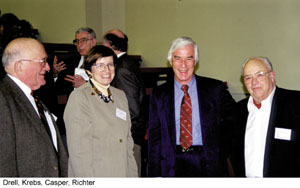
SLAC director Jonathan Dorfan’s welcome to the crowd of 300 people roasted his old boss with gentle jibes about Richter’s trainers, the trademark New Balance shoes that he habitually wears, almost regardless of the occasion. (Let the record show that Richter did wear leather shoes for his celebration.) Dorfan showed pictures of Richter in sneakers from 1970 to the present, with university presidents and royalty. Richter’s golf hats also came in for some ribaldry. Later on at the after-dinner speech, Sidney Drell admonished Dorfan on this topic. “Dorfan is a good scientist but a lousy historian. I lost my hair long before Burt, and I started the trend to golf hats at SLAC, and I want to set the record straight,” said Drell emphatically.
Others continued to roast Richter while praising his wife Laurose. SLAC emeritus director W K H (Pief) Panofsky complimented Richter on his good judgement. “He stole my secretary and married her,” he said, referring to Laurose. MIT’s Lou Osborne recalled the early days with Richter at MIT, but made sure that he added “that one of the best things about Burt is Laurose: her hospitality, her good sense and wisdom that rivals her husband’s.”
Nan Phinney stuck to the science of the SLC/SLD for her talk. Artie Bienenstock, now at the Office of Science and Technology Policy, flew in from Washington, DC, to his old home at SLAC. He made some political remarks, which, he assured the participants, “do not represent the President, the White House, the Congress or OSTP,” adding that he was sure to offend someone, since that’s what happens once a person moves to Washington.
That sentence gave Stanford University president Gerhard Casper just the opening he needed. “Artie, rest assured that you have offended at least one president in the audience,” he joked. A masterful speaker, Casper included erudite allusions and ad libs, fact and fiction. “One needs true genius to achieve praxis, the ability to combine theory and practice,” he said. “Richter bridges the conceptual, practical and political to get results.” Casper noted that Richter was lab director for 15 years, and in that time there were seven Secretaries of Energy. “Why so many? They were all worn down by Burt,” said Casper. “Politicians come and go, but like the Energizer Bunny, Richter keeps going and going.”
CERN’s Luciano Maiani, in paying tribute to Richter’s international science connections, was grateful for the arrival of a C-4 cargo plane in Italy. “It carried the BaBar coil back to America and allowed us in Italy to say the project was on time!”
John Rees spoke about Richter’s role in building SPEAR and how they struggled to design something cheap enough to get funding. “When we realized that we had spent too much the first year, like any good project managers, we decided to cut the construction time and we finished SPEAR sooner,” said Rees. Gus Voss traced the roots of the design for the next linear collider from SLAC projects in the past to the grand designs for the future generation machine.
At the evening’s dinner party, Sidney Drell brought the day’s events to an eloquent and pithy close, even though Richter still had the last word. “Physicists are not normal,” Drell said, “so we don’t have to follow Shakespeare’s seven stages of man.” Instead, Drell (the theorist) theorized on the stages of the physicist’s life: student, problem solver, builder, mentor, advisor, statesman. “Richter may choose at some point to answer to a higher authority and become a theorist himself.”
Richter came back with his own stages, having written them on his dinner napkin. “Monomaniacal physicist – that lasts up until about age 40,” he proposed. “Then in the 50s one becomes mature. I got a little concerned about turning 60, then I decided that was the age of wisdom. But in a few years I’ll turn 70, and I am looking forward to the next stage, whatever that might be.”
The next stage may well be rearranging his office to display all the plaques, pictures and memorabilia he acquired at his celebration. That is, if Richter takes the time away from his role as president of IUPAP, champion of the Next Linear Collider, advisor to Washington, and statesman for high energy physics.
Last year marked the 90th anniversary of the birth of an outstanding Russian scientist in the field of mathematics, mechanics and physics: academician Nikolai Nikolaevich Bogolyubov (1909-92). An international conference, Problems of Theoretical and Mathematical Physics, dedicated to his memory, took place on 27 September – 6 October. The scientific and memorial sessions were held in Moscow, Dubna and then Kiev – the cities in Russia and Ukraine where Bogolyubov left his remarkable heritage as a teacher and a founder of new scientific schools and research directions.
The conference covered those fields to which Bogolyubov made fundamental contributions and initiated new lines of research: mathematics and nonlinear mechanics; quantum field theory; elementary particle physics; statistical physics and kinetics; and nuclear physics. More than 200 scientists from many countries attended. The conference was organized by the Russian Academy of Sciences (RAS), the National Academy of Sciences of Ukraine (NASU) and the Joint Institute for Nuclear Research (JINR), with the support of UNESCO, INTAS, the International Mathematical Union, the Ministry of Science and Technology of the Russian Federation, the Ministry of Education of the Russian Federation, Moscow State University (MSU), the Russian Foundation for Basic Research, the State Committee of Ukraine for Science and Intellectual Property and the Heisenberg Landau and Bogolyubov-Infeld Programmes.
During the opening at MSU on 27 September, the participants were addressed by the president of the RAS, Yu S Osipov; the rector of MSU, V A Sadovnichy; and the director of the JINR, V G Kadyshevsky. The first day saw the award of prizes: the N N Bogolyubov Gold Medal of the Russian Academy of Sciences for 1999 went to academician V S Vladimirov; and the N N Bogolyubov Prize of the Joint Institute for Nuclear Research for 1999 was awarded to Prof. I R Progogine, Nobel Prize winner and director of the Solvay Institute (Brussels), and to academician V G Bar’yakhtar (Kiev).
At the plenary session, talks were presented by V S Vladimirov, Yu A Mitropol’sky and V G Bar’yakhtar. I R Progogine spoke about causality, irreversibility and non-locality. CERN director-general Luciano Maiani reviewed research on particle physics conducted and planned at CERN. Talks on mathematics and nonlinear mechanics; quantum field theory; and statistical physics and kinetics, given at parallel sessions, completed the first day’s proceedings.
On the following day the conference continued at the Steklov Mathematical Institute of the RAS, where plenary talks were delivered by D V Shirkov (Dubna), L D Faddeev (St Petersburg), G I Marchuk (Moscow), N N Bogolyubov Jr (Moscow), W Thirring (Vienna) and J Devreese (Antwerp).
On 29 September, participants paid tribute to Bogolyubov by laying flowers on his tomb in Moscow’s Novodevichy Cemetery. Participants then moved to Dubna, where sessions were continued at the Bogolyubov Laboratory of Theoretical Physics until 2 October. Of great interest were the reminiscences by N N Bogolyubov’s brothers, A N Bogolyubov (Kiev) and M N Bogolyubov (St Petersburg).
The Dubna part of the conference included more than 60 talks by well known physicists, including K Nishijima (Tokyo), V A Matveev (Moscow), A N Tavkhelidze (Tbilisi), A M Baldin (Dubna), H Araki (Tokyo), A A Logunov (Protvino), J Zinn-Justin (Saclay), I A Savin (Dubna), A A Slavnov (Moscow), A N Sissakian (Dubna), V A Moskalenko (Dubna) and Yu Ts Oganessian (Dubna).
The Kiev part of the conference opened on 4 October in the Main Conference Hall of the NASU. The participants were welcomed by B E Paton, president of the NASU; A G Sitenko, director of the Bogolyubov Institute of Theoretical Physics; and V G Kadyshevsky, director of the JINR. Academicians V G Bar’yakhtar (Kiev) and Yu A Mitropol’sky (Kiev) emphasized Bogolyubov’s role in developing new ideas and directions in statistical physics, kinetics and nonlinear mechanics. Plenary talks were presented by D V Shirkov (Dubna), P N Bogolyubov (Dubna) and O S Parasuyk (Kiev).
On 5 and 6 October, sessions continued at the Bogolyubov Institute for Theoretical Physics of the NASU and the Institute of Mathematics of the NASU with more than 70 talks. V G Kadyshevsky presented new ideas on the extension of the Standard Model, based on geometric reasoning. Problems of “ghost” singularities in quantum field theory were examined by D V Shirkov. N N Bogolyubov Jr suggested a development of polaron models. Plenary sessions included talks by R Jackiw (Cambridge, MA), I P Yukhnovski (Lvov), J Wess (Munich), D Ya Petrina (Kiev), W Manfliet (Antwerp), Yu L Klimontovich (Moscow), S P Peletminskii (Kharkov) and W Ebeling (Berlin). In the programme of parallel sessions on mathematics and physics, ample time was allotted to representatives of the Kiev School of Theoretical Physics, established by Bogolyubov.
The conference, including 42 plenary talks and more than 150 contributions at parallel sessions, closed on 6 October in Kiev.
Science brings nations together, and synchrotron radiation facilities bring different kinds of science together. Thus SESAME (Synchrotron Light for Experimental Science and Applications in the Middle East) could help to strengthen valuable new ties and develop new ones.
In the aftermath of the Second World War, CERN was created under the auspices of UNESCO with two objectives: to promote science and to foster international co-operation. Both aims have been achieved spectacularly and CERN is not only considered to be a great European success, but also recognized worldwide as a leading international focus with enormous benefits for knowledge and technology transfer, providing a hub where scientists from different nations, races and creeds can work together peacefully.
This dream is now being renewed, this time in the Middle East, and again within the UNESCO framework. Important progress was made during a meeting of the SESAME Interim Council in December. There is now a good chance that the project will fly, with the participation of Armenia, Cyprus, Egypt, Greece, Iran, Israel, Jordan, Morocco, Oman, the Palestinian Authority and Turkey – a list that, hopefully, is not yet complete. In addition, some countries participate as active observers: Germany, Japan, the US, Sweden, Italy, Russia and Switzerland.
BESSY 1 resurrected
This newest offspring of CERN goes back to an initiative of Sergio Fubini, who, enjoying the confidence of both the Israelis and the Arabs, started a Middle East Scientific Cooperation with the original aim of organizing seminars and workshops. During a meeting in Turin in autumn 1997, Herman Winick from SLAC and Gustav-Adolf Voss from DESY suggested that BESSY I, a Berlin synchrotron radiation machine scheduled to be closed down in 1999, could be upgraded as the core facility for a new laboratory in the Middle East. Remembering the origin and aims of CERN, I suggested bringing this project under the valuable political umbrella of UNESCO.
However, experience in elementary particle physics has shown that only viable projects with a sound scientific basis are worth pursuing as international ventures. Thus last spring a meeting was organized by Tord Ekelöf at Uppsala to discuss a possible scientific and technical programme and to ascertain whether there is sufficient interest in the region.
The outcome was very positive and the SESAME plan was brought to the attention of the director-general of UNESCO (at that time Federico Mayor), who expressed enthusiastic support and agreed to invite all governments in the Middle East and in the Mediterranean region to a meeting at UNESCO headquarters in June 1999. The delegations unanimously adopted a resolution to launch the project. An Interim Council (chairman Herwig Schopper) was created, advised by a Technical Committee (co-chairs G A Voss of Germany and C Papanicolas of Greece), a Scientific Committee (co-chairs H Winick of SLAC and E Alp of Turkey/US), a Training Committee (co-chair M Virasoro of Argentina/Italy and R Mansouri of Iran) and a Finance Committee (co-chairs S Assaf of the Palestinian Authority and M Comsan of Egypt). The similarity of this structure to that of CERN is not accidental.
A detailed proposal has been tabled for upgrading BESSY I to a facility that is fully competitive with other machines. Some 10 beamlines are foreseen, with two superconducting wigglers, serving research that ranges from physics, material science, molecular biology, environmental, archaeological and medical studies through to the industrial production of micromechanical parts.
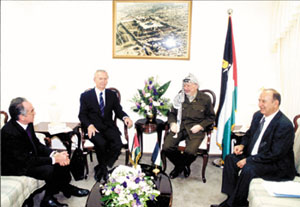
To explore and promote the project, assistant UNESCO director-general Maurizio Iaccarino and I recently visited Egypt, Israel, Jordan and the Palestinian Authority. The great interest that SESAME evokes in the region is not confined to scientists – we were received not only by several ministers but also by King Abdullah II of Jordan and President Arafat.
As with CERN, the next major problem to be solved is the selection of a site. All partners were asked to make site proposals. Some technical conditions had to be fulfilled, but, above all, free access to the laboratory for scientists from all over the world must be guaranteed. Proposals were received from Armenia, Egypt, Iran, Jordan, Oman, the Palestinian Authority and Turkey. Each proposal contained several possible sites.
A meeting of the Interim Council on 13 and 14 December agreed that political and financial criteria must be taken into account for a final site decision. A special committee chaired by the chairman of the Interim Council will meet this spring to prepare a proposal. In the meantime, discussions with and between governments will explore the possibility that one site might find support from several partners. The final decision should be taken before next summer.
The council meeting had to face a major problem. The German government had agreed to provide BESSY I as a gift – a decision that was much appreciated. However, at the same time, the funds for dismantling, packing and transport had to come from other sources and had to be found before the end of 1999, otherwise the components of BESSY I would be offered to other interested parties. To solve this problem, I asked each of the 11 SESAME partners to provide immediately US$20 000. This was agreed, with additional contributions coming from the US, Sweden and possibly Russia.
To complete the arrangements, I then had to beseech new UNESCO director-general, Koichiro Matsuura, who had been in office for only a few weeks, to underwrite an additional US$400 000.
With this initial funding in place, the dismantling of BESSY I can start. Experts from Armenia, Novosibirsk and from the region who will later install and operate the machine will be involved.
During all of the discussions, a remarkable and very pragmatic spirit of friendly co-operation prevailed, promising well for the future of the project. However, many problems remain, most notable of which is the funds for the creation of the laboratory and its operation.The installation and upgrading of the synchrotron are estimated at about US$20 million. Installing and equipping 10 beamlines within five years, together with putting in place the necessary infrastructure, will require a similar amount. Annual operating costs are estimated at US$3.5 million.
These hurdles will surely soon be overcome, and at the dawn of the century SESAME seems to be well on its way to becoming a “door opener” for a new wave of international co-operation, establishing a centre of excellence in a key region of the world.
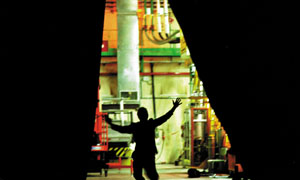
A hundred metres underground in the pit that houses the Delphi experiment in the world’s largest electron positron collider, LEP at CERN – what better stage for a play about antimatter?
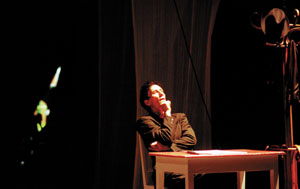
The Delphic Oracleby Geneva’s’Miméscope’ company, in collaboration with CERN, ran for an extended season this winter. Each audience had to be limited to 60 because of the logistics of the LEP pit, and it was carefully divided into smaller groups – electrons, positrons, up quarks – each with its own CERN guide to usher them down, around and back up again.
The Delphic Oracle’saction focused on Paul Dirac’s mathematical discovery of antimatter symmetry, with Markus Schmid playing the role of the scientist gripped by the intensity of original thought and the profound implications of a discovery that went on to change our view of the universe. Such intellectual acrobatics were underlined by Yasmina Krim’s graceful aerial ballet. The light show and backdrops illustrated matter and antimatter at work. At the end of the show, the audience was guided round the Delphi detector – a memorable experience, with even the access lift disguised as a time capsule.
Underground setting, lights and acrobatics apart, the strict scientific focus and the stark table-and-chair props were redolent of Michael Frayn’s play Copenhagen about Niels Bohr and Werner Heisenberg, which all goes to show that physics can make good theatre.
In The Delphic Oracle, Heisenberg did not appear but was the addressee of the letters that Dirac laboriously compiled on stage. Unlike Copenhagen, where Frayn had scrupulously done his homework, physics purists might react to the liberal interpretation of Dirac’s work in The Delphic Oracleand its scientific message. Although Dirac saw the need for symmetry between positive and negative charges in his famous 1928 relativistic treatment of the electron, for several years the proton was identified as the corresponding positive charge. Dirac himself said so in a letter to Naturein October 1930.
Others (notably Oppenheimer and Weyl) began to worry about a particle as heavy as the proton partnering a light electron in a theory that was supposed to be absolutely symmetrical. In May 1931, Dirac grasped the bull by the horns and finally proposed what his equations had been saying all along: “We may call such a [positively charged] particle an anti-electron. We should not expect to find any of them in nature, on account of their rapid rate of recombination with electrons, but if they could be produced experimentally in high vacuum, they would be quite stable and amenable to observation.” These would have been fine words with LEP only a few metres away.
As an introduction to antimatter and as a spectacle, The Delphic Oraclewas memorable, displaying Dirac’s torment at having constructed a theory so perfect that its implications were unthinkable. Dirac suspected that antimatter had to exist, but it took him three tortured years to summon the courage to say so.
Like champagne, antimatter is always stimulating, however it is served.
To provide the best experiences, we use technologies like cookies to store and/or access device information. Consenting to these technologies will allow us to process data such as browsing behavior or unique IDs on this site. Not consenting or withdrawing consent, may adversely affect certain features and functions.
Functional
Always active
The technical storage or access is strictly necessary for the legitimate purpose of enabling the use of a specific service explicitly requested by the subscriber or user, or for the sole purpose of carrying out the transmission of a communication over an electronic communications network.
Preferences
The technical storage or access is necessary for the legitimate purpose of storing preferences that are not requested by the subscriber or user.
Statistics
The technical storage or access that is used exclusively for statistical purposes.The technical storage or access that is used exclusively for anonymous statistical purposes. Without a subpoena, voluntary compliance on the part of your Internet Service Provider, or additional records from a third party, information stored or retrieved for this purpose alone cannot usually be used to identify you.
Marketing
The technical storage or access is required to create user profiles to send advertising, or to track the user on a website or across several websites for similar marketing purposes.