Bluefors – leaderboard other pages

Topics

Responsibility of scientists

I feel it is much preferable, rather than writing about Victor Weisskopf myself, to report the words of others who were closer to him than I – although I did have the privilege to meet him several times – and especially to quote his own words, in particular those that demonstrate his struggle with crucial decisions as well as his reflections that ring like those of a prophet.

So, I begin by reporting some of the commemorative words pronounced at the last Annual Pugwash Conference, held in August 2002 at the San Diego campus of the University of California, by Sir Joseph Rotblat. Indeed Weisskopf and Rotblat – Viki and Jo to their friends – have much in common: both were born in 1908, both were a part of – as Jo said in La Jolla referring to Viki – “Hitler’s gift…[to] the US and Britain” [1], both ended up in Los Alamos – where they became good friends – to help create the first nuclear weapons, both were motivated to do so “by the fear that Hitler could have an atomic bomb before the West did” [2], and both felt after 1945 the responsibility to do whatever they could to avoid the danger that nuclear weapons be again used to kill.

An ardent campaigner

Rotblat said of Weisskopf: “Immediately after the Hiroshima and Nagasaki bombs he became one of the most ardent campaigners to prevent further use of nuclear weapons. This made him a ‘natural’ for Pugwash. Indeed he was one of the ‘originals’ – the name we give to the small group of participants in the first Pugwash Conference, in 1957. With his death, only five of the originals are left.” (In the official picture of the group taken in Pugwash, a few of the 22 participants are missing, and Viki is one of them – maybe he was talking physics with Yukawa, who also is missing from that photo.)

Rotblat in La Jolla went on to say: “In one of his speeches at a Pugwash Conference Viki said: ‘We all dream of a world without nuclear weapons…But we should dream of a world order where people may be justified in saying: Nuclear Weapons? Who cares?’ Unfortunately, the world order now is one in which people say this, while some 30 000 nuclear weapons are still in the arsenals, many of them on hair-trigger alert. We have still a long way to go to fulfil Viki’s first dream, a world without nuclear weapons.”

On 26 September 1989, Viki delivered the third Olof Palme Memorial Lecture in Stockholm (this series of annual public lectures was initiated by the Stockholm International Peace Research Institute (SIPRI) in 1986; the first two lectures were delivered by Willy Brandt, former chancellor of Germany and by Marshal Sergey Akhromeyev, then chief of the general staff and first deputy minister of defence of the Soviet Union). The title he chose was “The responsibility of scientists in the nuclear age”. The rest of this text consists of quotations from that speech [2].

cernweca1_12-02

“The responsibility of scientists is a wide subject, with many ramifications, and my talk will cover only some of its aspects. I would like to start with a personal event in my life. In 1929 I was a student of Max Born studying quantum mechanics in Goettingen. This was and is a rather difficult and esoteric subject, and at that time I wanted to change to medicine. I felt that medicine had more relation to human beings compared with the abstract and esoteric study of theoretical physics. Max Born said to me: ‘No, you should stay in physics. You will see how deeply the new physics will be involved in human affairs.’ How right he was in many respects, both positive and negative. We should not forget the positive effects: new technology and the deeper understanding of atomic structure have helped humankind in many ways. The negative effects, of course, have been rather terrible: the new weapons of war, the nuclear bomb and other terrible things of this kind. […]

Joining the programme

“In 1942, as a recent immigrant to the US, I decided to join the [nuclear weapon] programme because of the overriding fear of Hitler and to help a host country that had received me with so much grace. We did not know that Hitler had not developed the bomb. It is an important question, and one that I cannot answer, whether the CIA or the British Secret Service knew this. They did not tell us. I do not want to accuse them, but it may be that they did not want to tell us because they wanted the bomb to be constructed. However, I have no proof of this.

“A very interesting moment as regards the feeling of responsibility actually came in May 1945 at the time of Hitler’s defeat, when it was clear that he did not have the bomb. Now, should we continue? Should we go on working on this weapon of mass destruction? We all, or almost all, continued [Joseph Rotblat quit at the end of 1944]; we were three months from the completion of the weapon and unfortunately, I say this with a certain feeling of shame, we did not think, at least I did not think, of stopping at that moment. The rationalizations were that the war with Japan was killing many, many people – there were 40,000 victims of the fire bombing each day – and an invasion would cost a million deaths on each side. These were rationalizations; in any event we went on. Perhaps unfortunately, one of the reasons was the attraction of the problem. Since we had worked almost day and night for three years, and were just three months from the fulfilment of this work, it was almost unthinkable not to continue. Robert Oppenheimer coined a term, which I do not like very much, namely, ‘technically sweet’. There is a lesson here, a dangerous lesson. Today we have similar ‘technically sweet’ problems in America, for example, for those people who work on the Strategic Defense Initiative (SDI) programme. Some of these people know that SDI – Star Wars – would really do more damage than good if it was ever to succeed – a question in itself – but because the programme presents interesting, technically sweet, problems some scientists are attracted to work on them.

Ethical questions

“When we knew the war would soon be over, ethical questions arose. What was this weapon? What would it mean for mankind? At that time, Niels Bohr joined the group at Los Alamos. He always taught us that we are responsible for our work. At that time, of course, we did not have much influence on what the government would do with the bomb. There were four possibilities.

“The first possibility was not to use the bomb at all. The second was to demonstrate its use on an uninhabited area. The third was to demonstrate the bomb over a military target, for example, a harbour where a large concentration of the Navy was assembled. The fourth possibility was to throw it over an inhabited city. Nobody took the first option seriously. It was unthinkable that the military would desist from using its most potent weapon in a war. A number of physicists, in particular those under the influence of James Frank, wrote a memorandum to the government, supporting the second option, but the government was unimpressed, afraid that the bomb might fizzle out and amount to nothing. Unfortunately, the third option was not considered either, and the fourth was the solution chosen as the one that would make the biggest impression on the world. The destruction of Hiroshima was bad enough but, looked at today, the decision to destroy a second city after three days was certainly a crime. […]

“The following six points somehow summarize in a very superficial way my view of the responsibility of scientists of all kinds, not only natural scientists, but also social scientists, engineers and statesmen – in other words, everybody:

• to prevent war;

• to prevent environmental catastrophe;

• to provide a creative, purposeful life for the majority;

• to provide assistance and education for the Third World;

• to insist on freedom of thought and the value of doubt;

• and to create an awareness of complementary attitudes.

“These points are not listed in order of importance; they are all equally important. First, we must help to prevent wars. We must show how terrible war is; this is already slowly penetrating into people’s minds. It makes little difference whether we speak of nuclear or conventional war. Even conventional war is terrible, and if the powers have nuclear weapons, then the losing side will certainly use them. The public must be made aware of how destructive modern weapons are. We must help arms reduction by proposing new methods of verification. Second, we must help to prevent environmental catastrophe. I am not sure myself whether this is not even the greater problem. To prevent a nuclear war is simple: do not use nuclear weapons. We do not even know exactly what causes environmental catastrophes and, as I said before, we face enormous political and social difficulties. Scientists must explain the processes leading to the catastrophes, expose technical abuses and redirect technical and societal creativity towards solutions.

Science can never decide what is good and what is bad, what is beautiful and what is ugly, or what is or is not great art.

“Third, we must provide a creative, purposeful life for the majority of the population, a very difficult but necessary task. Fourth, we must help to solve Third World problems by assistance and education. This is always a very difficult problem since it is very easy to feel superior because we are advanced. We are not superior, we are just further ahead – both in use and in abuse – but we still have to help them in many ways. Fifth, it is our responsibility as scientists to proclaim freedom of thought – to teach how doubt and discussions of different opinions are important. We have to demand the freedom for discussion and doubt to be recognized in all communities, and we know very well that the fight is far from won.

“Finally, and here I speak as a Bohr disciple, we must create a sense of complementary attitudes. What do I mean by this? There are several, indeed many, approaches to human problems apart from a scientific one: ethical, artistic and religious. They are not contradictory but complementary to science. Science can never decide what is good and what is bad, what is beautiful and what is ugly, or what is or is not great art. Education should not only be in science; it should attach equal importance to all these approaches so as to teach tolerance and even enthusiasm for the variety of human endeavours. Whenever one way of dealing with the human situation is dominant, abuses come about.

A sense of complementarity

“In medieval times, when the religious view was the dominant one, there were crusades, the Inquisition and the religious wars; today, in some ways, the scientific-technical ‘religion’ is dominant. The abuses are only too well known. What we need is a sense of complementarity. This is not relativism. It is not a denial of values to say that everything has values. Ethical principles and a value system must be derived from many sources, not just one, in order to foster openness and understanding for the different complementary approaches to the realities of life. I think that these are the preconditions for the survival of our civilization. It can provide us with much that is good, beautiful and uplifting, but not yet for the majority of mankind. Once I said that what made my life worth living in the terrible days of Nazism that I lived through were Mozart and quantum mechanics. What I really meant was art and science, the great everlasting creations of the human mind.”

Farewell to Viki

With the passing of Viki we have lost one of the few surviving members on the list of distinguished scientists who founded modern quantum physics. Ever since I became Viki’s research associate at MIT 50 years ago he has been one of my major mentors and closest friends. The way he did physics, the way he enjoyed physics and the way he shared his pleasure at expanding his understanding of physics were all major ingredients in the early formation of my career. With his deep intuitive insights and his creative approach, Viki made pivotal contributions to opening new frontiers, and to enhancing those already opened by adding to a deeper understanding of their significance.

Viki considered himself an amateur, as opposed to an expert because, as he said, what he did was always “for the pleasure of it”. Never did he come even close to falling in the trap that Pauli cautioned against: “Don’t become an expert for two reasons: you become a virtuoso of formalism and forget real nature, and…risk that you are not working for anything interesting anymore.” Certainly no-one would ever accuse Viki of being a virtuoso of formalism.

The anti-Pauli

In an earlier tribute to Viki at CERN on the occasion of his 80th birthday, I recalled the wonderful experience of my first year with him in words that he wrote in describing his experience working with Pauli. In the American Journal of Physics Viki wrote: “It was absolutely marvellous working for Pauli. You could ask him anything, there was no worry that he would think a particular question was stupid since he thought all questions were stupid.” But as I remarked then, Viki was the anti-Pauli, because he accepted all questions not as stupid but as interesting. To him they were challenges to probe to deeper levels of understanding. The resulting discussions – with their insights and enthusiasm – were valuable experiences for those of us who had the good fortune to participate in them. We generally emerged with a deeper physical and intuitive understanding of what was going on. The great school of physics that Viki created at MIT starting in the 1950s can only be described as making physics exhilarating, exciting, demanding, and fun. It was a model for many of us for our own subsequent endeavours.

Viki also proved that even a theoretical physicist, with the right human qualities, can be an outstanding administrator and leader, as he was in his years as CERN’s director-general. I spent a year at CERN during his reign as director-general and the atmosphere was charged with progress, enthusiasm, and high expectations.

Throughout his life no-one was more committed than Viki to the value of international collaboration in science. This was much more than simple theoretical idealism on his part. He firmly believed in the importance of international collaboration for the advancement of science; all science, not just expensive big science. It was good for science. It also served to strengthen the bonds between communities in different countries working towards a more peaceful and co-operative world based on common principles of humanity and brotherhood. Viki’s commitment to this was total, both in the way he opened doors to welcome scientists from all parts of the globe and in his dedication to ensure the success of CERN as the outstanding international scientific institution we all recognize. His skills in achieving consensus among fellow scientists and in identifying the important directions of physics to focus on not only served CERN so well but were also of great value in helping mould the successful national physics programme in the US. Particularly valuable were his years as chair of the High-Energy Physics Advisory Panel working with the DOE and NSF to ensure that the US programme in high-energy physics flourished as a major participant in the broad, world community effort.

The bomb did end the cruel and destructive war with Japan, but since then it has developed into the greatest danger that humankind has ever faced.

Victor Weisskopf

All his life, to quote Hans Bethe, Viki has “sought and contributed to knowledge, and all his life he has shown compassion”; and I would add commitment. This is what made Viki the great man that we all loved so well. We all know Viki’s commitment to the cause of world peace. Having worked to develop the atomic bomb in Los Alamos during the Second World War he was fully aware of the awesome destructive potential of these terrible new weapons and the vital importance of seeing that they were never used again in combat. To this end Viki worked with unflagging dedication to help world leaders, from US presidents to European prime ministers and the Pope in Rome, to understand the physical realities of the nuclear threat. Repeatedly he called on them to lead in efforts to walk away from the brink of nuclear disaster and reduce that threat. As he said in a post-war speech at Los Alamos: “The bomb did end the cruel and destructive war with Japan, but since then it has developed into the greatest danger that humankind has ever faced. And it threatens more and more to destroy everything on Earth that we consider worth living for.”

Viki’s commitment to science, international collaboration and the bonds joining the international community of science in the quest for peace are eloquently expressed in his tribute to Marie Curie at a ceremony in Warsaw in 1967:

Common value system

“The significance of scientific collaboration far exceeds the narrow aim of a more efficient prosecution of our scientific endeavours. It stresses a common bond among all human beings. Scientists, wherever they come from, adhere to a common way of thinking: they have a common system of values that guides their activities, at least within their own profession. New approaches in bringing nations together can perhaps be discussed with more ease within this community, some political misunderstandings can be cleared up, and dangerous tensions reduced. As an example, we recall that the agreement to stop the testing of nuclear bombs above ground stemmed, in part, from prior meetings among scientists.

“We must keep the doors of our laboratories wide open and foster the spirit of supranationality and human contact, of which the world is so much in need. It is our duty to stick together, in spite of mounting tension and threatening war in the world today. The present deterioration in the political world is a reason stronger than ever for closer scientific collaboration. The relationship among scientists must remain beyond the tensions and the conflicts of the day, even if these conflicts are as serious and frustrating as they are today. The world community of scientists must remain undivided, whatever actions are taken, or whatever views are expressed in the societies in which they live. We need this unity as an example for collaboration and understanding, as an intellectual bridge between the divided parts of mankind, and as a spearhead towards a better world.”

Thirty-five years later those words ring every bit as true as they did when he originally spoke them.

My most cherished recollections of Viki are the warm friendship that my wife and I enjoyed with him and Ellen, his wife for many years. With our families we had many wonderful occasions together that will always be a rich part of our lives. These included summer schools at Erice with Nino Zichichi, a spring together in Vienna in 1972, a year at CERN, summer visits to the Weisskopfs’ mountaintop home in Vesancy, France, and frequent visits to Cambridge and Stanford. Discussions ranged broadly over literature, politics, and especially music. Viki and I enjoyed a special bond of playing violin-piano sonatas together on many, many occasions. Indeed Viki often introduced me at seminars and colloquia, at CERN, MIT or wherever, by recalling that he first hired me as his research associate only after Felix Bloch said that even if I wasn’t all that great as a physicist, what a wonderful violinist I was for a sonata partner. I like to think that I can invoke a conservation law to balance those two evaluations, because I know the musical praise is excessive. But how we did enjoy our struggles with Brahms, Mozart, and Beethoven. That was a source of very special pleasure for us.

Viki was most fortunate to have enjoyed the loving, caring companionship of his wife, Duscha, for the last 13 years of his life. But as the 2nd Law assures us, all good things eventually come to an end. And so it has. We will sorely miss Viki, an irreplaceable friend, humanist, scientist and for me a musical colleague. He was surely one of the most beloved physics giants of our time.

A rich inheritance

In the spring of 1960, CERN’s new proton synchrotron was delivering its first beams. In the middle of this critical phase for European particle physics, the death of CERN’s director-general, Cornelis Bakker, in an aeroplane accident was a severe blow. Although CERN’s governing Council acted swiftly by appointing John Adams to the post of acting director-general, this step necessarily prolonged the period that, in retrospect, may be characterized by the dominance of brilliant accelerator scientists.

At the same Council meeting in June 1960 that confirmed the appointment of Adams, the “modern” structure of research committees with at least as many members from outside as inside the laboratory was also approved, and the search for a definite successor for Bakker was initiated.

In any case, Adams would have to leave CERN to take up an important position in Great Britain. The discussion centred around two eminent scientists – Hendrik B G Casimir and Victor F Weisskopf. The latter was already well known at CERN, having worked in the Theory Division for a year in 1957-1958. However, when first approached, he doubted his talents for such a position – with characteristic modesty – but he expressed his willingness to act as a director of research. Casimir, for his part, made it clear that his position with Philips would make it very difficult to free himself to take over the post of director-general of CERN.

In the course of the following months, a formal nomination procedure of candidates in the Scientific Policy Committee (where Weisskopf was formally proposed by Greece), extensive deliberations and successful persuasion led to Weisskopf’s election by the Council (8 December 1960). The period of his term was first envisaged to run from 1 August 1961 to 31 July 1963, which was later extended to 31 December 1965. It can be said, without exaggeration, that in that period and under Weisskopf’s guidance the future of CERN was shaped for many years to come.

Why was CERN so fortunate to be led by precisely a personality like Weisskopf at precisely this time? The difficult situation for the laboratory, whose harmonious development had been interrupted at a critical point in its evolution, needed the special abilities of its director-general. Every fast-developing scientific organization must deal with the danger that its very size makes on its scientific aims. Scientists with little inclination towards administrative matters have to become subject to administrative and bureaucratic rules. This is even truer for an international organization.

The selection of collaborators and the future style of work is determined at the stage of most rapid initial growth, because the natural inertia of a structure made up of human beings makes it extremely difficult later on to rectify earlier mistakes. Just one number may serve as an illustration: at the end of 1960 the number of CERN staff and visiting scientists was 1166, rising to no fewer than 2530 at the time of Weisskopf’s departure in 1965.

Therefore, at this time in the history of CERN, even more than at any other, the director-general had to be a physicist who once and for all set the direction of the laboratory towards an absolute priority of science. To achieve this he had to rely on the authority of an acknowledged high reputation in his field, together with an ability to deal effectively with the administrative and organizational needs of a rapidly growing organization. In addition, CERN was placed in the delicate position of having to restore European research parity with that of the US, profiting as much as possible from the experience gained already in US, while retaining or creating at the same time the dominantly European character of the new organization.

Distinguished career

Born in Vienna in 1908, Weisskopf followed a truly cosmopolitan scientific career as a theoretical nuclear physicist, working with the most important founding fathers of modern quantum theory, contributing important results himself. Thus he was not only familiar with Germany (collaboration with Heisenberg), with Switzerland (collaboration with Pauli) and with the Nordic countries (collaboration with Niels Bohr in Copenhagen) from extended stays in the respective countries, but also with Russia (work with Landau in Kharkov), eventually accepting a position at Rochester, US, in 1937.

His qualities as a leader of a technological project in which theoretical physics only played an auxiliary role was exploited in the Manhattan Project (Los Alamos) towards the end of the Second World War. The dominantly European background of many of his collaborators was excellent preparation for the task of leading a European laboratory. Even pursuing the same scientific goal, the individual style of scientists differs greatly, the more so if those differences are amplified by distinct national backgrounds.

After the war, as professor at the Massachusetts Institute of Technology, Weisskopf soon resumed contact with Europe, which was slowly recovering from the dark years. Besides his outstanding qualifications as a theoretical physicist and as a leader of scientific enterprises, Weisskopf possessed a special quality as a physicist that physics in Europe is lacking to a large degree. Possibly because of the general structure of secondary education in Europe, mathematics plays an extremely important role in theoretical physics. Hence theoretical physics frequently becomes almost a mathematical discipline with the physical ideas submerged by an overemphasized mathematical formalism. Among experimentalists this very often causes a spectrum of emotions ranging from uncertainty to refusal, as far as the judgement of theoretical ideas is concerned.

In the US only a handful of gifted physicists knew how to bridge this gap. In my opinion Weisskopf was a master of this. Before coming to CERN, he had already taught a generation of nuclear physicists how to pick out the essential physical ideas that are always very transparent and simple (once they have been understood), but which may be hidden under many layers of mathematical formalism. Of course, the true masters of mathematical physics always knew how to isolate the physical content of complicated mathematical arguments, but the great majority of theoreticians in Europe, to this very day, unfortunately, are sometimes over-fascinated by the mathematical aspects of the physical description of nature.

The understanding of physical phenomena very often does not even require the use of precise formulae. Students at MIT had invented the notion of the “Weisskopfian”, which naturally takes care of numerical factors such ±1, i, 2π, etc. Moreover, in the book Theoretical Nuclear Physics by John M Blatt and Weisskopf, which remains a standard textbook to this day, the emphasis on simple, physically transparent arguments by Weisskopf and the more precise, but more formal presentation topics by his co-author are clearly discernible.

From MIT to CERN

To facilitate the transition from MIT to CERN, and to make optimal use of his whole period as director-general of CERN, Weisskopf became a part-time member of the CERN directorate in September 1960, dividing his time equally between MIT and CERN. Unfortunately during this transition period, in February 1961, he was involved in a traffic accident. His treatment required complicated hip surgery and a long stay in hospital. At the start of his term as director-general and less so during a large part of his stay in Geneva, Weisskopf was hampered in his freedom of movement. I vividly remember his tall figure walking with crutches through the corridors and obviously suffering pain, but never losing his friendly disposition.

The first progress report to CERN Council in December 1961 clearly reflects the situation of CERN at the beginning of the Weisskopf era. Two years after the first beam at the proton synchrotron, breakdowns and construction work on beams had prevented a completely satisfactory use of this machine, whereas the smaller synchrocyclotron was working very well. As research director, Gilberto Bernardini very aptly remarked that European researchers with a nuclear physics background had had little difficulty orienting their work towards the synchrocyclotron. The proton synchrotron, on the other hand, was a novelty for physicists, so certain mistakes had been made, particularly owing to insufficient time for the preparation of experiments.

Nevertheless, 1961 was the first year with a vigorous research programme at CERN. Not surprisingly, organizational problems and difficulties in the management of relations with universities in the member states became acute. It was recognized that at least track chamber experiments required the collaboration with institutes outside CERN for the scanning, measuring and evaluation of data. For electronic experiments, such a need was not yet seen.

The construction of the 2 m bubble chamber was continuing well, but experimental work was still done on the basis of data from the tiny 30 cm chamber and with the 81 cm Saclay chamber. The heavy-liquid chamber had looked in vain for fast neutrinos in the neutrino beam. Simon van der Meer’s neutrino horn, intended to improve this situation, had just finished its design stage.

Addressing CERN Council for the first time on the problem of the long-range future of CERN, the new director-general strongly emphasized two directions of development that, as subsequent history has shown, were decisive for CERN’s future success. One project, based on design work by Kjell Johnson and collaborators, foresaw the construction of storage rings, the other was aimed at a much larger “300 GeV accelerator”.

The financial implications of such proposals and the necessity to formalize budget preparations for more than one year in advance led to the creation of a working group headed by the Dutch delegate Jan Bannier. From this group emerged the remarkable “Bannier procedure”, under which firm and provisional estimates of budget figures for the coming years are fixed annually. It was decided that the cost-variation index should not be provided automatically, and that Council should make a decision on this index each year.

First research successes

The discovery that different neutrinos came from electrons and from muons was made in 1962 not at CERN, but at Brookhaven. In retrospect it became clear that CERN’s attempt was bound to fail for technical reasons. The disappointment, however, did not overshadow some remarkable successes in the first full year of CERN under Weisskopf’s leadership. The shrinking of the diffraction peak in elastic proton collisions was first seen at CERN – in agreement with the new ideas of Regge pole theory, which had also originated in Europe. The cascade antihyperon was found simultaneously with Brookhaven, but the beta decay of the pi meson and the anomalous magnetic moment of the muon were “pure” CERN discoveries. For the first time, development of a novel type of scanning device for bubble-chamber pictures (the Hough-Powell device), which started at CERN, was taken over by US institutions. Still, Weisskopf had to complain to Council about the “equipment gap” at the proton synchrotron, caused by the lack of increase in real value of the budgets in 1960 and 1961.

In some sense, the most important experimental result of 1963 was the determination of the positive relative parity between the lambda and the sigma-hyperon, obtained at CERN in the evaluation of data from the 80 cm bubble chamber. This result was in disagreement with predictions from a much-publicized idea of Heisenberg, and gave further support to the growing confidence in internal symmetries. Despite a long shutdown, needed at the proton synchrotron to install the fast ejection mechanism giving extracted beam energies of up to 25 GeV, the proton synchrotron now began its reliable and faithful operation, which, to this day, is the basis of all accelerator physics at CERN. Thanks to a neutrino beam that was 50 times as intense as that at Brookhaven, the first bubble chamber pictures of neutrino events were made.

The year 1963 saw the creation of a new body of European physicists under the chairmanship of Edoardo Amaldi. Taking into account future plans outside Europe, this body strongly recommended the storage-ring project, as well as the plans for a 300 GeV accelerator. CERN Council authorized a “supplementary programme” for 1964 to study the technical implications of these two projects. This Amaldi Committee, set up as a working group of CERN’s Scientific Policy Committee, was the forerunner of ECFA, the European Committee for Future Accelerators, founded three years later, again under the chairmanship of Amaldi. ECFA has remained ever since the independent “parliament” of European particle physicists.

Weisskopf’s clear vision of the importance of education resulted in his legendary theoretical seminars for experimentalists at CERN. I had the privilege of being allowed to collaborate with him at that time on some aspects of the preparation of these seminars, and my view of theoretical physics has been decisively influenced by Weisskopf’s insistence on stressing the physical basis of new theoretical methods.

From 1964, CERN’s synchrocyclotron started to concentrate on nuclear physics alone, whereas the proton synchrotron was now the most intensive and most reliable accelerator in the world. Another world premiere was the first radiofrequency separator, allowing K-meson beams of unprecedented energy. At CERN, also for the first time, small online computers were employed in electronic experiments. A flurry of fluctuating excitement was caused by the analysis of muon and muon-electron pairs in the neutrino events seen in the spark chamber. When it turned out that they could not have been produced by the intermediate W-boson (to be discovered at CERN exactly 20 years later, at much higher energies), these events were more or less disregarded. Only 10 years later, after the charmed quark was found in the US, was it realized that these events were examples of charm decay – admittedly very difficult to understand on the basis of the knowledge of 1964. The unsuccessful hunt for free quarks also started in 1964, together with the acceptance of the concept of quarks as the fundamental building blocks of matter.

Relentless prodding

Thanks to Weisskopf’s relentless prodding in 1964, CERN member states were convinced that the time was ripe for a decision on the future programme of CERN. Rather than rush into an easier, but one-sided decision, Weisskopf was careful to emphasize the need for a comprehensive step involving three elements:

• further improvements of existing CERN facilities, comprising, among other things, two very large bubble chambers containing respectively 25 cubic metres of hydrogen and 10 cubic metres of heavy liquid;

• the construction of intersecting storage rings (ISR) on a new site offered by France, adjacent to the existing laboratory;

• and the construction of a 300 GeV proton accelerator “somewhere in Europe”.

Although a decision had to be postponed in 1964 – due to the difficult procedure to be set up for the site selection of the new 300 GeV laboratory – optimism prevailed that such a decision would be possible in 1965. After recommending the ISR supplementary programme in June 1965, the formal decision by Council was finally taken in December 1965.

The novel ISR project had no counterpart elsewhere in the world. Although experience had been gained at the CESR test ring for stacking electrons and for ultrahigh vacuum, this bold decision reflected the increasing self-confidence of European physics. Thus, the foundation stone was laid for the dominating role of European collider physics, which eventually led to the antiproton-proton collider, the LEP electron-positron collider and the LHC proton collider.

At the same time as the ISR project was authorized, a supplementary programme for the preparation of the 300 GeV project was also approved.

When Weisskopf’s mandate ended at the end of 1965, particle physics had passed through, perhaps, its most important stage of development. From an appendix to nuclear physics and cosmic-ray experiments, it had become a field with genuine new methods and results. The many new particle states disentangled by CERN and other laboratories gradually found a place in a framework determined by a new substructure, the quarks. In addition, many new discoveries in weak interactions, and especially at the unique neutrino beam of CERN, showed close similarities between weak and electromagnetic interactions and paved the way for unified field theory.

An important part of the enthusiasm that enabled CERN experimentalists to participate so successfully was certainly due to Weisskopf. It is still remembered at CERN how Weisskopf made a point of regularly visiting and talking to the experimentalists at their experiments. More than once he visited experiments during the night. These frequent contacts on the experimental floor with physicists at all levels gave CERN a new atmosphere and even created contacts between different groups – something that was lacking before. Weisskopf himself was aware of this. When asked on his departure from CERN what he thought his main contribution had been, he replied that administration, committees etc. would have functioned perfectly well without him. But he thought that he had just given CERN “atmosphere”.

During the Weisskopf era, directions were set for the distant future. Almost 40 years later, the basis of the CERN programme is still determined by those decisions taken in 1965. How could Weisskopf have been so successful in his promotion of CERN in Europe, dealing with member states among which at any given time there always was at least one with special problems regarding the support of particle physics and CERN?

Politicians have to trust valued experts. Weisskopf could achieve so much for the laboratory because he was deeply trusted by the representatives of the member states. Although enthusiastic in the support of new ideas in scientific projects, he never lost his self-critical attitude, quick to try to understand opposing points of view in science, and in scientific policy. The enthusiasm, honesty and modesty of Victor Weisskopf left a rich inheritance and have determined the future of CERN.

A friend and mentor

In April 2002, the outstanding theoretical physicist Victor Weisskopf left us. In a single person he united the cultural traditions of Vienna, the liberal spirit of the Weimar republic, the lack of prejudice of the Danes and the healthy pragmatism of the Americans. These qualities faithfully reflect his long and singularly successful career.

I shall attempt neither to summarize here that career, nor to present a commented list of his most important contributions. This can be done (and has been done) by others – some more qualified than I. I want to write about Viki, my mentor and my friend for more than half a century, from the bottom of my heart.

cernwete1_12-02

I first met Viki in1950 at ETH in Zurich, where I was a graduate student and he a visiting professor. He taught a wonderful course in nuclear physics, roughly based on notes for his forthcoming book with J Blatt. This book enabled many of us for the first time to understand the experiments that we were doing. Viki’s style was quite particular and some of his mannerisms were simply due to the fact that he was an American professor, one used to direct contact with the students – in contrast with the habits of the local faculty. Not only was he used to that contact, but he actively sought it. One salient feature of his character, one which later (when he ran CERN) played a great role, was his Leutseeligkeit, a Viennese term that can vaguely be translated as affability. In his lectures, Viki tried to use only quite elementary mathematics, but even so he frequently made mistakes. I must admit that we learned more from his mistakes (or, rather, from their corrections) than from many flawless, but uninspiring courses.

Meeting Viki in Zurich turned out to be decisive for my whole career: he promised to find me a job at MIT on his return there. Unfortunately (or fortunately) he discovered that there were no junior openings for the next academic year. “Under these circumstances”, he wrote, “I did the best for you that I could – I recommended you to Fermi.” Gratitude is too weak a word to express what I feel about this gesture even 50 years later.

Viki’s style in physics, especially after the war, was dominated by a quest for simplicity. In any theoretical situation, he always aimed to distill out the essence in its simplest mathematical form. He was particularly successful in this when the result had already been derived by cumbersome techniques, and I often accused him of being particularly skilled at making “postdictions”. That was perhaps too harsh, because his simplified re-derivations often enabled one to grasp the original derivations more clearly.

Viki, especially in his later years, loved to produce order-of-magnitude estimates of the most diverse physical effects, and he had planned a whole book on the subject. A typical problem was “How far can a bee fly on a drop of honey?”, and he wanted to get the answer in terms of fundamental atomic constants. Jokingly, I said to him: “Viki, you owe your whole career to the decimal system.” “Why?” he asked, and I replied: “You say that you can calculate only orders of magnitude. If we used a binary system, you would have to be right to within a factor two!” He accepted that with hearty laughter.

cernwete2_12-02

Viki was a true cosmopolitan in the literal sense of this word. The horrors of the Nazi regime have understandably polarized the attitudes of the Jewish survivors – some became rabid nationalists, while others, rejecting all forms of discrimination equally, became unshakable internationalists. Viki was decidedly in the latter camp, and maintained sincerely cordial relations with most of his German colleagues; he often visited his native country, Austria, without any bitterness. Similarly, although deeply aware of the shortcomings (to put it mildly) of the Soviet regime, he worked tirelessly to improve the contacts between Russian and Western scientists and even to promote collaborations between them.

Science, by its very nature, is an international or, more precisely, transnational activity. Music is even more so, because it has a universal language and can be enjoyed without any special training. Viki was deeply musical – both as a performer and as a listener. It was an unforgettable experience to hear him direct, during the celebration of his 65th birthday, a small orchestra playing a Mozart concerto.

During his tenure as CERN’s director-general, Viki made many wise choices that decisively shaped the future of the laboratory. These were, however, not his main contributions – the latter being of a more general nature: he set the style of the institution, the happy, smooth cooperation among people with the most diverse national traits. His appointments and promotions were based on qualification for the job, untainted by diplomatic juggling. CERN became a model for other joint European scientific undertakings. Last but not least, Viki enriched the scientific atmosphere of the laboratory through numerous excellent lectures.

One trait of Viki’s character was his self-confidence, his firmness devoid of arrogance. This characteristic enabled him to delegate tasks most skillfully – it made his reign a hard act to follow.

Those who had the privilege to know Viki personally will never forget him, as a man or as a physicist. To those who have not, I can only suggest that they read his autobiography, aptly titled The Joy of Insight – Passions of a Physicist.

A New Kind of Science

by Stephen Wolfram, Wolfram Media, Inc. ISBN 1579550088, $44.95 (US); £40 (UK).

cernbooks1_1-03

“Three centuries ago, science was transformed by the dramatic new idea that rules based on mathematical equations could be used to describe the natural world. My purpose in this book is to initiate another such transformation, and to introduce a new kind of science that is based on the much more general type of rules that can be embodied in simple computer programs.” Thus begins A New Kind of Science, in a probably self-conscious reference to Newton’s Principia. Ambition is certainly not lacking; this work claims to give us a radically new view of a large number of natural and social sciences. The author says that the discoveries he has made with his new kind of science will transform many fields of scientific endeavour, including the theory of evolution; the interpretation of genetic information; the origin of morphology in biological systems; embryology; the very notions of space and time; elementary particles; quantum mechanics; a fully fledged complexity theory; and brain function. A deeper understanding of things like free will and extraterrestrial intelligence are thrown in for good measure.

Wolfram was a child prodigy who also worked on particle physics and cosmology, making important contributions. He is well known as the author of Mathematica, a magnificent software package that allows sophisticated symbolic manipulations. This provides the basic tool for the investigations presented in this volume. When the program was released, it was an instant success, and most high-energy physicists are almost as addicted to it as they are to Paul Ginsparg’s archives. Nearly 20 years ago, Wolfram decided to study systems known as cellular automata. The simplest of these consists of an array of cells that can be in two states – say black and white – whose evolution generates a pattern in a two-dimensional array. The update rule that allows us to determine the state in the next row is (in the simplest variety) determined by the state of the cell and that of its two nearest neighbours. In this case the total number of possible rules is just 256, and one can program a computer to study their evolution for a variety of initial conditions. A particularly important program is rule 110, which states that if the cell is white, it will only turn black if its right neighbour is black, and if it is black, it will remain black unless its two neighbours are also black, in which case it will turn white. Given the initial condition, one can apply the rule and follow the two-dimensional pattern that is generated after many iterations. Wolfram discovered in the early 1980s that in spite of the simplicity of these rules, the patterns generated can contain great complexity – simple rules can generate complex behaviour. By thoroughly studying many kinds of cellular automata, he proposed their classification into four categories according to the long-term patterns they generate: uniformity, periodicity in time, fractals, and genuine complex non-repetitive patterns. With this principle, he begins his study of how to understand the complexity we observe in nature.

After making the basic observation by looking at computer experiments with linear cellular automata, Wolfram presents many other systems leading to complex behaviour, including higher-dimensional cellular automata, tag-systems, substitution systems, continuous automata and Turing machines. His conclusions always seem to be that once complex behaviour is achieved, the addition of new rules (complicating the initial program) will not significantly change the level of complexity. He also presents a plethora of natural phenomena that at first sight look complex. Traditional intuition might lead to the belief that the underlying rules are complicated, but Wolfram can produce simple automaton rules that visually reproduce their pattern of complexity. This includes snowflakes, leaves in plants, mollusc shells, iterated maps, pigmentation patterns throughout the animal world, the breaking of materials, earthquake patterns, and many others. Some of these phenomena have been studied by others, but since the main body does not include references, it is hard for the reader to know this.

In some instances, Wolfram’s case is convincing; in others it looks more like a good guess. In chapter 9, for example, he offers his view of the origin and exceptions of the second law of thermodynamics, together with a speculative model of the physical universe based on discrete causal networks where elementary particles are identified with localized structures of the universal automaton. The model is far from being testable, and furthermore, the way in which quantum mechanics is incorporated may have difficulties with the Bell inequalities.

The last two chapters on the notion of computations and the principle of computational equivalence are the natural conclusion of previous arguments. Like others (in particular Edward Fredkin), Wolfram proposes that the universe is a computation (“it for bit”, as John Wheeler would say). The fact that running simple programs roughly reproduces a large variety of complex patterns leads him to formulate his principle of computational equivalence (p720): “The principle of computational equivalence introduces a new law of nature to the effect that no system can ever carry out explicit computations that are more sophisticated than those carried out by systems like cellular automata and Turing machines.” In fact, in chapter 11 a proof is presented showing that rule 110 is a universal Turing machine – a universal computer. On p1115 we learn that the proof comes from one of Wolfram’s former employees, Matthew Cook, who was asked to work on it by Wolfram himself. The fact remains that to codify other universal computers as initial conditions to rule 110 so that it can simulate them seems extraordinarily complicated. Assuming the proof to be correct, and Wolfram is aware that a few errors may remain, it provides the simplest universal Turing machine constructed to date. However, a more unsettling conclusion can be drawn. Since humans are more processes than beings (we are gene survival kits, as Richard Dawkins colourfully puts it), we can describe our existence as an ongoing computation. Hence according to the principle of computational equivalence, we are computationally equivalent to rule 110. Ever since Copernicus, our place in the universe has diminished. Wolfram’s conclusion seems the epitome of Copernican recession. “But the Principle of Computational Equivalence also implies that the same is ultimately true of our whole universe,” Wolfram reassures us on p845. The problem may also be in the details of the initial conditions, and the devil is always in the detail.

If we follow the previous arguments, the same principle seems to lead inevitably to the conclusion that the whole universe, with all its subtle and wonderful features, can be encapsulated in a few lines of computer code (for example in Mathematica). The book ends with a humbling thought: “And indeed in the end the Principle of Computational Equivalence encapsulates both the ultimate power and the ultimate weakness of science. For it implies that all the wonders of our universe can in effect be captured by simple rules, yet it shows that there can be no way to know all the consequences of these rules, except in effect just to watch and see how they unfold.”

Wolfram has very high expectations for his new kind of science. No doubt many of his ideas and analyses will be incorporated in scientific discourse, but whether they will have the power to truly solve basic open questions in so many fields of knowledge (even in just one would be a great accomplishment) remains to be seen.

The book is often vague, which is in part due to the style of exposition chosen by the author, who is writing for a general audience. In (traditional) scientific practice, the identification of precise definitions and features of a given problem often takes us a long way towards its resolution. It is clear that much more work will be done following the methods of this book, and in a few years’ time, we will know whether they have become commonplace.

Apart from the controversial and speculative aspects of this book, it is worth mentioning that it provides an excellent expository account of large areas of physics, mathematics, computer science and biology in the main text and in the notes. The latter contain lucid presentations of vast areas of human knowledge. There is a lot to be learned from this book, and without a shadow of doubt, it will not leave you indifferent.

CERN Council sets the stage for the LHC

cernnews1_1-03

The CERN Council has nominated Robert Aymar, director of the International Thermonuclear Experimental Reactor (ITER), to succeed Luciano Maiani as the laboratory’s director-general, to take office on 1 January 2004. Aymar, who will serve a 5 year term, will oversee the start-up of CERN’s current major project, the Large Hadron Collider (LHC) in 2007. He was previously with the French Atomic Energy Commission (CEA), and directed the Tore Supra – one of the world’s largest tokamaks, based on superconducting toroidal magnets – from its design in 1977 through to its operation in 1988. He is familiar with the challenges presented by the LHC project, as he chaired the External Review Committee that was set up in December 2001 in response to the increased cost to completion of the LHC. Commenting on his appointment, Aymar said: “I am very honoured by this decision, and I thank the Council members for the confidence put in me. CERN is a prestigious institution; I will follow the good examples set by my predecessors, and with the help of the CERN staff, collaborators and supporters, I hope to be able to provide the institution with a future as brilliant and successful as it deserves.”

The LHC is now the main focus of activity at CERN, as components for the accelerator arrive at the laboratory from around the world. Council secured the future of the LHC project by unanimously endorsing the new Baseline Plan for 2003-2010, based on a revision of the 1996 financial framework for the LHC, which confirms the target of commissioning the LHC in April 2007. Most of CERN’s resources will be committed to the project, leaving only a very limited non-LHC programme. In the plan, overall cost-to-completion budgets (including materials and personnel costs, as well as a contingency) are set for the construction of the LHC and for CERN’s share of detector construction.

With the activities surrounding the LHC, CERN’s community of scientific users has grown to comprise about half of the world’s experimental particle physicists, with nearly a third coming from outside the CERN member states. India has been an active partner for many years, and in the December meeting, Council granted the country observer status. In the past, India has contributed equipment and technical teams to LEP, the PS injector complex and fixed-target experiments. This effort was formalized in a co-operation agreement in 1991, extended in 2001 for a further decade. Then, in the framework of the 1996 protocol signed with the Indian Department of Atomic Energy, India became one of the first non-member states to make significant contributions to the LHC. Indian scientists are also valued members of the ALICE and CMS collaborations, and Indian IT expertise is being put to good use in GRID computing projects.

Recognizing the increasingly global nature of particle physics, and CERN in particular, Council also agreed to create an associate status for non-European states that wish to make more substantial contributions to CERN’s activities. The new status would provide a closer partnership, including participation by right in CERN’s activities, eligibility of nationals for appointments at CERN, and entitlement of firms in the associate state to bid for CERN contracts. An associate state would contribute to funding at CERN through an annual contribution, but at a lower level than a member state.

DESY and SLAC agree to collaborate on X-ray free-electron laser development

Germany’s DESY laboratory in Hamburg and SLAC in Stanford, US, have formally agreed to pool resources for the development and promotion of X-ray free-electron lasers. At a ceremony at the Department of Energy in Washington, DC on 1 November 2002, the directors of the two laboratories signed a memorandum of understanding describing the exchange of personnel, equipment, research results and data, as well as know-how. The aim is to accelerate and contribute to the scientific programmes of SLAC’s Linac Coherent Light Source (LCLS) project and DESY’s TESLA X-Ray Free-Electron Laser (TESLA-XFEL), which, according to current planning, will start operation in 2008 and 2011 respectively. The first step will be the sharing of results from small pilot facilities already under construction in Stanford and Hamburg.

Commenting on the agreement, SLAC director Jonathan Dorfan said: “International collaboration is the most efficient, responsible and cost-effective way of building world-class science facilities. There is already dynamic collaboration between SLAC, DESY and the KEK laboratory in Japan on research and development for a future high-energy physics linear collider. Today’s agreement establishes stronger bonds between international centres of excellence.”

Albrecht Wagner, chairman of the DESY board of directors, said he is “delighted by this collaboration. Both projects will be enriched and accelerated by the first-class personnel and accumulated expertise at both laboratories.”

J-PARC project is inaugurated

cernnews6_1-03

While Japan’s KEK laboratory was celebrating the achievements of its B-factory, just 70 km away in Tokai, the official inauguration of the Japan Proton Accelerator Research Complex (J-PARC; formerly called the Japan Hadron Facility) was taking place. This is a joint project between KEK and the Japan Atomic Energy Research Institute.

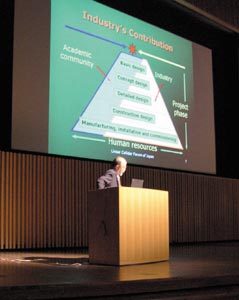
An inaugural lecture on the scope of science in the 21st century was given by former University of Tokyo president Akito Arima, who was also Japanese Minister of Education, Science, Sports and Culture. J-PARC project director Shoji Nagamiya described the status of the project. Funding for J-PARC was secured in 2001, and construction began in June 2002.

UK boosts technology transfer support

cernnews10_1-03

During the past year, the UK’s Particle Physics and Astronomy Research Council (PPARC) has begun an innovative approach to strengthening technology transfer with CERN. In September 2001, the UK Office of Science and Technology awarded PPARC £200,000 (€300,000) to appoint a UK Technology Transfer Coordinator for CERN. This role has been contracted to a Cambridge and Oxford-based firm, Qi3, whose task is to foster closer links between CERN and industry. The goal is to bring greater exploitation of science by encouraging wider and more rapid transfer of new ideas, products and processes to UK business.

CERN and PPARC share an interest in technology transfer. Particle physics research naturally pushes existing technologies beyond customary limits and can lead to novel technologies, so CERN’s member states have encouraged the laboratory to introduce an active technology transfer policy to demonstrate clear benefits from the research. Technology transfer is now an integral part of CERN’s mission, and is implemented via the Technology Transfer Service set up in 2000.

One of the main objectives of PPARC’s technology transfer work is to increase the return on its investment in CERN, which currently stands at about £90 million per year. Money to support the new initiative has been awarded from the UK’s Public Sector Research Establishment (PSRE) fund. This has been possible because PPARC argued that as the UK has no national particle physics accelerator facility, CERN is effectively the UK’s PSRE in the area of high-energy physics.

The Qi3 team of Nathan Hill, John Attard and David Rafe are now working to help UK businesses benefit from the diverse range of technologies developed by scientists at CERN and the associated laboratories in UK universities. Business partnerships, technology licences and spin-out companies will all form routes to commercialization for technologies developed at CERN. The team has already started looking at several opportunities, including novel semiconductor packaging materials, high-speed imaging cameras, accelerator components and cost improvements in the printed circuit board manufacturing process.

For information about this UK initiative, contact Qi3 (nathan.hill@qi3.co.uk or john.attard@qi3.co.uk).

CERN summer experience benefits US students

Boston’s Northeastern University launched its Research Experience for Undergraduates (REU) programme at CERN in 1998. Joining summer students from the laboratory’s member states, the participants use their experience to help them to establish what direction their careers will take. Christine Nattrass, a double major in biochemistry and physics at Colorado State University, says that her experience in the programme has influenced her future. “Now I’m more certain I want to study physics rather than biophysics or biochemistry,” she says, “and I think I’d like some kind of particle physics. The research experience confirmed my suspicions that physicists are more fun to work with than biochemists.”

cernedu1_1-03

Christine admits, however, that only time will tell just how deeply the whole programme has influenced her. Other students say that the experience at CERN helped determine what course their future studies will take; some have decided that they are more interested in theory than in experiment, while others say that the work they did over the summer has reaffirmed their love of the field.

Assessing the impact

Just as the students have to determine how their experiences in the programme have affected them, so the long-term impact of the programme itself must be assessed. Just how important are educational and research programmes of this sort, and what should their future be? It is often difficult to make these decisions when the programmes are still new, but now that the REU programme has reached maturity, we can begin to get a clearer sense of its value.

CERN has had a summer programme for undergraduate students for more than 40 years, but US students have only been able to participate since the REU programme was formed. Historically, only CERN member states have had the opportunity to send their students to experience what it’s actually like to work in a physics research group at the laboratory. In 1997, however, Stephen Reucroft, an experimental physicist at Northeastern University, sent a proposal to the US National Science Foundation (NSF) for funding to send US students to the summer student programme at CERN. Independently, Homer Neal of the University of Michigan made a similar proposal, and the NSF suggested that the two join forces. The result was the programme that exists today. CERN agreed to take 10 US undergraduates from the REU programme, starting in 1998.

After three years of running a joint programme, Reucroft and Neal split the programme in two and started sending 10 students each. The CERN summer student programme places half, and Northeastern University and the University of Michigan place the remainder. Additional funding has been provided by the Ford Motor Company, which now supports five students.

Participants in the REU programme are chosen from colleges all over the US, from small institutions as well as the larger, better-known universities. A committee of physicists chooses students with a strong academic record, an interest in physics, demonstrable creativity and a desire to take advantage of CERN’s culturally diverse environment. The social and cultural life of the programme is as important as the research and educational elements.

REU organizers brief successful candidates about what they can expect, and encourage them to network before they leave for Switzerland. There is a four-day orientation meeting for students in the US, and a programme administrator accompanies them to CERN and gives them a tour of the laboratory’s facilities. After they have settled in, the REU administration keeps in touch with the students throughout the summer. One of the programme’s coordinators, Artemis Egloff, says: “We try to keep a good balance between helping them and smothering them with too much attention. They like to be independent and we encourage them.”

While at CERN, the US summer students work with an assigned research group, supervised by a physicist who works with them and assigns them various tasks, allowing them to see what work as a particle physicist is like. Students perform research, take measurements, write computer programs, papers and reports, learn to use specialized software, build and test equipment, and inevitably do manual work. In short, they are expected to cover the entire range of activities that makes up experimental particle physics.

Students are expected to learn new skills on the fly – things that they don’t learn in the classroom. Their work is often disorganized and their days frequently unstructured, but as Reucroft points out, this is what research is often like. Students are often surprised at how much mundane manual labour is involved in science, such as connecting cables, and moving and stacking lead bricks.

cernedu2_1-03

Although hands-on work forms a large part of the activities at CERN, the students also attend lectures in experimental and theoretical physics, and in accelerator and detector techniques. Andrew Essin, a student at Reed College, Oregon, explains: “There were lectures on experimental high-energy physics, which allowed me to get a view of more than just mathematical formalism and phenomenology, to see the nitty-gritty of creating and detecting particles, accumulating and processing vast quantities of data and all that good stuff that I might miss if I simply concentrated on theoretical studies.” The CERN lectures focus on the detailed techniques of particle physics in both experiment and theory. Since the students are a mixture of potential experimentalists and theorists, the lecture material benefits all of them. In ordinary classroom lectures, most of what is taught about physics is historical information, neatly packaged.

The lectures often cover material that is too new to be taught to US physics undergraduates. As a consequence, some of the students find the lectures difficult. One, however, said that even the material he did not understand will be valuable to him eventually – either he will process it once it has had time to settle, or else the fact that he has already been exposed to it will make him feel more comfortable next time he comes across it.

International culture

The international atmosphere at CERN makes it an ideal place for US students to learn how scientists from different countries bring different approaches to physics. Students and advisors not only work together, but also get to know each other socially. Many returning students have remarked on the spirit of tolerance that reigns in CERN’s multicultural setting, with people choosing to pass over potentially awkward social situations rather than giving them too much weight or taking offence at unintended slights. Inevitably, this attitude is carried over into the work environment. The students learn how people in other countries are educated, and discover the strengths and weaknesses in the US system, as well as in others. It is one of the aims of the REU programme that as the students develop, they will keep in mind what they have learned, and perhaps bring good ideas back to the US system.

The vast majority of undergraduates participating in the REU programme have gone on to pursue PhDs in the sciences, including various aspects of physics, biophysics and aeronautical engineering. One became a Rhodes Scholar, and another went into business, although she changed her mind after a year and went back to physics because her experience at CERN was so good. One spent time developing computer simulations at a financial institution and is pursuing a Masters degree in architecture at MIT. He hopes to enter into a physics PhD programme after he has completed his Masters.

One of the main challenges of the REU programme is placing students with advisors. Even the best-intentioned researchers can find themselves unexpectedly busy by the time the summer arrives, and it is not uncommon for students to find themselves working largely independently. However, Reucroft says that experience has shown that if an advisor can motivate a student and give them a start, they frequently end up working happily and productively on their own.

Like the CERN summer student programme, the REU programme has a great potential impact. It helps students decide whether or not to pursue an advanced degree in physics. By ensuring that they are well informed about the nature of research before they embark on their career, it helps students find out whether experimental or theoretical physics – or even no physics at all – is right for them. It also attracts young people to science, exposing them to the demands and rewards of working at the leading edge of experimental physics, showing them how experiment and theory work together, and how particle physics impacts other branches of science. Perhaps most importantly, students also learn skills that are helpful in whatever career they choose to pursue, such as programming, problem solving and working with people from different backgrounds. All of the students who have participated in this programme say that they would recommend it to their friends. And it is safe to say that the majority will go on to be good ambassadors for science and for international collaboration, wherever their future careers take them.

bright-rec iop pub iop-science physcis connect