by Gian Francesco Giudice, Oxford University Press. Hardback ISBN 9780199581917, £25 ($45).
If you are of the opinion that working physicists do not care about the history of their discipline or that theorists, like Gian Giudice, have no interest in the details of the experimental machines and detectors, this book will come as a surprise. The same is true if you share the view that it is not possible to describe the frontiers of modern physics – including the most speculative ones – to non-experts in a way that is both faithful and comprehensible. This book does all of that and is enjoyable reading, with the important information that it carries mixed in with many fun facts and anecdotes of all sorts. Not to mention the spot-on explanatory metaphors that are distributed profusely throughout almost every chapter.
One quality of this book is its comprehensive character, with its contents in three approximately equal parts. The first gives a brief but inspired history of particle physics, from J J Thomson’s discovery of the electron up to the setting of the Standard Model, without neglecting James Clark Maxwell, quite appropriately, or even Galileo Galilei and Isaac Newton. In the author’s words, the expected “results for the LHC” – surely the main inspiration of the book – “cannot be appreciated without some notion of what the particle world looks like”. The central section “describes what the LHC is and how it operates” – no more or less than that – in a successful effort to make clear the astonishing technological innovations involved in the LHC enterprise. This is useful reading for everybody, including politicians.
Last but not least, the third section “culminates with an outline of the scientific aims and expectations of the LHC”, addressing the central open issues in particle physics and beyond. Here Giudice is also not afraid to venture into the description of interesting theoretical speculations, while always keeping a sober view of the overall subject. “We do not know what lies in zeptospace and the LHC has just started its adventure” is the very last sentence of the book, which I fully support. By the way, “a zeptometre is a billionth of a billionth of a millimetre”, not quite but almost the distance that will be explored for the first time by the LHC: hence “zeptospace”.
The coming of the LHC is certainly the main inspiration of the book. The awe and excitement brought on by the start of LHC operation exudes from all its pages. But I think there is more to it than that. There is a view of what I like to call “synthetic physics”, that is the physics that aims to describe nature, or at least some part of it, in terms of few principles and few equations. In many respects the book pays tribute to “synthetic physics”. This is what determines the unity of its style and of its arguments. To whom do I recommend its reading? To everybody, experts or non-experts. I would in particular encourage young people, starting from those who are nearing the end of their high-school studies. I am sure that their efforts will be highly rewarded, not to mention the pleasure they will find. I believe, and I certainly wish, that this book will become required reading for anyone interested in scientific human endeavour, in the reality of our world.
by Federico Brunetti (ed.), Editrice Abitare Segesta. Hardback ISBN 9788886116930, €50.
With 350 photographs in about 150 pages, The Rings of Knowledge is a beautiful photographic collection interspersed with some text, whose role in putting over the message is almost peripheral. The book is bilingual, English and Italian, and so is aimed at an international audience.
The authors and editor have succeeded in illustrating the Italian contribution to CERN and the LHC. The book particularly emphasizes the role of the Italian National Institute for Nuclear Research (INFN) and its involvement in leading worldwide scientific projects, of which the LHC is the flagship. The pride in contributing to the “LHC era” – as defined by the president of INFN, Roberto Petronzio, in the foreword – sometimes causes the authors to fall into the trap of excessive self-celebration. Statements such as “The LHC could not have been realized without Italy’s collaboration” apply equally to many other member states of CERN and could be badly perceived by an international readership.
The most distinctive feature is that Federico Brunetti, the editor, is an architect and photographer from the Industrial Design, Arts and Communication Department of Milan Politecnico. The chapters “The LHC between science and architecture” and “Physics as design” show his astonishment with the “enormous machines”, “enormous dimensions”, the “never-before-seen extremes of the place”. However, they also show that communication is an issue for any specialized discipline, including architecture.
The wording of these chapters is complex and the concepts are described with a sort of jargon that makes reading difficult. In particular, the concept of “beauty” in design and in physics is mentioned several times and in different places but is never really presented in a clear way. This is a pity because it would have been an interesting point to develop in a comprehensible way.
Back to the main point of the book: I found the photographs really amazing. The square layout is based on Fibonacci’s geometric series and shows the link between physics and design. Unfortunately, even this fascinating point is not clearly explained in the text. For example, one caption on page 25 helps the reader’s intuition but simpler phrasing would significantly increase the overall enjoyment of the book.
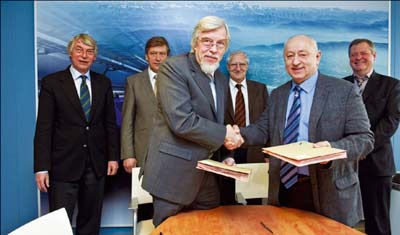
CERN and JINR have a long and successful history of collaboration – the first informal meeting on international co-operation in the field of high-energy accelerators took place at CERN in 1959 – and both provided a bridge between East and West for decades. In 1992 they signed a co-operation agreement that included an important number of protocols covering JINR’s participation in the construction of the LHC and the ALICE, ATLAS and CMS detectors, as well as in information technology. JINR has also made valuable contributions to smaller experiments at CERN.
Now that the major obligations undertaken by JINR for the construction of the LHC and its experiments have been met, CERN and JINR have decided to continue and reinforce their co-operation in the fields of particle physics, accelerator physics and technologies, educational programmes and the development of administrative and financial tools, mutually contributing to the scientific programmes of both laboratories. On 28 January, JINR’s director Alexei Sissakian and CERN’s director-general, Rolf Heuer, signed a new enlarged agreement to continue and enhance their co-operation in the field of high-energy physics.
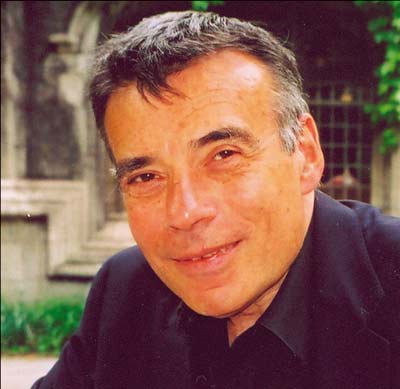
At the City College of New York, Arthur I Miller took large doses of philosophy in addition to physics. This was the start of a path that would lead him to become a well known historian of science and acclaimed author. He earned a PhD in physics at the Massachusetts Institute of Technology and went on to do research in theoretical particle physics. He soon became fascinated with the history of ideas and the role of visual thinking in highly creative research.
In 1991 Miller moved to England where he became professor of history and philosophy of science at University College London. Three years later he founded the Department of Science and Technology Studies, which grew out of the original Department of History and Philosophy of Science. He has lectured and written extensively about his research into the history and philosophy of 19th- and 20th-century science and technology, as well as about cognitive science, scientific creativity and the relationship between art and science.
He is the author not only of academic books but also of several widely acclaimed books meant for a wider audience, including Einstein, Picasso: space, time and the beauty that causes havoc (2001), nominated for the Pulitzer Prize, and Empire of the Stars: friendship, obsession and betrayal in the quest for black holes (2005). In December he visited CERN to give a colloquium on his latest book, Deciphering the Cosmic Number: the strange friendship of Wolfgang Pauli and Carl Jung (2009).
When did your interest in interdisciplinary studies start?
Even though physics was what I focused on at university, my passion has always been those pesky “what is the nature of” questions, such as “what is the nature of charge, of mass, of space, of time, of the mind, and so on”. I wanted to understand how scientists made discoveries and how the mind works. Looking into the original German-language papers written by giants of 20th-century physics such as Albert Einstein, Niels Bohr, Werner Heisenberg and Wolfgang Pauli, I came to understand the important role of visual imagery in scientific discovery. I decided to look into this further. I became curious as to how images were generated and stored in the mind, to be called out and used in thinking. I turned to cognitive science, which gave me the means to structure my ideas. This led to my investigation into concepts such as aesthetics, beauty, intuition and symmetry, and how they are used in science and art.
What intrigued you about the lives of Albert Einstein and Pablo Picasso?
The most important scientist of the 20th century, Albert Einstein, and its most important artist, Pablo Picasso, went through their period of greatest creativity and achievements around the same time, and in similar circumstances. In 1905 Einstein discovered his theory of relativity and in 1907 Picasso discovered Les Demoiselles d’Avignon, the painting that brought art into the 20th century and that contains the seeds of cubism. Even though they did not know about each other, they were both – each in his own way – identifying connections across the so-called “two cultures” of science and art, and striving to find a solution to the question of how to represent the nature of space and time in a more satisfying manner.
At the beginning of the 20th century, it was in the air that revolutionary changes were about to occur in many fields. Yet some of the greatest thinkers of the period bucked this tide. The great French philosopher-scientist Henri Poincaré was one of them. To my surprise, he turned out to be a common denominator between Einstein and Picasso. Both men were inspired by his book, Science and Hypothesis. Poincaré failed because he was unable to rid himself of the notion that time was an absolute and not a relative quantity. Just the opposite of what Einstein found when he combined space and time into a single continuum – space–time – and what Picasso did in his cubism, when he represented multiple perspectives all at once on a single canvas. Einstein studied temporal simultaneity, Picasso spatial simultaneity.
Is there a relationship between historical periods and people’s achievements?
Definitely. At that time, people were responding, with different degrees of success, to the mysterious synchronous effects of the Zeitgeist – the avant-garde, the intellectual tidal wave that swept across Europe. In fact, it was not an accident that Einstein and Picasso worked on the same problem – the nature of space and time. It was the principal problem of the avant-garde. In 1902, two years after his graduation from the ETH, Einstein was employed at the Swiss Federal Patent Office, in Bern, and was out of the academic mainstream. Picasso, on the other hand, was in Paris, in the centre of things. Most scientists thought that Poincaré would make major breakthroughs in physics, although of a sort that supported the claims of Newtonian science regarding space and time. Most artists in Paris considered that André Derain, Henri Matisse’s star student, was the one who would make the breakthrough to a radically new conceptual art.
Just as Poincaré could not break away from classical thought, Derain did not take seriously the dazzling developments in science, technology and mathematics. Only Picasso and Einstein were in resonance with the drum beat of the avant-garde. To accomplish their breakthroughs both men realized that they had to discover a new aesthetic: for Picasso it was the reduction of forms to geometry; for Einstein it was a minimalist aesthetic, which allowed him to remove “asymmetries that do not appear to be inherent in the phenomena”, as he wrote in the first sentence of his 1905 relativity paper. At their creative moment boundaries between disciplines dissolved and aesthetics became paramount for both of them.
What criteria do you use to compare people in your books?
I look for parallelisms in the working and private lives of highly creative thinkers (Einstein and Picasso). Pairs in opposition are of interest to me in what they say about the human element in science (Chandrasekhar and Eddington) or in a situation in which each learns from the other (Pauli and Jung). For example, Pauli was able to understand the forces that drove his personal life as well as his creative verve. In fact, an important discovery of his – CPT symmetry – stemmed from a dream that he and Jung analysed using Jungian psychoanalysis. Jung learnt enough quantum physics from Pauli to bring to fruition one of his greatest ideas – synchronism.
What can you say about high creativity?
Highly creative researchers are not deterred by mistakes and failures. Rather, they learn from them and turn the situation to their advantage. J Robert Oppenheimer once gave a particularly interesting definition of an expert as “a person who has made all possible mistakes”. Some other hallmarks of high creativity are that early in life the highly creative person realizes the field in which he or she is most competent and then mines it. They also exhibit an almost frighteningly focused mind when they work on a problem, to the exclusion of all else. Such was the case with Einstein and Picasso.
Is intuition part of creativity and the intellectual process?
I think that it is in both. There is nothing mysterious about intuition. It comes about mainly through an accumulation of knowledge. People can make an evaluation within a fraction of a second just because they have a lot of experience behind them. Having an intuition for what to do, solving a problem, judging a work of art, means having made a lot of errors and judgements along the way. Intuition is an achievement, albeit with a bit of the irrational mixed in – just like in scientific discovery. I think that there is not much difference between artistic thinking and scientific thinking, even if sometimes scientists want to appear less emotional and artists less rational.
Of course, an objective truth exists – on this every scientist would agree, even in this era of multiverses. There is a real external world “out there” beyond appearances and science is a way of getting a glimpse of it. Today, scientists have only begun to explore concepts like consciousness. One of the reasons I wrote my book about Jung and Pauli was to bring to everyone’s attention the high level of their discussions about issues that spanned physics, psychology, biology, religion, ESP, UFOs and Armageddon. They realized that neither physics nor psychology alone could reply to such deep questions such as: “What is the nature of consciousness?” Only an interdisciplinary approach could succeed.
What can you say about interdisciplinary research today?
Beginning in about the 1980s it became evident that, for example, biology needed various forms of technology – and also mathematics and physics. The need for interdisciplinarity soon became evident for physics as well, especially with the advent of health physics, computing physics, nanotechnology and then developments in biology. Nevertheless, most universities maintain a departmental structure and consequently a lack of complete interdisciplinarity. Moreover, there are too many instances where students with a PhD in an interdisciplinary topic have problems in obtaining a job.
One of the stumbling blocks here is the need for a common language across different domains. This lack of communication makes people afraid of an outsider interfering in their field. When I was writing my book on Einstein and Picasso I found that, whereas in most cases artists were easy to deal with, not so for historians of art. Their post-modernistic jargon necessarily closes them off from an interdisciplinary approach. Most of them still consider Picasso’s discovery of cubism to have been rooted in African art and the art of Cézanne, ignoring the essential role of science, technology and mathematics in his thinking. Picasso’s stunning discovery of cubism formalized the formerly informal language of art and brought it back into contact with science, where it has been ever since.
• For the video of the colloquium by Arthur I Miller, “The strange friendship of Pauli and Jung – when physics met philosophy”, see http://cdsweb.cern.ch/record/1228081.
Murray Gell-Mann and I were born a few days apart in September 1929. Being born on almost the same date as a genius does not help much, except for the fact that by having the same age there was a non-zero probability that we would meet. And indeed this is what happened; furthermore, we and our families became friends. Because I was unable to attend the meetings in honour of Murray, I am making this testimony on the occasion of his 80th birthday.
Murray’s family was much affected by the crash of October 1929. His father had to change jobs completely. If this had not happened, it is possible that Murray might have become a successful businessman instead of a brilliant physicist. Everybody knows that Murray is immensely cultured and has multiple interests. I can quote a few at random: penguins, other birds (tichodromes for instance), Swahili, Creole, Franco-Provençal (and more generally the history of languages), pre-Columbian art and American-Indian art, gastronomy (including French wines and medieval food), the history of religions, climatic change and its consequences, energy resources, protection of the environment, complexity, cosmology and the quantum theory of measurement. However, it is in the field of theoretical particle physics that he made his most creative and important contributions. For these, I personally consider him to be the best particle-physics theoretician alive today.
Bright beginnings
I met Murray for the first time at Les Houches in 1952, one year after the foundation of the school by Cecile Morette-DeWitt. It was immediately obvious that he was extremely bright. Then he was invited by Maurice Levy to the Ecole Normale and gave some lectures at the Institut Henri Poincaré. He gave these in French, which had an amusing consequence as a result of a practical joke by Maurice. For months, as they worked together, speaking French, whenever Murray had said something like “ces deux termes s’annulent” (these two terms cancel) Maurice repeated it, substituting “se chancellent” for “s’annulent.” Now Murray knew that “chanceler” means to wobble and not to cancel, but he finally supposed that in English-influenced French scientific jargon, “chanceler” could mean “to cancel.” Otherwise, why would Maurice keep using that word? When Murray actually employed the word in one of his lectures, Maurice went into paroxysms of laughter.
In 1955 I attended my first physics conference, in Pisa. After a breakfast with Erwin Schroedinger, I took the tram and met Murray. In the afternoon, at the University of Pisa, he made the first public presentation of the strangeness scheme. The auditorium was packed. I was completely bewildered by this extraordinary achievement, with its incredible predictive power (which was very soon checked) including the KK system. I had already left Ecole Normale-Orsay for CERN when he and Maurice wrote their famous paper featuring for the first time what was later called the “Cabbibo angle”.
I then had the luck to be sent to the La Jolla conference in 1961. There I met Nick Khuri for the first time, who became a close friend, and I heard Murray presenting “the Eightfold Way” (i.e. the SU(3) octet model). Also attending were Marcel Froissart, who derived the “Froissart Bound”, and Geoff Chew, who presented his version of the S-matrix programme. Both were most inspiring for my future work. What I did not realize at the time was that the Chew programme had been largely anticipated by Murray, who first was involved in the use of dispersion relations and then noticed, in 1956, that the combination of analyticity, unitarity and crossing symmetry could lead to field theory on the mass shell, with some interesting consequences (as exemplified by Froissart’s work and by my later work on the subject).
In 1962, during the Geneva “Rochester” conference, I was again present when Murray, after a review of hadron spectroscopy by George Snow, stood up and pointed out that the sequence of particles Δ, Σ*, Ξ* could be completed by a particle that he called Ω– to form a decuplet in the SU(3) scheme. He predicted its mode of production, its decay, which was to be weak, and its mass. This was followed by a period of deep scepticism among theoreticians, including some of the best. However, at the end of 1963, while I was in Princeton, Nick Samios and his group at Brookhaven announced that the Ω– had been discovered, with exactly the correct mass within a few mega-electron-volts. Frank Yang, one of the sceptics, called it “the most important experiment in particle physics in recent years”. I missed the invention of the quarks, being in Princeton, far from Caltech, where Murray was, and from CERN where George Zweig was visiting. I met Bob Serber but I was completely unaware of his catalytic role in that discovery.
Close friends
My next important meeting with Murray was in Yerevan in Armenia in 1965, where Soviet physicists had invited a group of some eight western physicists. This time Murray came with his whole family: his wife, Margaret – a British archaeology student whom he met in Princeton – and his children, Lisa and Nick. During the following summer, which the Gell-Manns spent in Geneva, our families met several times. I remember once when my children, seeing a portrait of Lisa by the famous Armenian painter H Galentz, said: “This is a green Lisa.” The Gell-Manns spent another year at CERN before Harold Fritzsch, Gell-Mann, and Heinrich Leutwyler wrote the “Credo” of QCD.
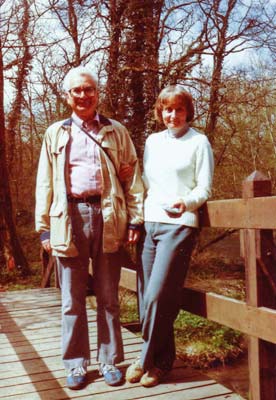
Margaret and Murray came to Geneva again for the academic year 1979/80. They were living in an apartment in the same group of buildings as us. Schu, my wife, then became a close friend of Margaret, who was a typically British girl: very reserved, very intelligent and possessing a good sense of humour. An example of how she was very modest is that, while we knew that she had been digging at Mycenae for an archaeologist named Alan Wace, we found out only long after her death that she had played a personal role in destroying a theory of Sir Arthur Evans, who claimed wrongly that the Cretans had dominated the Mycenaeans during a certain part of the late-Minoan period – while the reverse was true. In fact, she was the first to discover a Linear B tablet at Mycenae. Although Carl Blegen had found Linear B tablets at Pylos long before, finding them at Mycenae as well was important additional evidence once Michael Ventris had proved that the language of Linear B was an early form of Greek, and that Margaret’s boss was right. He had suffered terribly from his refusal to agree with Evans.
An extraordinary friendship grew up between Margaret and Schu. When the Gell-Manns left Geneva for Pasadena, Margaret knew that there was something wrong with her health. Back in the US she discovered that she had cancer. I do not know the number of transatlantic trips that we made – sometimes both of us, sometimes Schu alone – to help Margaret. This included stays in Aspen during the summers of 1980 and 1981. In between, Schu and Margaret had an extensive correspondence. Schu decided to initiate Margaret into French poetry. In particular, she sent Margaret poems by Jacques Prévert and Paul Eluard. On Margaret’s grave, in Aspen, Murray put the inscription: “Mais ou en est ce léger sourire” (Eluard, about Nuesch, his late wife). After Margaret’s death, we all kept in touch because Murray has one remarkable quality: faithfulness in friendship.
• I am grateful to my wife, Schu, and to Murray for suggestions and corrections.
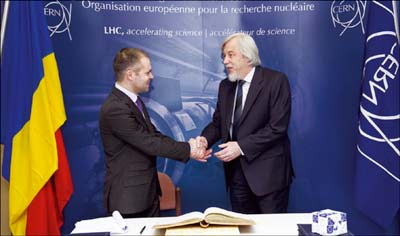
On 11 February the Romanian minister of education, research, youth and sport, Daniel Petru Funeriu, and CERN’s director-general, Rolf Heuer, signed an agreement that formally recognizes Romania as a candidate for accession to membership of CERN.
Romania’s pre-membership will cover a five-year period during which the country’s contributions will increase to normal member-state levels, in parallel with Romania’s participation in CERN projects. At the end of this five-year period CERN Council will decide on Romania’s application for full membership, as the organization’s 21st member state.
Romania entered into direct collaboration with CERN in the early 1990s. In recent years the country has constantly increased its expenditure on R&D, in particular since the country’s accession to the EU in January 2007. Romania is involved in three LHC experiments: ATLAS, ALICE and LHCb. It also contributes to the DIRAC and ISOLDE programmes and to Grid computing.
by Arthur I Miller, W W Norton. Hardback ISBN 9780393065329, £18.99 ($27.95). Paperback, published as 137: Jung, Pauli, and the Pursuit of a Scientific Obsession. ISBN 9780393338645, £11.99 ($16.95).
Do you think there is a sense beyond numbers? Do they have any special meaning? Are there some more powerful than others? Many great men throughout the centuries have exercised their minds to find answers to these questions. In his latest book, the distinguished historian of science Arthur I Miller (p17) investigates one of the possible responses in the unique blend of two extraordinary lives, those of Carl Jung and Wolfgang Pauli.
The book tells the story of the fruitful friendship between two of the greatest thinkers of our times, who were obsessed with the power of certain numbers. The two personalities are central to the narrative and the author masters their story with plenty of interesting details that hold our attention with humour. In the course of reading, we sometimes encounter complex physics formulas, but Miller expertly translates them into a refined interpretation that novices can understand.
Among the accurate account of the enormous and lasting contributions to their respective fields, such as Pauli’s hypothesis of the neutrino in physics and Jung’s theory of a collective unconscious in psychoanalysis, we find indeed “the” number: 137. This pure number, the fine structure constant, which to the eyes of a layman may appear harmless and meaningless, was the “step toward the great goal of finding a theory that would unite the domains of relativity and quantum theory, the large and the small, the macrocosm and the microcosm”. But it is not only that. Through the unfolding of dreams, mandalas, archetypes and symbols, this number turns out to be the golden gate between rational and emotional, creativity and intelligence, science and belief. This tale provides us with a window across time and space into enlightenments of genius.
Deciphering the Cosmic Number is a revelation of something beyond intuition that compels us to participate in the human torment in those whose lives are marked by the quest to find answers to questions transcending centuries and ages. It describes, looking through a magnifying glass, the lives of two human beings who achieved so much in their fields through a “strange friendship” during the difficult period of the Second World War.
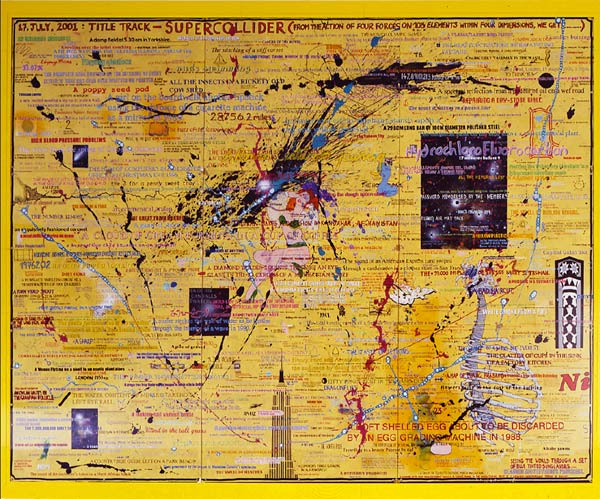
It should come as no surprise then, that the work at the Large Hadron Collider at CERN has been the jumping-off point for some of Keith’s most critically acclaimed work. His 2002 exhibition “Supercollider”, shown at the South London Gallery in the UK, took its title from the goings on at CERN. The title piece of the exhibition (right) was a giant studio drawing with the subtitle “From the Action of Four Forces on 103 elements within four dimensions, we get…” and needs no explanation to any scientist. Random quotes drawn from everything from planetary charts to entries in anonymous diaries, combined with splashes of colour and pictures of a red-haired model wearing an itsy-bitsy, green bikini, are some of the myriad miscellaneous items that collide on this giant painting and which reflect the wonderful diversity of the world created “from the action of four forces…”. Another mixed-media piece, Bubble Chambers: 2 Discrete Molecules of Simultaneity, bursts with random quotes with random dates from 1325 to 2002 dotted across a surface that is crammed with molecules represented as bubbles in reds, blacks, blues, pinks and whites.
Both of these pieces are like a mirror held up to the viewer. Look at them both and, inevitably, the temptation kicks in to start drawing conclusions or to make narratives out of the random juxtapositions: the mind’s processes writ large. Like much of Keith’s work, he is interested in the way that we make sense of the world: as the observer and the observed; the viewer and the artist; and the ways in which we use logic, counter-intuition and intuition to make these discoveries. In essence, we are all in this artistic experiment together, discovering who and what we are in the act of looking – the artist included.
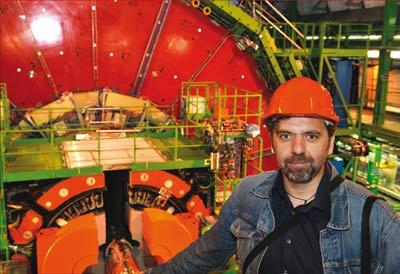
But if looking is important to Keith, it wasn’t until 2009 that he finally came to take his own look at CERN. Talk to him about his visit and he says that what impressed him above everything was “not so much the LHC or the machines themselves, as the way in which the scientists at CERN meet ideas head on and change the way we think about ourselves”.
He came as part of a private party of artists, including fellow British artist Cerith Wynn-Jones and the German experimentalist Ali Janka, who were shown round the CERN complex by the communication team in September 2009. In many ways, visting CERN was a homecoming for Keith and one that he found profoundly moving. He encountered an international community dedicated to breaking the boundaries of knowledge and challenging the world of appearances – ideals that are so close to his heart and mind too.
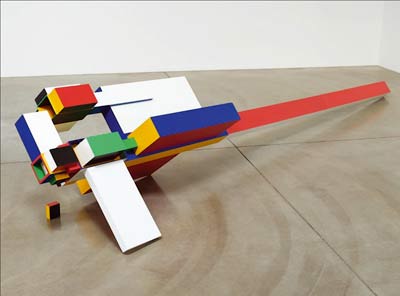
For someone who is so omnivorous in his wish to gain knowledge, physics isn’t the only science that fascinates him. Chemistry and mathematics engage him too. Some of his most famous pieces include the fractal dice, part of the Geno Pheno series (2005), which explores the worlds of cause and effect and takes its title from genetics. The work explores the idea of what is a starting point – an artwork’s DNA, so to speak; its physical manifestation or where it leads. The fractal dice pieces are three-dimensional aluminium and plastic sculptures, in vibrant primary colours – reds, blacks, greens and yellows. They are assembled in galleries around the world where they are shown according to a mathematical system, known as random iterative-functions systems, which is supplied to the curators by the artist. The form of each piece – sometimes as many as 14 are shown at any one time, sometimes fewer – is determined by the rolls of a dice and by the rules set out by the artist. For example, rule number one determines which colour a particular side of the sculpture should be. Complexity and unpredictability are both shown to be crucial components of the creative process, which involves both decisions and chance.
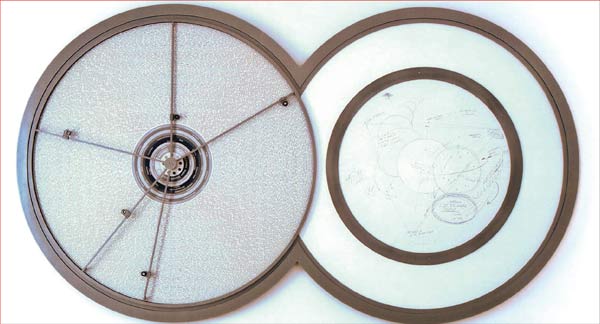
This love of engaging with different sciences and their processes shows how critical Keith is of being enslaved by any one knowledge system. His sculptural piece, Teleological Accelerator (2003), clearly shows this (top right). It is a massive wall installation measuring 5 m across, with two interlocking metal discs made of aluminium and steel that comprise a diagram of words and concepts written in pencil, ranging over all kinds of human achievements as well as an accumulation of scientific definitions. The flexible indicators can be twisted by the viewer so that the artist playfully conveys his idea that teleology is whatever you can make of it. Meaning is not a fixed point: it is always changing.
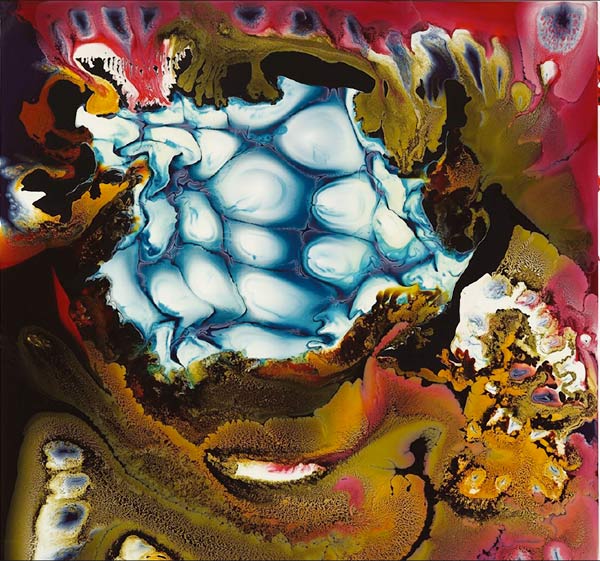
If much of Keith’s work shows a great indebtedness to science and a love of it as a knowledge system, and form of enquiry about the world, some of his latest work also shows an awe-inspiring sense of nature. After all, as Keith so eloquently says, “Science and art are the ways in which we describe the world. Nature is the world.” The 2009 work Mathematical Nature Painting Nested (bottom right), currently being shown at the Royal Academy of Art, London, is a portrait of original transformations. Paints and chemicals have been poured onto a primed aluminium sheet and a painting takes shape thanks to the hydrophic reaction that forms the basis of the painting. This is the first phase. In the second phase, Keith determines the appearance of the painting, as far as he can, to make it resemble cells structures or geographical strata, according to the way that he dries the paint over the following month.
Like particle physics itself, Keith is pushing boundaries, working within limits and constraints and outside them too: “I am not interested in the role of the artist as creator. Art is a vehicle of enquiry and the role of the artist is much more like that of Christopher Columbus – we are navigators and discoverers of what is already out there in the world but has yet to be discovered.”
He could just as easily be talking about the role of the scientist, but he is clear about how different artists and scientists are, as well as the ways in which the arts and science could and should interact: “Artists, unlike scientists, are not attempting to model the world. They are trying to engage the viewer with the wonder of it. If you attempt to marry and equate art with science, then you fail. If you allow what is not similar about art and science, and their different methods and processes to co-exist and thrive, then a real art/science collaboration and aesthetic will emerge. But at the end of the day, both art and science are united by one logic and one impulse – both are attempts to understand what it is to be human and the world around us.”
• For more information about Keith Tyson’s latest creations, see his official website at www.keithtyson.com.
by Eugenie Samuel Reich, Palgrave Macmillan. Hardback ISBN 9780230224674, £15.99 ($26.95). Paperback ISBN 9780230623842, £12.99 ($17).
This book devotes 266 dense pages – 20 of them listing hundreds of notes – to a case of scientific misconduct staged at Bell Labs between 2000 and 2002, with Jan Hendrik Schön as the central figure. The plot follows the path leading up to the discovery that Schön’s breakthroughs on “molecular electronics” (which included lasers and superconductors made of organic plastics) were fraudulent.
Reich makes a good case in defending the argument that the economic situation at Bell Labs and the need to justify keeping a strong basic-research department in the company made the ground fertile for an ambitious young person to flourish and enchant (fool) the senior people. It is actually quite amazing to see that the co-authors of Schön’s papers knew so little about important points of the reported work, and that the fabrication of data was not uncovered earlier than it was, given the frequent questions being asked by many Bell people, including close collaborators, managers and other staff. It helped that many of his papers presented “measurements” that matched predictions. He seemed to write his papers backwards: first the conclusions, then the “data” that supported them, often generated from equations rather than from the apparatus.
In hindsight, it looks preposterous to think that Schön could possibly write more than 20 groundbreaking publications in such a short time period, including seven papers in a single month, November 2001. This, alone, should have alerted people to the possibility that the reported results may have been fabricated. The journals Nature and Science emerge from this book as not being very careful about reviewing the articles that they publish, placing the emphasis on selecting papers that will make the headlines (the “breakthrough of the year”) rather than in ensuring that they provide enough technical details to allow for a good scrutiny of their plausibility and for an efficient verification by other labs. Many people wasted time and money trying to replicate the fabricated results. Schön’s publication “success” surely benefited from having signed the papers with a senior co-author, a well known expert who gave further credibility to the fraudulent results by giving a multitude of seminars on the subject, to the point of being awarded, and accepting, prizes for the “discoveries”.
This is an interesting book and Reich clearly convinces the reader that, despite our natural tendency to think that scientists can be trusted (honest people, who might make mistakes), some of them deliberately fudge the measurements to fit with preconceived ideas, old or new. The scientific method needs to be learned, sometimes through years of careful training, modulated by sceptical professors (who can notice patterns that look “too good to be true”). However, I would gladly have exchanged many of the specific details about this single case for more information about other cases, together with a global discussion of the factors that lead to such frauds. Are they caused by young people with inadequate training and supervision? Or by ambitious senior people desperately looking for an important prize and pushing their young partners to search for anomalies and “new physics”, neglecting the importance of time-consuming validation checks? Are there branches of science where they are more frequent?
Reich was very meticulous and gives all sorts of details that interrupt the fluidity of the reading. She could have redesigned the narrative, avoiding some repetition, placed the introductory text of chapter 9 (!) at the start of the book, and removed a few of the lines and paragraphs containing little information. Without an introductory chapter preceding the main plot and giving a broad overview of this field, most readers will lack the minimum background knowledge needed to appreciate the reported saga. As a side remark, it is curious to learn that Nobel laureate Bob Laughlin repeatedly claimed that Schön’s results had to be fraudulent but his opinion “didn’t count because he was known to be too sceptical”.
by G Kane and A Pierce (eds), World Scientific. Hardback ISBN 9789812779755, $99/£55. Paperback ISBN 9789812833891, $54/£30. E-book ISBN 9789812779762, $129.
This book could hardly seem more timely, with the Large Hadron Collider (LHC) having started operations and new discoveries being eagerly awaited (but quite possibly a few years off yet). It consists of 17 chapters, each on a different topic, ranging from a description of the detectors to discussions of naturalness in quantum-field theories of particle physics.
The contributors are particle physicists, several of whom are prominent in the field. However, each chapter has different authors, so the result is inevitably a little patchy. The chapters differ widely in scope, in character and in the level of expertise assumed for the reader. For instance, the chapter on dark matter at the LHC is very basic and could be read by undergraduates, whereas the informative chapter on top physics is of a graduate level. There are also some much more general expansive essays, such as one that explores similarities between the BCS theory of superconductivity and particle physics, and the introductory chapter. The introduction assumes a fair amount of prior knowledge and is much too optimistic for my taste about the chance of discovering supersymmetry at the LHC. The author asserts that supersymmetry must be correct because of several pieces of circumstantial evidence, but I really think that other such a posteriori scraps could be used to prop up the evidence for competing theories.
There are a couple of obvious omissions, for example quark-gluon plasma physics and the ALICE detector. After all, the LHC will spend some of its time providing collisions between heavy ions, rather than protons, and ALICE will be trying to divine the properties of the resulting soup of quarks and gluons. The other missing topic is that of diffractive physics. It is likely that both the ATLAS and CMS experiments will eventually have forward detectors to measure protons that have just grazed another one in a collision. Under certain theoretical circumstances, it is even possible to produce Higgs bosons in the central detector during these collisions. Such rare events could provide useful experimental constraints on the properties of Higgs bosons. The chapter about the ATLAS and CMS detectors is welcome, but it could benefit from some basics about how particles interact as they travel through matter. This important link in the logical chain is missing from the discussion.
Perspectives on LHC Physics is a timely, heterogeneous offering, with some interesting gems and informative parts, as well as some fairly off-the-wall speculation. I think that there should be sections of it to interest most readers in the physical sciences, but that they may well wish to choose particular chapters to read. Luckily, the format of the book makes this easy to achieve.
To provide the best experiences, we use technologies like cookies to store and/or access device information. Consenting to these technologies will allow us to process data such as browsing behavior or unique IDs on this site. Not consenting or withdrawing consent, may adversely affect certain features and functions.
Functional
Always active
The technical storage or access is strictly necessary for the legitimate purpose of enabling the use of a specific service explicitly requested by the subscriber or user, or for the sole purpose of carrying out the transmission of a communication over an electronic communications network.
Preferences
The technical storage or access is necessary for the legitimate purpose of storing preferences that are not requested by the subscriber or user.
Statistics
The technical storage or access that is used exclusively for statistical purposes.The technical storage or access that is used exclusively for anonymous statistical purposes. Without a subpoena, voluntary compliance on the part of your Internet Service Provider, or additional records from a third party, information stored or retrieved for this purpose alone cannot usually be used to identify you.
Marketing
The technical storage or access is required to create user profiles to send advertising, or to track the user on a website or across several websites for similar marketing purposes.