In analysing data from the 2010 running of the LHC, the LHCb collaboration has made some important measurements of the oscillation properties of Bs mesons.
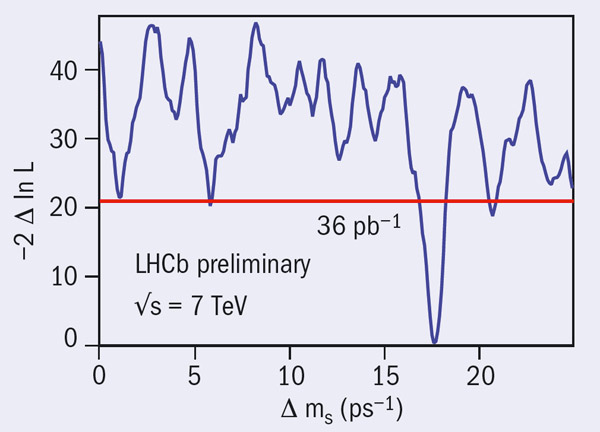
In the Bs system, the Bs and the Bs are mixtures of mass eigenstates that differ in mass by Δms and it this difference that determines the frequency of the oscillations between the Bs and BBs states. It also modifies the probability distribution for the proper time for B0s decays. To measure Δms, the collaboration analysed some 1350 candidates for four decays of the kind B0s → D–sπ and B0s → Ds3π, which were selected from 36 pb–1 of data collected in 2010 at 7 TeV in the centre-of-mass. The team measured the proper decay times for these events, tagging them according to whether they corresponded to un-mixed or mixed decay, i.e. whether the production and decay flavour are the same or opposite, respectively. The preliminary result yields a result of Δms = 17.63 ± 0.11 (stat.) ± 0.04 (syst.) ps–1 (LHCb collaboration 2011a). This is to be compared with the previous best measurement in the world, from the CDF experiment at the Tevatron, of 17.77 ± 0.10 (stat.) ± 0.07 (syst.) ps–1 (CDF collaboration 2006).
The Bs can also decay to J/Ψφ, either by Bs → Bs oscillation or directly, and the interference between these two decay modes gives rise to the CP-violating phase φs. The LHCb collaboration has made its first measurement of this phase using 836 Bs → J/Ψφ signal candidates from the same 2010 data sample used to determine Δms. In the Standard Model, φs is approximately equal to the angle –2βs from a unitarity triangle of the Cabibbo-Kobayashi-Maskawa matrix, and global fits to data give –2βs = (0.0363 ± 0.0017) rad. The Tevatron experiments – CDF and DØ – have reported values for φs that are somewhat inconsistent with the Standard Model expectation, so this is a crucial measurement for LHCb. The first result from last year’s data is consistent with the Tevatron results, but not yet as precise (LHCb collaboration 2011b). However, the LHCb experiment has already taken enough data this year to make a much more precise measurement, and will be able to clarify whether there is any sign of new physics in this decay.
Our understanding of QCD continues to depend on the contributions from totally unexpected results found at the Intersecting Storage Rings (ISR). Some of the most relevant of these also represent an interesting frontier for research at the LHC. In particular, the “effective energy” remains the basic parameter for revealing the features of universality in the multiparticle hadronic systems that are produced, while the “leading” effect is still present at LHC energies, with all of its consequences, such as the total independence of the two hemispheres of the interaction.
Effective energy
The perceived wisdom, up to the moment when the first unexpected results came from the ISR, was that each pair of strongly interacting particles produces its own final state. The properties of these final states were measured to be all different, as shown by a remarkable number of well established quantities, namely: the fractional momentum distribution dσ/dxF (where xF is Feynman x); the average number of charged particles < nch >; the ratio of the average energy in the charged channel to the total energy < Ech >/< Etotal >; the transverse-momentum distributions dσ/dpT2; the normalized transverse-momentum distribution dσ/(dσ/pT /< pT >); the event planarity; the two-particle correlations; and the scale-breaking effects.
Out of these eight quantities, the most popular is the average number of charged particles, < nch >. It was taken for granted that different pairs of interacting particles – πp, Kp, pp, p–p, etc. – had to give different values for < nch >. That the other seven quantities were different for different pairs of interacting particles was considered a natural consequence of the fact that different initial states have to produce different final states. This perceived wisdom was shown to be wrong when the effective energy was discovered at the ISR.
At the ISR, and at any other collider, the quantity √s = √(q1inc + q2inc)2 = 2Einc was considered to be the total energy available in the centre-of-mass system (Einc being the incident energy of each colliding proton). The Bologna-CERN-Frascati (BCF) group proved that this is not true: the quantity √s should be considered as the “nominal”, not the “effective”, value for the total energy available.
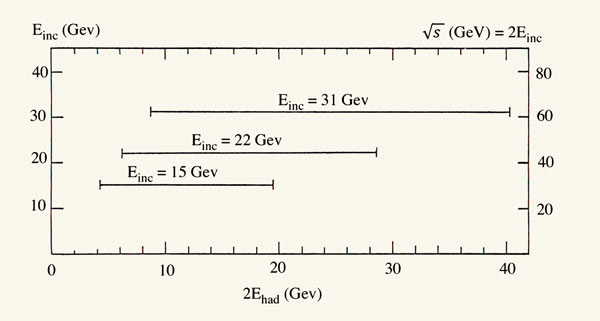
The key point is that in a pp collision, such as at the ISR, the total energy available for particle production is not (√s)pp = 2Einc. In fact, the incoming proton can carry a large fraction of the primary energy away into the final state. If you examine the final state of a pp interaction, in 90% of the cases you find in each hemisphere a “leading” particle: q1leading and q2leading. On average, they carry 50% of the nominal energy, 2Einc. The hadronic system produced in each hemisphere has at its disposal the quadrimomentum qhad = qinc – qleading, which gives rise to the quantity 2Ehad. This is the effective energy.
The BCF group measured the detailed features of 105 pp collisions, on an event-by-event basis, to identify the effective energy of each collision. Once this quantity is taken as the correct energy for a given process, the eight quantities quoted above are the same, no matter what the nature of the pairs of interacting particles or the type of interaction. The leading effect is a very general phenomenon that is present when a hadron interacts – whether strongly, electromagnetically or weakly (Basile et al. 1981a and 1981b). When a hadron in the final state shares energy with all other particles produced in this highly privileged way, the effect must be accounted for correctly to compare the properties of the multiparticle hadronic system produced in the interaction. This is how we found the first evidence for universality features between pp and e+e– data using pp interactions at the nominal ISR energy, (√s)pp = 62 GeV (Basile et al. 1980).
As figure 1 (p39) indicates, this fixed nominal energy corresponds to a set of effective energies available for particle production, 2Ehad, in a range of about 5–40 GeV. We collected data at three ISR energies, (√s)pp = 30, 44, and 62 GeV for the following reason. It was crucial to show that the multiparticle hadronic systems produced in pp interactions with the same values of 2Ehad, but with different values of Einc, had the same properties in terms of the eight quantities mentioned above.
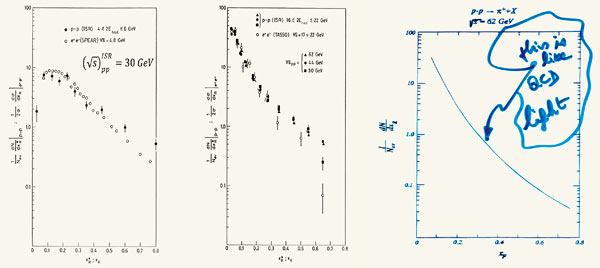
Let us take one example. The BCF group discovered that the fractional momentum distribution, dσ/dxF, of a pion produced in the reaction pp→π+ + X at the nominal total energy (√s)pp = 62 GeV is the sum of the fractional momentum distributions at different effective energies (figure 2). This is why Vladimir Gribov liked to call the pion spectrum the “QCD-light”.
The effective energy also dismantled another myth, the one that gave a special role to “high” transverse-momentum phenomena. We found at the ISR that the multiparticle systems (jets) produced at high pT and at low pT show the same universality features (Basile et al. 1988).
The leading effect
The discovery of effective energy was the driving force to study in detail the leading effect, which is a basic non-perturbative QCD phenomenon. In another impressive set of totally unexpected results, the BCF group at the ISR established the following five properties of the effect, which need to be explained by QCD.
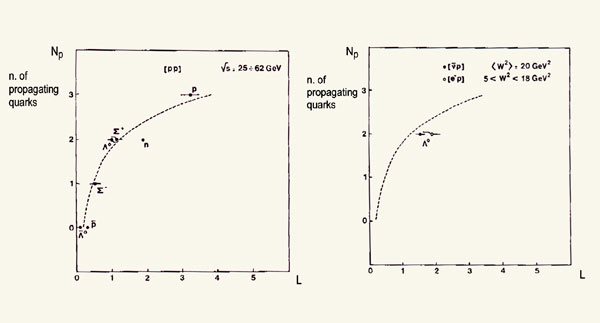
1. The leading effect depends on the quantum number flow. For example, if in the initial state there is a proton (uud) that goes into the final state, the probability of having the same “proton” (uud) with more energy-momentum than all the other particles is very high. The proof is in figure 3a, which shows how the number of quarks that go from the initial to the final state varies with the value of a function, L, which is proportional to the probability of having the particle in the privileged leading status with respect to all other particles in the final state. The leading effect decreases with the number of propagating quarks from the initial to the final state. For example, when the process is p(uud) → p(uud), all three quarks of the initial state go into the final state and L _˜ 3. However, in both p(uud) → Λ0(uds) and p(uud) → Σ+(uus) there are two propagating quarks and L _˜ 1. For p(uud) → Σ0(dds) there is only one propagating quark and L _˜ 0.5. The minimum value of L is when there are no quarks going from the initial to the final state.
2. The leading effect is flavour independent. The neutron, produced in the process p(uud) → n(udd), seems to indicate some deviation from the other cases with two propagating quarks in figure 3a. To study if there is a flavour dependence in the leading effect, we extended our research to all heavy flavours. This is how we discovered the leading production of Λc+ (Basile et al. 1981c) and found for the first time the Λb0, which at the time was the heaviest particle known (Basile et al. 1981d). The search for the Λb0 proved that the leading production mechanism is valid also for the Λb0 and that the same leading-baryon effect is present in the Λb0, Λc+ and Λs0 production mechanisms. So, despite the large mass difference between the strange (s), the charm (c), and the beauty (b) quarks, the production of these differently flavoured baryonic states shows the same leading effect (Basile et al. 1981e). The conclusion is that there is no mass-dependence in the leading effect and that it is flavour-invariant.
3. The leading effect is present in deep inelastic scattering (electromagnetic and weak). Figure 3b shows two examples of deep inelastic scattering: one is electromagnetic (e–p) and the other is weak (ν–p). In both cases the leading effect is present. Taking into account the results previously reported, where the interactions were all strong, the data prove that no matter if the interaction is strong, electromagnetic or weak, the leading effect is there and depends on the flow of quantum numbers from the initial to the final state.
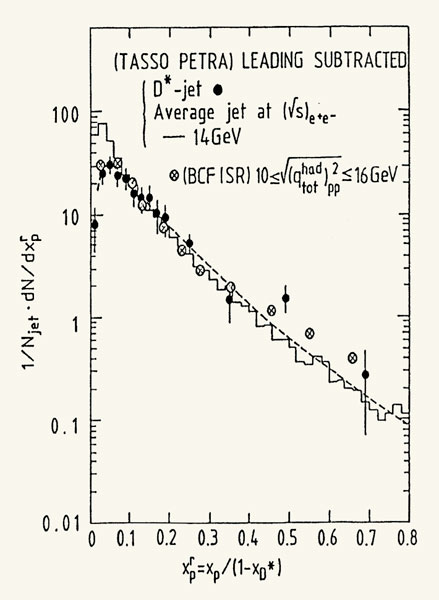
4. The leading effect also exists when there are no hadrons in the initial state, as in e+e– annihilation. The fractional momentum distribution measured by the TASSO experiment of the particles produced in e+e– annihilation at √s = 34.4 GeV at the PETRA collider deviated markedly from the expected spectrum when a leading D* was present in the final state. Using pp data from the ISR at effective energies in the range 10–16 GeV, the TASSO data showed excellent agreement (figure 4). The only correction needed was the subtraction of the D* leading effect.
5. There are no long-range correlations in the leading effect. For many years experimental data have given evidence for a correlation between the two ISR hemispheres. The same problem needs to be studied at the LHC. The BCF group proved that these correlations disappear when the data are analysed in terms of the effective energy. The best proof came from the study of p1inc + p2inc → p1leading + p2leading + anything, where p1,2inc indicate the two incident protons, and p1,2leading the two leading protons. The data-taking was performed using unbiased events to have a set of genuine inclusive pp interactions. The results, shown in figure 5, prove that the two hemispheres are totally independent and – contrary to what had been believed before – there are no long-range correlation effects.
Two final remarks should be made on the leading effect. First, when there is no quantum number flow from the initial to the final state, the leading effect depends on the probability that the fragmentation products recombine themselves into one leading particle. From high-pT data at the ISR we have: σ(single particle) ETinclusive/σ(jet) ETinclusive ≈ 10–2 for ET _˜ 5–10 GeV; from e+e– annihilation the results are: σ(e+e– → D* + other particles)/σ(e+e– → C + other particles) ≈ 10–2. We can deduce that if a single particle carries a large part of a certain available energy, it must “pay” a factor of around 10–2. How this recombination into one leading particle can be possible is a problem for non-perturbative QCD theorists.
A second point is that in pp interactions at ISR energies, about 20 mb of cross-section is in the leading effect. At the ISR this effect is dominated by the quantum number flow. In e+e– there is no quantum number flow from the initial to the final state and only about 1% of the total cross-section is in the leading effect. For an explanation we must wait until non-perturbative QCD can give the correct “predictions”.
In conclusion
The ISR were the source of a series of totally unexpected results. The effective energy with its universality features plays a fundamental role in all QCD processes. The leading effect is flavour independent, has no long-range correlation and exists no matter whether the process originates in a strong, electromagnetic or weak interaction. The next frontier is to find out if these properties are still valid at LHC energies.
The LHCf collaboration has measured the production spectrum of photons using the highest-energy accelerator beams in the world, at CERN’s LHC machine. With proton beams at 3.5 TeV the total collision energy is equivalent to when protons of 2.5 × 10¹⁶ eV strike a stationary target, which is an energy region that is of interest to cosmic-ray physicists.
The LHCf experiment consists of two independent calorimeters installed on either side of the ATLAS interaction point at the LHC. Using data obtained in 2010 during proton runs at 7 TeV in the centre-of-mass, the collaboration has measured the photons emitted into two very forward regions, that is, close to zero degrees to the beam direction, in the pseudo-rapidity ranges from 8.81 to 8.99 and from 10.94 to infinity (Adriani et al. 2011). To minimize contamination from beam-gas background and pile-up events, the team chose a limited but best dataset corresponding to an integrated luminosity of 0.68 nb–1. After selecting single photon-like events in common pseudo-rapidity ranges, they obtained consistent energy spectra from two detectors.
The collaboration has compared its data with the predictions from various hadron interaction models used in the study of cosmic-ray air showers, together with PYTHIA 8.145, which is popular in the high-energy-physics community. As the figure shows, there is significant deviation between the data and model above 2 TeV in the higher rapidity region. Three well known models – DPMJET 3.04, QGSJET II-03 and PYTHIA 8.145 – predict significantly higher photon yields than the experiment finds above 2 TeV, but agree reasonably well with the data at 0.5–1.5 TeV. The other models – SIBYLL 2.1 and EPOS 1.99 – do not predict such high photon yields but predict a smaller yield over the whole energy range. The difference is less marked in the lower rapidity region, but nevertheless none of the models shows perfect agreement with data.
The energy spectra of collision products at high-rapidities are crucial to understand correctly the development of cosmic-ray-induced air showers. Following recent notable improvements in observations of ultra-high-energy cosmic rays (UHECR), it is becoming increasingly important to reduce the uncertainty. The impact of the current LHCf results on cosmic-ray physics is now under study as the collaboration works together with theorists on further analyses of the data on neutral pions and neutrons. The data will also cast light on the energy dependence of hadron interactions and the extrapolation into the UHECR energy range. At the same time, the collaboration is studying the feasibility of data-taking during ion collisions (ion–ion and/or proton–ion), which would give a better simulation of cosmic-ray-air collisions.
The top quark was first observed in the mid-1990s by the CDF and DØ experiments at the Tevatron collider at Fermilab. These were produced and observed as top-antitop pairs, but it was not until 2009 that the two experiments reported the observation of single-top quarks. The ATLAS and CMS experiments at the LHC reported the first signs of top-antitop last summer, just a few months after the first collisions at a centre-of-mass energy of 7 TeV. Now, CMS has completed two complementary single-top analyses using the full data sample of 2010; that is, an integrated luminosity of 36 pb–1.
Such single tops are much more difficult to observe experimentally because they are produced at a lower rate and have a less distinctive signature compared with top-antitop pairs. This makes it more difficult to distinguish single-top events from the background physics processes.
In their recent analyses, the CMS collaboration focused on the production of single top via the so-called “t-channel W boson exchange” process in which the top quark emerges from the exchanged W together with a light quark. They observed the top quark through its decay into a W boson and a b-quark. The W boson was detected in turn through its decay to a charged lepton (electron or muon) plus a neutrino, while the jet from the b-quark was tagged by the high-precision silicon tracking detectors in CMS.
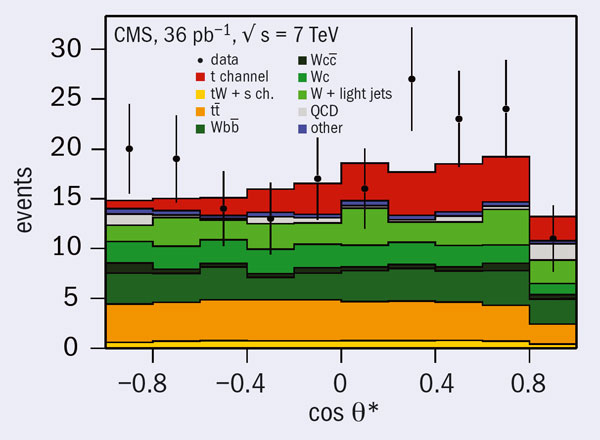
The two analyses establish the observation of single-top production by CMS with a statistical significance of about 3.5 σ. One analysis exploited the angular characteristics between the light quark jet and final-state lepton, shown in the figure, while the other used a multivariate analysis technique to separate the signal from the background. Data-driven background estimates were used in both these analyses. The two analysis methods were combined to yield a cross-section for single-top production in proton–proton collisions at 7 TeV of 83.6± 29.8 (stat+syst.)± 3.3 (lumi.) pb. This result agrees well with the rate predicted by the Standard Model.
Such a rapid detection of the elusive single top, despite the challenging background conditions, shows that the experiments are well prepared to detect and measure signals of new physics. These may soon manifest themselves as the LHC continues to produce ever more data at the high-energy frontier.
The ATLAS collaboration has announced its latest cross-section measurements of inclusive jet and dijet production, which involve final states containing at least one or two jets, respectively. Each jet is the result of a parton (quark or gluon) that emits radiation through the strong force, creating a collimated spray of hadrons.
These high-pT jet measurements confront QCD, the theory of the strong force, in a large and previously unexplored kinematic region in jet transverse-momentum and dijet invariant-mass. The measurements constitute one of the most stringent tests of QCD ever performed. They probe predictions of perturbative QCD, constrain the density of partons within the proton and are sensitive to new physics scenarios, such as quark compositeness, which may become apparent at very short distance scales.
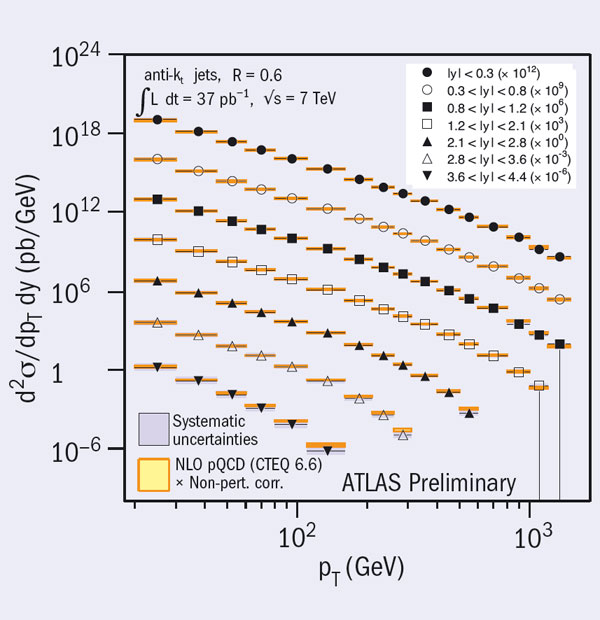
The analysis uses the full data sample collected in LHC proton–proton collisions at 7 TeV during 2010, corresponding to an integrated luminosity of 37 pb–1. The results extend far beyond the kinematic reach achieved at the Tevatron, as do recent results from CMS (CMS collaboration 2011). The ATLAS results extend to 1.5 TeV in jet transverse-momentum (as in figure 1) and to 4.1 TeV in dijet invariant-mass. These jet measurements also provide unprecedented coverage out to forward rapidities of ΙyΙ < 4.4. Next-to-leading order perturbative QCD predictions are found to be in good agreement with the measured data across 10 orders of magnitude in cross-section (figure 2).
The jet cross-section measurements have been corrected for detector effects, and the analysis exploits a greatly improved understanding of the detector performance. The dominant source of systematic uncertainty is in the calibration of the jet energy scale, which has been determined to within 2.5% for central jets with pT above 60 GeV.
A publication is currently in preparation. Work is on-going to reduce the systematic uncertainties further and the collaboration will extend the kinematic reach of these exciting high-pT jet measurements with much larger datasets in 2011–2012.
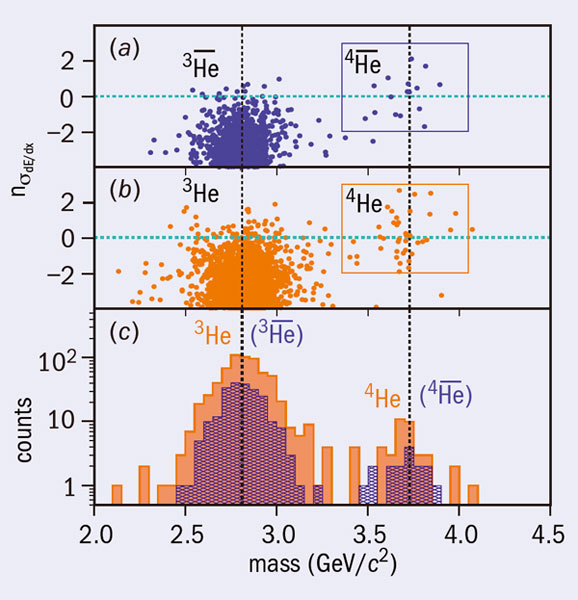
Members of the international STAR collaboration at the Relativistic Heavy Ion Collider (RHIC) at Brookhaven National Laboratory have observed antihelium-4. This is the heaviest antinucleus detected so far, following the discovery of the first antihypernucleus (an antiproton, an antineutron and a Λ) by the same collaboration just a year ago. After sifting through 0.5 × 10¹² tracks in data for 109 gold–gold collisions at centre-of-mass energies of 200 GeV and 62 GeV per nucleon–nucleon pair, the STAR collaboration found 18 events with the signature of the antihelium-4 nucleus, which is distinguished by its mass together with its charge of -2.
While the curvature of the tracks in the magnetic field of the STAR detector provide a momentum measurement, key information also comes from the mean energy-loss per unit track length, 〈dE/dx〉, in the gas of the TPC and from the time of flight of particles arriving at the time-of-flight barrel that surrounds the TPC. The 〈dE/dx〉 information helps in identification by distinguishing particles with different masses or charges, the time of flight being needed for identification at higher momenta, above 1.75 GeV/c. The figure shows the identification of isotopes based on energy loss and mass calculated from momentum in the region of helium-3 and helium-4 for both positive and negative particles, with 18 counts for antihelium-4.
The team used this observation to calculate the antimatter yield at RHIC and found that the production rate falls by a factor of 1.6 +1.0/–0.6 × 103 (1.1 +0.3/–0.2 × 103) for each additional antinucleon (nucleon). This is in line with the expectations from coalescent nucleosynthesis models, as well as from thermodynamic models.
The finding ties in with the scientific goals of the Alpha Magnetic Spectrometer launched on 16 May (AMS takes off), which will search for antimatter in space. It also nicely marks the centenary of the paper by Ernest Rutherford in which he analysed the scattering of helium nuclei (alpha particles) on gold and first established the existence of the atomic nucleus.
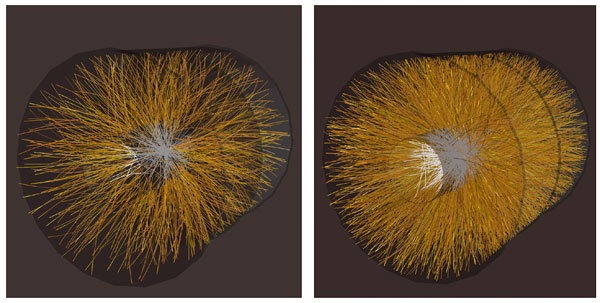
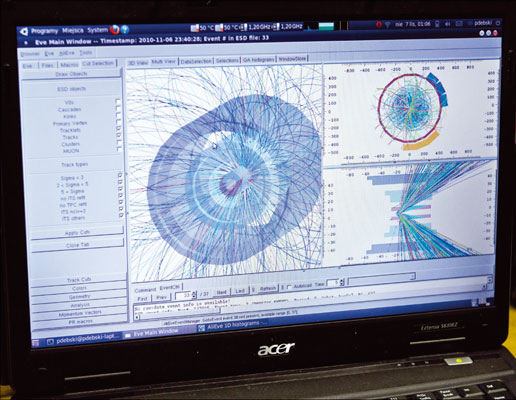
The goal of ALICE (A Large Ion Collider Experiment) is to measure the properties of strongly interacting matter generated in heavy-ion collisions at the LHC at CERN. On 7 November 2010, the LHC became the world’s most energetic heavy-ion accelerator when lead nuclei collided at a centre-of-mass energy √(sNN) = 2.76 TeV per colliding nucleon pair. This is an energy more than 10 times higher than that of the previous record holder, the Relativistic Heavy-Ion Collider (RHIC) at Brookhaven National Laboratory in New York.
Quantum chromodynamics (QCD), the theory of strong interactions, predicts that at a temperature of about 170 MeV (2 × 10¹² K), nuclear matter undergoes a phase transition from its normal hadronic state to a deconfined partonic phase, the quark-gluon plasma (QGP). This is about 100,000 times hotter than the core of the Sun, and such extreme conditions occur only under special circumstances. One such circumstance is the early universe, where the QGP filled all space a few microseconds after the Big Bang; another is the head-on collision of heavy ions at the LHC and RHIC, where a QGP may be created for a fleeting instant.
RHIC has now been running for a decade. One of its spectacular findings was that the matter generated in heavy-ion collisions flows like a liquid with very low internal resistance to flow, almost at the limit of what is allowed for any material in nature. This tells us that the constituents of this matter are quite different from freely interacting quarks and gluons. This almost-perfect fluid has been found to be opaque to even the most energetic partons (quarks and gluons), which appear as “jets” of particles from the collisions – an effect known as jet quenching. The physical mechanisms underlying these phenomena are not well understood. One of the first tasks of heavy-ion studies at the LHC is to “rediscover” these effects and probe them further with new tools as the basis for a much broader and deeper study of the QGP in the coming years. So what have we learnt at the LHC from heavy ions so far?
“Calibrating” at the LHC
To explore the features of hot QCD matter we have to calibrate our tools. Interpretation of the complex interaction of heavy-ions relies on theoretical modelling, beginning with the initial conditions of the hot system – the fireball – at the instant after the collision. One of the crucial inputs for calibrating the models is the distribution of the multiplicity (total number) of particles produced in a collision. This tells us a great deal about how the quarks and gluons in the incoming nuclei transform into the particles (pions, kaons, and so on) observed in the detector.
The number of generated particles is correlated with the impact parameter of the collision; that is, the distance between centres of the colliding nuclei. Small impact parameters, in which the colliding nuclei hit each other nearly head-on so that the largest number of incoming protons and neutrons “participate” in the collision, generate the most particles. Thus, ordering the ensemble of measured collisions according to their multiplicity allows them to be sorted into different classes of impact parameter. The number of created particles can also tell us about the energy density reached within the collisions and the temperature of the fireball.
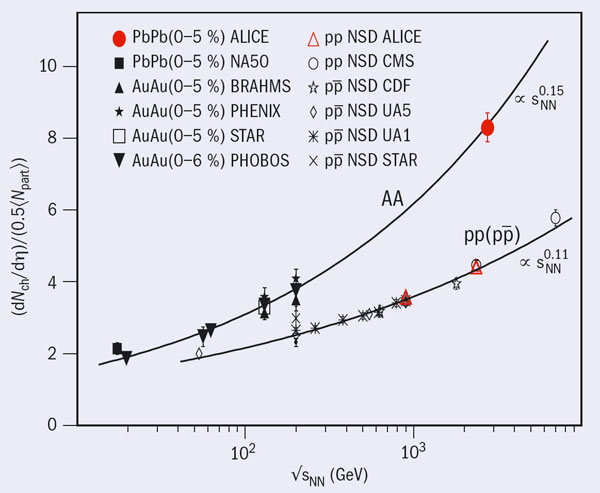
Multiplicity measurements by the ALICE experiment show that the system created at the LHC initially has much higher energy density and is at least 30% hotter than at RHIC, resulting in about double the particle multiplicity for each colliding nucleon pair (Aamodt et al. 2010a). Figure 1 shows the energy dependence of particle production with the new measurement obtained at the LHC.
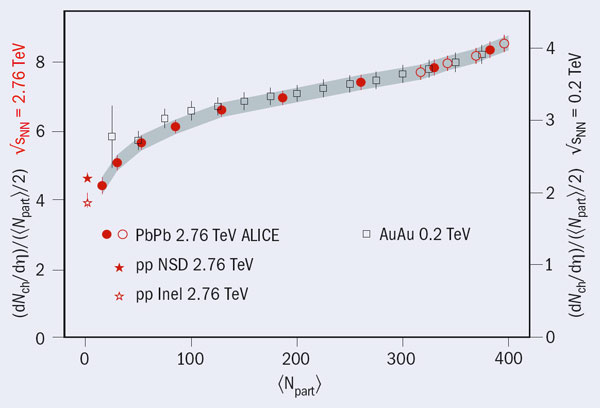
Perhaps surprisingly, despite their vastly different collision energies, the growth in particle multiplicity from RHIC to the LHC is similar at all impact parameters, as figure 2 shows (Aamodt et al. 2011). These measurements by ALICE also show that various predictions driven either by phenomenological extrapolation from the lower energies or by colour-charge density-saturation models are inadequate at the LHC.
A perfect liquid at the LHC?
Off-centre nuclear collisions, with a finite impact parameter, create a strongly asymmetric “almond-shaped” fireball. However, experiments cannot measure the spatial dimensions of the interaction (except in special cases, for example in the production of pions). Instead, they measure the momentum distributions of the emitted particles. A correlation between the measured azimuthal momentum distribution of particles emitted from the decaying fireball and the initial spatial asymmetry can arise only from multiple interactions between the constituents of the created matter; in other words it tells us about how the matter flows, which is related to its equation of state and its thermodynamic transport properties.
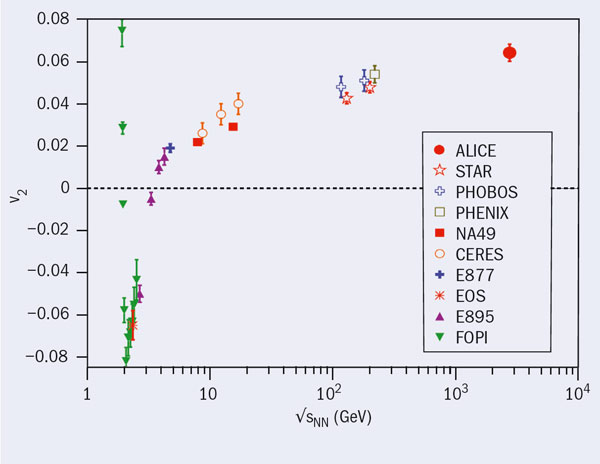
The measured azimuthal distribution of particles in momentum space can be decomposed into Fourier coefficients. The second Fourier coefficient (v2), called elliptic flow, is particularly sensitive to the internal friction or viscosity of the fluid, or more precisely, η/s, the ratio of the shear viscosity (η) to entropy (s) of the system. For a good fluid such as water, the η/s ratio is small. A “thick” liquid, such as honey, has large values of η/s. Comparison of the elliptic flow measured in heavy-ion collisions at RHIC with theoretical models suggests that the hot matter created in the collision flows like a fluid with little friction, with η/s close to its lower limit – the theoretical limit for a perfect fluid limit – given by η/s = ħ/4πkB, where ħ is Planck’s constant and kB is the Boltzmann constant.
In heavy-ion collisions at the LHC, the ALICE collaboration found that the elliptic flow of charged particles increases by about 30% compared with flow measured at the highest energy at RHIC of 0.2 TeV (figure 3). However, hydrodynamic calculations tuned to reproduce the results at RHIC – when recalibrated to the LHC energy regime – reproduce the new measurements well. The hot and dense matter at the LHC also behaves like a fluid with almost zero viscosity. With these measurements, ALICE has just begun to explore the temperature dependence of η/s and we anticipate many more in-depth flow-related measurements at the LHC that will constrain the hydrodynamic features of the QGP even further.
A basic process in QCD is the energy loss of a fast parton in a medium composed of colour charges. This phenomenon, “jet quenching”, is especially useful in the study of the QGP, using the naturally occurring products (jets) of the hard scattering of quarks and gluons from the incoming nuclei. A highly energetic parton (a colour charge) probes the coloured medium rather like an X-ray probes ordinary matter. The production of these partonic probes in hadronic collisions is well understood within perturbative QCD. The theory also shows that a parton traversing the medium will lose a fraction of its energy in emitting many soft (low energy) gluons. The amount of the radiated energy is proportional to the density of the medium and to the square of the path length travelled by the parton in the medium. Theory also predicts that the energy loss depends on the flavour of the parton.
Jet quenching was first observed at RHIC by measuring the yields of hadrons with high transverse momentum (pT). These particles are produced via fragmentation of energetic partons. The yields of these high-pT particles in central nucleus–nucleus collisions were found to be a factor of five lower than expected from the measurements in proton–proton reactions. ALICE has recently published the measurement of charged particles in central heavy-ion collisions at the LHC. As at RHIC, the production of high-pT hadrons at the LHC is strongly suppressed. However, the observations at the LHC show qualitatively new features (see box). The observation from ALICE is consistent with reports from the ATLAS and CMS collaborations on direct evidence for parton energy loss within heavy-ion collisions using fully reconstructed back-to-back jets of particles associated with hard parton scatterings. The latter two experiments have shown a strong energy imbalance between the jet and its recoiling partner (G Aad et al. 2010 and CMS collaboration 2011). This imbalance is thought to arise because one of the jets traversed the hot and dense matter, transferring a substantial fraction of its energy to the medium in a way that is not recovered by the reconstruction of the jets.
With the first findings on hydrodynamic features of the medium created at the LHC and its opaqueness to energetic partons, the LHC has, to a large extent, reproduced measurements at RHIC. The measurements at the LHC will, however, profit from the denser medium and its longer lifetime. The vast kinematic reach provided by the higher-energy collision system enables qualitatively new measurements of the QGP.
On 23–28 May, Quark Matter, a key conference in heavy-ion physics, takes place in Annecy. The most recent experimental results and theoretical state-of-the-art concepts and calculations will be presented, targeted at the detailed understanding of QGP at RHIC and at the LHC. The ALICE collaboration will report on the observations discussed here and will also present new, in-depth studies of the elliptic flow with respect to the type of particle and its mass. Also, the first studies addressing the interplay between collective features of the medium and jet production at the LHC will be shown. Moreover, ALICE will present its first insight into the energy loss of heavy flavour (charm and bottom quarks) in the hot QCD medium. In the coming years, all of these crucial measurements will help to uncover the key properties of the QGP at the LHC.
The 13th International Conference on B-Physics at Hadron Machines (Beauty 2011) was held at the Felix Meritis building in the historic centre of Amsterdam on 4–8 April. Hosted by Nikhef, the National Institute for Subatomic Physics of the Netherlands, the meeting attracted about 100 participants, including experts from Europe, America and Asia. There were 60 invited talks.
The main topic was the physics of Bq mesons, which consist of a b (“beauty”) quark and an anti-q quark, where q can be an up, down, strange or charm quark. These particles offer interesting probes for precision tests of the Standard Model. In this context, asymmetries between decay rates of B and B mesons, which violate the charge-parity (CP) invariance of weak interactions, play a key role. Such observables and various strongly suppressed rare decays of B mesons show a sensitivity to “new physics”, thanks to the possible impact of the contributions of new particles to virtual quantum loops.
The search for these indirect footprints of physics beyond the Standard Model through high-precision measurements is complemented by the search for direct signals of new particles at high-energy colliders. Here, physicists aim to produce new particles (such as supersymmetric squarks or new gauge bosons) and to study their decays in general-purpose detectors – ATLAS and CMS, in the case of the LHC at CERN. The exploration of heavy flavours, and the B-meson system in particular, is the target of the LHCb experiment, which is exploiting the many B mesons that are produced in the proton–proton collisions at the LHC.
Studies of CP violation
The Beauty conferences traditionally have a strong focus on studies of B mesons at hadron machines. In the previous decade, this field was the domain of the CDF and DØ experiments at the Tevatron, the proton–antiproton collider at Fermilab. The electron–positron B factories at SLAC and KEK, with the BaBar and Belle detectors respectively, were the first to establish CP violation in the B-meson system, while the Tevatron experiments have extended the measurements into the Bs-meson sector, which is still poorly explored. These studies have shown that the Cabibbo-Kobayashi-Maskawa matrix is the dominant source of flavour and CP violation, in accordance with the Standard Model.
However, there is evidence that this model is not complete and recent studies of Bs-decays by the CDF and DØ collaborations give a hint of new sources of CP violation in a quantum-mechanical phenomenon, Bs–Bs mixing – although the uncertainties are still too large to draw definite conclusions. In specific scenarios for physics beyond the Standard Model (such as supersymmetry and models with extra Z’ bosons), it is actually possible to accommodate the effect of new physics of this kind.
The first physics results from the LHC experiments were the main highlight of Beauty 2011. It was impressive to see the wealth and high quality of the data presented. The LHCb collaboration’s presentation of the first analysis of the CP-violating observables of the Bs → J/Ψφ decay was particularly exciting. Although the experimental errors are still large, it is intriguing that the data seem to favour a picture similar to the results from CDF and DØ, mentioned above. Fortunately, the LHCb experiment should be able to reduce the uncertainties significantly within a year, with the prospects of revealing new phenomena in Bs–Bs mixing.
Quantum loops
Another exciting decay in which to search for new physics is the rare decay Bs → μ+μ–, which originates from quantum-loop effects in the Standard Model. New particles running in the loops or even contributing at the tree level may significantly enhance the decay rate. So far, this decay has been the domain of the CDF and DØ experiments; they have put upper bounds on the branching ratio that are still about one order of magnitude above the Standard Model prediction. Now LHCb has entered the arena, presenting a first upper bound that is similar to the results from the Tevatron. The constraints from LHCb, and soon those from ATLAS and CMS, will quickly become stronger and it will be interesting to see whether eventually a signal for Bs → μ+μ– will emerge that is significantly different from the predictions of the Standard Model.
In addition to these key channels that are facilitating the search for new physics in B decays in the early phase of the LHC, the conference covered a range of other topics. Results on heavy-flavour production were presented with the first LHC data collected in the ATLAS, CMS, LHCb and ALICE experiments. Another interesting topic was charm physics, with results from the BES III experiment, CDF and the first analyses from LHCb. A summary was given of B-factory results on the measurement of CP violation and the unitarity triangle parameters and the status of lepton-flavour violation and models of physics beyond the Standard Model was also presented. Moreover, the potential of upcoming B-physics experiments – SuperB, SuperKEKB and the LHCb upgrade – was discussed.
The many experimental presentations were complemented by theoretical review talks. Theory also figured in the conference summaries, in which Andrzej Buras of the Technische Universität München developed a vision for theory for 2011 and beyond, while the outgoing LHCb spokesperson, Andrei Golutvin, highlighted the experimental results. The discussions about physics also continued in an informal way during a tour on historic boats through the canals of Amsterdam, with people enjoying the spectacular weather and a visit to the Hermitage museum where the conference dinner was held.
Beauty 2011 showed that these are exciting times for B physics, with plenty still happening at the Tevatron and the first physics results from the LHC. It will be interesting to see whether the data collected by LHCb and the general-purpose detectors in 2011 will already reveal new physics in the B-meson sector. Flavour physics is moving towards new frontiers and is a fascinating part of the LHC adventure. Correlations between various flavour-physics observables and the interplay with the direct searches for new particles will play a key role in obtaining insights into the physics lying beyond the Standard Model.
For further information and the slides of the presentations, visit the conference webpage www.beauty2011.nikhef.nl.
The ALICE collaboration has measured the size of the pion-emitting system in central lead–ion collisions at the LHC at a centre-of-mass energy of 2.76 TeV per nucleon pair. The radii of the pion source were deduced from the shape of the Bose-Einstein peak in the two-pion correlation functions.
In hadron and ion collisions, Bose-Einstein quantum statistics leads to enhanced production of bosons that are close together in phase space, and thus to an excess of pairs at low relative momentum. The width of the excess region is inversely proportional to the system size at decoupling, i.e. at the point when the majority of the particles stop interacting.
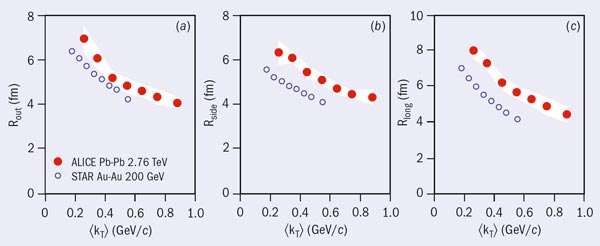
An important finding at the Relativistic Heavy Ion Collider (RHIC) at Brookhaven was that the QCD matter created there behaved like a fluid, with strong collective motions that are well described by hydrodynamic equations. The collective flow makes the size of the system appear smaller with increasing momentum of the pair. This behaviour is also clearly visible for the radii measured at the LHC in the ALICE experiment. Figure 1 shows the results for measurements of the radius of the pion source in three dimensions: along the beam axis, Rlong; along the transverse momentum (kT) of the pair, Rout; and in a direction perpendicular to these two, Rside.
The similarity between the values for Rout and Rside indicates a short duration for the emission, hence an “explosive” emission. The time when the emission reaches its maximum – measured with respect to the first encounter – can be derived from the dependence of the longitudinal radius on the transverse momentum, Rlong(kT). ALICE has found this to be 10–11 fm/c, which is significantly longer than it is at RHIC. Moreover, the product of the three radii at low pair-momentum – the best estimate of the homogeneity volume of the system at decoupling – is twice as large as at RHIC (figure 2).
These results, taken together with those obtained from the study of the multiplicity and the azimuthal anisotropy, indicate that the fireball formed in nuclear collisions at the LHC is hotter, lives longer and expands to a larger size than at lower energies. Further analyses, in particular including the full dependence of these observables on centrality, will provide more insights into the properties of the system – such as initial velocities, the equation of state and the fluid viscosity – and strongly constrain the theoretical modelling of heavy-ion collisions.
Measurements with leptons are an important tool for physics studies at the LHC. While electrons and muons – being the easiest to detect and identify – are used for many analyses, studies that include τ leptons are important for searches and for electroweak measurements in particular. It is a sign that experimental analyses are reaching maturity when physics results on τ leptons become available, as they are now doing with CMS.
The lifetime of the τ is of the order of 10–13 s, so it decays shortly after production, complicating its identification and use in physics analyses. It decays most often leptonically, into an electron or muon plus two neutrinos, or hadronically to either one or three charged particles together with neutral hadrons and a neutrino. The hadronic decays of the τ thus contain collimated low-multiplicity jets, a feature that is used experimentally to select τ decays, while reducing background from QCD jets.
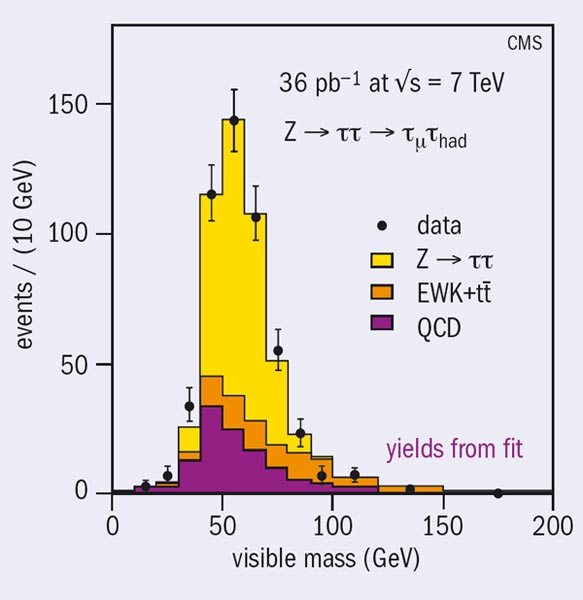
CMS recently published two physics papers studying decays into τ leptons. The first presents a study of the decay of Z bosons into τ pairs, using both leptonic and hadronic decays of the τ (CMS collaboration 2011a). The τ leptons are identified via isolated groups of particles, found through the CMS particle-flow event reconstruction, that are compatible with the possible τ decays. Figure 1 shows the visible invariant mass of the two τ candidates for a τ pair, where one decays leptonically to a muon and the other decays hadronically. Because of the escaping neutrinos in the τ decays the reconstructed Z boson mass is not at its known value, but the result of the measurement agrees well with the expectation from the Monte Carlo simulation.
This yields a cross-section for Z → ττ, in proton–proton collisions at 7 TeV, of 1.00 ± 0.05 (stat.) ± 0.08 (syst.) ± 0.04 (lumi.) nb. This agrees well with similar cross-sections measured in the electron and muon decay modes of the Z – as is expected from the lepton universality in Z decays that was established in precision measurements by experiments in the 1990s at the Large Electron Positron collider.
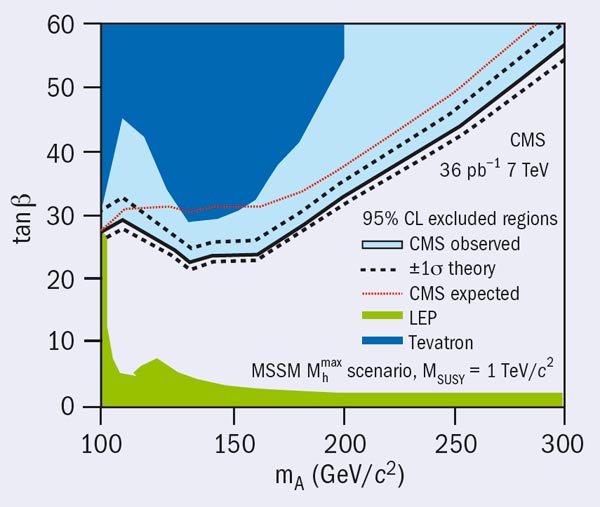
More interestingly, the τ can be used to search for new particles, for the Higgs boson in particular. Higgs particles in the minimal supersymmetric extension of the Standard Model (MSSM) are expected to show a large decay-rate to τ pairs, especially for large values of the parameter tanβ, which is the ratio of the vacuum expectation values of the two members of the Higgs doublet.
CMS has carried out such an analysis with the full data sample of 2010 and found no excess of τ pair production above the expected background (CMS collaboration 2011b). The resulting excluded region in the plane of tanβ and the mass of pseudoscalar Higgs boson in the MSSM, for a benchmark scenario called mhmax, is shown in figure 2.
The surprise is that the search already goes well beyond the reach of the searches at the Tevatron, in part thanks to the high efficiency and high quality of the detection and reconstruction of the τ leptons in CMS. Clearly, the τ has now become an important tool for the collaborations in exploring the new energy region at the LHC.
To provide the best experiences, we use technologies like cookies to store and/or access device information. Consenting to these technologies will allow us to process data such as browsing behavior or unique IDs on this site. Not consenting or withdrawing consent, may adversely affect certain features and functions.
Functional
Always active
The technical storage or access is strictly necessary for the legitimate purpose of enabling the use of a specific service explicitly requested by the subscriber or user, or for the sole purpose of carrying out the transmission of a communication over an electronic communications network.
Preferences
The technical storage or access is necessary for the legitimate purpose of storing preferences that are not requested by the subscriber or user.
Statistics
The technical storage or access that is used exclusively for statistical purposes.The technical storage or access that is used exclusively for anonymous statistical purposes. Without a subpoena, voluntary compliance on the part of your Internet Service Provider, or additional records from a third party, information stored or retrieved for this purpose alone cannot usually be used to identify you.
Marketing
The technical storage or access is required to create user profiles to send advertising, or to track the user on a website or across several websites for similar marketing purposes.